287
Copyright © 2021 The Korean Society of Fisheries and Aquatic Science pISSN:0374-8111, eISSN:2287-8815
서 론
새우는전세계적으로수요가높은대표적인양식대상종으로
,
그생산량은1980
년도에75,000
톤에서2017
년도에5,500,000
톤으로계속해서증가하고있다(FAO, 2018).
새우의가식부는 체중의약50-60%
로,
가공과정에서머리,
갑각,
내장과같은 부산물이다량발생한다(Gulzar et al., 2020).
새우가공부산물(shrimp by-products)
을처리하기위한다양한연구가수행되 었으나,
아직까지명확한처리방안을찾지못한상황이다.
새우 가공부산물은단백질의함량이약68%
로높을뿐만아니라,
생 리활성물질을함유하고있어양식사료내에서단백질원과기 능성원료로써의이용가능성이높다고보고되었다(Plascencia-
Jatomea et al., 2002; Gisbert et al., 2018).
그러나, chitin
과같 이난소화성물질의함량이높아,
동물사료에서의사용범위가 제한적이다.
새우가용성추출물
(shrimp soluble extract, SSE)
은 다양한 효소를 이용하여 새우가공부산물을 가수분해하여 제조된다(Gildberg and Stenberg, 2001). SSE
는peptides
의평균분자량 이새우가공부산물에비해낮고,
제조과정에서비가용성물질 을제거하여 동물사료내이용성이매우높은것으로알려져 있다(Gildberg and Stenberg, 2001). SSE
는동물의비특이적 면역력증진에효과가있는활성펩타이드(bioactive peptides)
를다량함유하고있어,
양식사료에단백질원료혹은기능성첨 가제로써의이용가능성이일부연구를통해보고되었다(Gild-
사료 내 새우가용성추출물(shrimp soluble extract) 첨가가 흰다리새우 (Litopenaeus vannamei)의 성장, 면역력 및 소화율에 미치는 영향
고대현·신재형·김민기·이초롱·김성삼
1·박건현
1·이경준
2*
제주대학교 해양생명과학과, 1CJ 생물자원, 2제주대학교 해양과학연구소
Effects of Dietary Supplementation of Shrimp Soluble Extract on Growth Performance, Innate Immunity and Digestibility of Pacific White Shrimp Litopenaeus vannamei
Daehyun Ko, Jaehyeong Shin, Min-Gi Kim, Chorong Lee, Sung-Sam Kim1, Gunhyun Park1 and Kyeong-Jun Lee2*
Department of Marine Life Sciences, Jeju National University, Jeju 63243, Korea
1CJ Feed & Care, Incheon 04548, Korea
2Marine Science Institute, Jeju National University, Jeju 63333, Korea
This study was conducted to evaluate the effects of dietary supplementation with shrimp soluble extract (SSE) on growth performance, feed utilization, innate immunity and digestibility of Pacific white shrimp Litopenaeus van- namei . A basal diet (Con) was formulated and three other diets were prepared with SSE supplementation at different levels of 1, 2 and 4% (designated as SSE1, SSE2 and SSE4, respectively). Triplicate groups of shrimp (1.20±0.01 g) were fed one of the experimental diets for 6 weeks. At the end of the feeding trial, growth performance and feed uti- lization of the shrimp were significantly improved by dietary supplementation of SSE4 compared to those of shrimp fed the Con diet. Shrimp fed SSE4 diet had significantly higher phagocytic activity than shrimp fed the Con diet.
Dietary supplementation of SSE improved the protein and dry matter digestibility of shrimp. These results indicate that SSE can be used as a functional additive in the diets for Pacific white shrimp.
Keywords: Shrimp soluble extract, Growth performance, Digestibility, Pacific white shrimp, Feeds
*Corresponding author: Tel: +82. 64. 754. 3423 Fax: +82. 64. 756. 3493 E-mail address: [email protected]
This is an Open Access article distributed under the terms of the Creative Commons Attribution Non-Commercial Licens (http://creativecommons.org/licenses/by-nc/3.0/) which permits unrestricted non-commercial use, distribution, and reproduction in any medium, provided the original work is properly cited.
Received 26 March 2021; Revised 30 April 2021; Accepted 3 May 2021
저자 직위: 고대현(대학원생), 신재형(대학원생), 김민기(인턴연구원), 이초롱(
박사 후 연구원), 김성삼(부장), 박건현(부장), 이경준(교수) https://doi.org/10.5657/KFAS.2021.0287
Korean J Fish Aquat Sci 54(3), 287-292, June 2021
berg and Stenberg, 2001; Jo et al., 2017).
흰다리새우는염분 에대한내성이강하고,
성장이빨라고부가가치양식대상종 으로각광받고있다(Saoud et al., 2003).
전세계흰다리새우양 식생산량은2016
년도에4,155,826
톤으로전체새우류생산량 의80%
를 차지한다(FAO, 2018).
국내흰다리새우의생산량 은2013
년도에3,785
톤에서2019
년도에7,542
톤으로계속해 서증가하고있다(KOSIS, 2020).
그러나,
현재까지흰다리새우 사료내SSE
첨가에대한연구는전무한실정이다.
따라서본 연구는사육실험과소화율평가를통해흰다리새우사료내기 능성첨가제로써SSE
의이용가능성을평가하고자수행되었다.
재료 및 방법
실험사료
실험에 사용된 액상 형태의
SSE
는㈜CJ
제일제당(Suwon, Korea)
에서제공받아사용하였고, SSE
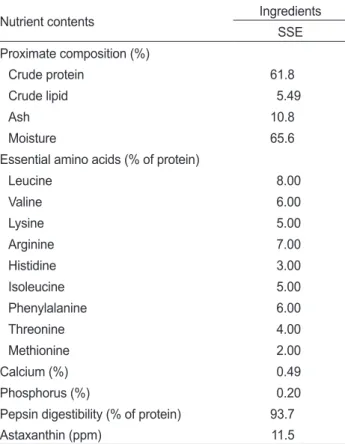
의영양소함량은Table 1
에나타내었다.
대조사료(Con)
는흰다리새우의영양소요구 량을충족시키도록조성하였다(Table 2).
실험사료는총3
종으 로SSE
를사료에1, 2, 4%
첨가하였다(SSE1, SSE2, SSE4).
실험사료는모든사료원료를사료조성표에따라측량한후혼 합하였다
.
혼합물에사료원료총중량의10%
에해당하는증류수와어유를첨가한후
,
사료제조기(SP-50; KumKang ENG, Daegu, Korea)
를이용하여2
가지크기(1, 2 mm)
의펠렛사료를 제작하였다.
실험사료는건조후(25°C, 17 h), SSE
를사료내농 도가각각1, 2, 4%
가되도록증류수(100 mL)
에희석하여사료 표면에분무하였다.
완성된사료는건조(25°C, 17 h)
후,
사료공 급전까지냉동보관(-20°C)
되었다.
실험새우와 사육관리
흰다리새우
Post-larvae
는충청남도서산에위치한새우종묘 장에서구입하였다.
실험새우는시판배합사료(SAJO DongA
Table 1. Nutrient content of shrimp soluble extract (SSE, dry mat- ter)
Nutrient contents Ingredients
SSE Proximate composition (%)
Crude protein 61.8
Crude lipid 5.49
Ash 10.8
Moisture 65.6
Essential amino acids (% of protein)
Leucine 8.00
Valine 6.00
Lysine 5.00
Arginine 7.00
Histidine 3.00
Isoleucine 5.00
Phenylalanine 6.00
Threonine 4.00
Methionine 2.00
Calcium (%) 0.49
Phosphorus (%) 0.20
Pepsin digestibility (% of protein) 93.7
Astaxanthin (ppm) 11.5
Table 2. Dietary formulation and proximate composition of the ex- perimental diets for Pacific white shrimp Litopenaaeus vannamei (% dry matter)
Ingredients Con SSE1 SSE2 SSE4
Wheat flour 30.2 29.5 28.8 27.4
Soybean meal1 27.0 27.7 28.4 29.8
Shrimp soluble extract (SSE)2 0.00 1.00 2.00 4.00
Gluten 1.00 1.00 1.00 1.00
Meat, bone meal 3.00 3.00 3.00 3.00
Blood meal 1.00 1.00 1.00 1.00
Fish meal, LT3 17.0 16.0 15.0 13.0
Fish meal, Tuna 10.0 10.0 10.0 10.0
Squid liver powder 4.00 4.00 4.00 4.00
Fish oil 1.50 1.50 1.50 1.50
Lecithin powder 2.00 2.00 2.00 2.00
Mineral Mix4 1.00 1.00 1.00 1.00
α-Tocopherol 0.20 0.20 0.20 0.20
Choline chloride 0.08 0.08 0.08 0.08
Vitamin-C 0.10 0.10 0.10 0.10
Vitamin-A 0.80 0.80 0.80 0.80
Cholesterol 0.02 0.02 0.02 0.02
Mold inhibitor 0.05 0.05 0.05 0.05
Antitox 0.05 0.05 0.05 0.05
Guar gum 1.00 1.00 1.00 1.00
Proximate composition
Crude protein 45.1 45.1 44.8 45.2
Crude lipid 8.31 8.24 8.54 9.47
Crude ash 9.74 9.74 9.61 9.54
Moisture 8.48 8.40 8.00 8.49
144% crude protein, South America. 2CJ CheilJedang Feed &
Livestock Research Institute, Su-won, Korea. 3Norse LT-94®, low-temperature dried fish meal, Norsildmel, Bergen, Norway.
4MgSO4.7H2O, 80.0; NaH2PO4.2H2O, 370.0; KCl, 130.0; Ferric ci- trate, 40.0; ZnSO4.7H2O, 20.0; Ca-lactate, 356.5; CuCl, 0.2; AlCl3. 6H2O, 0.15; Na2Se2O3, 0.01; MnSO4.H2O, 2.0; CoCl2.6H2O, 1.0.
One, Seoul, Korea)
를공급하며, 2
주간사육실험환경에순치 시켰다.
예비사육 후흰다리새우(1.20±0.01 g)
는 총12
개의acryl
수조(110 L)
에18
마리씩배치하였다.
광주기는형광등을 이용하여, 12 light:12 dark
조건으로유지하였다.
환수는수조 내사육수의상태를고려하여, 2-3
일간격으로진행하였다.
실 험사료는1
일4
회(08:30, 12:00, 15:00, 18:30)
에나누어6
주에 걸쳐제한공급(
새우체중3-8%)
하였다.
사육실험은 제주대학 교 동물생명윤리위원회의 윤리규정(
승인번호, 2019-0038)
을 준수하면서진행되었다.
Sampling과 분석
실험새우의무게는사료공급량을설정하기위해
2
주간격으 로측정하였고,
무게측정12
시간전부터실험사료의공급을 중단하였다.
최종무게측정후,
수조당5
마리의흰다리새우를 무작위로선별하여(
실험구당15
마리)
얼음물로마취시킨후, Alsever’s
용액(Sigma-Aldrich, St. Louis, MO, USA)
이처리 된주사기를이용하여hemolymph
를채혈하였다. Hemolymph
의일부는대식세포활성(nitroblue-tetrazolium, NBT)
분석에 사용되었고,
나머지는 원심분리(800 g, 10 min)
후 냉동보관(-70°C)
하였다.
수조내수질은
1
일1
회측정되었으며,
평균수온은29.1°C,
용존산소는5.20 ppm, pH
는7.78,
염분은31 psu,
암모니아 는0.040 ppm
으로나타났다.
실험사료의일반성분은AOAC (2005)
방법에 따라수분은상압가열건조법(125°C, 3 h),
회 분은직접회화법(550°C, 4 h)
으로분석되었다.
조단백질은조 단백분석기(Kjeltec system 2300; Foss, Hillerød, Denmark)
로분석하였으며,
조지방은Folch et al. (1957)
의 방법에따 라Soxhlet
추출장치(SOX406 fat analyzer, Jinan Hanon In- struments, Shandong, China)
를이용하여분석되었다. Hemo- lymph
내대식세포활성은(NBT)
은Zhang et al. (2013)
의방법 을, phenoloxidase (PO)
활성은Hernández-López et al. (1996)
의방법을사용하여분석하였다.
외관상소화율 평가
소화율 실험사료는 사료에 지시제
(indicator)
로chromium
oxide (Cr
2O
3; Sigma-Aldrich, St. Louis, MO, USA)
를1%
첨 가하여제작하였다.
새우(9.12±1.00 g)
는총4
개의acrylic
수 조(110 L)
에수조당15
마리씩배치하였다.
실험사료는1
일2
회(08:30, 14:00 h)
에나누어공급되었고,
사료공급1
시간후에 각수조의사료와찌꺼기를siphon
을이용하여제거하였다.
분 은1
일2
회(13:00, 18:00)
에걸쳐4
주동안수집하였고,
수집된 분은동결건조후분석에사용하였다.
실험사료의건물소화율 및단백질소화율은Divakaran et al. (2002)
의방법을바탕으 로계산하였다.
Apparent digestibility of dry matter (%, ADCd)=
100-100×(% of Cr
2O
3in diet/% of Cr
2O
3in feces) Apparent digestibility of protein (%, ADCp)=
100-100×(% of Cr
2O
3in diet/% of Cr
2O
3in fe- ces)×(% of protein in feces / % of protein in diet)
통계학적 분석
실험사료의배치는완전확률계획법
(completely randomized design)
에따라실시하였고,
모든결과는SPSS (Version 24.0;
International Business Machines Co., New York, NY, USA)
프로그램을이용하여One-way ANOVA
로통계분석되었다.
데이터값의유의차는Duncan's multiple range test (P<0.05)
로비교되었다.
모든데이터는평균값±
표준편차(mean±SD)
로나타내었다.
백분율데이터는arcsine
변형값으로계산하여 통계분석하였다.
결 과
실험새우의성장률
(final body weight, FBW; specific growth rate, SGR),
단백질이용효율(protein efficiency ratio, PER)
은SSE4
실험구가대조구에비해유의적으로높았다(Table 3).
사 료계수(feed conversion ratio, FCR)
는SSE4
실험구가대조구 에비해유의적으로낮았다. SSE1
및SSE2
실험구에서도대Table 3. Growth performance, feed utilization and survival of Pacific white shrimp Litopenaeus vannamei (initial body weight, 1.20±0.01 g) fed the experimental diets for 6 weeks. The diets were added with graded levels of SSE by 0, 1, 2 and 4% (Con, SSE1, SSE2 and SSE4)
Dietary treatments FBW1 SGR2 FCR3 PER4 Survival (%)
Con 2.88±0.40b 2.18±0.35b 2.75±0.56a 0.83±0.18b 63.0±3.21
SSE1 3.51±0.67ab 2.65±0.45ab 2.17±0.55ab 1.07±0.30ab 72.2±20.0
SSE2 3.49±0.70ab 2.63±0.50ab 2.14±0.36ab 1.06±0.19ab 64.8±11.6
SSE4 4.08±0.46a 3.05±0.30a 1.65±0.35b 1.38±0.26a 83.3±19.2
1Final body weight (g)=final mean body weight-initial mean body weight. 2Specific growth rate (%)=[(loge final body weight - loge initial body weight)/days]×100. 3Feed conversion ratio=feed intake/wet weight gain. 4Protein efficiency ratio=wet weight gain/total protein given.
SSE, shrimp soluble extract. Values are mean of triplicate groups and presented as mean±SD. Values with different superscripts in the same column are significantly different (P<0.05). The lack of superscript letter indicates no significant differences among treatments.
조구에비해성장과사료계수가증가하는경향을보였다
.
생존율은대조구와실험구사이에유의적인차이가없었다
. Hemo-
lymph
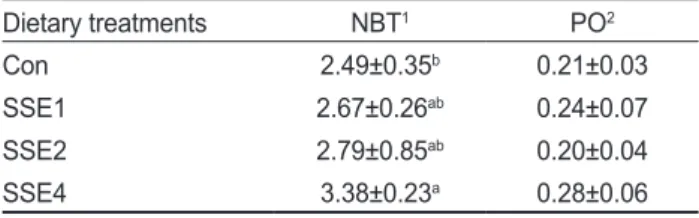
내대식세포활성(NBT)
은SSE4
실험구가대조구에비 해유의적으로높았다(Table 4). SSE
를저농도로첨가한실험구에서도
NBT
활성은증가하는경향을보였다. PO
활성은대조구와실험구사이에유의적인 차이를보이지않았다
.
흰다 리새우의건물소화율및단백질소화율은SSE
를첨가한실험 구(SSE1, SSE2, SSE4)
가대조구에 비해유의적으로높았다(Table 5).
고 찰
이번연구에서 사료내
SSE
의 첨가(1-4%)
는 흰다리새우의성장과 사료계수를 증진시키는 것으로 나타났다
. Bui et al.
(2014)
은 사료 내 새우가수분해물의 첨가(5%)
는 참돔 치어(Pagrus major) (29.0-113 g, 15
주)
의성장과사료전환효율을 증진시킨다고보고하였다.
틸라피아(Oreochromis niloticus)
를 대상으로한연구에서도새우가수분해물을사료에첨가(15%)
하여8
주간공급했을때,
어류의성장과사료효율이향상된다 고보고되었다(Plascencia-Jatomea et al., 2002). Zheng et al.
(2012)
은 사료에 어류단백질가수분해물을 첨가(3.7%)
할 경우
,
넙치(Paralichthys olivaceus)
의성장률과사료효율이증가 하였고,
혈장내insulin-like growth factor-1 (IGF-1)
의발현량 이증진되었다고보고하였다.
소화효소를이용하여단백질원 료를가수분해하면원료내고분자peptides
가분자량이낮은tri-peptides, di-peptides
혹은유리아미노산으로분해되어소화 율과이용성이증진되는것으로알려져있다(Khosravi et al., 2015b; Bhattarai et al., 2017). SSE
는평균분자량이다른원료 에비해낮아,
동물의체내에서소화율이높을뿐만아니라필 수아미노산을다량함유하고있어사료내이용성이높다고보 고되었다(Gildberg and Stenberg, 2001).
또한,
단백질가수분해물을사료에소량으로
(0.5-2%)
첨가할경우,
사료섭취량을증 가시켜새우의성장에직접적으로도움을주는것으로보고되 었다(Fox et al., 1994; Bui et al., 2014). Kader et al. (2012)
은 사료내fish soluble extract
나krill meal
을사료에첨가하면제 한아미노산(lysine, methionine)
의불균형을보완함으로써사 료의기호성을향상시키는데도움을줄수있다고보고하였다. SSE
는lysine (5.0%), methionine (2.0%)
의함량이대표적인 어분대체원료인대두박(3.2%, 0.7%)
에비해높아,
사료의기호 성향상에효과가있을것으로추측된다.
따라서, SSE
는분자량 이낮아소화되기쉬우며사료유인효과가뛰어나흰다리새우 사료의기능성원료로써가치가높다고판단된다.
이번연구에서사료내
SSE
의첨가(1-4%)
는흰다리새우의단백질소화율을증가시키는것으로나타났다
. Khosravi et al.
(2015b)
은새우가수분해물을사료에3.3%
첨가했을때단백질 소화율이증가했다고보고하였다.
대서양연어(Salmo salar)
에 서도어류단백질가수분해물의사료내첨가(18-30%)
는단백질 소화율을증가시키는것으로알려져있다(Hevrøy et al., 2005).
Aksnes et al. (2006)
은무지개송어(Oncorhynchus mykiss)
사 료내어류부산물을첨가(32%)
할경우,
어류의단백질소화율 이증가한다고보고하였다.
더불어,
단백질가수분해물은사료 에첨가할경우,
어류의소화효소의활성을증진시키는것으로 보고되었다(Aguila et al., 2007).
따라서, SSE
의높은저분자펩 타이드와유리아미노산의함량이흰다리새우의단백질소화율 을향상시켰던것으로사료된다.
이번연구에서흰다리새우사료내
SSE
의첨가는새우의비특이적면역력
(NBT, PO)
증진에도움을주는것으로나타났다
. NBT
는대식세포활성도를나타내며선천적면역반응의중요한지표로알려져있다
.
사료내틸라피아가수분해물의첨가 도넙치의대식세포활성을높이는것으로나타났다(Khosravi et al., 2015a). Jo et al. (2017)
은사료내어분을어류가수분해 물로대체하면서SSE
를2%
첨가했을때무지개송어의비특이Table 4. Non-specific immune responses of Pacific white shrimp Litopenaeus vannamei fed the experimental diets for 6 weeks. The diets were added with graded levels of SSE by 0, 1, 2 and 4% (Con, SSE1, SSE2 and SSE4)
Dietary treatments NBT1 PO2
Con 2.49±0.35b 0.21±0.03
SSE1 2.67±0.26ab 0.24±0.07
SSE2 2.79±0.85ab 0.20±0.04
SSE4 3.38±0.23a 0.28±0.06
1Nitro-blue tetrazolium activity (absorbance). 2Phenoloxidase ac- tivity (absorbance). SSE, shrimp soluble extract. Values are mean of triplicate groups and presented as mean±SD. Values with dif- ferent superscripts in the same column are significantly different (P<0.05). The lack of superscript letter indicates no significant dif- ferences among treatments.
Table 5. Apparent digestibility of coefficients (%, ADC) of dry matter and protein of Pacific white shrimp Litopenaeus vannamei fed the experimental diets for 6 weeks. The diets were added with graded levels of SSE by 0, 1, 2 and 4% (Con, SSE1, SSE2 and SSE4)
Dietary treatments ADCd1 ADCp2
Con 53.9±2.9c 71.7±2.0b
SSE1 68.0±0.7b 84.1±0.6a
SSE2 71.6±2.0a 83.9±1.1a
SSE4 71.4±0.8a 82.0±0.5a
1Apparent digestibility coefficient of dry matter (%). 2Apparent di- gestibility coefficient of protein (%). SSE, shrimp soluble extract.
Values are mean of triplicate groups and presented as mean±SD.
Values with different superscripts in the same column are signifi- cantly different (P<0.05).
적면역력
(superoxide dismutase, lysozyme)
을 향상시켰다고 보고하였다.
전복(Haliotis discus)
에서도어류단백질가수분해 물이첨가된사료를장기간(153
일)
공급했을때,
대식세포활성 이증가되었다고보고되었다(Goosen et al., 2014).
이러한비특 이적면역력의증가는어류단백질가수분해물과SSE
에존재하 는생리활성펩타이드의항산화,
항균능력에기인한것으로보 고되었다(Robert et al., 2014; Khosravi et al., 2015b).
그러나,
생리활성펩타이드와비특이적면역력에있어서의정확한작용 기전에관한연구가미흡하여,
후속연구를통해보다명확한규 명이요구된다.
결론적으로
, SSE
를사료에적정량으로첨가할경우,
흰다리 새우의성장,
사료계수,
소화율및비특이적면역력증진에도움을줄수있을것으로판단된다
. SSE
의적정첨가량은사료내
4%
로판단된다.
사 사
이연구는
2019
년도정부(
교육부)
의재원으로한국연구재단의 지원을받아수행된기초연구사업(2019R1A6A1A03033553)
과CJ
제일제당주식회사의지원으로수행되었습니다.
References
Aguila J, Cuzon G, Pascual C, Domingues PM, Gaxiola G, Sánchez A, Maldonado T and Rosas C. 2007. The effects of fish hydrolysate (CPSP) level on Octopus maya (Voss and Solis) diet: digestive enzyme activity, blood metabolites, and energy balance. Aquaculture 273, 641-655. https://doi.
org/10.1016/j.aquaculture.2007.07.010.
Aksnes A, Hope B, Jönsson E, Björnsson BT and Albrektsen S. 2006. Size-fractionated fish hydrolysate as feed ingredi- ent for rainbow trout Oncorhynchus mykiss fed high plant protein diets. I: Growth, growth regulation and feed utili- zation. Aquaculture 261, 305-317. https://doi.org/10.1016/j.
aquaculture.2006.07.025.
AOAC (Association of Official Analytical Chemists). 2005.
Official methods of analysis. Arlington, VA, U.S.A., 1298.
https://doi.org/10.1002/0471740039.vec0284.
Bhattarai RR, Dhital S, Wu P, Chen XD and Gidley MJ. 2017.
Digestion of isolated legume cells in a stomach-duodenum model: three mechanisms limit starch and protein hydro- lysis. Food Funct 8, 2573-2582. https://doi.org/10.1039/
C7FO00086C.
Bui HTD, Khosravi S, Fournier V, Herault M and Lee KJ. 2014.
Growth performance, feed utilization, innate immunity, di- gestibility and disease resistance of juvenile red seabream
Pagrus major fed diets supplemented with protein hydroly-
sates. Aquaculture 418-419, 11-16. https://doi.org/10.1016/j.aquaculture.2013.09.046.
Divakaran S, Obaldo LG and Forster IP. 2002. Note on the meth-
ods for determination of chromic oxide in shrimp feeds. J Agric Food Chem 50, 464-467. https://doi.org/10.1021/
jf011112s.
FAO (Food and Agriculture Organization of the United Na- tions). 2018. The State of World Fisheries and Aquaculture 2018. Meeting the sustainable development goals. FAO Re- port, 227
Folch J, Lees M and Sloane-Stanley GH. 1957. A simple method for the isolation and purification of total lipids from animal tissues. J Boil Chem 226, 497-509.
Fox CJ, Blow P, Brown JH and Watson I. 1994. The effect of various processing methods on the physical and biochemi- cal properties of shrimp head meals and their utilization by juvenile Penaeus monodon Fab. Aquaculture 122, 209-226.
https://doi.org/10.1016/0044-8486(94)90511-8.
Gildberg A and Stenberg E. 2001. A new process for advanced utilization of shrimp waste. Process Biochem 36, 809-812.
https://doi.org/10.1016/S0032-9592(00)00278-8.
Gisbert E, Fournier V, Solovyev M, Skalli A and Andree KB.
2018. Diets containing shrimp protein hydrolysates pro- vided protection to European sea bass Dicentrarchus labrax affected by a Vibrio Pelagius natural infection outbreak.
Aquaculture 495, 136-143. https://doi.org/10.1016/j.aqua- culture.2018.04.051.
Goosen NJ, de Wet LF and Görgens JF. 2014. The effects of pro- tein hydrolysates on the immunity and growth of the abalone
Haliotis midae. Aquaculture 428-429, 243-248. https://doi.
org/10.1016/j.aquaculture.2014.03.018.
Gulzar S, Raju N, Nagarajarao RC and Benjakul S. 2020. Oil and pigments from shrimp processing by-products: Ex- traction, composition, bioactivities and its application- A review. Trends Food Sci Technol 100, 307-319. https://doi.
org/10.1016/j.tifs.2020.04.005.
Hernández-López J, Gollas-Galván T and Vargas-Albores F.
1996. Activation of the prophenoloxidase system of the brown shrimp (Penaeus californiensis Holmes). Comp Bio- chem Physiol C Pharmacol Toxicol Endocrinol 113, 61-66.
https://doi.org/10.1016/0742-8413(95)02033-0.
Hevrøy EM, ESPE M, Waagbø R, Sandnes K, Ruud M and Hemre GI. 2005. Nutrient utilization in atlantic salmon (Salmo salar L.) fed increased levels of fish protein hydroly- sate during a period of fast growth. Aquac Nutr 11, 301-313.
https://doi.org/10.1111/j.1365-2095.2005.00357.x.
Jo H, Lee S, Yun H, Hong J, Moniruzzaman M and Bai SC.
2017. Evaluation of dietary fishmeal analogue with addi- tion of shrimp soluble extract on growth and nonspecific immune response of rainbow trout Oncorhynchus mykiss.
J World Aquac Soc 48, 583-591. https://doi.org/10.1111/
jwas.12355.
Kader MA, Bulbul M, Koshio S, Ishikawa M, Yokoyama S, Nguyen BT and Komilus CF. 2012. Effect of complete replacement of fishmeal by dehulled soybean meal with
crude attractants supplementation in diets for red sea bream,
Pagrus major. Aquaculture 350-353, 109-116. https://doi.
org/10.1016/j.aquaculture.2012.04.009.
Khosravi S, Bui HTD, Rahimnejad S, Herault M, Fournier V, Kim SS, Jeong JB and Lee KJ. 2015a. Dietary supplementa- tion of marine protein hydrolysates in fish-meal based diets for red sea bream Pagrus major and olive flounder Para-
lichthys olivaceus. Aquaculture 435, 371-376. https://doi.
org/10.1016/j.aquaculture.2014.10.019.
Khosravi S, Rahimnejad S, Herault M, Fournier V, Lee CR, Bui HTD, Jeong JB and Lee KJ. 2015b. Effects of protein hy- drolysates supplementation in low fish meal diets on growth performance, innate immunity and disease resistance of red sea bream Pagrus major. Fish Shellfish Immunol 45, 858- 868. https://doi.org/10.1016/j.fsi.2015.05.039.
KOSIS (Korea Statistical Information Service). 2020.
Survey on the status of aquaculture. Retrieved from http://kostat.go.kr/portal/korea/kor_nw/1/1/index.
board?bmode=read&aSeq=380812 on Dec 8, 2020.
Plascencia-Jatomea M, Olvera-Novoa MA, Arredondo- Figueroa JL, Hall GM and Shirai K. 2002. Feasibility of fishmeal replacement by shrimp head silage protein hydro- lysate in Nile tilapia (Oreochromis niloticus L) diets. J Sci Food Agric 82, 753-759. https://doi.org/10.1002/jsfa.1092.
Robert M, Zatylny-Gaudin C, Fournier V, Corre E, Corguille Gl, Bernay B and Henry J. 2014. Transcriptomic and pep- tidomic analysis of protein hydrolysates from the white shrimp L. vannamei. J Biotechnol 186, 30-37. https://doi.
org/10.1016/j.jbiotec.2014.06.020.
Saoud IP, Davis DA and Rouse DB. 2003. Suitability studies of inland well waters for Litopenaeus vannamei culture.
Aquaculture 217, 373-383. https://doi.org/10.1016/S0044- 8486(02)00418-0.
Zhang S, Li J, Wu X, Zhong W, Xian J, Liao S, Miao Y and Wang A. 2013. Effects of different dietary lipid level on the growth, survival and immune-relating genes expres- sion in Pacific white shrimp Litopenaeus vannamei. Fish Shellfish Immunol 34, 1131-1138. https://doi.org/10.1016/j.
fsi.2013.01.016.
Zheng K, Liang M, Yao H, Wang J and Chang Q. 2012.
Effect of dietary fish protein hydrolysate on growth, feed utilization and IGF-I levels of Japanese floun- der Paralichthys olivaceus. Aquac Nutr 18, 297-303.
https://doi.org/10.1111/j.1365-2095.2011.00896.x.