I. Introduction
Children in the upper elementary school grades are beginning adolescence, it is a crucial period of self-growth (Kang et al., 2007), as they learn to become more independent. According to the Korea National Institute for Corresponding author : Park, Sin-Ae
Tel : 02-450-0537
E-mail : [email protected]
Youth Policy (2016), the number one cause of stress in elementary school students was academic problems, and their ratio increased year-on-year. In addition, various social, behavioral, and psychological problems have arisen in children owing to changes in society and family structure, such as nuclear family, increasing divorce rates, and competitive school atmosphere (Costello and Angold, 2000; Doll and Lyon, 1998; Farmer and Farmer, 1999;
Hoagwood and Erwin, 1997; US Department of Health and
사회정서학습이론을 기반으로 한 농업체험 프로그램이 초등학생의 정서적 건강에 미치는 효과 분석
오윤아*⋅김대식**⋅박신애***
*건국대학교 원예치료학과 석사 ∙**충남대학교 지역환경토목학과 교수 ∙***건국대학교 환경보건과학과 조교수
Analysis of the Emotional Effects of Agricultural Experience Program Based on Social Emotional Learning Theory in
Elementary School Students
Yun-Ah Oh*⋅Dae-Sik Kim**⋅Sin-Ae Park***
*Master, Dept. of Horticultural Therapy, Konkuk University
**Professor, Dept. of Agricultural and Rural Engineering, Chungnam National University
***Assistant Professor, Dept. of Environmental Health Science, Konkuk University
ABSTRACT : 본 연구는 방과 후 농업 체험활동 프로그램이 초등학생의 정서지능과 회복탄력성 향상 및 우울감 감소에 미 치는 영향을 알아보고자 실시하였다. 서울시 초등학교에 재학 중인 4-6학년(11-13세) 초등학생 총 30명이 본 연구에 참여하 였다. 참여에 동의한 30명의 학생 중 농업체험 프로그램에 참여를 희망한 18명은 실험군으로, 농업체험 프로그램에 참여를 희망하지 않은 학생 12명은 대조군으로 집단화 하였다. 실험군은 2018년 4월부터 7월까지, 총 12주간(주 1회, 회기당 60분)의 방과 후 활동으로 본 프로그램에 참여하였다. 초등학생의 정서적 건강 증진을 위해 사회정서학습 이론에 기반한 농업체험 프로그램을 설계하였다. 프로그램 실시 전과 후에 자기보고식 설문지를 이용해 정서지능, 우울, 회복탄력성을 측정하였다.
그 결과, 농업 체험활동 프로그램에 참여한 초등학생의 정서지능이 향상되었고(P=0.031), 우울감이 감소된(P=0.011) 반면 대 조군에서는 유의한 차이가 나타나지 않았다(P>0.05). 회복탄력성은 실험군과 대조군에서 모두 실험 전후 유의한 차이가 없었 다(P>0.05). 본 농업체험 프로그램에 참여한 아동들은 프로그램에 대해 높은 만족감을 보고하였다. 따라서 본 연구에서 사회 정서학습이론을 적용한 농업체험 프로그램이 초등학교 고학년 학생의 정서지능 향상과 우울감 감소에 효과적인 것으로 나 타났다. 추후, 표본수를 확대하여 농업 체험활동 프로그램의 효과 검증 연구가 추가적으로 필요할 것이라 생각되며, 다양한 지역의 초등학생들에게 확대 적용하는 연구도 필요할 것이다.
Key words : Agro-healing, Care farming, Gardening, Horticultural therapy, Pre-test/Post-test control group design, School farming1).
Human Services, 1999). Among adolescents under 18 years old, 23.6% had experienced depression (Korea Institute for Health and Social Affairs, 2017). Notably, the higher the grade of late childhood, the more likely they were to be depressed and show antisocial behavior (Sim, 1997).
Since the development of a child is formed through interaction with the environment, maintaining a healthy environment is very important for the child (Chung, 2013).
Relf (1992) reported that experiencing nature during childhood is an effective way to learn the value of life and living together. Horticultural activities have been shown to have positive physical, psychological, cognitive, social, and educational effects (Hodgson et al., 2011;
Lovell, 2010; Park et al., 2016; Williams and Dixon, 2013). It has been reported that activities involving plants are effective in enhancing positive emotions such as emotional intelligence, social competence, school adaptability, self-confidence, aggression, and stress reduction in elementary school students (Han and Yoo, 2014; Joo, 2008; Seok et al., 2009). Besides, group horticulture activities improved peer relationships and sociability (Song and Lee, 2008). Thus, plant-mediated education programs, like school farms, have been implemented in various countries like South Korea, Japan, the USA, and the UK (Federation of City Farms and Community Gardens, 2017;
Korea Agency of Education Promotion and Information Service in Food, Agriculture, Forestry and Fisheries, 2015).
In South Korea and Japan, the concept of ‘studying in rural areas’ was created to provide a place for children to grow in the whole community including school, village, and nature, and more than forty rural study facilities were established in South Korea (Ha et al., 2014). This means that agricultural education is needed to realize the potential of children in the agricultural environment (Randle, 1991;
O’Brien, 2009; Sobel, 2014). Although the necessity and interest of agricultural education is increasing, there is still a lack of development of a formalized and verified agricultural education program suitable for the characteristics of children.
Recently, it has been argued that character education is essential for solving the behavioral and social problems of children. As one of the methods of character education, social and emotional learning theory (SEL) has been developed to address the emotional problems of school-aged students (CASEL, 2018). SEL teaches skills for
preventing mental health problems and for effective early intervention. Many programs based on SEL theory have been devised. The Strong Kids program is a practical SEL curriculum that is aimed at reducing depression, fear, and social anxiety, with a focus on social-emotional skills and resilience (Merrell et al., 2007). The curriculum of ‘Strong Kids’ program includes a total of twelve themes to foster children’s emotional competence. Indeed, Strong Kids program has been shown to be effective in reducing negative socio-emotional behavior of Korean children and adolescents, and curricula that have been applied to various subjects such as music, art and english have been developed and verified (Kim, 2018; Park, 2015; So, 2019).
However, the Strong Kids program has not been applied to agricultural education yet.
Therefore, the purpose of this study was to analyze the emotional effect such as depression, emotional intelligence and resilience of 12-week agricultural experience program which was developed based on the Strong Kids curriculum in upper elementary school students.
II. Materials and Methods
1. Subjects
For this study, a recruitment letter regarding agricultural experience program participation was sent to elementary schools in the Seoul area. An elementary school in Seoul was selected, based on its location, school garden environment, available grade levels, and the number of students who agreed to participate in the study. The school sent the promotional materials about the research and agricultural experience program to parents through the school’s e-alert system and received parental consent from the subjects who agreed to participate in the study. Since our gardening space was limited, the maximum number of students in each group was limited to 20. Finally, 30 students in grades 4-6 took part in this study. Of the 30 students who agreed to participate in the research, 18 completed the 12-week agricultural activity program and were classified as the experimental group; the remaining 12 did not participate and were classified as the control.
Before the program began, the researchers visited the school and conducted an orientation about the research
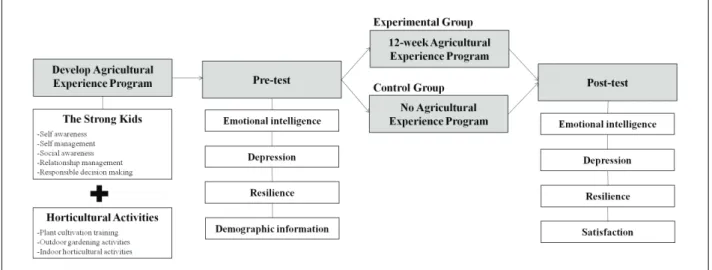
Figure 1. Experimental procedure
Session Agricultural experience Program Strong Kids Topic Horticultural crops
1 Designing a garden
Creating name tag with compressed flowers
About strong kids: emotional
strength training Compressed flowers
2 Creating a garden
Sowing potatoes and carrots Understanding your feelings 1 Potato (Solanum tuberosum) Carrot (Daucus carota var. sativa) 3 Making green vegetable doll
Planting leaf vegetables Understanding your feelings 2 Bok choy (Brassica rapa) Lettuce (Lactuca sativa)
4 Cutting herb plants Dealing with anger
Geranium (Pelargonium inquinans) Rosemary (Rosmarinus officinalis)
Mints (Mentha species)
5 Planting fruit vegetables Setting up plant stakes
Understanding other people's feelings
Cherry tomato (Solanum lycopersicum var.
cerasiforme) Eggplant (Solanum melongena)
6 Sowing radish
Making garden sign Solving people problems Radish (Raphanus sativus) 7 Making and using environmentally friendly
pesticides and fertilizer Clear thinking 1 -
8 Weeding
Making canapé Clear thinking 2 Carrot (Daucus carota var. sativa)
Radish (Raphanus sativus)
9 Dyeing handkerchiefs with flowers The power of positive thinking
Lisianthus (Eustom a russelianum) Rose (Rosa hybrida)
Chrysanthemum (Chrysanthemum morifolium)
10 Weeding
Fertilizing Letting go of stress -
11 Making frame with Scandia moss Behavior change: setting goals
and staying active Scandia moss
12
Harvesting Packing harvests Making non-alcohol mojito
Finishing up!
Potato (Solanum tuberosum) Carrot (Daucus carota var. sativa)
Lettuce (Lactuca sativa) Radish (Raphanus sativus) Table 1. The 12-session agricultural experience program based on the Strong Kids curriculum
purpose, schedule, and cautions. The subjects completed the written consent and responded to the demographic information questionnaire (Figure 1).
2. Agricultural experience activity program
A 12-session agricultural experience program called
"Little Urban Farmer Program", consisting of 12 weekly sessions (60 min each) was developed. The program integrated outdoor gardening activities and indoor agricultural activities. The children participating in the agricultural activities were divided into six groups and performed group activities. The group was provided a garden area of approximately 1.0 × 1.8 m. For this study, we selected seasonal crops that have been shown to have a high preference among elementary school students.
The agricultural experience program in this study was centered on the Strong Kids curriculum. Various studies showed that SEL, such as Strong Kids program, is very effective as a way of character education that fosters children’s emotional competence. However, there are concerns about whether SEL from books reflects the emotional complexity that can be learned from experience (Kim, 2017). Rather than learning from books in the classroom, character education is needed to experience and learn outside the classroom like nature education. Among SEL, Strong Kids program was considered to be an appropriate educational method for this study because they were designed to learn and improve the positive concept of emotion through 12 short-term activities. Thus, we planned agricultural activities that aligned with the purpose of each Strong Kids session (Table 1). First, we introduced basic knowledge of agricultural activity, such as understanding seeds, soil, propagation, and cultivation. Then, students had the opportunity to talk with each other about the Strong Kids topic during agricultural experience program.
Table 2 provides an example of a session in the 12-week “Little Urban Farmer Program”, which aimed to distinguish between comfortable and uncomfortable emotions. For this lesson, students sowed carrot and potato seeds. Then, they recorded their feelings for each activity and compared them with those of their friends. Through these, they could understand a variety of emotions and correctly identify whether their feelings were positive or negative. Also, they realized that they can feel different
emotions depending on the situation and the feelings of others during the same activity could be different.
3. Assessments
To evaluate the emotional effects of the agricultural experience program on depression, emotional intelligence, and resilience of the children, self-report questionnaires were administered before and after the program. The experimental group further evaluated program satisfaction in the post-evaluation.
A five-point Likert scale was used in the depression questionnaire, which consisted of 27 questions with five subscales developed by Kovacs (1982) and adapted by Cho and Lee (1990)—the higher the score, the more likely the depressive symptoms. According to the scores, 19–21 indicates mild depression, 22–25 moderate depression, 26–
28 severe depression, and 29 indicates very severe. Choi (2017) reported a Cronbach’s ɑ of 0.88.
To understand the effects of the program on emotional intelligence, an emotional intelligence questionnaire with 47 questions designed for elementary school students was administered. It was developed by Moon (1996), based on the emotional intelligence model of Salovey and Mayer (1990)—the higher the score, the greater the emotional intelligence.
To assess the resilience of the children, we used a resilience test modified by Lee (2013) and based on the survey developed by Reivich and Shatte (2002). A five-point Likert scale was used in the survey, which consisted of 36 questions with 8 subcategories: emotion control ability, impulse control ability, optimism, causal analysis ability, empathy ability, self-efficacy, and positive conductivity. Higher scores indicate better resilience. Lee (2013) reported a Cronbach’s ɑ of 0.94.
Finally, the researchers revised the satisfaction questionnaire from Park et al. (2016) and Lee (2017). The satisfaction questionnaire consisted of nine items: total satisfaction of agricultural experience program, program time, program frequency, preferred activities, re-participation, and recommendation to others.
4. Data analysis
To compare the results of the psychological and emotional questionnaire evaluations before and after the agricultural experience program of the experimental group and the control group, SPSS software (version 24 for Windows; IBM, Armonk, NY) was used.
The Shapiro-Wilk’s test showed that the emotional evaluation scores of the experimental group and the control group were normally distributed (p > 0.05). Therefore, the homogeneity of the control group was verified through the independent T-test, and the corresponding T-test was performed to compare the pre- and post-test results.
Demographic information and satisfaction with the agricultural experience program were analyzed using descriptive statistics for each collected item using Excel software (Microsoft Office 2007; Microsoft Corp., Redmond, WA). In addition, a Chi-square test was performed using SPSS software to compare the
demographic information of the two groups. The level of statistical significance was based on p < 0.05.
Title Comfortable feelings, Uncomfortable feelings Strong Kids Topic Understanding your feelings
Agricultural activity Sowing seeds
Purpose
Distinguishing between comfortable feelings and uncomfortable feelings Recognizing the various feelings during gardening activities
Realizing that emotions in the same situation can be different
Supplies Shovels, Rake, Hoe, Carrot seed, Potato seed, Watering can, Activity list Activity sequence (time) Activity contents
Introduction (10 min)
1. Greeting
2. Reminding the last session 3. Explaining today’s activities
Development (45 min)
1. Explaining the concepts of comfortable and uncomfortable feelings 2. Explaining various feelings that can be felt in our lives
3. Asking about the benefits of gardening
4. Explaining the reasons and how to make garden beds
5. Explaining the method of sowing (Broadcasting, Line sowing, Dibbling) 6. Making the list of today’s gardening activities
7. Making garden bed in groups (making furrow) 8. Line sowing with carrot seeds
9. Covering the seeds with the soil and watering 10. Dibbling the potato seeds at intervals of 25 cm
11. Marking comfortable feelings as (+), uncomfortable feelings as (-) on the activity list 12. Comparing the lists with the groups
13. Knowing people can feel differently about the same situation 14. Discussing how to react to uncomfortable feelings in a helpful way Closure
(5 min)
1. Announcement of next session 2. Arrangement used tools 3. Saying goodbye
Table 2. Example of a session in the 12-session agricultural experience program
Variable
Horticultural Activity Group
(n=18)
Control Group (n=12)
Significance
Average (SD)
Age 11.5 (0.6) 11.9 (0.8) NS (0.284)
% (N) Gender
Male 27.8 (5) 50.0 (6)
NS (0.216) Female 72.2 (13) 50.0 (6)
Grade
4th 50.0 (9) 33.3 (4)
NS (0.284)
5th 44.4 (8) 41.7 (5)
6th 5.6 (1) 25.0 (3)
Table 3. Demographic characteristics of participants in the 12-session horticultural activity program
Variable
Agricultural Experience Program Group
(n = 18)
Control Group
(n = 12) Significance
Mean (SD) Emotional
intelligence 68.89 (11.95) 70.33 (13.44) NS (0.681) Depression 8.22 (5.72) 9.08 (5.85) NS (0.673) Resilience 135.33 (13.02) 134.00 (17.60) NS (0.813) Table 4. Homogeneity test between the agricultural activity
group and control group in the pre-test
Variable
Agricultural Experience Program Group
(n = 18)
Control Group (n = 12)
Mean (SD)
Emotional intelligence
Pre-test 68.89 (11.95) 70.33 (13.44) Post-test 73.89 (10.52) 72.75 (10.54) Significance * (0.031) NS (0.397)
Depression
Pre-test 8.22 (5.72) 9.08 (5.85) Post-test 5.11 (4.27) 9.92 (8.38) Significance * (0.011) NS (0.681)
Resilience
Pre-test 135.33 (13.02) 134.00 (17.60) Post-test 135.28 (15.53) 130.00 (18.10) Significance NS (0.986) NS (0.592) Table 5. Psycho-emotional changes in children before and
after the 12-session agricultural activity program.
III. Results and Discussions
1. Characteristics subjects
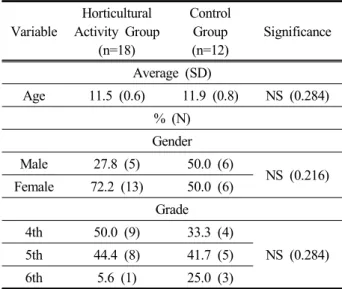
The average age of the participants was 11.5 ± 0.6 years, with 5 males (27.8%) and 13 females (72.2%).
There were 9 students (50.0%) in 4th grade, 8 (44.4%) in 5th, and 1 (5.6%) in 6th. The mean age of the control group who were not participating in the agricultural experience program was 11.9 ± 0.8 years, with 6 male (50.0%) and 6 female participants (50.0%). The control group consisted of 4 students (33.3%) in 4th grade, 5 (41.7%) in 5th, and 3 (25.0%) in 6th. There were no
significant differences in the age, sex, and grade of the participants (Table 3). The program attendance rate of the participation group was 89%.
2. Homogeneity test
The homogeneity test of emotional intelligence, depression, and resilience to the experimental and control groups before the agricultural activity program was administered. As a result, the two groups appeared to be in the same group (Table 4).
3. Emotional intelligence
The agricultural experience program was effective in improving children’s emotional intelligence (Table 5). The emotional intelligence of the children participating in the program significantly improved from 68.89 ± 11.95 to 73.89 ± 10.52 (p = 0.031). In contrast, there was no significant difference in the control group (mean changed from 70.33 ± 13.44 to 72.75 ± 10.54; p = 0.397). This is consistent with the results of various previous studies that have shown improved emotional intelligence after horticultural activities (Jeong and Lee, 2009; Park et al., 2016; Park and Huh, 2010; Ryu et al., 2013).
Emotional intelligence includes the concepts of emotional perception, expression, empathy, regulation, and utilization, and it is considered essential to one’s quality of life (Goleman, 1995; Salovey and Mayer, 1990). Activities with living plants could lead to positive thoughts through mutual feedback between plants and subjects, by observing changes in the plants (Kim, 2003; Son et al., 2006). The children’s emotional perception could be enhanced by experiencing the plants through the five senses and identifying their emotions through various horticultural activities (Gu, 2003;
Williams, 1990). The present program provided a variety of agricultural activities with various plants for 12 weeks, which may stimulate the five senses of children and improve emotional intelligence. The students would have felt the preciousness and fulfillment of life as they managed their own gardens and communicated with the crops they planted. In addition, the program was applied to the Strong Kids curriculum, allowing students to spend time learning and discussing positive and negative emotions each session. The teacher suggested various situations every
session, and the children were asked to record and discuss the feelings they felt when solving the problem situation in the garden. These activities could help children learn about emotional awareness and how to express properly.
Furthermore, having a indirect experience while observing other friends’ behaviors and feelings through group activities helped learn how to manage and control their feelings.
4. Depression
The agricultural experience program was effective in reducing depression in children (Table 5). The depression of children in the agricultural activity group significantly decreased from 8.22 ± 5.72 to 5.11 ± 4.27, after participating in the 12-session program (p = 0.011).
However, there was no significant difference in the control group, from 9.08 ± 5.85 to 9.92 ± 8.38 (p = 0.681). This is consistent with previous studies that indicated outdoor or indoor gardening programs were effective in reducing depression in a variety of subjects.
Gonzalez et al. (2011) found that a 12-week horticultural therapy program effectively reduced depression, anxiety, and stress and elicited positive mood changes. In addition to long-term horticultural therapy programs, 2-h short-term gardening activities also positively affected depression, anxiety, stress reduction, and quality of life (Hayashi et al., 2008). Furthermore, continuous gardening activities have been shown to be highly effective in reducing depression, aggression, and fatigue (Wilson and Christensen, 2011;
Wood et al., 2016). These results could be due to touching the soil or exposure to the green environment eliminates stress-related factors and activates the secretion of serotonin of human body, known as the happy hormone (Lowry et al., 2007). The children who participated in the program were continuously exposed to the green environment by touching and nurturing the plants for 12 weeks. It is believed that continuous exposure to the natural environment is effective for psycho-emotional stability in children.
According to Schuch et al. (2016), moderate-intensity exercise was effective in patients with major depressive disorder. Park et al. (2014) reported that agricultural activities such as shoveling, hoeing, and weeding provided moderate-high intensity physical activity for children. The agricultural program applied to the present study included various physical activities such as shoveling, weeding,
watering, and sowing. Therefore, it seemed to have a positive effect on depression through physical activity- oriented outdoor gardening.
Moreover, as a result of applying the Strong Kids program, at each session, psycho-emotional topics were applied to agricultural activities. Learning about feelings, completing worksheets, and sharing feelings about gardening at the end of each class seemed to reduce the negative feelings of children.
5. Resilience
There was no significant difference in both groups in resilience (Table 5). The resilience score of the children participating in the program was 135.33 ± 13.02 before the program and 135.28 ± 15.53 (p = 0.986) after the program. The control group was not statistically significant, but the score tended to decrease from 134.00 ± 17.60 to 130.00 ± 18.10 (p = 0.592). This result differed from that of previous studies.
Recovery resilience is the ability to cope and adapt to situations that need to be overcome from everyday stress or trauma (Reivich and Gillham, 2010). Children with high resilience are more likely to respond successfully when exposed to risk factors (Block and Kremen, 1996; Masten et al., 1990; Reivich and Shatté, 2002). Resilience is not innate but very dynamic, changing over time and affected by the interaction of environmental factors (Hong, 2006).
Factors that make up resilience are personal internal protection factors such as individual temperament, cognitive ability, and personality, and external factors such as parent-child relationship, companionship, and school life (Lee and Jo, 2005). The 60-minute lessons once a week weren’t enough to stimulate or improve all of these factors.
It is necessary to create tasks and activities that can be applied and practiced with families to improve the parent-child relationship that is particularly important for resilience.
6. Satisfaction with the program
After completing the agricultural experience program, the participants were asked about their satisfaction with the program. 72.2% (13 students) were very satisfied with the overall program, and 27.8% (5 students) were satisfied.
Moreover, 38.9% (7 students) answered ‘very satisfied’, 22.2% (4 students) were ‘satisfied’, and 27.8% (5 students) were ‘not satisfied’ with the time per session. Some of those who answered ‘not satisfied’ indicated they would like to participate in a program that was longer than 60 min in duration. Regarding the number of sessions per week, 33.3% (6 students) answered ‘very satisfied’, 44.4%
(8 students) answered ‘satisfied’, 11.1% (2 students) were neutral, 5.6% (1 student) reported ‘not satisfied’, and 5.6%
(1 student) reported very dissatisfied. Those who answered
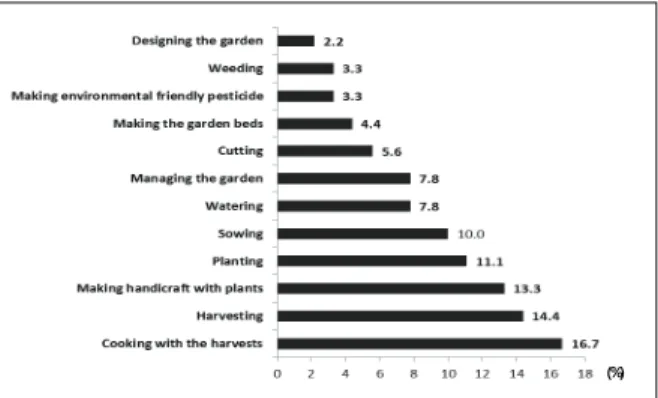
‘not satisfied’ suggested that sessions three times a week would be adequate. The most preferred activity in the agricultural activity program was cooking with the harvests (16.7%). Harvesting was the next most popular activity, at 14.4%. The next preferred activities were making handicrafts with plants (13.3%), planting (11.1%), sowing (10.0%), watering (7.8%), managing the garden (7.8%), cutting (5.6%), making the garden beds (4.4%), making environmental friendly pesticide (3.3%), weeding (3.3%), and designing the garden (2.2%) (Figure 2).
Additionally, 66.7% (12 students) answered that they hoped for a continuation of the program. Eleven students responded that they would recommend this agricultural experience program to other friends.
(%)
Figure 2. Activity preferences of the 12-session agricultural experience program
IV. Conclusion
In conclusions, the present showed that our agricultural experience program improved the psychological stability
and social-emotional competence of the elementary school-age participants. This study examined the emotional effectiveness of 12-session agricultural experience programs applying SEL to 30 elementary school students in grades 4-6 in Seoul. Of the 30 children, 18 children who participated in the agricultural experience program were grouped as experiments and 12 children who did not participate in the agricultural experience program were grouped as controls. As a result, The group who participated in the program showed positive emotional changes in depression and emotional intelligence, and the control group did not. Furthermore, the experimental group was generally satisfied with the program. In our program, we implemented an agricultural experience program with 12 themes presented by Strong Kids curriculum. It is thought that the agricultural activities combined with the Strong Kids topics effectively reduced the children’s mental health problems and improved their emotional intelligence. This study is meaningful in that the theory-based agricultural education program was developed and applied beyond just analyzed the effect of agricultural experience activities.
Accordingly, the results of this study can be used as basic data for the development of systematic programs for agricultural experience activities and rural study. However, this study has a limitation that the number of subjects and region is limited. Further studies are necessary to show how this program can supplement the standard school curriculum and verify the program’s effectiveness when implemented in various schools.
This work was carried out with the support of “Joint Research Project (Project title: Determining the Effects of Urban Agriculture Program for Health of Elementary School Students, Project No.
PJ012808012019)” Rural Development Administration, Republic of Korea.
References
1. Block, J. and Kremen, A.M., 1996, IQ and ego-resiliency: conceptual and empirical connections and separateness, J. Pers. Soc. Psychol. 70(2), 349-361.
2. Cho, S.C and Lee, Y.S., 1990, Development of the
Korean Form of the Kovacs’ Children’s Depression Inventory, Journal of Korean Neuropsychiatric Association, 29, 943-956.
3. Choi, H.J., 2017, The influence of art therapy to reduction of anxiety and aggressiveness of parental divorce children, Master’s thesis, Daejeon University, Daejeon, Korea.
4. Chung, O.B., 2013, Understanding of the developmnet of children, Seoul, Korea: Hakjisa.
5. Collaborative for Academic, Social and Emotional Learning (CASEL), 2018, What is SEL?, Retrieved from https://casel.org/what-is-sel/
6. Costello, E.J and Angold, A., 2000, Developmental psychopathology and public health: Past, present, and future, Dev. Psychopathol, 12(4), 599-618.
7. Doll, B.L. and Lyon, M.A., 1998, Risk and resilience:
Implications for the delivery of educational and mental health services in schools, School. Psychol. Rev., 27(3), 348-363.
8. Farmer, E.M. and Farmer, T.W., 1999, The role of schools in outcomes for youth: Implications for children’s mental health services research, Journal of Child and Family Studies, 8(4).
9. Federation of City Farms and Community Gardens, 2018, Federation of city farms and community gardens, Scotland, Retrieved from http://www.farmgarden.org.uk 10. Goleman, D., 1995, Emotional Intelligence, New York,
A Bantam book.
11. Gonzalez, M.T., Hartig, T., Patil, G.G., Martinsen, E.W., and Kirkevold, M., 2011, A prospective study of group cohesiveness in therapeutic horticulture for clinical depression, Int. J. Ment. Health Nurs, 20(2), 119-129.
12. Gu, J.Y., 2003, Effect of indoor garden in the elementary school classroom on the change of school bullying and attention of children, Master’s thesis, Konkuk University, Seoul, Korea.
13. Ha, T.W. Lee, B.K., Park, D.W., Ko, B.C., Cha, S.J., Kim, S.H., Yang, S.H., and Kang, B.R., 2014, A study on the improvement of the system for the operation, management and activation of rural studies, Asia Life Universiy, Alternative Education Research Institution.
14. Han, M.H and Yoo, Y.K., 2014, Effect of horticultural activity program on the emotional intelligence, social competency and school adjustment in elementary school
students, J. Korean. Soc. People Plants Environ, 17(2), 117-123.
15. Hayashi, N., Wada, T., Hirai, H., Miyake, T., Matsuura, Y., Shimizu, N., Kurooka, H., and Horiuchi, S., 2008, The effects of horticultural activity in a community garden on mood changes, Environ. Control in Biol., 46(4), 233-240.
16. Hoagwood, K. and Erwin, H.D., 1997, Effectiveness of school-based mental health services for children: A 10-year research review, Journal of Child and Family Studies, 6(4).
17. Hodgson, K., Campbell, M.C., and Baikey, M., 2011, Investing in healthy, sustainable places through urban agriculture, Funders’ Network for Smart Growth and Livable Communities, 2011, 1-15.
18. Hong, E.S., 2006, Conceptual understanding of resilience and instructional suggestion, Kor. J. Special Educ., 41(2), 45-67.
19. Jeong, Y.O and Lee, J.H., 2009, The influence of in-classroom horticultural activities on the reduction of elementary school students’ aggression and stress, J.
Korean Pract. Arts. Educ., 22(4), 151-172.
20. Joo, E.Y., 2008, Effect of horticultural therapy based on positive psychology on development of at-risk children’s creativity, Dissertation, Catholic University of Daegu, Daegu, Korea.
21. Kang, K.A., Kim, S.J., Song, M.K., Sim, S., and Kim, S.H., 2007, Development of an instrument to measure meaning of life (MOL) for higher grade primary school children, Journal of Korean Academy of Child Health Nursing, 13(3), 308-317.
22. Kim Y., 2017, A critical study on social and emotional learning (SEL), J. Ethics Education Studies, 43, 201-221.
23. Kim, J.H., 2018, The effects of art activity using String Kids program on social-emotional empetence, Master’s thesis, Seoul National University of Education, Seoul, Korea.
24. Kim, Y.L., 2003, Effects of ecologically approached science activities on young children’s science ability, Doctoral dissertation, WonKwang University, Wonju, Korea.
25. Korea Agency of Education, Promotion & Information Service in Food, Agriculture, Forestry & Fisheries, 2015, Korea, Retrieved from http://okdab.com/
news/issueTrend/issueView.do?issueSeq=881&searchValue
=¤tPage=1.
26. Korea Institute for Health and Social Affairs, 2017, Adolescents’ mental health and its relationship with health behaviors.
27. Korea National Institute for Yout Policy, 2016, Survey on human rights of child youth (Report No. 16-R11), Retrieved from http://www.nypi.re.kr.
28. Kovacs, M., 1982, The children’s depression inventory:
A self-rating depression scale for school-aged youngsters, University of Pittsburgh. School of Medicine, Western Psychiatric Institute and Clinic (Pittsburgh, Pa.), University of Pittsburgh School of Medicine: USA.
29. Lee, A.R., 2013, The effects of the cognitive-behavioral counselling program on resilience according to the environmental risk factor level, Master’s thesis, Seoul National University of Education, Seoul, Korea.
30. Lee, A.Y., 2017, Analysis of kinematic and kinetic characteristics of horticultural therapy activity and verification of its rehabilitative effectiveness, Doctoral dissertation, Konkuk University, Seoul, Korea.
31. Lee, H. and Jo, H.I., 2005, A study for development of the resilience scale of Korean adolescents, Studies on Korean Youth, 42(12), 161-206.
32. Lovell, S.T., 2010, Multifunctional urban agriculture for sustainable land use planning in the United States, Sustainability, 2(8), 2499-2522.
33. Lowry, C.A., Hollis, J.H., de Vries, A., Pan, B., Brunet, L.R., Hun, J.R., Paton, J.F., van Kampen, E., Knight, D.M., and Evans, A.K., 2007, Identification of an immune-responsive mesolimbocortical serotonergic system: potential role in regulation of emotional behavior, Neuroscience, 146(2), 756-772.
34. Masten, A.S., Best, K.M., and Garmezy, N., 1990, Resilience and development: Contributions from the study of children who overcome adversity, Dev.
Psychopathol., 2(4), 425-444.
35. Merrell, K., Carrizales, D., Feuerborn, L., Gueldner, B., and Tran, O., 2007, Strong Kids: a social and emotional learning curriculum for students in grades 3–
5, Baltimore, Brookes Publishing.
36. Moon Y.L., 1996, Comprehensive career aptitude test, Seoul, Korea: Daekyo press.
37. O’Brien, L., 2009, Learning outdoor : the forest school
approach, Education 3-13, 37(1), 45-60.
38. Park, S.A., Cho, M.K., Yoo, M.H., Kim, S.Y., Im, E.A., Song, J.E., Lee, J.C., and Jun, I.G., 2016, Horticultural activity program for improving emotional intelligence, prosocial behavior, and scientific investigation abilities and attitudes in kindergarteners, HortTechnol, 26(6), 754-761.
39. Park, S.A., Lee, A.Y., Lee, G.J., Kim, D.S., Kim, W.S., Shoemaker, C.A., Son, K.C., 2016, Horticultural activity interventions and outcomes: A review, Korean Journal of Horticultural Science & Technology, 34(4), 513-527.
40. Park, S.A., Lee, A.Y., Lee, K.S., and Son, K.C., 2014, Comparison of the metabolic costs of gardening and common physical activities in children, Korean J.
Hortic. Sci. Technol, 32(1), 123-128.
41. Park, S.H. and Huh, M.R., 2010, Effects of a horticultural program on the preschool children’s emotional intelligence and daily stress, Korean J.
Hortic. Sci. Technol., 28(1), 144-9.
42. Park, Y.S., 2015, The effects of applying social emotional learning to English class on vocational high school students’ learning attitudes and achievements, Master’s thesis, Chonnam National University, Gwangju, Korea.
43. Randle, D., 1991, Teaching green : a parent’s guide to education for life on earth, London : Green Preen.
44. Reivich, K. and Gillham, J., 2010, Building resilience in youth: The penn resiliency program, Communique, 38(6).
45. Reivich, K. and Shatte, A., 2002, The resilience factor:
7 keys to finding your inner strength and overcoming life’s hurdles, Broadway Books, New York: Harmony Publishing.
46. Relf, D., 1992, Human issues in horticulture, HortTechnology, 2(2), 159-171.
47. Ryu, S.H., Park, Y.Y., Lee, S.W., 2013, The effects of gardening activities promoting nature-experience on young children’s emotional intelligence and nature-friendly attitude, The Research Institute of Korean Education, 31(3), 1-20.
48. Salovey P., and Mayer, J.D., 1990, Emotional intelligence, Imagination Cognition Personality 9(3), 185-211.
49. Schuch, F.B., Vancampfort, D., Richards, J., Rosenbaum, S., Wardm P.B., and Stubbs, B., 2016,
Exercise as a treatment for depression: a meta-analysis adjusting for publication bias, J. Psychiatr. Res., 77, 42-51.
50. Seok, D.W., Lee, J.H., and Jeong, Y.O., 2009, The effects of plant raising activities in home upon school student’s emotion intelligence, J. Agric & Life Sci, 43(6), 46-52.
51. Sim, H.O., 1997, Factors influencing internal and external problem behaviors in late elementary school children: Depression and antisocial behavior, Korean J.
Child Stud., 18(1), 39-52.
52. So, Y., 2019, A study on music curriculum guideline for social and emotional learning : using Padlet program, Master’s thesis, Kookmin University, Seoul, Korea.
53. Sobel, D., 2014, Learning to walk between the raindrops: The value of nature preschools and forest kindergartens. children, youth and environments, 24(2), 228-238.
54. Son, K.C., Cho, M.K., Song, J.E., Kim, S.Y., and Lee, S.S., 2006, The practice of professional horticultural therapy, Seoul, Korea: Korea University Publishing.
55. Song, D.Y and Lee, J.B., 2008, The effect of classroom horticultural activity program on children’s self-esteem and peer relationship, J Korean Practical Arts Education, 2008(1), 167-181.
56. US Department of Health and Human Services, 1999, Mental health: A report of the surgeon general, Washington, D.C., USA, Retrieved from http://www.hhs.gov
57. Williams, D.R. and Dixon, P.S., 2013, Impact of garden-based learning on academic outcomes in schools:
Synthesis of research between 1990 and 2010, Review of Educational Research, 83(2), 211-235.
58. Williams, S., 1990, Evaluation of the horticulture therapy program. The role of horticulture in human well-being and social development, A national symposium, Arlington, Virginia.
59. Wilson, J.F. and Christensen, K.M., 2011, The relationship between gardening and depression among individuals with disabilities, J. Therapeutic Horticulture, 21(2), 28-41.
60. Wood, C.J., Pretty, J., and Griffin, M., 2016, A case - control study of the health and well-being benefits of allotment gardening, J. Public Health, 38(3), 336-344.
Received 1 October 2019
First Revised 21 October 2019
Second Revised 5 November 2019
Finally Revised 7 November 2019
Accepted 7 November 2019