Introduction Introduction
Osteoclasts are tartrate-resistant acid phosphatase (TRAP)- positive multinucleated cells that degrade bone by secreting protons and enzymes. However, the roles of osteoclasts are not limited to bone resorption. For example, osteoclasts are in- volved in coupling bone resorption and formation by stimulation of osteoblast differentiation [1]. Additionally, several studies suggest that osteoclasts have phagocytic activity under physi-
ological conditions. Osteoclasts containing cells are found in various bones, such as tibia, femur, calvaria, and alveolar bone of young animals that show active bone modeling or remodel- ing [2-5]. Cells phagocytosed by osteoclasts have been char- acterized as macrophages, osteoblasts, or osteocytes based on morphological features or immunohistochemical analysis [3,4,6-9]. Apoptotic bone cells have also been identified within osteoclasts in the alveolar bone of normal young rats [5,10]. In another study, rats treated with parathyroid hormone showed Int J Oral Biol 45:92-98, 2020
pISSN: 1226-7155 • eISSN: 2287-6618 https://doi.org/10.11620/IJOB.2020.45.3.92
Phagocytic osteoclasts in the alveolar bone of diabetic rats with periodontitis
Eun-Jung Bak 1 , Ae Ri Kim 1,2,3 , Ji-Hye Kim 4 , and Yun-Jung Yoo 1 *
1 Department of Oral Biology, Yonsei University College of Dentistry, Seoul 03722, Republic of Korea
2 BK21 PLUS Project, Yonsei University College of Dentistry, Seoul 03722, Republic of Korea
3 Department of Applied Life Science, The Graduate School, Yonsei University, Seoul 03722, Republic of Korea
4 Department of Dental Hygiene, Baekseok University, Cheonan 31065, Republic of Korea
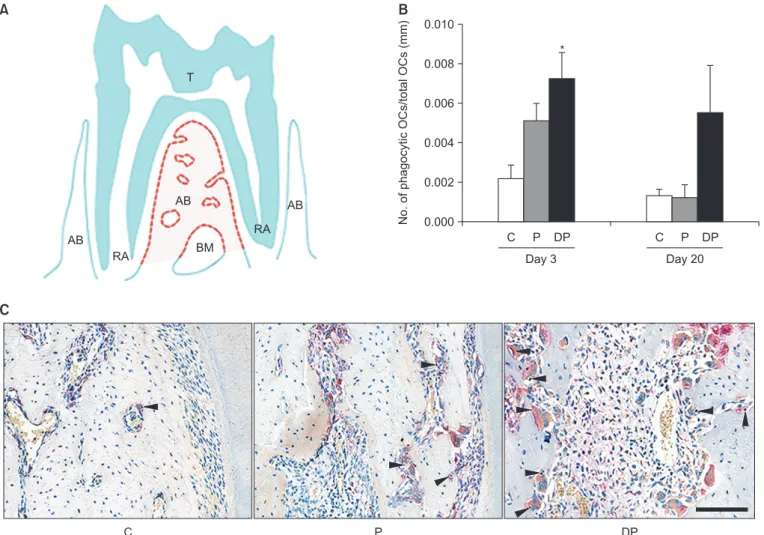
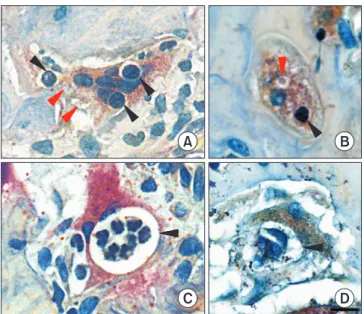
Periodontitis is a bacteria-induced inflammatory disease associated with alveolar bone loss. Osteoclast is a macrophage-lineage cell that exhibits phagocytic activity; however, osteoclast phagocytic activity has not been demonstrated under pathological conditions. Diabetes is a pathological condition that exacerbates alveolar bone loss via periodontitis; therefore, we examined phagocytic osteoclasts in diabetic rats that had periodontitis. The rats were divided into the control (C), periodontitis (P), and diabetes with periodontitis (DP) groups. Diabetes and periodontitis were induced by streptozotocin injection and ligature of the mandibular first molars, respectively. On days 3 and 20 after the ligature, the rats were sacrificed, and osteoclasts containing inclusions were quantified by tartrate-resistant acid phosphatase staining. On day 3, there were more osteoclasts containing inclusions in the DP group than in the C group. Among inclusions, osteocyte-like cells and dense bodies were more frequently observed in the DP group than in the C group. Cytoplasm-like structures were elevated more in the DP group than in the C and P groups. However, no differences were observed on day 20. Interestingly, some osteoclasts were in contact with the osteocytes within the exposed lacunae and contained several inclusions within a large vacuole. Thus, the elevation of phagocytic osteoclasts in rats with diabetes and periodontitis provides insight into the role of osteoclast phagocytic activity under pathological conditions.
Keywords: Periodontitis, Diabetes mellitus, Osteoclasts, Phagocytosis
Received June 3, 2020; Revised August 21, 2020; Accepted August 22, 2020
*Correspondence to: Yun-Jung Yoo, E-mail: [email protected] https://orcid.org/0000-0002-0045-9597 Copyright © The Korean Academy of Oral Biology
CC