Compressive force regulates ephrinB2 and EphB4 in osteoblasts and osteoclasts contributing to
alveolar bone resorption during experimental tooth movement
Objective: To investigate the involvement of ephrinB2 in periodontal tissue remodeling in compression areas during orthodontic tooth movement and the effects of compressive force on EphB4 and ephrinB2 expression in osteoblasts and osteoclasts. Methods: A rat model of experimental tooth movement was established to examine the histological changes and the localization of ephrinB2 in compressed periodontal tissues during experimental tooth movement.
RAW264.7 cells and ST2 cells, used as precursor cells of osteoclasts and osteoblasts, respectively, were subjected to compressive force in vitro. The gene expression of EphB4 and ephrinB2, as well as bone-associated factors including Runx2, Sp7, NFATc1, and calcitonin receptor, were examined by quantitative real-time polymerase chain reaction (PCR). Results: Histological examination of the compression areas of alveolar bone from experimental rats showed that osteoclastogenic activities were promoted while osteogenic activities were inhibited. Immunohistochemistry revealed that ephrinB2 was strongly expressed in osteoclasts in these areas. Quantitative real-time PCR showed that mRNA levels of NFATc1, calcitonin receptor, and ephrinB2 were increased significantly in compressed RAW264.7 cells, and the expression of ephrinB2, EphB4, Sp7, and Runx2 was decreased significantly in compressed ST2 cells. Conclusions:
Our results indicate that compressive force can regulate EphB4 and ephrinB2 expression in osteoblasts and osteoclasts, which might contribute to alveolar bone resorption in compression areas during orthodontic tooth movement.
[Korean J Orthod 2014;44(6):320-329]
Key words: Tooth movement, Bone biology, Cell/molecular biology, EphrinB2, EphB4
Jianhua Hou
a,bYanze Chen
aXiuping Meng
cCe Shi
aChen Li
aYuanping Chen
bHongchen Sun
aa
Department of Oral Pathology, School and Hospital of Stomatology, Jilin University, Changchun, China
b
Department of Orthodontics, School and Hospital of Stomatology, Jilin University, Changchun, China
c
Department of Endodontics, School and Hospital of Stomatology, Jilin University, Changchun, China
Received March 14, 2014; Revised April 10, 2014; Accepted April 14, 2014.
Corresponding author: Hongchen Sun.
Professor, Department of Oral Pathology, School and Hospital of Stomatology, Jilin University, 1500 Qinghua Road, Changchun 130021, China.
Tel +86-431-8879-6012 e-mail [email protected]
*This work was supported by grants from the National Natural Science Foundation of China (No.81271111).
© 2014 The Korean Association of Orthodontists.
The authors report no commercial, proprietary, or financial interest in the products or companies described in this article.
This is an Open Access article distributed under the terms of the Creative Commons Attribution Non-Commercial License (http://creativecommons.org/licenses/by-nc/3.0) which permits unrestricted non-commercial use, distribution, and reproduction in any medium, provided the original work is properly cited.
pISSN 2234-7518 • eISSN 2005-372X
http://dx.doi.org/10.4041/kjod.2014.44.6.320
INTRODUCTION
Orthodontic tooth movement is coupled with the remodeling of alveolar bone, which occurs due to mechanical forces such as compression and tension.
1,2Compressive force causes bone resorption on the compressed side of an orthodontically moving tooth, resulting in tooth movement. Two major cell types that are actively involved in the remodeling of alveolar bone are osteoblasts and osteoclasts. They are sensitive communicators between microenvironment and genome, capable of restoring system homeostasis disturbed by orthodontic mechanics.
3Under the load of orthodontic forces, many molecular reactions occur in and around these cells. However, the mechanism of these reactions has not been fully elucidated. A more comprehensive understanding of the underlying mechanism will provide valuable information for the development of agents regulating the activities of osteoblasts and osteoclasts to better control the bone resorption in compression areas, which is the rate-limiting step in orthodontic tooth movement.
4Some effectors of bone remodeling have been reported, and one of the most well-studied molecular networks in this process is the receptor activator of nuclear factor kappa B (RANK)/RANK ligand (RANKL)/
osteoprotegerin (OPG) pathway.
5-7Osteoblasts can regulate osteoclast differentiation via this pathway.
OPG is one of the rate-limiting agents for osteoclast differentiation and function,
8since it can block the membrane docking of RANK and RANKL. Recently, another family of molecules known as ephrin/Eph has been demonstrated to modulate the differentiation of osteoblasts and osteoclasts.
9-11Similar to RANK and RANKL, ephrins and Ephs have a ligand-receptor relationship—ephrins are transmembrane ligands, and Ephs are tyrosine kinase receptors. Interaction between ephrinB- and EphB-expressing cells results in bidirectional signal transduction. The activation of EphB receptors by ephrinB ligands is referred to as “forward signaling”, whereas the activation of ephrinB ligands by EphB receptors is designated “reverse signaling”. Ephrin and Eph were characterized initially through their roles in embryogenesis,
12as ephrin—Eph signaling is critically involved in neural development, cell morphogenesis, tissue patterning, and angiogenesis.
13Within the ephrin/Eph family, EphB4 and its preferred ligand, ephrinB2, have been studied intensively in osteoblasts and osteoclasts. EphrinB2 expression is induced during osteoclast differentiation, and then reverse signaling through this ligand suppresses osteoclast differentiation, forming a negative feedback loop.
9Moreover, forward signaling through the EphB4 receptor on osteoblasts enhances their differentiation.
The bidirectional activation of the ephrinB2—EphB4 signaling pathway in osteoclasts and osteoblasts leads to the suppression of osteoclast differentiation with concurrent stimulation of osteoblast differentiation and, consequently, bone formation. The communication between ephrinB2 and EphB4 has recently been shown to be involved in the stimulation of osteoblast differentiation within the osteoblast lineage.
14,15In addition, ephrinB2 and EphB4 have been demonstrated to be regulated by mechanical forces in endothelial progenitor cells and periodontal ligament fibroblasts.
16-18It was shown that mechanical strain induced ephrinB2 upregulation in periodontal ligament fibroblasts, contributing to osteogenesis at tension sites of orthodontic tooth movement.
17However, the effects of compressive force on these two molecules in osteoblasts and osteoclasts have not been clearly elucidated.
Our objective was to investigate the involvement of ephrinB2 in periodontal tissue remodeling in compression areas during orthodontic tooth movement and the effect of compressive force on ephrinB2 and EphB4 expression in osteoblasts and osteoclasts. We hypothesized that compressive force would affect alveolar bone remodeling through the regulation of ephrinB2 and EphB4 expression during orthodontic tooth movement.
MATERIALS AND METHODS
Materials
The murine monocyte/macrophage cell line RAW264.7 and stromal cell line ST2 were obtained from the Chinese Academy of Sciences Cell Bank (Shanghai, China). A four-point bending system was obtained from Sichuan University (Chengdu, China). The force-loading plates were made from the bottom part of the 75-cm
2cell canted-neck culture flasks (Falcon #353135; Corning Life Sciences, Tewksbury, MA, USA), each 3 × 8 cm
2in area and 1.15 mm thick. Rabbit anti-human ephrinB2 polyclonal antibodies were purchased from Santa Cruz Biotechnology (Santa Cruz, CA, USA).
Experimental tooth movement
All procedures involving animals were approved by the
Animal Care and Use Committee of Jilin University. The
animals used were 8-week-old male Wistar rats, with
an average weight of 200 g. The rats were anesthetized
by intramuscular injection with 0.2 mL·kg
−1Sumianxin
(Academy of Military Medical Sciences, Changchun,
China). A nickel-titanium closed-coil spring exerting
an orthodontic force of 50 cN was ligated unilaterally
to the maxillary first molar and incisor (Figure 1). The
maxillary first molar on the opposite side was not moved
and was used as the control group. We examined a total
of 10 teeth in five rats. Experimental tooth movement was conducted for 3 days (n = 5).
Immunohistochemistry of ephrinB2
Rats were sacrificed by intracardial perfusion with 4% paraformaldehyde in 0.1 M of phosphate buffer (pH 7.4) under anesthesia. The maxillae were dissected and molar-bearing segments of alveolar bone were cut from each side and further fixed overnight in 4% paraformaldehyde buffer. The specimens were decalcified in 10% ethylenediamine tetraacetic acid solution (pH 7.4) for 8 weeks, and further dehydrated in ascending concentrations of ethanol and embedded in paraffin. Serial 5-μm-thick sections including the crestal areas mesial and distal to the maxillary molars were cut and mounted on L-poly-lysine-coated glass slides. Sections were stained with hematoxylin and eosin and immunohistochemistry was performed. For immunohistochemistry staining, endogenous peroxidase in the tissue section was blocked with 1% hydrogen peroxide for 10 minutes and then further blocked with 1% goat serum in phosphate-buffered saline for 30 minutes. The primary antibody used was polyclonal rabbit anti-human ephrinB2. An immunohistochemistry staining kit (Maixin Bio, Fuzhou, China) was used for further staining. Finally, sections were counterstained with hematoxylin and mounted. Negative controls were labeled using the same procedures, but omitting the incubation with primary antibodies. Staining density was analyzed using Image-Pro Plus (Media Cybernetics, Bethesda, MD, USA) and represented as the mean density.
Cell cultures
RAW264.7 cells were maintained in low-glucose Dulbecco’s modified Eagle medium (L-DMEM; Life Technologies, Gaithersburg, MD, USA) and ST2 cells in alpha-minimum essential medium containing 10% fetal
bovine serum (Life Technologies), 100 U·mL
−1penicillin, and 100 mg·mL
−1streptomycin (Life Technologies) at 37
oC in a humidified atmosphere of 5% CO
2. The medium was changed every 2−3 days. The cells were seeded onto the force-loading plate at a density of 1
× 10
5cells·cm
−2. RAW264.7 cells on the force-loading plates were cultured in L-DMEM containing 50 ng·mL
−1recombinant mouse RANKL (rmRANKL; R&D Systems, Minneapolis, MN, USA). RAW cells differentiated into tartrate resistant acid phosphatase-positive multinucleated osteoclastic cells in the presence of RANKL.
19Application of cyclic compressive force
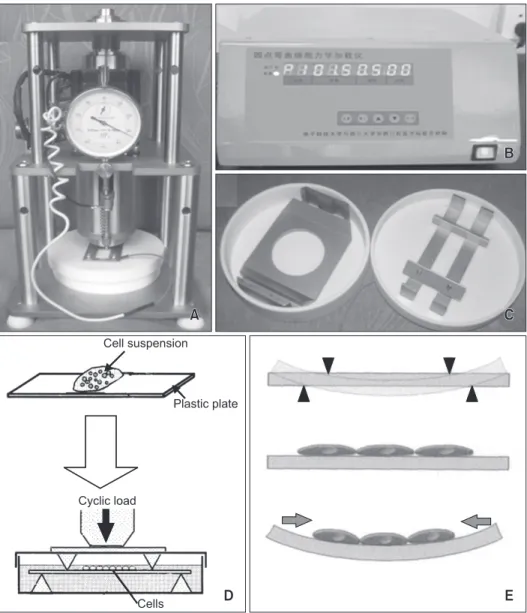
The force-loading plates were subjected to cyclic uniaxial compressive strain by the four-point bending system
20at 0.5 Hz (Figure 2). Cells were loaded with compressive force at 2000 με (με is defined as deformation, with 1,000 με corresponding to 0.1%
deformation) for 1, 2, and 4 hours, respectively. Control cells were cultured on similar plates without any mechanical loading and kept in the same incubator.
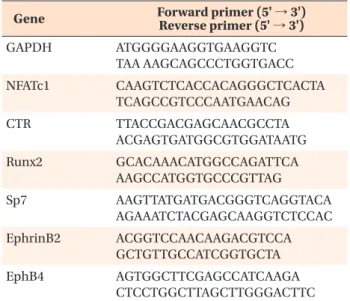
Quantitative real-time polymerase chain reaction (qPCR) Cells were harvested after 1, 2, and 4 hours of the application of compressive force. Total RNA was extracted using an EASYspin RNA extraction reagent kit (Biomed, Beijing, China) from cells cultured on the plates according to the manufacturer’s instructions.
RNA was reverse-transcribed using the PrimerScript
®RT reagent kit (Takara, Dalian, China) with gDNA eraser
to synthesize cDNA. qPCR (n = 3) was performed using
SYBR Green Premix Ex Taq (Takara) and the MxPro
Mx3005P real-time PCR detection system (Agilent
Technologies, Santa Clara, CA, USA). Glyceraldehyde
3-phosphate dehydrogenase (GAPDH) was used as
a normalization control. The primers used for qPCR
were shown in Table 1. The cycling conditions were as
Figure 1. A rat model of orthodontic tooth movement can provide compressive force on alveolar bone. A nickel-titanium
closed-coil spring exerting an orthodontic force was ligated unilaterally to the maxillary first molar and incisor. The
maxillary first molar on the other side was without movement and was used as the control group. A, Lateral and occlusal
view of the rat maxillae with appliance. B, The principle of orthodontic tooth movement: when the tooth was subjected
to mechanical loading, some compression areas occurred on the alveolar bone surface around the tooth.
follows: 95
oC for 30 seconds followed by 40 cycles of 95
oC for 5 seconds, 55
oC for 30 seconds, and 72
oC for 1 minute. The 2
-ΔΔCtmethod was used for calculating the relative expression levels, and values were the average of triplicate measurements.
Statistical analysis
All experiments were performed on at least three individuals. Results are presented as the mean ± standard deviation (SD). The significance of the differences was determined using the two-tailed Student’s t-test and one-way analysis of variance (ANOVA). The difference was considered significant if p < 0.05. The IBM SPSS
ver. 19.0 for Windows (IBM Co., Armonk, NY, USA) was used for statistical analysis.
RESULTS
Histological changes and ephrinB2 expression in the compression areas of periodontal tissues in experimental rats
Histological examination showed a gap between the first and second molar indicating that the loaded maxillary first molar was moved mesially. In the compression area, the surface of alveolar bone was rough and there were resorption lacunae on the bone
Cell suspension
Plastic plate
A A
B B
C C
D E
Cyclic load
Cells
Figure 2. A four-point bending system can provide cyclic uniaxial compressive force on adherent cells in vitro. A,
Actuator. B, Digital-control part. C, Culture dish with pressure head. D, Schematic representation of the apparatus used
for application of mechanical force to cell cultures. The cell suspension was plated on a plastic plate, then, after 2 hours
of cultivation, cells were subjected to cyclic compressive force in culture medium. E, The principle of the four-point
bending system used for compressive force application (conceptual diagram).
surface (Figure 3). Multinucleated osteoclasts were seen adjacent to the alveolar bone surface. No osteoblasts were observed in the compression area.
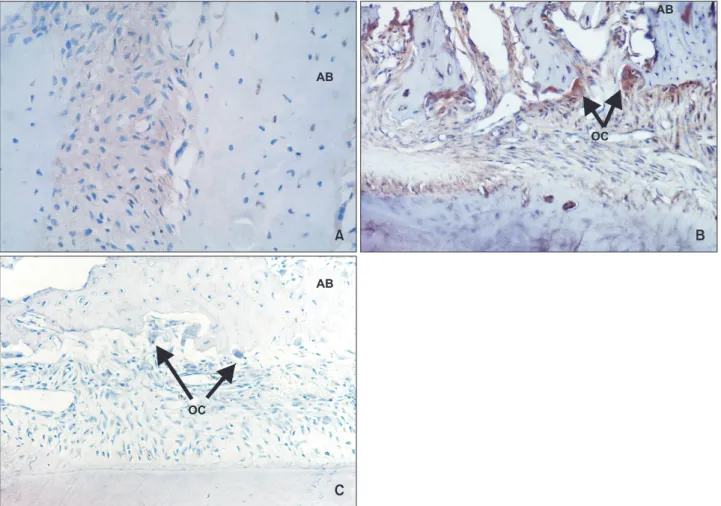
Since no osteoblasts were found in the compression area, only ephrinB2 was examined by immuno- histochemistry. EphrinB2 immunoreactivity was observed in fibroblasts in periodontal tissues from both the control and experimental groups (Figure 4A and 4B).
In periodontal tissues of the control group without tooth movement, ephrinB2 was weakly and uniformly expressed in periodontal fibroblasts (Figure 4A). In periodontal tissues of the experimental group, ephrinB2 was strongly expressed in osteoclasts adjacent to alveolar bone in the compression area (Figure 4B). Negative controls showed no immunolabeling (Figure 4C). As shown in Table 2, the difference in ephrinB2 expression levels in periodontal tissues between the experimental and control groups was statistically significant (p < 0.05).
Osteoclastogenic gene expression in compressed RAW264.7 cells
In order to investigate whether compressive force could directly stimulate osteoclast differentiation, we applied cyclic uniaxial compressive force produced by a four- point bending system to RAW264.7 cells. Following this, gene expression was assessed for two well-known markers of differentiated osteoclasts, nuclear factor of activated T cells cytoplasmic 1 (NFATc1)
21-23and calcitonin receptor (CTR).
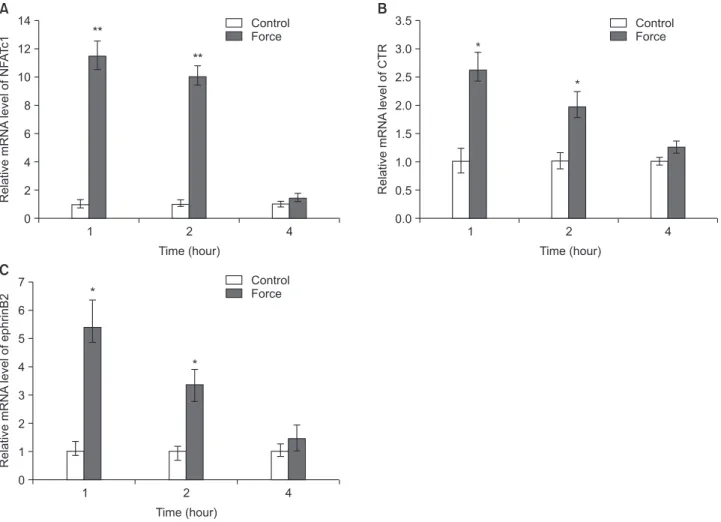
24As shown in Figure 5A
and 5B, the levels of NFATc1 and CTR mRNA were significantly upregulated in RAW264.7 cells after 1 hour and 2 hours of the application of compressive force (p
< 0.05). Our data indicate that cyclic compressive force can promote the differentiation of osteoclasts.
EphrinB2 mRNA expression in RAW264.7 cells in response to compressive force
To understand the relationship between compressive force and ephrinB2 expression in osteoclasts, we evaluated the expression of ephrinB2 in RAW264.7 cells.
As shown in Figure 5C, there was a significant increase in the expression of the ephrinB2 gene after 1 hour and 2 hours in compressed RAW264.7 cells (p < 0.05).
Osteogenic gene expression in compressed ST2 cells To investigate the response of osteoblasts to compressive force, we performed an in vitro experiment using ST2 cells. The expression of the transcription factors Runx2 and Sp7 was assessed in these cells after the application of compressive force. Runx2 plays a key role in mediating osteoblast maturation and is necessary for normal osteogenesis,
25,26while Sp7 is believed to be downstream of Runx2 and may promote osteoblast maturation.
27,28As shown in Figure 6A and 6B, the mRNA levels of Runx2 and Sp7 were significantly decreased in ST2 cells after the application of compressive force (p < 0.05). These findings suggest that compressive force can inhibit osteoblast differentiation.
Figure 3. Histological examination of the compression areas of periodontal tissues from the experimental group.
Multinucleated osteoclasts were seen adjacent to the alveolar bone surface, with no osteoblasts observed.
Hematoxylin and eosin stain, 200× magnification.
AB, Alveolar bone; R, root of molar; OC, osteoclast.
Table 1. The primers used for qPCR of various genes Gene Forward primer (5' → 3')
Reverse primer (5' → 3')
GAPDH ATGGGGAAGGTGAAGGTC
TAA AAGCAGCCCTGGTGACC
NFATc1 CAAGTCTCACCACAGGGCTCACTA
TCAGCCGTCCCAATGAACAG
CTR TTACCGACGAGCAACGCCTA
ACGAGTGATGGCGTGGATAATG
Runx2 GCACAAACATGGCCAGATTCA
AAGCCATGGTGCCCGTTAG
Sp7 AAGTTATGATGACGGGTCAGGTACA
AGAAATCTACGAGCAAGGTCTCCAC EphrinB2 ACGGTCCAACAAGACGTCCA
GCTGTTGCCATCGGTGCTA
EphB4 AGTGGCTTCGAGCCATCAAGA
CTCCTGGCTTAGCTTGGGACTTC GAPDH, glyceraldehyde 3-phosphate dehydrogenase;
NFATc1, nuclear factor of activated T cells cytoplasmic 1;
CTR, calcitonin receptor; Runx2, runt-related transcription
factor 2; SP7, specificity protein 7; G, guanine; C, cytosine; A,
adenine; T, thymine.
EphB4 and ephrinB2 mRNA expression in ST2 cells in response to compressive force
It has been reported that both EphB4 and ephrinB2 are found in osteoblasts. To understand whether EphB4 and ephrinB2 expression in osteoblasts is affected by compressive force, we evaluated the expression of these molecules in ST2 cells. As shown in Figure 6C and 6D, there was a significant decrease in the expression of the
EphB4 gene in ST2 cells after 1 hour and 2 hours of exposure to compressive force (p < 0.05). A significant decrease in the expression of ephrinB2 was also detected after 4 hours of compressive force (p < 0.05).
DISCUSSION
The findings of this study, which show the response of tissues in compression areas during orthodontic tooth movement, agree with many previous histological studies.
29,30We determined that multinucleated osteoclasts adhered to resorption lacunae along the alveolar bone surface, and no osteoblasts were observed.
EphrinB2 was examined by immunohistochemistry;
however, since no osteoblasts were found in the compression area, EphB4 expression was not assessed.
We observed strong expression of ephrinB2 in osteoclasts, suggesting that this ligand may be involved Figure 4. Immunohistochemical analysis of ephrinB2 expression in periodontal tissues. A, Photomicrograph showing weak anti-ephrinB2 antibody immunolabeling of fibroblasts in periodontal tissues from the control group (without tooth movement). B, Photomicrograph showing strong anti-ephrinB2 antibody immunolabeling of osteoclasts in the compression area of periodontal tissues from the experimental group. C, Negative controls show no immunolabeling of osteoclasts. All images are at 200× magnification.
AB, Alveolar bone; OC, osteoclast.
A B
C
AB
OC
AB
OC
AB