• 검색 결과가 없습니다.

Analysis of the Traditional Setting-up as an Application for Spatial Composition

N/A
N/A
Protected

Academic year: 2021

Share "Analysis of the Traditional Setting-up as an Application for Spatial Composition"

Copied!
13
0
0

로드 중.... (전체 텍스트 보기)

전체 글

(1)

Analysis of the Traditional Setting-up as an Application for Spatial Composition

1

Sun Nam-Goong

2

, Yuri Lee

2

ABSTRACT

Recently, there is a new issue, among the contemporary people, for new life style, such as green design and well being. This trend brought up the necessity that there should be alternatives for interior spatial design. In order to catch up with these new issues, the new convenient and environment friendly methods are in need.

Space composition using setting-up is skill that can express both the structural aspect and esthetic because it represents traditional beauty into the contemporary age through the structural rigidity and formal beauty.

Also the lumber, as main materials for setting up, is in line with well being life style and environment friendliness. The construction of structure by setting-up has advantages in terms of the reuse and the convenience in that the construction of structure is adjustable according to environment.

And setting-up has enough plasticity not only because of its own role as linking the objects but also because of being framed by itself. Therefore setting-up will be a design element, if it is expressed outward. Thus, this study aims to give a guide line about how to apply the result from the evaluating that "what is the most suitable setting-up" and "what is the most suitable detail setting-up", based on that structural rigidity, decorativeness and the ease of works.

As a result of evaluation, the most excellent types of setting-up in terms of structural rigidity are

"Jangbu" and "Panjae" and "Yeongui". The most excellent types of setting-up in terms of decorativeness are "Panjae" and "Yeongui", and the most excellent type of the ease of work is

"Mat". And also the most applicable detail setting-up for the utilization of spatial composition is proposed.

Key words: spatial composition application, structure, structural rigidity, decorativeness, the ease of workmanship.

1. INTRODUCTION

Recently, there is a new issue, among the contemporary people, for new life style, such as green design and well being. This trend brought up the necessity that there should be alternatives for interior spatial design. As a result, the development of new materials, recycle of wasted material and

Received for publication: Jan 11, 2010 ; Reviewed: Feb 23, 2010 ; Accepted: May 15, 2010 1) This paper was supported by research project of Culture Research Center (CRC) in 2009-2010.

2) Department of Design Manufacturing, Chonbuk National University, Millennium Jeonju Specialty Business Organization

† Corresponding author: Sun Nam-Goong(E-mail: [email protected])

(2)

217

the, development of green design for the purpose of the reservation of environment and the resource are settling down in global perspective.

In an effort to catch up this trend, the furniture industry also launch the new concept furniture such as, knockdown furniture, the unit furniture, the partial knockdown furniture, the union furniture and DIY furniture, fixture furniture. In order to cope with this new issue, the spatial composition also has to find the environment friendliness, the convenience.

This study is to propose the possibility of setting-up application for the spatial composition. In order to stretch the meaning of traditional setting-up not into furniture but also of into elements that compose space, setting-ups is classified that can be applied to modern spatial composition and ,as a result of that, this study aims to establish an application system for the purpose of using them structurally and decoratively. The spatial composition using setting-up is a skill that can express both the structural aspect and artistic aspect by expressing traditional beauty into today based on its structural rigidity and formal beauty. Also the lumber, as main materials for setting-up, is in line with well-being life style. The construction of structure by setting-up has advantage in terms of its being environment friendly and the reuse and the convenience in that the construction of structure is adjustable according to environment.

Of course, hardware, as an assistance of frame, can be substitute for hidden nails. Even though the development of technology and tools can enhance the expediency, that can not imitate the unique decorativeness and rigidity that only traditional setting-up can possess. And setting-up has enough plasticity not only because of its own role as linking the objects but also because of being framed by itself. This makes setting up be used as a element in designing if it is expressed outward.(Shin, 2004)

Before studying the applicability of setting-up for utilization of spatial composition, the concept of space and the elements composing the space based on theoretical background should be looked into.

After that, setting-up in terms of applicability of spatial composition will be looked into by examining knock-down furniture and knock-down space structure where setting-up is used.

The scope of this study is focused on analyzing the types of setting-up that can enhance the expression when applied to spatial composition not on the furniture. For the empirical analysis, the specialist developed items that are based on 3 basics of application of setting-ups i.e. "structural rigidity", "decorativeness", "ease of work". These items will be evaluated in terms of both the setting-up and detail setting-up and through the comparison between setting-up types, the most suitable setting-up and the most suitable detail setting-up and the applicability to the utilization of spatial composition will be proposed.

2. THEORETICAL BACKGROUND 2-1 Concept of space

The concept of space is a present image of environment of a space, being a concrete place of daily life, livelihoods. Namely, it is the space that provides pleasant and physical space for the human's mobility, living and activities and also is adjustable, modified, or fixed according to information. (Chang, 2008)

Basic integral part of spatial composition can be possibly divided into "vertical element" and

"horizontal elements". Vertical elements are pillar, walls, stairways as mobile elements, horizontal

elements are floor, ceiling. This is the basic elements forming actual space.

(3)

2-1-1 vertical elements

The role of the wall is to limit the internal space freely and express the external facade according to developed technology and change of the recognition while as the role of the wall in the past was interpreted as confined space surround by bearing walls. The expression used in the past on the bearing walls is becoming more aggressive or expand its expression territory. Accordingly, walls become an architectural element that can change the image of the space and design element that can create diverse spatial image especially in modern times when there is the need for expression of diverse elements including human emotions. Pillar is intermittent wall and important element that can decide the aesthetic impression by showing the relations between the support object and supported object which express law of gravity. Pillar can act a role of solitarily transformed wall, instead of being just relations with walls. In case of round walls, the forms concentrate, while in case of angular walls, horizontal directions are instructed.

2-1-2 horizontal elements

The floor is excellent in terms of human tactile impression but not so excellent in terms of visual impression. Therefore, how to effectively express the tactile element impression and disadvantageous visual element will become very important.

Ceiling is also to define, like a horizontal element composing a space together with wall, the inner space between the floor and the ceiling. The ceiling is a place whether the visual flow stay at last and therefore, play critical role as an important visual structural element affecting sensibility of human.

2-1-3 mobile elements

The stairway has close relationships with space composing elements such as pillar, ceiling and walls. If stairways are linked with to other structural components, it will soon have the characteristics of closure. Consequently, there will be less movement and less visual experiences.

On the contrary, if stairways are detached from structural components, it will induce the movement and enrich the visual experience. Thus, the important aspect, as for the architecture of stairways, is the quality and the quantity of spaces that are linked by stairways. (Jin, 2008)

2-2 Setting up in space

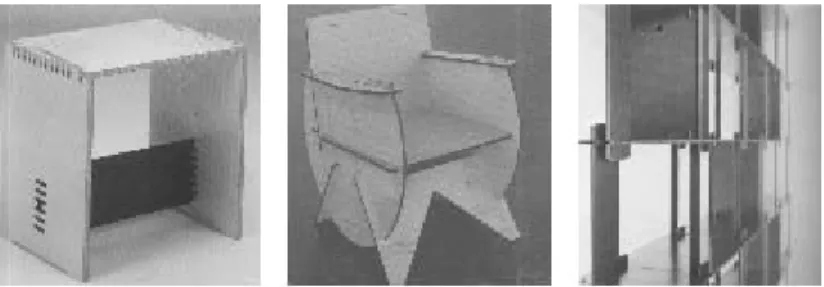
2-2-1 knock-down furniture with application of setting-up.

Knock-down furniture is the most representative form of the furniture in terms of environment friendliness, efficiency for space composition, and also mobility. It was designed for the purpose of ease in assembling and disassembling. It is differentiated from the prefabricated furniture in aspect that the knock down furniture can be disassembled with simple tools or even with bare hands, and minimize the use of hardware or prevent using hardware and adhesives and apply setting up.

Fig 1. Knock-down furniture (INTERNI)

(4)

219

Characteristics of knock-down furniture for spatial composition

1) In case of multipurpose space that has small living space and needs of frequent removal of furniture inside, knock down furniture can enhance the applicability of space.

2) Assembling with arbitrary selection of parts in size, color, shape will enable people to cope with the change of living environment caused by its assembling. If necessary, the user can design for themselves according to their needs.

3) Being complete disintegration possible, the storing takes less space compared to the other furniture and the space utilization is very efficient.

The manufacturing technique of knock-down wood furniture is an application of setting-up. The setting-ups, which is applicable to knock-down wood furniture, are Bantuk, Jangbu, Sipjabantuk.

When applying setting up, the adhesive is not in use, therefore the furniture can be easily disassembled. Instead, for the purpose the enforcement, various types of joint parts are used such as wedge, arrowheads, and nibs. (Lee, 2004)

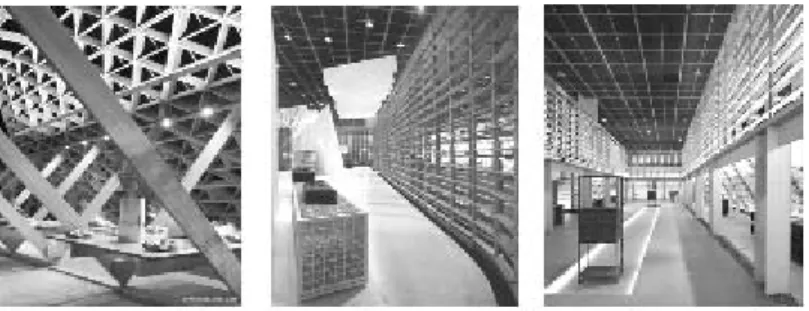
2-2-2 The spatial structure which applies setting up

Setting up is used in various ways, from architecture to furniture. Various types setting-up has been applied to Korean traditional house, because the rigidity that can support the whole structure without using any specific hardware. Accordingly it is possible to make spatial structure by using these setting-up structures.

Fig 2. A Case fo the spatial structure which applies setting up (The work of Kim, Paik-Sun) Features of pre-hab system wooden structures

1) Structural stability

This is a setting-up of coupling parts without using nails and this setting-up very resistant against external force such as external impact.

2) It is an aesthetic exterior

3) It is economical in aspect of construction. Additional and excessive parts are not necessary and field work time is also reduced.

4) It is possible to construct small-sized building oneself. (Lumber research technical development center, 2008)

3. ACTUAL PROOF RESEARCH

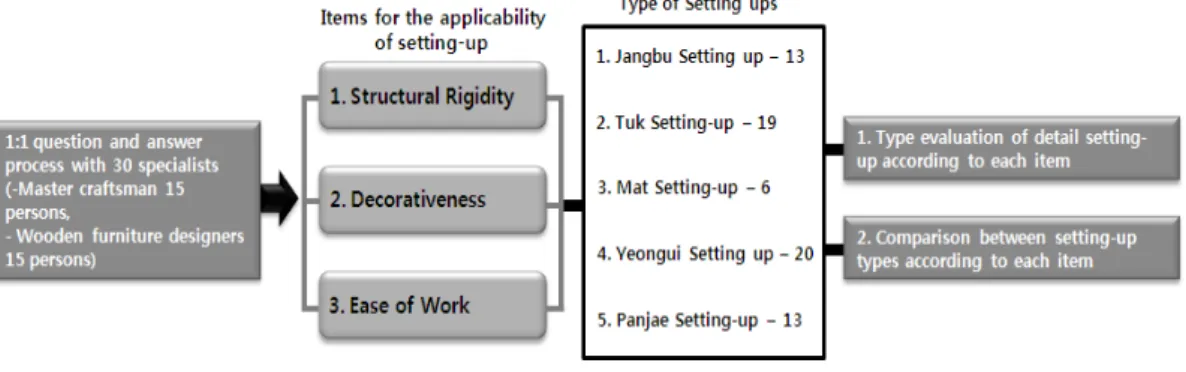
This study analyzes the setting-up whose structure seems to have high applicability in spatial

structure. First, 3 items, ie structural rigidity, decorativeness and ease of work, which are important

for the applicability of setting-up have been developed through 1:1 question and answer process

with 30 specialists including master craftsman, wooden furniture designers. These developed items

have been again analyzed and evaluated by questioning 30 specialists in 5 numerical rating scale in

(5)

aspect of 71 detail setting-ups from Jangbu setting up, Tuk setting-up, Mat setting-up, Yeongui setting up, Panjae setting-up that are well organized by precedential study (Millennium Jeonju Specialty Business Organization , 2009).

3-1 Type evaluation of detail setting-up according to each item

First, by specialists in regard to the application of spatial composition i.e, 1. Structural rigidity 2 Decorativeness 3 Ease of work , only the detail setting-up of each setting-up which scores marks above average in above 3 types are significant, the followings are proposed.

Fig 3. Research Framework 3-1-1 Jangbu setting-up

In case of Jangbu setting-up, average score for the item "structural rigidity" is 3.82.

Makjangbuchok, Makisanjijangbu, Bangdusanji, Bulimssoigijanbu, Sanjangbumat, scoring higher marks than average are classified as setting-up with structural rigidity.

As for decorative setting-up, Bangdusanjijangbu and Sangjangbumat are the most applicable and as for the ease of work, Sumeonjangbu, Makjangbuchok, Oichokjangbu(in the order of it's applicability) are most applicable.

Table 1 . Average score for each item of detail Jangbu Setting ups

name structural rigidity decorativeness ease of work

Jangbu

Sumeonjangbu 3.60 1.53 4.37

Makjangbuchok 4.23 2.37 4.13

Makisanjijangbu 4.73 3.60 2.73

Bangdusanji 4.60 3.93 2.70

Deriljangbu 3.37 2.20 2.93

Bulimssoigijanbu 4.37 3.43 2.83

Jiokjangbu 3.70 1.90 2.63

Oichokjangbu 2.40 2.70 3.83

Jumokjangbu 3.60 3.60 2.63

Ginjumukjang 3.70 2.17 2.93

Nerimtukyeulljang 3.33 2.53 2.03

Jangbunechokyeongui 3.87 2.27 2.20

Sanjangbumat 4.10 3.97 2.47

Average 3.82 2.78 2.95

(6)

221

3-1-2 Tuk setting-up

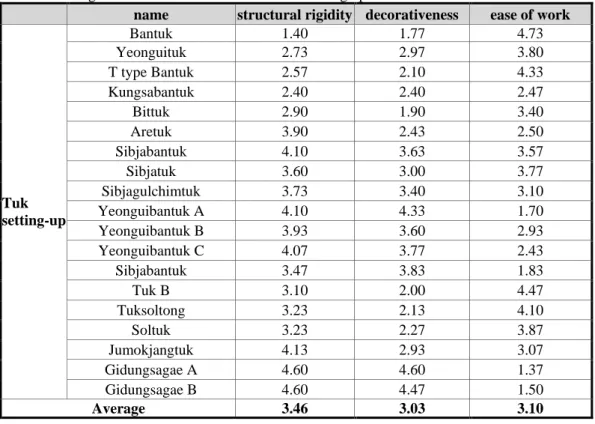
In case of Tuk setting-up, in aspect of “the structural rigidity”, Gidungsagae, Jumokjantuk, Sibjabantuk, Yeonguibantuk score higher marks than the average mark of 3.46 and classified as being structural rigid. And Gidungsagae, Yeonguibantuk is the most decorative setting-up. In aspect of the ease of work, Bantuk, Tuk, "T" type Bantuk(in the order of its applicability) are applicable. In case of Tuk setting-up, in aspect of structural rigidity and decorativeness, the setting-ups have similar result but for the ease of work, they score lower marks.

Table 2 . Average score for each item of detail Tuk Setting ups

name structural rigidity decorativeness ease of work

Tuk setting-up

Bantuk 1.40 1.77 4.73

Yeonguituk 2.73 2.97 3.80

T type Bantuk 2.57 2.10 4.33

Kungsabantuk 2.40 2.40 2.47

Bittuk 2.90 1.90 3.40

Aretuk 3.90 2.43 2.50

Sibjabantuk 4.10 3.63 3.57

Sibjatuk 3.60 3.00 3.77

Sibjagulchimtuk 3.73 3.40 3.10

Yeonguibantuk A 4.10 4.33 1.70

Yeonguibantuk B 3.93 3.60 2.93

Yeonguibantuk C 4.07 3.77 2.43

Sibjabantuk 3.47 3.83 1.83

Tuk B 3.10 2.00 4.47

Tuksoltong 3.23 2.13 4.10

Soltuk 3.23 2.27 3.87

Jumokjangtuk 4.13 2.93 3.07

Gidungsagae A 4.60 4.60 1.37

Gidungsagae B 4.60 4.47 1.50

Average 3.46 3.03 3.10

3-1-3 Mat setting-up

If case of Mat setting-up, it is easy for work but as for structural rigidity and decorativeness, it scores mostly lower marks below 3.0. Even though it scores average 1.61, 2.01 respectively but in 5 numerical rating scale, the marks are lower that the average 3.0. Therefore in these two items ie.

structural rigidity and decorativeness, Mat setting-up is not applicable.

Table 3 . Average score for each item of detail Mat Setting ups

name structural rigidity decorativeness ease of work Mat

setting-up

Mat A 2.41 2.90 4.60

Mat B 1.13 1.27 4.87

Huritdem 1.13 1.27 4.87

Matyeongui 1.13 2.17 4.20

(7)

Anyeongui 1.93 2.17 3.53

Bakyeongui 1.93 2.30 3.40

Average 1.62 2.01 4.24

3-1-4 Yeongui setting-up

In case of Yeongui setting-up, it scores higher marks in terms of structural rigidity and decorativeness. Jeabichokjangbu and Sambangyeonguijangbu A&C are evaluated as of being rigid and decorative. But in case of Yeongui setting-up it scores lower marks in spaect of ease of work as the level of difficulty in works is high.

Table 4. Average score for each item of detail Yeongui Setting ups

name structural rigidity decorativeness ease of work

Yeongui setting-up

Snajiyeongui 3.00 3.57 3.47

Necholbulimssoigiyeongui 4.20 4.03 2.60

Sumeonjangbuyeongui 3.20 3.03 3.00

Makjangbuyeongui 3.67 3.40 3.13

Oichokjangbuyeongui 3.87 3.27 3.40

Ssanjangbuyeongui 4.33 4.00 2.20

Gesimyeongui 4.23 3.90 2.73

Yeonguijangbu A 4.60 3.53 2.23

Yeonguijangbu B 4.37 3.80 2.50

Yeonguijangbu C 4.47 3.90 2.13

Yeonguijangbu D 4.37 3.93 2.23

Yeonguijumokjang 4.60 4.00 2.10

Banyeonguisumeon 3.97 4.00 2.73

Jeabichokjangbu 4.37 4.50 2.43

Yeonguisimoktuk 4.10 4.73 2.30

Sambangyeonguijangbu A 4.33 4.47 1.60

Sambangyeonguijangbu B 3.83 3.70 1.60

Sambangyeonguijangbu C 4.20 4.23 1.60

Sambangyeonguijangbu D 3.70 3.70 1.60

Sambangyeonguijangbu E 3.40 3.97 1.20

Average 4.04 3.88 2.34

3-1-5 Panjae setting-up

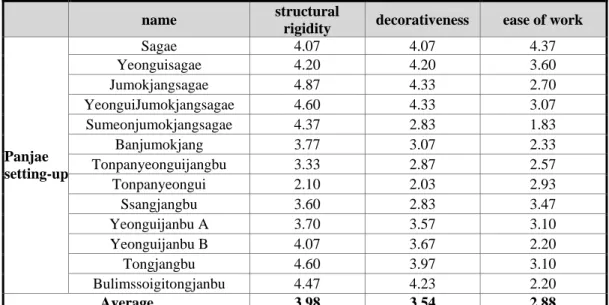
In case of Panjae setting-up, as for the structural rigidity, 8 structures out of 13 Panjae have been classified as being the rigid setting-up. And among these, Jumokjangsagae and Tongjangbu are the most rigid setting-ups. In aspect of the decorativeness,Jumokjangsagae/ YeonguiJumokjangsagae/

Bulimssoigitongjangbu/ Yeonguisagae (in the order of its applicability) are the most decorative setting-ups.

And Sagae is rated highest in terms of the ease of work that is most commonly used for the works

on the edge.

(8)

223

Table 5 . Average score for each item of detail Panjae Setting ups

name structural

rigidity decorativeness ease of work

Panjae setting-up

Sagae 4.07 4.07 4.37

Yeonguisagae 4.20 4.20 3.60

Jumokjangsagae 4.87 4.33 2.70

YeonguiJumokjangsagae 4.60 4.33 3.07

Sumeonjumokjangsagae 4.37 2.83 1.83

Banjumokjang 3.77 3.07 2.33

Tonpanyeonguijangbu 3.33 2.87 2.57

Tonpanyeongui 2.10 2.03 2.93

Ssangjangbu 3.60 2.83 3.47

Yeonguijanbu A 3.70 3.57 3.10

Yeonguijanbu B 4.07 3.67 2.20

Tongjangbu 4.60 3.97 3.10

Bulimssoigitongjanbu 4.47 4.23 2.20

Average 3.98 3.54 2.88

3-2 Comparison between setting-up types according to each item

This study verifies, through One-Way ANOVA analysis, whether there is any difference in terms of setting-up type in accordance with items, such as structural rigidity, decorativeness and the ease of work. In ANOVA analysis, statistics is be used to verify whether there will be any difference between the averages of each setting-up type. In Scheffe ex post analysis, the difference between setting-up types will be verified.

3-2-1 Comparison between setting-up types in accordance with structural rigidity Table 6 . Comparison between setting-up types according to "structural rigidity" item

(N=30)

Groups Mean Std. deviation Std. Error F Sig.

1. Jangbu 3.8154 .43119 .07872

170.531 .000

2. Tuk 3.4632 .38711 .07068

3. Mat 1.6222 .34166 .06238

4. Yeongui 4.0400 .56361 .10290

5. Panjae 3.9795 .35678 .06514

Total 3.3841 .99819 .08150

As a result of verification of difference between the average of each group of setting-ups in

accordance with structural rigidity, the average of 5 groups of setting-up appear as being

statistically significant under condition that the level of significance is less than 1%.

(9)

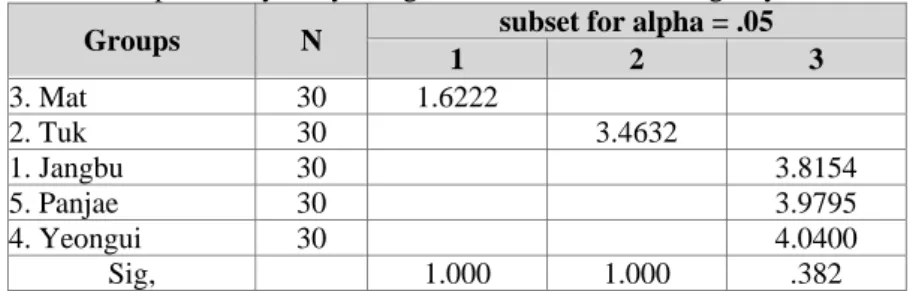
Table 7. Ex post analysis by using Scheffe of “structural rigidity”

Groups N subset for alpha = .05

1 2 3

3. Mat 30 1.6222

2. Tuk 30 3.4632

1. Jangbu 30 3.8154

5. Panjae 30 3.9795

4. Yeongui 30 4.0400

Sig, 1.000 1.000 .382

As a result of ex post analysis by using Scheffe price, each 3 groups has identical tendency in accordance with structural rigidity. The first group is Mat setting-up, second group is Tuk setting-up, the third group is Jangbu, Panjae, Yeongui setting-up. These three groups have identical tendency and there is difference between groups.. And among these 3 groups, Jangbu, Panjae, Yeongui setting-up are the most excellent in aspect of its structural rigidity.

3-2-2 Comparison between setting-up types in accordance with decorativeness Table 8. Comparison between setting-up types according to "decorativeness" item

(N=30)

Groups Mean Std. deviation Std. Error F Sig.

1. Jangbu 2.7846 .59220 .10812

64.663 .000

2. Tuk 3.0281 .32022 .05846

3. Mat 2.0111 .60002 .10955

4. Yeongui 3.8833 .45738 .08351

5. Panjae 3.5385 .43090 .07867

Total 3.0491 .80906 .06606

As a result of verification of differences between the average of each group of setting-ups in accordance with decorativeness, the average of 5 groups of setting-up appear as being statistically significant under condition that the level of significance is less than 1%.

Table 9. Ex post analysis by using Scheffe of “decorativeness”

Groups N subset for alpha = .05

1 2 3

3. Mat 30 2.0111

1. Jangbu 30 2.7846

2. Tuk 30 3.0281

5. Panjae 30 3.5385

4. Yeongui 30 3.8833

Sig, 1.000 .454 .123

As a result of ex post analysis by using Scheffe price, each 3 group has identical tendency in

accordance with decorativeness. The first group is Mat setting-up, second group is Jangbu and Tuk

and the third group is Panjae, Yeongui setting-up. These three groups have identical tendency and

there is difference between groups. And among these 3 groups, Panjae setting-up and Yeongui

setting-up are the most excellent in aspect of its decorativeness.

(10)

225

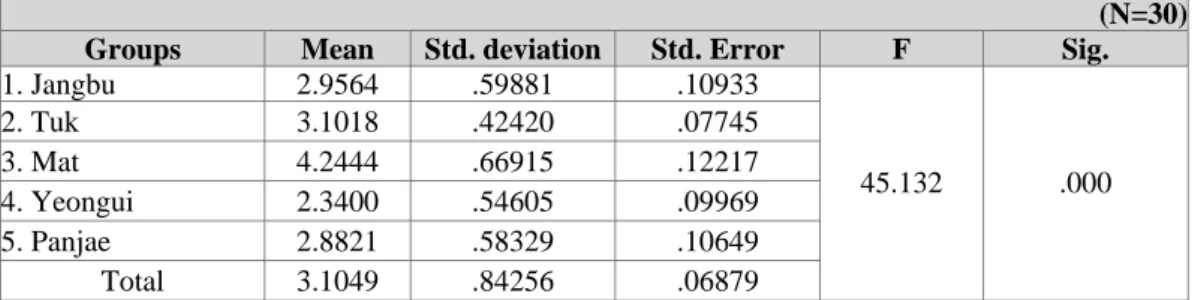
3-2-3 Comparison between setting-up types in accordance with the ease of work Table 10. Comparison between setting-up types according to "Ease of Work" item

(N=30)

Groups Mean Std. deviation Std. Error F Sig.

1. Jangbu 2.9564 .59881 .10933

45.132 .000

2. Tuk 3.1018 .42420 .07745

3. Mat 4.2444 .66915 .12217

4. Yeongui 2.3400 .54605 .09969

5. Panjae 2.8821 .58329 .10649

Total 3.1049 .84256 .06879

As a result of verification of the differences between the average of each group of setting-ups in accordance with the ease of work, the average of 5 groups of setting-up appear as being statistically significant under condition that the level of significance is less than 1%.

Table 11. Ex post analysis by using Scheffe of “Ease of Work”

Groups N subset for alpha = .05

1 2 3

4. Yeongui 30 2.3400

5. Panjae 30 2.8821

1. Jangbu 30 2.9564

2. Tuk 30 3.1018

3. Mat 30 4.2444

Sig, 1.000 .694 1.000

As a result of ex post analysis by using Scheffe price, each 3 group has identical tendency in accordance with the ease of work. The first group is Yeongui setting-up, second group is Panjae, Jangbu and Tuk and the third group is Mat setting-up.

These three groups have identical tendency and there is difference between groups. And among these 3 groups, Mat setting-up is the most excellent in aspect of it's the ease of work.

3-3 The result of analysis of setting-up types

Followings are types of setting-ups which have been developed from the analysis in accordance with the structural rigidity, decorativeness and the ease of work. 6 Jangbu, 8 Tuk and 9 Yeongui and 6 Panjae has been developed, when these three items are analyzed in terms of its applicabilities for the spatial composition in line with the score frequency. As a result of analysis, Mat is not suitable for utilization of the spatial composition because of its characteristics in aspects of structural rigidity, decorativeness.

3-3-1 Jangbu setting-up and Tuk setting-up

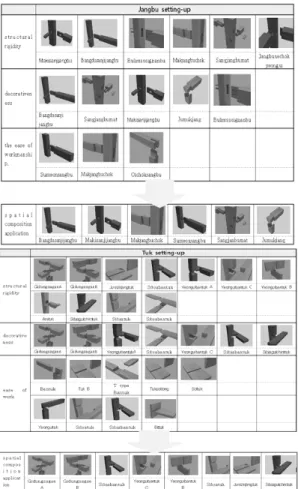
According to analytical result, Jangbu is applicable setting-up for the utilization of spatial

composition. Bangdusanjijangbu, Makisanjijangbu, Makjangbuchok, Sumeounjangbu,

Sanjangbumat, Jumokjang are developed. And Tuk setting-up is also known as being applicable to

Gidungsagae works despite of its difficulties, due to structural rigidity and decorativeness, and

Bantuk types are evaluated as being applicable to the utilization of spatial composition.

(11)

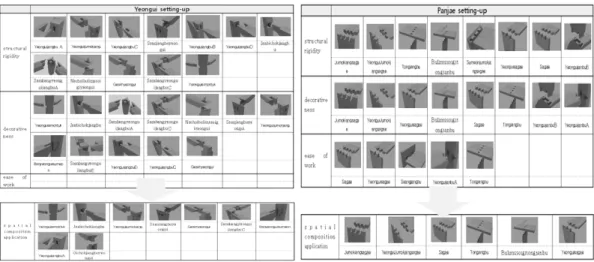
Fig 4. Applicable setting-ups for the utilization of spatial composition to Janbu Setting-up and Tuk Setting-up (Left: Jangbu Setting-up/ Right: Tuk Setting-up), (Millennium Jeonju

Specialty Business Organization) 3-3-2 Yeongui setting-up and Panjae setting-up.

As Yeongui setting-up is difficult setting up in terms of the level of works, there is no such a easy structure. However, in terms of structural rigidity and decorativeness, many types of setting-up have been developed. Accordingly, the applicable setting-up to the utilization of the spatial composition is the setting-up among Yeongui which can be seen externally for the decorative effect.

In case of Panjae setting-up, Jumokjangsagae, Tongjangbu are the most applicable to the utilization

of spatial composition.

(12)

227

Fig 5. Applicable setting-ups for the utilization of spatial composition to Yeongui Setting-up and Panjae Setting-up (Left: Yeongui Setting-up/ Right: Panjae Setting-up), (Millennium

Jeonju Specialty Business Organization) 4. CONCLUSION

It is true that the reality of modern space is viewed at the formal perspective from visual recognition rather than spatial essence, however the space should be realistic and functional for humans. If the forms, methods used in the past are expressed through our traditional setting-up techniques, the space can be experienced not only visually but also through tactile sense, movement, sound and other senses. And if the versatile structures of setting-up are applied to spatial composition, the structure of setting-up itself will have the effect of design decoration, and its environment friendly element of using lumber in line with new life style will become an advantage.

Therefore, this study aims to give a guide line to the application of the spatial composition, resulted from the evaluation that "what is the most suitable setting-up" and what is the most suitable detail setting-up, based on that structural rigidity, decorativeness and the ease of works which are most important aspects in utilization of spatial composition.

The most excellent types of setting-up in terms of structural rigidity are "Jangbu", "Panjae" and

"Yeongui". The most excellent types of setting-up in terms of decorativeness are "Panjae" and

"Yeongui" and the most excellent type of the ease of work is “Mat". And also the most applicable detail setting-up for the utilization of spatial composition has been proposed in this study. It is also meaningful that this study analyzes the setting-up in order that traditional setting-up can be applied to utilization of modern space, not the furniture nor the traditional housings. There is an expectation for the future study in a hope that it will propose Korean life style which can re-translate traditional space into today.

5. REFERENCES

[1]Jin Kyoung Mi. 2008, Study on reciprocal characteristics between furniture and interior space Kukmin University Master's Thesis : 7-15

[2]Lee Jung Su. 2004, Study on Knock-down furniture design, Hongik University , master's Thesis :

6-20

(13)

[3]Shin Young Sik. 2004, Study on decorative effect of thorn type setting-up in Korean traditional furniture, ournal from Korea Furniture Society(Vol 15, 3)

[4]Chang young Sun. 2008, The effects of flower design display on spatial environment Jeonbuk University, Master's Thesis:14

[5]Millennium Jeonju Specialty Business Organization. 2009, Study of intellectual property of traditional skills of millennium Jeonju, Ministry of Culture, Sports & Tourism, Korea Creative Contents Agency:25-34

[6]INTERNI. 1998, DICEMBER, 486:148 - 153

[7]Wood research & Developement Center. 2008, http://woodrnd.com/1731

수치

Fig 1. Knock-down furniture (INTERNI)
Fig 2. A Case fo the spatial structure which applies setting up (The work of Kim, Paik-Sun)  Features of pre-hab system wooden structures
Fig 3. Research Framework  3-1-1    Jangbu setting-up
Table 2 . Average score for each item of detail Tuk Setting ups
+7

참조

관련 문서

Zao Wou-Ki generated the best H1 result for the entire Asian continent in Hong Kong; 53% of Zhang Daqian’s turnover was hammered there, and lots of new

The Volume structure of the STA308A consists of individual volume registers for each channel and a master volume register that provides an offset to each channels volume

The changes in life style and working environment such as double-income family and 5-day work week have brought about generalization of dining out. For this,

The aims of this study are to evaluate the endoscopic modality for assessment of severity of ulcerative colitis during follow up and to know whether there

Not only to build up a theoretical foundation for how to make the best use of the start-up mentoring education as in the start-up educational programs

In the United States, for example, the image that spoke for the New Woman found expression in the Gibson Girl style , in which women sloughed off

Her hairstyles added with the smoky make-up and creative elements can be evaluated as a new and unprecedented attempt in the previous historical plays or movies, and

- Example) Suppose that a new product or facility is proposed and that the criterion for success is a 10 percent rate of return on the investment for a 5-year life of the