ORIGINAL ARTICLE
엔테카비어 1 mg을 투여 중인 항바이러스 내성 만성 B형간염 환자에서 제네릭 약제로의 교체 시 치료 효과
안영은, 서상준, 김태형, 정영걸, 임형준
고려대학교 의과대학 내과학교실
Maintaining Antiviral Efficacy after Switching to Generic Entecavir 1 mg for Antiviral-resistant Chronic Hepatitis B
Young Eun Ahn, Sang Jun Suh, Tae Hyung Kim, Young Kul Jung and Hyung Joon Yim Department of Internal Medicine, Korea University College of Medicine, Seoul, Korea
Background/Aims: Clinical equivalence of generic antiviral agents for chronic hepatitis B (CHB) has not been demonstrated, par- ticularly in cases with previous antiviral resistance. Entecavir 1 mg is prescribed frequently as a mono- or combination therapy in antiviral-resistant CHB patients. This study evaluated the efficacy and safety of switching to generic entecavir 1 mg (Baracle®) in CHB patients taking brand-name entecavir 1 mg (Baraclude®) alone or in combination with other nucleotide analogs after the de- velopment of antiviral resistance.
Methods: This study was a single-arm prospective study. The primary endpoint was undetectable HBV DNA (<20 IU/mL) at 12 months after switching treatment. The biochemical and serologic responses, virologic breakthrough, and antiviral resistance rates were also evaluated.
Results: Forty CHB patients with undetectable HBV DNA through the brand-name entecavir 1 mg treatment as a mono- or combi- nation therapy after developing antiviral resistance to nucleos(t)ide analogs were enrolled in this study. No significant difference in the HBV DNA non-detection rate was observed between the baseline and 12 months after switching therapy (p=0.324).
Furthermore, non-inferiority of the generic entecavir 1 mg to the brand-name entecavir 1 mg with 10% margin in maintaining un- detectable HBV DNA was demonstrated (95% CI -2.80 to 8.20%). Similarly, no difference in the biochemical response rate was ob- served after switching therapy. Serum hepatitis B e antigen loss was observed in 12.5%. No virologic breakthrough was reported.
Conclusions: Generic entecavir 1 mg is a reasonable alternative to the brand-name entecavir 1 mg in antiviral-resistant CHB pa- tients with viral suppression. (Korean J Gastroenterol 2021;77:22-29)
Key Words: Entecavir; Hepatitis B, chronic; Therapeutics
Received October 11, 2020. Revised November 16, 2020. Accepted November 17, 2020.
CC This is an open access article distributed under the terms of the Creative Commons Attribution Non-Commercial License (http://creativecommons.org/licenses/
by-nc/4.0) which permits unrestricted non-commercial use, distribution, and reproduction in any medium, provided the original work is properly cited.
Copyright © 2020. Korean Society of Gastroenterology.
교신저자: 임형준, 15355, 안산시 단원구 적금로 123, 고려대학교 안산병원 소화기내과
Correspondence to: Hyung Joon Yim, Division of Gastroenterology and Hepatology, Department of Internal Medicine, Korea University Ansan Hospital, 123 Jeokgeum-ro, Danwon-gu, Ansan 15355, Korea. Tel: +82-31-412-6565, Fax: +82-31-412-5582, E-mail: [email protected], ORCID: https://orcid.org/0000-0002-6036-2754 Financial support: This project was partly funded by Dong-A Science Technology Research Fund and partly funded by the Korea University Research Grant.
Conflict of interest: None.
INTRODUCTION
The primary goal of treating chronic hepatitis B (CHB) is preventing the progression of hepatic fibrosis by inhibiting the
replication of the hepatitis B virus (HBV), stabilizing liver en- zymes, and improving intrahepatic inflammation or fibrosis.1-4 The longer-term goal is to inhibit the development of cirrhosis or liver cancer and improve the patient survival rates.1-4 To
date, approved antivirals for the CHB treatment include inter- ferons and nucleos(t)ide analogs. The major drawback of a hepatitis B treatment using oral antiviral agents is the occur- rence of antiviral resistance.5
Lamivudine is the first approved drug for the treatment of CHB.6 When resistance to lamivudine occurs, the treatment guidelines suggested switching to entecavir 1 mg or adding adefovir before tenofovir became widely available.2,7,8 The same treatment is also applicable to the resistance to L-nucleoside analogs (telbivudine, clevudine) other than lamivudine.5,9
Adefovir is a nucleotide analog drug that can be used in treatment-naïve or treatment-experienced patients. Combination therapy based on entecavir 1 mg is recommended if resistance to adefovir develops because these drugs do not share cross-resistance.10 Recently, tenofovir monotherapy or a combi- nation of tenofovir and entecavir 1 mg have been preferred.1,3,4 Adefovir- or tenofovir-based treatment is recommended when entecavir resistance occurs, but entecavir 1 mg in combination is preferable to prevent further resistance.11-13 In cases of multidrug-resistant CHB, a combination of tenofovir with en- tecavir 1 mg is recommended.1,3,14,15 Therefore, entecavir 1 mg has frequently been prescribed as a mono- or combination therapy in various cases of resistance to existing antiviral agents.
With the recent expiration of the patent for entecavir, a variety of same-component products or generic drugs have become available in addition to the original drug, Baraclude® (Bristol-Myers Squibb [BMS], New York, NY, USA). On the other hand, clinical experience with these drugs is lacking.
Moreover, the clinical equivalency of generic antiviral agents for CHB has not been demonstrated thus far, particularly in cases with previous antiviral resistance. Therefore, direct evi- dence regarding the actual clinical effects of generic drugs as replacements for Baraclude® 1 mg in CHB patients with antiviral resistance is needed.
This study examined the efficacy and safety of switching to a generic entecavir, Baracle® (Dong-A Science Technology [Dong-A ST], Seoul, Korea), 1 mg in CHB patients taking the brand-name entecavir, Baraclude®, 1 mg (BMS) alone or in combination with other agents for the treatment of resistance to nucleos(t)ide analogs.
SUBJECTS AND METHODS
1. Ethics statement
The Institutional Review Board at Korea University Hospital approved the study protocol (IRB No. 2106AS0033). Written informed consent was obtained from all the patients, and the study was conducted in accordance with the ethical principles of the Declaration of Helsinki.
2. Study design
This study was a prospective single-arm open-label trial at the Department of Internal Medicine, Korea University Medical Center, South Korea, from December 2016 to March 2019. The primary endpoint was undetectable HBV DNA (<20 IU/mL) at 12 months after switching treatment. The secon- dary endpoints were the biochemical and serologic responses, viral breakthrough, antiviral resistance, and clinical adverse events at 12 months after switching treatment.
CHB patients receiving treatment with Baraclude® 1 mg alone or in combination with other nucleos(t)ide analogs for 12 months or longer after the development of antiviral resist- ance were screened. All subjects had controlled viral repli- cation (HBV DNA <20 IU/mL at two or more time points) and agreed to participate in the present study by providing written informed consent.
Patients who satisfied the inclusion and exclusion criteria switched from Baraclude® 1 mg to Baracle®. Every 3 months, after the start of the clinical trial, scheduled tests were per- formed, which include biochemistry, hepatitis B e antigen (HBeAg), anti-HBe, and HBV DNA tests. An assessment of the treatment response at 12 months was performed by compar- ing the undetectable HBV DNA rates between the baseline and 12 months after switching therapy.
3. Patients
This study planned to analyze 34 or more subjects by en- rolling 40 patients who satisfied the inclusion and exclusion criteria. The number of patients needed was calculated and is described in the statistical analyses section.
The inclusion criteria were as follows: 1) age >19 years old and diagnosis of CHB by positive hepatitis B surface anti- gen (HBsAg) for more than 6 months, and confirmed antiviral resistance for nucleos(t)ide analogs once or more in the past;
2) taking entecavir 1 mg alone or in combination with other
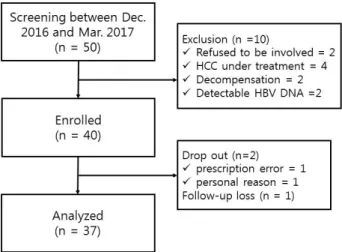
Fig. 1. Study flow chart. HBV, hepatitis B virus; HCC, hepatocellular carcinoma.
drugs (adefovir, tenofovir, etc.) for more than 1 year; 3) HBV DNA <20 IU/mL measured at two or more time points at three-month intervals; 4) compensated liver cirrhosis (Child-Pugh-Turcotte score ≤7, prothrombin time ≤3 seconds above the upper limit of normal or international normalized ratio ≤1.5, serum albumin >3 g/dL, total bilirubin <2.5 mg/dL, no history of variceal bleeding, ascites requiring diuretic ad- ministration, or paracentesis and hepatic encephalopathy;
and 5) understanding the need and process of clinical trials and agreed in writing to participate.
The exclusion criteria were as follows: 1) failure to meet the inclusion criteria; 2) serum creatinine level ≥1.5 mg/dL;
3) hepatitis C antibody positivity; 4) decompensated cirrhosis;
5) currently pregnant or lactating; 6) need for continuous treatment for hepatocellular carcinoma (HCC) or other un- treated malignant tumors; or 7) regular consumption of a sig- nificant amount of alcohol (males, ≥140 g/week; females, ≥ 70 g/week).
4. Assays
Assays were performed (HBV DNA quantification, HBsAg, HBeAg, and anti-HBe tests) at the Department of Laboratory Medicine, Korea University Ansan Hospital. The lower detection limit of HBV DNA quantification was <20 IU/mL by a real-time polymerase chain reaction using COBAS AmpliPrep-COBAS TaqMan HBV testTM, v2.0 (Roche Diagnostics, Branchburg, NJ, USA).
5. Criteria for dropout
Patients were removed from the study when medication
compliance was not maintained (failure to take medication for more than 28 days during the 12 months), if the visiting schedule was violated twice or more during the study period, if they took nucleos(t)ide analogs other than those prescribed in this trial, or if any serious adverse events occurred.
6. Statistical analysis
The primary endpoint was undetectable HBV DNA at 12 months after switching treatment. Based on previous studies, the rate of undetectable HBV DNA at 12 months after enroll- ment was assumed to be 97.8%.16 The following assumptions were made to confirm that the rate of undetectable HBV DNA at 12 months after switching therapy (test drug, or Baracle®) was not inferior to the rate of undetectable HBV at the base- line when therapy was not changed (control drug or Baraclude®). The number of subjects required in the non-in- feriority test was calculated using the SAS 6.4 (SAS Institute, Cary, NC, USA) program with a 0.025 significance level (α), 0.8 statistical power (1-β), and 10% limit of clinical non-in- feriority (ε) according to the following formula:
The calculation determined that 34 patients would be needed. Forty subjects were required in this study, consider- ing a dropout rate of 15%.
All statistical analyses were performed using SPSS 18.0 (SPSS, Chicago, IL, USA), and p-values <0.05 were considered significant. The t-test was used for the continuous variables, while a chi-square test was used for the categorical variables.
For safety analysis, the incidence of clinical or laboratory abnormalities was calculated for each treatment group. Adverse events related to safety issues were assessed using the Common Terminology Criteria for Adverse Events v5.0 (https://ctep.cancer.gov/protocolDevelopment/elec- tronic_applications/ctc.htm). A Fisher’s exact test or chi-square test was used to assess the association between the adverse events and the test drug.
RESULTS
1. Baseline characteristics
Fifty patients were asked to participate in the study. Of them, two refused, and eight did not meet the inclusion criteria. Overall, 40 were enrolled in the study in accordance
*
Table 1. Patients’ Baseline Characteristics According to the Treatment Group
All patients (n=40) ETV+TDF (n=18) ETV+ADV (n=15) ETV mono (n=7) p-valuea
Age (years) 53.1±7.7 55.0±7.5 51.3±7.5 52.0±8.4 0.364
Gender (male) 34 (85.0) 16 (88.9) 13 (86.7) 5 (71.4) 0.620
History of HCC 4 (10.0) 3 (16.7) 1 (6.7) 0 (0.0) 0.504
Concomitant disease
(none/DM/HTN/asthma/DM+HTN)
28/5/5/1/1 (70.0/12.5/12.5/
2.5/2.5)
12/3/1/1/1 (66.7/16.7/5.6/5.6/
5.6)
12/2/1/0/0 (80.0/13.3/6.7/0.0
/0.0)
4/0/3/0/0 (57.1/0.0/42.9/0.0/
0.0)
0.285
HBV DNA (IU/mL) 20.0±0.0 20.0±0.0 20.0±0.0 20.0±0.0 NA
HBeAg positivity 16 (40.0) 9 (50.0) 6 (40.0) 1 (14.3) 0.273
AST (U/L) 23.5±7.0 24.9±8.7 22.1±5.1 23.1±5.4 0.524
ALT (U/L) 26.1±11.4 25.0±8.7 24.8±8.0 31.5±20.9 0.385
Total bilirubin (mg/dL) 0.74±0.30 0.77±0.38 0.70±0.21 0.72±0.30 0.834
Albumin (g/dL) 4.4±0.2 4.4±0.2 4.4±0.2 4.6±0.1 0.100
BUN (mg/dL) 14.7±3.2 15.7±2.8 13.7±3.0 13.9±4.3 0.189
Creatinine (mg/dL) 0.88±0.21 0.90±0.21 0.84±0.19 0.93±0.26 0.561
PT (INR) 1.01±0.08 1.04±0.09 1.01±0.04 0.95±0.05 0.088
Hemoglobin (g/dL) 15.0±1.1 15.3±1.4 14.8±0.9 15.1±0.9 0.438
Platelet (×103/mm3) 206±71 172±61b 229±65b 240±77 0.024
Alpha fetoprotein (ng/mL) 2.7±2.3 2.0±0.9 3.6±3.4 2.4±1.5 0.169
Sonographic finding (non-LC/LC) 27/13 (67.5/32.5) 10/8 (55.5/44.5) 12/3 (80.0/20.0) 5/2 (71.4/28.6) 0.126 eCCr (Cockcroft-Gault formula) (mL/min) 99.9±34.0 93.7±26.0 107.6±24.6 99.3±62.6 0.520
Previous resistance to 0.003
LMV or CLV 6 (15) 1 (5.6) 0 5 (71.4)
LMV+ADV 19 (47.5) 5 (27.8) 12 (80) 2 (28.6)
LMV+ETV 5 (12.5) 3 (16.7) 2 (13.3) 0
LMV+ADV+ETV 7 (17.5) 7 (38.9) 0 0
ETV 3 (7.5) 2 (11.1) 1 (6.7) 0
Values are presented as n (%).
ETV, entecavir; TDF, tenofovir; ADV, adefovir; LMV, lamivudine; CLV, clevudine; DM, diabetes mellitus; HTN, hypertension; HBV, hepatitis B virus; n, number of patients; NA, not applicable; HBeAg, hepatitis B e antigen; AST, aspartate aminotransferase; ALT, alanine aminotransferase; BUN, blood urea nitrogen; PT, prothrombin time; INR, international normalized ratio; LC, liver cirrhosis; eCCr, estimated creatinine clearance rate.
aComparison of three groups by one-way analysis of variance; bDifference between ETV+TDF and ETV+ADV (p<0.017) by Bonferroni method.
with the inclusion and exclusion criteria (Fig. 1). These pa- tients switched from the brand-name entecavir (Baraclude®) 1 mg to the generic entecavir (Baracle®) 1 mg but did not change the adjunctive therapy when combined with other anti- viral agents. Among the 40 patients enrolled, three were lost to follow-up or dropped out of the study. Therefore, the data of 37 subjects at 12 months after switching therapy were analyzed.
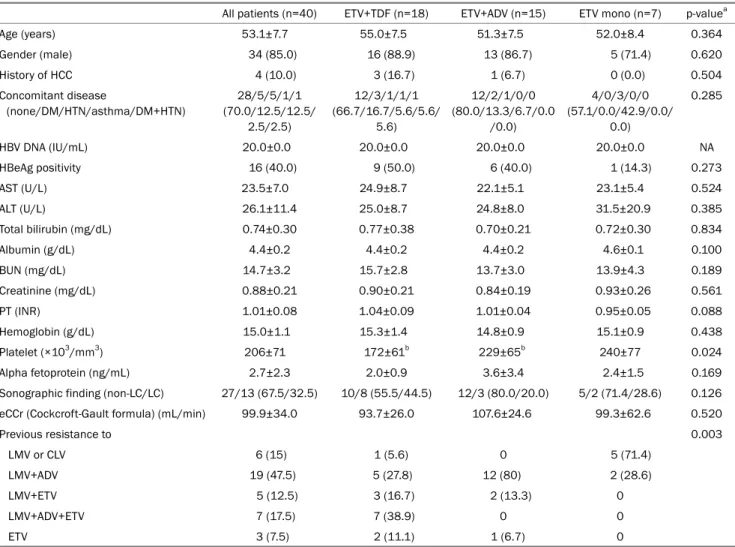
The mean age of the initial 40 subjects was 53.1±7.7 years; 34 (85%) were men. At the time of registration, the HBV DNA levels in all cases were under the lower detection limit (<20 IU/mL) (Table 1). The mean AST and ALT levels were 23.5±7.0 U/L and 26.0±11.4 U/L, respectively; 32.5%
of the patients had underlying liver cirrhosis. All subjects had
a prior history of antiviral resistance; most received combina- tion therapy consisting of tenofovir (45%) or adefovir (37.5%) in addition to Baraclude® 1 mg. Seven patients (17.5%) were receiving Baraclude® 1 mg monotherapy. The prior history of antiviral resistance was different between the groups, sug- gesting the combination therapy groups were more heavily treated than the monotherapy group (Table 1). Of note, seven patients (38.9%) experienced antiviral resistance to three drugs in the ETV+TDF group.
2. Changes in serum HBV DNA
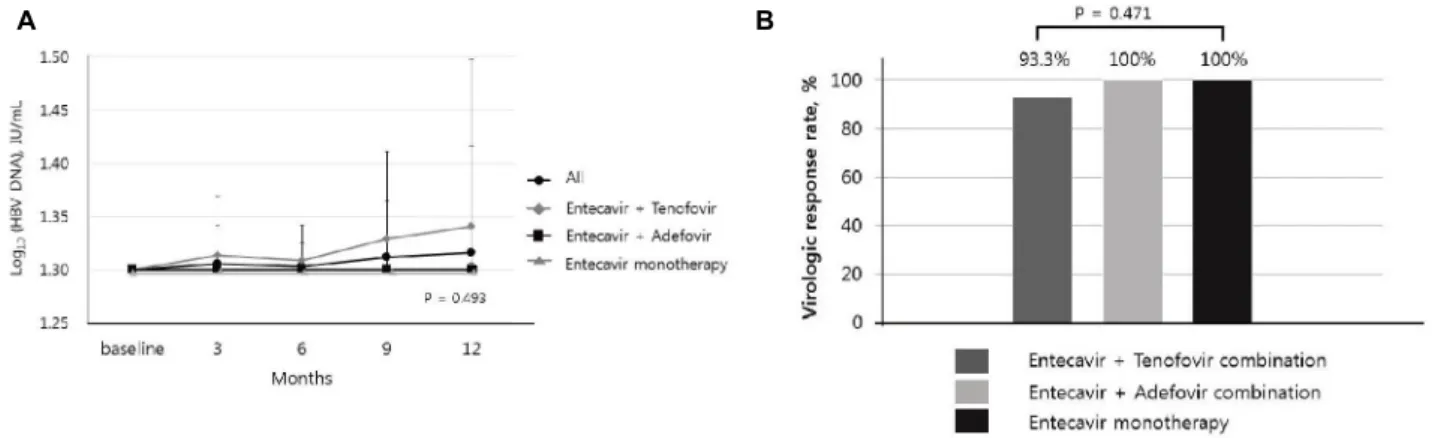
Fig. 2A shows the baseline HBV DNA level, and changes in the HBV DNA level at 3, 6, 9, and 12 months after switching therapy. One case of detectable HBV DNA was noted at 12
A B
Fig. 2. Changes in the HBV DNA levels and virologic response rates after the 12 months follow-up according to the treatment group. (A) Changes in the HBV DNA levels after switching to generic entecavir 1 mg. (B) Virologic response rates after 12 months of switching to generic entecavir 1 mg. HBV, hepatitis B virus.
Fig. 3. Comparison of the virologic response rate defined by undetectable HBV DNA at baseline and 12 months after switching therapy. Patients received the standard drug (Baraclude® 1 mg;
BMS) until the baseline and were switched to and continued the test drug (Baracle® 1 mg; Dong-A ST) for 12 months. HBV, hepatitis B virus; BMS, Bristol-Myers Squibb; ST, Science Technology; PP, per protocol.
months, and none of the remaining cases had detectable HBV DNA until the last follow-up visit. The patient with detectable HBV DNA was receiving combination therapy with entecavir 1 mg and tenofovir. The elevation of HBV DNA was less than 1 log10 IU/mL compared to that at the baseline.
This study compared the HBV DNA levels and virologic re- sponse rates among the entecavir 1 mg monotherapy, combi- nation entecavir 1 mg and tenofovir, and combination en- tecavir 1 mg and adefovir groups after 12 months of switching therapy. No intergroup differences in the HBV DNA levels (p=0.493) (Fig. 2) and virologic response rates (p=0.471) (Fig.
2B) were observed.
3. Non-inferiority test
To determine if the test drug (Baracle® 1 mg) has a non-inferior ability to suppress HBV DNA compared to the standard drug (Baraclude® 1 mg), the rate of undetectable HBV DNA at the time of taking Baraclude® was compared with that of undetectable HBV DNA after 12 months of the Baracle® 1 mg treatment (Fig. 3). The rates were 100% and 97.3%, respectively (p=0.324; 95% CI -2.80 to 8.20%). The 95% CI did not exceed the non-inferiority margin, as it was predefined at 10%. The antiviral effect was similar, and the test drug was not inferior to the standard drug.
4. Serological and biochemical responses
Table 2 lists the results of this study. The biochemical re- sponses at the baseline and after taking the test drug for 12 months were compared. No significant differences in the rate or mean normal ALT level before and after the treatment
change were observed.
HBeAg loss was detected in 12.5% of 16 patients who were HBeAg-positive at the time of enrollment, but HBeAg sero- conversion was not observed. None of the 40 subjects who were initially enrolled showed HBsAg loss.
No statistically significant differences in the biochemical and serological response rates were noted among the three groups when the patients were categorized according to the actual antiviral treatment: entecavir 1 mg monotherapy, com- bination of entecavir 1 mg and tenofovir, and combination of entecavir 1 mg and adefovir (Table 3).
Table 2. Biochemical and Serologic Response Rates According to the Time Point
Timeline Baseline Month 12 p-value
Normal ALT (%) (n=37)a 38/40 (95.0%) 31/37 (83.8%) 0.144
Mean ALT (U/L)b 26.1±11.4 27.6±11.8 0.562
HBeAg loss rate (n=16)c 0/16 2/16 (12.5%) NA
HBeAg seroconversion rate (n=16) 0/16 0/16 NA
ALT, alanine aminotransferase; HBeAg, hepatitis B e antigen; n, number of patients; NA, not applicable.
aTwo patients dropped out, one was lost to follow-up; bIndependent t-test; cHBeAg positivity at baseline.
Table 3. Biochemical and Serologic Response Rates According to the Treatment Group
Group ETV+TDF ETV+ADV ETV mono p-value
Mean HBV DNA (log IU/mL) 1.34±0.16 1.30±0.00 1.30±0.00 0.493
Normal ALT rate (n=37)a 13/15 (86.7%) 12/15 (80.0%) 5/7 (71.4%) 0.859
HBeAg loss rate (n=16)b 1/9 (11.1%) 0/6 (0.0%) 1/1 (100.0%) 0.223
HBeAg seroconversion rate (n=16) 0/9 (0.0%) 0/6 (0.0%) 0/1 (0.0%) NA
ETV, entecavir; TDF, tenofovir; ADV, adefovir; ALT, alanine aminotransferase; HBV, hepatitis B virus; HBeAg, hepatitis B e antigen; n, number of patients; NA, not applicable.
aTwo patients dropped out, one was lost to follow-up; bHBeAg positivity at baseline.
Table 4. Adverse Events
Adverse event Number of cases
Dyspepsia (grade 1) 1/40 (2.5%)
New hepatocellular carcinoma 1/40 (2.5%)b
eCCr aggravationa 0/37
eCCr, estimated creatinine clearance rate; ETV, entecavir; TDF, tenofovir.
aDecreased to <50 mL/min or <50% versus baseline; data were missing for three; bETV+TDF group.
5. Adverse events
There were no cases of viral breakthrough during treatment.
Therefore, there were no cases of resistance testing. The anti- viral resistance rates were not compared for the same reason.
Only one patient in the ETV+TDF group showed detectable HBV DNA after 9 months of switching therapy, but the levels were relatively low (28 and 81 IU/mL at nine and 12 months, respectively). The patient had been treated for HCC with under- lying Child-Pugh class A liver cirrhosis at enrollment, but the baseline low platelet count of 57,000/mm3 suggested hyper- splenism and significant portal hypertension. He experienced HCC recurrence during the study period and underwent anti- cancer therapy from the third month.
Another patient newly developed HCC at 6 months after switching therapy. The patient had underlying liver cirrhosis, and no association with the drug was suspected. Adverse events occurred in a patient with mild dyspepsia (grade 1).
None of the patients showed deterioration of the renal func- tion (Table 4).
DISCUSSION
Access to treatment is an important factor for achieving the World Health Organization goal of eliminating HBV in- fection by 2030.17 The increased availability of generic anti- virals has likely improved access to treatment.18 Several inter- national guidelines recommend newer agents, such as en- tecavir and tenofovir as a first-line treatment because they have high barriers to resistance.3,7 Thus, the accessibility of generic entecavir and tenofovir will play an important role in controlling HBV infections worldwide.
The median price of generic tenofovir on the international market decreased from $208/person-year in 2004 to
$38/person-year in 2014.19 In contrast, the lowest reported price of entecavir was $427/person-year in 2015.20 This means that generic entecavir must become less expensive, considering the current price of generic tenofovir, through the development of more generic products.
A major concern regarding generic agents is whether they show comparable efficacy and safety to the brand name drugs. In a survey, 25% of physicians said they would pre- scribe generic drugs more often if additional clinical trials were offered. Therefore, this study could provide important
evidence for the selection of generic entecavir by physicians.18 In addition, the daily dosage of entecavir is very low (0.5 or 1 mg), which means that the requirement for the active pharmaceutical ingredient is low, resulting in a low manu- facturing cost. Some reports estimate the minimum target prices for entecavir at $36/person-year, which is substantially lower than the current generic prices and below those of tenofovir.20
Therefore, encouraging the widespread competitive generic production of entecavir would enable dramatic price reduc- tions and rapid scale-up of HBV treatments globally. To this end, a study on the efficacy and safety of generic entecavir and recommendations for its use will be needed.
In this regard, a randomized controlled trial comparing a new generic drug, Baracle® 0.5 mg (Dong-A ST), and the original drug, Baraclude® 0.5 mg, was recently conducted in treat- ment-naïve CHB patients.21 On the other hand, an evaluation of generic entecavir 1 mg, which is indicated for anti- viral-resistant HBV, has not been performed.
This study evaluated the safety and efficacy of switching to the entecavir 1 mg of a generic drug in CHB patients taking brand-name entecavir 1 mg as a mono- or combination ther- apy after the development of antiviral resistance to previous nucleos(t)ide analogs.
In this single-arm study, no significant difference in the viral detection rate was noted between before and after changing the drug. No inferiority was noted in the maintenance of un- detectable HBV DNA after switching therapy compared to the baseline. As a result, no difference in the clinical effect was observed between the standard and test drugs. Similarly, no difference in biochemical response was observed after chang- ing the drug. Serum HBeAg loss was confirmed in 12.5% of patients, but the clinical significance was limited. No major adverse effects were reported, and the incidence of recurred or newly developed HCC was considered unrelated to the drug; recurred or newly developed HCC was observed in the ETV+TDF group, of which the patients were treated more heavily and had more advanced liver diseases judged by the lower platelet counts. Overall, these findings suggest that ge- neric entecavir, Baracle® 1 mg, is comparable to brand-name entecavir, Baraclude® 1 mg.
This study had several limitations to the present study.
First, it was not a randomized control trial, which is an ideal study design for comparing two drugs. On the other hand,
although it was a single-arm study, it demonstrated non-in- feriority of the virologic response rate between the last time brand-name entecavir 1 mg was prescribed and after 12 months of generic entecavir 1 mg treatment.
Second, there was a limitation in evaluating the effective- ness of generic entecavir alone. As the study included patients taking entecavir 1 mg due to the antiviral resistance to previous nucleos(t)ide analogs, this study should have also included patients who were being prescribed this drug combined with other drugs. On the other hand, the generic entecavir mono- therapy group did not show any evidence of HBV DNA elevation during the 12 months of treatment, although the cohort size was insufficient. Switching to entecavir 1 mg monotherapy from adefovir-based combination therapies might be consid- ered in limited situations,22,23 but it would not be effective switching from the tenofovir-based combination therapy.15 Hence, combination therapy needs to be ensured in multiple treatment failures.15 Third, the kinetics of the decline in viral replication was not compared because all the patients already had undetectable HBV DNA at enrollment. Nevertheless, a study design comparing the rates of maintaining undetectable HBV DNA would be relevant because the incidence of newly developed antiviral resistance has decreased after introducing high genetic barrier drugs.1,24,25
Entecavir 1 mg is an important medication prescribed fre- quently either alone or in combination in a variety of situations involving resistance to antiviral agents. A previous study com- pared the efficacy of generic entecavir 0.5 mg with the brand name drug for treatment naïve CHB. To the best of the au- thors’ knowledge, this study is the first to evaluate the clinical efficacy and safety of generic entecavir 1 mg. Therefore, this study provides important evidence for selecting generic drugs in cases of antiviral resistance.
In conclusion, generic entecavir (Baracle®) 1 mg, is a rea- sonable alternative to brand-name entecavir 1 mg, in CHB patients with compensated liver diseases who are resistant to previous nucelos(t)ide analogs with viral suppression.
ACKNOWLEDGEMENT
The authors thank Ms. Seo EJ for helping with the data collection and Prof. Cha JH at Department of Biostatics, Korea University Ansan Hospital for supervising the stat- istical analysis. Also, the authors would like to thank Editage
(www.editage.co.kr) for English language editing.
REFERENCES
1. European Association for the Study of the Liver. EASL 2017 clin- ical practice guidelines on the management of hepatitis B virus infection. J Hepatol 2017;67:370-398.
2. Lok AS, McMahon BJ. Chronic hepatitis B: update 2009.
Hepatology 2009;50:661-662.
3. Terrault NA, Lok ASF, McMahon BJ, et al. Update on prevention, diagnosis, and treatment of chronic hepatitis B: AASLD 2018 hepatitis B guidance. Hepatology 2018;67:1560-1599.
4. Korean Association for the Study of the Liver (KASL). KASL clin- ical practice guidelines for management of chronic hepatitis B.
Clin Mol Hepatol 2019;25:93-159.
5. Yim HJ, Hwang SG. Options for the management of antiviral re- sistance during hepatitis B therapy: reflections on battles over a decade. Clin Mol Hepatol 2013;19:195-209.
6. Lok AS, Lai CL, Leung N, et al. Long-term safety of Lamivudine treatment in patients with chronic hepatitis B. Gastroenterology 2003;125:1714-1722.
7. European Association For The Study Of The Liver. EASL clinical practice guidelines: management of chronic hepatitis B virus infection. J Hepatol 2012;57:167-185.
8. Yim HJ, Seo YS, Yoon EL, et al. Adding adefovir vs. switching to en- tecavir for Lamivudine-resistant chronic hepatitis B (ACE study):
a 2-year follow-up randomized controlled trial. Liver Int 2013;33:244-254.
9. Cho EY, Yim HJ, Jung YK, et al. Management of clevudine-re- sistant chronic hepatitis B: a multicenter cohort study. Gut Liver 2017;11:129-135.
10. Kang SH, Yim HJ, Kim HR, et al. Comparison of Lamivudine plus adefovir therapy versus entecavir with or without adefovir ther- apy for adefovir-resistant chronic hepatitis B. J Clin Gastroenterol 2014;48:889-895.
11. Kim HS, Yim HJ, Jang MK, et al. Management of entecavir- resistant chronic hepatitis B with adefovir-based combination therapies. World J Gastroenterol 2015;21:10874-10882.
12. Lee S, Ahn SH, Jung KS, et al. Tenofovir versus tenofovir plus en- tecavir for chronic hepatitis B with Lamivudine resistance and en- tecavir resistance. J Viral Hepat 2017;24:141-147.
13. Park JY, Kim CW, Bae SH, et al. Entecavir plus tenofovir combina- tion therapy in patients with multidrug-resistant chronic hep- atitis B: results of a multicentre, prospective study. Liver Int
2016;36:1108-1115.
14. Lee YB, Lee JH, Lee DH, et al. Efficacy of entecavir-tenofovir com- bination therapy for chronic hepatitis B patients with multi- drug-resistant strains. Antimicrob Agents Chemother 2014;58:
6710-6716.
15. Petersen J, Ratziu V, Buti M, et al. Entecavir plus tenofovir combi- nation as rescue therapy in pre-treated chronic hepatitis B pa- tients: an international multicenter cohort study. J Hepatol 2012;56:520-526.
16. Huang ZB, Zhao SS, Huang Y, et al. Comparison of the efficacy of Lamivudine plus adefovir versus entecavir in the treatment of Lamivudine-resistant chronic hepatitis B: a systematic review and meta-analysis. Clin Ther 2013;35:1997-2006.
17. Hutin Y, Nasrullah M, Easterbrook P, et al. Access to treatment for hepatitis B virus infection - worldwide, 2016. MMWR Morb Mortal Wkly Rep 2018;67:773-777.
18. Global price reporting mechanism for HIV, tuberculosis and malaria. [Internet]. Geneva (CH): World Health Organization (WHO); 2014 [cited 2020 Dec 1]. Available from: www.wh- o.int/hiv/amds/gprm/en/
19. Kersnik J, Peklar J. Attitudes of Slovene general practitioners to- wards generic drug prescribing and comparison with interna- tional studies. J Clin Pharm Ther 2006;31:577-583.
20. Hill A, Gotham D, Cooke G, et al. Analysis of minimum target pri- ces for production of entecavir to treat hepatitis B in high- and low-income countries. J Virus Erad 2015;1:103-110.
21. Kim DY, Kim JH, Tak WY, et al. Baracle® vs Baraclude® for 48 weeks in patients with treatment-naïve chronic hepatitis B: a comparison of efficacy and safety. Drug Des Devel Ther 2017;
11:3145-3152.
22. Oh MJ, Lee HJ. Antiviral efficacy of entecavir versus entecavir plus adefovir for hepatitis B virus rtA181V/T mutants alone.
Saudi J Gastroenterol 2016;22:37-42.
23. Heo NY, Lim YS, Lee HC, Chung YH, Lee YS, Suh DJ. Lamivudine plus adefovir or entecavir for patients with chronic hepatitis B re- sistant to lamivudine and adefovir. J Hepatol 2010;53:449-454.
24. Kitrinos KM, Corsa A, Liu Y, et al. No detectable resistance to te- nofovir disoproxil fumarate after 6 years of therapy in patients with chronic hepatitis B. Hepatology 2014;59:434-442.
25. Tenney DJ, Rose RE, Baldick CJ, et al. Long-term monitoring shows hepatitis B virus resistance to entecavir in nucleo- side-naïve patients is rare through 5 years of therapy. Hepatology 2009;49:1503-1514.