Transport properties of boron/nitrogen/phosphorus binary doped graphene nanoribbons:
An ab initio study
Seong Sik Kim, Han Seul Kim
Graduate School of EEWS, KAIST, 291 Daehak-ro, Yuseong-gu, Daejeon 305-701, Korea
*E-mail : [email protected]
We apply a density functional theory (DFT) and DFT-based non-equilibrium Green’s function approach to study the electronic and transport properties of graphene nanoribbons (GNRs) co-doped with boron- nitrogen, nitrogen-phosphorus and boron-phosphorus. We analyze the structures and charge transport properties of co-doped GNRs and particularly focus on the novel effects that are absent for the single N-, B-, or P-doped GNRs. It is found that co-doped GNRs tend to be doped at the edges and the electronic structures of co-doped GNRs are very sensitive to the doping sites. Also, in case of B-N and B-P co-doped GNRs, conductance dips of single-doped GNRs disappeared with the disappearance of localized states associated with doped atoms. This may lead to a possible method of band engineering of GNRs and benefit the design of graphene electronic devices.
I. INTRODUCTION
For many years, the research of electron transport through carbon nanotubes (CNTs) has increased convulsively because they have some of the advantages such as the unique electrical, mechanical, and thermal properties for the development of energy storage and conversion devices, and sensors. Also, CNT have long been considered as a prime candidate for next- generation field-effect transistor channel materials.
But it is not easy to make pure CNT with no defect because there are some defects we can't control in the course of production. Achieving high performance CNT transistors with no defect for future technology nodes still remains a paramount challenge.
Recently, Graphene nanoribbons (GNRs) become a hot topic as a simple test system for CNT investigation.
1While the doping of CNT has been studied as the way to control the electronic properties,
1,2,3there is a lack of research on the doping effect in the GNR. In contrast with CNT,
the properties of GNR present more complex features depending on the dopant sort, dopant position, ribbon width and symmetry.
4-8Most of all, the chemical doping is the important methods to adjust electronic properties of GNR. For obtaining the electronics properties of GNRs suitable for the applications, the effect of zigzag (zGNRs) and armchair (zGNRs)
4substitutionally doped with single defect have been investigated by several groups.
Boron (B), nitrogen (N), phosphorus (P) atoms are possible candidate to control the properties of GNRs
9-16because the system is not changed from sp
2hybridized to sp
3hybridized by B-N or B-P binary doping. B has only three electrons in its valence shell, and when present in sp
2bonded carbon the missing P
zelectrons behaves as "holes"
in the carbon orbital network. On the other hand,
the fifth electron that nitrogen possesses in its
valence shell sp ills into the π* band in the sp
2carbon network. It follows that an electron donor
behavior is usually observed. So, B-N co-doped
GNRs are very similar to the properties of pristine GNRs. We also considered B-P co-doped GNRs because P has fifth electron in its valence shell as same group with N.
In this paper, we apply a density functional theory (DFT) and DFT-based non-equilibrium Green's function (NEGF) approach to study the electronic and transport properties of GNRs co- doped with B-N, B-P. We analyze the structures and charge transport properties of co-doped GNRs and particularly focus on the novel effects that are absent for the single N-, B-, or P-doped GNRs.
The goal of this work is to improve the existing understanding of the electronic and transport properties of doped GNRs in both zigzag and armchair GNRs. The improved understanding could offer insight into the tailoring of the properties of CNTs through impurity doping and defect engineering.
II. METHODS
In Fig. 1, we first show the two different types of systems were considered to study on the effects of co-doped GNRs; an 11-aGNR (armchair graphene nanoribbon) with a width of 14.4128Å and a length of 19.8670 Å , and a 12-zGNR with a width of 13.7576 Å and a length of 20.90994 Å.
Here, the numbers preceding the GNR type means the number of carbon atoms along the width of GNR. The calculation system is composed of a central scattering region and two semi-infinite electrodes. A unit cell the two different types of systems is shown in Fig. 1. The 11-aGNR system is comprised of Seven-unit cells and six for the 12- zGNR system, with the two dopants. All edges of GNRs are fully terminated by hydrogen atoms to increase the thermodynamics stability
17and C-C bond length is 1.424 Å before geometry optimization. A minimum lateral distance of 20 Å was maintained between supercells in the GNR's finite-size dimensions. Doping was achieved by substituting two carbon atoms with binary B-N or B-P atoms. The atomic dopants were initially displaced slightly above the plane of the GNR (~0.2 Å ) for preventing metastable state. As Fig.
1(a) shows, the six atoms labeled by number are positions of the N or P atom when the B atom is fixed at one point. As Fig. 1.(b) shows, The four (two) atoms labeled by 1 to 4 (1' and 3') are positions of the B atom (P atom) when the N atom (B atom) is fixed at one point.
The electronic transport properties were investigated using the fully self-consistent DFT- based NEGF method, as implemented in the TranSIESTA code. The spin-polarized DFT calculations were performed within the GGA-PBE, with double ξ-plus-polarization (DZP) basis sets and a real space mesh cutoff of 200 Ry. The Brillouin zone was sampled using a Monkhorst- Pack grid corresponding to 1x1x14 and 1x1x16 respectively in the ribbon growth direction.
18Fig. 1. (color online) Atomic models of (a) 11-aGNR. (b) 12-zGNR.
As Fig. 1(a) shows, the six atoms labeled by number are positions of the N or P atom when the B atom is fixed at one point. As Fig. 1.(b) shows, The four (two) atoms labeled by 1 to 4 (1' and 3') are positions of the B atom (P atom) when the N atom (B atom) is fixed at one point. The unit cell of GNR is marked by the red square frame. The gray and white balls correspond to carbon and hydrogen atoms, respectively.
Fig. 2. Relative formation energy for six different dopants positions in the armchair and zigzag graphene nano-ribbons.
Fig. 3. (color online) Conductance and Density of states as a function of the energy for the 11-aGNR. (a) Conductance and Density of states of 11-aGNR doped by B, N, P at the edge site. (b) Conductance and Density of states of 11-aGNR doped by binary B-N, B-P at position 1.
Insets: same as in main frame for B-P co-doped 11-aGNR but all atoms are fixed in this case. Spin-dependent behavior is not observed.
The dashed lines correspond to the pristine 11-aGNR.
III. RESULTS AND DISCUSSION
First, the formation energy of B-N and B-P co- doped GNRs were calculated and six different positions were considered as shown in Fig. 1. The relative formation energy for single doped GNRs has been reported by E. Cruz-silva. The formation Energy (E
F) was computed using the following equation
15:
E
F= E
DT- E
P+ 2 μ
C- μ
D1- μ
D2where E
Fis the formation energy of the binary doped structure, E
CDis the total energy of the co- doped GNR and E
Pis the total energy of the pristine GNR, and μ
xis the knowledge of the chemical potential energy of atomic species x.
The position 1 is energetically the most stable case for both B-N
19and B-P co-doped 11-aGNR.
But in case of 12-zGNR, the lowest energy configurations for B-N and B-P co-doping occurs when the dopants is placed at the position 1’ and position 4 respectively.
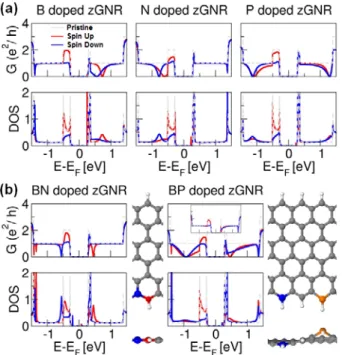
Fig. 4. (color online) Conductance and Density of states as a function of the energy for the 12-zGNR. (a) Conductance and Density of states of 11-aGNR doped by B, N, P at the edge site. (b) Conductance and Density of states of 12-zGNR doped by binary B-N, B-P at position 1’
and 4 respectively. Insets: same as in main frame for B-P co-doped 12-zGNR but all atoms are fixed in this case. Spin-dependent behavior is observed. The dashed lines correspond to the pristine 12- zGNR.
A. Binary doped 11-aGNR
In Fig. 3(a), we show the conductance and density of states (DOS) of 11-aGNR doped by single dopant such as B, N and P at the edge site.
The results about the single doped GNRs has been reported by other groups
12,19-20and are entirely consistent with our research. The single B doped 11-aGNR exhibits the accptorlike state and has a localized state on the Fermi level. In contrast, The single N doped 11-aGNR exhibits the donorlike state and also have a localized state on the Fermi level. The single P doped 11-aGNR exibit a bigger drop in conductance centered around the Fermi level due to the presence of a localozed state in the energy range surrounded by band gaps. In Fig.
3(b), we show the conductance and density of
states of 11-aGNR doped by binary B-N, B-P at
position 1. The Conductance dips of single-doped
GNRs disappeared with the disappearance of
localized states associated with doped atoms in
both case. The conductance of B-N co-doped 11-
aGNR exhibits almost like pristine 11-aGNR. This
result may be related to the two factors, namely the Stoichiometric relationships and structural aspect.
Both boron and nitrogen have three and fifth electrons in its valence shell so they can cancel out each other and there is no distortion in this system.
The conductance of B-P co-doped 11-aGNR also exhibits almost like pristine 11-aGNR. Both boron and phosphorus also have three and fifth electrons in its valence shell so they can cancel out each other. However, there is a structure distortion around the doping sites, since the presence of boron can’t help to reduce the structure distortions caused by the phosphorus. The reason why the conductance has been recovered in spite of the structure distortions is that stoichiometric relationships is thought to be more important than structural aspect in case of aGNR.
B. Binary doped 12-zGNRs
In Fig. 4(a), we show the conductance and density of states (DOS) of 12-zGNR doped by single dopant such as B, N and P at the edge site. The single B and N doped 12-zGNR exhibit the donorlike state and acceptorlike state respectively.
The single P doped 12-zGNR exibit both a donor state and acceptor state, since there is a significant structure distortion in the ribbon in consequence of the sp
3character and length of the P-C atomic bond.
21In Fig. 4(b), we show the conductance and density of states of 12-zGNR doped by binary B-N, B-P at position 1’ and 4 respectively. The conductance of B-N co-doped 12-zGNR exhibits almost like pristine 12-zGNR for reasons mentioned in armchair case. However, The conductance of B-P co-doped 12-zGNR exibit the conductance dips around the Fremi level that is very different from the armchair case. If we calculate in case of fixed defect, transmission curve come to rise again near the Fermi energy level. This result indicates that structure distortion by the presence of phosphorus surly has some effect especially in zigzag GNR. In other words, Structural aspect is thought to be more important than stoichiometric relationships in case of zGNR.
IV. CONCLUSION
In summary, The electronic transport properties of the binary Boron-Nitrogen (B-N), Boron- PhosPhorus (B-P) doped armchair and zigzag graphene nanoribbons (GNRs) were investigated using the fully self-consistent DFT-based NEGF method, as implemented in the TranSIESTA code.
The conductance of B-N, B-P co-doped 11-aGNR and B-N co-doped 12-zGNR exhibit almost like pristine case. However, The conductance of B-P co-doped 12-zGNR exhibit the conductance dips around the Fermi level. This result may be related to the two factors, namely the Stoichiometric relationships and structural aspect. Structural aspect is thought to be more important than stoichiometric relationships in case of zGNR. This may lead to a possible method of band engineering of GNRs and benefit the design of graphene electronic devices.
REFERENCES
1Cruz-Silva, E. et al. Electronic Transport and Mechanical Properties of Phosphorus- and Phosphorus−Nitrogen-Doped Carbon Nanotubes. ACS Nano. 3, 1913 (2009).
2aciel, I. O. et al. Synthesis, Electronic Structure, and Raman Scattering of Phosphorus-Doped Single-Wall Carbon Nanotubes. Nano Lett. 9, 2267 (2009).
3Souza Filho, A. et al. Selective Tuning of the Electronic Properties of Coaxial Nanocables through Exohedral Doping.
Nano Lett. 7, 2383 (2007).
4Nakada, K. et al. Edge state in graphene ribbons: Nanometer size effect and edge shape dependence. Phy. Rev. B. 54, 17954 (1996).
5Wakabayashi, K. Electronic transport properties of nanographite ribbon junctions. Phys. Rev. B. 64, 125428 (2001).
6Zheng, H. et al. Analytical study of electronic structure in armchair graphene nanoribbons. Phys. Rev. B. 75, 165414 (2007).
7Sasaki, K. et al. Stabilization mechanism of edge states in graphene. Appl. Phys. Lett. 88, 113110 (2006).
8Dubois, S. et al. Quantum Transport in Graphene Nanoribbons: Effects of Edge Reconstruction and Chemical Reactivity. ACS Nano. 4, 1971 (2010).
9Martins, T. B. et al. Electronic and Transport Properties of Boron-Doped Graphene Nanoribbons. Phy. Rev. Lett. 98, 196803 (2007).
10Martins, T. B. et al. σ- and π-Defects at Graphene Nanoribbon Edges: Building Spin Filters. Nano. Lett. 8, 2293 (2008).
11Yan, Q. et al. Intrinsic Current−Voltage Characteristics of Graphene Nanoribbon Transistors and Effect of Edge Doping.
Nano Lett. 7, 1469 (2007).
12Biel B. et al. Anomalous Doping Effects on Charge Transport in Graphene Nanoribbons. Phys. Rev. Lett. 102, 096803 (2009).
13Wang, X. et al. N-Doping of Graphene Through Electrothermal Reactions with Ammonia. Science. 324, 768 (2009).
14Wei, D. et al. Synthesis of N-Doped Graphene by Chemical Vapor Deposition and Its Electrical Properties. Nano Lett. 9, 1752 (2009).
15Yu, S. S. et al. First principle calculations of the electronic properties of nitrogen-doped carbon nanoribbons with zigzag edges. Carbon. 46, 537 (2008).
16Huang, B. et al. Making a field effect transistor on a single graphene nanoribbon by selective doping. Appl. Phys. Lett. 91, 253122 (2007).
17Barone, V. et al. Electronic Structure and Stability of Semiconducting Graphene Nanoribbons. Nano Lett. 6, 2748 (2006).
18Monkhorst, H. J. and J. D. Pack. Special points for Brillouin-zone integrations. Phy. Rev. B. 13, 5188 (1976).
19Cruz-Silva, E. et al. Structural, magnetic, and transport properties of substitutionally doped graphene nanoribbons from first principles. Phys. Rev. B. 83, 155445 (2011).
20Xiao Jin, et al. Electronic properties of graphene nanoribbon doped by boron/bitrogen pair: a firsr-principles study. Chin.
Phys. B. 21, 027102 (2012).
21Cruz-Silva, E. et al. Electronic Transport and Mechanical Properties of Phosphorus- and Phosphorus−Nitrogen-Doped Carbon Nanotubes. ACS Nano. 3, 1913 (2009).