J Korean Soc Coloproctol Vol. 19, No. 5, 2003
299
The Postoperative Impact of Co-morbidity in Colorectal Cancer Surgery
Hee Seok Suh, M.D.1, Kang Hong Lee, M.D., Hee Cheol Kim, M.D., Chang Sik Yu, M.D., Jin Cheon Kim, M.D.
1Hang-Sarang Coloproctology Clinic, Ansan, and Department of Surgery, University of Ulsan College of Medicine and Colorectal Clinic, Asan Medical Center, Seoul, Korea
Purpose: Co-morbidity is the presence of co-existing or additional diseases during the initial diagnosis. It may be used as a prognostic indicator for the postoperative outcomes in most cancers, including colorectal cancers. The impact of respective co-morbidities in colorectal cancer surgeries were evaluated to identify their outcomes re- garding complications and hospital stay.
Methods: The medical records of 2,242 colorectal cancer patients, who had had curative operations between Jan.
1997 and Dec. 2001, were reviewed to evaluate the prev- alence of co-morbidities. All co-morbidities were ade- quately evaluated and managed preoperatively.
Results: Co-morbidities were observed in 789 out of the 2,242 (35.2%) patients. Hypertension was the most frequent (340, 15.2%), with diabetes (210, 9.4%) and car- diovascular diseases (124, 5.5%) following. Early stages (0∼II) were more frequently associated with co-mor- bidities, compared to late stages (III∼IV) (P<0.001).
Hypertension and cerebrovascular diseases were signifi- cantly associated with postoperative complications (P<
0.05). Postoperative complications occurred in 578 out of the 2242 (25.8%) patients: e.g., ileus (10.2%), voiding difficulty (4.4%), wound problems (4.3%), etc. Pulmonary complications occurred more often in patients with cerebrovascular diseases, hypertension, and asthma. Wound complications were observed in patients with hypertension, cerebrovascular diseases, chronic obstructive pulmonary disease, and chronic renal failure (P<0.05). Patients with more than one co-morbidity were closely associated with frequent postoperative co-mplications (P<0.05). However, comorbidities did not seem to affect the duration of the postoperative hospital stay.
Conclusions: Postoperative complications frequently occur in colorectal cancer patients with specific co- morbidities, especially in those with more than one. An adequate management of the co-morbidities preoperatively leads to a good outcome. J Korean Soc Coloproctol 2003;19:299-306
Key Words: Comorbidity, Complications, Length of stay, Colorectal neoplasms
동반이환, 합병증, 재원기간, 대장암 ꠏꠏꠏꠏꠏꠏꠏꠏꠏꠏꠏꠏꠏꠏꠏꠏꠏꠏꠏꠏꠏꠏꠏꠏꠏꠏꠏꠏꠏꠏꠏꠏꠏꠏꠏꠏꠏꠏꠏꠏꠏꠏꠏꠏꠏꠏꠏꠏꠏ
서 론
동반질환(comorbidity)이란 대상 질환의 진단 시점에 이미 공존하거나 발견되는 만성 질환을 말하며 고혈 압, 당뇨, 각종 심장질환, 뇌혈관질환, 폐질환 등이 이 에 속한다.1 일반적으로 동반질환의 유병률은 나이가 많아질수록 증가하며, 대부분의 암도 나이가 많아짐에 따라 발병률이 증가하므로 동반질환을 가진 암 환자 는 나이가 많아짐에 따라 증가한다고 할 수 있다.2 동 반질환은 대장암을 포함한 각종 암의 치료와 예후에 영향을 미치게 되므로 매우 중요하다. 대체로 암 환자 의 50% 이상은 동반질환이 있는 것으로 알려져 있으 며,1,2 수술 후 합병증 발생률 증가와 재원기간의 연장 으로 인한 치료비의 증가를 가져오므로 이에 대한 올 바른 인식과 치료가 필요하다.2,3 반면 동반질환이 있 는 경우 이에 대한 정기적 검진을 하는 과정에서 대장 암이 오히려 조기에 진단될 가능성이 많다는 연구 결 과도 있다.4
본 연구는 대장암으로 근치 절제술을 받은 환자의 동반질환과 대장암의 임상적 특성, 병리학적 특성, 수 술 후 합병증과 재원기간을 분석하여 동반질환이 대 장암 수술과 결과에 어떤 영향을 미치는지 알아보고 향후 동반질환을 가진 대장암 환자의 효과적인 치료 에 대한 기준을 살펴보고자 하였다.
대장암 수술에서 동반질환의 영향
1항사랑외과, 울산대학교 의과대학 외과학교실 및 서울아산병원 대장항문클리닉
서희석1․이강홍․김희철․유창식․김진천
책임저자: 김진천, 서울특별시 송파구 풍납동 388-1
서울아산병원 외과 대장항문클리닉(우편번호: 138-736) Tel: 02-3010-3480, Fax: 02-474-9027
E-mail: [email protected]
본 논문의 요지는 2003년 대한대장항문학회 춘계학술대회에서 구연되었음.
방 법
1997년 1월부터 2001년 12월까지 서울아산병원 외과 대장항문클리닉에서 대장암으로 근치 절제술을 받은 2242명의 의무기록을 후향적으로 분석하였다. 국제질 병분류(International Classification of disease, 9th Revi- sion, Clinical modification)에 따른 동반질환과 수술 후 합병증을 조사하였고, 임상적 특성과 병리학적 특성은 나이, 성별, 병기, 세포 분화도, 원발암 위치, 수술 방법 과 초기 사망률로 세분하여 조사하였다. 동반질환은 계통별로 크게 11가지로 분류하였다(Table 1). 전체 환 자의 남녀 비는 61:39였고 평균 연령은 58세(14∼88) 였으며, 추적기간은 평균 24 (1∼66)개월이었다. 동반
질환이 있었던 환자는 789명(35.2%)이었고, 모든 예에 서 수술 전 적절한 평가와 처치를 시행한 후 수술하였으 며, 동반질환이 없었던 환자를 대조군으로 선정하였다.
통계분석은 SPSS (version 11.0, SPSS Inc.) 프로그램 을 이용하였으며 수술 후 합병증이 발생한 환자의 임 상적 특성 및 병리학적 특성과 동반질환 간 관련성은 chi-square test로 검정하였고, 개별 동반질환에 따른 재 원기간의 차이는 student t-test로 검정하였으며, 수술 후 합병증에 따른 동반질환의 유무는 logistic regres- sion test를 시행하였다. P<0.05를 유의수준으로 판정 하였다.
결 과
동반질환은 고혈압(340명, 15.2%)이 가장 빈번하였 고, 당뇨병(210명, 9.4%), 심혈관계 질환(124명, 5.5%) 순으로 나타났다(Table 1). 동반질환이 있는 환자군은 동반질환이 없는 환자군에 비해 남자(64.9% vs. 58.4%) 가 많았으며(P<0.001), 동반질환이 있는 환자군 중 고 령(66세 이상) 환자는 305명(38.7%)으로 동반질환이 없는 환자군의 327명(22.5%)에 비해 유의하게 많았다 (P<0.001). AJCC 병기 0∼II기 대장암 환자는 III∼IV 기 대장암 환자에 비해 동반질환이 많았으며(P<0.05) (Fig. 1), 특히 뇌혈관 질환과 고혈압이 0∼II기 대장암 환자에서 유의하게 많은 것으로 나타났다(P<0.05). 전 체 환자의 수술 후 합병증 발생률은 25.7%였고, 동반 질환이 있는 환자군 789명 중 217명(27.5%)에서 수술 후 합병증이 발생하였으며, 동반질환이 없는 환자는 Table 1. Prevalence of comorbidity
ꠚꠚꠚꠚꠚꠚꠚꠚꠚꠚꠚꠚꠚꠚꠚꠚꠚꠚꠚꠚꠚꠚꠚꠚꠚꠚꠚꠚꠚꠚꠚꠚꠚꠚꠚꠚꠚꠚꠚꠚꠚꠚꠚꠚꠚꠚꠚꠚꠚ Comorbidity No. of patients (%) ꠏꠏꠏꠏꠏꠏꠏꠏꠏꠏꠏꠏꠏꠏꠏꠏꠏꠏꠏꠏꠏꠏꠏꠏꠏꠏꠏꠏꠏꠏꠏꠏꠏꠏꠏꠏꠏꠏꠏꠏꠏꠏꠏꠏꠏꠏꠏꠏꠏ
Anemia 59 (2.6%)
Asthma 10 (0.4%)
Cardiovascular disease 124 (5.5%)
Angina and coronary disease 33 (1.5%)
Arrhythmia 48 (2.1%)
Congestive heart failure 26 (1.2%)
Valvular disease 12 (0.5%)
History of myocardial infarction 11 (0.5%) Cerebrovascular accident 29 (1.3%)
Diabetes mellitus 210 (9.4%)
Currently receiving insulin 26 (1.2%) Problem without insulin 184 (8.2%)
Hepatic disease 89 (4.0%)
Hepatitis B carrier 52 (2.3%) Chronic active hepatitis and cirrhosis 38 (1.7%)
Hypertension 340 (15.2%)
Previous cancer 56 (2.5%)
HNPCC related 20 (0.9%)
Others cancer 36 (1.6%)
Pulmonary disease 72 (3.2%)
Chronic obstructive pulmonary disease 66 (2.9%) Tuberculosis (active) 6 (0.3%)
Chronic renal failure 4 (0.2%)
Thyroid disease 15 (0.7%)
Hyperthyroidism 10 (0.4%)
Hypothyroidism 5 (0.2%)
Others 11 (0.5%)
ꠏꠏꠏꠏꠏꠏꠏꠏꠏꠏꠏꠏꠏꠏꠏꠏꠏꠏꠏꠏꠏꠏꠏꠏꠏꠏꠏꠏꠏꠏꠏꠏꠏꠏꠏꠏꠏꠏꠏꠏꠏꠏꠏꠏꠏꠏꠏꠏꠏ HNPCC = hereditary nonpolyposis colorectal carcinoma Some patients reported more than one comorbidity (9.3%).
Fig. 1. Prevalence of comorbidity according to stage of colorectal cancer.
1,453명 중 361명(24.8%)에서 수술 후 합병증이 발생하 여 양군간 유의한 차이는 없었다(Table 2). 전체 환자 중 10명은 수술 후 3개월 이내에 사망하였으며, 이 시 기에 동반질환이 있는 환자가 7명 사망하여 동반질환 이 없는 환자에 비해 수술 후 3개월 이내 사망률이 높 았고(P<0.05), 사망원인은 대부분 수술 후 호흡부전, 출혈 및 패혈증이었다. 수술 방법, 세포 분화도, 종양 의 육안적 형태 및 원발암 위치는 동반질환의 빈도와 유의한 상관관계가 없었다(Table 3).
Table 3. Clinicopathologic characteristics according to comorbidity and complication
ꠚꠚꠚꠚꠚꠚꠚꠚꠚꠚꠚꠚꠚꠚꠚꠚꠚꠚꠚꠚꠚꠚꠚꠚꠚꠚꠚꠚꠚꠚꠚꠚꠚꠚꠚꠚꠚꠚꠚꠚꠚꠚꠚꠚꠚꠚꠚꠚꠚꠚꠚꠚꠚꠚꠚꠚꠚꠚꠚꠚꠚꠚꠚꠚꠚꠚꠚꠚꠚꠚꠚꠚꠚꠚꠚꠚꠚꠚꠚꠚꠚꠚꠚꠚꠚꠚꠚꠚꠚꠚꠚꠚꠚꠚꠚꠚꠚꠚꠚꠚꠚꠚꠚꠚ With/without comorbidity With/without complication ꠏꠏꠏꠏꠏꠏꠏꠏꠏꠏꠏꠏꠏꠏꠏꠏꠏꠏꠏꠏꠏꠏꠏꠏꠏꠏꠏꠏꠏꠏꠏꠏꠏ ꠏꠏꠏꠏꠏꠏꠏꠏꠏꠏꠏꠏꠏꠏꠏꠏꠏꠏꠏꠏꠏꠏꠏꠏꠏꠏꠏꠏꠏ
(789/1453) (578/1664)
ꠏꠏꠏꠏꠏꠏꠏꠏꠏꠏꠏꠏꠏꠏꠏꠏꠏꠏꠏꠏꠏꠏꠏꠏꠏꠏꠏꠏꠏꠏꠏꠏꠏꠏꠏꠏꠏꠏꠏꠏꠏꠏꠏꠏꠏꠏꠏꠏꠏꠏꠏꠏꠏꠏꠏꠏꠏꠏꠏꠏꠏꠏꠏꠏꠏꠏꠏꠏꠏꠏꠏꠏꠏꠏꠏꠏꠏꠏꠏꠏꠏꠏꠏꠏꠏꠏꠏꠏꠏꠏꠏꠏꠏꠏꠏꠏꠏꠏꠏꠏꠏꠏꠏꠏ
Sex Male 517 (65.5%)* 848 (58.4%) 382 (66.1%)§ 983 (59.1%)
Female 272 (34.5%) 605 (41.6%) 196 (33.9%) 681 (40.9%)
Age Below 65 yr 484 (61.3%) 1126 (77.5%) 385 (66.6%)‡ 1225 (73.6%)
Above 66 yr 305 (38.7%)* 327 (22.5%) 193 (33.4%) 439 (26.4%)
Stage O 25 (3.2%)† 69 (4.8%) 22 (3.8%) 72 (4.3%)
I 95 (12.0%)† 159 (10.9%) 59 (10.2%) 195 (11.7%)
II 320 (40.6%)† 505 (34.8%) 202 (34.9%) 623 (37.4%)
III 272 (34.4%) 525 (36.1%) 222 (38.4%) 575 (34.6%)
IV 77 (9.8%) 195 (13.4%) 73 (12.6%) 199 (12.0%)
Differentiation WD, MD 692 (87.7%) 1266 (87.1%) 500 (86.5%) 1458 (87.6%)
PD, MUC, SRC 88 (11.2%) 155 (10.7%) 73 (12.6%) 170 (10.2%)
Unknown 9 (1.1%) 32 (2.2%) 5 (0.9%) 36 (2.2%)
Borrman type I 150 (19.0%) 287 (19.7%) 102 (17.6%) 335 (20.1%)
II 499 (63.2%) 905 (62.3%) 358 (61.9%) 1046 (62.9%)
III, IV 139 (17.6%) 257 (17.8%) 116 (20.0%) 280 (16.8%)
Location Right colon 134 (17.0%) 229 (15.8%) 78 (13.5%) 285 (17.1%)
Transverse colon 22 (2.8%) 55 (3.8%) 22 (3.8%) 55 (3.3%) Left colon 22 (2.8%) 67 (4.6%) 22 (3.8%) 67 (4.0%) Sigmoid colon 172 (21.8%) 254 (17.5%) 80 (13.8%) 346 (20.8%)
Rectum 438 (55.5%) 845 (58.1%) 374 (64.7%)‡ 909 (54.6%)
Anus 1 (0.1%) 3 (0.2%) 2 (0.2%) 2 (0.1%)
Early mortality (within 3 months) 7 (0.9%)* 3 (0.2%) 9 (1.6%) 1 (0.1%) Operation type Right hemicolectomy 127 (16.1%) 251 (17.3%) 82 (14.2%) 296 (17.8%)
Left hemicolectomy 18 (2.3%) 47 (3.2%) 24 (4.2%)‡ 41 (2.5%) Total colectomy 44 (5.6%) 94 (6.5%) 42 (7.3%) 96 (5.8%) Anterior resection 186 (23.5%) 257 (17.7%) 79 (13.7%) 364 (21.9%)
LAR 222 (28.1%) 393 (27.0%) 147 (25.8%)§ 466 (28.0%)
Ultralow AR 67 (8.5%) 149 (10.3%) 57 (9.9%)‡ 159 (9.6%)
APR 107 (13.6%) 238 (16.4%) 137 (23.7%)§ 208 (12.5%)
ꠏꠏꠏꠏꠏꠏꠏꠏꠏꠏꠏꠏꠏꠏꠏꠏꠏꠏꠏꠏꠏꠏꠏꠏꠏꠏꠏꠏꠏꠏꠏꠏꠏꠏꠏꠏꠏꠏꠏꠏꠏꠏꠏꠏꠏꠏꠏꠏꠏꠏꠏꠏꠏꠏꠏꠏꠏꠏꠏꠏꠏꠏꠏꠏꠏꠏꠏꠏꠏꠏꠏꠏꠏꠏꠏꠏꠏꠏꠏꠏꠏꠏꠏꠏꠏꠏꠏꠏꠏꠏꠏꠏꠏꠏꠏꠏꠏꠏꠏꠏꠏꠏꠏꠏ WD = well differentiated; MD = moderate differentiated; PD = poorly differentiated; MUC = mucinous; SRC = signet ring cell; LAR =lower anterior resection; APR = abdominoperineal resection. *P<0.001, with comorbidity vs. without comorbidity;
†P<0.05, with comorbidity vs. without comorbidity; ‡P<0.001, with; complication vs. without complication; §P<0.05, with complication vs. without complication
Table 2. Overall prevalence of comorbidity and complication ꠚꠚꠚꠚꠚꠚꠚꠚꠚꠚꠚꠚꠚꠚꠚꠚꠚꠚꠚꠚꠚꠚꠚꠚꠚꠚꠚꠚꠚꠚꠚꠚꠚꠚꠚꠚꠚꠚꠚꠚꠚꠚꠚꠚꠚꠚꠚꠚꠚ
Complication
Comorbidity ꠏꠏꠏꠏꠏꠏꠏꠏꠏꠏꠏꠏꠏꠏꠏꠏꠏꠏꠏꠏ Total
Any None
ꠏꠏꠏꠏꠏꠏꠏꠏꠏꠏꠏꠏꠏꠏꠏꠏꠏꠏꠏꠏꠏꠏꠏꠏꠏꠏꠏꠏꠏꠏꠏꠏꠏꠏꠏꠏꠏꠏꠏꠏꠏꠏꠏꠏꠏꠏꠏꠏꠏ
Any 217 572 789 (35.2%)
None 361 1092 1453 (64.8%)
ꠏꠏꠏꠏꠏꠏꠏꠏꠏꠏꠏꠏꠏꠏꠏꠏꠏꠏꠏꠏꠏꠏꠏꠏꠏꠏꠏꠏꠏꠏꠏꠏꠏꠏꠏꠏꠏꠏꠏꠏꠏꠏꠏꠏꠏꠏꠏꠏꠏ Total 578 (25.7%) 1664 (74.3%) 2242 ꠏꠏꠏꠏꠏꠏꠏꠏꠏꠏꠏꠏꠏꠏꠏꠏꠏꠏꠏꠏꠏꠏꠏꠏꠏꠏꠏꠏꠏꠏꠏꠏꠏꠏꠏꠏꠏꠏꠏꠏꠏꠏꠏꠏꠏꠏꠏꠏꠏ
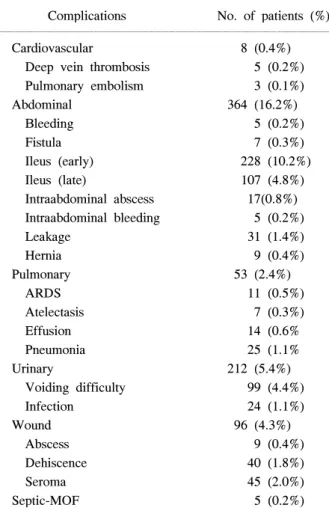
수술 후 합병증은 마비성 장폐색이 228명(10.2%)으 로 가장 빈번하였으며 배뇨장애 99명(4.4%), 창상 합 병증이 96명(4.3%)순으로 나타났으며(Table 4), 남성, 66세 이상 고령, 직장암, 좌측대장절제술, 저위전방절 제술 및 복회음절제술을 받은 환자에서 유의하게 많 이 발생하였다(P<0.05)(Table 3). 개별 동반질환과 수 술 후 합병증 발생률 간 관련성을 알아보면 뇌혈관 질 환과 고혈압 환자에서 특히 높은 수술 후 합병증 발생 률을 보였다(P<0.05)(Table 5). 동반질환이 있는 환자 군은 심부정맥 혈전, 호흡부전과 폐렴을 포함한 호흡 기계 합병증, 창상 합병증 및 패혈증의 빈도가 동반질 환이 없는 환자군에 비해 높았고(P<0.05), 특히 호흡 기계 합병증은 뇌혈관 질환, 고혈압 및 천식 환자에서, 창상 합병증은 고혈압, 뇌혈관 질환, 만성 폐쇄성 폐질 환과 만성 신부전증 환자에서 많이 나타났다(P<0.05)
(Table 6). 동반질환이 2개 이상인 환자는 208명(9.3%) 이었고, 이중 69명(33.2%)에서 수술 후 합병증이 발생 하였으며 동반질환의 수가 많을수록 수술 후 합병증 발생률이 높았다(P<0.05)(Fig. 2).
전체 환자의 평균 재원일수는 15.4일이었다. 동반질 환이 있는 환자군의 평균 재원일수 15.9일은 동반질환 이 없는 환자군의 평균 재원일수 15.2일보다 긴 경향 이 있었으나 통계적으로 유의한 차이는 없었다(P=0.069).
그러나 고혈압이 있었던 환자의 평균 재원일수는 16.4 일로 다른 동반질환이 있었던 환자의 평균 재원일수에 비해 유의한 차이가 있었다(P<0.05)(Fig. 3).
Fig. 3. Length of hospital stay according to comorbidity (*P=0.069, †P<0.05).
Fig. 2. Relation between complication and number of com- orbidity (P<0.05).
Table 4. Overall prevalence of complications ꠚꠚꠚꠚꠚꠚꠚꠚꠚꠚꠚꠚꠚꠚꠚꠚꠚꠚꠚꠚꠚꠚꠚꠚꠚꠚꠚꠚꠚꠚꠚꠚꠚꠚꠚꠚꠚꠚꠚꠚꠚꠚꠚꠚꠚꠚꠚꠚꠚ
Complications No. of patients (%) ꠏꠏꠏꠏꠏꠏꠏꠏꠏꠏꠏꠏꠏꠏꠏꠏꠏꠏꠏꠏꠏꠏꠏꠏꠏꠏꠏꠏꠏꠏꠏꠏꠏꠏꠏꠏꠏꠏꠏꠏꠏꠏꠏꠏꠏꠏꠏꠏꠏ
Cardiovascular 8 (0.4%)
Deep vein thrombosis 5 (0.2%) Pulmonary embolism 3 (0.1%)
Abdominal 364 (16.2%)
Bleeding 5 (0.2%)
Fistula 7 (0.3%)
Ileus (early) 228 (10.2%)
Ileus (late) 107 (4.8%)
Intraabdominal abscess 17(0.8%) Intraabdominal bleeding 5 (0.2%)
Leakage 31 (1.4%)
Hernia 9 (0.4%)
Pulmonary 53 (2.4%)
ARDS 11 (0.5%)
Atelectasis 7 (0.3%)
Effusion 14 (0.6%
Pneumonia 25 (1.1%
Urinary 212 (5.4%)
Voiding difficulty 99 (4.4%)
Infection 24 (1.1%)
Wound 96 (4.3%)
Abscess 9 (0.4%)
Dehiscence 40 (1.8%)
Seroma 45 (2.0%)
Septic-MOF 5 (0.2%)
ꠏꠏꠏꠏꠏꠏꠏꠏꠏꠏꠏꠏꠏꠏꠏꠏꠏꠏꠏꠏꠏꠏꠏꠏꠏꠏꠏꠏꠏꠏꠏꠏꠏꠏꠏꠏꠏꠏꠏꠏꠏꠏꠏꠏꠏꠏꠏꠏꠏ ARDS = adult respiratory distress syndrome; MOF = multiple organ failure; Some patients reported more than one complication.
고 찰
동반질환의 중요성은 기존 연구에서 나타난 것과 같 이 암 자체의 치료와 결과에 많은 영향을 미칠 수 있 다.3-7 또한 대장암의 예후를 결정하는 인자로서 병기 가 가장 중요하지만 동반질환의 유무와 질환의 심한 정도도 중요한 인자 중 하나로 인식되고 있다.5 동반질 환은 특히 재원기간 연장과 수술 후 합병증 발생 증가 및 단기 사망률 증가에도 영향을 미치는 것으로 알려 져 있다.3 많은 연구에서 동반질환의 수와 심한 정도를 점수로 환산하여 사망률과 이환율을 비교하였는데 질 환의 정도가 심할수록 또 그 수가 많을수록 합병증을
포함한 수술 후 이환율이 높았으며, 이 점수가 사망률 의 예측 인자가 된다고 하였다.8,9 내과적 동반질환은 대장암 환자의 치료, 결과 및 재원기간에 영향을 주고, 특히 심장 질환은 생존율 저하에 가장 큰 영향을 준다 는 연구도 있다.6 따라서 동반질환 자체의 적절한 치료 로 수술 후 합병증을 줄이고 재원기간을 단축시켜, 더 나은 치료 결과를 얻을 수 있다는 가정하에 본 연구를 시행하였다.
대부분 연구에서 동반질환을 국제질병분류와 Charl- son Comobidity Index에 따라 분류하였으며,8 동반질환 은 연령이 증가할수록 빈도가 증가하여 70세 이하는 35%, 70세 이상에서는 61%가 동반된다고 보고하였 Table 5. Incidence of postoperative complications according to comorbidity
ꠚꠚꠚꠚꠚꠚꠚꠚꠚꠚꠚꠚꠚꠚꠚꠚꠚꠚꠚꠚꠚꠚꠚꠚꠚꠚꠚꠚꠚꠚꠚꠚꠚꠚꠚꠚꠚꠚꠚꠚꠚꠚꠚꠚꠚꠚꠚꠚꠚꠚꠚꠚꠚꠚꠚꠚꠚꠚꠚꠚꠚꠚꠚꠚꠚꠚꠚꠚꠚꠚꠚꠚꠚꠚꠚꠚꠚꠚꠚꠚꠚꠚꠚꠚꠚꠚꠚꠚꠚꠚꠚꠚꠚꠚꠚꠚꠚꠚꠚꠚꠚꠚꠚꠚ Complication (%)
Comorbidity ꠏꠏꠏꠏꠏꠏꠏꠏꠏꠏꠏꠏꠏꠏꠏꠏꠏꠏꠏꠏꠏꠏꠏꠏꠏꠏꠏꠏꠏꠏꠏꠏꠏꠏꠏꠏꠏꠏꠏꠏꠏꠏꠏꠏꠏꠏꠏꠏꠏꠏꠏ
Any (578, 25.8%) None (1664, 74.2%)
ꠏꠏꠏꠏꠏꠏꠏꠏꠏꠏꠏꠏꠏꠏꠏꠏꠏꠏꠏꠏꠏꠏꠏꠏꠏꠏꠏꠏꠏꠏꠏꠏꠏꠏꠏꠏꠏꠏꠏꠏꠏꠏꠏꠏꠏꠏꠏꠏꠏꠏꠏꠏꠏꠏꠏꠏꠏꠏꠏꠏꠏꠏꠏꠏꠏꠏꠏꠏꠏꠏꠏꠏꠏꠏꠏꠏꠏꠏꠏꠏꠏꠏꠏꠏꠏꠏꠏꠏꠏꠏꠏꠏꠏꠏꠏꠏꠏꠏꠏꠏꠏꠏꠏꠏ
Anemia 11 (1.9) 48 (2.9)
Asthma 4 (0.7) 6 (0.4)
Cardiovascular disease 43 (7.4) 81 (4.9)
Angina and coronary disease 12 (2.1) 21 (1.3)
Arrhythmia 18 (3.1) 30 (1.8)
Congestive heart failure 8 (1.4) 18 (1.1)
Valvular disease 4 (0.7) 8 (0.5)
History of myocardial infarction 3 (0.5) 8 (0.5)
Cerebrovascular accident* 15 (2.6) 14 (0.8)
Diabetes mellitus 50 (8.7) 160 (9.6)
Currently receiving insulin 5 (0.9) 21 (1.3)
Problem without insulin 45 (7.8) 139 (8.4)
Hepatic disease 29 (5.0) 60 (3.6)
Hepatitis B carrier 16 (2.8) 36 (2.2)
Chronic active hepatitis and cirrhosis 13 (2.2) 25 (1.5)
Hypertension† 107 (18.5) 233 (14.0)
Previous cancer 14 (2.4) 42 (2.5)
HNPCC related 7 (1.2) 13 (0.8)
Others cancer 7 (1.2) 29 (1.7)
Pulmonary disease 20 (3.5) 52 (3.1)
Chronic obstructive pulmonary disease 18 (3.1) 48 (2.9)
Tuberculosis (active) 2 (0.3) 4 (0.2)
Chronic renal failure 2 (0.3) 2 (0.1)
Thyroid disease 2 (0.3) 13 (0.8)
Hyperthyroidism 4 (0.3) 8 (0.5)
Hypothyroidism 0 5 (0.3)
Others 1 (0.2) 10 (0.6)
ꠏꠏꠏꠏꠏꠏꠏꠏꠏꠏꠏꠏꠏꠏꠏꠏꠏꠏꠏꠏꠏꠏꠏꠏꠏꠏꠏꠏꠏꠏꠏꠏꠏꠏꠏꠏꠏꠏꠏꠏꠏꠏꠏꠏꠏꠏꠏꠏꠏꠏꠏꠏꠏꠏꠏꠏꠏꠏꠏꠏꠏꠏꠏꠏꠏꠏꠏꠏꠏꠏꠏꠏꠏꠏꠏꠏꠏꠏꠏꠏꠏꠏꠏꠏꠏꠏꠏꠏꠏꠏꠏꠏꠏꠏꠏꠏꠏꠏꠏꠏꠏꠏꠏꠏ HNPCC = hereditary nonpolyposis colorectal carcinoma. *P<0.05, Odd Ratio = 1.343, with complication vs. without complication; †P<0.05, Odd Ratio = 2.733, with complication vs. without complication.
고,4 동반질환 중 79%가 내과적 질환이라고 하였다.6 다른 연구에서도 대부분의 암이 65세 이상에서 발생 하며, 전체 암 환자의 55%와 암 사망 환자의 67%가 이 나이군에 있고, 나이가 많은 환자일수록 동반질환 이 많으며, 동반질환으로는 고혈압과 심혈관계 질환이 가장 높은 비율을 차지한다고 하였고,10,11 암 환자의 81%에서 동반질환이 있고 심혈관계 질환이 59%, 폐질 환이 17%를 차지하며, 고혈압의 빈도가 가장 높다고 하였다.3 본 연구에서도 위의 분류를 기초로 의무기록 에 명시되어 있고, 치료를 받은 병력이 있는 질환을 동 반질환으로 분류하였으며, 그 빈도는 고혈압, 당뇨병, 심혈관계 질환순으로 나타났고, 기존 연구와 같이 나 이가 증가할수록 높은 빈도의 동반질환을 가지고 있
었다. 동반질환은 나이뿐만 아니라 성별간 차이를 보 일 수 있다. 동반질환 유무와 성별간 일정한 결과가 없
지만,12-14 본 연구에서는 남자에서 동반질환의 빈도가
높았다.
동반질환은 대장암 발견 시기와 관련이 있으며 조 기 대장암 환자는 동반질환의 유병률이 높다는 연구 가 있으나,4 그와 반대로 동반질환이 있는 대장암 환자 들은 진행성 암이 더 많다는 연구도 있다.2 이러한 논 란은 동반질환이 있는 환자는 동반질환에 대한 진료 시 각종 암에 대한 선별검사가 많이 이루어져 발견시 기가 빨라질 수 있다는 점과, 동반질환에 의한 증상이 조기암 증상을 희석하여 암의 진단이 늦어질 수도 있 다는 점을 반영한 결과라 생각된다. 본 연구에서는 동 Table 6. Correlation between complication and comorbidity
ꠚꠚꠚꠚꠚꠚꠚꠚꠚꠚꠚꠚꠚꠚꠚꠚꠚꠚꠚꠚꠚꠚꠚꠚꠚꠚꠚꠚꠚꠚꠚꠚꠚꠚꠚꠚꠚꠚꠚꠚꠚꠚꠚꠚꠚꠚꠚꠚꠚꠚꠚꠚꠚꠚꠚꠚꠚꠚꠚꠚꠚꠚꠚꠚꠚꠚꠚꠚꠚꠚꠚꠚꠚꠚꠚꠚꠚꠚꠚꠚꠚꠚꠚꠚꠚꠚꠚꠚꠚꠚꠚꠚꠚꠚꠚꠚꠚꠚꠚꠚꠚꠚꠚꠚ Comorbidity (%)
Complications ꠏꠏꠏꠏꠏꠏꠏꠏꠏꠏꠏꠏꠏꠏꠏꠏꠏꠏꠏꠏꠏꠏꠏꠏꠏꠏꠏꠏꠏꠏꠏꠏꠏꠏꠏꠏꠏꠏꠏꠏꠏꠏ Significant specific comorbidity† Any (789, 35.2%) None (1453, 64.8%)
ꠏꠏꠏꠏꠏꠏꠏꠏꠏꠏꠏꠏꠏꠏꠏꠏꠏꠏꠏꠏꠏꠏꠏꠏꠏꠏꠏꠏꠏꠏꠏꠏꠏꠏꠏꠏꠏꠏꠏꠏꠏꠏꠏꠏꠏꠏꠏꠏꠏꠏꠏꠏꠏꠏꠏꠏꠏꠏꠏꠏꠏꠏꠏꠏꠏꠏꠏꠏꠏꠏꠏꠏꠏꠏꠏꠏꠏꠏꠏꠏꠏꠏꠏꠏꠏꠏꠏꠏꠏꠏꠏꠏꠏꠏꠏꠏꠏꠏꠏꠏꠏꠏꠏꠏ
Cardiovascular 5 (0.6) 3 (0.2) Hypertension
Deep vein thrombosis* 4 (0.5) 1 (0.1) Hypertension Pulmonary embolism 1 (0.1) 2 (0.1)
Abdominal 125 (15.8) 239 (16.4)
Intraluminal bleeding 3 (0.4) 2 (0.2)
Fistula 2 (0.3) 5 (0.3)
Ileus (early) 84 (10.6) 144 (9.9)
Ileus (late) 27 (3.4) 80 (5.5)
Intraabdominal abscess 5 (0.6) 12 (0.8)
Intraabdominal bleeding 3 (0.4) 2 (0.1) Hypertension
Leakage 12 (1.5) 19 (1.3)
Hernia 3 (0.4) 6 (0.4)
Pulmonary* 30 (3.8) 23 (1.6) CVA
ARDS* 7 (0.9) 4 (0.4)
Atelectasis 2 (0.3) 5 (0.3) CVA
Effusion 8 (1.0) 6 (0.4)
Pneumonia* 14 (1.8) 11 (0.8) Asthma, hypertension
Urinary 38 (4.8) 83 (5.7)
Voiding difficulty 27 (3.4) 72 (5.0)
Infection 12 (1.5) 12 (0.8)
Wound* 49 (6.2) 47 (3.2) Asthma, CVA, hypertension
Abscess 4 (0.5) 5 (0.3) CVA
Dehiscence* 23 (2.9) 17 (1.2) Asthma, CRF, hypertension
Seroma 20 (2.5) 25 (1.7) CVA, COPD
Septic-MOF* 4 (0.5) 1 (0.1) CVA
ꠏꠏꠏꠏꠏꠏꠏꠏꠏꠏꠏꠏꠏꠏꠏꠏꠏꠏꠏꠏꠏꠏꠏꠏꠏꠏꠏꠏꠏꠏꠏꠏꠏꠏꠏꠏꠏꠏꠏꠏꠏꠏꠏꠏꠏꠏꠏꠏꠏꠏꠏꠏꠏꠏꠏꠏꠏꠏꠏꠏꠏꠏꠏꠏꠏꠏꠏꠏꠏꠏꠏꠏꠏꠏꠏꠏꠏꠏꠏꠏꠏꠏꠏꠏꠏꠏꠏꠏꠏꠏꠏꠏꠏꠏꠏꠏꠏꠏꠏꠏꠏꠏꠏꠏ ARDS = adult respiratory distress syndrome; MOF = multiple organ failure, CRF = chronic renal failure; CVA = cere- brovascular accident; COPD = chronic obstructive pulmonary disease. *P<0.05, with comorbidity vs. without comorbidity;
†P<0.05, logistic regression test.
반질환을 가진 대장암 환자는 0∼II기 환자가 통계적 으로 유의하게 많은 것으로 나타났으며 이는 전자의 원인으로 일부 설명할 수 있다고 생각된다. 대장암 발 생 부위에 따른 동반질환의 빈도는 대장암이 상행결 장으로 가까울수록 동반질환의 유병률이 높다는 보고 도 있으나 명확한 이유를 제시하지는 못하였고,4 반면 결장암 환자가 빈혈을 포함한 더 많은 동반 질환을 가 진다는 보고도 있다.11
본 연구에서는 수술 후 합병증 발생률과 원발암 위 치, 세포 분화도, 종양의 육안적 형태 및 수술 방법 등 과 관련성을 발견할 수는 없었다. 동반질환을 가진 환 자의 초기 사망이 동반질환이 없는 환자에 비해 많았 는데 이는 동반질환의 중증도의 차이 때문이라 생각 되며, 초기 사망의 대부분의 원인은 호흡부전, 출혈과 패혈증이었다. 기존 연구에서 대장암 수술 후 단기 사 망률은 대개 2∼5% 정도로 보고되지만,15-17 본 연구에 서는 0.4%로 아주 낮았는데 이것은 근치적 절제술을 시행할 수 있었던 환자를 대상으로 한 연구이고, 수술 전 타과의 협진을 통하여 충분한 수술 전 처치와 마취 및 수술 후 집중치료, 그리고 수술수기의 정확성 등이 기여했다고 여겨진다.
대장암 수술 후 합병증 발생률은 대개 28∼38% 정 도로 보고되고 있고, 호흡기와 심혈관계 합병증이 많 다는 보고와 장폐색증, 폐렴, 요로감염이 많다는 보고 도 있다.15,18 본 연구에서는 장폐색증이 가장 빈번하였 으며 배뇨장애, 창상 합병증순으로 나타났다. 장폐색 증 환자는 일차적으로 보존적 치료를 하였으며 경비 위배액관 또는 Miller-Abbott 배액관과 적절한 수액 공 급으로 치료하였다. 그러나 복막 자극 증상, 발열, 백 혈구 증가 등 장교액의 증거가 나타나면 응급 개복술 을 시행하였다. 배뇨장애는 뇨관을 제거한 후에도 자 의로 배뇨를 못하거나 잔료량이 300 cc 이상일 때를 말하며 뇨관을 재삽입하여 방광의 휴식을 유도하고 적절한 약물치료를 병행하였다. 창상 감염은 균 동정 후 적절한 치료를 하였다. 수술 후 합병증은 남성, 고 령, 직장암, 좌측대장절제술, 저위전방절제술, 복회음 절제술을 시행한 경우 유의하게 빈번하였으나, 병기를 포함한 조직병리학적 특성과는 연관성이 없었다. 동반 질환 종류와 수술 후 합병증 발생 빈도간 관련성에 대 한 기존 연구에서 뇌혈관 질환은 수술 후 합병증 빈도 가 높고 폐렴이 잘 생기며, 폐질환은 호흡기 합병증을 증가시킨다는 보고가 있다.6 본 연구에서 동반질환 종 류와 수술 후 합병증간 관련성을 연구한 결과 고혈압 과 심혈관계 질환이 있는 경우 수술 후 합병증 발생
빈도가 높았으나 당뇨, 폐 질환, 간질환 및 신장질환 등은 수술 후 합병증 발생 빈도에 영향을 주지 못하였 다. 이는 창상 치유에 관여하는 인자로 혈액순환이 중 요하다는 사실을 암시하는 것이라 생각되며, 당뇨병은 창상 치유에 영향을 미치지만 잘 조절된 당뇨는 거의 영향을 미치지 않는다고 생각된다. 수술 후 합병증 종 류와 동반질환 종류간 관련성에 대한 연구는 거의 없 는 상태이며, 본 연구에서 회귀분석을 시행한 결과 호 흡기 합병증은 고혈압, 천식, 뇌혈관 질환을 가진 환자 에서 빈번하였고, 창상 합병증은 천식, 뇌혈관 질환, 고혈압, 만성 신부전증에서 유의하게 빈번하였다. 특 히 뇌혈관 질환은 감염과 밀접한 연관성을 보였는데 이는 당뇨병, 간질환 등과 달리 고혈압, 뇌혈관질환, 폐질환 등은 혈액순환 장애 및 산소 공급 결핍을 유발 하기 때문이며, 특히 혈관질환에 대한 수술 전 관리는 매우 중요하다는 것을 의미한다. 동반질환의 수가 많 을수록 수술 후 합병증 발생률이 높아진다는 점은 기존 연구와2,5 유사하다고 생각된다(Fig. 2).
재원일수에 영향을 미치는 인자는 여러 가지가 있 고 재원일수를 줄이기 위해 다양한 수술 후 환자 관리 프로토콜을 보고한 연구들이 있다.19-22 대장절제술을 받은 환자에서 수술 후 지속적인 경막외마취를 통해 수술 부위 통증을 줄이고 조기 운동과 조기 경구 투여 로 재원기간의 감소와 수술 후 마비성 장폐색증, 심장, 호흡기 합병증을 줄일 수 있다고 하였고,19 복부 수술 후 조기 경구 투여와 운동으로 심한 동반질환을 가진 환자에서 빠른 회복과 재원기간 단축 및 병원 내 감염 기회를 줄일 수 있다는 보고도 있다.20 반면 고령, 수술 후 경비위배액관의 삽입, 응급수술은 평균 재원일수를 의미있게 증가시킨다고 하였다.22 수술 후 합병증 발생 유무가 동반질환 유무보다 재원기간에 더 큰 영향을 준다고 보고가 있으며,6 본 연구에서도 재원기간이 동 반질환이 있는 환자에서 긴 경향은 있었으나 통계적 유의성은 없었고, 동반질환보다 장폐색증, 배뇨장애 등 수술 후 합병증이 재원기간을 연장시키는 것으로 나타났다. 그러나 이러한 합병증은 동반질환을 가진 환자에게서 더 많이 발생하므로 결과적으로 동반질환 이 재원기간과 연관성이 있다고 하겠다.
본 연구는 몇 가지 제한점을 가지고 있다. 의무기록 을 분석하여 후향적으로 조사하였기 때문에 연구의 정확성과 객관성이 부족하며, 동반질환의 심한 정도를 파악하기 어려워 동반질환의 세분화가 되지 않았다는 점이 연구 결과에 영향을 주었으며, 동반질환에 대한 의무기록이 비교적 양호한 최근 환자만을 대상으로
하였기 때문에 수술 후 장기 성적을 비교할 수 없었다.
향후 더욱 정확한 연구를 위해서는 충분한 추적기간 과 함께 전향적인 연구가 필요하다고 생각한다.
결 론
대장암 환자의 동반질환은 대장암의 진단, 치료, 결 과, 수술 후 합병증 등과 밀접한 관계가 있다. 그러므 로 수술 전 동반질환을 철저히 진단하고, 동반질환의 종류에 따른 환자 개개인에 적절한 수술 전 처치와 마 취 및 수술 후 집중치료를 시행하면 수술 후 합병증을 최소화하고 대장암의 치료 성적을 향상시키고 재원일 수를 줄이며 병원비용을 감소시킬 수 있으리라 생각 한다. 또한 향후 전향적인 연구와 충분한 추적관찰 기 간을 통하여 동반질환이 있는 대장암 환자에 적절한 수술 전, 마취 및 수술 후 관리 프로그램 개발이 수반 되어야 한다고 생각한다.
REFERENCES
1. Feinstein AR. The pre-therapeutic classification of comor- bidity in chronic disease. J Chron Dis 1970;23:455-68.
2. Gonzalez EC, Ferrante JM, Van Durme DJ, Pal N, Roe- tzheim RG. Comorbid illness and the early detection of cancer. South Med J 2001;94:913-20.
3. Ko C, Chaudhry S. The need for a multidisciplinary ap- proach to cancer care. J Surg Res 2002;105:53-7.
4. De Marco MF, Janssen-Heijnen ML, van der Heijden LH, Coebergh JW. Comorbidity and colorectal cancer according to subsite and stage: a population-based study.
Eur J Cancer 2000;36:95-9.
5. Rieker RJ, Hammer E, Eisele R, Schmid E, Hogel J. The impact of comorbidity on the overall survival and the cause of death in patients after colorectal cancer resec- tion. Langenbecks Arch Surg 2002;387:72-6.
6. Payne JE, Meyer HJ. The influence of other diseases upon the outcome of colorectal cancer patients. Aust N Z J Surg 1995;65:398-402.
7. Piccirillo JF. Importance of comorbidity in head and neck cancer. Laryngoscope 2000;110:593-602.
8. Charlson ME, Pompei P, Ales KL, MacKenzie CR. A new method of classifying prognostic comorbidity in longitudinal studies: development and validation. J Chron Dis 1987;40:373-83.
9. Charlson M, Szatrowski TP, Peterson J, Gold J. Valida- tion of a combined comorbidity index. J Clin Epidemiol 1994;47:1245-51.
10. Yancik R, Ries LG. Cancer in the aged. An epidemi-
ologic perspective on treatment issues. Cancer 1991;68:
2502-10.
11. Yancik R, Wesley MN, Ries LA, Havlik RJ, Long S, Edwards BK, et al. Comorbidity and age as predictors of risk for early mortality of male and female colon carcinoma patients: a population-based study. Cancer 1998;82:2123-34.
12. Dominitz JA, Samsa GP, Landsman P, Provenzale D.
Race, treatment, and survival among colorectal carci- noma patients in an equal-access medical system. Cancer 1998;82:2312-20.
13. Repetto L, Venturino A, Vercelli M, Gianni W, Bian- cardi V, Casella C, et al. Performance status and comorbidity in elderly cancer patients compared with young patients with neoplasia and elderly patients with- out neoplastic conditions. Cancer 1998;82:760-5.
14. Wudel LJ Jr, Chapman WC, Shyr Y, Davidson M, Jeya- kumar A, Rogers SO Jr, et al. Disparate outcomes in patients with colorectal cancer: effect of race on long- term survival. Arch Surg 2002;137:550-4.
15. Longo WE, Virgo KS, Johnson FE, Oprian CA, Vernava AM, Wade TP, et al. Risk factors for morbidity and mor- tality after colectomy for colon cancer. Dis Colon Rectum 2000;43:83-91.
16. Frizelle FA, Emanuel JC, Keating JP, Dobbs BR. A multicentre retrospective audit of outcome of patients undergoing curative resection for rectal cancer. N Z Med J 2002;115:284-6.
17. Kessler H, Hermanek P Jr, Wiebelt H. Operative mor- tality in carcinoma of the rectum. Results of the German Multicentre Study. Int J Colorectal Dis 1993;8:158-66.
18. Bokey EL, Chapuis PH, Fung C, Hughes WJ, Koorey SG. Brewer D, et al. Postoperative morbidity and mor- tality following resection of the colon and rectum for cancer. Dis Colon Rectum 1995;38:480-6.
19. Basse L, Jakobsen DH, Billesbolle P, Lund C, Werner M, Kehlet H. Accelerated rehabilitation after colon resec- tion. Ugeskr Laeger 2001;163:913-7.
20. Delaney CP, Fazio VW, Senagore AJ, Robinson B, Halverson AL, Remzi FH. ‘Fast track' postoperative management protocol for patients with high co-mor- bidity undergoing complex abdominal and pelvic colore- ctal surgery. Br J Surg 2001;88:1533-8.
21. Azimuddin K, Rosen L, Reed JF 3rd. Computerized assessment of complications after colorectal surgery: is it valid? Dis Colon Rectum 2001;44:500-5.
22. Schoetz DJ Jr, Bockler M, Rosenblatt MS, Malhotra S, Roberts PL, Murray JJ, et al. “Ideal” length of stay after colectomy: whose ideal? Dis Colon Rectum 1997;40:
806-10.