ISSN 2234-3806 • eISSN 2234-3814
http://dx.doi.org/10.3343/alm.2015.35.6.611
Increase in Anti-Gal IgM Level is Associated With Early Graft Failure in Intraportal Porcine Islet
Xenotransplantation
Hee Jung Kang, M.D.1, Haneulnari Lee, M.S.1, Eun Mi Park, M.S.1, Jong Min Kim, Ph.D.2, Jun-Seop Shin, Ph.D.2, Jung-Sik Kim, Ph.D.2, Chung-Gyu Park, M.D.2,3, and Sang Joon Kim, M.D.2
Department of Laboratory Medicine1, Hallym University College of Medicine, Anyang; Xenotransplantation Research Center2, Seoul National University College of Medicine, Seoul; Department of Microbiology and Immunology3, Cancer Research Institute, Seoul National University College of Medicine, Seoul National University Hospital Biomedical Research Institute, Seoul, Korea
Background: Anti-Gal is a major antibody induced in non-human primates (NHPs) after xenotransplantation. To understand the mechanism of graft rejection, we investigated the association between anti-Gal responses and graft failure in NHP recipients of porcine islet transplantation (PITx).
Methods: Intraportal PITx was performed in 35 diabetic NHPs, and graft function was monitored. Early graft failure (EGF) was defined as loss of graft function within a month af- ter PITx. Seven, 19, nine NHPs received immunosuppression (IS) without CD40 pathway blockade (Group I), with anti-CD154 (Group II), and with anti-CD40 (Group III), respec- tively. The anti-Gal levels on day 0 and day 7 of PITx were measured by ELISA.
Results: The frequency of EGF was significantly lower in Group II (26.3%) than in Group I (100%, P =0.0012) and Group III (77.8%, P =0.0166). While levels of anti-Gal IgG in Group I and anti-Gal IgM in Group III increased on day 7 compared with day 0 (P =0.0156 and 0.0273), there was no increase in either on day 7 in Group II. The ratio of anti-Gal IgM or IgG level on day 7 to that on day 0 (Ratio7/0) was significantly higher in recipients with EGF than without EGF (P =0.0009 and 0.0027). ROC curve analysis of anti-Gal IgM Ratio7/0 revealed an area under the curve of 0.789 (P =0.0003).
Conclusions: IS with anti-CD154 suppressed anti-Gal responses and prevented EGF in PITx. Anti-Gal IgM Ratio7/0, being associated with EGF, is a predictive marker for EGF.
Key Words: Pig, Non-human primate, Islets, Xenotransplantation, Antibody, Gal, Early graft failure
Received: February 16, 2015 Revision received: May 4, 2015 Accepted: August 9, 2015
Corresponding author: Hee Jung Kang Department of Laboratory Medicine, Hallym University College of Medicine, 22 Gwanpyeong-ro 170beon-gil, Dongan-gu, Anyang 14068, Korea
Tel: +82-31-380-3929 Fax: +82-31-380-3934
E-mail: [email protected]
© The Korean Society for Laboratory Medicine This is an Open Access article distributed under the terms of the Creative Commons Attribution Non-Commercial License (http://creativecom- mons.org/licenses/by-nc/3.0) which permits unrestricted non-commercial use, distribution, and reproduction in any medium, provided the original work is properly cited.
INTRODUCTION
Islet transplantation is a useful therapeutic modality for patients with type 1 diabetes [1, 2]; however, a shortage of donor organs impedes the widespread application of islet transplantation [3].
Porcine islets have been proposed as a readily available and conceptually unlimited alternative source [4], and long-term glu- cose control has been achieved in diabetic non-human primate
(NHP) recipients of intraportal porcine islet transplantation (PITx) with the use of CD40 costimulation pathway blockade [5-9].
However, the reported graft survival is not highly reproducible.
PITx in a human or NHP recipient elicits humoral responses against porcine antigens, including Galα1,3Gal (Gal) and non- Gal antigens [10]. Gal is a carbohydrate antigen, expressed uni- versally in most species including bacteria and fungi, but not in humans or NHPs [11]. Anti-Gal is the most abundant natural
antibody in humans, which is found as IgM, and to a lesser ex- tent as IgG and IgA; it is continuously produced in response to antigenic stimulation by common gut bacteria [11, 12]. Use of Gal-deficient porcine organ significantly prevents graft rejection in organ xenotransplantation [13, 14], but transplantation of Gal-deficient porcine islets does not improve graft survival in PITx [15].
CD40 signaling on B cells via interaction with CD154 ex- pressed on T cells is critical for B cell survival and proliferation, antibody production and isotype switching, germinal center for- mation, memory generation, and cytokine production [16]. Anti- CD154 or anti-CD40 antibodies targeting the CD40 costimula- tion pathway efficiently suppress humoral responses in the re- cipient of a xenotransplantation [5, 9, 17-19]. We previously re- ported that an immunosuppression (IS) regimen involving the use of anti-CD154 suppresses the induction of anti-non-Gal and anti-Gal antibodies and prolongs graft survival for up to a year in NHP recipients of PITx [8, 10]. In contrast, a similar IS regimen involving anti-CD40 suppressed xenoreactive IgG responses af- ter PITx as well, but failed to sustain the graft function for longer than a month [10]. Thus, suppression of humoral responses against xenoantigens appears to be essential but insufficient for sustained graft survival in PITx. The exact mechanism underly- ing early graft rejection in recipients with anti-CD40 IS is not clearly defined. Considering humoral responses are brought about by cross-talk with other innate and adaptive immune cells following contact with the antigen [20-22], precise characteriza- tion and measurement of xenoreactive antibodies after trans- plantation may provide useful information on graft rejection.
Thus, we measured the levels of anti-Gal IgG and IgM prior to and on day 7 of PITx and investigated the association of anti- body responses with the graft survival in the NHP recipients of PITx. This study demonstrates that the ratio of the anti-Gal anti- body level on day 7 to that on day 0 of PITx is significantly asso- ciated with the loss of graft function within a month after PITx.
METHODS
1. Intraportal PITx in rhesus monkeys
All data on animal experiments, the use of IS agents, and the survival of the grafts were retrospectively collected from the ar- chival database of our research group and have partly been pre- viously reported [8, 10]. Preparation of the porcine islets and in- traportal transplantation were performed as previously described [8]. All animals used in this study were cared for in accordance with the National Institutes of Health Guide for the Care and Use
of Laboratory Animals; the primate study protocols were ap- proved by the Institutional Animal Care and Use Committee at Seoul National University Hospital, Seoul, Korea. Briefly, islets were isolated by using the modified Ricordi method from wild- type Seoul National University miniature adult pigs [23, 24]. Iso- lated porcine islets were infused via the portal vein into strepto- zotocin-induced diabetic rhesus monkeys receiving induction IS.
Data for a total of 35 transplantations in naïve rhesus monkeys were collected; data of repeat transplantations or transplanta- tions into recipients with previous exposure to porcine tissues were excluded. The induction IS regimens are summarized in Table 1: seven recipients received various induction IS regimens without CD40 pathway blockade (Group I) and 28 recipients re- ceived induction IS with anti-CD154 (n=19, Group II) or anti- CD40 (n=9, Group III). The dose of IS regimen and route of ad- ministration were described in our previous studies [8, 10].
Blood samples were drawn in EDTA tubes from each recipient prior to the transplantation (day 0) and a week after transplanta- tion (day 7 +/- 2 days). Aliquots of plasma samples were stored at -70°C until they were used. The survival of the graft was deter- mined as the time at which the recipient did not maintain eugly- cemia without exogenous insulin at a dose similar to the pre-PITx
Table 1. Frequencies of EGF in 35 recipients after porcine islet transplantation according to induction immunosuppression regimen
Group Induction immunosuppression N EGF
Group I no CD40 pathway blockade (N=7)
Tacrolimus, leflunomide, MMF, basiliximab, rituximab
1 7 (100%)
Campath, tacrolimus, leflunomide, MMF 1 ATG, bortezomib, leflunomide, MMF 1
ATG, bortezomib 1
Anti-ICAM1, bortezomib, rituximab 1
Anti-ICAM1 1
Anti-ICAM1, bortezomib, leflunomide 1 Group II
anti-CD154 (N=19)
Anti-CD154, sirolimus, anti-ICAM1 10 5 (26.3%)*
Anti-CD154, sirolimus, ATG 7
Anti-CD154, sirolimus 2
Group III anti-CD40 (N=9)
Anti-CD40, sirolimus, ATG 2 7 (77.8%) Anti-CD40, sirolimus, CTLA4-Ig 1
Anti-CD40, sirolimus, ATG, CTLA4-Ig 2 Anti-CD40, sirolimus, tacrolimus 1 Anti-CD40, sirolimus, tacrolimus, ATG 3
*Fisher’s exact test; vs. Group I, P =0.0012; vs. Group III, P =0.0166.
Abbreviations: Anti-ICAM1, anti-human intercellular adhesion molecule 1 antibody; ATG, anti-thymocyte globulin; CTLA4-Ig, CTLA4-immunoglobulin;
EGF, early graft failure; MMF, mycophenolate mofetil.
requirement. Graft survival of less than a month regardless of the cause was defined as early graft failure (EGF).
2. Anti-Gal IgG and IgM measurements
The levels of anti-Gal IgG and IgM antibodies were measured by using an in-house ELISA as previously described [10]. In brief, each well was coated with 100 μL of Galα1-3Galβ1-4GlcNAc- human albumin (5 μg/mL; GlycoTech, Gaithersburg, MD, USA) and blocked with 1% human albumin (Green Cross Corp., Yon- gin, Korea) diluted in phosphate buffered saline (PBS). Recipi- ent monkey plasma (100 μL) diluted 1:50 (for anti-Gal IgG) or 1:100 (for anti-Gal IgM) in PBS containing 0.1% human albu- min was added into each well in duplicate and incubated at 37°C for 30 min. Subsequently, antibody binding was detected with peroxidase-conjugated anti-human IgG or anti-human IgM (Sigma-Aldrich, St. Louis, MO, USA) and subsequent color re- actions. Serial dilutions of a selected rhesus monkey plasma (as a calibrator), designated as 2,809 artificial units (AU)/mL of anti-Gal IgG and 5,610 AU/mL of anti-Gal IgM, were tested in parallel. A mean absorbance of the sample was compared with that of the calibrator, and each antibody level of the sample was calculated from the calibration curve. Positive control plasma was simultaneously tested in each run, and the cumulative co- efficient of variation of control plasma for 90 independent as- says was 4.53% at the mean concentration of 98 AU/mL for anti-Gal IgG and 6.33% at the mean concentration of 1,169 AU/mL for anti-Gal IgM. The calibrator and control plasma were obtained from rhesus monkeys after repeated sensitization with porcine islets. The reference range of anti-Gal IgG and IgM cal- culated from 45 naïve rhesus monkeys was less than 121 AU/
mL and less than 625 AU/mL, respectively.
3. Statistical analysis
Antibody levels were expressed as the median (range) of a group. Differences in antibody levels between day 0 and day 7 were compared by the Wilcoxon signed rank test, and differ- ences between the groups were compared by the Mann-Whitney U test. Differences in the frequency of EGF between the groups were compared by the Fisher’s exact test. The predictive perfor- mance of antibody ratio for EGF was evaluated by ROC curve analysis. A P value less than 0.05 was considered significant.
RESULTS
1. Graft survival after PITx according to induction IS regimen
The survival of 35 NHP recipients of PITx varied from 3 day tolonger than 750 day (Fig. 1). Among them, 19 recipients (54.3%) lost graft function within a month, defined as EGF.
When we compared the frequency of EGF according to the type of induction IS agent used (Table 1), the frequency of EGF in Group II (26.3%) was significantly lower than that in Group I (100%, P =0.0012) or Group III (77.8%, P =0.0166).
2. Changes in anti-Gal IgG and IgM levels after PITx according to induction IS regimen
When we compared the levels of anti-Gal between day 0 and day 7 in each PITx recipient, the levels of anti-Gal IgM and IgG in- creased on day 7 of PITx compared with that on day 0 in each recipient in Group I, although only the increase in the level of anti-Gal IgG was significant (506 vs. 285 AU/mL for IgM, P =0.0781; 63 vs. 8 AU/mL for IgG, P =0.0156; Table 2). In the recipients of Group II, the level of anti-Gal IgM did not change (P =0.3955), and the level of anti-Gal IgG decreased on day 7 (11 vs. 12 AU/mL, P =0.0361), indicating a suppression of anti- Gal IgM and IgG responses by anti-CD154. In contrast, the re- cipients of Group III showed an increase in the level of anti-Gal IgM on day 7 compared with that on day 0 (472 vs. 332 AU/mL, P =0.0273) but no change in the level of anti-Gal IgG, suggesting a suppression only of the anti-Gal IgG response by anti-CD40.
When the ratio of the level of anti-Gal antibody on day 7 to that on day 0 (Ratio7/0) was compared between three IS groups (Table 2), the anti-Gal IgM Ratio7/0 in the recipients of Group II (0.92) tended to be or was significantly lower than those in the recipients of Group I (1.78, P =0.0603) and Group III (1.52, P =0.0208). The values of anti-Gal IgG Ratio7/0 in Group II (0.75) and Group III (1.01) were not statistically different from
60 50 40 30 20 10 0
0 60 120 180 240 300 360 420 480 540 600 660 720 780 Survival (days)
Relative frequency (%)
Fig. 1. Histogram of graft survival in 35 non-human primate recipi- ents after porcine islet transplantation.
each other but were significantly lower than that in Group I (3.33, P =0.0013 and 0.0229).
3. Relationship between the levels of anti-Gal antibodies and EGF
We next compared the levels of anti-Gal antibodies of the recipi- ents of PITx with and without EGF. There was no difference be- tween these two groups of recipients in the levels of anti-Gal, ei- ther IgM or IgG, on day 0 (P =0.3625 and 0.1907, respectively) and in those on day 7 (P =0.2465 and 0.3043, respectively) of PITx (Table 3). However, when we compared the paired levels of anti-Gal antibodies between day 7 and day 0 in each PITx re- cipient, the level of anti-Gal IgG significantly decreased on day 7
and the level of anti-Gal IgM did not change (P =0.0092 and 0.1297, respectively) in the recipients without EGF, but the lev- els of anti-Gal IgM and IgG significantly increased on day 7 in the recipients with EGF (P =0.0006 and 0.0237, respectively).
Accordingly, the values of anti-Gal IgM Ratio7/0 and IgG Ra- tio7/0 were significantly higher in the recipients with EGF than in the recipients without EGF (IgM Ratio7/0, 1.52 vs. 0.85, P =0.0009; IgG Ratio7/0, 1.33 vs. 0.74, P =0.0027), suggesting a strong association between relative increase of anti-Gal re- sponses on day 7 compared with day 0 and development of EGF in each recipient of PITx.
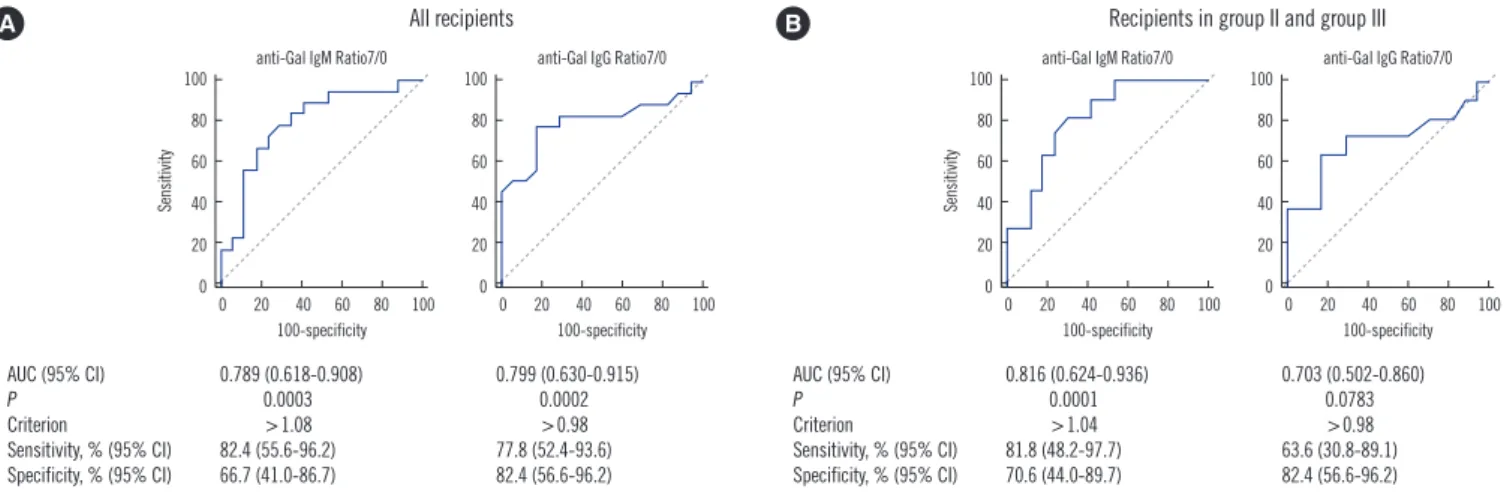
When the predictive performances of the anti-Gal Ratio7/0 for EGF were analyzed by ROC curve, the area under the ROC curve (AUC) of anti-Gal IgM and IgG Ratio7/0 was 0.789 and 0.799 (P =0.0003 and 0.0002, respectively; Fig. 2A) in the analysis of the data from all recipients, and 0.816 and 0.703 (P =0.0001 and 0.0783, respectively; Fig. 2B) in the analysis of the data from the recipients in Group II and Group III, revealing a significant performance of anti-Gal IgM Ratio7/0 for the pre- diction of EGF.
DISCUSSION
This is the first report demonstrating the association between humoral responses and graft outcome in NHP recipients of PITx. Anti-Gal antibodies are frequently induced in NHP recipi- ents of PITx. However, because islet graft rejection precedes antibody induction and the use of Gal-deficient porcine islets delay but not prevent graft failure [15], antibody responses in Table 2. The plasma levels of anti-Gal antibodies in the recipients of porcine islet transplantation according to induction immunosuppres- sion regimen
Anti-Gal Group I
no CD40 pathway blockade (N=7)
Group II anti-CD154
(N=19)
Group III anti-CD40
(N=9)
IgM, median (range) Day 0, AU/mL 285 (90-6,926) 363 (42-1,135) 332 (151-502)
Day 7, AU/mL 506 (57-12,699) 413 (41-2,373) 472 (144-983)
Ratio7/0 1.78 (0.63-2.03) 0.92† (0.36-12.62) 1.52 (0.84-2.23)
P*, day 0 vs. day 7 0.0781 0.3955 0.0273
IgG, median (range) Day 0, AU/mL 8 (3-13,955) 12 (3-48) 6 (1-228)
Day 7, AU/mL 63 (4-46,480) 11 (1-39) 13 (2-230)
Ratio7/0 3.33 (1.25-62.18) 0.75‡ (0.31-5.67) 1.01§ (0.5-6.5)
P*, day 0 vs. day 7 0.0156 0.0361 0.5469
*Wilcoxon signed rank test; †Mann-Whitney test; vs. Group I, P =0.0603; vs. Group III, P =0.0208; ‡Mann-Whitney test; vs. Group I, P =0.0013; §Mann-Whit- ney test; vs. Group I, P =0.0229.
Abbreviations: AU, artificial units; Ratio7/0, ratio of the antibody level on day 7 to that on day 0.
Table 3. The relationship of anti-Gal antibody levels with occur- rence of EGF in the recipients of porcine islet transplantation
Anti-Gal No EGF
(N=16) EGF
(N=19)
P†, no EGF vs.
EGF IgM, Day 0, AU/mL 399 (42-1,135) 285 (90-6,926) 0.3625 median Day 7, AU/mL 439 (41-566) 456 (57-12,699) 0.2465 (range) Ratio7/0 0.85 (0.36-2.17) 1.43 (0.63-12.62) 0.0009
P*, day 0 vs. day 7 0.1297 0.0006
IgG, Day 0, AU/mL 15 (3-48) 7 (1-13,955) 0.1907 median Day 7, AU/mL 11 (3-39) 15 (1-46,480) 0.3043 (range) Ratio7/0 0.74 (0.31-1.75) 1.33 (0.33-62.18) 0.0027
P*, day 0 vs. day 7 0.0092 0.0237
*Wilcoxon signed rank test; †Mann-Whitney test.
Abbreviations: AU, artificial units; EGF, early graft failure; Ratio7/0, ratio of the antibody level on day 7 to that on day 0.
PITx have not been a primary concern. In this study, an in- creased value of anti-Gal antibody Ratio7/0 was associated with early loss of graft function in PITx. Furthermore, we demon- strated that anti-CD40 and anti-CD154 have different effects on anti-Gal IgG and IgM responses.
The costimulatory pathway of CD40-CD154 interaction is es- sential for activation of T cells against antigens [25, 26] and plays an important role in mounting T cell-dependent humoral responses [27, 28]. Consistent with previous studies [5, 6, 19, 29], the use of anti-CD154 in this study suppressed anti-Gal antibody responses and reduced the frequency of EGF in NHP recipients of adult PITx. Unfortunately, anti-CD154 is not clini- cally applicable because of thromboembolic complications [30];
therefore, anti-CD40, which blocks CD40-CD154 interaction in an alternative way, has been used in place of anti-CD154. How- ever, as shown in this study and previously [10], anti-CD40 is not as effective as anti-CD154 in prolonging graft survival. Inter- estingly, anti-CD154 suppressed the induction of both anti-Gal IgG and IgM on day 7 of PITx, whereas anti-CD40 only sup- pressed an increase of anti-Gal IgG.
In this study, the levels of anti-Gal IgM and IgG increased sig- nificantly on day 7 compared with those on day 0 in each PITx recipient with EGF, and anti-Gal IgM and IgG Ratio7/0 signifi- cantly correlated with the occurrence of EGF. However, there was no difference in the levels of anti-Gal, either IgM or IgG, on day 0 and day 7 of PITx between the recipients with and without EGF. These results demonstrate that EGF in the recipients re-
ceiving IS are not caused by antibody-mediated cytotoxicity and that relatively increased antibody responses on day 7 compared with day 0 in the PITx recipients are epiphenomena reflecting uncontrolled activation of immune cells resulting in EGF, as pre- viously suggested in other reports [10, 15, 31].
Thomson et al. [15] reported induction of anti-Gal IgM re- sponses in Gal-deficient xenoislet recipients, indicating that the anti-Gal IgM response is induced by non-specific inflammation independently of the exposure to porcine Gal antigen. Diverse innate immune cells like natural killer (NK) cells, NK T cells, and neutrophils are reported to help B cells produce antibodies against carbohydrate antigens like Gal [22, 32-34]. Taken to- gether, it appears that increased anti-Gal IgM Ratio7/0 may be linked to the activation of innate immune cells following PITx, which mediates graft damage. Recently, Giovannoi et al. [35]
reported the enhancement of islet engraftment and achieve- ment of long-term islet allograft survival by Toll-like receptor 4 blockade in murine islet transplantation models, supporting our speculation of the association between the activation of innate immune cells and EGF in PITx recipients.
It is not clear why anti-CD40 does not prevent EGF while anti- CD154 does, considering both inhibit CD40-CD154 pathway signaling. While CD40 is expressed on antigen presenting cells such as endothelial cells, B cells, monocytes, and dendritic cells, CD154 is expressed on cytotoxic effector cells such as ac- tivated CD4+ and CD8+ T cells, NK cells, basophils, and eosin- ophils [36]. The CD40-CD154 interaction delivers bidirectional
100 80 60 40 20 0
100 80 60 40 20 0 100
80 60 40 20 0
100 80 60 40 20
0 20 40 60 80 100 0 20 40 60 80 100 0 20 40 60 80 100 0 0 20 40 60 80 100
100-specificity 100-specificity
0.789 (0.618-0.908) 0.0003 >1.08 82.4 (55.6-96.2) 66.7 (41.0-86.7)
0.816 (0.624-0.936) 0.0001 >1.04 81.8 (48.2-97.7) 70.6 (44.0-89.7) AUC (95% CI)
P Criterion
Sensitivity, % (95% CI) Specificity, % (95% CI)
AUC (95% CI) P Criterion
Sensitivity, % (95% CI) Specificity, % (95% CI) 0.799 (0.630-0.915)
0.0002 >0.98 77.8 (52.4-93.6) 82.4 (56.6-96.2)
0.703 (0.502-0.860) 0.0783 >0.98 63.6 (30.8-89.1) 82.4 (56.6-96.2)
100-specificity 100-specificity
anti-Gal IgM Ratio7/0 anti-Gal IgG Ratio7/0 anti-Gal IgM Ratio7/0 anti-Gal IgG Ratio7/0
Sensitivity Sensitivity
Fig. 2. Receiver operating characteristic (ROC) curves of anti-Gal IgM Ratio7/0 and IgG Ratio7/0 for the prediction of early graft failure (loss of graft function within a month) in porcine islet transplantation (PITx) analyzed from the data of all recipients (n=35, A) and from the data of the recipients receiving CD40 pathway blockade (n=28, B). Using an in-house ELISA, the levels of anti-Gal IgG and IgM were quantita- tively measured in the plasma samples obtained from the rhesus monkey recipients prior to PITx (day 0) and on day 7 (±2) of PITx. The values of anti-Gal IgM Ratio7/0 and IgG Ratio7/0 for each recipient were calculated from the equation: (antibody level on day 7)/(antibody level on day 0). The area under the ROC curve (AUC) with P value, sensitivity, and specificity at a given optimal criterion are summarized.
Abbreviation: CI, confidence interval.
A All recipients B Recipients in group II and group III
signals: forward signaling for the activation of antigen presenting cells and reverse signaling for the stimulation of T cells and in- nate NK cells [37]. The close association between anti-CD154 IS and the prevention of EGF allows us to hypothesize an addi- tional inhibitory effect of anti-CD154 on reverse signaling of CD154 in innate effector cells attacking porcine islet grafts.
This study was not designed to clarify the precise mechanism of graft rejection nor to prove the effect of each IS regimen on graft survival. However, our study with NHP recipients of PITx demonstrates that lower values of anti-Gal IgM Ratio7/0 are as- sociated with anti-CD154 induction IS and prevention of EGF.
The anti-Gal IgM Ratio7/0 may be useful to predict subsequent development of EGF in NHP recipients of PITx .
Authors’ Disclosures of Potential Conflicts of Interest
No potential conflicts of interest relevant to this article were re- ported.
Acknowledgments
This research was supported by a grant from the Korea Health Technology R&D Project through the Korea Health Industry De- velopment Institute (KHIDI), funded by the Ministry of Health &
Welfare, Republic of Korea (grant number : HI13C0954).
REFERENCES
1. Shapiro AM, Lakey JR, Ryan EA, Korbutt GS, Toth E, Warnock GL, et al.
Islet transplantation in seven patients with type 1 diabetes mellitus us- ing a glucocorticoid-free immunosuppressive regimen. N Engl J Med 2000;343:230-8.
2. Shapiro AM, Ricordi C, Hering BJ, Auchincloss H, Lindblad R, Robert- son RP, et al. International trial of the Edmonton protocol for islet trans- plantation. N Engl J Med 2006;355:1318-30.
3. Matsumoto S. Islet cell transplantation for Type 1 diabetes. J Diabetes 2010;2:16-22.
4. van der Windt DJ, Bottino R, Kumar G, Wijkstrom M, Hara H, Ezzelarab M, et al. Clinical islet xenotransplantation: how close are we? Diabetes 2012;61:3046-55.
5. Hering BJ, Wijkstrom M, Graham ML, Hårdstedt M, Aasheim TC, Jie T, et al. Prolonged diabetes reversal after intraportal xenotransplantation of wild-type porcine islets in immunosuppressed nonhuman primates. Nat Med 2006;12:301-3.
6. Cardona K, Korbutt GS, Milas Z, Lyon J, Cano J, Jiang W, et al. Long- term survival of neonatal porcine islets in nonhuman primates by target- ing costimulation pathways. Nat Med 2006;12:304-6.
7. van der Windt DJ, Bottino R, Casu A, Campanile N, Smetanka C, He J, et al. Long-term controlled normoglycemia in diabetic non-human pri- mates after transplantation with hCD46 transgenic porcine islets. Am J
Transplant 2009;9:2716-26.
8. Kang HJ, Lee H, Ha JM, Lee JI, Shin JS, Kim KY, et al. The role of the alternative complement pathway in early graft loss after intraportal por- cine islet xenotransplantation. Transplantation 2014;97:999-1008.
9. Thompson P, Cardona K, Russell M, Badell IR, Shaffer V, Korbutt G, et al. CD40-specific costimulation blockade enhances neonatal porcine is- let survival in nonhuman primates. Am J Transplant 2011;11:947-57.
10. Kang HJ, Lee H, Park EM, Kim JM, Shin JS, Kim JS, et al. Dissociation between anti-porcine albumin and anti-Gal antibody responses in non- human primate recipients of intraportal porcine islet transplantation.
Xenotransplantation 2015;22:124-34.
11. Galili U. Anti-Gal: an abundant human natural antibody of multiple pathogeneses and clinical benefits. Immunology 2013;140:1-11.
12. Cramer DV. Natural antibodies and the host immune responses to xe- nografts. Xenotransplantation 2000;7:83-92.
13. Kuwaki K, Tseng YL, Dor FJ, Shimizu A, Houser SL, Sanderson TM, et al. Heart transplantation in baboons using alpha1,3-galactosyltransfer- ase gene-knockout pigs as donors: initial experience. Nat Med 2005;
11:29-31.
14. Chen G, Qian H, Starzl T, Sun H, Garcia B, Wang X, et al. Acute rejec- tion is associated with antibodies to non-Gal antigens in baboons using Gal-knockout pig kidneys. Nat Med 2005;11:1295-8.
15. Thompson P, Badell IR, Lowe M, Cano J, Song M, Leopardi F, et al. Islet xenotransplantation using gal-deficient neonatal donors improves en- graftment and function. Am J Transplant 2011;11:2593-602.
16. van Kooten C and Banchereau J. CD40-CD40 ligand. J Leukoc Biol 2000;67:2-17.
17. Galili U. Induced anti-non gal antibodies in human xenograft recipients.
Transplantation 2012;93:11-6.
18. Mohiuddin MM, Singh AK, Corcoran PC, Hoyt RF, Thomas ML 3rd, Lewis BG, et al. Role of anti-CD40 antibody-mediated costimulation blockade on non-Gal antibody production and heterotopic cardiac xe- nograft survival in a GTKO.hCD46Tg pig-to-baboon model. Xenotrans- plantation 2014;21:35-45.
19. Mohiuddin MM, Singh AK, Corcoran PC, Hoyt RF, Thomas ML 3rd, Ayares D, et al. Genetically engineered pigs and target-specific immuno- modulation provide significant graft survival and hope for clinical cardiac xenotransplantation. J Thorac Cardiovasc Surg 2014;148:1106-13.
20. Vos Q, Lees A, Wu ZQ, Snapper CM, Mond JJ. B-cell activation by T-cell- independent type 2 antigens as an integral part of the humoral immune response to pathogenic microorganisms. Immunol Rev 2000;176:154- 70.
21. Alugupalli KR, Akira S, Lien E, Leong JM. MyD88- and Bruton’s tyrosine kinase-mediated signals are essential for T cell-independent pathogen- specific IgM responses. J Immunol 2007;178:3740-9.
22. Li S, Yan Y, Lin Y, Bullens DM, Rutgeerts O, Goebels J, et al. Rapidly in- duced, T-cell independent xenoantibody production is mediated by marginal zone B cells and requires help from NK cells. Blood 2007;
110:3926-35.
23. Kim HI, Lee SY, Jin SM, Kim KS, Yu JE, Yeom SC, et al. Parameters for successful pig islet isolation as determined using 68 specific-pathogen- free miniature pigs. Xenotransplantation 2009;16:11-8.
24. Jin SM, Shin JS, Kim KS, Gong CH, Park SK, Kim JS, et al. Islet isola- tion from adult designated pathogen-free pigs: use of the newer bovine nervous tissue-free enzymes and a revised donor selection strategy would improve the islet graft function. Xenotransplantation 2011;18:
369-79.
25. Armitage RJ, Fanslow WC, Strockbine L, Sato TA, Clifford KN, Macduff BM, et al. Molecular and biological characterization of a murine ligand for CD40. Nature 1992;357:80-2.
26. van Essen D, Kikutani H, Gray D. CD40 ligand-transduced co-stimula- tion of T cells in the development of helper function. Nature 1995;378:
620-3.
27. Noelle RJ, Roy M, Shepherd DM, Stamenkovic I, Ledbetter JA, Aruffo A.
A 39-kDa protein on activated helper T cells binds CD40 and transduc- es the signal for cognate activation of B cells. Proc Natl Acad Sci U S A 1992;89:6550-4.
28. Mackey MF, Barth RJ Jr, Noelle RJ. The role of CD40/CD154 interac- tions in the priming, differentiation, and effector function of helper and cytotoxic T cells. J Leukoc Biol 1998;63:418-28.
29. Kirk AD, Burkly LC, Batty DS, Baumgartner RE, Berning JD, Buchanan K, et al. Treatment with humanized monoclonal antibody against CD154 prevents acute renal allograft rejection in nonhuman primates. Nat Med 1999;5:686-93.
30. Boumpas DT, Furie R, Manzi S, Illei GG, Wallace DJ, Balow JE, et al. A short course of BG9588 (anti-CD40 ligand antibody) improves serologic activity and decreases hematuria in patients with proliferative lupus glo- merulonephritis. Arthritis Rheum 2003;48:719-27.
31. Kirchhof N, Shibata S, Wijkstrom M, Kulick DM, Salerno CT, Clemmings
SM, et al. Reversal of diabetes in non-immunosuppressed rhesus ma- caques by intraportal porcine islet xenografts precedes acute cellular rejection. Xenotransplantation 2004;11:396-407.
32. Snapper CM, Yamaguchi H, Moorman MA, Mond JJ. An in vitro model for T cell-independent induction of humoral immunity. A requirement for NK cells. J Immunol 1994;152:4884-92.
33. Puga I, Cols M, Barra CM, He B, Cassis L, Gentile M, et al. B cell-helper neutrophils stimulate the diversification and production of immunoglob- ulin in the marginal zone of the spleen. Nat Immunol 2011;13:170-80.
34. Vinuesa CG and Chang PP. Innate B cell helpers reveal novel types of antibody responses. Nat Immunol 2013;14:119-26.
35. Giovannoni L, Muller YD, Lacotte S, Parnaud G, Borot S, Meier RP, et al. Enhancement of islet engraftment and achievement of long-term is- let allograft survival by Toll-like receptor 4 blockade. Transplantation 2015; 99:29-35.
36. Grewal IS and Flavell RA. CD40 and CD154 in cell-mediated immunity.
Annu Rev Immunol 1998;16:111-35.
37. Sun M and Fink PJ. A new class of reverse signaling costimulators be- longs to the TNF family. J Immunol 2007;179:4307-12.