ISSN 2234-3806 • eISSN 2234-3814
290 www.annlabmed.org https://doi.org/10.3343/alm.2017.37.3.290 Ann Lab Med 2017;37:290-292
https://doi.org/10.3343/alm.2017.37.3.290
Letter to the Editor
Diagnostic Immunology
Two Cases of Antibody-Mediated Rejection Following Kidney Transplantation due to HLA-DQB1 Allele-
Specific and DQ Alpha Protein-Specific HLA Antibodies
Seung Hwan Song, M.D.1, Borae G. Park, M.D.2,3, Beom Seok Kim, M.D.4, Yu Seun Kim, M.D.1, and Hyon-Suk Kim, M.D.3
Department of Transplantation Surgery1, Severance Hospital, Yonsei University Healthcare System, Seoul; Department of Laboratory Medicine2, Asan Medical Center and University of Ulsan College of Medicine, Seoul; Department of Laboratory Medicine3, Severance Hospital, Yonsei University College of Medicine, Seoul; Department of Internal Medicine4, Yonsei University College of Medicine, Seoul, Korea
Dear Editor,
The HLA-A, HLA-B, and HLA-DR loci have been used for trans- plant candidate matching. Recent studies using single antigen bead-based assays (SABAs) have revealed that HLA-DQ donor- specific HLA antibodies (DSHAs) are associated with inferior al- lograft outcomes [1, 2]. Therefore, donor HLA-DQ typing prior to transplantation is now thought to be highly important.
HLA-DQ antigen typing is determined by HLA-DQB1 genotyp- ing. The HLA-DQ antigen is composed of two alpha protein do- mains, coded by the DQA1 gene, and two beta protein domains, coded by the DQB1 gene. HLA-DQ antigen Luminex SABA beads are coated with both DQ alpha and DQ beta proteins. Therefore, DQ alpha proteins are taken into account in the interpretation of HLA-DQ antibody reactions. However, the clinical significance of DQ alpha-specific DSHA is questionable. In addition, although the clinical significance of allele-specific DSHAs has been es- tablished, the routine application of high-resolution HLA geno- typing remains controversial [3-5].
We report two representative cases of antibody-mediated re- jection (ABMR) following kidney transplantation (KT) due to HLA-
DQB1 allele-specific DSHA and DQ alpha protein-specific DSHA.
HLA typing assays for detecting the HLA-A, -B, -DRB1, and -DQB1 loci were performed by using Luminex technology and LIFECODES HLA SSO typing kits (Immucor Transplant Technol- ogy, Stamford, CT, USA). High-resolution HLA-DQB1 and DQA1 typing results were achieved through direct sequencing of exons 2, 3 of the HLA-DQB1 gene and exons 1, 2, 3, 4 of the HLA- DQA1 gene, using the ABI PRISM 3100 Genetic analyser (Ap- plied Biosystems, Hitachi, Japan). SABAs were performed by using two commercially available Luminex assays (LIFECODES Single Antigen Class I/II [Immucor Transplant Technology] and LABScreen Single Antigen Class I and II [One Lambda, Canoga Park, CA, USA]) and the C1q assay (C1q Screen; One Lambda) was performed to determine DSHA status.
CASE 1
A 21-yr-old woman with end-stage renal disease caused by lu- pus nephritis received a KT from her mother with 0% calculated panel reactive antibody (PRA) in February 2010. Four years fol-
Received: August 30, 2016 Revision received: October 6, 2016 Accepted: December 29, 2016 Corresponding author: Borae G. Park
Department of Laboratory Medicine, Asan Medical Center and University of Ulsan College of Medicine, 88 Olympic-ro 43 gil, Songpa-gu, Seoul 05505, Korea
Tel: +82-2-3010-4510, Fax: +82-2-478-0884 E-mail: [email protected]
© Korean Society for Laboratory Medicine.
This is an Open Access article distributed under the terms of the Creative Commons Attribution Non-Commercial License (http://creativecommons.org/licenses/by-nc/4.0) which permits unrestricted non-commercial use, distribution, and reproduction in any medium, provided the original work is properly cited.
Song SH, et al.
HLA-DQB1 and DQ alpha specific DSHA
https://doi.org/10.3343/alm.2017.37.3.290 www.annlabmed.org 291
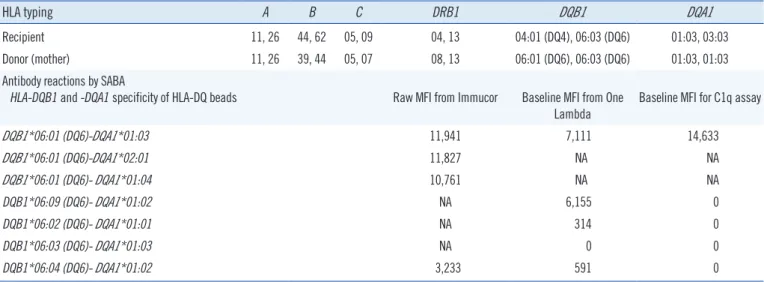
lowing the KT, serum creatinine levels increased to 2.32 mg/dL and a biopsy of the allograft kidney revealed active ABMR with diffusely positive deposition of C4d, g3 (glomerulitis, score 3), and ptc3 (peritubular capillaritis, score 3). At the time of rejec- tion, only HLA-DQ6 class II HLA antibodies were identified by
SABA. No HLA-DQ mismatch was revealed by antigen-level typ- ing. Therefore, high-resolution HLA-DQB1 and DQA1 typing were performed and an HLA-DQB1*06:01 allele-specific DSHA was identified. The C1q assay revealed positive C1q fixing for HLA- DQB1*06:01 DSHA (Table 1).
Table 1. HLA typing and antibody reaction results for case 1 (HLA-DQB1 allele-specific DSHA)
HLA typing A B C DRB1 DQB1 DQA1
Recipient 11, 26 44, 62 05, 09 04, 13 04:01 (DQ4), 06:03 (DQ6) 01:03, 03:03
Donor (mother) 11, 26 39, 44 05, 07 08, 13 06:01 (DQ6), 06:03 (DQ6) 01:03, 01:03
Antibody reactions by SABA
HLA-DQB1 and -DQA1 specificity of HLA-DQ beads Raw MFI from Immucor Baseline MFI from One Lambda
Baseline MFI for C1q assay
DQB1*06:01 (DQ6)-DQA1*01:03 11,941 7,111 14,633
DQB1*06:01 (DQ6)-DQA1*02:01 11,827 NA NA
DQB1*06:01 (DQ6)- DQA1*01:04 10,761 NA NA
DQB1*06:09 (DQ6)- DQA1*01:02 NA 6,155 0
DQB1*06:02 (DQ6)- DQA1*01:01 NA 314 0
DQB1*06:03 (DQ6)- DQA1*01:03 NA 0 0
DQB1*06:04 (DQ6)- DQA1*01:02 3,233 591 0
Abbreviations: DSHA, donor-specific HLA antibody; SABA, single antigen bead assay; MFI, mean fluorescence intensity; NA, not applicable.
Table 2. HLA typing and antibody reaction results for case 2 (HLA-DQA1-specific DSHA)
HLA typing A B DRB1 DQB1 DQA1
Recipient 02, 33 48, 61 12, 14 03:01 (DQ7), 05:03 (DQ5) 01:04, 05:08
Donor (mother) 02, 26 48, 55 12, 14 03:01 (DQ7), 05:03 (DQ5) 01:04, 06:01
Antibody reactions by SABA
HLA-DQB1 and -DQA1 specificity of HLA-DQ beads Raw MFI from Immucor Baseline MFI from One Lambda
DQB1*02:01 (DQ2)-DQA1*04:01 NA 3,867
DQB1*03:03 (DQ9)-DQA1*04:01 3,004 NA
DQB1*04:02 (DQ4)-DQA1*04:01 2,833 5,219
DQB1*04:01 (DQ4)-DQA1*04:01 2,599 NA
DQB1*02:01 (DQ2)-DQA1*05:01 1,323 4,626
DQB1*02:02 (DQ2)-DQA1*05:01 1,450 NA
DQB1*04:01 (DQ4)-DQA1*05:01 2,003 NA
DQB1*03:01 (DQ7)-DQA1*02:01 NA Negative
DQB1*03:01 (DQ7)-DQA1*03:01 NA Negative
DQB1*03:01 (DQ7)-DQA1*03:02 Negative NA
DQB1*03:01 (DQ7)-DQA1*05:01 2,993 NA
DQB1*03:01 (DQ7)-DQA1*05:03 NA 4,627
DQB1*03:01 (DQ7)-DQA1*05:05 NA 3,174
DQB1*03:01 (DQ7)-DQA1*06:01 2,538 4,591
DQB1*03:03 (DQ9)-DQA1*06:01 2,386 NA
DQB1*04:02 (DQ4)-DQA1*06:01 2,075 NA
Abbreviations: see Table 1.
Song SH, et al.
HLA-DQB1 and DQ alpha specific DSHA
292 www.annlabmed.org https://doi.org/10.3343/alm.2017.37.3.290
CASE 2
A 23-yr-old woman with end-stage renal disease caused by IgA nephropathy received a KT with 0% calculated PRA from her mother in August 2011. Three years later, her creatinine level in- creased to 2.24 mg/dL, and a biopsy of the allograft kidney re- vealed active T-cell-mediated rejection (TCMR). Four months later, the creatinine level increased to 6.17 mg/dL, and the al- lograft biopsy revealed TCMR with active ABMR, grade II with C4d negative, g1, and ptc3. Several class II HLA antibodies were identified by SABA. Both donor and recipient’s HLA-DQ antigens were identified as HLA-DQ5 and DQ7. However, the HLA-DQ7 antibody reactions in serum were positive against two of the three Immucor DQ7 beads and three of five One Lambda beads. High- resolution HLA-DQB1 and DQA1 typing revealed donor HLA- DQA1*06:01 that was different from patient HLA-DQA1 gene.
The HLA antibody reactions were positive for HLA-DQA1*04:01, DQA1*05:01, DQA1*05:03, DQA1*05:05, and DQA1*06:01;
these alleles share a confirmed epitope, 40GR3 (40G 41R 45V 47C 48L 50V 51L 52R 53Q 54F 55R, according to the HLA epi- tope registry). Therefore, the recipient antibody reaction was iden- tified as HLA-DQA1*06:01-specific DSHA (Table 2).
HLA antibodies against DQ alpha antigens are observed in up to 79% of highly sensitized patients [5]. HLA-DQ antibodies show activity against both DQ alpha and beta proteins; however, their specific reactions against each type of protein cannot be easily differentiated. Our second case did not exhibit HLA antibodies prior to KT; however, HLA-DQ alpha protein-specific DSHA de- veloped four years after transplantation, and the allograft biopsy revealed C4d negative ABMR.
Allele-specific DSHAs have been reported to have clinical sig- nificances [4]. However, only one of 67 crossmatches was posi- tive for allele-specific DSHAs [6]. Therefore, the clinical signifi- cance of these DSHAs requires further investigation.
Our two cases showed biopsy-proven ABMR due to HLA-DQB1
allele-specific DSHA and DQ alpha protein-specific DSHA. Al- though HLA-DQ typing is not included in routine HLA antigen- matching strategies, it must be performed to evaluate DSHA fol- lowing KT. In addition, high-resolution HLA-DQB1 and DQA1 typing results should be considered when necessary for the in- terpretation of DSHAs in SABA.
Authors’ Disclosures of Potential Conflicts of Interest
No conflicts of interest relevant to this article were reported.
Acknowledgments
This study was supported by a faculty research grant from Yon- sei University College of Medicine (6-2015-0081).
REFERENCES
1. Willicombe M, Brookes P, Sergeant R, Santos-Nunez E, Steggar C, Gal- liford J, et al. De novo DQ donor-specific antibodies are associated with a significant risk of antibody-mediated rejection and transplant glomeru- lopathy. Transplantation 2012;94:172-7.
2. Carta P, Di Maria L, Caroti L, Buti E, Antognoli G, Minetti EE. Anti-hu- man leukocyte antigen DQ antibodies in renal transplantation: Are we underestimating the most frequent donor specific alloantibodies? Trans- plant Rev (Orlando) 2015;29:135-8.
3. Tambur AR, Leventhal JR, Zitzner JR, Walsh RC, Friedewald JJ. The DQ barrier: improving organ allocation equity using HLA-DQ informa- tion. Transplantation 2013;95:635-40.
4. Lomago J, Jelenik L, Zern D, Howe J, Martell J, Zeevi A, et al. How did a patient who types for HLA-B*4403 develop antibodies that react with HLA-B*4402? Hum Immunol 2010;71:176-8.
5. Cecka JM, Reed EF, Zachary AA. HLA high-resolution typing for sensi- tized patients: a solution in search of a problem? Am J Transplant 2015;
15:855-6.
6. Baxter-Lowe LA, Cecka M, Kamoun M, Sinacore J, Melcher ML. Center- defined unacceptable HLA antigens facilitate transplants for sensitized patients in a multi-center kidney exchange program. Am J Transplant 2014;14:1592-8.