The Interference Phenomenon of Microcatheters in the Jailing Treatment for Internal Carotid Artery Side Wall Aneurysms with an Open Cell Stent System
Minwook Yoo1, Sung-Chul Jin1, Seung-Hwan Kim1, Byeong-Sam Choi1, Hae Yu Kim1, SungJun Lee1, Sung Tae Kim2, Hae Woong Jeong3
1Department of Neurosurgery, Inje University, Haeundae Paik Hospital, Busan, Korea
2Department of Neurosurgery, Inje University, Busan Paik Hospital, Busan, Korea
3Department of Diagnostic Radiology, Inje University, Busan Paik Hospital, Busan, Korea
Objective : Excelsior XT-27 (Stryker Neurovascular, Fremont, CA, USA) or Rebar 27 (eV3 Covidien, Irvine, CA, USA) microcatheters have recently been used to overcome the limitations of the Renegade Hi-Flo microcatheter such as interference between two microcatheters (one for stent delivery and the other for cerebral aneurysm coiling) during the jailing technique.
We evaluated differences and influential factors related to the interference phenomenon according to these two microcatheters group.
Materials and Methods : Between June 2011 and September 2013, the jail- ing technique was applied to 94 internal cerebral artery (ICA) aneurysms.
The jailing technique with the Neuroform EZ stent system was performed using Renegade (n = 22), Rebar (n = 35), and XT-27 microcatheters (n = 37). In the Renegade Hi-Flo microcatheter group, the jailing technique was successful in 19/22 patients (86.4%) and interference between the two microcatheters occurred in 6/21 patients (28.6%). In the Rebar and XT-27 microcatheter group, the jailing technique was successful in 71/72 pa- tients (98.6%) and interference between the two microcatheters occurred in 1/72 patients (1.4%).
Results : There was a significant difference in the interference between the two delivered microcatheters group (p-value < 0.000) and the carotid siphon angle (p-value: 0.004) in the univariate analysis. In the multiple lo- gistic regression analysis, the Rebar and XT-27 microcatheter group (odds ratio [OD] [95% confidence interval (CI)]; 31.277 [3.138-311.729], p-value:
0.003) and the carotid siphon angle (OD [95%CI]; 0.959 [0.922-0.997], p-value: 0.035) were found to be influential factors in the interference phenomenon.
Conclusion : The Rebar 27 and XT-27 microcatheters were more success- ful and exhibited less interference between the two microcatheters than the Renegade Hi-Flo microcatheter.
J Cerebrovasc Endovasc Neurosurg.
2016 December;18(4):363-368 Received : 22 March 2016 Revised : 1 September 2016 Accepted : 26 November 2016 Correspondence to Sung-Chul Jin
Department of Neurosurgery, Inje University Haeundae Paik Hospital, 875 Haeundae-ro, Haeundae-gu, Busan 48108, Korea Tel : 82-51-797-0607
Fax : 82-51-703-0434 E-mail : [email protected]
ORCID : http://orcid.org/0000-0001-5282-9329
This is an Open Access article distributed under the terms of the Creative Commons Attribution Non- Commercial License (http://creativecommons.org/li- censes/by-nc/3.0) which permits unrestricted non- commercial use, distribution, and reproduction in any medium, provided the original work is properly cited.
Keywords ICA, Open cell stent, Side wall aneurysm, Microcatheter
INTRODUCTION
The Neuroform EZ stent system may represent aRenegade Hi-Flo microcatheter Rebar 27 or XT 27 microcatheter p-value
Gender 0.537
Male 5 18
Female 17 54
Age (years) 56.7 ± 8.8 56.5 ± 11.1 0.949
Aneurysm location 0.547
Paraclinoid segment 18 60
p-com segment 4 12
Carotid siphon angle 75.8 ± 30.0 84.3 ± 30.0 0.223
Aneurysm height (mm) 3.6 ± 1.3 3.7 ± 1.7 0.667
Aneurysm neck size (mm) 3.2 ± 0.8 3.7 ± 1.6 0.179
Aneurysm width (mm) 3.6 ± 1.1 4.5 ± 2.3 0.015
Values are presented as number or mean ± standard deviation
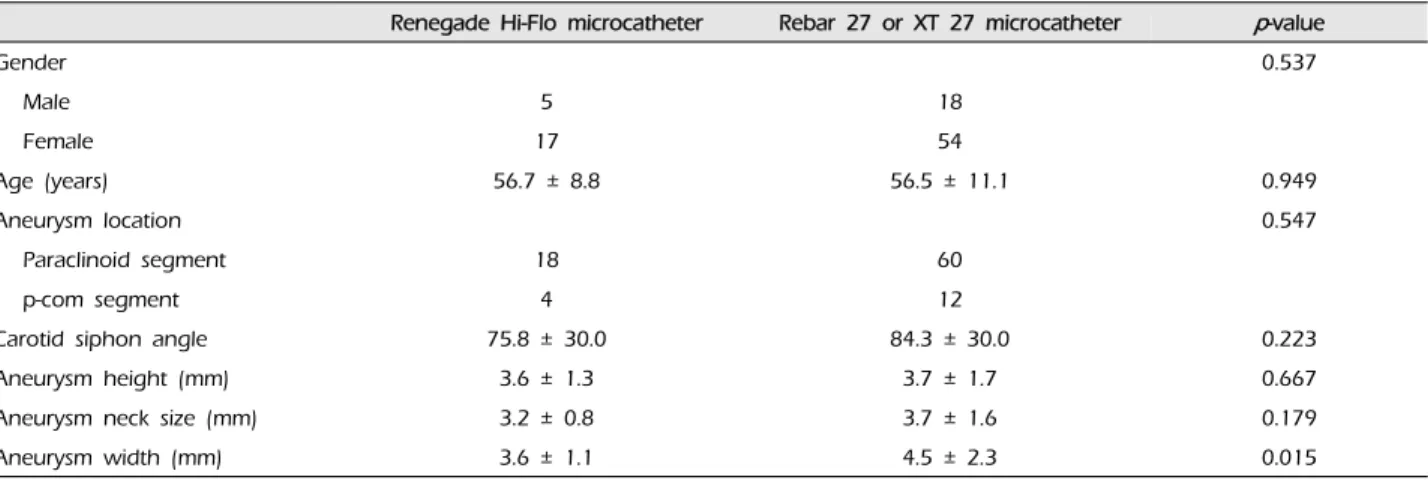
Table 1. Comparison of the demographic and aneurysmal characteristics of the Renegade Hi-Flo microcatheter (n = 22) and Rebar 27 or XT 27 microcatheter (n = 72) groups
good option for internal cerebral artery (ICA) sidewall aneurysms due to its good conformation to the vessel curvature, which results in delayed lower thromboem- bolism.2)3) However, in real practice, the jailing techni- que using the Neuroform EZ stent system suffers a critical problem related to interference between the two microcatheters used for ICA sidewall aneurysms.
In this scenario, the microcatheter that is inserted into the cerebral aneurysm is dislodged from its previous position by the transfer catheter used with the Renegade Hi-Flo microcatheter (Stryker Neurovascular, Watertown, MA, USA), which is positioned for stent deployment during advancement of the Neuroform EZ stent system.
Such interference between microcatheters is common (28.6%) and results in the failure of the procedure or the requirement for additional steps to correct this problem.7) In our series, the degree of interference be- tween the two microcatheters was significantly differ- ent according to the tortuosity of the vessels and the Renegade Hi-Flo microcatheter itself. Recently, stain- less steel braided microcatheters, such as the Excelsior XT-27 (Stryker Neurovascular, Fremont, CA, USA) and the Rebar 27 (ev3 Covidien, Irvine, CA, USA) have been widely used to increase the success rate and re- duce the interference between two microcatheters, in- cluding the Renegade Hi-Flo microcatheter. We hy- pothesized that there would be no difference in inter-
ference between the two microcatheters according to the deliveries of each microcatheter. In this study, we compared the differences in interference and eval- uated the influential factors between the two micro- catheters according to each delivery microcatheter.
MATERIAL AND METHODS
Between June 2011 and September 2013, the jailing technique with the Neuroform stent was applied to 94 patients with 94 ICA sidewall aneurysms (n = 71, fe- male; segment of paraclinoid; n = 78, segment of pos- terior communicating artery; n = 16) (Table 1). The median age was 56.0 years (mean ± standard devia- tion, 56.5 ± 1.1 years; range, 31-83 years). From June 2011 to December 2011, the Neuroform EZ stent sys- tem using the Renegade Hi-Flo microcatheter as the delivery catheter was applied to 22 ICA sidewall aneurysms. From May 2012 to September 2013, the Rebar 27 or XT-27 microcatheters were used as the de- livery catheters for 72 ICA sidewall aneurysms (Rebar 27 microcatheter, n = 35; XT-27 microcatheter, n = 37).
The aneurysms treated with the Neuroform EZ stent system were paraclinoid aneurysms (n = 78) and aneurysms in the posterior communicating artery seg- ment (n = 16).
Without developing an initial plan for the coil em-
bolization, such as the single-catheter technique or stent-assisted coiling, we administered aspirin (300 mg) and clopidogrel (300 mg) to the patients with un- ruptured cerebral aneurysms for at least 3 hours be- fore the procedure and administered the same to pa- tients with ruptured cerebral aneurysms immediately after the stent-assisted coiling procedure via a naso- gastric tube. Anticoagulation was initiated by the in- jection of a bolus of 3,000 IU heparin (Green Corss Corp., Yongin, Korea) that was intravenously ad- ministered immediately after femoral puncture, fol- lowed by an hourly intermittent bolus injection of 1,000 IU heparin. Coil embolization was performed through a single femoral access in all cases with a 7F Guider guiding catheter (Boston Scientific, Natick, MA, USA). Typically, a partial coil packing of an an aneur- ysm was performed to reduce the risk of an unexpected rupture of an aneurysm due to interference between the two microcatheters prior to the advancement of the Neuroform EZ stent delivery system into the de- livery microcatheter (e.g., the Renegade Hi-Flo or Rebar or XT-27 microcatheter).
Interference between the two microcatheters was de- fined as the phenomenon in which the microcatheter that was inserted into the cerebral aneurysm was dis- lodged from its previous position by another micro- catheter that was positioned for stent deployment during any step of the jailing technique. The carotid siphon angle was arbitrarily defined as the angle be- tween the supraclinoid segment of the internal carotid artery and the anterior vertical or horizontal segment of the cavernous internal carotid artery.
The statistical analyses were performed to evaluate factors that could affect the interference between the two microcatheters. The nominal data were analyzed using the χ2 or Fisher's exact tests, and the numerical data were examined with Student's t-test or the Mann-Whitney U test as appropriate. A two-tailed p
< 0.05 was defined as statistically significant. The in- fluential factors regarding the interference between the two microcatheters were analyzed using multi-
variate logistic regression.
RESULTS
In the renegade Hi-Flo microcatheter group, we found that the jailing technique using the Neuroform EZ stent system was successful in 19/22 cerebral aneurysms (86.4%); however, the Renegade Hi-Flo mi- crocatheter was well positioned in all of the lesions.
The failure of the jailing technique using the Neuroform EZ stent system was evident in 3 lesions during the following steps of the procedure: 1) the Neuroform EZ stent delivery system failed to advance into the positioned Renegade Hi-Flo microcatheter; 2) the Excelsior SL-10 microcatheter, which had been na- vigated into the cerebral aneurysm, was dislodged from the cerebral aneurysm by the advancement of the Neuroform EZ stent system into the Renegade Hi-Flo microcatheter; and 3) the Excelsior SL-10 mi- crocatheter failed to be navigated into the cerebral aneurysm after the Renegade H-Flo microcatheter had been positioned distal to the aneurysm. In the Rebar 27 and XT-27 microcatheter group, the jailing techni- que using the Neuroform EZ stent system was suc- cessful in 71 cerebral aneurysms and failed in 1 (1.4%). The failure of the jailing technique was due to dislodgement of the microcatheters from the aneur- ysm sacs after the deployment of Neuroform stents without interference between the two microcatheters.
This factor was likely responsible for the unstable mi- crocatheter positioning into the aneurysm.
In the Renegade Hi-Flo microcatheter group, inter- ference between the two microcatheters occurred in 6 of the 21 cerebral aneurysms (28.6%). One lesion, into which a microcatheter was not inserted, was excluded.
In all of these cases, the interference developed dur- ing the step in which the Neuroform EZ stent deliv- ery system was advanced into the Renegade Hi-Flo microcatheter, regardless of which jailing technique was used. In the Rebar 27 and XT-27 microcatheter group, there was no interference between the two mi-
Factors Adjusted OR Adjusted 95% CI p-value
Carotid siphon angle 0.959 0.922-0.997 0.035
Rebar 27 or XT 27 microcatheter 32.277 3.138-311.729 0.003
OR = odds ratio; CI = confidence interval
Table 3. Multiple logistic regression analysis of the factors influencing the interference between the two microcatheters dur- ing the jailing technique using the Neuroform EZ stent system
Presence of interference Absence of interference p-value
Carotid siphon angle 51.2 ± 27.6 85.4 ± 27.0 0.002
Delivery catheter 0.000
Renegade Hi-Flo 6 15
Rebar 27 or XT 27 1 71
Age of patients 0.707
> 60 years 2 32
≤ 60 years 5 53
Values are presented as number or mean ± standard deviation
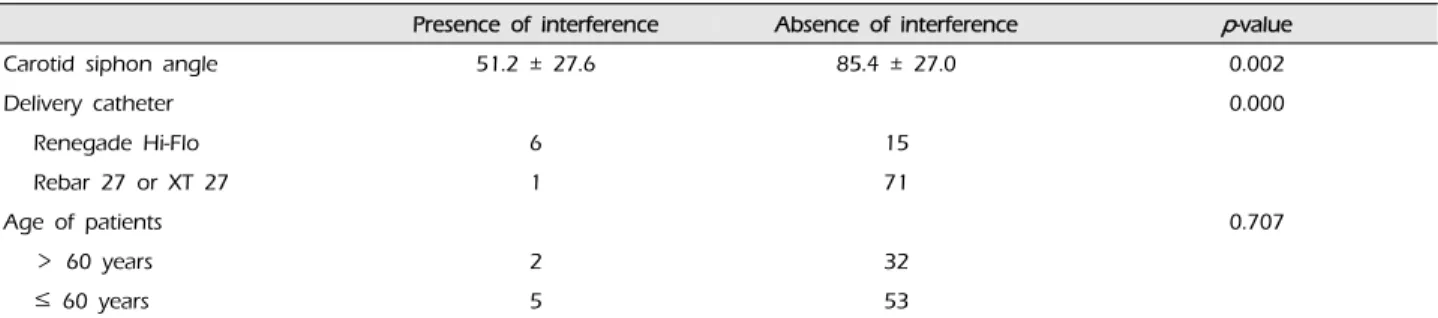
Table 2. Univariate analysis of the factors influencing the interference between the two microcatheters during the jailing technique using the Neuroform EZ stent system
crocatheters with the exception of one lesion. In this case, interference between two microcatheters devel- oped during the step in which the Neuroform EZ stent system was advanced into the XT-27 microcatheter.
In the Renegade Hi-Flo microcatheter group, proce- dural aneurysm rupture developed into two lesions (9.1%) that were stopped by further packing the coils.
No other procedural complications, including throm- boembolism, were observed. Our procedural morbid- ity and mortality rates were 9.1% and 0%, respectively.
The procedural morbidity resulted in neurological deficits at discharge in none of the cases. In the Rebar 27 and XT-27 microcatheter group, the procedural morbidity, and mortality rates were 0% and 0%, respectively.
There were no significant differences in the demo- graphic or aneurysmal characteristics between the Renegade Hi-Flo and the Rebar 27 or XT-27 micro- catheter group, except the aneurysm width. In the univariate analysis, there were statistically significant differences in the interference between the two micro- catheter groups according to the carotid siphon angle (p-value: 0.002) and the delivery microcatheters (p-val-
ue < 0.000) (Table 2). In the multiple logistic regression analysis, the stainless steel braided delivery micro- catheter (odds ratio [OR] [95% confidence interval (CI)];
31.277 [3.138-311.729], p-value: 0.003) and carotid si- phon angle (OR [95%CI]; 0.959 [0.922-0.997], p-value:
0.035) were found to be influencing factors in the in- terference between the two microcatheters (Table 3).
DISCUSSION
The use of the Neuroform EZ stent system should be technically feasible for general use in the jailing treatment for ICA sidewall aneurysms despite the open cell stent system of the Neuroform EZ stent, which can result in reduced delays in thromboem- bolic complications compared to closed cell stent sys- tems, such as the Enterprise stent system.5) The tech- nical feasibility of stent systems can be evaluated ac- cording to the ease of navigating the delivery micro- catheter for stent deployment and the lack of interfer- ence between the two microcatheters during stent deployment.6) Our previous study showed that the jailing technique using the Neuroform EZ stent sys-
tem was difficult to apply, particularly to cerebral aneurysms with acute carotid siphon angles.7) The failure of the jailing technique using the Neuroform EZ stent system was attributed to the interference be- tween the two microcatheters; the factors that influ- enced this interference were the Renegade micro- catheter itself and the carotid siphon angle.1) The mi- crocatheter is a technical factor that can be modified, whereas the carotid siphon angle is an anatomical fac- tor that cannot be modified. Based on our results, we suggest that stainless steel braided microcatheters, such as the Rebar 27 and XT-27 microcatheter, may be more technically feasible than the Renegade Hi-Flo microcatheter.
In the Renegade Hi-Flo microcatheter group, the failure rate of the jailing technique was 13.6%, and the rate of interference between the two catheters was 28.6%. However, in the Rebar 27 and XT-27 micro- catheter groups, the failure rate of the jailing techni- que and the rate of interference between the two mi- crocatheters were 1.4% and 1.4%, respectively. However, there were no procedural morbidities or mortalities in the Rebar 27 and XT-27 microcatheter group. Therefore, the jailing technique with the Neuroform EZ stent system using the Rebar 27 or XT-27 microcatheter as a delivery catheter is more technically feasible and safe than with the use of the Renegade Hi-Flo microcatheter. Additionally, the procedural feasibility and safety of the Neuroform EZ stent system using the Rebar or XT-27 microcatheter was not lower than those of the closed cell stent systems, such as the Enterprise stent.1)4) In the multiple logistic regression analysis, the stainless steel braided delivery micro- catheter (OR [95%CI]; 31.277 [3.138-311.729], p-value:
0.003) and carotid siphon angle (OR [95%CI]; 0.959 [0.922-0.997], p-value: 0.035) were found to be influential in the interference between the two microcatheters.
Based on the ORs of the microcatheter and carotid si- phon angle, the microcatheter exerts a stronger influ- ence on the interference between the two microcatheters.
Because the braided characteristics of the delivery mi- crocatheters are different, the Rebar 27 and XT-27 mi-
crocatheters, which are stainless steel and braided, may likely be more resistant to the crumpling of the inner lumen according to angulation than the Renegade Hi-Flo microcatheter, which is fiber braided. And then, the XT-27 microcatheter has a more supportive double helix winding reinforcement compared to the Renegade Hi-Flo microcatheter. This characteristic of the Rebar microcatheter and the XT-27 microcatheter results in less interference between the two micro- catheters than with the Renegade microcatheter.
CONCLUSION
The jailing technique with the Neuroform EZ stent system using a Rebar 27 or XT-27 microcatheter may be safer and more feasible than that with the Renegade Hi-Flo microcatheter and may exhibit less interference phenomenon two microcatheters when applied to ICA sidewall aneurysms.
Disclosure
The authors report no conflict of interest concerning the materials or methods used in this study or the findings specified in this paper.
REFERENCES
1. Chen YA, Hussain M, Zhang JY, Zhang KP, Pang Q.
Stent-assisted coiling of cerebral aneurysms using the Enterprise and the Solitaire devices. Neurol Res. 2014 May;36(5):461-7.
2. Heller RS, Malek AM. Parent vessel size and curvature strongly influence risk of incomplete stent apposition in enterprise intracranial aneurysm stent coiling. ANJR Am J Neuroradiol. 2011 Oct;32(9):1714-20.
3. Heller RS, Miele WR, Do-Dai DD, Malek AM. Crescent sign on magnetic resonance angiography revealing in- complete stent apposition: correlation with diffusion- weighted changes in stent-mediated coil embolization of aneurysms. J Neurosurg. 2011 Sep;115(3):624-32.
4. King B, Vaziri S, Singla A, Fargen KM, Mocco J. Clinical and angiographic outcomes after stent-assisted coiling of cerebral aneurysms with Enterprise and Neuroform stents:
a comparative analysis of the literature. J Neurointerv Surg. 2015 Dec;7(12):905-9.
5. Mangubat EZ, Johnson AK, Keigher KM, Lopes DK.
Initial experience with Neuroform EZ in the treatment of wide-neck cerebral aneurysms. Neurointervention. 2012
Feb;7(1):34-9.
6. Wajnberg E, de Souza JM, Marchiori E, Gasparetto EL.
Single-center experience with the Neuroform stent for endo- vascular treatment of wide-necked intracranial aneurysms.
Surg Neurol. 2009 Dec;72(6):612-9.
7. Yoon SG, Jin SC, Kim SH, Jeon KD, Kim DY, Lee SI, et al. Jailing technique using a catheter-based open-cell stent system in internal carotid artery sidewall aneur- ysms unfeasible to simple coiling. J Cerebrovasc Endovasc Neurosurg. 2013 Dec;15(4):293-8.