자폐 스펙트럼 장애의 산전 및 주산기 합병증
남보라1)·유희정2)·조인희3)·박태원4)·손정우5)·정운선6)·신민섭1) 김붕년1)·김재원1)·양영희1)·강제욱7)·송숙형1)·조수철1)
서울대학교병원 신경정신과,1) 분당서울대학교병원 신경정신과,2) 가천의과대학병원 정신과,3) 충북대학교병원 정신과,4) 전북대학교병원 정신과,5) 경북대학교병원 정신과,6) 인제대학교병원 신경정신과,7)
Prenatal, Perinatal and Infancy History of Autism Spectrum Disorder
Bo-Ra Nam, M.D.
1), Hee-Jeong Yoo, M.D., Ph.D.
2), In-Hee Cho, M.D., Ph.D.
3), Tae-Won Park, M.D., Ph.D.
4), Jung-Woo Son, M.D., Ph.D.
5), Un-Sun Chung, M.D., Ph.D.
6),
Min-Sup Shin, Ph.D.
1), Bung-Nyun Kim, M.D., Ph.D.
1), Jae-Won Kim. M.D., Ph.D.
1), Young-Hui Yang, M.D.
1), Je-Wook Kang, M.D.
7),
Sook-Hyung Song, M.D.
1)and Soo-Churl Cho, M.D., Ph.D.
1)1)Department of Psychiatry, Seoul National University Hospital, Seoul, Korea
2)Department of Neuropsychiatry, Seoul National University Bungdang Hospital, Seongnam, Korea
3)Department of Psychiatry, Gachon University of Medicine and Science, Incheon, Korea
4)Department of Psychiatry, Chungbuk National University Hospital, Cheongju, Korea
5)Department of Psychiatry, Chonbuk National University Hospital, Jeonju, Korea
6)Department of Psychiatry, Kyungpook National University, Daegu, Korea
7)Department of Neuropsychiatry, School of Medicine and Institute of Neuroscience, Inje University, Busan
Objectives
:The purpose of this study was to evaluate the prenatal, perinatal, and infancy history of children with autism spectrum disorder (ASD) as compared to unaffected siblings (SIB) and typically developing children (TC).
Methods
:Subjects with ASD, their SIB, and TC were recruited. All subjects were assessed using both the Korean version of Autism Diagnostic Interview-Revised (K-ADI-R) and the Korean version of Autism Diagnostic Observation Schedule (K-ADOS) and were subsequently identified as affected or unaffected. Prenatal, perinatal, and infancy history was obtained from the primary caregivers and each facet was compared in those with ASD, the SIB, and the TC groups using SPSS ver. 17.0 (p<.05).
Results
:70 individuals with ASD (63 males, 87.94±37.8months), 53 SIB (27 males, 85.40±48.06 months), and 32 TC (19 males, 104.19±23.409 months) were analyzed. The ASD group showed significantly higher rates of insufficient vaccination as they aged age (χ
2=15.54, p=.000). Among the scheduled vaccinations, the DPT vaccination (χ
2=10.08, p=.006) was insufficient in ASD groups. The ASD group also showed higher rates of sleep disturbances from infancy.
Differences in maternal/paternal age at conception, gestational age, and growth parameters at birth were not significantly difference among the three groups.
Conclusion
:These results do not support the previous controversies regarding the relationship between prenatal/
perinatal complications and ASD. However, these results indicate that perinatal and prenatal factors may contribute to the development of ASD.
KEY WORDS
:Autism·Autism Spectrum Disorders·Pervasive Development Disorders·Neonatal·Prenatal·
Perinatal.
접수완료:2010년 5월 24일 / 심사완료:2010년 8월 16일
Address for correspondence:Soo-Churl Cho M.D., Ph.D., Department of Psychiatry, Seoul National University Hospital, 101 Daehak-ro, Jongno-gu, Seoul 110-744, Korea
Tel:+82.2-2072-3648, Fax:+82.2-744-7241, E-mail:[email protected]
이 연구는 대한민국 보건복지부의 보건의료기술진흥사업 협동 중개 연구 지원을 받았다(A080651).
서 론
자폐 장애는 사회성과 의사 소통의 질적 장애 및 제한된 관 심 범위, 상동증적인 행동을 특징으로 하는 발달 장애이다.
1)자폐 스펙트럼 장애(autism spectrum disorders, ASD) 또 는 전반적 발달 장애(pervasive developmental disorder, PDD)는 자폐 장애, 레트 장애, 아동기 붕괴성 장애, 아스퍼 거 씨 장애, 기타 전반적 발달 장애를 포함하는 광범위한 개 념이다. 기존 연구에서 ASD의 일란성 쌍생아 일치율은 60%
전후로 보고되고 있으며 광의의 자폐 표현형(broader autis- tic spectrum)으로 범위를 확대했을 때는 90%로 증가하는 것으로 보아
2)ASD는 강력한 유전적 원인론의 영향 하에 있 는 것으로 보이지만, 일치율이 100%가 되지 않는다는 점에 서 환경적 요인 또한 관련될 것으로 생각할 수 있다. ASD 의 유병률은 1966년에 10,000명당 4명이었던 것이
3)최근 연구에서는 10,000명당 30~60명으로 증가하였는데
4)이러 한 증가 추세는 진단 기준의 확장과 정확성의 증가에 기인한 바도 있지만 환경적 요인을 시사하는 또 다른 근거가 될 수 있다.
5)자폐장애의 초기 징후들이 최소 생후 2년 이내에 분명해 진다는 사실은 자폐장애가 태아기, 주산기, 영아기의 위험 요 인과 관련되어 있을 것이라는 가설을 가능케 하며, 실제로 이들 요인에 대한 연구가 진행되어 왔다. 하지만 그 인과관 계는 아직 불분명한 수준이다.
6)이전 연구에서 보고된 위험 가운데 단일 위험 요인은 없고 서로 모순되는 결과들도 많은 데, 이는 진단 기준, 대조군, 표본 크기 등 연구 방법의 다양 성 때문으로 생각된다. 특히 많은 연구들이 환자군을 정의함 에 있어 단순히 Diagnostic and Statistical Manual of Men- tal Disorders(DSM) 기준만으로 정의하거나 입원 환자만으 로 제한하는 등의 방법을 사용하여 현재로는 ASD로 진단되 었을 지도 모르는 일부 환자들이 대조군에 포함되어 결과해 석에 혼재 변인으로 작용하였을 가능성이 있었다.
7)본 연구의 목적은 국내에서 처음으로 ASD를 가진 환아들 의 태아기, 주산기, 영아기의 병력과 발달력을 분석하고, 이 것이 ASD의 위험 요인이 될 가능성이 있는지를 규명하는 것이다. 기존 연구들의 한계를 보완하고자 환자군(autism spectrum disorder, ASD), 장애에 이환 되지 않은 생물학 적 형제군(unaffected siblings, SIB), 정상 대조군(typical- ly developing children, TC)을 분석 대상으로 함으로써 유 전적인 배경을 통제하고자 시도하였다. 또한 세 군을 모두 한국어판 자폐증 진단 면담(Korean version of Autism Dia - gnostic Interview-Revised, K-ADI-R)과 한국어판 자폐
증 관찰 스케줄(Korean version of Autism Diagnostic Ob- servation Schedule, K-ADOS)을 사용하여 진단 혹은 배 제 진단 함으로써 세 군의 진단적 변별을 명확히 하고자 하 였다.
방 법
1. 대상군
이 연구는 ASD의 행동 유전학 연구의 일환으로 이루어졌 으며, 자폐 장애 아동, 자폐 장애에 이환 되지 않은 형제, 그 리고 정상 대조군은 모두 이 연구 프로젝트에 참여하는 한국 자폐 스펙트럼 장애 유전 연구 컨소시엄을 통해 모집하였다.
환자군은 진단적 정확성을 높이기 위해 연령을 36개월 이상 으로 제한하였고, 세 군의 연령대를 짝짓기하고 초기 발달력 에 대한 부모들의 후향적 기억 왜곡을 최소화 하기 위해 연 령을 200개월 이하로 제한하였다. SIB은 이들 ASD 아동의 형제들 중에 동시 이환이 없는 것으로 확인된 아동들을 모두 포함하였다. TC는 형제와 일차 친척 중에 ASD로 진단되거 나 의심되는 사람이 없는 지역 사회 지원자로 하였다. 모든 대상자들 가운데 임상적으로 의미 있는 신경학적 질환이나 심각한 내과적 질환, 잘 알려진 기존의 염색체 이상이 있는 경우는 분석에서 제외하였다. 태생기, 주산기, 영아기의 병력 은 서울대학교 발달력 & 가족력 설문지(Seoul National Uni - versity Developmental & Family History Questionnaire, SNU-DFHQ)를 사용하여 훈련된 간호사가 일차 양육자로 부터 얻었다. 이 연구는 참여 기관의 임상 시험 윤리 위원회 의 승인을 받았고 모든 대상자의 부모로부터 서면으로 사전 동의를 받았다.
2. 평 가
모든 대상자들은 우선 소아 정신과 의사가 DSM-IV-TR
기준으로 전반적 발달 장애에 대해 선별하였다. 한국판 사회
적 상호작용 설문지(Korean versions of Social Communi-
cation Scale, K-SCQ)
8)와 한국판 아스퍼거 증후군 진단
척도(Asperger Syndrome Diagnostic Scale, ASDS)
9)가
선별 검사 도구로 사용되었다. ASD 진단을 확인하기 위해
K-ADI-R
10)과 K-ADOS
11)을 사용하였다. 지능과 적응 능
력 평가를 위해 한국판 웩슬러 아동 지능 검사(Korean Edu-
cational Developmental Institute-Wechsler Intelligence
Scale for Children, KEDI-WISC)
12)-단축형과 한국판 라
이터 국제 동작 척도(Korean version of Leiter Internatio-
nal Performance Scale),
13)한국판 바인랜드 적응행동 척도
(Vineland Adaptive Behavior Scale, K-VABS)
14)를 사용
하였다. 언어 평가는 발달 단계에 따라 한국판 그림 어휘력 검사-개정판(Korean versions of Peabody Picture Voca- bulary Test-Revised),
15)영유아 언어 발달 선별 검사(Se- quenced Language Scale for In-fants),
16)취학 전 아동의 수용언어 및 표현언어 척도(Preschool Receptive-Expres- sive Language Scale),
17)한국어에 특이적인 수용 언어 검 사와 언어 능력을 이용한 문제 해결력 검사(Korean langua- ge-specific tests for receptive language and for prob- lem-solving through language skills),
18)언어 문제 해결 력 검사(Sentences and Language Problem Solving Test), 구문 의미 이해력 검사(Tests for Understanding of Ph- rases)
19)가운데 선택해서 시행하였다.
장애에 이환 되지 않은 생물학적 형제와 정상 발달 아동들 은 ASD 환아와 같은 방법으로 평가하였다.
3. 연구 변수
다음과 같은 변수들을 분석하였다(Table 1).
4. 통계 방법
자료 분석을 위하여 SPSS(Statistical Package for the Social Sciences) version 17.0을 사용하였다. 통계적 유의 성은 p value<.05로 정의하였다. 연속형 변수의 평균 비교의 경우 ANOVA로 분석하고 사후 검정은 post-hoc tests 로 하였다. 범주형 변수의 경우 카이 제곱 검정으로 각 군의 빈 도를 비교하였다.
결 과
70명의 ASD(10.0% females, 87.94±37.8 months)과 53명의 SIB(49.1% females, 85.40±48.06 months), 32
Table1. Study variables in Seoul National University Developmental & Family History Questionnaire Pregnancy-related events
(prenatal events)
Delivery-related events (perinatal events)
Infancy and early childhood histories Pregnancy-related
complication Gestational edema Emesis gravidarum Toxemia of pregnancy dizziness Anemia complicating pregnancy Pregnancy induced Hypertension Gestational diabetes Gestational proteinuria Possibility of abortion Vaginal bleeding Incompetent cervix Rh incompatibility Oligohydramnios Hydramnios Blurred vision Trauma of abdomen Radiography, vaccinations Hypothyroidism hyperthyroidism psychiatry treatment number of antenatal exams
Maternal age on conception, Parternal age on conception, Infertility treatment, Artificial fertilization
Medication during pregnancy Antibiotics, steroids, Asthma medications, antihypertensives Diabetes medications Cardiovascular medications, antiepileptics Antipsychotics, antidepressants Mood stabilizers Hypnotics, antianxiety drugs thyroid medications analgesics, digestant, NSAIDS, Hormone, caffeine, Cigarette, alcohols
Pregnancy-related diseases,
Varicella, herpes zoster
herpes, influenza, measles, mumps, rubella,
skin rash, severe enteritis, allegic diseases, food poisonings asthma, high fever, epilepsy/seizure, vaginitis nephritis/
pyelonephritis
Gestational age Cesarean section Induced labor Forceps or vacuum General anesthesia Spinal anesthesia nuchal code cord prolapse Placenta previa Abruption placentae Birth trauma Birth height , Birth weight Head circumference Staining of amniotic fluids
Meconium aspiration Neonatal anemia Neonatal jaundice, Seizure
Encephalomeningitis sepsis
floppy infant spastic infant facial malformations extremity
malformations musculoskelectal malformations.
Heart malformations Digestive
malformations Urogenital malformations phenylketonuria hypothyroidism hypokalemia hypocalcemia Postnatal treatment Oxygen supply CPR
Intensive care unit Incubator Hypothermia Poor oral intake Do not cry Respiratory distress Abnormality of heart rate Renal diseases
Handedness hearing disturbance visual disturbance Insufficient vaccination
BCG HBV Polio DPT MMR Varicella breast feeding Duration of breast feeding Beginning age of weaning food Food allergy Drug allergy Allergy (others) Rhinitis Conjunctivitis Atopic dermatitis Multiple sclerosis Neurofibromatosis Epilepsy/seizure Brain tumor Cerebrovascular diseases Rubella, measles Mumps, varicella
Viral hepatitis Respiratory disease Heart disease Renal disease, urogenital disease, endocrine disease Gastroenteric disease
Musculoskelectal disease
Surgery history, Motor dysfunction Clumsiness in movement Abnormality in MRI or EEG tic Hours of sleep in infancy Sleep induction difficulty Sending to sleep Shallow sleep Sleep walking nightmare Night awakening Daytime sleepiness Snoring
Enuresis Encephalitis, meningitis Head trauma Cerebral palsy
Periodization of the questionnaire items in Seoul National University Developmental & Family History Questionnaire were used
명의 TC(40.6% females, 104.19±23.409 months)를 대 상으로 분석하였다. 세 군의 인구학적 변수와 특징을 먼저 살펴보면(Table 2) 나이를 제외한 성별, 전체 지능, 라이터 국제 동작 척도, 바인랜드 적응 행동 척도, 언어 연령, 사회적 상호 작용 척도 항목에서 환자 군은 다른 두 군과 유의한 차 이를 보였다.
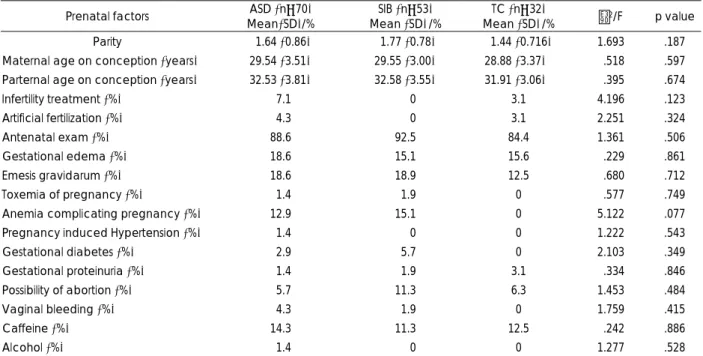
임신과 관련된 사건에서는 세 군에서 통계적으로 유의한 변수는 없었다(Table 3). 그러나 임신성 빈혈이 TC는 한 명도 없지만 ASD와 SIB에서는 비슷한 수준으로 있고 p=
.077로 경향성을 보였다.
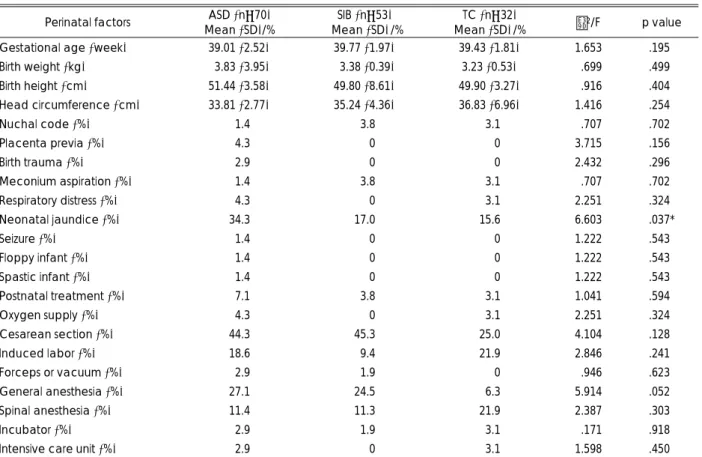
출산과 관련된 사건(Table 4)에서는 신생아 황달만이 환 자 군에서 다른 두 군에 비해 더 높은 비율을 보였다(χ
2= 6.60, p=.037). 제왕 절개 시 전신마취가 ASD과 SIB에서 TC에 비해 현저하게 많고 p=.052로 상당한 경향성이 나타 났다.
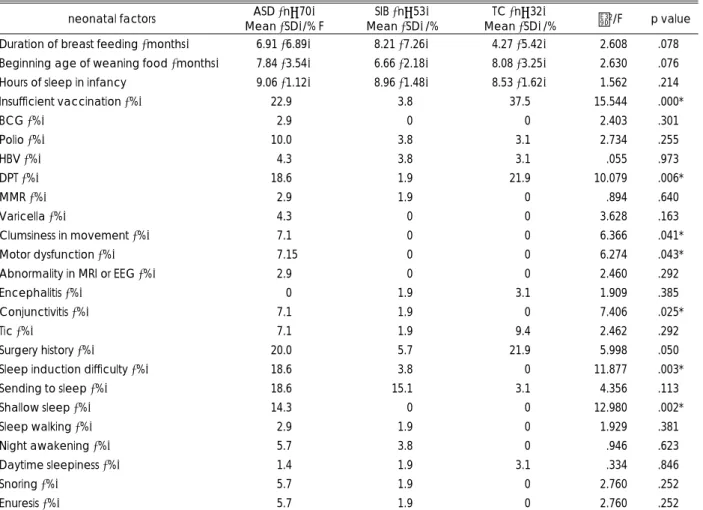
영아기와 아동기 병력(Table 5)에서는 ASD에서 예방 접 종을 스케쥴대로 시행하지 않은 비율이 SIB와 비교하여 높았 다(χ
2=15.54, p=.001). 비씨지(Bacillus Calmette Guerin, BCG), B형 간염(hepatitis B virus, HBV), 폴리오(polio), 디프테리아/파상풍/백일해(Diphtheria-Pertussis-Tetanus, DPT), 홍역/볼거리/풍진(Measles, Mumps, Rubella, MMR), 수두(varicella) 예방 접종 중에서 DPT 예방 접종(χ
2=10.08, p=.006)만이 SIB와 비교하여 차이가 있었다. 또한 환자군 의 질병력 중에서 결막염(χ
2=7.41, p=.025), 운동 기능 이상 (χ
2=6.27, p=.043), 동작이 어색함(χ
2=6.37, p=.041)의 비율이 나머지 두 군보다 더 높았다. 잠들기 어려움(χ
2=11.88, p=.003)과 얕게 잠(χ
2=12.98, p=.002)의 항목에서도 다 른 두 군과 차이를 보여 환자군에서 수면 문제가 있음이 나 타났다.
추가적으로 ASD와 TC의 비교 분석에서 ASD군에서 임신
Table 3. Pregnancy-related events of ASD, siblings, and control groups Prenatal factors ASD (n=70)
Mean(SD)/%
SIB (n=53) Mean (SD)/%
TC (n=32)
Mean (SD)/% χ2/F p value Parity 01.64 (0.86) 01.77 (0.78) 01.44 (0.716) 1.693 .187 Maternal age on conception (years) 29.54 (3.51) 29.55 (3.00) 28.88 (3.37)0 0.518 .597 Parternal age on conception (years) 32.53 (3.81) 32.58 (3.55) 31.91 (3.06)0 0.395 .674
Infertility treatment (%) 07.1 00.0 3.1 4.196 .123
Artificial fertilization (%) 04.3 00.0 3.1 2.251 .324
Antenatal exam (%) 88.6 92.5 84.4 1.361 .506
Gestational edema (%) 18.6 15.1 15.6 0.229 .861
Emesis gravidarum (%) 18.6 18.9 12.5 0.680 .712
Toxemia of pregnancy (%) 01.4 01.9 0 0.577 .749
Anemia complicating pregnancy (%) 12.9 15.1 0 5.122 .077
Pregnancy induced Hypertension (%) 01.4 00.0 0 1.222 .543
Gestational diabetes (%) 02.9 05.7 0 2.103 .349
Gestational proteinuria (%) 01.4 01.9 3.1 0.334 .846
Possibility of abortion (%) 05.7 11.3 6.3 1.453 .484
Vaginal bleeding (%) 04.3 01.9 0 1.759 .415
Caffeine (%) 14.3 11.3 12.5 0.242 .886
Alcohol (%) 01.4 00.0 0 1.277 .528
χ2 test for comparison of frequency and ANOVA and post-hoc Tukey test for analyses of differences. ASD:Probands with autism spectrum disorder, SIB:Unaffected siblings, TC:Typically developing children
Table 2. Demographic and clinical characteristics of ASD, siblings, and control groups
ASD (n=70) SIB (n=53) TC (n= 32) χ2/F, p-value Post-hoc Gender (% female) 7 (10.0%) 26 (49.1%) 13 (40.6%) χ2=24.36, p=.000 ASD<SIB=TC Age (months, mean±SD) 87.94±37.80 085.40±48.06 104.19±23.41 F=2.526, p=.083 Full Scale Intelligence Quotient 59.37±30.74 110.95±14.08 112.95±09.70 F=66.524, p=.000* ASD<SIB=TC Leiter International Performance Scale 79.24±26.66 120.33±18.45 118.20±27.96 F=41.722, p=.000* ASD<SIB=TC Verbal age 29.28±16.24 044.10±17.71 073.75±01.50 F=16.432, p=.000* ASD<SIB<TC Vineland Adaptive Behavior Scale 96.60±38.00 112.88±14.17 110.24±20.88 F=4.097, p=.019* ASD<SIB=TC Social Communication Scale (lifetime) 20.94±08.25 003.12±04.06 003.66±02.62 F=152.602, p=.000* ASD>SIB=TC χ2 test for comparison of frequency and ANOVA and post-hoc Tukey test for analyses of differences. *:p<.05. ASD:Probands with autism spectrum disorder, SIB:Unaffected siblings, TC:Typically developing children
성 빈혈(χ
2=4.51, p=.034)과 제왕 절개 시 전신 마취(χ
2= 5.86, p=.015), 엄마가 꼭 재워줘야 함(χ
2=4.43, p=.035) 의 비율이 더 높았으며, ASD와 SIB 비교에서는 ASD군에서 불임 치료(χ
2=3.95, p=.047)와 영아기 동안 외과 수술력 (χ
2=5.21, p=.022)이 더 많았다.
ASD의 진단에 영향을 미치는 변인을 확인하기 위해 환자 와 대조군에서 차이를 보이는 6가지 항목들에 대한 회귀 분 석을 실시한 결과 제왕 절개 시 전신 마취 항목(p=.023)에 서만 통계적으로 유의하였다(Table 6).
고 찰
이 연구에서는 국내에서 처음으로 ASD의 태생기, 주산기, 영아기 병력에 관해 조사하였다. 이 연구의 강점은 첫째로 K- ADOS 및 K-ADI-R 등 표준화된 진단 도구를 이용하여 ASD를 정확히 진단하고자 한 것이며, 둘째는 정상 대조군과 생물학적 형제군을 모두 비교대상에 포함 시켜 세 군간의 차 이를 비교했다는 점이다.
세 군간 비교한 결과 출산과 관련된 사건 중에서 신생아 황달이 환자군에서 유의하게 높게 나왔다. 이전 연구에서 황
달과 자폐 장애의 관련성은 일관성 없게 나왔는데 이것은 연 구 대상수가 너무 적거나 환아의 체중과 같은 교란 변수를 잘 통제하지 못해서인 것으로 보인다.
20,21)또 다른 연구에서 는 고빌리루빈혈증이 만삭 출생의 영아에서 자폐 장애의 위 험을 4배 이상 높이는 것으로 보고된 바 있다.
22)그러나 그 기전에 관해서는 아직 잘 알려져 있지 않아서 고빌리루빈혈 증이 자폐 장애의 원인인지 자폐 장애의 취약한 환아에서 나 타나는 현상인지는 추후 연구가 필요하다. 또한 혈중 빌리루 빈 농도만으로 신생아 황달을 진단하는 것이 아니므로 황달 이 자폐 장애의 위험을 높인다고 해석하기는 어렵다. 본 연 구에서도 황달이 환자군에서 더 많았으나 신생아 황달은 생 리적 황달과 병적 황달로 구분되므로 추가적인 병력을 통해 추후 연구가 필요할 것으로 생각된다.
영아기 병력 중에서 정해진 스케줄대로 DPT 예방접종을 시행하지 않은 환아가 유의하게 더 많았다. 이전 연구에서 이런 결과가 보고된 적은 없었고 오히려 싸이메로잘(thime- rosal)을 포함하는 DTP 예방 접종이 원인인가에 대한 논란 은 있었다.
23,24)이번 연구 결과에서 확인된 ASD 군에서 DPT 예방 접종이 스케쥴대로 되지 않은 이유는 이 연구에 사용된 설문지만으로는 알 수가 없다. ASD 환아가 예방 접종에 비
Table 4. Delivery-related events of ASD, siblings, and control groups Perinatal factors ASD (n=70)
Mean (SD)/%
SIB (n=53) Mean (SD)/%
TC (n=32)
Mean (SD)/% χ2/F p value Gestational age (week) 39.01 (2.52) 39.77 (1.97) 39.43 (1.81) 1.653 .195*
Birth weight (kg) 03.83 (3.95) 03.38 (0.39) 3.23 (0.53) 0.699 .499*
Birth height (cm) 51.44 (3.58) 49.80 (8.61) 49.90 (3.27) 0.916 .404*
Head circumference (cm) 33.81 (2.77) 35.24 (4.36) 36.83 (6.96) 1.416 .254*
Nuchal code (%) 01.4 03.8 03.1 0.707 .702*
Placenta previa (%) 04.3 00.0 00.0 3.715 .156*
Birth trauma (%) 02.9 00.0 00.0 2.432 .296*
Meconium aspiration (%) 01.4 03.8 03.1 0.707 .702*
Respiratory distress (%) 04.3 00.0 03.1 2.251 .324*
Neonatal jaundice (%) 34.3 17.0 15.6 6.603 .037*
Seizure (%) 01.4 00.0 00.0 1.222 .543*
Floppy infant (%) 01.4 00.0 00.0 1.222 .543*
Spastic infant (%) 01.4 00.0 00.0 1.222 .543*
Postnatal treatment (%) 07.1 03.8 03.1 1.041 .594*
Oxygen supply (%) 04.3 00.0 03.1 2.251 .324*
Cesarean section (%) 44.3 45.3 25.0 4.104 .128*
Induced labor (%) 18.6 09.4 21.9 2.846 .241*
Forceps or vacuum (%) 02.9 01.9 00.0 0.946 .623*
General anesthesia (%) 27.1 24.5 06.3 5.914 .052*
Spinal anesthesia (%) 11.4 11.3 21.9 2.387 .303*
Incubator (%) 02.9 01.9 03.1 0.171 .918*
Intensive care unit (%) 02.9 00.0 03.1 1.598 .450*
χ2 test for comparison of frequency and ANOVA and post-hoc Tukey test for analyses of differences. *:p<.05. ASD:Probands with autism spectrum disorder, SIB:Unaffected siblings, TC:Typically developing children
협조적일 가능성이 있고 예방 접종 시행 횟수가 5회로 다른 예방접종보다 더 많아서 일 수도 있을 것으로 생각된다.
ASD 환아가 잠들기 어려워하고 얕게 자는 것으로 나왔는 데 이 또한 이전 연구에서 보고되었던 것을 다시 한 번 확인 하였다.
25)ASD 환아에서 수면의 장애와 일주기 리듬의 장애 는 단순히 시계 유전자(clock gene)나 멜라토닌 분비의 문 제뿐만 아니라 의사 소통의 질적 장애 및 제한된 관심 범위,
상동증적인 행동과 같은 ASD의 핵심적인 증상이 모두 영향 을 주는 것으로 생각된다.
26)ASD와 SIB 비교에서 외과 수술력이 ASD에서 더 많은데 어떤 수술인지에 대한 정보는 없으나 ASD에서 동반되는 많 은 신체적인 질환과 연관되었을 것으로 생각된다.
ASD와 TC의 비교에서 임신성 빈혈이 ASD에서 더 많았 고 세 군간의 비교에서 TC에서는 임신성 빈혈이 한 명도 없
Table 5. Infancy and early childhood factors of ASD, siblings, and control groups neonatal factors ASD (n=70)
Mean (SD)/% F
SIB (n=53) Mean (SD)/%
TC (n=32)
Mean (SD)/% χ2/F p value Duration of breast feeding (months) 6.91 (6.89) 8.21 (7.26) 4.27 (5.42) 02.608 .078*
Beginning age of weaning food (months) 7.84 (3.54) 6.66 (2.18) 8.08 (3.25) 02.630 .076*
Hours of sleep in infancy 9.06 (1.12) 8.96 (1.48) 8.53 (1.62) 01.562 .214*
Insufficient vaccination (%) 22.90 03.8 37.5 15.544 .000*
BCG (%) 02.90 00.0 00.0 02.403 .301*
Polio (%) 10.00 03.8 03.1 02.734 .255*
HBV (%) 04.30 03.8 03.1 00.055 .973*
DPT (%) 18.60 01.9 21.9 10.079 .006*
MMR (%) 02.90 01.9 00.0 00.894 .640*
Varicella (%) 04.30 00.0 00.0 03.628 .163*
Clumsiness in movement (%) 07.10 00.0 00.0 06.366 .041*
Motor dysfunction (%) 07.15 00.0 00.0 06.274 .043*
Abnormality in MRI or EEG (%) 02.90 00.0 00.0 02.460 .292*
Encephalitis (%) 00.00 01.9 03.1 01.909 .385*
Conjunctivitis (%) 07.10 01.9 00.0 07.406 .025*
Tic (%) 07.10 01.9 09.4 02.462 .292*
Surgery history (%) 20.00 05.7 21.9 05.998 .050*
Sleep induction difficulty (%) 18.60 03.8 00.0 11.877 .003*
Sending to sleep (%) 18.60 15.1 03.1 04.356 .113*
Shallow sleep (%) 14.30 00.0 00.0 12.980 .002*
Sleep walking (%) 02.90 01.9 00.0 01.929 .381*
Night awakening (%) 05.70 03.8 00.0 00.946 .623*
Daytime sleepiness (%) 01.40 01.9 03.1 00.334 .846*
Snoring (%) 05.70 01.9 00.0 02.760 .252*
Enuresis (%) 05.70 01.9 00.0 02.760 .252*
χ2 test for comparison of frequency and ANOVA and post-hoc Tukey test for analyses of differences. *:p<.05. ASD:Probands with autism spectrum disorder, SIB:Unaffected siblings, TC:Typically developing children
Table 6. Logistic regression model with 6 explanatory variables (All cases compared with control subjects)
95% C.I.for EXP (B)
B S.E. Wald df Sig. Exp (B)
Lower Upper Anemia complicating pregnancy -20.263 11964.053 0.000 1 .999* .000 .000 . Sleep induction difficulty -20.310 09931.666 0.000 1 .998* .000 .000 . Sending to sleep 0-1.879 00001.123 2.800 1 .094* .153 .017 1.380 Shallow sleep -18.402 11224.925 0.000 1 .999* .000 .000 . General anesthesia during cesarean section 0-1.861 00000.820 5.151 1 .023* .156 .031 0.776 Conjunctivitis -20.118 11950.521 0.000 1 .999* .000 .000 .
Constant -82.598 22596.249 0.000 1 .997* 7.446E35
*:p<.05
었으나 ASD와 SIB 에서는 비슷한 수준인 것으로 보아 임신 성 빈혈이 ASD의 원인이라기 보다는 ASD와 병인 기전을 공유할 가능성 또는 환경과 유전학적인 요인의 상호작용이 있음을 보여주고 있다. 임신성 빈혈에 관해 ASD를 대상으로 한 연구는 없었으나 지능 장애의 위험을 높인다는 연구 결과 가 있다.
27)임신성 빈혈의 치료 여부에 대한 설문은 없어 추 가 연구가 더 필요하다.
ASD와 TC에 대한 로지스틱 회귀분석에서 제왕 절개시 전신 마취가 위험 인자로 나왔다. 이전 연구에서 전신 마취 를 사용한 출산에서 자폐 장애가 더 많았다는 보고가 있었 다.
28)전신 마취 동안 사용하는 다이아제팜(diazepam)이 태 아의 중추 신경계의 활동성을 감소시키고 무 호흡 발작, 낮 은 아프가 점수, 근 긴장 저하 등을 일으킬 수 있다고 한다.
29)또한 전신 마취시 사용하는 세보프루렌(sevoflurane)에 관 해서 쥐를 대상으로 한 연구 결과를 보면 뇌세포 괴사와 지 속되는 학습장애를 일으키고 사회적인 상호작용에서도 장애 를 일으킨다고 한다.
30)세 군간의 비교에서 전신마취가 ASD 과 SIB에서 TC 에 비해 현저하게 많은 경향성을 보이는 것 으로 보아 전신 마취가 단순한 ASD의 원인이라기 보다는 환경과 유전학적인 요인의 상호작용임을 보여주고 있다.
회귀 분석에서 제왕 절개 시 전신 마취 항목만이 위험 인 자로 작용하고 있다는 것은 세 군의 차이가 ASD를 예측해 줄 수 있는 변인이라기보다 단지 ASD집단이 다른 집단에 비해 많이 가지고 있는 특성으로 생각된다.
이 연구에서 몇 가지 제한 점이 있는데, 첫째로 후향적인 연구로 환아 부모의 회상 치우침을 배제하지 못하였다. 둘째 로 환자군을 비롯한 연구 대상자의 수가 많지 않아 앞으로 대규모의 전향적인 연구가 필요할 것으로 생각된다. 또한 환 자군을 정의할 때 심각한 신경학적 질환이나 내과적 질환이 있는 경우에 배제하였는데 주산기 합병증에 의해 이러한 질 환이 생길 수 있으므로 심각한 주산기 합병증에 대한 분석이 이루어지지 못하였다는 점을 들 수 있다.
결 론
이 연구에서 태생기, 주산기, 영아기의 환경적 요인이 ASD 와 연관이 있음을 알 수 있었다. ASD에서 환경적 요인이 단 일한 원인이라기 보다는 ASD집단이 다른 집단에 비해 많이 가지고 있는 특성을 나타내거나 환경과 유전의 상호작용이 있음으로 보여주고 있다. 앞으로 좀더 큰 규모의 전향적인 연구가 더 필요할 것으로 생각된다.
중심 단어:자폐증·자폐 스펙트럼 장애·전반적 발달장애·
신생아기의·분만전기의·주산기의.
References
1) Association AP. Diagnostic and Statistical Manual of Mental Dis- orders, Fourth Edition. Washington, DC: American Psychiatric Association;1994.
2) Volkmar FR, Lord C, Bailey A, Schultz RT. Klin A. Autism and pervasive developmental disorders. J Child Psychol Psychi- atry 2004;45:135-170.
3) Lotter V. Epidemiology of autistic conditions in young children.
Soc Psychiatry Psychiatr Epidemiol 1967;1:124-135.
4) Fombonne E. Epidemiological surveys of autism and other per- vasive developmental disorders: an update. J Autism Dev Disord 2003;33:365-382.
5) Rutter M. Incidence of autism spectrum disorders: Changes over time and their meaning. Acta Paediatr 2005;94:2-15.
6) Kolevzon A, Gross R, Reichenberg A. Prenatal and Perinatal Risk Factors for Autism: A Review and Integration of Findings.
Arch Pediatr Adolesc Med 2007;161:326-333.
7) Larsson HJ, Eaton WW, Madsen KM, Vestergaard M, Olesen AV, Agerbo E, et al. Risk factors for autism: perinatal factors, parental psychiatric history, and socioeconomic status. Am J Epi- demiol 2005;161:916-925; discussion 926-918.
8) Kim SK, Kim OK. Korean Vineland Social Maturity Scale. Seoul:
ChungAng Jeokseong Press;2002.
9) Kim JH, Shin MS. A study of reliability and validility for the Korean version of Asperger Syndrome Diagnostic Scale. Kor J Child Adolesc Psychiatry 2005;16:98-105.
10) Yoo HJ. Korean Version of Autism Diagnostic Interview-Re- vised (ADI-R). Seoul: Hakjisa;2007.
11) Yoo HJ, Kwak Y. Korean version of Autism Diagnostic Obser- vation Schedule (ADOS). Seoul: Hakjisa;2007.
12) Park KS, Yoon JY, Park HJ, Kwon KO. Korean Educational Developmental Institute-Wechsler Intelligence Scale for Chil- dren (KEDI-WISC). Seoul: Korean Educational Development Institute;1992.
13) Roid GH, Miller LJ, Leiter RG. Leiter International Perform- ance Scale-Revised: examiners manual. Wood Dale: Stoelting;
1997.
14) Lee YJ, Lee JS, Yang OS. Research on Development of the Adaptive Behavior Scales for Young Children. Kor Soc Early Child Educ 1988;8:87-105.
15) Seo SJ. A Study of Children’s Pro-social Behavior: Children’s Language Development, Requestive Strategies, and Maternal Socialization Beliefs and Strategies. J Kor Open Assoc Early Child Educ 2006;11:287-310.
16) Kim YT, Kim KH, Yun HR, Kim HS. Sequenced Language Scale for Infants. Seoul: Special education Press;2003.
17) Kim YT, Seong TJ, Lee YK. Preschool Receptive-Expressive Language Scale. Seoul: Seoul Community Rehabilitation Center;
2003.
18) Bea SY, Lim SS, Lee JH. Test of Problem Solving. Seoul: Seoul Community Rehabilitation Center;2000.
19) Bae SY, Lim SS, Lee JH, Chang HS. Manual for KOSECT. Se- oul: Seoul Community Rehabilitation Center;2004.
20) Juul-Dam N, Townsend J, Courchesne E. Prenatal, perinatal, and neonatal factors in autism, pervasive developmental disorder- not otherwise specified, and the general population. Pediatrics 2001;107:e63.
21) Bolton PF, Murphy M, Macdonald H, Whitlock B, Pickles A.
Rutter M. Obstetric complications in autism: consequences or causes of the condition? J Am Acad Child Adolesc Psychiatry 1997;36:272-281.
22) Maimburg RD, Vaeth M, Schendel DE, Bech BH, Olsen J, Thorsen P. Neonatal jaundice: a risk factor for infantile autism?
Paediatr Perinat Epidemiol 2008;22:562-568.
23) Geier DA, Geier MR. A two-phased population epidemiological study of the safety of thimerosal-containing vaccines: a follow- up analysis. Med Sci Monit 2005;11:CR160-CR170.
24) Geier DA, Geier MR. An evaluation of the effects of thimerosal
on neurodevelopmental disorders reported following DTP and Hib vaccines in comparison to DTPH vaccine in the United States.
J Toxicol Environ Health A 2006;69:1481-1495.
25) Glickman G. Circadian rhythms and sleep in children with autism.
Neurosci Biobehav Rev;2009.
26) Richdale AL, Schreck KA. Sleep problems in autism spectrum disorders: prevalence, nature, & possible biopsychosocial aeti- ologies. Sleep Med Rev 2009;13:403-411.
27) Leonard H, de Klerk N, Bourke J, Bower C. Maternal health in pregnancy and intellectual disability in the offspring: a popu- lation-based study. Ann Epidemiol 2006;16:448-454.
28) Hattori R, Desimaru M, Nagayama I, Inoue K. Autistic and de- velopmental disorders after general anaesthetic delivery. Lancet 1991;337:1357-1358.
29) Rowlatt RJ. Effect of maternal diazepam on the newborn. Br Med J 1978;1:985.
30) Satomoto M, Satoh Y, Terui K, Miyao H, Takishima K, Ito M, et al. Neonatal exposure to sevoflurane induces abnormal social behaviors and deficits in fear conditioning in mice. Anesthesiol- ogy 2009;110:628-637