ISSN: 2233-601X (Print) ISSN: 2093-6516 (Online)
†
This study was presented at the 14th meeting of The Korean Coronary Artery Surgery Forum on May 2015.
Received: December 22, 2015, Revised: February 21, 2016, Accepted: March 2, 2016, Published online: December 5, 2016
Corresponding author: Kwang Ree Cho, Department of Thoracic and Cardiovascular Surgery, Sejong Heart Institute, Sejong General Hospital, 28 Hohyeon-ro 489beon-gil, Bucheon 14754, Korea
(Tel) 82-32-340-1443 (Fax) 82-32-340-1236 (E-mail) [email protected]
© The Korean Society for Thoracic and Cardiovascular Surgery. 2016. All right reserved.
This is an open access article distributed under the terms of the Creative Commons Attribution Non-Commercial License (http://creativecommons.org/
licenses/by-nc/4.0) which permits unrestricted non-commercial use, distribution, and reproduction in any medium, provided the original work is properly cited.
Results of Protocol-based Perioperative Management in Off-Pump Coronary Artery Bypass Grafting for Patients with
Non-dialysis-dependent Chronic Kidney Disease
Jeong-Won Kim, M.D., Hyung Tae Sim, M.D., Jae Suk Yoo, M.D., Dong Jin Kim, M.D., Kwang Ree Cho, M.D., Ph.D.
Department of Thoracic and Cardiovascular Surgery, Sejong Heart Institute, Sejong General Hospital
Background: Recent studies have demonstrated the benefits of off-pump coronary bypass grafting over the on-pump technique in patients with chronic kidney disease (CKD). To further reduce the risk of acute kidney injury and the need for renal replacement therapy, even in patients undergoing off-pump coronary artery by- pass grafting, we adopted protocol-based perioperative management for patients with CKD. Methods: From December 2012 to March 2015, 265 patients underwent isolated off-pump coronary artery bypass grafting.
To analyze renal function in a stable condition, we excluded 12 dialysis-dependent end stage renal failure and 10 emergency or urgent cases. Among the remaining 243 patients, 208 patients had normal kidney func- tion (normal group), and 35 patients had CKD (CKD group). Minimizing contrast exposure, ensuring adequate hydration, using strict drug dosage adjustment, and optimizing hemodynamic status were key elements of the protocol for the CKD group. Results: The risk of acute kidney injury was about ×3 higher in the CKD group than in the normal group (p=0.01). Estimated glomerular filtration rates and serum creatinine levels deterio- rated until the third postoperative day in the CKD group. However, by adopting protocol-based perioperative management, this transient renal dysfunction recovered to preoperative levels by the fifth postoperative day without requiring renal replacement therapy in all cases. Conclusion: Off-pump coronary bypass surgery com- bined with this protocol-based perioperative management strategy in patients with non-dialysis-dependent CKD could mostly be performed without renal replacement therapy.
Key words: 1. Coronary artery bypass surgery 2. Off-pump
3. Renal insufficiency, chronic 4. Acute kidney injury 5. Perioperative care
Introduction
Patients with chronic kidney disease (CKD) who require coronary revascularization tend to have ad- vanced cardiovascular disease and more accelerated
coronary artery atherosclerosis than patients with normal kidney function [1]. Furthermore, CKD is an independent risk factor for postoperative renal dys- function after coronary artery bypass grafting (CABG).
The occurrence of CKD is also known as an important
https://doi.org/10.5090/kjtcs.2016.49.6.427
predictor of postoperative morbidity and poor long-term outcomes [2-5]. Most recent studies have focused on the effects of surgical techniques (on-pump vs. off-pump CABG) on postoperative outcomes in patients with CKD [6-8]. The impact of off-pump coronary artery bypass (OPCAB) on postoperative renal function in CKD patients has been sparsely reported in the liter- ature [5,9,10]. However, those studies have analyzed the risk factors for postoperative renal replacem ent therapy (RRT) using a heterogeneous population by including dialysis-dependent and non-dialysis CKD patients [11,12].
Recently, protocol-based management has become broadly adopted as a means of improving clinical outcomes in a number of different clinical settings.
So far, the available studies are limited to demon- strating the superior features of protocol-based man- agement compared to individual protocols [13]. To prevent the development or worsening of acute kid- ney injury (AKI) in high-risk patients in the perioper- ative setting, guidelines suggest that “using proto- col-based management is superior to no protocol” [14].
Although several guidelines and articles have sug- gested methods for the appropriate management of AKI, this has yet to be elucidated and properly tested. There are no previous studies in the liter- ature concerning how to manage these patients, not even those reporting excellent postoperative outcom es.
The aim of this study is to verify the effects of pro- tocol-based management on postoperative kidney function in patients with non-dialysis-dependent CKD undergoing OPCAB.
Methods
Between December 2012 and March 2015, 265 pa- tients underwent isolated CABG at Sejong General Hospital. To evaluate renal function in a stable clin- ical condition, we excluded 12 patients with dialy- sis-dependent end stage renal failure and 10 patients with emergency or urgent cases. The remaining 243 patients were included in this study, and categorized into 2 groups (the norm al group and CKD group) ac- cording to the presence of CKD. The institutional re- view board of Sejong General Hospital approved this retrospective study and waived the requirement for individual patient consent (IRB approval number:
1534).
1) Definition
We defined CKD, according to guidelines in Kidney Disease: Improving Global Outcomes [12], as an estim ated glomerular filtration rate (eGFR) <60 mL/min/1.73 m
2for >3 months according to the Modification of Diet in Renal Disease equation [15]. The occurrence of AKI was defined as an increase in the serum crea- tinine level of >0.3 mg/dL within 48 hours or an in- crease of >1.5× above baseline known or presumed to have occurred within the previous 7 days [14].
2) Surgical technique
OPCAB using skeletonized bilateral internal thoracic arteries was performed in most cases. Heparin was administered just before taking down the grafts, and an activated clotting time of >300 seconds was maintained during surgery. After graft harvesting, composite Y or I grafts were constructed using conti- nuous 8-0 polypropylene sutures. In most cases, the in situ left internal thoracic artery was used for the territory of the left anterior descending artery. A se- quential anastom osis technique was used for revascu- larization in the additional territories. The ascending aorta was not touched in any case.
3) Standardized protocol-based perioperative ma- nagement
(1) Preoperative management: In the normal group, computed tomography (CT) was the preferred imag- ing method for evaluating any abnormalities in the brain, carotid, aorta and arch vessels, iliofemoral ar- teries, and peripheral vessels. In the CKD group, al- ternative imaging methods were used. If the eGFR was within 30–60 mL/min/1.73 m
2, we delayed sur- gery until kidney function was recovered to baseline, if possible. If the eGFR was <30 mL/min/1.73 m
2, carotid Doppler ultrasonography and one-stage an- giography to evaluate carotid arteries, subclavian ar- teries, internal thoracic arteries, and iliofemoral ves- sels during coronary angiography were preferred over contrast CT in order to minimize radiocontrast exposure. All CKD patients were hydrated using po- tassium-free fluid.
(2) Intraoperative management: To maintain optimal
hemodynamic performance, every effort was made,
especially during manipulation of the beating heart,
to keep the target mean blood pressure at a minimum
of 65 mm Hg using a potassium-free fluid infusion
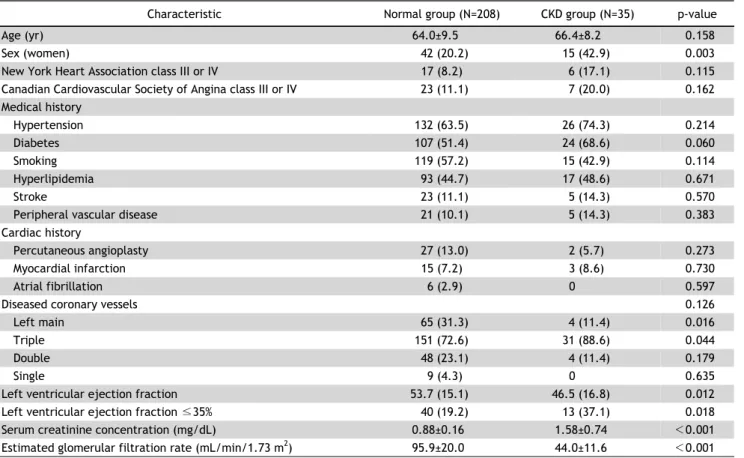
Table 1. Baseline characteristics of patients in the normal group and the CKD group
Characteristic Normal group (N=208) CKD group (N=35) p-value
Age (yr) 64.0±9.5 66.4±8.2 0.158
Sex (women) 42 (20.2) 15 (42.9) 0.003
New York Heart Association class III or IV 17 (8.2) 6 (17.1) 0.115
Canadian Cardiovascular Society of Angina class III or IV 23 (11.1) 7 (20.0) 0.162
Medical history
Hypertension 132 (63.5) 26 (74.3) 0.214
Diabetes 107 (51.4) 24 (68.6) 0.060
Smoking 119 (57.2) 15 (42.9) 0.114
Hyperlipidemia 93 (44.7) 17 (48.6) 0.671
Stroke 23 (11.1) 5 (14.3) 0.570
Peripheral vascular disease 21 (10.1) 5 (14.3) 0.383
Cardiac history
Percutaneous angioplasty 27 (13.0) 2 (5.7) 0.273
Myocardial infarction 15 (7.2) 3 (8.6) 0.730
Atrial fibrillation 6 (2.9) 0 0.597
Diseased coronary vessels 0.126
Left main 65 (31.3) 4 (11.4) 0.016
Triple 151 (72.6) 31 (88.6) 0.044
Double 48 (23.1) 4 (11.4) 0.179
Single 9 (4.3) 0 0.635
Left ventricular ejection fraction 53.7 (15.1) 46.5 (16.8) 0.012
Left ventricular ejection fraction ≤35% 40 (19.2) 13 (37.1) 0.018
Serum creatinine concentration (mg/dL) 0.88±0.16 1.58±0.74 <0.001
Estimated glomerular filtration rate (mL/min/1.73 m
2) 95.9±20.0 44.0±11.6 <0.001
Values are presented as mean±standard deviation or number of patients (%).
CKD, chronic kidney disease.
with or without inotropes. To optimize oxygen deliv- ery, we used a transfusion of red blood cells to ma- intain a hem atocrit of >30%. We used isotonic crys- talloids rather than colloids to manage the expansion of intravascular volume in patients at risk for AKI.
(3) Postoperative management: Dehydration was avoided to maintain sufficient kidney blood flow. Ri- gorous physical examination was performed to detect signs of dehydration, including dehydrated tongue, tachycardia, and decreased urine output. If any signs were present, positive input-output balance was ach- ieved using potassium-free fluid hydration (about 500 mL positive) for the first 3 days after surgery.
Fentanyl-based pain medication rather than non-ster- oidal anti-inflammatory drugs was used. Doses were strictly adjusted based on eGFR, especially when us- ing prophylactic antibiotics. Tight insulin therapy was performed to maintain plasma glucose levels <180 mg/dL.
4) Data collection and statistical analysis
The eGFR and serum creatinine levels were meas- ured preoperatively, on postoperative days (POD) 1, 2, 3, and 5, and prior to discharge. Statistical analy- ses were performed with IBM SPSS ver. 22.0 soft- ware (IBM Co., Arm onk, NY, USA). Preoperative char- acteristics, operative data, and postoperative out- comes were compared between the normal and CKD groups. Categorical variables are expressed as num- bers and percentages of patients. Continuous varia- bles are expressed as means±standard deviations.
Statistical analysis comparing 2 groups was per-
formed with the independent t-test or the Mann-Wh-
itney U-test for continuous variables. The Pearson
chi-square or Fisher exact test was used to compare
categorical variables. Univariate and multivariate lo-
gistic regression models were used to determine in-
dependent risk factors for AKI. All variables with a
p-value <0.10 were entered into a subsequent multi-
variate analysis. On multivariate analysis, variables
Table 3. AKI after off-pump coronary artery bypass surgery
Variable Normal group Chronic kidney disease group Odds ratio (95% confidence interval) p-value
Overall AKI 24 (11.5) 10 (28.6) 3.07 (1.31 –7.16) 0.010
POD #1 8 (3.8) 6 (17.1) 5.17 (1.67 –15.98) 0.004
POD #2 16 (7.7) 3 (8.6) 1.13 (0.31 –4.08) 0.858
POD #3 4 (1.9) 0 -
POD #5 0 1 (2.9) -
Renal replacement therapy 0 0
Values are presented as number of patients (%).
Table 2. Operative characteristics and postoperative outcomes of patients in the normal group and the CKD group
Characteristic Normal group CKD group p-value No. of grafts per patient 3.48±0.98 3.46±0.92 0.719 Grafts used
Bilateral ITAs 198 (95.2) 34 (97.1) Bilateral ITAs+right
saphenous vein
1 (0.5) 1 (2.9)
Inotrope use 49 (23.6) 12 (34.3) 0.176
Transfusion 44 (21.2) 15 (42.9) 0.006
New onset atrial fibrillation 17 (8.2) 6 (17.1) 0.115 Wound complications 7 (3.4) 4 (11.4) 0.057
Stroke 5 (2.4) 0 >0.999
Re-exploration for bleeding 2 (1.0) 2 (5.7) 0.100 Perioperative intra-aortic
balloon pump
2 (1.0) 1 (2.9) 0.374
Mechanical ventilation (hr) 8.6±6.8 9.4±5.6 0.444 Total intensive care unit
stay (day)
1.1±0.6 1.1±0.3 0.752
Postoperative length of stay (day)
9.9±9.0 10.5±10.3 0.106
In-hospital mortality 1 (0.5) 0 >0.999
Values are presented as mean±standard deviation or number of patients (%).
CKD, chronic kidney disease; ITA, internal thoracic artery.
that retained a p-value <0.05 were defined as inde- pendent risk factors for AKI. A linear mixed model was used to analyze the serial changes in serum cre- atinine levels and eGFR. A p-value <0.05 was consi- dered statistically significant.
Results
The baseline characteristics of the 2 groups are shown in Table 1. The CKD group had more female patients (p=0.003) and lower left ventricle ejection fractions (p=0.012) than the normal group. The CKD
group tended to have more diabetic patients, but this was not statistically significant (p=0.06). The normal group had a higher rate of left main coronary le- sions. However, the CKD group had more diffuse cor- onary lesions presenting as triple vessel disease. In the CKD group, the mean serum creatinine concen- tration was 1.58±0.74 mg/dL, and the mean eGFR was 44.0±11.6 mL/min/1.73 m
2.
Operative data and postoperative outcomes are shown in Table 2. The mean number of grafts was similar between the 2 groups (3.48±0.98 in the nor- mal group vs. 3.46±0.92 in the CKD group, p=0.719).
Bilateral internal thoracic arteries were used in most patients (normal group, 95.2%; CKD group, 97.1%).
Patients in the CKD group received more trans- fusions than those in the normal group (p=0.006).
There was a slightly higher incidence of wound com- plications in the CKD group (p=0.057). However, the occurrence of m ediastinitis did not significantly differ between the 2 groups. Re-exploration for bleeding, ventilation hours, and postoperative length of hospi- tal stay did not significantly differ between the 2 groups. In-hospital mortality occurred in only 1 pa- tient in the norm al group (overall m ortality, 0.004%) and in none in the CKD group.
1) Risk factors for postoperative acute kidney injury The overall incidence of AKI after OPCAB is re- ported in Table 3. Cases of AKI occurred in 34 pa- tients (13.9%). Most of these presented on or before POD 2. Patients in the CKD group were at a ×3 high- er risk of developing AKI than those in the normal group (odds ratio [OR], 3.07; 95% confidence interval [CI], 1.31 to 7.16; p=0.01), especially on POD 1 (OR, 5.17; 95% CI, 1.67 to 15.98; p=0.04). However, none of these patients needed RRT.
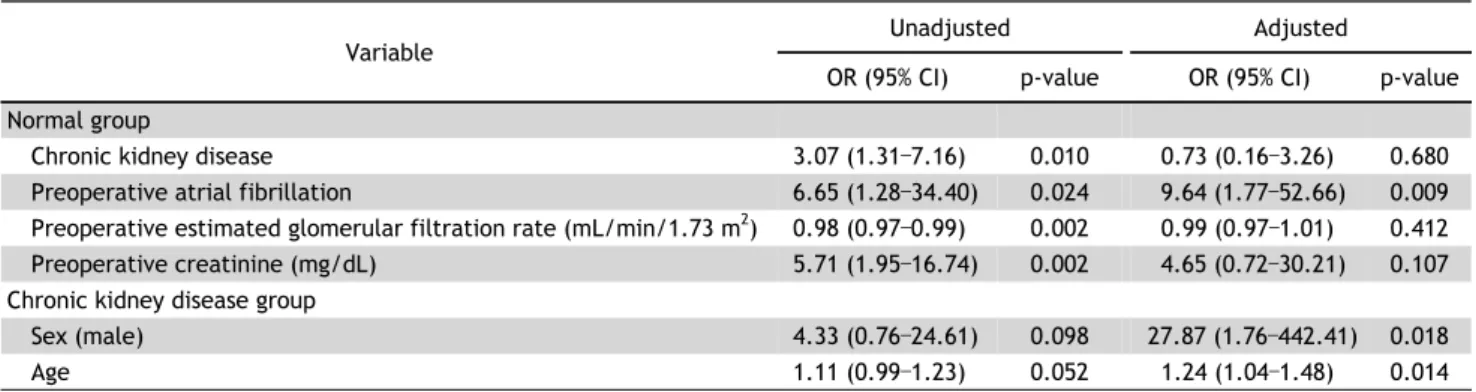
The risk factors for AKI are represented in Table 4.
Table 4. Risk factors for postoperative acute kidney injury after off-pump coronary artery bypass surgery Variable
Unadjusted Adjusted
OR (95% CI) p-value OR (95% CI) p-value Normal group
Chronic kidney disease 3.07 (1.31 –7.16) 0.010 0.73 (0.16 –3.26) 0.680
Preoperative atrial fibrillation 6.65 (1.28 –34.40) 0.024 9.64 (1.77 –52.66) 0.009
Preoperative estimated glomerular filtration rate (mL/min/1.73 m
2) 0.98 (0.97 –0.99) 0.002 0.99 (0.97 –1.01) 0.412
Preoperative creatinine (mg/dL) 5.71 (1.95 –16.74) 0.002 4.65 (0.72 –30.21) 0.107
Chronic kidney disease group
Sex (male) 4.33 (0.76 –24.61) 0.098 27.87 (1.76 –442.41) 0.018
Age 1.11 (0.99 –1.23) 0.052 1.24 (1.04 –1.48) 0.014
OR, odds ratio; CI, confidence interval.
Table 5. Postoperative serial changes in eGFR
Variable Estimated marginal means
a)Standard error t p-value
Chronic kidney disease group
POD #1 −0.958 2.423 −0.40 0.693
POD #2 −1.366 2.760 −0.49 0.621
POD #3 1.685 2.729 0.62 0.538
POD #5 9.408 2.569 3.66 <0.001
Discharge 10.696 2.332 4.59 <0.001
Normal group
POD #1 −0.719 0.994 −0.72 0.470
POD #2 −4.242 1.132 −3.75 <0.001
POD #3 −1.077 1.119 −0.96 0.337
POD #5 0.824 1.055 0.78 0.436
Discharge 1.121 0.957 1.17 0.243
eGFR, estimated glomerular filtration rate; POD, postoperative day.
a)
Differences of eGFR between preoperative values and postoperative values at each time were calculated by estimated marginal means.
Univariate analysis revealed that CKD, atrial fibrilla- tion, preoperative eGFR, and serum creatinine level were risk factors for AKI in all patients. However, in multivariate analysis, CKD was not a risk factor for AKI. Preoperative atrial fibrillation was the only in- dependent risk factor for AKI (OR, 9.64; 95% CI, 1.77 to 52.66; p=0.009). In subgroup analysis in the CKD group, male gender and older age were independent risk factors for AKI after OPCAB (OR, 27.87; 95% CI, 1.76 to 442.41; p=0.018; and OR, 1.24; 95% CI, 1.04 to 1.48; p=0.014, respectively). Left ventricle ejection fraction, preoperative eGFR, and serum creatinine level did not affect the occurrence of AKI.
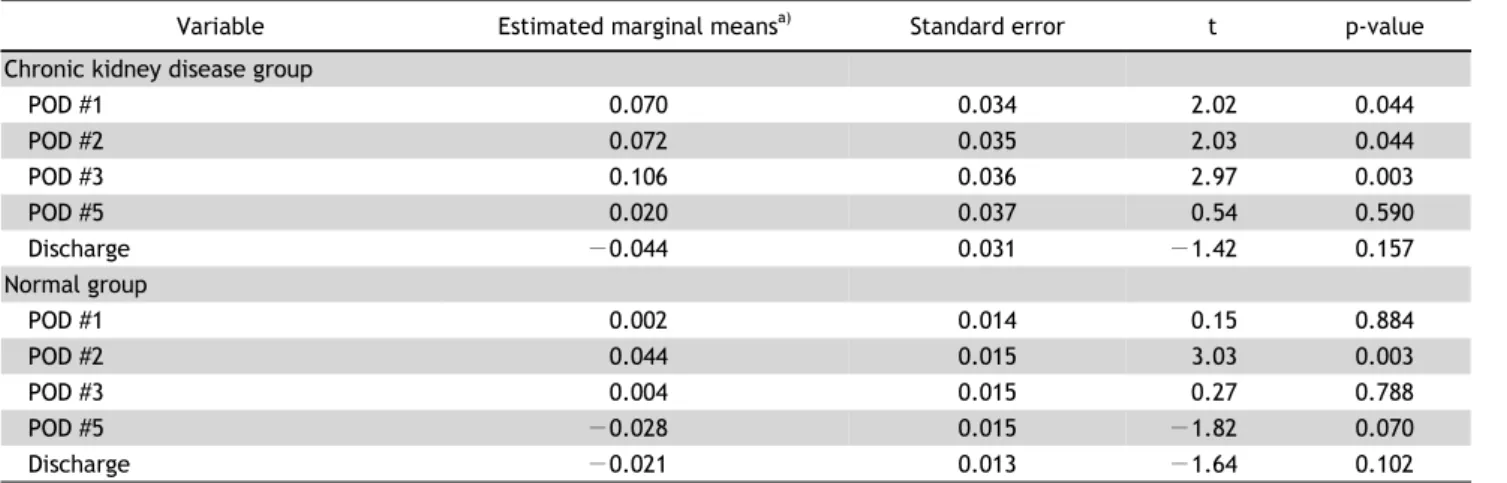
2) Serial changes of postoperative renal function Postoperative serial changes of measured eGFR and serum creatinine levels are shown in Tables 5 and 6.
(1) Estimated glomerular filtration rate: In the CKD group, eGFR decreased until POD 2. After POD 3, eGFR was slightly increased, and further increased significantly compared to preoperative values until prior to discharge, indicating recovery of renal func- tion (p<0.001). The normal group also showed sim- ilar recovery patterns with respect to renal function.
However, the worst eGFRs com pared to preoperative values were recorded on POD 2, and these differ- ences were statistically significant (p<0.001).
(2) Serum creatinine levels: In the CKD group, se-
rum creatinine levels were elevated until POD 3 and
decreased after POD 5 until discharge, but statisti-
cally significant differences compared to preoperative
values were noted from POD 1 to 3 (p<0.05). In the
normal group, serum creatinine levels were elevated
until POD 2, and decreased until prior to discharge.
Table 6. Postoperative serial changes in serum creatinine levels
Variable Estimated marginal means
a)Standard error t p-value
Chronic kidney disease group
POD #1 0.070 0.034 2.02 0.044
POD #2 0.072 0.035 2.03 0.044
POD #3 0.106 0.036 2.97 0.003
POD #5 0.020 0.037 0.54 0.590
Discharge −0.044 0.031 −1.42 0.157
Normal group
POD #1 0.002 0.014 0.15 0.884
POD #2 0.044 0.015 3.03 0.003
POD #3 0.004 0.015 0.27 0.788
POD #5 −0.028 0.015 −1.82 0.070
Discharge −0.021 0.013 −1.64 0.102
POD, postoperative day.
a)