• 검색 결과가 없습니다.

Severity of Musculoskeletal Pain and Its Effect on Psychosocial Factors in Veterans With Posttraumatic Stress Disorder

N/A
N/A
Protected

Academic year: 2021

Share "Severity of Musculoskeletal Pain and Its Effect on Psychosocial Factors in Veterans With Posttraumatic Stress Disorder"

Copied!
9
0
0

로드 중.... (전체 텍스트 보기)

전체 글

(1)

Research Article Open Access

Severity of Musculoskeletal Pain and Its Effect on Psychosocial Factors in Veterans With Posttraumatic Stress Disorder

Chun-suk Kwon, PT, MPH, MA·Suhn-yeop Kim, PT, PhD

1†

Department of Physical Therapy, Graduate School of Daejeon University

1

Department of Physical Therapy, College of Health and Medical Science, Daejeon University

Received: July 7, 2015 / Revised: July 9, 2015 / Accepted: July 24, 2015

ⓒ 2015 J Korean Soc Phys Med

| Abstract |

1)

PURPOSE: The aim of this study is to investigate the relationship between psychosocial factors and the severity of musculoskeletal pain in veterans with posttraumatic stress disorder (PTSD).

METHODS: A total of 60 subjects were recruited from among the veterans with musculoskeletal pain at D Veterans Hospital. PTSD was evaluated by using the Diagnostic and Statistical Manual of Mental Disorders, Fourth Edition;

severity of pain was measured by using the short-form McGill Pain Questionnaire (SF-MPQ); depression and anxiety were measured by using the Symptom Checklist- 90-Revision; and the quality of sleep was measured by using the Pittsburgh Sleep Quality Index. All data were analyzed using SPSS 18.0 software for Windows.

RESULTS: The averages cores of pain intensity (7.48±

1.67), SF-MPQ-sensory (13.84±7.52), SF-MPQ-affective (4.41±3.79), depression (19.30±11.37), anxiety (13.39±7.99), and quality of sleep (10.05±5.89) were obtained in veterans

†Corresponding Author: [email protected]

This is an Open Access article distributed under the terms of the Creative Commons Attribution Non-Commercial License (http://creativecommons.org/licenses/by-nc/3.0) which permits unrestricted non-commercial use, distribution, and reproduction in any medium, provided the original work is properly cited.

with PTSD. SF-MPQ-sensory measures sleep quality (r=0.346, p<0.01), SF-MPQ-affective measures depression (r=0.318, p<0.01) and anxiety (r=0.404, p<0.01), and these showed a statistically significant positive correlation in veterans with PTSD. Pain levels were observed to be higher in veterans with PTSD. Moreover, in these subjects, physical pain had a significant influence on the anxiety variable among the psychosocial factors.

CONCLUSION: These findings suggest that musculoskeletal pain provides meaningful information about depression, anxiety, and sleep disorder in veterans with PTSD. Our data suggest that musculoskeletal pain may need to be addressed as part of the health management process of veterans.

Key Words: Anxiety, Depression, Pain, Quality of sleep

Ⅰ. Introduction

In this study, veterans refer to soldiers who fought in the Korean War or the Vietnam War and have been discharged. Veterans could have psychological problems due to posttraumatic stress disorder (PTSD) from combat situations, and musculoskeletal pain (Otis et al, 2009).

PTSD refers to an anxiety disorder with specific symptoms

that occur after exposure to shocking incidences such as

(2)

life-threatening events, war, torture, natural disaster, and accidents (Sungur and Gunduz, 2014). In the Diagnostic and Statistical Manual of Mental Disorder-Fourth Edition (DSM-IV) of the American Psychiatric Association, 17 symptoms of re-experience, avoidance, and hyperarousal were described as clinical diagnosis criteria for PTSD (Ghanizadeh, 2013). PTSD patients had a high pain incidence, which are mostly musculoskeletal pain diseases such as fibromyalgia syndrome (Shipherd et al, 2007).

Patients both with pain and PTSD may have a higher pain intensity and more pain-related psychological effects than those with pain alone (Pietrzak, 2014).

Pain results from a long period of bed rest for stabilization for anxiety, and from a reduction of physical activities, and the rate of these patterns becomes higher with increasing age (Kim, 2013). Most of the veterans are elderly, and their physical activities as well as physical and psychological functions decrease with age, leading to a reduction of muscular function (Yokoya et al, 2008) and the occurrence of pain (Stalnacke and Ostman, 2010). In general, veterans experience pain in various body parts including the head, legs, waist, and shoulders (Clark et al, 2007); they also experience pain-related negative changes, and have altered beliefs and behaviors toward pain that result in chronic pain with a vicious cycle of depression, anxiety, and sleep disorder (Otis et al, 2009).

The prevalence rate of chronic pain in the general US population was reported to be between 10% and 20%

(Villano et al, 2007), where as 46.5% of veterans were reported to experience pain (Gironda et al, 2006). Pain is affected by psychosocial factors, contributes to physical disability, and causes gradual increases in the number of visits to medical facilities (Shipherd et al, 2007). Pain affects all aspects of physical, psychological, and social functions; thus, pain could have negative effects on the life of the affected person, including causing depression, anxiety, sleep disorder, and physical and mental disorders (Otis et al, 2009).

Depression and anxiety are commonly accompanied by affective changes in patients with physical pain, and the common symptoms of pain with depression and anxiety include sleep disorder, fatigue, and reduction of movement.

In addition, it has been reported that patients with pain accompanied with depression and anxiety had fewer physical activities, more difficulty in daily activities, and more severe disorders than patients with pain but without depression and anxiety; moreover, elderly patients with more severe pain had a higher level of depression (Keogh et al, 2006).

Sleep is an essential part of life, providing the body with energy to enable it to exert its best function;

quantitative and qualitative disturbance of sleep causes discomfort in life, or sleep disorders. Pain is accompanied by sleep disorder, and pain functions as a physical and mental factor that disturbs regular sleep, or affects the quantity and quality of sleep (Hwang, 2013). Despite the increase of musculoskeletal pain, depression, anxiety, and sleep disorder in veterans, there are only a few studies on the correlation of musculoskeletal pain with depression, anxiety, and sleep quality in veterans with PTSD.

Thereby, the present study was aimed at providing fundamental data for the health management of veterans with PTSD. In this study, we investigated the levels of musculoskeletal pain, depression, anxiety, and sleep disorder in veterans with PTSD, identified the correlations between these factors, and analyzed the effect of pain on the psychosocial characteristics of veterans with PTSD.

The hypotheses of the present study are as follows: (1)

the level of pain that veterans with PTSD experience

correlates with the levels of depression, anxiety, and sleep

disorder and (2) psychosocial factors affecting pain level

are different between veterans with and those without

PTSD.

(3)

Table 1. General characteristics of veterans subjects with and without PTSD diagnosis

Variables PTSD

a)

Diagnosis Range

(min~max) t p

PTSD (n=44) No PTSD (n=16)

Age (years) 69.00±4.00

b)

71.68±5.82 62~83 -2.02 0.94

Height (cm) 167.34±4.99 168.81±6.05 154~178 -0.95 0.96

Weight (kg) 68.32±10.00 65.69±6.39 43~86 0.97 0.43

BMI

c)

(%) 20.39±2.82 19.45±1.74 26.88~13.44 1.24 0.43

Present Pain Index (score) 3.61±0.97 3.31±1.49 1~5 -0.75 0.46

SF-MPQ

d)

-Sensory (score) 13.84±7.52 12.06±7.32 1~32 -0.81 0.41

SF-MPQ-Affective (score) 4.41±3.79 2.31±3.07 0~12 -1.98 0.05

*

Duration of illness (years) 21.08±16.81 10.06±14.00 0.4~54 -2.33 0.02

*

Number of sites of pain 3.16±1.68 2.00±1.03 1~7 -3.20 0.01

**

a) Post-traumatic Stress Disorder, b) Mean±Standard deviation, c) Body mass index, d) Short Form-McGill Pain Questionnaire, Sensory score (range: 0~33), Affective score (range: 0~12). * p<0.05, ** p<0.01

Ⅱ. Methods

1. Study participants

The present study was performed in 60 patients receiving physical therapy services at B hospital located in D city from March 2015 to April 2015. According to on the diagnostic criteria for PTSD, 44 of these participants were diagnosed with PTSD and 16 did not have PTSD. The selection criteria for participants were veterans who were experiencing bodily pain for >3 months, and had depression, anxiety, and sleep disorder. Patients with problems in cognitive function preventing them from responding to questionnaires were excluded. The participants were given an explanation about the goal and contents of the present study, and they signed a consent form for participation. The mean age of the participants was 69.67±4.75 years; their general characteristics are shown in Table 1.

2. Measurement tools and methods

1) Posttraumatic stress disorder

The Posttraumatic Diagnosis Scale is a self-reported tool developed by Edna B. Foa at the University of Pennsylvania

in 1997 for the evaluation of PTSD symptoms. Moreover, DSM-IV (Ghanizadeh, 2013), which was composed of 17 questions including 5 questions on re-experience symptoms, 7 questions on avoidance symptoms, and 5 questions on hyperarousal symptoms, was used in the present study.

All questions were designed to receive answers about the frequencies of symptoms during the past 1 month according to a four-point scale from 0 to 3 points. There should be at least one or more re-experience symptoms, three or more avoidant symptoms, and two or more hyperarousal symptoms, and duration of illness of at least 1 or more months to meet the DSM-IV-TR diagnosis criteria. A list of PTSD symptoms was presented, and the subjects answered by using a four-point Likert scale totaling 51 points, in which a higher point means a higher degree of PTSD (Ghanizadeh, 2013).

2) Pain level

The short-formMcGill Pain Questionnaire (SF-MPQ) was used to evaluate physical pain level of the participants.

The SF-MPQ is a questionnaire that can measure both in

one-dimensional and in multidimensional scales, by which

pain level was measured with words that are frequently

used by chronic pain patients. The multidimensional scale

(4)

Table 2. The psychosocial variables of Veterans subjects with and without PTSD diagnosis

Variables PTSD

a)

Diagnosis

t p

PTSD (n=44) Range No PTSD (n=16) Range

SCL-90R

b)

-Depression 19.30±11.37

c)

3~39 12.06±10.23 0~31 -2.23 0.02

*

SCL-90R-Anxiety 13.39±7.99 2~30 6.13±4.63 0~16 -4.34 0.01

**

Quality of sleep

d)

10.05±5.89 0~21 7.38±4.22 0~4 -1.66 0.10

a) Post-traumatic Stress Disorder, b) Symptom checklist-90-Revision; Depression score (range: 0~39), Anxiety score (range: 0~30),

c) Mean±Standard deviation, d) Pittsburgh sleep quality index (range: 0~21). * p<0.05, ** p<0.01

was composed of a total of 15 questions, including 11 questions in the sensory domain and 4 questions in the affective domain, which totaled 45 points in a four-point scale. The ordinal scale for measuring present pain intensity (PPI) is a questionnaire developed to evaluate subjective experience and was composed of one question. In addition, the visual analogue scale (VAS) was used to evaluate the pain level in a one-dimensional scale, in which a higher point means more severe pain (Melzack, 2005). The measurement reliability of the SF-MPQ has a Cronbach α value of 0.86, showing a high internal consistency (Kim, 2004); the reliability of the original evaluation tool was r=0.89, and its validity was 0.70 (Yakut et al, 2007).

3) Depression and anxiety levels

The Symptom Checklist-90-Revision (SCL-90R) was used to evaluate the depression and anxiety levels of the participants. The SCL-90R was composed of 13 questions to measure the degree of depression and 10 questions on anxiety. It was designed with a four-point scale, in which 0 point in each question means “never,” where as 3 points means “extremely severe.” A higher measurement point indicated a more severe degree of depression and anxiety, and its internal consistency was r=0.77–0.90 (Derogatis et al, 1976).

4) Sleep quality level

The sleep quality level was measured using the Pittsburgh Sleep Quality Index (PSQI) (Buysse et al, 1989), which was composed of a total of 18 questions on 7

components including 1 question on sleep quality, 2 questions on sleep latency, 1 question on sleep duration, 2 questions on effectiveness of habitual sleep, 9 questions on sleep disturbance, 1 question on the use of sleep aid, and 2 questions on day time functional disorder. It was evaluated in a four-point scale, in which 0 point in each question means “no problem,” where as 3 points means

“extremely problematic”; the range of points was from 0 point to 21 points, in which ≥5 points means sleep disturbance. A higher measurement point indicated a lower sleep quality, and the Cronbach α value at the time of tool development was 0.83 (Buysse et al, 1989).

3. Data analysis

Descriptive statistics were used for analyzing the general characteristics of the study participants and the mean and standard deviation of each measurement variable. The Shapiro–Wilk test was employed to examine the normality of major variables, and Pearson’s correlation analysis and regression analysis were used to analyze the effect of pain level on depression, anxiety, and sleep quality. The PASW 18.0 statistical analysis program was used for the study, and the statistical significance level α was set to 0.05.

Ⅲ. Results

1. General characteristics of pain

The general characteristics and physical pain of the study

participants are presented in Table 1. Of the participants,

(5)

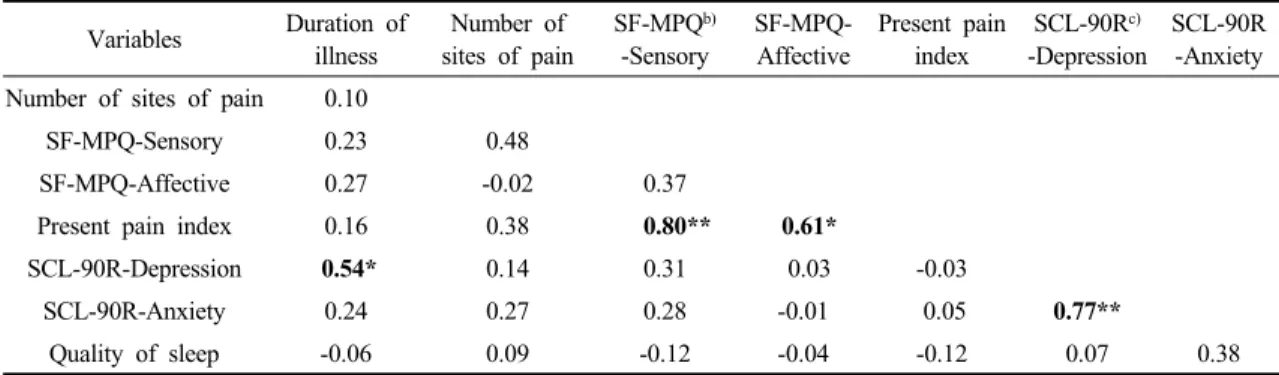
Table 3. Correlation coefficients between pain and psychosocial variables without PTSD

a)

diagnosis (N=16) Variables Duration of

illness

Number of sites of pain

SF-MPQ

b)

-Sensory

SF-MPQ- Affective

Present pain index

SCL-90R

c)

-Depression

SCL-90R -Anxiety Number of sites of pain 0.10

SF-MPQ-Sensory 0.23 0.48

SF-MPQ-Affective 0.27 -0.02 0.37

Present pain index 0.16 0.38

0.80** 0.61*

SCL-90R-Depression

0.54*

0.14 0.31 0.03 -0.03

SCL-90R-Anxiety 0.24 0.27 0.28 -0.01 0.05

0.77**

Quality of sleep -0.06 0.09 -0.12 -0.04 -0.12 0.07 0.38

a) Post-traumatic Stress Disorder, b)Short Form-McGill Pain Questionnaire, c)Symptom checklist-90-Revision. * p<0.05, ** p<0.01

Table 4. Correlation coefficients between pain and psychosocial variables with PTSD

a)

diagnosis (N=44) Variables Duration of

illness

Number of sites of pain

SF-MPQ

b)

-Sensory

SF-MPQ- Affective

Present pain index

SCL-90R

c)

-Depression

SCL-90R -Anxiety Number of sites of pain 0.09

SF-MPQ-Sensory 0.16

0.43**

SF-MPQ-Affective

0.30*

0.28

0.65**

Present pain index

0.43**

-0.09

0.33** 0.59**

SCL-90R-Depression 0.24 0.19 0.23

0.31*

0.29

SCL-90R-Anxiety 0.23 0.14 0.17

0.40** 0.44** 0.77**

Quality of sleep 0.13 0.26

0.34**

0.12 0.15

0.60** 0.56**

a) Post-traumatic Stress Disorder, b) Short Form-McGill Pain Questionnaire, c) Symptom checklist-90-Revision. * p<0.05, ** p<0.01
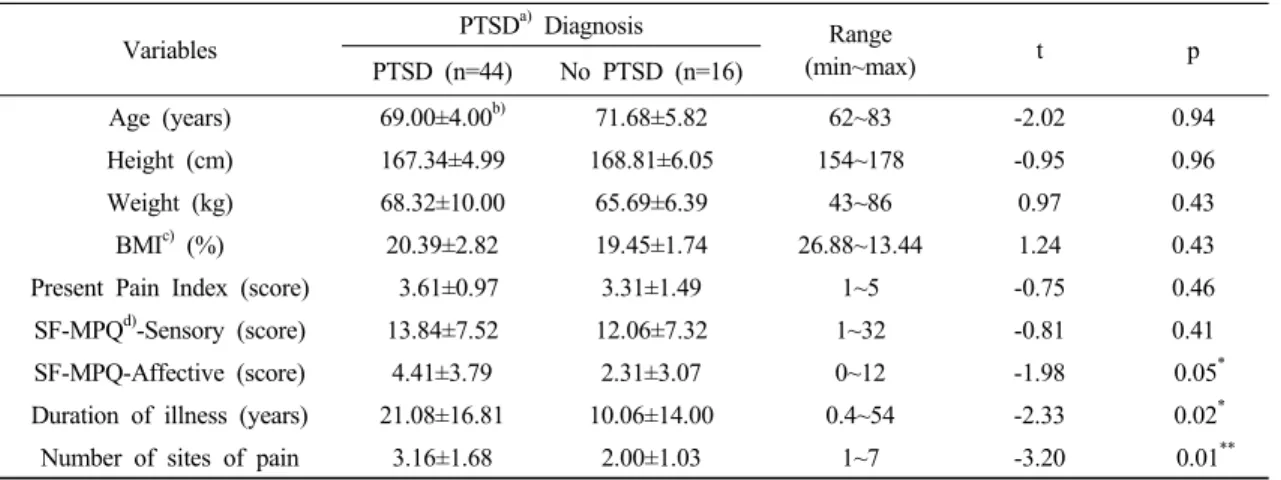
44 (73.3%) were veterans with PTSD and 16 (26.7%) were veterans without PTSD. The present pain intensity of the group with PTSD was 7.48±1.67 points; the SF-MPQ sensory domain was 13.84±7.52; the SF-MPQ affective domain was 4.41±3.79; and the present pain level was 3.61±0.97, which had no differences from those of the group without PTSD. On the other hand, the duration of illness of the PTSD group was 21.08±16.81 years, which was significantly longer (p<0.05), and the number of body areas that were experiencing pain was 3.16±1.68 sites, which was also significantly higher than that of the group without PTSD (p<0.01).

2. Patterns of psychosocial factors

The scores of psychosocial factors, including depression,

anxiety, and quality of sleep, are presented in Table 2.

The depression (p<0.05) and anxiety (p<0.01) levels of the group with PTSD were significantly higher than those of the group without PTSD, whereas there was no difference in the level of sleep quality between the groups.

3. Correlation between pain level and psychosocial factors

The correlations between pain-related variables and

psychosocial factor variables in the groups with and without

PTSD are presented in Tables 3 and 4, respectively. The

veterans group without PTSD showed a significant

correlation only between the depression level and the

duration of illness (p<0.05). The veterans group with PTSD

showed a correlation between the pain variable in the

(6)

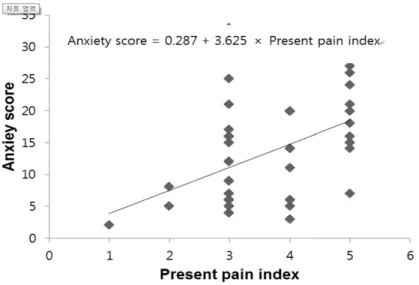
Fig. 1. Scatter-plot showing the bivariate correlation between level of present pain and anxiety score. (r=0.44, p<0.001)

SF-MPQ sensory domain and sleep quality (r=0.346, p<0.01), and the pain variable in the SF-MPQ affective domain of the PTSD group had significant correlations with depression (r=0.318, p<0.05) and anxiety (r=0.404, p<0.01). In addition, the present pain intensity had a significant correlation with the anxiety level (r=0.440, p<0.03).

4. Effects of pain level on psychosocial charac- teristics

The present pain level of the veterans group with PTSD was found to significantly affect the anxiety variable among the psychosocial factors (Fig. 1). In the regression equation with pain level as the independent variable, “anxiety level

=0.287+3.625×present pain level,” and the explanatory power of this regression equation was 19.3%.

Ⅳ. Discussion

The present study was aimed at providing fund a mental data in physical therapy for the treatment planning and clinical approach to veterans with PTSD and musculoskeletal

pain. As a result, veterans with PTSD were found to have more severe pain, depression, anxiety, and sleep disorder than those without PTSD. In addition, there were significant correlations between the level of musculoskeletal pain and the psychosocial variables, including depression, anxiety, and sleep quality levels in veterans with PTSD.

In a study by Lew et al (2007), there were 81.5% chronic pain patients and 68.2% PTSD patients out of 340 veterans, and Clark et al (2007) found that 96% of veterans out of 50 had pain and 44% had PTSD. The present study also found that 73.3% of veterans with pain had PTSD, showing that many veterans had both pain and PTSD. It was reported that chronic pain occurs with age owing to physical and psychological deterioration, as well as a reduction of physical activities (Stalnacke and Ostman, 2010). The ages of the participants of the present study were between 62 and 83 years (mean age, 69.67±4.75 years), showing that veterans with musculoskeletal pain were mostly elderly.

Melzack (2005) overlooked the fact that pain could not

be evaluated by using a single scale because of the complex

psychosocial factors involved. They evaluated pain by

dividing into the sensory domain and the affective domain

(7)

that were in one-dimensional and multidimensional scales, respectively; by using the SF-MPQ; and then by evaluating the present pain intensity. The SF-MPQ has been widely used in Western countries to evaluate the various pain levels that patients experience. In the present study, we used the Korean version of the SF-MPQ, which has a reliability of measurement of the Cronbach  of 0.861, showing a high internal consistency (Kim, 2004). As veterans mostly have chronic pain rather than acute pain, it is considered appropriate to use this tool for measuring the degree of pain. The sensory domain of the SF-MPQ for multidimen- sional pain evaluation was composed of sensory words to express the type of pain that patients feel, including aching, stabbing, stinging, sharp, squeezing painful, gnawingly painful, burning, shooting, heavy, tender, and painful like being folded. The affective domain of the SF-MPQ comprised affective pain words, including tired and exhausted, vomitous painful, awfully painful, and cruelly painful like being punished.

In the study by Kim (2013), the pain level reported by participants showing a medium level of pain was 4.63±2.20 points out of 10, and that in the study by Choi (2009) was 4.51±2.41 points. In contrast, the pain level of veterans with PTSD (7.48±1.67 points) was higher than that of veterans without PTSD (6.69±2.05 points) in the present study, which was considered to be because many veterans both have PTSD and pain (due to combat situations) as well as psychosocial problems, which resulted in a relatively higher pain intensity. It was reported that if pain and PTSD accompany each other, more severe pains and more mental disorders would be experienced owing to the interaction between pain and PTSD, and those patients would have a greater disability than patients with pain without PTSD. Therefore, patients in this condition might be difficult to cure because of this association (Otis et al, 2009).

In a study by Asmundson et al (2004), the prevalence rate of PTSD in veteran patients with chronic pain was

10–50%, and its symptoms were psychosocial factors, including anxiety, depression, and reduction of activities (Moeller-Bertram et al, 2012). According to preceding studies on pain, the elderly with more severe pain tended to have higher levels of depression and anxiety (Keogh et al, 2006). Moreover, Kim (2013) and Choi (2009) found that as the pain intensity becomes higher, the levels of depression, anxiety, and sleep disorder also become higher.

Consistently, the veterans with PTSD in the present study scored 19.30±11.37 points for depression, 13.39±7.99 points for anxiety, and 10.05±5.89 points for sleep quality in psychosocial variables, which were higher than those of veterans without PTSD; therefore, the pain of veterans with PTSD had high correlations with psychosocial variables. In addition, the pain variable in the SF-MPQ sensory domain had a correlation with sleep quality (r=0.346, p<0.01) in veterans with PTSD, whereas the pain intensity variable in the SF-MPQ affective domain had correlations with depression (r=0.318, p<0.05) and anxiety (r=0.404, p<0.01), and the present pain intensity had a correlation with anxiety (r=0.440, p<0.01). These results indicate that as the musculoskeletal pain level becomes higher, the levels of depression, anxiety, and sleep disorder symptoms also become higher. The pain level in veterans with PTSD significantly affected the anxiety variable in psychosocial factors in the present study, which was consistent with preceding studies.

Sleep disorder is caused by a quantitative and qualitative disturbance in sleep, causing discomfort in life or disorders.

In a study by Kim (2013), the elderly with pain had a poor sleep quality, and a study by Jun (2004) found that

>50% of the elderly >65 years of age complained of sleep

disorders. In the present study, 43.3% of all participants

had a poor sleep quality because of pain, and 25% of the

participants were using a sleep aid three or more times

per week, indicating that veterans had a poor quality of

sleep. The results of the study indicate that pain is an

important factor that negatively affects sleep.

(8)

As the participants of the present study were limited to veterans who were using a hospital in a city, it is difficult to generalize the results for all veterans. In addition, as this study is a cross-sectional research that measured various variables at one time point, it was difficult to have a fine control on the causality between the variables. In conclusion, musculoskeletal pain in veterans with PTSD had effects on psychological factors; therefore, it is considered necessary to implement interventions that reduce depression and anxiety symptoms independent of drugs as well as to decrease body pain for improving sleep quality. Thereby, a follow-up study should be performed on the developments of the intervention program, appropriate education, and treatment measures to reduce depression, anxiety, and sleep disorder for pain control in veterans with PTSD.

Ⅴ. Conclusion

The present study was conducted to investigate the effect of musculoskeletal pain on depression, anxiety, and sleep quality in veterans with PTSD. The SF-MPQ was used to evaluate pain level; the SCL-90R was used to evaluate depression and anxiety levels; and the PSQI was employed to evaluate sleep quality. The analysis of measured variables showed that the severity of musculoskeletal pain in veterans with PTSD had significant correlations with depression, anxiety, and sleep quality, and regression analysis revealed that the musculoskeletal pain of the PTSD group was significantly affected by anxiety among the psychosocial factors. We suggest that a further study should include an active intervention program for body pain control when establish in gan intervention and control program for veterans with PTSD based on the findings of various studies.

Asmundson GJ, Wright KD, Stein MB. Pain and PTSD symptoms in female veterans. Eur J Pain. 2004;8(4):

345-50.

Buysse DJ, Reynolds CF, Monk TH, et al. The Pittsburgh Sleep Quality Index: a new instrument for psychiatric practice and research. Psychiatry Res. 1989;28(2):

193-213.

Clark ME, Bair MJ, Buckenmaier CC, et al. Pain and combat injuries in soldiers returning from Operations Enduring Freedom and Iraqi Freedom: implications for research and practice. J Rehabil Res Dev.

2007;44(2):179-94.

Choi MG. I feel the pain of the elderly, chronic condition, and research on the impact on daily life activities.

Master’s Degree, Hanyang University. 2009.

Derogatis LR, Rickels K, Rock AF. The SCL-90 and the MMPI:

a step in the validation of a new self-report scale.

Br J Psychiatry. 1976;128:280-9.

Ghanizadeh A. Agreement between Diagnostic and Statistical Manual of Mental Disorders, Fourth Edition, and the proposed DSM-V attention deficit hyperactivity disorder diagnostic criteria: an exploratory study.

Compr Psychiatry. 2013;54(1):7-10.

Gironda RJ, Clark ME, Massengale JP, et al. Pain among veterans of Operations Enduring Freedom and Iraqi Freedom. Pain Med. 2006;7(4):339-43.

Hwang HY. The relationship among pain, depression and sleep disturbance of the elderly with chronic low back pain. Master’s Degree. Catholic University of Pusan.

2013.

Jun, MH. The Relationship between Pain Coping Strategies and Depression of patients with Chronic Lower Back Pain Department of Counseling & Psychotherapy.

Master’s Degree. Seoul Women's University. 2004.

Keogh E, McCracken LM, Eccleston C. Gender moderates

the association between depression and disability in

(9)

chronic pain patients. Eur J Pain. 2006;10(5):413-22.

Kim HJ. Chronic pain, Sleep pattern and quality of life in the elderly. Master’s Degree. Hanyang University.

2013.

Kim EJ. Reliability and validity of the short-form McGill pain questionnaire (SF-MPQ) Korean version for measuring the old adult’s pain. Clinical Nursing Research. 2004;10(1):20-7.

Lew HL, Poole JH, Vanderploeg RD, et al. Program development and defining characteristics of returning military in a VA Polytrauma Network site. J Rehabil Res Dev.

2007;44:1027-34.

Melzack R. The McGill pain questionnaire: from description to measurement. Anesthesiology. 2005;103(1):199-202.

Moeller-Bertram T, Keltner J, Strigo IA. Pain and post traumatic stress disorder - review of clinical and experimental evidence. Neuropharmacology. 2012;62(2):586-97.

Otis JD, Keane TM, Kerns RD, et al. The development of an integrated treatment for veterans with comorbid chronic pain and posttraumatic stress disorder. Pain Med. 2009;10(7):1300-11.

Pietrzak M. Diagnosis and management of acute medial tibial stress syndrome in a 15 year old female surf life-saving competitor. Int J Sports Phys Ther. 2014;9(4):525-39.

Shipherd JC, Keyes M, Jovanovic T, et al. Veterans seeking treatment for posttraumatic stress disorder: what about comorbid chronic pain? J Rehabil Res Dev. 2007;

44(2):153-66.

Stalnacke BM, Ostman A. Post-traumatic stress in patients with injury-related chronic pain participating in a multimodal pain rehabilitation program. Neuropsy- chiatr Dis Treat. 2010;6:59-66.

Sungur MZ, Gunduz A. A comparison of DSM-IV-TR and DSM-5 definitions for sexual dysfunctions: critiques and challenges. J Sex Med. 2014;11(2):364-73.

Villano CL, Rosenblum A, Magura S, et al. Prevalence and correlates of posttraumatic stress disorder and chronic severe pain in psychiatric outpatients. J Rehabil Res Dev. 2007;44(2):167-78.

Yakut Y, Yakut E, Bayar K, et al. Reliability and validity of the Turkish version short-form McGill pain questionnaire in patients with rheumatoid arthritis.

Clin Rheumatol. 2007;26(7):1083-7.

Yokoya T, Demura S, Sato S. Fall risk characteristics of the elderly in an exercise class. J Physiol Anthropol.

2008;27(1):25-32.

수치

Table  1.  General  characteristics  of  veterans  subjects  with  and  without  PTSD  diagnosis
Table  2.  The  psychosocial  variables  of  Veterans  subjects  with  and  without  PTSD  diagnosis Variables  PTSD a)   Diagnosis t p PTSD  (n=44) Range No  PTSD  (n=16) Range SCL-90R b) -Depression 19.30±11.37 c) 3~39 12.06±10.23 0~31 -2.23 0.02 * SCL-9
Table  3.  Correlation  coefficients  between  pain  and  psychosocial  variables  without  PTSD a) diagnosis              (N=16) Variables Duration  of  illness Number  of  sites  of  pain SF-MPQ b)-Sensory SF-MPQ-Affective Present  pain index SCL-90R c)
Fig.  1.  Scatter-plot  showing  the  bivariate  correlation  between  level  of  present  pain  and  anxiety  score

참조

관련 문서

The degree of stress in accordance with general characteristics of the subjects showed no signifiant statistical difference, while the degree of physical

OABSS, overactive bladder symptom score; PSS, perceived stress scale; CES-D, center for epidemiological studies depression scale... PSS, CES-D associations with OABSS

In this study, it is showed that female and blood type O are the significant factors associated with prolonged C/Epi CT value despite of aspirin discontinuation more

The effect of the stress management program on the stress coping and perceived stress of the patients with finger replantation. Unpublished master's

Statistical

An Effect of Group Art Therapy on the Anxiety, Depression and Self-Esteem of single-parented children.. 2009년

In other hands, the higher stress levels by parent, academics, appearance and material factors showed more atrophy, physical symptoms,

 Although van der Waals equation is still less accurate at high