■
이한숙, 김명철
1■
수원여자대학 물리치료과,
1을지대학교 보건과학대학 물리치료학과
The Effect of Balance Task-Related Circuit Training on Chronic Stroke Patients
HanSuk Lee, PT, PhD; MyungChul Kim, PT, PhD
1Department of Physical Therapy, Suwon women’s College;
1Department of Physical Therapy, College of Health Science, Eulji University
Purpose: This study investigated the efficacy of task-related circuit training aimed at improving balance in individuals discharged from rehabilitation facilities following a stroke.
Methods: We recruited 12 stroke patients (34-66 years of age) to participate in a task-related circuit training program.
Baseline assessment included a history of stroke and an assessment using the Mini-Mental State Examination Korea (MMSE-K). After a baseline assessment, follow-up assessments were administered pre- and post-training. These included Berg Balance Scale (BBS), Functional Reach Test (FRT), and the Time Up & Go Test (TUG). Physiotherapists trained study subjects under the one-to-one supervision of students from the department of physical therapy. Circuit class study participants attended 90-minute treatment sessions, one day a week for 12 weeks (from September to December 2008).
The program consisted of a light warm-up period (10 min), physical exercises for improving balance (20 min), tasks focused on improving balance (50 min) and a cool-down period (10 min).
Results: Scores for the BBS assessment increased significantly (from 43.2 to 49.7) after the training (p<0.05). Reach distance on the FRT increased substantially (from 27.7 cm to 47.0 cm), although the improvement was not significant (p>0.05). The average time on the TUG test decreased significantly (from 23.7 sec to 19.5 sec) after the training (p<0.05).
Conclusion: The task-related circuit training program improved the balance and mobility of subjects, indicating that such a group program is useful for stroke patients who are discharged from the hospital. More such task-related programs set in a community environment should be developed.
Keywords: Task-related circuit training, Balance, BBS, FRT, TUG
논문접수일: 2009년 8월 1일 수정접수일: 2009년 10월 21일 게재승인일: 2009년 11월 1일 교신저자: 김명철, [email protected]
The Journal Korean Society of Physical Therapy
I. Introduction
Stroke is a major cause of disability and handicap in adults.
1It is not only an important health problem but also it imposes sociological and economic burdens on patients
and caregivers.
2Furthermore, despite intensive therapy
during the first six months post-stroke, many individuals
are still significantly disabled and handicapped.
1,3Stroke
patients not admitted to hospital receive significantly less
rehabilitation than patients who are admitted, even if they
need rehabilitation.
4After they leave the hospital, most cannot walk quickly or far and may stay at home and become isolated from society.
5In the past decade, there has been an increased amount of interest in alternatives to in-hospital rehabilitation services for stroke patients. Early, supported discharge and home-based programs for stroke patients have been developed.
6The need for community-based rehabilitation is increasing, and many community-based rehabilitation programs are being developed.
4,7-12Also, people with stroke has the high risk of falling and falls are common when people return home after stroke.
16Repeat fallers had greater mobility deficits and significantly reduced arm function and ADL ability.
17Important risk factors for falls are balance and gait deficits, attention deficits. The Stroke patients showed excessive postural sway and instability. So, Interventions addressing these deficits can be expected to prevent falls more successfully.
18-20The effect of group programs on the chronic stroke community has been evaluated in Korea.
3,5,7,13However, few studies have investigated the benefit of community physiotherapy for patients with long-term problems after a stroke,
14and most studies have focused on the effects of mat and band exercises.
15Group therapy is effective due to the interaction between members in the group. Classes are advantageous because they not only provide the opportunity for exercise and social interaction, but are also cost-effective with several individuals participating at the same time.
1,22Dean and Shepherd
23provided evidence of the efficacy of task-related motor training in improving the ability to balance during seated reaching activities after stroke. Yang et al
9suggested that the dual-task-based exercise program is feasible and beneficial for improving walking ability in chronic stroke.
Dean et al
1found the efficacy of a task-related circuit class at improving locomotor function in chronic stroke. In these days, the effect of the circuit class program has been increasing. But, most of them focused the strength and the ability of gait. There are few article about task related circuit program, particular focusing on the balance.
Therefore, we selected a group-based program for our stroke patients in the hope that the group format would have a positive effect on the subjects. The main objective of
this study was to investigate the efficacy of a circuit class aimed at improving the performance of balance-related tasks that can be expected to prevent falls in individuals discharged from rehabilitation following stroke. The class program focused on improving the balance of patients.
Ⅱ. Methods
1. Subjects
A group of 21 subjects was recruited from S city. To be eligible to participate, subjects had to meet the following inclusion criteria: (1) discharged from all rehabilitation services and living at home; (2) able to walk 10 meters independently with or without an assistive device; (3) capable of understanding and following directions given by a researcher during the program; (4) should have completed at least three months post-stroke; and (5) score more than 24 on the Mini-Mental State Examination Korea (MMSE-K). Subjects were excluded if they had any medical condition that would prevent participation in a training program.
2. Design
Before beginning the circuit training program, the purpose and procedures were fully explained to participants, and informed consent was obtained from each participant for this study. All subjects were evaluated individually pre- and post-training; they were tested using the following measurements.
1) Measurements
Participants were evaluated by two physiotherapists (with three years experience as a physiotherapist). Baseline assessment included history of stroke and administration of the MMSE-K. After the baseline assessment, follow-up assessments were administered pre and post-training. The equipment used for the tests were a step stool, a chair with arms, a tape measure, a stopwatch, and a pen.
(1) Functional Reach Test (FRT)
The FRT was used to assess balance in all participants and
was defined as the maximal distance the individual could
reach forward beyond arm's length, while maintaining a fixed based of support in the standing position. The participants flexed their unaffected arm to 90 degrees with the elbow extended and the hand fisted, while standing with legs about shoulder width apart. Before the subjects were evaluated, a physiotherapist explained and demonstrated how to perform the test. An initial measurement was made by the physiotherapist and then the subject leaned as far forward as possible without losing balance or taking a step.
A second measurement was taken and then subtracted from the initial measurement.
(2) Berg’s Balance Scale (BBS)
The balance assessment consisted of 14 subtests performed in a standard order. Each task was scored on a five-point scale (0-4) according to the quality of the performance or the time taken to complete the task, as ranked by the test developers. The maximum possible score for this assessment was 56.
23The BBS is a psychometrically sound measure of balance impairment for use in post-stroke assessment.
24(3) Time Up & Go Test (TUG)
From a starting position of sitting on a chair with arms, the subjects were asked to turn around 3 m and then sit on a chair. Physiotherapists recorded the time to complete the task, using a stop watch. The subjects practiced the task once, and then were timed three times. The mean of the three values was used in the analyses.
252) Intervention
The subjects attended the circuit class for 12 weeks. The aim of the task related circuit training program was to educate participants themselves and caregiver and improve participants’ balance. A physiotherapist trained participants under the one-to-one supervision of students in the Department of Physical Therapy. Circuit class participants attended the 90-minute treatment session one day a week.
The functional exercise program comprised a light warm-up period (10 min), physical exercises for improving balance (20 min), tasks focused on improving balance (50 min) and a cool-down period(10 min). Task-related circuit training program was designed as follows. First, we started just 5 tasks and then we suggested more task as the participants worked well. In addition, participants were challenged by
being asked to complete increasingly difficult tasks and increasing time for performing task every week.
(1) The physical exercises
The physical exercises were a modified version of the National Rehabilitation Center recommendations for older individuals. The aim of the activity was to improve the balance ability.
(2) Walking along a ladder laid out on the floor and walking on a line
(3) Walking on a parallel bar (4) Turning in a circle
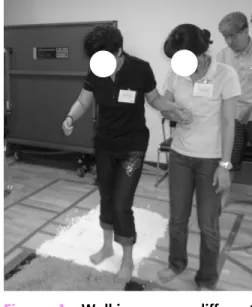
(5) Walking on a different surface (sand, gravel, a small rock)(Figure 1)
Figure 1. Walking on a different surface (sand, gravel, a small rock):
Left fig.
(6) Walking along an Z-shaped route
(7) Holding and throwing a small object while balancing on an exercise ball (Figure 4)
(8) Bouncing on an exercise ball
(9) Moving a ring while sitting on a physical therapy roll (Figure 2)
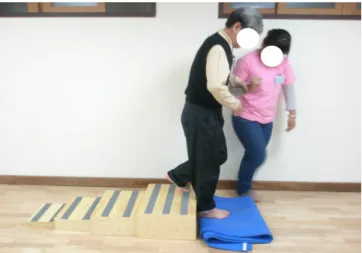
(10) Ascending and descending a stair (Figure 3)
(11) Jumping from a parallel bar.
Figure 2. Moving a ring while sitting on a physical therapy roll
Figure 3. Ascending and descending a stairs
3. Data Analysis
Information from all participants was entered into a computerized database and analyzed by using the SPSS statistical package (version 12.0) with a significance level of α equal to 0.05. Data obtained from the evaluations (pre- and post-training) were compared using the paired t-test.
Figure 4. Holding and throwing a small object while balancing on an exercise ball
Ⅲ. Results
1. General Characteristics of the Subjects
This study was conducted between September and December 2008. In total, 21 stroke patients were recruited and had consented to participate. However, five participants quit the program in favor of individual treatment.
Therefore, 16 participants completed the pre-training test.
Two participants withdrew from the circuit class after week 4 due to health concerns, and two participants did not participate in the post-training test because they were absent on the final day of the program. Thus, a total of 12 participants completed the pre- and post-training evaluations. The attendance rate was 75% for the entire 12-week training program. All participants were able to perform the exercises as planned.
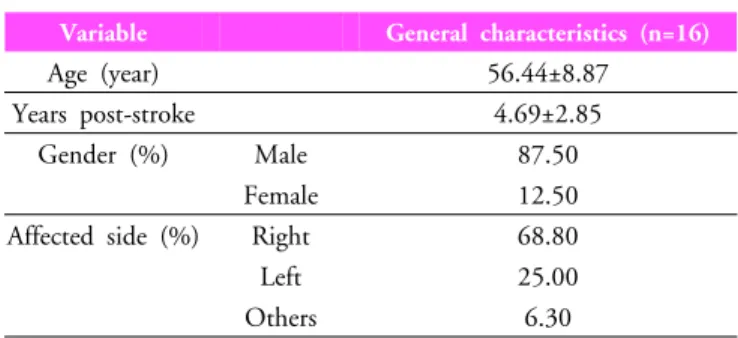
Among the 16 participants who completed the
pre-training test, 14 were male (87.5%) and two were
female (12.5%). The average age of the participants was
56.44 years, and the average time post-stroke was 4.69
years. There were 11 participants with right-side paralysis
(68.8%), four participants with left-side paralysis (25.0%),
and one participant with olivoponto atrophy (6.3%)(Table 1).
Variable General characteristics (n=16)
Age (year) 56.44±8.87
Years post-stroke 4.69±2.85
Gender (%) Male 87.50
Female 12.50
Affected side (%) Right 68.80
Left 25.00
Others 6.30
Values are mean±SD (range) or frequency (percentage)
Table 1. General characteristics of subjects
2. Berg’s Balance Scale Test
The average score on Berg’s Balance Scale was 43.2 before starting the program. The increase in scores for the group ranged from 43.2 to 49.7, and there was a significant difference between pre- and post-training scores (p<0.05)(Table 2).
Measures Values
Pre-training Post-training p t BBS (score) 43.20 ± 10.50 49.70 ± 4.40 0.02 -2.72 TUG (sec) 23.70 ± 12.70 19.50 ± 9.50 0.01 3.50 FRT (cm) 27.70 ± 9.08 47.00 ± 5.70 0.08 -1.89
Values: mean ± SDBBS: Berg's balance scale FRT: Functional reach test TUG: Time up and go test