Brief Report
486 Ann Dermatol
Received May 25, 2018, Revised January 22, 2019, Accepted for publication January 22, 2019
Corresponding author: Kyoung-Chan Park, Department of Dermatology, Seoul National University Bundang Hospital, Seoul National University College of Medicine, 82 Gumi-ro 173beon-gil, Bundang-gu, Seongnam 13620, Korea. Tel: 82-31-787-7311, Fax: 82-31-787-4058, E-mail: [email protected]
ORCID: https://orcid.org/0000-0002-1588-3307
*The two authors equally contributed to the article.
This is an Open Access article distributed under the terms of the Creative Commons Attribution Non-Commercial License (http://creativecommons.org/
licenses/by-nc/4.0) which permits unrestricted non-commercial use, distribution, and reproduction in any medium, provided the original work is properly cited.
Copyright © The Korean Dermatological Association and The Korean Society for Investigative Dermatology
https://doi.org/10.5021/ad.2019.31.4.486
Population-Based Epidemiologic Study on Herpes Zoster in Korea: Seven-Year Nationwide Analysis from 2010 to 2016
Soon-Hyo Kwon*, Jung-Im Na*, In Su Kim, Sang-Young Byun, Kyoung-Chan Park
Department of Dermatology, Seoul National University College of Medicine, Seoul, Department of Dermatology, Seoul National University Bundang Hospital, Seongnam, Korea
Dear Editor:
Herpes zoster (HZ) is caused by the reactivation of vari- cella zoster virus (VZV). Lowered VZV-specific cell-medi- ated immunity (CMI) causes the reactivation of VZV1. The incidence of HZ is rapidly increasing worldwide, which may be caused by an aging population2. The purpose of the study was to evaluate the annual incidence and sea- sonality of HZ in the general population in Korea.
Data of patients with HZ between January 2010 and De- cember 2016 were collected from Health Insurance Re- view and Assessment Service (HIRA) database3. Patients with at least one record of a diagnostic code (International Classification of Diseases-10, ICD-10) of B02.0 (zoster en- cephalitis), B02.1 (zoster encephalitis), B02.2 (Ramsay-Hunt syndrome), B02.3 (herpes zoster ophthalmicus), B02.7 (zoster with other complications), or B02.9 (herpes zoster) were included. Those who had a previous history of HZ were not excluded in this study. The study population was de- fined as the number of subscribers to the National Health Insurance Service (NHIS) during the study period. In addi- tion, Google Trends data for ‘herpes zoster’ in Korean lan- guage were downloaded for further analysis of seasonality in HZ occurrence. The frequency of information-seeking behavior regarding the search term, ‘herpes zoster,’ ranged from 0 to 100. Available data from January 2012 to Feb- ruary 2018 were categorized into four seasons by calculat-
ing the average value in three-month periods; spring (March to May), summer (June to August), fall (September to November), and winter (December to February). This study was exempted for a review by the institutional re- view board of Seoul National University Bundang Hospital in accordance with the exemption criteria (IRB no.
X-1407-257-902).
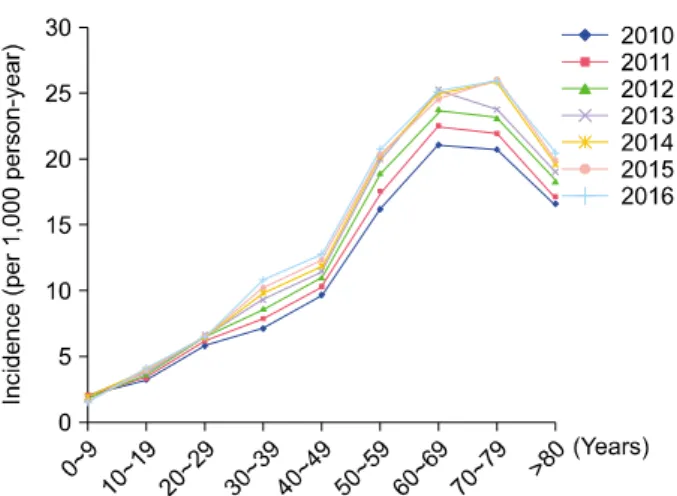
Of the total 4,232,576 HZ patients during the study peri- od, 1,666,937 were male and 2,565,539 were female (male:female=0.65:1). The annual incidence of HZ stead- ily increased from 9.6 per 1,000 person-years (PY) in 2010 to 13.3 per 1,000 PY in 2016. While the number of medi- cal insurance subscribers increased by 1,691,564 (3.3%) from 50,581,191 in 2010 to 52,272,755 in 2016, the num- ber of HZ patients increased by 208,722 (43.0%) from 485,544 to 694,266. For those aged over 50 years, the number of HZ patients increased by 155,615 (57.7%) while the number of medical insurance subscribers in- creased by 3,875,179 (26.3%). Though the number of medical insurance subscribers aged under 50 years de- creased by 2,183,615 (6.7%) during the study period, the number of HZ patients increased by 53,107 (24.6%). Fig. 1 demonstrates that the incidence of HZ steadily increased from 2010 to 2016 in all of the age groups. The age group of 70 to 79 years showed the most prominent increase in the incidence. The incidence of HZ increased with age,
Brief Report
Vol. 31, No. 4, 2019 487 Fig. 2. (A) The seasonality of herpes zoster (HZ) occurrence in Korea.
The number of HZ patients pre- sented a circannual pattern; it was increased during the spring season (March, April, and May), reaching its peak in the summer season (June, July, and August). Then the number of HZ patients decreased in the fall season (September, October, and November), reaching its lowest in the winter season (December, Janu- ary, and February). (B) Google Trends data demonstrating information- seeking behavior for HZ in Korea.
Except in 2015, information-seeking behavior showed the seasonal pat- tern; highest in the summer and lowest in the winter.
Fig. 1. The incidence of herpes zoster (HZ) by the age groups bet- ween 2010 and 2016 in Korea. The incidence of HZ steadily in- creased from 2010 to 2016 in all of the age groups. The age group of 70 to 79 years showed the most prominent increase in the inci- dence. The incidence of HZ increased with age, which was the high- est in the age group of 60 to 69 years during the period of 2010 to 2014. In the period of 2015 to 2016, however, the peak incidence shifted to the age group of 70 to 79 years. A rapid increase in the incidence of HZ was observed in the age group of 50 to 59 years.
which was the highest in the age group of 60 to 69 years during the period of 2010 to 2014. In the period of 2015 to 2016, however, the peak incidence shifted to the age group of 70 to 79 years.
Fig. 2A shows the seasonality with respect to the inci- dence of HZ; it reached its peak in the summer season and lowest in the winter season. The number of patients in the spring, summer, fall, and winter seasons comprised of 24.0%, 27.2%, 25.8%, and 22.9%, respectively. Information- seeking behavior by analyzing Google search queries fur- ther revealed the seasonal pattern of HZ occurrence ex- cept in 2015 (Fig. 2B).
A previous epidemiologic study analyzing the HIRA data- base for a 5-year period also demonstrated a steady in- crease in the annual incidence of HZ from 7.93 per 1,000 PY in 2003 to 12.54 per 1,000 PY in 20074. This value might be exaggerated since they included patients with postherpetic neuralgia. Nevertheless, the incidence results reported in Korea were considerably higher than that of other populations which were 4 to 6.24 per 1,000 PY2,5. The higher incidence in Korea could be attributed to the
Brief Report
488 Ann Dermatol
medical service system, as it features mandatory enroll- ment of all citizens into NHIS with low medical cost bur- den and easy accessibility to medical services. Ethnic dif- ference could also contribute to the higher incidence, al- though its genetic or environmental risk factor remains unknown.
Korean population is under a rapid aging, which is a well- known risk factor for HZ. There have been several reports on the association between the rise in HZ incidence and age2. This correlation is readily explained by the pro- gressive decline in VZV-specific CMI with aging1. How- ever, an aging population solely could not explain the stead increase of the incidence of HZ in all of the age groups. Reduced chance of re-exposure to VZV is hy- pothesized to contribute to the lowered VZV-specific CMI in Korean population. Re-exposure to VZV might boost VZV-specific CMI to provide protection against HZ6. Intro- duction of universal VZV vaccination in 2005 has dramati- cally lowered the number of varicella patients in Korea, which decreased from 140,359 in 2010 to 79,321 in 20163. A previous epidemiologic analysis revealed that the in- cidence of HZ was negatively associated with the in- cidence of varicella5.
The relationship between seasonality and incidence of HZ has been controversial. In contrary to the analysis of 1-year HIRA data, our study investigating 7-year HIRA and Google Trend data clearly demonstrated the seasonality of HZ occurrence7. A recent study clarified a strong associa- tion of the incidence of HZ with temperature and ultra- violet (UV) exposure5. Sunny hours during the summer in- crease exposure to UV irradiation, inducing immune sup- pression and VZV reactivation from latency8.
The limitation of this study is the absence of validation of the HZ diagnosis. A recent study revealed that the positive predictive value of HZ diagnosis based on ICD-10 was 86.2% by reviewing medical chart9. Defining the HZ diag- nosis as a presence of disease code for HZ with at least 5-day use of antiviral medication or acyclovir injection raised the positive predictive value to 99.5%. In addition, we could not exclude the patients who had a previous his- tory of HZ in this study
In conclusion, the annual incidence of HZ was increased not only in the total study population but also in all of the age groups from 2010 to 2016. The seasonality in the oc- currence of HZ was demonstrated, which was the highest
in summer.
CONFLICTS OF INTEREST
The authors have nothing to disclose.
ORCID
Soon-Hyo Kwon, https://orcid.org/0000-0002-7295-5725 Jung-Im Na, https://orcid.org/0000-0002-5717-2490 In Su Kim, https://orcid.org/0000-0002-2734-6517 Sang-Young Byun, https://orcid.org/0000-0002-1527-1570 Kyoung-Chan Park, https://orcid.org/0000-0002-1588-3307
REFERENCES
1. Levin MJ. Immune senescence and vaccines to prevent her- pes zoster in older persons. Curr Opin Immunol 2012;24:
494-500.
2. Yawn BP, Gilden D. The global epidemiology of herpes zoster. Neurology 2013;81:928-930.
3. HIRA. Statistical information-open system for health and medical big data [Internet]. [cited 2018 Mar 3]. Available from: https://opendata.hira.or.kr.
4. Choi WS, Noh JY, Huh JY, Jo YM, Lee J, Song JY, et al.
Disease burden of herpes zoster in Korea. J Clin Virol 2010;47:325-329.
5. Wu PY, Wu HD, Chou TC, Sung FC. Varicella vaccination alters the chronological trends of herpes zoster and vari- cella. PLoS One 2013;8:e77709.
6. Ogunjimi B, Van den Bergh J, Meysman P, Heynderickx S, Bergs K, Jansens H, et al. Multidisciplinary study of the secondary immune response in grandparents re-exposed to chickenpox. Sci Rep 2017;7:1077.
7. Kim YJ, Lee CN, Lim CY, Jeon WS, Park YM. Population- based study of the epidemiology of herpes zoster in Korea. J Korean Med Sci 2014;29:1706-1710.
8. Zak-Prelich M, Borkowski JL, Alexander F, Norval M. The role of solar ultraviolet irradiation in zoster. Epidemiol In- fect 2002;129:593-597.
9. Kim YS, Seo HM, Bang CH, Lee JH, Park YG, Kim YJ, et al.
Validation of herpes zoster diagnosis code in the electronic medical record: a retrospective, multicenter study. Ann Dermatol 2018;30:253-255.