INTRODUCTION
Total occlusion of left main stem is known to be a fatal coronary artery disease, usually manifested as a sudden car- diac death and acute myocardial infarction. After the intro- duction of percutaneous coronary intervention, a few cases have been reported for the successful management of patients’lives (1-3). However, long-term survival is rela- tively poor due to the time delay between onset of symp- toms and revascularization (4). We hereby report a case of long-term survival after successful primary stenting for the total occlusion of left main stem with the aid of platelet glycoprotein IIb/IIIa receptor blocker.
CASE REPORT
A 61-yr-old male patient presented with severe chest pain. Blood pressure on admission was 70/30 mmHg and physical examination on chest revealed summation gallop and inspiratory crackles over both lower lung fields.
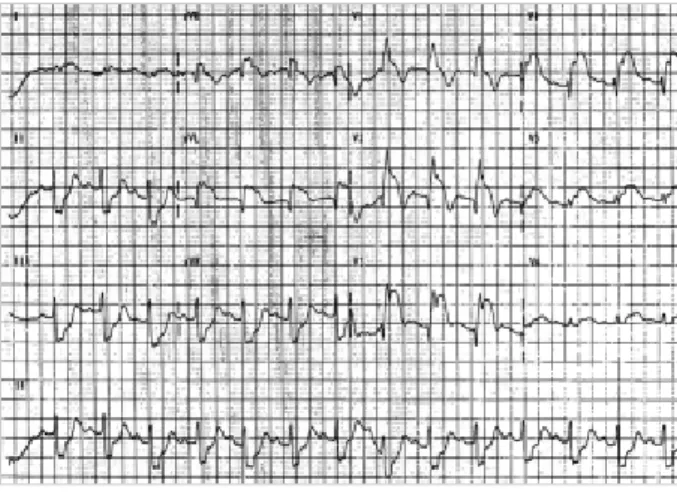
Twelve-lead electrocardiogram demonstrated complete right bundle branch block, PR prolongation with left axis deviation, and ST-segment elevation over the precordial and lateral leads through V1 to V6, I and aVL (Fig. 1). Two-
dimensional echocardiogram showed severe left ventricular (LV) systolic dysfunction (ejection fraction=17%).
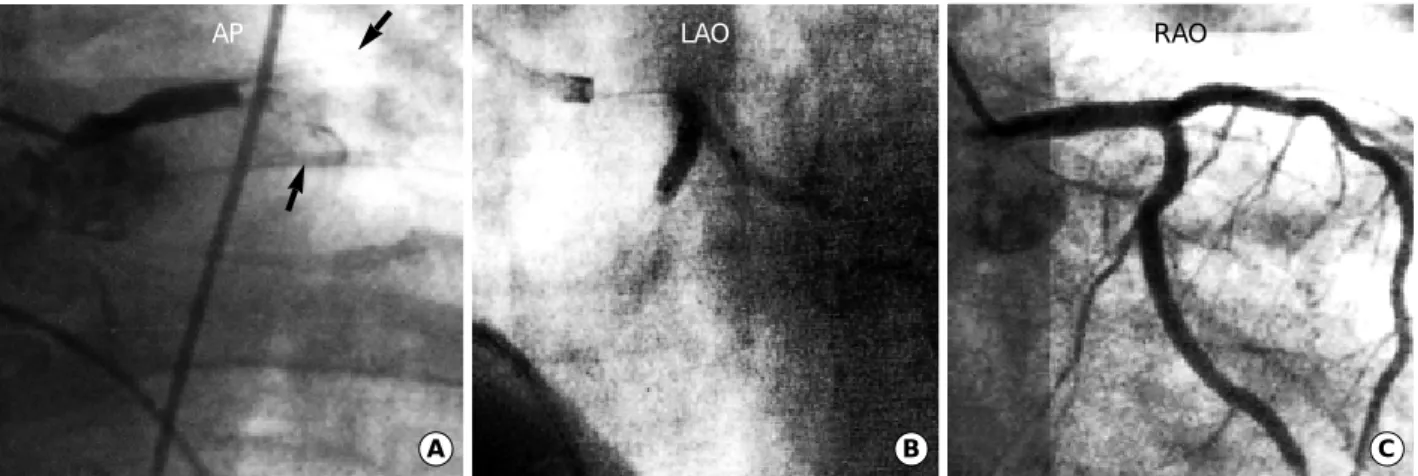
Emergent coronary angiogram obtained immediately after placing temporary pacing electrode revealed total thrombotic occlusion in the left main stem (Fig. 2A). We performed direct coronary intervention using kissing bal-
Myung Ho Jeong, Young Keun Ahn, Jong Cheol Park, Byoung Hee Ahn, Kook Joo Na, Nam Ho Kim, Kun Hyung Kim, Jeong Gwan Cho, Jong Chun Park, Sang Hyung Kim, Jung Chaee Kang
The Heart Center, Chonnam National University Hospital, Kwangju, Korea
Received : 19 July 2000 Accepted : 30 August 2000
Address for correspondence Myung Ho Jeong, M.D.
Director of Catheterization Laboratory, The Heart Center of Chonnam National University Hospital, 8 Hak-dong, Dong-ku, Kwangju 501-757, Korea Tel: +82-62-220-6243, Fax: +82-62-228-7174 E-mail: [email protected]
509 J Korean Med Sci 2001; 16: 509-11
ISSN 1011-8934
Copyright � The Korean Academy of Medical Sciences
A Case of Successful Primary Coronary Intervention for the Total Occlusion of Left Main Stem with the Aid of Abciximab
A 61-yr-old male patient presented with severe chest pain with cardiogenic shock due to an extensive anterolateral myocardial infarction. Two-dimensional echocardiogram showed severe left ventricular systolic dysfunction (ejection fraction=17%). Emergent coronary angiogram obtained immediately after plac- ing temporary pacing electrode revealed total thrombotic occlusion in the left main stem. We performed direct coronary intervention using kissing balloon technique with the aid of Abciximab (ReoPro�) infusion. Residual stenosis with thrombus remained even after high pressure balloon dilatations, therefore we placed two stents, one in the ostia of left anterior descending (LAD) and the other in left circumflex artery (LCX). Coronary angiogram after kissing stents showed improved LAD and LCX flows without residual stenosis. Chest pain resolved and blood pressure normalized after coronary intervention. The whole procedure time was 15 min. Follow-up coronary angiogram taken one week later showed patent previous stented arteries, and echocardiography demon- strated 40% of left ventricular ejection fraction. The clinical course for one-year follow-up was uneventful.
Key Words : Coronary Intervention; Coronary Artery; Myocardial Infarction; Thrombosis
Fig. 1.Twelve-lead electrocardiogram demonstrates complete right bundle branch block, PR prolongation with left axis devia- tion, and ST-segment elevation over the precordial and lateral leads through V1 to V6, I and aVL.
510 M.H. Jeong, Y.K. Ahh, J.C. Park, et al.
loon technique with the aid of Abciximab (ReoPro�) infu- sion. Residual thrombus with stenosis remained even after high pressure balloon dilatations, therefore two CrossFlex (Cordis, U.S.A.) stents were implanted, one (3.5×15 mm) in the ostium of left anterior descending artery (LAD) and the other (3.0×15 mm) in the ostium of left circumflex artery (LCX) at 12 atm (Fig. 2B). Coronary angiogram after kissing stents showed improved LAD and LCX flows (Thrombolysis In Myocardial Infarction Flow grade III) without residual stenosis (Fig. 2C). His chest pain was sub- sided and blood pressure normalized after coronary inter- vention. The whole procedure time was 15 min.
One week later, follow-up coronary angiogram showed that patent stented arteries and echocardiography demon- strated 40% of left ventricular ejection fraction. He has no major adverse cardiac events for following one year.
DISCUSSION
Acute occlusion of the left main coronary artery is a rare and serious coronary artery disease, and urgent coronary revascularization should be attempted for survival, especial- ly in the patients without collateral circulation from right coronary artery (5-7). Survival after myocardial infarction due to the left main coronary artery occlusion is usually related with collaterals to the left coronary artery system.
Emergent stenting for the left main coronary artery occlu- sion can be a life-saving procedure, but it can also be related with subacute stent thrombosis (8). Platelet glycoprotein IIb/IIIa receptor blocker in conjunction with primary coro- nary stenting for acute myocardial infarction complicated by cardiogenic shock has been used in the field of interven-
tional cardiology (9). It will be beneficial in the resolution of platelet thrombus formation and the improvement of microvascular perfusion during or after coronary interven- tion of acute myocardial infarction. We used Abciximab (ReoPro�) during coronary intervention in this case. The benefit of intra-aortic balloon pump (IABP) before primary percutaneous coronary intervention for acute myocardial infarction in the patients with left ventricular failure has been documented (10). In our case, we could not perform prophylactic IABP because of poor femoral pulse associated with severe hypotension.
In conclusion, long-term survival can be achieved in the patient with the left main total occlusion after primary stenting with the aid of platelet glycoprotein IIb/IIIa recep- tor blocker.
REFERENCES
1. La Vecchia L, Castellani A, Bedogni F, Vincenzi M. Rescue PTCA for a totally occluded left main coronary artery in acute myocardial infarction with cardiogenic shock: technical success and long-term survival. Cardiology 1997; 88: 482-5.
2. Itoh T, Fukami K, Oriso S, Umemura J, Nakajima J, Obonai H, Hiramori K. Survival following cardiogenic shock caused by acute left main coronary artery total occlusion. A case report and review of the literature. Angiology 1997; 48: 163-71.
3. Yuda S, Nonogi H, Itoh T, Daikoku S, Morii I, Sasako Y, Nakatani T, Miyazaki S. Survival using percutaneous cardiopulmonary support after acute myocardial infarction due to occlusion of the left main coronary artery-a report of two cases. Jpn Cir J 1998; 62: 779-82.
4. Chauhan A, Zubaid M, Ricci DR, Buller CE, Moscovich MD, Mercier B, Fox R, Penn IM. Left main intervention revisited: early
A B C
LAO RAO
AP
Fig. 2.(A) Emergent coronary angiogram obtained immediately after placing temporary pacing electrode reveals total thrombotic occlusion in the left main stem. Arrows indicate filling defects in the left anterior descending and circumflex arteries. (B) We per- formed direct coronary intervention using kissing balloon technique with the aid of Abciximab (ReoPro) infusion. Residual thrombus with stenosis remained even after high pressure balloon dilatations, and thus we placed two CrossFlex (Cordis, U.S.A.) stents, one in the ostium of left anterior descending artery (LAD) and the other in the ostium of left circumflex artery (LCX). (C) Coronary angiogram after kissing stents shows improved LAD and LCX flows without residual stenosis.
Coronary Intervention for Left Main Total Occlusion 511
and late outcome of PTCA and stenting. Cathet Cardiovasc Diagn 1997; 41: 21-9.
5. Spiecker M, Erbel R, Rupprecht HJ, Meyer J. Emergency angio- plasty of totally occluded left main coronary artery in acute myo- cardial infarction and unstable angina pectoris-institutional experi- ence and literature review. Eur Heart J 1994; 15: 602-7.
6. Takayanagi K, Satoh T, Inoue T, Sakai Y, Morooka S, Takabatake Y. Survival from acute occlusion of the left main coronary artery with preexisting collateral vessels-a case report. Angiology 1991;
42: 935-9.
7. Cohen MC, Ferguson DW. Survival after myocardial infarction caused by acute left main coronary artery occlusion: case report and review of the liturature. Cathet Cardiovasc Diagn 1989; 16:
230-8.
8. Fabbiocchi F, Trabattoni D, Galli S, Bartorelli AL. Emergency stenting of totally occluded left main coronary artery in acute myocardial infarction. J Invasive Cardiol 1999; 11: 309-12.
9. Schultz RD, Heuser RR, Hatler C, Frey D. Use of c7E3 Fab in con- junction with primary coronary stenting for acute myocardial infarctions complicated by cardiogenic shock. Cathet Cardiovasc Diagn 1996; 39: 143-8.
10. Brodie BR, Stuckey TD, Hansen C, Muncy D. Intra-aortic balloon counterpulsation before primary percutaneous transluminal coro- nary angioplasty reduces catheterization laboratory events in high- risk patients with acute myocardial infarction. Am J Cardiol 1999;
84: 18-23.