INTRODUCTION
Numerous studies explored the efficacy of vitamin C in the treatment of cancer, but their mixed findings caused a great deal of controversy. In 1949, Klenner first suggested the possibility of using vitamin C for the treatment of can- cer. In 1952, McCormick asserted that vitamin C has been proposed as a chemotherapeutic agent. Hundreds of articles including an array of in vitro, in vivo, cell culture, animal, and human studies have been published on this topic. As a result, it is believed that vitamin C might have anti-cancer effects (1-3).
Twenty-six years ago, Cameron et al. reported that they increased the time of survival of cancer patients and improved their quality of life by administrating high doses of vitamin C (4). As a result, Pauling and Cameron continuously assert- ed the effect of vitamin C on cancer. However, Moertel et al.
(Mayo Clinic) reported that high-dose vitamin C therapy was not effective against advanced cancer (5). This finding is critical because it may prevent clinicians from using vita- min C for cancer patients.
A critical point of both studies (Cameron et al. and Moer- tel et al.) is that they used a different administration method, intravenous route in the former and oral route of vitamin C
in the latter. Oral absorption of vitamin C cannot achieve plasma concentrations comparable to those obtained by intra- venous administration. Moreover, it has been recently report- ed that vitamin C acts as a toxic agent against cancer cells when given intravenously (6).
Unlike most mammals, human and other primates cannot synthesize vitamin C from glucose due to L-gulonolactone oxidase deficiency. Therefore, we must be obtained adequate amounts of this nutrient from foods and supplements. Vita- min C plays a crucial role in the synthesis of L-carnitine from lysine, neurotransmitters synthesis, cytochrome p-450 activ- ity, cholesterol metabolism, detoxification of exogenous com- pounds and as an antioxidant (7-10). In addition, when given in large doses, vitamin C may function as an ergogenic agent (11). Because the levels of vitamin C in the blood of the can- cer patients were significantly decreased compared to healthy persons, cancer patients required larger amounts of vitamin C (12, 13).
Improved health-related quality of life is important as much as a cure of cancer in terminally ill cancer patients who have an estimated survival of less than 6 months. The objective of this study was to examine changes in the quality of life in terminally ill cancer patients after administration of high- doses of vitamin C.
Chang Hwan Yeom, Gyou Chul Jung, Keun Jeong Song*
Department of Family Medicine, Myongji Hospital, Kwandong University College of Medicine, Goyang;
Department of Emergency Medicine*, Samsung Medical Center, Sungkyunkwan University School of Medicine, Seoul, Korea
Address for correspondence Keun Jeong Song, M.D.
Department of Emergency Medicine, Samsung Medical Center, Sungkyunkwan University School of Medicine, 50 Ilwon-dong, Gangnam-gu, Seoul 135-710, Korea
Tel : +82.2-3410-0259, Fax : +82.2-3410-0012 E-mail : [email protected]
* This research was supported by Huons Co. Ltd.
7
Changes of Terminal Cancer Patients' Health-related Quality of Life after High Dose Vitamin C Administration
Over the years there has been a great deal of controversy on the effect of vitamin C on cancer. To investigate the effects of vitamin C on cancer patients’ health-relat- ed quality of life, we prospectively studied 39 terminal cancer patients. All patients were given an intravenous administration of 10 g vitamin C twice with a 3-day inter- val and an oral intake of 4 g vitamin C daily for a week. And then we investigated demographic data and assessed changes in patients’ quality of life after adminis- tration of vitamin C. Quality of life was assessed with EORTC QLQ-C30. In the glob- al health/quality of life scale, health score improved from 36±±18 to 55±±16 after administration of vitamin C (p=0.001). In functional scale, the patients reported sig- nificantly higher scores for physical, role, emotional, and cognitive function after ad- ministration of vitamin C (p<0.05). In symptom scale, the patients reported signifi- cantly lower scores for fatigue, nausea/vomiting, pain, and appetite loss after admin- istration of vitamin C (p<0.005). The other function and symptom scales were not significantly changed after administration of vitamin C. In terminal cancer patients, the quality of life is as important as cure. Although there is still controversy regard- ing anticancer effects of vitamin C, the use of vitamin C is considered a safe and effective therapy to improve the quality of life of terminal cancer patients.
Key Words : Neoplasms; Cancer; Ascorbic Acid; Quality of Life; Terminal Care
Received : 31 March 2006 Accepted : 2 June 2006
MATERIALS AND METHODS Study subjects
Outpatients with terminal cancer who were treated in the Department of Family Medicine, Myungji-Hospital, Kwan- dong University College of Medicine from 1 February 2004 through 31 August 2005, were included in the study. The study included 39 cancer patients (male: 20, female: 19) after excluding those who were undergoing chemotherapy.
Assessment of cancer patients’ life-related quality
A written consent was obtained from all patients. They were given an intravenous administration of 10 g vitamin C twice with a 3-day interval and an oral intake of 4 g vitamin C daily for a week. And then we investigated demographic data and assessed changes in patients’ quality of life 1 week after administration of vitamin C.
Demographic data included sex, age, cancer diagnosis, anti- cancer therapy, recurrence, metastasis and performance sta- tus (Eastern Cooperative Oncology Group, ECOG). Quality of life was assessed by the European Organization for Research and Treatment of cancer (EORTC). This was a self-adminis- trated questionnaire (EORTC) that was used to assess the quality of life of the patients. When a patient was unable to self-administer the questionnaire, an interviewer or the pa- tient’s caregiver completed the questionnaire after finding out answers from the patient. The Korean version of the Euro- pean Organization for Research and Treatment of cancer core quality-of-life questionnaire (EORTC QLQ-C30) was used as the questionnaire. It was designed to ask clinical symptoms experienced by the patients during the previous week. The questionnaire consists of 30 items, that comprise a global evaluation of health status and quality of life, five functions (physical, role, emotional, cognitive, and social), three symp- toms (fatigue, pain, and nausea/vomiting), and six additional single items (dyspnea, appetite loss, sleep disturbance, con- stipation, diarrhea, and financial impact of the disease and treatment) (14). Scores for each scale on the EORTC QLQ- C30 questionnaire were calculated as suggested by the EO- RTC Study Group on Quality of Life. All of the scales and single-item measures ranged in score from 0 to 100. A high scale score represents a higher response level. Thus a high score for the global health status/quality of life represents a high quality of life and a high score for a functional scale rep- resents a high/health level of functioning. But a high score for a symptom scale/item represents a high level of symp- tomatology/problems.
Statistical analysis
The EORTC scales scores before and after administration of vitamin C, were compared using the Wilcoxon signed
rank-test. A p-value of less than 0.05 is considered statisti- cally significant.
RESULTS Demographic data
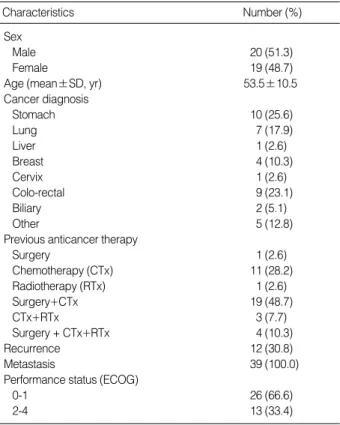
The demographic data (age, sex, cancer diagnosis, anti- cancer therapy, metastasis, performance status) are shown in Table 1. All patients were stage IV, and 12 (30.8%) patients experienced a recurrence of their cancers. No patients were excluded due to side effects of vitamin C.
Quality of life (EORTC)
The quality of life before and after administration of high dose vitamin C, are shown in Table 2. In the global health/
quality of life scale, health score improved from 36±18 to 55±16 after administration of vitamin C (p=0.001). In fun- ctional scales, the patients reported significantly higher scores for physical, role, emotional, cognitive, and social function after administration of vitamin C (p<0.005). In symptom scales, the patients reported significantly lower scores for fa- tigue, nausea/vomiting, pain, sleep disturbance, and appetite loss after administration of vitamin C (p<0.005). The other symptom scales such as dyspnea, constipation, diarrhea, fin- ancial impact were not significantly changed after adminis-
Characteristics Number (%)
Sex
Male 20 (51.3)
Female 19 (48.7)
Age (mean±SD, yr) 53.5±10.5
Cancer diagnosis
Stomach 10 (25.6)
Lung 7 (17.9)
Liver 1 (2.6)
Breast 4 (10.3)
Cervix 1 (2.6)
Colo-rectal 9 (23.1)
Biliary 2 (5.1)
Other 5 (12.8)
Previous anticancer therapy
Surgery 1 (2.6)
Chemotherapy (CTx) 11 (28.2)
Radiotherapy (RTx) 1 (2.6)
Surgery+CTx 19 (48.7)
CTx+RTx 3 (7.7)
Surgery + CTx+RTx 4 (10.3)
Recurrence 12 (30.8)
Metastasis 39 (100.0)
Performance status (ECOG)
0-1 26 (66.6)
2-4 13 (33.4)
Table 1.Demographic data
tration of vitamin C.
DISCUSSION
In terminal cancer patients, the quality of life is as impor- tant as cure. The treatment for terminal cancer patients was particularly focused on the patient’s well-being in addition to the efforts to minimize symptoms. Thus, the ultimate goal of treatment for terminal cancer patients can differ from those pursued in treatments designed to cure.
If terminal cancer patients were concerned about emotion- al changes and functional impairment and if the patients’
quality of life did not improve, the treatment that they under- went should not be considered successful even though it ex- tended their life expectancy. Although investigators are divid- ed in their opinions on whether vitamin C is effective for the treatment of cancers, many of them reported that cancer pa- tients showed improvement in their quality of life.
This study also demonstrated improvement in global health/
quality of life in terminal cancer patients after administra- tion of vitamin C along with improvements in all functions (physical, role, emotional, cognitive, and social) and some symptoms (fatigue, nausea/vomiting, pain, sleep disturbance, and appetite loss).
The therapeutic impacts of vitamin C, expected when ad- ministered to terminal cancer patients, include anticancer effects, positive impact on the central nervous system and mental ability, pain relief and contribution to energy gener- ation. The anticancer effects of vitamin C boost cytotoxicity of tumor cells, collagen synthesis, antioxidant action, immu- nity system and low concentration of certain amino acids.
First, the mechanism underlying the action of vitamin C in combating cancer cells explains that vitamin C in blood is oxidized to dehydroascorbate acid, which passes freely back and forth through the cell membranes via glucose transport.
When dehydroascorbate acid enters cancer cells, glutathione turned the dehydroascorbate back into ascorbic acid (vitamin C), which is not allowed to move out of cancer cells. This ascorbic acid is converted to dehydroascorbate again and pro- duces H2O2, which destroy cancer cells (15). Higher levels of ascorbic acid were observed around cancer cells when com- pared to normal cells (16). Casciari et al. study reported tumor cells apoptosis occurred in 42.9% of total patients and necro- sis in 24.4% when patients’ blood level of vitamin C was 11.2 mM. They said apoptosis increased to 57.6% and necrosis to 33.1%, respectively, when patients’ blood level of vitamin C rose to 33.7 mM (17). Secondly, an increase in the synthe- sis of collagen inhibits the growth of cancer cells, leading to apoptosis and necrosis in cancer cells (18). That is, cancer cells releases collagenase and dissove collagen between cells/tissues.
This means that these enzymes dissolve basement membranes, an organization of collagen and extracellular matrices, enabling cancer cells to infiltrate and destroy adjacent normal tissues.
An increase in collagen synthesis due to vitamin C would however increase membrane mechanical integrity and cohe- sion and eventually prevent the growth of cancer cells. Third- ly, antioxidant properties of vitamin C inhibit cancer growth induced by free radicals (3, 19). It is however an interesting fact that vitamin C is taken up in oxidized form by cancer cells. Fourthly, vitamin C enhances the immune system by elevating the production of infection-fighting white blood cells and interferon levels, so cancer cells are suppressed or eliminated (20, 21). Last, the vitamin C can change the lev- els of certain amino acids in body fluids and may deplete the bioavailability of lysine and cyteine, 2 amino acids that re- quired for rapidly growing tumors (22, 23).
The impact of vitamin C on the central nervous system and mental ability is based on the following mechanisms: First, increased c-AMP enables vitamin C to block phosphodi- esterase, so the breakdown of c-AMP can be prevented (24).
An increase in blood c-AMP levels therefore boosts mental ability. Secondly, vitamin C also prevents the formation of toxic neurotransmitters. Vitamin C deficiency triggers the oxidation of adrenalin and noradrenalin, and adrenochrome and noradrenochrome are generated, respectively, and their toxic effects pose various problems (25).
The impact of vitamin C on pain relief is explained by vari- ous mechanisms (26). First, vitamin C has anti-inflammato- ry effects by stimulating c-AMP production, which in turn elevates production of steroid in the ACTH. Secondly, vitamin C works to help decrease blood calcium levels and enhances calcium uptake in bone. As a result, bone pain is relieved (27).
It was recently discovered that vitamin C also supports the body’s energy generation (28). The mechanism of ergogenic activity of vitamin C is probably due to vitamin C’s oxidation
EORTC (Mean±SD) Before After
p-value
Global Health Scale
Global health 36±18 55±16 0.001
Function scale
Physical 66±20 72±15 0.037
Role 59±31 73±22 0.002
Emotional 68±24 78±19 0.001
Cognitive 69±23 80±16 0.002
Social 62±34 71±24 0.049
Symptom scale
Fatigue 52±24 40±19 0.001
Nausea/Vomiting 24±25 11±15 0.001
Pain 30±32 21±25 0.013
Dyspnea 23±28 15±20 0.051
Sleep disturbance 32±35 26±25 0.029
Appetite loss 50±43 31±29 0.005
Constipation 19±26 16±25 0.390
Diarrhea 16±24 11±18 0.218
Financial impact 25±27 23±24 0.914 Table 2.Change of terminal cancer patients’ health-related qual- ity of life (EORTC) after high dose vitamin C adminstration
reduction potential, capable of providing necessary electrons to the electron transport system in the mitochondria for in- creased energy production.
Since Szent-Gyorgyi reported the efficacy of vitamin C for the first time in 1928, studies in the same area have contin- ued and anticancer effects of vitamin C are still under debate.
While Cameron et al. suggested beneficial effects of vitamin C on the treatment of cancer (4), the Mayo Clinic study report- ed no anticancer effects of vitamin C (5). Investigators cited the different administration method as the reason for such opposite results. The former used intravenous vitamin C ad- ministration at a dose of 10 g and subsequent oral adminis- tration, whereas the latter used oral administration only. Pa- dayatty et al. proved that it was difficult to increase vitamin C level to more than 220 M/L in blood through oral admin- istration and that blood levels of vitamin C that are required for combating cancer could be achieved through intravenous adminstration (6). Their findings provided the scientific basis for using intravenous administration in cancer patients.
Vitamin C is a water-soluble and remarkably nontoxic at high levels. Nevertheless, this treatment should be adminis- tered with caution to patients with glucose-6-phosphate de- hydrogenase (G6PD) deficiency (29). When given high doses of vitamin C, these patients may have the risk of developing hemolysis. Before applying vitamin C therapy, patients should be screened for this deficiency.
Although there is still controversy regarding anticancer effects of vitamin C, the use of vitamin C is considered the safe and effective therapy to improve the quality of life in terminal cancer patients. The further study is required to com- pare effects of vitamin C in between placebo and vitamin C group in terminal cancer patients with well-designed exper- imental strategy.
REFERENCES
1. Padayatty SJ, Katz A, Wang Y, Eck P, Kwon O, Lee JH, Chen S, Corpe C, Dutta A, Dutta SK, Levine M. Vitamin C as an antioxidant:
evaluation of its role in disease prevention. J Am Coll Nutr 2003; 22:
18-35.
2. Tamayo C, Richardson MA. Vitamin C as a cancer treatment: state of the science and recommendation for research. Altern Ther Health Med 2003; 9: 94-101.
3. Gonzalez MJ, Miranda-Massari JR, Mora EM, Guzman A, Riordan NH, Riordan HD, Casciari JJ, Jackson JA, Roman-Franco A. Ortho- molecular oncology review: ascorbic acid and cancer 25 years later.
Integrative Cancer Therapies 2005; 4: 32-44.
4. Cameron E, Pauling L, Leibovitz B. Ascorbic acid and cancer: a review. Cancer Res 1979; 39: 663-81.
5. Moertel CG, Fleming TR, Creagan ET, Rubin J, O’Connell MJ, Ames MM. High-dose vitamin C versus placebo in the treatment of patients with advanced cancer who have had no prior chemotherapy. A ran- domized double-blind comparison. N Engl J Med 1985; 312: 137-41.
6. Padayatty SJ, Sun H, Wang Y, Riordan HD, Hewitt SM, Katz A, We- sley RA, Levine M. Vitamin C pharmacokinetics: implications for oral and intravenous use. Ann Intern Med 2004; 140: 533-7.
7. Levine M. New concepts in the biology and biochemistry of ascorbic acid. N Engl J Med 1986; 314: 892-902.
8. Sies H, Stahl W, Sundquist AR. Antioxidant functions of vitamins. Ann N Y Acad Sci 1992; 669: 7-20.
9. Leibovitz B, Mueller J. Carnitine. J Optimal Nutr 1993; 2: 90-109.
10. Block G. Vitamin C and cancer prevention: the epidemiologic evi- dence. Am J Clin Nutr 1991; 53: 270-82.
11. Komarova SV, Ataullakhanov FI, Globus RK. Bioenergetics and mitochondrial transmembrane potential during differentiation of cultured osteoblasts. Am J Physiol 2000; 279: 1220-9.
12. Khanzode SS, Muddeshwar MG, Khanzode SD, Dakhale GN. Anti- oxidant enzymes and lipid peroxidation in different stages of breast cancer. Free Radic Res 2004; 38: 81-5.
13. Lee JG, Chung HW, Lee KH, Ahn HS. Antioxidant vitamins and lipid peroxidation in patients with cervical intraepithelial neoplasia.
J Korean Med Sci 2005; 20: 267-72.
14. Yun YH, Park YS, Lee ES, Bang SM, Heo DS, Park SY, You CH, West K. Validation of the Korean version of the EORTC QLQ-C30.
Qual Life Res 2004; 13: 863-8.
15. Agus DB, Vera JC, Golde DW. Stromal cell oxidation: a mechanism by which tumors obtain vitamin C. Cancer Res 1999; 59: 4555-8.
16. Langemann H, Torhorst J, Kabiersch A, Krenger W, Honegger CC.
Quantitive determination of water and lipid soluble antioxidants in neoplastic and non-neoplastic human breast tissue. Int J Cancer 1989;
43: 1169-73.
17. Casciari JJ, Riordan NH, Schmidt TL, Meng XL, Jackson JA, Rior- dan HD. Cytotoxicity of ascorbate, lipoic acid, and other antioxidants in hollow fibre in vitro tumours. Br J Cancer 2001; 84: 1544-50.
18. Henson DE, Block G, Levine M. Ascorbic acid: biologic functions and relation to cancer. J Natl Cancer Inst 1991; 83: 547-50.
19. Do MH, Lee SS, Jung PJ, Lee HY. Intake of dietary fat and vitamin in relation to breast cancer risk in Korean women: a case-control study. J Korean Med Sci 2003; 18: 534-40.
20. Cameron E, Pauling L. Vitamin C and the immune system. In: Can- cer and vitamin C. 2nd ed. USA. Camino Book 1990: 108-11.
21. Basu TK. Possible role of vitamin C in cancer therapy. In: Hanck A and Ritzel G. Vitamin C: Recent Advances and aspects in virus dis- ease, Cancer and in lipid metabolism, Hans Huber, 1979: 95-102.
22. Tsao CS, Miyashita K. Effects of high intake of ascorbic acid on plas- ma levels of amino acids. IRCS Med Sci 1984; 12: 1052-3.
23. Tsao CS, Miyashita K. Effects of large intake of ascorbic acid on uri- nary excretion of amino acids and related compounds. IRCS Med Sci 1985; 13: 855-6.
24. Lewin S. The link between ascorbate and c-AMP and c-GMP. In:
Vitamin C: Its molecular biology and medical potential. Academic Press, London, 1976: 93-8.
25. Lewin S. Activity of ascorbate in the adrenals. In: Vitamin C: Its molecular biology and medical potential. Academic Press, London, 1976: 98-101.
26. Jensen NH. Reduced pain from osteoarthritis in hip joint or knee joint during treatment with calcium ascorbate. Ugeskr Laeger 2003;
165: 2563-6.
27. Lewin S. Maintenance of physiological actions by c-AMP and c-GMP.
In: Vitamin C: Its molecular biology and medical potential. Aca- demic Press, London 1976: 92-3.
28. Luo G, Xie ZZ, Liu FY, Zhang GB. Effect of vitamin C on mitochon-
drial function and ATP content in hypoxic rats. Zhongguo Yao Li Xue Bao 1998; 19: 351-5.
29. Rivers JM. Safety of high-level vitamin C ingestion. In: Third confer- ence on AA. Ann NY Acad Sci 1987; 498: 445-54.