http://dx.doi.org/10.7585/kjps.2014.18.1.33 Open Access
33
Cyantraniliprole의 담배가루이에 대한 살충활성과 이를 통한 토마토황화잎말림바이러스 예방
이문행·이희경·이환구·이순계·김점순1·김성은2·김영식2·서정근3·윤영남4* 충청남도농업기술원 부여토마토시험장, 1농촌진흥청 고령지농업연구센터, 2상명대학교,
3단국대학교, 4충남대학교 응용생물학과
Effect of Cyantraniliprole against of Bemisia tabaci and Prevention of Tomato Yellow Leaf Curl Virus (TYLCV)
Mun-Haeng Lee, Hee-Kyoung Lee, Hwan-Gu Lee, Sun-Gye Lee, Jeom-Soon Kim1, Sung-Eun Kim2, Young-Shik Kim2, Jeung-Keun Suh3 and Young-Nam Youn4*
Buyeo Tomato Experiment Station, CARES, Buyeo, Chungnam 323-814, Korea
1Highland Agricultural Research Center, NICS-RDA, Pyeongchang 232-955, Korea
2Sangmyung University, 300 Anseo-dong, Cheonan, Chungnam 330-720, Korea
3College of Bio-resources Science, Dankook University, Cheonan, Chungnam 330-714, Korea
4Department of Applied Biology, Chungnam National University, Daejeon 305-764, Korea (Received on January 14, 2014. Revised on January 21, 2014. Accepted on March 7, 2014)
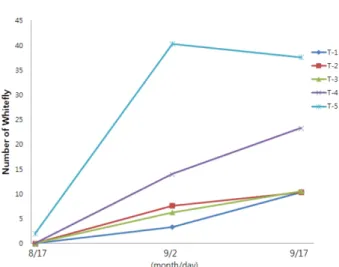
Abstract To control Bemisia tabaci on tomato, we applied five different combinations of chemical treatments as below: 1) treatment of combinations of cyantraniliprole on the root area and leaf with the existing registered chemicals three times; 2) treatment of combinations of cyantraniliprole on the root area and dinotefuran + emamectin benzoate on the leaf with the existing registered chemicals three times; 3) treatment of combinations of dinotefuran on the root area and cyantraniliprole on the leaf with the existing registered chemicals three times; 4) treatment of combinations of dinotefuran on the root area and dinotefuran + emamectin benzoate on the leaf with the existing registered chemicals three times; 5) untreated control plot (Table 1). Twenty days after treatment (17th Aug.), the number of population of B. tabaci was zero on the 1, 2, 3, 4 treatments of combinations, and only 2 individuals were found on the 5 treatment of combination per each 20 plant. On 17th Sep., in the last observation, the average number of population of B. tabaci was 10.3, 10.3, 10.6 on the 1, 2, 3 treatments of combinations on the 20 plants per each combination, however, the average number of 23.3 and 37.6 were examined on the 4 and 5 treatments of combinations, respectively.
TYLCV was not occurring on the 1 and 2 treatments of combinations, and presented only 3% and 17% on the 3 and 4 treatments of combinations, respectively, which indicates that the treatments (1-4) should be effective on TYLCV control as considering that 33% of TYLCV occurred on the untreated control plot.
However, after the third flowering period, there is no difference among the five combinations. The amount of products was 9,148g and 9,698g on the 1 and 2 treatments of combinations, respectively, which was the most among the 5 combinations. The number of fallen fruits and the average weight of fruits showed the similar tendency.
Key words Bemisia tabaci, control effect, cyantraniliprole, tomato, tomato yellow leaf curl virus
*Corresponding author
Tel: +82-42-821-5769, Fax: +82-42-823-8679 E-mail: [email protected]
ORIGINAL ARTICLES / CONTROL
서 론
담배가루이(Bemisia tabaci)는 전 세계적으로 발생하며, 직접적인 흡즙 피해와 함께 바이러스 매개를 통하여 시설재 배 작물의 수량과 품질에 큰 영향을 미치는 중요한 농업해 충이다(Bedford et al., 1994; Lee and Barro, 2000). 600종 이상의 넓은 기주 범위를 갖고 있으며, 기주 선호성이나 매 개하는 바이러스의 종류 등에 따라 세계적으로 24가지의 생 태형(biotype)이 보고되어 있다(Brown et al., 1995; Bedford et al., 1994; Burban et al., 1992; Perring, 2001). 또한 시설 내에 침입한 후에는 급격히 피해 밀도를 형성하고 살충제에 대한 저항도 쉽게 획득함으로 관리가 어려운 실정이다 (Choi, 1990; Nauen et al., 2002). 1998년 충북 진천군 시설 장미 단지와 경기도 고양시 포인세치아에서 처음 발견된 담 배가루이는 B biotype으로 밝혀졌으며, A biotype은 국내에 서식하고 있던 것으로 알려졌다(Lee et al., 2000). 담배가루 이는 여러 종류의 바이러스를 매개하며(Brown et al., 1995), 낮은 밀도로 발생했다 하더라도 바이러스 매개를 통 하여 작물에 주는 피해가 상당히 크다. 여러 가지 생태형 (biotype) 중 B와 Q 형이 가장 문제가 되고 있는데, 특히 채 소 시설하우스에서 심각한 피해를 주고 있는 biotype Q는 40여 종의 바이러스를 매개하며(Muòiz, 2000; Navas- Castillo et al., 2000; Zhang et al., 2005), 특히 토마토황화 잎말림바이러스(tomato yellow leaf curl virus, TYLCV)가 가장 문제되는 바이러스로 알려져 있다(Matsui, 1995; Brown et al., 1995; Berlinger et al., 1996; Rubinstein et al., 1999).
담배가루이는 생태형에 따라 살충제에 대한 반응에 차이를 보이는 것으로 알려져 있는데, biotype B가 Q에 비해 살충 제에 더 큰 감수성을 보였으며, Kim et al. (2007)은 dinote- furan, emamectin benzoate, pyridaben, spinosad 4종의 살충 제가 담배가루이 약충과 성충에 90% 이상의 살충 효과를 보인다고 하였다.
담배가루이 방제를 위하여 미생물농약이나 천적 등을 이 용하는 생물학적 방제법과 식물추출물이나 천연오일의 살충 력을 이용한 연구가 진행되고 있다(Choi et al., 2003;
Gonzlez-Coloma et al., 2006; Isman, 2000; Isman, 2006;
Negahban et al., 2007; Nerio et al., 2009; Tandon et al., 2008; Lee et al., 2013). 그러나 아직까지는 화학적 방제가 일반적으로 사용되고 있으며, 세대가 짧아 연간 발생횟수가 많으므로 살충제에 대한 저항성이 빠르게 발달할 가능성이 크다고 하였다(Devine and Denholm, 1998). 몇몇 연구를 통해 담배가루이의 imidacloprid에 대한 저항성 및 acetamiprid 와 thiamethoxam에 대한 교차저항성이 보고된 바 있으며 (Nauen et al., 2002), biotype B와 Q 모두 카바메이트계, 피 레스로이드계, 곤충생장조절제(insect growth regulator, IGR 계), 네오니코티노이드계 등의 살충제에 대해서도 저항성이
폭넓게 발달된 것으로 보고되어 방제에 어려움을 겪고 있다 (Prabhaker et al., 1992; Ishaaya and Horowitz, 1995;
Dennehy and Wiliams, 1997; Devine et al., 1999; Horowitz et al., 2005; Karatolos et al., 2011). 한편, cyantraniliprole 은 디이아마이드(diamide)계 살충제로 곤충의 ryanodine receptor에 작용하여 근육을 마비시키는 작용기구를 가지고 있고 섭식을 억제한다고 보고되었으며(Sattelle et al., 2008), 담배가루이를 비롯하여 아메리카잎굴파리, 나무이류, 매미 충류, 총채벌레류, 나방류, 노린재류 등의 방제에 효과가 있 다고 알려져 있다(Liu et al., 2012; Misra, 2013; Yadav et al., 2012; Jaconson and Kennedy, 2011). 또한 이 약제는 토 마토에 엽면살포 시 14일간 담배가루이에 잔류 살충활성을 보였다(Smith, 2013).
따라서 cyantraniliprole의 담배가루이 밀도 억제 및 토마 토황화잎말림바이러스병(TYLCV) 방제효과를 알아보고자 본 연구를 실시하였다.
재료 및 방법
처리약제
토마토 근부관수용으로 cyantraniliprole 18.66% 액상수화 제[베리마크®, ㈜동부팜한농]를 사용하였고, 엽면살포용으로 cyantraniliprole 5% 분산성액제[토리치®, ㈜농협케미컬]를 사용하였다. 비교약제는 Kim et al. (2007)이 담배가루이 약 충과 성충에 90% 이상의 높은 살충활성을 나타내었다고 보 고한 dinotefuran 20% 수화제[팬텀®, ㈜농협케미컬], acetami- prid 8% 수화제[모스피란®, ㈜경농], emamectin benzoate 2.15% 유제[에이팜®, ㈜신젠타], pyridaben 20% 수화제[산 마루®, ㈜한국삼공] 등 4종을 사용하였다.
처리방법
살충효과를 확인할 시험약제인 관수처리용 cyantraniliprole 액상수화제와 엽면살포용 cyantraniliprole 분산성액제 두 종 을 포함해 비교약제 4종까지 총 6종의 살충제를 처리순서를 달리하여 4가지 방법으로 처리하였다(Table 1). 배추좀나방 에서 디아마이드계 약제에 대한 내성이 보고되어 있으며 (Bartek et al., 2012), 담배가루이는 세대가 짧아 약제 내성 을 쉽게 획득할 수 있어 본 시험에서는 cyantraniliprole의 사용을 2회 이내로 제한하였다. Dinotefuran을 위시한 다른 약제들은 모두 담배가루이에 등록되어 사용되고 있다. 모든 시험구는 10일 간격 5회 처리를 기준으로 하였다. 처리구 1 에서는 토마토 정식 다음날인 7월 29일에 cyantraniliprole 액상수화제를 400배로 희석하여 포기당 8 ml를 근부관수하 고, 10일 후부터 cyantraniliprole 분산성액제(1,000배), ema- mectin benzoate (2,000배) + acetamiprid (2,000배)(+는 혼용 살포), dinotefuran (1,000배) + pyridaben (1,000배), emamectin
benzoate + dinotefuran을 경엽살포하였다. 처리구 2에서는 cyantraniliprole 액상수화제를 근부관수하고, 이어서 emamectin benzoate + dinotefuran을 경엽살포하였으며, 나머지는 처리 구 1과 같이 하였다. 처리구 3에서는 dinotefuran 수화제를 1,000배로 희석하여 근부관수하고, 이어서 cyantraniliprole 을 경엽살포하였으며, 나머지는 처리구 1과 같이 하였다. 처 리구 4에서는 dinotefuran 수화제를 근부관수하고, 이어서 emamectin benzoate+dinotefuran을 경엽살포하였으며, 나머 지는 처리구 1과 같이 하였다. 처리구 5는 무처리로 하여 약 효를 비교하였다.
시험품종 및 재배법
충청남도 부여군에 위치한 부여토마토시험장 벤로형 유리 온실(폭 36 m × 길이 36 m × 높이 3.2 m)에서 실시하였으며, 주변에 다른 시험이 이루어지고 있는 개방된 온실이었다.
시험품종은 황화잎말림바이러스병(TYLCV)에 감수성 품종 인 유니콘(Unicon, 몬산토코리아)으로 2013년 7월 28일 반 복당 20포기씩 3반복으로 정식하였다. 재배 방법은 수경재 배였으며 배양액은 야마자끼(Yamajaki) 토마토 전용액, 배 지는 펄라이트(perlite) 자루를 사용하였다.
담배가루이 조사
2013년 8월 17일, 9월 2일, 9월 17일 3회 담배가루이 개 체수를 조사하였으며, 조사방법은 완전히 전개 된 상위 5엽 앞면과 뒷면의 담배가루이 성충수를 조사하였다. 조사 주수 는 처리구 당 20주였으며(전수조사) 3반복으로 실시하였다.
담배가루이의 개체수는 육안으로 관찰하여 조사하였다. 본 연구가 수행된 온실은 개방되어 있으며 다른 포장에서 담배 가루이가 쉽게 접근할 수 있는 곳에 위치하고 있어 약제의 잔효성을 확인하고자 하였다.
토마토황화잎말림바이러스(TYLCV) 발병조사
7화방 적심 직후 인 9월 16일에 반복당 10주씩 3반복으로 조사를 실시하였다. 조사방법은 6화방까지 TYLCV가 발병 하지 않은 것, 4-6화방에서 발병한 것, 3화방 이전에 발병한 것을 구분하여 조사하였다. 이와 같이 나누어 조사한 이유 는 토마토의 3화방은 정식 후 20-25일 정도에 출현하며, TYLCV는 잠복기가 20일 정도이므로 3화방 이전에 TYLCV 가 발생하였다는 것은 정식 초기에 TYLCV가 감염된 것으 로 관주처리가 효과가 낮음을 의미한다. 4-6화방에서 TYLCV가 발생되었다는 것은 정식 후 20-40일 사이에 감염 된 것으로 2-4회 약제처리의 효과가 낮았음을 의미한다.
토마토 수확량 조사
수량조사는 9월 25일부터 11월 21일까지 7-8일 간격으로 9회 실시하였으며 3반복으로 반복당 5포기씩 조사하였다
결과 및 고찰
처리에 따른 담배가루이 개체수 변화
시험포장은 개방된 곳으로 자연 발생한 담배가루이 개체 수를 조사하였다. 완전히 전개된 상위 5엽 앞면과 뒷면의 담배가루이 성충수를 조사한 결과, 마지막 조사에서 담배가 루이 발생은 처리구 1, 2, 3에서 각각 10.3, 10.3, 10.6마리 였으며, 처리구 4에서는 23.3마리, 무처리인 처리구 5에서는 37.6마리였다. Cyantraniliprole이 포함된 처리 1, 2, 3에서는 담배가루이 밀도가 비교적 낮았다. 기존 살충제만으로 이루 어진 처리 4의 경우 무처리보다는 발생수가 적었으나, cyantraniliprole처리와 비교했을 때 담배가루이 발생량이 높 은 것으로 나타났다(Fig. 1). 이 것은 cyantraniliprole이 다른 약제에 비해 담배가루이 기피효과와 잔효성이 높음을 의미 하는 것으로 판단된다. Smith and Giurcanu (2013)은 cyan- Table 1. Chemicals and schedule of treatment
7/29 8/9 Treatment date
8/17 8/26 9/16
T-1 cyantrailiprole irrigation
cyantrailiprole foliar spray
emamectin benzoate + acetamiprid foliar spray
dinotefuran + pyridaben foliar spray
emamectin benzoate + dinotefuran foliar spray T-2 cyantrailiprole
irrigation
dinotefuran + emamectin benzoate foliar spray
emamectin benzoate + acetamiprid foliar spray
dinotefuran + pyridaben foliar spray
emamectin benzoate + dinotefuran foliar spray T-3 dinotefuran
irrigation
cyantrailiprole foliar spray
emamectin benzoate + acetamiprid foliar spray
dinotefuran + pyridaben foliar spray
emamectin benzoate + dinotefuran foliar spray T-4 dinotefuran
irrigation
dinotefuran + emamectin benzoate foliar spray
emamectin benzoate + acetamiprid foliar spray
dinotefuran + pyridaben foliar spray
emamectin benzoate + dinotefuran foliar spray
T-5 Untreated
traniliprole을 토마토에 처리하고 14일 후 담배가루이 알과 유충의 밀도를 조사한 결과 기존약제 처리 및 무처리보다 낮았다고 한 보고와 유사한 결과였다.
8월 17일 이후 담배가루이 발생량이 증가하는 경향을 보 였는데, 이는 시험포장 인근에 수확이 종료된 포장들이 산 재하여 그 포장으로부터 담배가루이 유입량이 증가한 결과 로 보인다.
처리에 따른 토마토황화잎말림바이러스병 발생 정도 TYLCV 감염 2-3주 후부터 잎이 말리고 어린잎이 노랗게 변하며 꽃이 불임되는 증상이 나타난다고 하였고(Sinisterra et al., 2000; Sider et al., 2001; Gafni, 2003), El-Monem et al. (2011)은 담배가루이를 이용하여 바이러스를 인공 접종 한 결과 TYLCV의 증상이 3-5주 후 나타났다고 하였다. 이 번 연구에서 3화방 이전과 이후를 구별하여 나타낸 이유는 토마토는 일반적으로 3주 정도 지나야 3화방이 완전히 개화 되므로 3화방 이전에 발병하였다는 것은 정식 3주 안에 TYLCV에 감염되었음을 의미한다. 따라서 3화방 이전 TYLCV 발생은 정식 직후 근부관수하였던 약제의 효과가 없는 것을 의미한다.
약제처리에 따른 TYLCV 감염률은 처리구 1, 2에서는 1- 3화방까지 발생이 없었으며, 처리구 3에서는 3% 발생하였 다. 처리구 4에서는 17%, 처리구 5에서는 33%로 정식초기 에 cyantraniliprole를 근부관수한 처리구에서 TYLCV발생 이 없었다. Dinotefuran을 근부관수하고 cyantraniliprole 엽 면 처리한 처리구 3에서는 3화방 이전에 3%의 TYLCV가 발생하였으며 4-6화방까지는 37%가 발생하였다. Dinotefuran 을 근부관수하고 dinotefuran+emamectin benzoate를 엽면살 포한 처리구 4에서는 3화방까지 17%, 4-6화방까지 40%의 발생률을 보여(Fig. 2, Fig. 3) cyantraniliprole을 엽면살포한 처리가 dinotefuran + emamectin benzoate을 엽면살포한 처
리보다 효과가 좋았다. 이것은 cyantraniliprole의 엽면살포 가 기존 사용되던 약제보다 우수하다는 것을 의미한다.
Fig. 1. Changes of number of Bemisia tabaci according to times in each treatment.
Fig. 2. TYLCV occurrence degree in T1 and T5. Symptom of TYLCV can be distinguished between A and B by their height of tomato plants.
Fig. 3. TYLCV occurrence rate according to cluster development stage between treatments.
Dinotefuran 처리가 cyantraniliprole보다 낮은 담배가루이 방 제효과를 보인 것은 세대가 짧아 연간 발생횟수가 많으므로 기존 살충제에 대한 저항성이 빠르게 발달할 가능성이 크기 때문이라고 하였다(Devine and Denholm, 1998). 현재 담배 가루이는 카바메이트계, 피레스로이드계, 곤충생장조절제 (IGR)계, 네오니코티노이드계 등의 살충제에 대해서도 저항 성이 폭넓게 발달된 것으로 보고되어 방제에 어려움을 겪고 있다(Prabhaker et al., 1992; Ishaaya and Horowitz, 1995;
Dennehy and Wiliams, 1997; Devine et al., 1999; Horowitz et al., 2005; Karatolos et al., 2011). Kim et al. (2007)은 dinotefuran을 관주처리하면 담배가루이에 대해 높은 방제효 과를 보인다고 하였는데 본 시험에서는 그러한 결과를 확인 할 수 없었다. 국내에서 담배가루이에 등록된 후 5년이 지 난 dinotefuran에 대해 저항성이 발달했을 가능성이 크며, 2012년 국내에서 처음 사용되기 시작한 cyantraniliprole에 대해서는 상대적으로 저항성 개체가 적었기 때문으로 판단 된다. 처리구 1의 cyantraniliprole 근부관수 후 cyantraniliprole 엽면살포와 처리구 2의 cyantraniliprole 근부관수 후 기존약 제 처리가 유사한 성적을 보인 것은 cyantraniliprole 근부관 수와 cyantraniliprole 엽면살포의 약효가 중복되어 차이를 나타내지 않는 것으로 보인다. Smith and Giurcanu (2013) 은 cyantraniliprole을 엽면살포하였을 경우 약효지속기간이 14일 정도라고 하였다. 본 시험에서 cyantraniliprole 근부관 수 후 엽면살포의 효과가 처리구 1, 2에서 20일 이상 유지 되었고, 8월 17일 이후 담배가루이 밀도가 계속 증가한 것 으로 미루어 기존약제에 어느 정도 저항성이 생겼다고 가정 할 때 cyantraniliprole 근부관수 처리의 약효지속기간이 20 일 정도라고 추정된다. 처리구 3의 dinotefuran 근부관수 처 리 후 cyantraniliprole 엽면살포가 처리구 4의 기존약제 처 리보다 3화방까지 TYLCV증상이 적게 나타난 것은 관주처 리 뿐 아니라 엽면살포에서도 dinotefuran보다 cyantraniliprole 엽면살포가 방제효과가 좋았다는 것을 의미한다. Dinotefuran 과 cyantraniliprole 모두에서 무처리보다 낮은 TYLCV발생 을 보였는데, 이것은 토마토에 thiamethoxam 처리 시 잎에 남아있던 약액이 담배가루이의 섭식장애 또는 기피효과를 유발시켰기 때문에 TYLCV의 전염이 억제되었다는 Mason et al. (2000)의 결과와 유사하였다. 따라서 토마토에 처리된
cyantraniliprole의 잔류성분이 담배가루이에 섭식저해를 일 으키며, 이에 따라 TYLCV감염에 부정적인 영향을 주었을 것으로 판단된다.
처리별 토마토 상품 수량
약제처리구별 상품수량은 cyantraniliprole을 근부관수한 처리구 1과 처리구 2에서 각각 9,148 g/5주, 9,698 g/5주로 가장 높았으며, 약제처리를 하지 않은 처리구 5에서 3,542 g/5주로 가장 적은 수량을 보였다. Dinotefuran을 근부관수 처리하고 cyantraniliprole을 엽면살포하였던 처리구 3이 dinotefuran을 근부관수처리하고 기존약제를 처리한 처리구 4보다 상품수량이 22% 높았으며 개당 과일무게도 높았다 (Table 2). 처리구 5는 처리구 1과 2와 비교하여 보면, 각각 61%와 63%의 수량 감소를 보였으며, 과일의 무게는 처리구 1과 처리구 2에서 13.0g으로 같았다. 반면, 살충제를 처리하 지 않은 처리구 5가 9.6g으로 가장 낮았다. 이것은 TYLCV 발생 시 생육이 억제되고, 꽃이 불임화하며 과일도 작아지 고, 재배 초기에 발병되면 최고 80%까지 수확량이 감소한 다는 결과와 유사하였다(Cohen and Antigus, 1994; Louro et al., 1996; Momol et al., 1999, Moustafa, 1991).
Fig. 4는 처리에 따른 토마토 생산량 변동을 나타낸 것으 로 초기에는 처리별 차이가 나타나지 않았으나, 10월 10일 부터 처리구 1과 처리구 2가 다른 처리보다 수확량이 높았 다. 초기 생산량이 유사한 것은 TYLCV가 3화방 이후부터 Table 2. Commercial product yield according to treatment
Chemical treatments Commercial yield (g/5 plant) Fruit number (5 plant) Fruit weight (g)
T-1 9,148ab* 706a 13.0a
T-2 9,698a 748a 13.0a
T-3 8,551b 684a 12.5ab
T-4 7,013c 611a 11.5b
T-5 3,542d 368b 9.6c
*DMRT 5%, Harvest period: 2013. 9.25 - 11.21.
Fig. 4. Changes of tomato yield according to treatments.
발생하여 바이러스 피해를 적게 본 저단(1-3화방) 화방에서 생산된 과일은 정상적으로 수확이 되었기 때문으로 생각되 며 중기부터 처리구 3, 4, 5의 생산량이 처리구 1, 2와 비교 했을 때 떨어지는 것은 TYLCV가 발병한 후 생육이 떨어지 고 착과가 되지 않아 과일수와 무게가 떨어졌기 때문인 것 으로 판단된다.
감사의 글
본 연구는 미래창조과학부 및 한국산업기술평가관리원의 산업융합원천기술개발사업의 일환으로 수행하였음. [10044889, 원예 작물의 전염병(역병) 발생 감시, 예보 및 확산 방지를 위 한 실시간 웹기반 원예 전염병(역병) 감시/예측 시스템 개발]
Literature cited
Bartek, T., T. Z. Christoph, E. Jan, S. Corinna, B. Chris, T. G.
Emyr Davises, M. F. Linda, S. W. Martin, S. Russel and N.
Ralf (2012) Resistance to diamide insecticides in diamondback moth, Plutella xylostella (Lepidoptera:
Plutellidae) is associated with a mutation in the membrane- spanning domain of the rynodine receptor. Insec. Biochem.
and Mol. Biol. 42:873-880
Bedford, I. D., R. W. Briddon, J. K. Briddon, R. C. Rosell and P. G. Markhan (1994) Geminivirus transmission and biological characterization of Bemisia tabaci (Gennadius) biotype from different geographic regions. Ann. Appl. Biol.
125: 311-325.
Berlinger, J. M., S. Lebiush-Mordecchi, R. Dahan and R. A. J.
Taylor (1996) A rapid method for screening insecticides in the laboratory. Pestic. Sci. 46:345-354.
Brown, J. K., D. R. Frohilch and R. C. Rosell (1995) The sweetpotato/silverleaf whiteflies: Biotypes of Bemisia tabaci genn, or a species complex? Ann. Rev. Entomol. 40:
511-534.
Burban, C., L. D. C. Fishpool, C. Fauquet, D. Fargette and J. C.
Thouvenel (1992) Host associated biotypes within West African population of the whitefly Bemisia tabaci (Genn.) (Hom., Aleyrodidae). J. Appl. Entmol. 113:416-423.
Choi, W. I., E. H. Lee, B. R. Choi, H. M. Park, H. M. Park and Y. J. Ahn. (2003) Toxicity of plant essential oils to Trialeurodes vaporarioum (Homoptera: Aleyrodidae). J.
Econ. Entomol. 96:1497-1487.
Choi, G. M. (1990). Ecology and control of vegetable insect pests. NIAST. pp.224.
Cohen, S and Y. Antignus (1994) Tomato yellow leaf curl virus, a whitefly-borne geminivirus of tomatoes. In: Advances in Disease Vector Research. 10. Spring-Verlag. N. Y., pp.259- 288.
Dennehy, T. J. and L. Willams (1997) Management of resistance in Arizona cotton. Pestic. Sci. 51:398-406.
Devine, G. J. and I. Delholm (1998) An unconventional use of piperonyl butoxide of managing the cotton whitefly, Bemisia tabaci (Hemiptera: Aleyrodidae). Bull. Entomol.
Res. 88:601-610.
Devine, G. J., I. Ishaaya, A. R. Horowitz and I. Denholm (1999) The response of pyripoxyfen resistant and susceptible Bemisia tabaci (Homoptera: Aleyrodidae) to pyriproxyfen and fenoxycarb alone and in combination with piperonyl butoxide. Pestic. Sci. 55:405-411.
El-Monem, A. F. A., K. A. El-Dougdong, I. A. Hamad, E. A.
Ahmad and H. S. A. El-Kader (2011) Identification and molecular characterization of tomato yellow leaf curl virus- EG. Emir. J. Food. Agric. 23(4):355-367.
Gafni, Y. (2003) Tomato yellow leaf curl virus, the intracellular dynamics of a plant DNA virus. Mol. Plant Pathol. 4(1):9- 15.
Gonzlez-Coloma, A., D. Martn-Benito, N. Mohamed, C.
Garca-Vallejo and A. C. Soria. (2006) Antifeedant effects and chemical composition of essential oils from different populations of Lavandula luisieri L. Biochem. Syst. Ecol.
34:609-616.
Horowitz, A. R., S. Kontsedalov, V. Khasdan and I. Ishaaya (2005) Biotypes B and Q of Bemisia tabaci and their relevance to neonicotinoid and pyrioroxyfen resistance.
Arch. Insect Biochem. Physiol. 58:216-225.
Ishaaya, I. and A. R. Horowitz (1995) Pyriproxyfen, a novel insect growth regular to controlling whiteflies: mechanism and resistance (Homoptera: Aleyrodidae). Pestic. Sci. 43:
227-232.
Isman, M. B. (2000) Plant essential oils for pest and disease management. Crop Prot. 19:603-608.
Isman, M. B. (2006) Botanical insecticides, deterrents, and repellents in modern agriculture and an increasingly regulated world. Ann. Rev. Entomol. 51:45-66.
Jaconson, A. L. and G. G. Kennedy (2011) The effect of three rates of cyabtraniliprole on the transmission of tomato spotted wilt virus by Frankliniella occidentalis and Frankliniella fusca (Thysanoptera: Thripidae) to Capsicum annuum. Crop Protection 30:512-515.
Karatolos, N., K. Gorman, M. S. Williamson and I. Denholm (2011) Mutations in the sodium channel associated with pyrethroid resistance in the greenhouse whitefly, Trialeurodes vaporariorum. Pest Manag. Sci. 68:834-838.
Kim, E. H., J. W. Sung, J. O. Yang, H. G. Ahn, C. M. Yoon, M.
J. Seo and G. H. Kim (2007) Comparison of insecticide susceptibility and enzyme activities of biotype B and Q of Bemisia tabaci. Kor. J. Pesticide Sci. 11(4):320-330.
Lee, M. H., S. E. Kim, Y. S. Kim, H. K. Lee, H. G. Lee, H. J.
Jee, Y. K. Kim, C. K. Shim, M. J. Kim, S. J. Hong and Y. S.
Lee (2013) Studies on the eco-friendly management of whiteflies on organic tomatoes with oleic acid. Kor. J. Org.
Agri. 21(1):95-104.
Lee, M. L. and P. J. De Barro (2000) Characterization of
different biotypes of Bemisia tabci (Gennadius) (Homoptera:
Aleyrodidae) in South Korea based on 16s ribosomal RNA sequence. Kor. J. Entomol, 30(2):125-130.
Liu, T. X., Y. M. Zhang, L. N. Peng, R. Patricia and J. T.
Trumble (2012) Risk assessment of selected insecticides on Tamarixia triozae (Hymenoptera: Eulophidae), a parasitoid of Bactericera cockerelli (Hemiptera: Trizoidae). Horticul.
Entomol. 105(2):490-496.
Louro, D, E. Noris, F. Veratti, G. P. Accotto (1996) First report of tomato yellow leaf curl virus in Portugal. Plant Dis.
80(9):1079.
Mason, G., M. Rancati and D. Bosco (2000) The effect of thiamethoxam, a second generation neonicotinoid insecticide, in preventing transmission of tomato yellow leaf curl geminivirus (TYLCV) by the whitefly Bemisica tabaci (Gennadius). Crop Prot. 19: 473-479.
Matsui, M. (1995) Efficiency of Encarsia formosa Gahan in suppressing population density of Bemisia argentifolii Bellows & Perring on tomatoes in plastic greenhouses. Jpn.
J. Appl. Entomol. Zool. 39:25-31.
Misra, H. P. (2013) Management of serpentine leafminer (Liriomyza trifolii) (Diptera: Agromyzidae) on tomato (Lycopersicon esculentum) with a new insecticide cyantraniliprole. Indi. Jour. Agri. Sci. 83(2):210-215.
Momol, M. T., G. W. Simon, W. Danker, K. Sprenkel, S. M.
Olson, E. A. Momol, J. E. Polston and E. Hiebert (1999) First report of Tomato yellow leaf curl virus in tomato in South Georgia. Plant Dis. 83(5):487.
Moustafa, S. E. (1991) Tomato cultivation and breeding programme for tomato yellow leaf curl virus. In: H.
Latterrot and C. Trousse (Eds.) pp. 6-8, Resistance of the Tomato to TYLCV, Proceedings of the Seminar of EEC contact DGXII-TS2-A-055 F (CD) partners. INRA-Station de Amelioratin des plants Maraicheres, Montfavet- Avignon, France (cf. Nakhla and Maxwell, 1998).
Mu iz, M. (2000) Host suitability of two biotypes of Bemisia tabaci on some common weeds. Entomol. Exp. Appl. 95:
63-70.
Nauen, R., N. Stump and A. Elbert. (2002) Toxicological and mechanistic studies on neonicotinoid cross resistance in Q- type Bemisia tabaci. Pest Manag. Sci. 58:868-875.
Navas-Caxstillo, J., R. Camero, M. Bueno and E. Moriones (2000) Severe yellowing outbreaks in tomato in spain associated with infections of tomato chlorosis virus. Plant Dis. 84:835-837.
Negahban, M., S. Moharramipour and F. Sefidkon (2007) Fumigant toxicity of essential oil from Artemisia siebri Besser against three stored product insects. J, Stored Prod.
Res. 43:123-128.
Nerio, L. S., J. O. Verbal and E. E. Stanhenko (2009) Repellent activity of essential oil from seven aromatic plants grown in Colombia against Sitophilus zeamais Mostchusky (Coleoptera). J. Stores Prod. Res. 45(3):212-214.
Perring, T. M. (2001) The Bemisia tabaci species complex.
Crop Prot. 20:739-765.
Prabhaker, N., N. C. Toscano, T. M. Perring, G. Nuessly, K.
Kido and R. R. Youngman (1992) Resistance monitoring of the sweetpotato whitefly (Homoptera: Alcyrodidae) in the Imperial Valley of California. J. Econ. Entomol. 85(4):
1063-1068.
Rubinstein, G., S. Morin and H. Czosneck (1999) Transmission of tomato yellow leaf curl geminvirus to imidacloprid treated tomato plants by the whitefly, Bemisia tabaci (Hemoptera: Aleyrodidae). J. Econ. Entomol. 92:658-662.
Sattelle, D. B., D. Cordova and T. R. Cheek (2008) Insect ryanodine receptors: molecular targets for novel pest control chemicals. Invert Neurosci. 8:107-119.
Sider, M. M. F., A. D. Franco, C. Volvas and D. Gallitelli (2001) First report of tomato yellow leaf curl virus in Apulia (Southern Italy). J. Plant Pathol. 83(2):148.
Sinisterra, X., C. P. Patte, S. Siewnath and J. E. Paston (2000) Identification of tomato yellow leaf curl virus-Is in the Bahanas. Plant Dis. 84(5): 592.
Smith, H. A. and M. C. Giurcanu (2013) Residual effects of new insecticides on egg and nymph densities of Bemisia tabaci (Hemiptera: Aleyrodidae). Florida Entomol. Sci.
96(2):504-511.
Tandon, S., A. L. Mittal and A. K. Pant (2008) Insect growth regulatory activity of Vitex trigolia and Vitex qgnus-castus essential oils against Spilsoma oblque. Fitoterapia. 79:283- 286.
Yadav, D. S., A. S. Kamte and R. S. Jadhav (2012) Bio-efficacy of cyantraniliprole, a new molecule against Scelodonta strigicollis Motschulsky and Spodoptera litura Farbicius in grapes. Pest Manag. Horticul. Eco. 18(2):128-134.
Zhang, L. P., Y. J. Zhang, Q. J. Wu, B. Y. Xu and D. Chu (2005) Analysis of genetic diversity among different geographical populations and determination of biotypes of Bemisia tabaci in China. J. Appl. Entomol. 129:121-128.
nê
⊙ ··· ⊙
Cyantraniliprole의 담배가루이에 대한 살충활성과 이를 통한 토마토황화잎말림바이러스 예방
이문행·이희경·이환구·이순계·김점순1·김성은2·김영식2·서정근3·윤영남4* 충청남도농업기술원 부여토마토시험장, 1농촌진흥청 고령지농업연구센터, 2상명대학교,
3단국대학교, 4충남대학교 응용생물학과
요 약 토마토에 발생하는 담배가루이 방제를 위하여 토마토 정식 직후 cyantraniliprole 근부관수 fb cyantraniliprole 경엽살포 fb 기존 등록약제 3회 혼용살포(처리 1), cyantraniliprole 근부관수 fb dinotefuran + emamectin benzoate 혼 용경엽살포 fb 기존 등록약제 3회 혼용경엽살포(처리 2), dinotefuran 근부관수 fb cyantraniliprole 경엽살포 fb 기존 등록약제 3회 혼용살포(처리 3), dinotefuran 근부관수 fb dinotefuran + emamectin benzoate 혼용경엽살포 fb 기존 등 록약제 3회 혼용경엽살포(처리 4) 및 무처리(처리 5) 등 5처리를 시험하였다(Table 1 참조). 정식 20일 후 조사(8월17 일)에서는 담배가루이의 밀도는 처리 1, 2, 3에서 각각 20주당 0, 0, 0마리였으며, 처리 4, 5에서는 0, 2마리로 담배가 루이의 유입이 적었다. 9월 17일 마지막 조사에서는 처리 1, 2, 3에서 각각 20주당 10.3, 10.3, 10.6마리였으며, 처리 4, 5에서는 23.3, 37.6마리로 cyantraniliprole 근부관수 및 경엽살포가 비교적 우수하였다. 황화잎말림바이러스병 (TYLCV)의 발생도 유사한 경향으로 3화방기까지 처리 1, 2에서는 발병이 없었으며, 처리 3, 4에서는 각각 3, 17%로 무처리의 33%에 비하여 효과가 인정되었다. 그러나 3화방기 이후에는 처리간 차이가 없었다. 상품수량은 처리 1, 2 에서 각각 5주당 9,148 g, 9,698 g으로 많았으며, 착과수와 평균과중도 같은 경향이었다.
색인어 토마토, 담배가루이, 토마토황화잎말림바이러스, cyantraniliprole, 방제효과
⊙ ··· ⊙