Gilded goatfish, Upeneus doriae (Günther, 1869) was originally described on the basis of 18 speci- mens collected from the Persian Gulf by Marquis J. Doria in 1862. One of the characteristics of the species is presence of a narrow yellowish longitu- dinal stripe from the upper portion of opercle to the dorsal region of caudal base on sides of body.
Taxonomy of U. doriae has been confused, since the species was briefly described originally and has a yellowish longitudinal stripe on body. For example, Tortonese (1959, 1963), and Kuronuma and Abe (1972) misidentified U. doriae as Mulloi- dichthys auriflamma (=M. flavolineatus (Lacepède, 1801)) because the latter has also a similar long- itudinal stripe on body. Gallotti (1971) erroneou- sly regarded it as a synonym of U. moluccensis (Bleeker, 1855), and Kuronuma and Abe (1986) also misidentified it as U. sulphureus Cuvier in Cuvier and Valenciennes, 1829, as pointed out by Randall (1995). Randall (1995) dealt with U.
doriae as a valid species of Upeneus, but he did not provide sufficient evidence of validity for the species.
In present study, we redescribe Upeneus doriae based on the type materials, and make compari- son with its most similar species, U. sulphureus.
Counts and measurements, and institutional abbreviations follow those of Randall and Guézé (1992) and Leviton et al. (1985), respectively.
Upeneus doriae (Günther, 1869) (Fig. 1; Tables 1~3)
Upeneoides doriae Günther, 1869: 445 (type local- ity: Persian Gulf).
Mulloidichthys auriflamma (non Forsskål): Tor- tonese, 1959: 4, 1963: 336 (Persian Gulf); Kuro- numa and Abe, 1972 (in part): 87, pl. 13 (Persian Gulf).
Upeneus moluccensis (non Bleeker): Gallotti, 1971: 2 (Persian Gulf).
Upeneus sulphureus: Kuronuma and Abe, 1986 (in part): 194, pl. 22 (Arabian Gulf).
Upeneus doriae: Randall, 1995: 243 (Arabian Gulf, Gulf of Oman).
Material examined : Upeneus doriae: BMNH 1869.3.4.36 (syntypes of Upeneoides doriae Gün- ther), 5 specimens, 76.7~93.8 mm in standard length (SL), MSNG 13056 (syntypes of U. doriae), 11 specimens, 66.4~93.8 mm SL, ZMB 7056 (syntypes of U. doriae), 2 specimens, 83.5~70.6 mm SL, Bender Abassi, Persian Gulf, 1862, M. J.
─
─ 109 ──
Redescription of a Poorly-known Goatfish, Upeneus doriae (Perciformes: Mullidae) from the Persian Gulf
and Comparison with U. sulphureus
Byung-Jik Kim and Kazuhiro Nakaya*
Faculty of Ocean Science, College of Ocean Science, Cheju National University, 1, Ara 1-dong, Jeju-si, Jeju-do, 690-756, Korea
*Laboratory of Marine Biodiversity, Graduate School of Fisheries Sciences, Hokkaido University, 3-1-1, Minato-cho, Hakodate, Hokkaido, 041-8611, Japan
Upeneus doriae is redescribed based on type materials, and compared with its most similar species, U. sulphureus. The former is most similar to the latter in overall body appearance and color pattern, but differs in having a larger number of gill rakers on the lower limb and in lacking ectopteryogid teeth and color pattern of the first dorsal fin as well as vomerine teeth.
Key words : Mullidae, redescription, Upeneus doriae, comparison, U. sulphureus
Doria coll.
Comparative materials : Upeneus sulphur- eus: MNHN A. 3458 (syntypes of Upeneus sul- phureus Cuvier), 3 specimens, 64.2~82.1 mm SL, Anjer, Sunda Strait, Indonesia; MNHN 4064 (holotype of Upeneus bilineatus Valenciennes), 68.5 mm SL, Ambon Isl., Moluccas Isls., Indone- sia; MNHN A. 3816 (syntype of Upeneus bivittatus Valenciennes), 112.3 mm SL, Coromandel, India;
HUMZ 43444, 84.5 mm SL, Singapore Fish mar- ket, 19 December, 1957; NSMT-P 54127*, 98.7 mm SL, Igang Bay, Philippines, 20 March, 1975;
UMMZ 219963, 5 specimens, 99.4~123.9 mm SL, Vietnam, 26 September, 1974; UMMZ 225612, 3 specimens, 87.8~105.1 mm SL, Songkhla, Thailand, 7 January, 1965; UMMZ 226398, 4 specimens, 89.2~112.0 mm SL, Penang Isl., Malaysia, 9 January, 1965; URM-P 25778*, 131.6 mm SL, Okinawa, Japan, 23 April, 1991. *, stain- ed and dissected for osteological examination.
Diagnosis : A species of Upeneus having a narrow yellowish longitudinal stripe from oper- cle to caudal base on sides of body, first dorsal fin with three dusky bars, caudal fin with a black
tinge along central margin; vomerine teeth absent or present, palatines with one or two irregular rows of small teeth, ectopterygoid with- out teeth; lacking preorbital scales; weak oper- cular medial strut; VIII-9 dorsal fin rays, 15~17 (modally 16) pectoral fin rays, 8 ~9±22~24 (9±23) gill rakers.
Description : Meristic counts and proportion- al measurements of the 18 syntypes were given in Table 1.
Body moderately elongated and compressed, head profile commencing vertically above upper lip and becoming progressively less convex to flat in interorbital region. Mouth relatively large, slightly inferior; maxilla partly hidden beneath lacrimal, nearly reaching a vertical at front edge of pupil. Small granular teeth in two or three irregular rows on both jaws; vomerine teeth absent or present, its number one to five on both sides when present; one or two irregular rows of small teeth on each palatine. Anterior nostril small, vertically oval; posterior nostril vertical slit-like. Barbel short, not reaching a vertical at posterior margin of preopercle. A single, flat
Fig. 1. Upeneus doriae (above), syntype, ZMB 7056, 83.5 mm SL and U. sulphureus (below), syntype, MNHN A. 3458, 79.9 mm SL.
posteriorly directed spine on opercle at level of pupil; medial opercular strut weak. First dorsal fin acute, much higher than the second, the first spine minute, and the second one longest. Second dorsal and anal fins equal in height. Scales on body finely ctenoid, head fully scaled except for preorbital region, small scales present on second dorsal and anal fins, base of caudal fin with large scales.
Color of preserved specimens : Body uni- formly pale with a narrow yellowish longitudinal stripe from upper portion of opercle to caudal base. First dorsal fin with traces of three alter- nate dusky and whitish longitudinal bars, upper- most dusky one formed by fine spots. Caudal with a black tinge along the central margin. Other
fins more or less yellowish.
Distribution : Upeneus doriae is currently known from the Persian Gulf, and the Gulf of Oman (Randall, 1995).
Remarks : According to the original descrip- tion (Günther, 1869:445), the vomerine teeth of U. doriae forms “continuous angular band” (in- verted V shape), but we could not confirmed this condition in all the type materials of the species.
The vomerine teeth of U. doriae is variable: half of type specimens do not have any teeth and the rest of them have only one to five teeth on vomer.
Therefore, the description of U. doriae by Gün- ther (1869) is erroneous. Tortonese (1959, 1963) was erroneously given the number of first dorsal fin of Upeneoides doriae as seven, but we found
Table 1. Counts and proportional measurements in percentage of standard length (mean) in Upeneus doriae and U. sul- phureus. A, anal fin; D1, first dorsal fin; D2, second dorsal fin; P1, pectoral fin; P2, pelvic fin
Upeneus doriae Upeneus sulphureus
Syntypes Syntypes Non-types
BMNH MSNG ZMB MNHN
1869.3.4.36 13056 7056 A.3458 (n = 16)
(n = 5) (n = 11) (n = 2) (n = 3)
Standard length (mm) 76.7~93.8 66.4~93.8 70.6~83.5 64.2~82.1 65.8~123.9
Dorsal fin rays VIII-9 VIII-9 VIII-9 VIII-9 VIII-9
Anal fin rays I, 7 I, 7 I, 7 I, 7 I, 7
Pectora fin rays 16~17 15~17 16 15~16 15~16
(mainly 16) (16) (16) (16)
Pelvic fin rays I, 5 I, 5 I, 5 I, 5 I, 5
Gill rakers 8~9±22~23 8~9±22~24 8~9±23 8±20 8~9±20~22
(9±23) (9±23) (8±23)
Body depth 25.8~29.2 (27.8) 21.5~26.4 (24.5) 26.1~33.3 (29.5)
Head length 26.8~33.9 (31.4) 29.7~29.9 (29.8) 29.1~33.4 (31.4)
Snout length 10.4~12.4 (11.1) 8.3~10.3 (9.3) 10.2~12.8 (11.4)
Orbit diameter 8.6~10.1 (9.4) 8.5~ 9.1 (8.7) 7.7~ 9.9 (8.9)
Interorbital width 7.3~ 8.3 (7.6) 7.6~ 7.8 (7.7) 7.3~ 8.7 (7.8)
Upper jaw length 11.7~13.2 (12.4) 11.8~12.3 (12.0) 12.1~14.4 (13.2)
Barbel length 14.8~18.7 (16.9) 15.1~16.0 (15.5) 15.4~24.0 (18.6)
Caudal peduncle depth 10.7~12.5 (11.5) 10.9~11.4 (11.2) 10.4~11.9 (11.5)
Caudal peduncle length 23.3~26.3 (24.9) 23.4~25.1 (24.1) 21.7~26.6 (23.9)
Snout to origin of D1 39.7~43.8 (41.3) 38.9~40.4 (39.9) 37.7~43.6 (41.0)
Snout to origin of D2 66.1~70.1 (67.8) 65.7~68.1 (67.0) 65.0~72.8 (68.3)15
Snout to origin of P1 32.2~35.0 (33.3) 30.1~31.9 (31.1) 31.0~35.2 (32.8)
Snout to origin of P2 28.0~36.7 (34.2) 30.2~33.0 (32.0) 31.4~37.0 (34.3)
Snout to origin of A 64.8~69.6 (67.8) 68.1~69.9 (69.1) 65.5~71.5 (68.8)
Base of D1 15.1~20.8 (18.9) - 13.3~22.9 (20.1)15
Second dorsal spine 19.6~23.2 (21.4)17 - 21.5~24.5 (22.9)13
Base of D2 12.7~14.8 (13.9) 13.9~15.3 (14.8) 12.9~15.3 (14.3)
Second dorsal soft ray 13.6~16.0 (14.8)12 15.6~17.3 (16.6)1 14.5~16.9 (15.4)15
Base of A 10.2~11.6 (10.8) 9.8~10.8 (10.4) 10.5~12.0 (11.1)
Second anal soft ray 14.0~15.9 (14.8)16 15.1~16.3 (15.6) 12.9~16.1 (14.9)14
P1 length 17.5~25.9 (21.9) 22.1~22.8 (22.5) 20.0~29.4 (25.2)14
P2 length 17.2~19.6 (18.7) 18.5~19.9 (19.6) 16.6~21.1 (19.4)
Superscriptions mean the number of specimens in each measurement.
eight spines on the first dorsal fin in all type materials of the species. It seems that he was overlooked the minute first dorsal spine. Kuro- numa and Abe (1972) reported Mulloidichthys auriflamma (= M. flavolineatus) from the Persian Gulf, however their description was based on two species of U. doriae and M. flavolineatus, i.e. the morphometric characters given by them were correspond to M. flavolineatus, but the descrip- tion of color (color plate 13) was correspond to U.
doriae. The photo (Pl. 13) of Kuronuma and Abe (1972) was also used in Kuronuma and Abe (1986) under the name of Upeneus sulphureus.
Randall (1995) indicated U. sulphureus from the Arabian Gulf by Kuronuma and Abe (1986) appe- ars to be U. doriae, but their description about teeth on vomer and palatines at least is not of U.
doriae. Randall (1995) also mentioned that Bleg- vad (1944) have misidentified U. doriae as Mul- loidichthys auriflamma (= M. flavolineatus), but Blegvad’s (1944) “Mulloidichthys auriflamma” is not identical with U. doriae as some of description were of M. flavolineatus, for example, 37 lateral line scales and color patters of fins.
Upeneus doriae is most similar to U. sulphureus in overall body appearance and color pattern as mentioned by Randall (1995). In addition, U. sul-
phureus has a continuous angular band of teeth on vomer (author’s observations of the syntypes).
Present direct comparison of the syntypes of U.
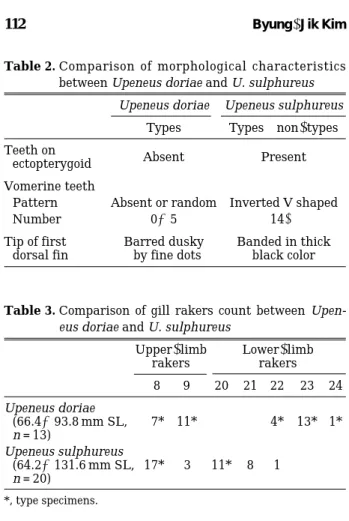
doriae with those of U. sulphureus also indicates that they are quite similar morphologically and morphometrically (Table 1). U. doriae, however, is apparently distinct from U. sulphureus in having larger number of gill rakers on the lower limb, lacking ectopterygoid teeth and color pat- tern of the first dorsal fin as well as vomerine teeth (Tables 2, 3).
Acknowledgements
We are sincerely grateful to Dr. Kunio Amaoka for his kind support of our study. We are also thank to J. Maclaine (BMNH), R. Poggi (MSNG), P. Bartsch (ZMB), G. Duhamel (MNHN), G. Shi- nohara (NSMT-P), T. Yoshino (URM-P), and W.
L. Fink (UMMZ) for providing type or compara- tive materials.
References
Blegvad, H. 1944. Fishes of the Iranian Gulf. Einar Munksgaard, Copenhagen. pp. 1 ~247.
Cuvier, G. and M. Valenciennes. 1829. Histoire nat- urelle des poissons. Vol. 3, pp. i ~xxij±1~368.
Gallotti, A.M. 1971. Intorno all’identita di Upeneoi-
des doriae Güunther (Pisces, Percoidei). Doriana,4 : 1 ~3.
Günther, A. 1869. Descriptions of two new species of fishes discovered by the Marquis J. Doria.
Ann. Mag. Nat. Hist., Ser., 4, 3 : 444 ~445.
Kuronuma, K. and Y. Abe. 1972. Fishes of Kuwait.
Kuwait Institute For Scientific Research, Kuwait City, Kuwait, pp. i ~xiv±1~123.
Kuronuma, K. and Y. Abe. 1986. Fishes of the Ara- bian Gulf. Kuwait Institute For Scientific Rese- arch, Kuwait City, Kuwait, pp. i ~xii±1~356.
Leviton, A.E., R.H. Gibbs, Jr., E. Heal and C.E.
Dawson. 1985. Standards in herpetology and ichthyology: Part I. Standard symbolic codes for institutional resource collections in herpetology and ichthyology. Copeia, 1985 : 802 ~832.
Randall, J.E. and P. Guézé. 1992. Upeneus francisi, a new goatfish (Perciformes: Mullidae) from Norfolk Island and New Zealand. Cybium, 16 : 21 ~29.
Randall, J.E. 1995. Coastal fishes of Oman. Craw- ford Hose Publishing, Bathurst, Australia, pp.
i ~xiii±1~439.
Tortonese, E. 1959. Su alcuni tipi di pesci perciformi esistenti nel Museo di Genova. Doriana, 2 : 1 ~5.
Table 2. Comparison of morphological characteristics between Upeneus doriae and U. sulphureus
Upeneus doriae Upeneus sulphureus Types Types±non-types
Teeth on Absent Present
ectopterygoid Vomerine teeth
Pattern Absent or random Inverted V shaped
Number 0~5 14�
Tip of first Barred dusky Banded in thick dorsal fin by fine dots black color
Table 3. Comparison of gill rakers count between Upen- eus doriae and U. sulphureus
Upper-limb Lower-limb
rakers rakers
8 9 20 21 22 23 24
Upeneus doriae
(66.4~93.8 mm SL, 7* 11* 4* 13* 1*
n = 13)
Upeneus sulphureus
(64.2~131.6 mm SL, 17* 3 11* 8 1 n = 20)
*, type specimens.
Tortonese, E. 1963. Catalogo dei tipi di pesci del Museo Civico di Storia naturale di Genova. (Parte
III). Ann. Mus. Civ. Stor. Nat. ‘Giacomo Doria’, 37 : 333 ~350.
Received : February 26, 2003 Accepted : May 7, 2003
Upeneus doriae
(농어목: 촉수과)의 재기재 및 유사종U. sulphureus
와의 비교 김 병 직∙Kazuhiro Nakaya
*제주대학교 해양과학대학 해양과학부
,*Graduate School of Fisheries Sciences, Hokkaido University, Japan