28
4-Nitroquinoline 1-Oxide에 대한 유산균의 항돌연변이 효과
송수연1·정종욱1·김광현1·박동준2·오세종1*
1전남대학교 농업생명과학대학 동물자원학부, 2한국식품연구원
Antimutagenicity of the Cell Extracts of Lactic Acid Bacteria against 4-Nitroquinoline 1-Oxide
Sooyeon Song1, Jong-Wook Jeong1, Kwang-Hyun Kim1, Dong-June Park2, and Sejong Oh1*
1Division of Animal Science, Chonnam National University, 77 Yongbong-Ro, Bukgu, Gwangju 500-757, Korea
2Korea Food Research Institute, Seongnam 463-746, Korea
Abstract: Intestinal lactic acid bacteria (LAB) for humans are closely associated to the host’s health because the presence of LAB is an important bio-defense factor in preventing colonization and subsequent proliferation of pathogenic bacteria in the intestine. Some probiotics such as Lactobacillus species can intoxication of carcinogens including chemical mutagens.
The purpose of this study was to compare the ability of antimutagenesity among 24 strains of LAB isolated from infant feces, yogurt and kimchi etc. The antimutagenic effects of protein fractions extracted from the cells of 24 LAB strains were investigated using mutagens as 4-nitroquinoline-N'-oxide in Ames test (Salmonella Typhimurium TA 100). In the Ames test, dose-dependent activity was exhibited significantly against 4NQO. Three strains of Lactobacillus showed the highest anti-4NQO activitiy (62.1%) among the tested strains of LAB.
Keywords: Antimutagenicity, 4-Nitroquinoline 1-Oxide, Lactic Acid Bacteria
서 론
현재 우리나라에서는 서구화된 식습관과 생활 양식 여러 환경적인 요인들에 의해 심장병, 고혈압, 뇌졸중, 당뇨병, 암, 신경통 등의 각종 질병이 증가하고 있다. 이러한 여러 질병 중 대표적인 질병은 암으로 현대사회의 인류의 건강 에 가장 큰 위협으로 다가오고 있다(Watson and Leonard, 1986). 암은 일반적으로 유전자의 변형이 있을 경우 종양 발생유전자가 활성화해서 암세포가 만들어지게 된다. 암은 다양한 화학적 발암 물질과 식이 인자들이 서로 다른 과정 을 통하여 영향을 발생시키기 때문에 의학의 발전에도 불 구하고 아직까지 정확한 암 발생 원인 및 기전은 밝혀지지 않고 있으며 발병률과 사망률은 지속적으로 증가하고 있다 (Ames et el., 1973). 문제의 원인으로 14~20%가 과체중과 고도비만 등에 의한 요인이며, 75~80%가 유전적인 요소와
환경적인 요소를 지적하고 있다. 요인 중 환경적 요소의 큰 비중을 차지하고 있는 부분이 식품 및 영양물질이다(Cancer Facts & Figures, 2009). 환경적인 요인들 중 식품의 섭취 는 인간의 암 발생의 주요한 원인과 연관 되어 있으며 식 품의 섭취는 최근 중요한 문제로 대두되고 있다(Washington, DC, American Institute for Cancer Research, 1997). 우리나 라의 경우 위암 및 간암의 발생빈도가 다른 선진국에 비해 월등히 높고 그로 인한 사망률이 모든 암 사망 환자의 과 반수 이상을 차지하고 있다. 이는 우리나라 특유의 음식이 나 생활습관이 암 발생과 연관이 있는 물질이 있을 가능성 이 있을 것으로 추정된다(Montesano and Hall, 1990). 최근 암의 예방과 치료를 위해 부작용의 우려가 없는 식품을 이 용한 여러 연구가 진행 중에 있다. 최근 개발된 많은 기능 성 식품들이 신체의 면역 활성 증가나 항암 효과를 주장하 고 있다(Kim et al., 2008; Yeo et al., 2008). 이 연구들 중 대표적인 것은 유산균으로 유산균을 이용한 발효 식품들은 항돌연변이와 항암 효과에서 다양하게 영양적으로 중요하 며 치료에 도움을 준다(Rao et al., 1986; Gilliland, 1990).
유산균은 분류학적으로 그람 양성, catalase 음성, 포자를 형 성하지 않고 전자전달체로 시토크롬을 사용하지 않는 특성 을 지닌 미생물로 구형 또는 간상 형태로 산소에 대한 내
*Corresponding author: Sejong Oh, Division of Animal Science.
Chonnam National University, Gwangju 500-757, Korea Tel: 82-62-530-2116, Fax: 82-62-530-2129
E-mail: [email protected]
Received June 17, 2015; Revised June 20, 2015;
Accepted June 25, 2015
성과 낮은 pH에 대한 내성이 있고 탄수화물을 발효시켜 최 종 대사산물로 젖산을 생산하며, 유산균의 젖산 생성과정 은 homo 또는 hetero fermentative pathway를 통해서 이루 어진다. 유산균은 probiotics로 이용되는 대표적인 미생물로 써 장운동 조절, 병원성 세균의 억제, 소화 흡수의 촉진, 변 비 설사 방지 등의 영양생리적인 건강 증진과 더불어 발효 유제품, 자연발효식품, 사람이나 동물의 소화관, 가축의 사 료, 제약 분야에서 다양하게 사용되고 있다. 최근에는 항 돌연변이 효과, 면역증강 효과 등의 효능이 보고되면서 광 범위하게 연구가 진행되고 있다(Andersson et al, 2001; Mc- Farland, 2000; Salminen, 2001; Saul, 1998).
본 연구는 치즈, 김치, 분변, 유제품 등에서 분리한 유산 균을 포함하여 총 24종의 유산균에 대하여 항돌연변이 활 성을 조사하여 새로운 probiotics로써의 가능성을 탐색하고 자 하였다.
재료 및 방법 유산균
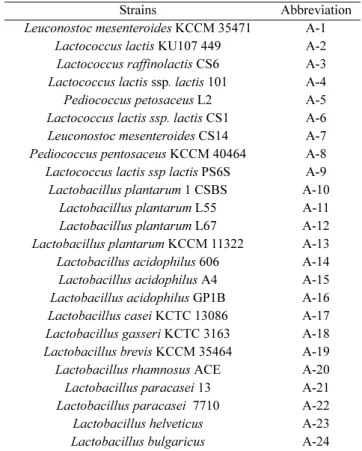
본 실험에서 사용한 유산균은 김치, 치즈, 유제품, 스타 터, 유아분변 등에서 분리하여 보관중인 유산균을 포함하 여 총 24종을 이용하였다(Table 1). 유산균은 MRS 배지를 사용하여 37oC, 16~18시간 2차 계대 배양한 다음, 3,000 rpm에서 15분간 원심분리하여 세포를 얻었다. 멸균 생리 식염수로 2회 세척한 뒤 세포 침전물을 1.5 mL eppendorf tube에 Skim milk 1 mL과 함께 -80oC deep freezer에 보관 하였다. 유산균 세포질 성분 물질을 추출하기 위해서 원심 분리 후 얻어진 세포에 MRS 배양액 10 mL에서 나온 세 포 침전물에 lysis buffer (40 mM Tris, 1 mM EDTA) 1 mL 을 첨가한 후, ice bath에서 초음파파쇄기(Sonics & Materials, INC, USA)로 15분간 amplitude 35%, pulse on 3 sec, pulse off 5 sec의 조건으로 초음파 파쇄하였다. 파쇄물은 원심분 리 후 상등액을 취하여 -80oC deep freezer에 보관하면서 시 료로 사용하였다. 단백질 정량은 Bradford 방법을 사용하여 단백질 정량하였다.
돌연변이 유발 물질
4-Nitroquinoline 1-oxide(4-NQO)는 Sigma-Aldrich Inc (St. Louis, MO, USA)로부터 구입하여 dimethylsul foxide (DMSO, Sigma-Aldrich Co, St. Louis, MO, USA)에 녹여 서 사용하였다. 4-Nitroquinoline 1-oxide(4-NQO)는 100 µL 당 0.005~50 µg의 농도로 희석하여 선택하였다. 본 실험의 적정 농도를 선택하기 위하여 돌연변이 물질의 농도에 따 른 histidine revertant의 colony 수와 spontaneous colony 수 를 판단하였다. Direct mutagen의 평가에는 경우 0.2 M so- dium phosphate buffer (pH 7.4) 500 µL를 사용하였으며, 대 사 활성 물질이 필요한 Indirect mutagen의 평가에는 S9
Mixture 500 µL를 histidine revertant colony를 확인하기 위 하여 사용하였다. Spontaneous colony 수의 경우 돌연변이 물질만 빼고 histidine revertant의 colony 수의 측정과 동일 하게 진행하였다.
Salmonella Typhimurium TA100
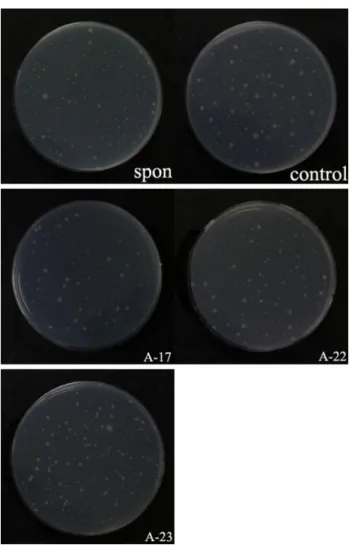
Salmonella Typhimurium TA100은 부산대학교 식품영양 학과 식품 미생물 연구실로부터 분양 받아 사용하였다(Fig.
1). Nutrient broth에 16시간, 2차 계대 배양 후 0시간부터 48시간까지는 3시간 단위로 측정하였으며, 48시간부터 120 시간까지는 24시간 단위로 총 균수, pH를 측정하였다. 각 각의 측정 시간에 배양 균주 1 mL을 0.1% peptone수에 10-1~10-9 으로희석 후 Nutrient 배지에서37oC, 24시간 배 양 후 나타난 colony의 총 균수를 측정하였다. pH 측정은 pH meter (Mettler-Toledo International Inc, UK)를 이용하 여 측정하였다.
Salmonella Typhimurium TA100의 유전형질 확인 항돌연변이 실험에 앞서 Salmonella Typhimurium TA100 는 정기적으로 Genotype test, Crystal violet sensitivity test, Ampicillin resistance test, uvrB deletion test, Spontaneous reversion test 등의 유전형질을 확인하면서 실험에 사용하 였다.
Table 1. List of tested Lactic acid bacteria
Strains Abbreviation
Leuconostoc mesenteroides KCCM 35471 A-1 Lactococcus lactis KU107 449 A-2 Lactococcus raffinolactis CS6 A-3 Lactococcus lactis ssp. lactis 101 A-4 Pediococcus petosaceus L2 A-5 Lactococcus lactis ssp. lactis CS1 A-6 Leuconostoc mesenteroides CS14 A-7 Pediococcus pentosaceus KCCM 40464 A-8 Lactococcus lactis ssp lactis PS6S A-9 Lactobacillus plantarum 1 CSBS A-10
Lactobacillus plantarum L55 A-11 Lactobacillus plantarum L67 A-12 Lactobacillus plantarum KCCM 11322 A-13 Lactobacillus acidophilus 606 A-14 Lactobacillus acidophilus A4 A-15 Lactobacillus acidophilus GP1B A-16 Lactobacillus casei KCTC 13086 A-17 Lactobacillus gasseri KCTC 3163 A-18 Lactobacillus brevis KCCM 35464 A-19 Lactobacillus rhamnosus ACE A-20 Lactobacillus paracasei 13 A-21 Lactobacillus paracasei 7710 A-22 Lactobacillus helveticus A-23 Lactobacillus bulgaricus A-24
S9 Mixture 제조
standard S9 mixture를 사용하였다. S9 mixture는 50 mL 당 S9 fraction(4%) 2.0 mL, MgCl2-KCL salts 1.0 mL, 1 M glucose-6-phosphate (Sigma-Aldrich Co, St. Louis, MO, USA) 0.25 mL, 0.1 M NADP (Amresco, Inc) 2.0 mL, 0.2 M phosphate buffer (pH 7.4) 25 mL, 멸균 증류수 19.75 mL를 각각 역순으로 첨가하였다.
항돌연변이 활성 평가
Maron과 Ames(1983)의 방법에 따라 Ames test로 항돌연 변이 효과를 실험하였다. 모든 실험은 3반복으로 진행하였 으며 그 평균값으로 계산하였다. Salmonella Typhimurium TA100 균주를 멸균된 시험관에서 14~16시간 배양한 균주 100 µL (1~2×10⁹ cells/mL), 유산균 세포질 추출물 시료 50 µL, 돌연변이 유발물질 100 µL씩을 각각 첨가한 다음 37oC shaking water bath에서 30분간 예비 배양하였다. 45oC Top agar 10 mL에 0.5 mM histidine/biotin solution 1 mL의 비 율로 첨가 후 37oC incubator에서 48시간 배양하여 각각의
histidine revertant의 colonies를 계수하였고, inhibition rate (%)를 계산하였다.
M: 돌연변이 유발물질에 의해 유도된 복귀돌연변이 수 A: 유산균 sonication 상등액을 처리한 후 복귀돌연변이 수 S: 자연복귀돌연변이원 수
결과 및 고찰
일반적으로 돌연변이 실험은 Maron와 Ames(1983) 방법 에 따른 Ames test를 이용하여 실행한다. Ames test는 화 학물질이 돌연변이원인지를 결정하는데 이용되는 실험으로 간편성, 경제성, 신뢰성 등의 이유 때문에 널리 이용되는 in vitro 돌연변이 유발 실험이다. 이 실험은 돌연변이원이 암 유발성을 갖는 물질과 동일하다는 것을 전제로 하며 (Ames et al., 1975). 암 유발의 초기단계에는 돌연변이가 중요하게 작용한다(Garner and Hradec, 1990). 발암물질과 돌연변이유발 물질을 보면 돌연변이 유발 물질의 약 83%
가 발암물질로 알려지고 있다. 이런 돌연변이원들은 체세 포 돌연변이를 통해 암을 유발시킨다고 추정되고 있다. 즉 DNA를 mutation시키는 것이 발암기전의 promotion 단계로 보는 것이다. Ames test에 이용하는 박테리아는 Salmonella typhimurium을 이용하며 이 박테리아들 중에서 histidine을 합성하지 못하는 돌연변이체가 이용되어진다. 여기에 돌연 변이원을 처리하면 DNA를 돌연변이 시켜서 역돌연변이가 일어나서 histidine 요구 균주가 다시 hitidine을 합성할 수 있게 된다. 따라서 역돌연변이가 일어난 박테리아는 histidine 이 첨가되지 않은 배지에서도 생존할 수 있게 된다. Histidine 불활성 돌연변이체인 박테리아의 경우 histidine이 없는 배 양액에 쥐의 간 효소와 함께 배양한다. 그런 후 암유발인 자로 알려진 화학물질을 넣게 되면 박테리아 중 역돌연변 이가 일어나 박테리아는 생존하게 된다. 체내에서 물질대 사과정을 거치면서 돌연변이 인자가 될 수도 있기 때문에 간의 효소를 첨가한다. 이런 방법을 이용하여 실험으로써 확인하여 항돌연변이의 효과의 유무에 따라서 발암물질임 을 판단하는 것이다(Maron and Ames, 1983).
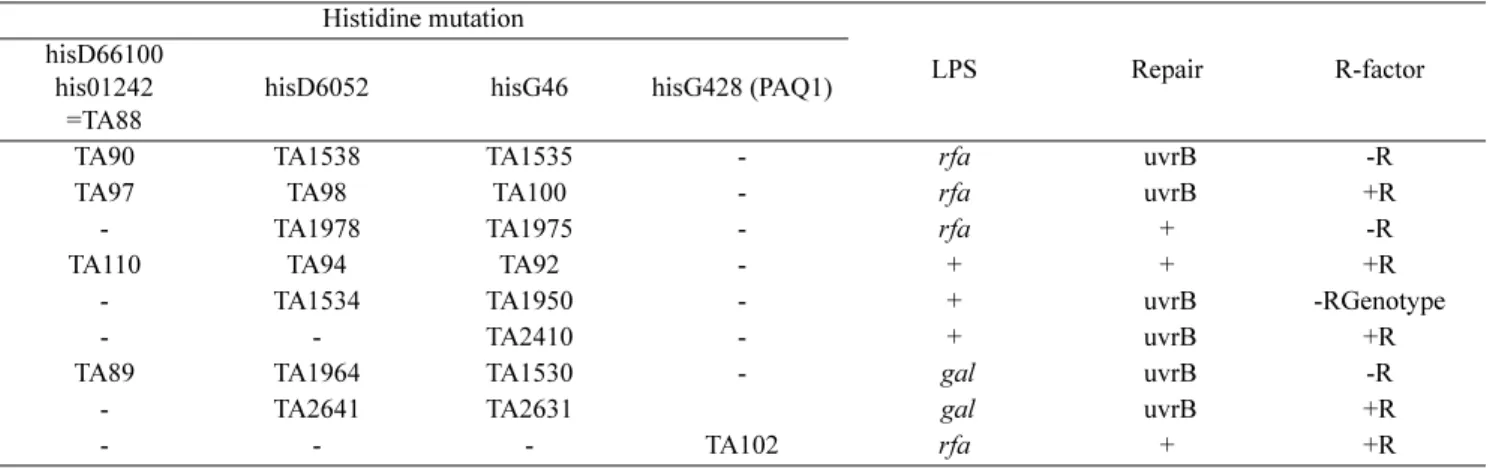
Table 2은 항돌연변이 실험을 하면서 가장 일반적으로 사 용되는 Salmonella tester strain를 나타내며, Table 3는 일반 적으로 사용되는 Salmonella tester strain의 주요 돌연변이 의 DNA sequence를 나타내며, Table 4는 tester strain들의 Genotype을 나타내고 있다.
Salmonella Typhimurium TA100은 Salmonella Typhimu- rium LT-2로부터 유래한 histidine-requiring strain 중에서 염 기치환 변이원인 his G46을 모균으로 갖는다. 이 균은 세 포벽의 lipopolysaccharide(LPS)가 부분적으로 감소를 유발
Inhibition rate %( ) M A– M S– --- 100×
=
Fig. 1. Colonies of Lactic acid bacteria against 4-NQO on Salmonella Typhimurium TA100.
하여 돌연변이 물질의 통과가 쉽게 이루어지며, deep rough (rfa) 돌연변이, uvrB 돌연변이를 가지는 TA1535에 저항인 자인 plasmid pKM101의 도입으로 감수성을 높인 균주이 다. his G46는 histidine 생합성의 최초 효소를 coding하는 his 유전자의 돌연변이를 유발시킴으로써 DNA 염기서열의 분석 시 야생형의 -GAG-/-CTC-(leucine) -GGG-/-CCC-(pro- line)으로 전환되어 있다(Levin et al., 1982; Maron and Ames, 1983).
유산균의 항돌연변이 효과에 관련된 많은 연구들이 보고 되고 있다. Lactobacillus bulgaricus와 Streptococcus ther- mophilus에 의해 발효된 우유는 중요한 항돌연변이 효과를 나타내며(Bogdanov et al., 1975; Bodana and Rao., 1990;
Hosoda et al., 1992; Nadathur et al., 1994), Lactobacillus helveticus L89에 의해 발효된 우유와 이 균의 protease-defi- cient varient가 4-NQO 사용 시 0, 12, 24시간의 발효 시간 에 따서 각각 15%, 50%, 62%와 13%, 20%, 40%로 발효 시간이 지날수록 항돌연변이 효과가 높게 나타났다. 이는
유산균에 의해 발효된 우유와 casein hydrolysates가 비 발 효 우유와 native casein보다 높은 항돌연변이 효과를 나타 낸다는 것을 의미한다고 하였다(Chantal et al., 1997). Hsieh 과 Chou는 Lactobacillus acidophilus CCRC 14079, Strep- tococcus thermophilus CCRC 14085, Bifidobacterium ing- antis CCRC 14633, Bifidobacterium longum B6 유산균으로 발효시킨 두유는 4-NQO 와 DMAB 돌연변이 물질에 대해 각각 35.0~85.1%, 57.8~85.8%의 항돌연변이 효과를 나타내 었다고 보고하였다(Hsieh and Chou, 2006). 또한, Lee 와 Park(1999)은 김치로부터 분리, 동정된 Lactobacillus planta- rum KLAB21 균주가 point mutant인 Salmonella Typhimu- rium TA100의 경우 돌연변이 유발 물질 MNNG, NPD, AFB1에 대해 각각 98.42%, 3.95%, 82.52%로 나타났으며, frame shift mutant인 Salmonella Typhimurium TA98의 경 우 돌연변이 유발 물질 NPD, NO, AFB1에 대해 각각 62.78%, 57.21%, 78.53%의 항돌연변이 활성을 나타낸다고 보고하였다(Lee and Park, 1999).
Table 2. Genotype of the most commonly used Salmonella tester strains
Mutation
(strain) bio chlD uvrB gal LPS
defect Plasmid hisG46
TA1535 Deletion mutation rfa No plasmid TA100 Deletion mutation rfa PKM101 hisD3052
TA1538 Deletion mutation rfa No plasmid
TA98 Deletion mutation rfa PKM101
hisC3076
TA1537 Deletion mutation rfa No plasmid hisD6610 Deletion mutation rfa PKM101
his01242 TA97 hisG428
TA104 Deletion mutation rfa No plasmid
TA102 Wild type rfa PKM101, pAQ1
Table 3. DNA sequence specificity on the Salmonella tester strains
Allele/
strain(s) DNA target Reversion event hisG46 -G-G-G- Base-pair substitution
Ta100 TA1535
hisD3052 -C-G-C-G-C-G-C-G- Frameshifts TA98
TA1538
hisC3076 +1 frameshift (near -C-C-C- run)
Frameshifts TA1537
hisD6610 -C-C-C-C-C-C- (+1 cytosine at run of C's)
Frameshifts TA97
hisG428 TAA(ochre) Transitions/transversions TA102
TA104
Table 4. Genotype of the TA strains used for Mutagenesis testing Histidine mutation
LPS Repair R-factor
hisD66100 his01242
=TA88
hisD6052 hisG46 hisG428 (PAQ1)
TA90 TA1538 TA1535 - rfa uvrB -R
TA97 TA98 TA100 - rfa uvrB +R
- TA1978 TA1975 - rfa + -R
TA110 TA94 TA92 - + + +R
- TA1534 TA1950 - + uvrB -RGenotype
- - TA2410 - + uvrB +R
TA89 TA1964 TA1530 - gal uvrB -R
- TA2641 TA2631 gal uvrB +R
- - - TA102 rfa + +R
(Maron and Ames, 1983)
Salmonella Typhimurium TA100 균주를 이용하여 항돌 연변이 실험을 한 결과는 Table 5에 제시된 바와 같다. 총 24종 유산균 중에서 A-1, A-5, A-6, A-13, A-19, A-24 균 주를 제외한 나머지 균주에서 항돌연변이 효과를 확인하였 다. 항돌연변이 효과가 높은 균주는 A-17, A-22, A-23 균 주로 A-17 균주는 복귀 돌연변이 집락수가 190±5, Inhibi- tion rate는 62.10%, A-22 균주는 복귀 돌연변이 집락수가 190±6, Inhibition rate는 62.10%, A-23 균주는 243±8, Inhi- bition rate 33.60%로 나타났다(Fig. 1). 이 연구 결과 다양 한 유산균들이 항돌연변이 효과를 가지고 있었으며, 유산 균에 따라 항돌연변이 활성의 차이가 나타났다.
요 약
24종의 유산균 세포질 성분 물질을 이용하여 항돌연변이 효과 실험을 진행한 결과 각각의 돌연변이 유발 물질에 따 라 다른 항돌연변이 효과를 확인하였다. 4-NQO에 대하여 A-17, A-22, A-23 균주의 경우 각각 62.10%, 62.10%, 33.60%로 높은 항돌연변이 효과가 나타났다. 따라서 이러 한 유산균을 이용한 식품의 섭취를 통해서 발암물질의 활 성을 저해하거나 무독화하여, 암 발생 예방 및 치료는 물
론 기능성 식품에 적용이 가능할 것으로 판단된다.
참고문헌
Ames BN, Durston WE, Yamasaki E, and Lee FD (1973) Carcin- ogens are mutagens: a simple test system combining liver homogenates for activation and bacteria for detection. Proc.
Net. Acad. Sci. USA 70, 2281-2285.
Andersson, H. Asp NG, Bruce S, Roos S, Wadström T, and Wold A (2001) Health effects of probiotics and prebiotics. A liter- ature review on human studies. Scan. J. Nutr. 45, 58-75.
Bodana AR and Rao DR (1990) Antimutagenic activity of milk fermented by Streptococcus thermophilus and Lactobacillus bulgaricus. J. Dairy Sci. 73, 3379-3384.
Bogdanov IG, Daley PG, Plemyannikova LA, and Sorokina IB (1975) Antitumor glycopeptides from Lactobacillus bulgar- icus cell wall. FEBS Lett. 57, 259-261.
Bruce N. Ames, Joyce McCann, and Edith Yamasaki (1975) Me- thods for detecting carcinogens and mutagens with the salm- onella/mammalian-microsome mutagenicity test. Mutation- Research/Environmental Mutagenesis and Related Subjects, 31, 347-363.
Cancer Facts & Figures (2009) American Cancer Society.
Chantal Matar, Sudarshan S. Nadathur, Alant. Bakalinsky, and Jacques Goulet., (1997) Antimutagenic effects of milk ferm- ented by Lactobacillus helveticus L89 and a protease-defi- cient derivative. J. Dairy Sci. 80, 1965-1970.
Gilliland SE (1990) Health and nutritional benefits from lactic acid bacteria. FEMS Micro. Rev. 86, 175-188.
Hosoda M, Hashimoto H, Morita H, Chiba M, and Hosono A (1992) Antimutagenicity of milk cultured with lactic acid bac- teria against N-methyl-N'-nitro-Nnitrosoguanidine. J. Dairy Sci. 75, 976-981.
Kim BS, Rhee CH, Hong YA, Kwon TH, Shin MK, Kim JH, Woo CJ, Kim YB, and Park HD (2008) Changes of enzyme activ- ity and physiological functionality of traditional Kanjang (Soy sauce) during fermentation in the using Bacillus sp. SP- KSW3. Korean J. Food Preserv. 15, 293-299.
Lee CH and Park HD (1999) Isolation and characterization of lactic acid bacteria producing antimutagenic substance from Korean Kinchi. Rhee, Kor. J. Appl. Microbiol. Biotechnol.
27, 15-22.
Maron DM and Ames BN (1983) Revised methods for the Sal- monella mutagenicity test. Mutat. Res. 113, 173-215.
Meng-Li Hsieh and Cheng-Chun Chou (2006) Mutagenicity and antimutagenic effect of soymilk fermented with lactic acid bacteria and bifidobacteria. Int. J. Food Microbiol. 111, 43- 47.
Montesano R and Hall J (1990) Environmental causes of human cancers. Ministry of Science and Technology.
Nadathur SR, Gould SJ, and Bakalinsky AT (1994) Antimutage- nicity of fermented milk. J. Dairy Sci. 77, 3287-3295.
Salminen S (2001) Human studies on probiotics: Aspects of sci- entific documentation. Scand. J. Nutr. 45, 8-12.
Saul Scheinbach (1998) Probiotics: Functionality and commer- Table 5. Antimutagenic activity effect of Lactic acid bacteria
against 4-NQO on Salmonella Typhimurium TA100 Sample Revertants/plate Inhibition rate (%)
Control 305 ± 10 0
Spontaneous 119 ± 4 100
A-1 307 ± 4 -0.81
A-2 267 ± 1 20.43
A-3 268 ± 2 20.16
A-4 293 ± 12 6.72
A-5 330 ± 9 -13.17
A-6 308 ± 10 -1.61
A-7 301 ± 7 2.15
A-8 297 ± 16 4.30
A-9 279 ± 16 14.25
A-10 286 ± 10 10.22
A-11 271 ± 1 18.55
A-12 245 ± 7 32.26
A-13 328 ± 6 -12.10
A-14 260 ± 15 24.46
A-15 259 ± 14 24.73
A-16 300 ± 16 2.69
A-17 190 ± 5 62.10
A-18 298 ± 3 3.76
A-19 309 ± 1 -1.88
A-20 302 ± 13 1.88
A-21 262 ± 19 23.39
A-22 190 ± 6 62.10
A-23 243 ± 8 33.60
A-24 310 ± 6 -2.69
cial status. Biotechnology Advances 16, 581-608.
Washington, DC, American Institute for Cancer Research (1997) World Cancer Research Fund/American Institute for Cancer Research Food. Nutrition and the Prevention of Cancer: A
Global perspective.
Watson RR and Leonard TK. (1986) Selenium and vitamins A, E, and C: nutrients with cancer prevention properties. J. Am.
Diet. Assoc. 86, 505-510.