51
후산 발효 적합 균주 선발 및 특성
손 지 양․김 세 헌*
고려대학교 생명과학대학 식품공학부
Properties of Lactic Acid Bacteria That Cause Decrease in Post-Fermentation to Apply Product
Ji Yang Sohn and Sae Hun Kim*
Division of Food Bioscience and Technology, College of Life Sciences and Biotechnology, Korea University, Seoul 136-701, Korea
Abstract
Emerging studies suggest that vegetables or fruit juices deemed to be potential alternative base medium for lactic acid bacteria fermentation. Until now, limited studies have been carried out to evaluate such applications. Thus, the objective of present study is that lactic acid bacteria were evaluated for their viability at low pH, growth during storage at low temperature, and CO2 formation. Furthermore, the effects of grapefruit extract with respect to cell viability, sensory ability, and organic acid production were evaluated for these strains. The probiotic properties of the strains, including acid tolerance, bile tolerance, and adhesion to human intestinal epithelial cells (HT-29 cells), prebiotic characteristics, and safety features were examined. All strains survived in MRS medium broth adjusted to pH 3.8, at 10℃ for 6 days, and did not produce CO2 to check post fermentation. The medium of grapefruit extract fermentation by Lactobacillus plantarum CJIH 203 resulted in maximal viable counts, compared with other strains, and the extract subsequently tasted sour due to the presence of lactic acid. Lactobacillus plantarum CJIH203 was highly resistant to artificial gastric juice and intestinal juice, while
Lactococcus lactis SJ09 strongly adhered to HT-29 cells. Tagatose showed the greatest ability to enhance the growth of L. plantarum SJ21, relative to the other strains. All strains were verified by safety tests such as hemolysis, gelatin hydration,
and urea degradation. Therefore, these strains could be promising candidates for use in reducing excessive post-fermentation and functional products.Keywords: Lactic acid bacteria, post-fermentation, probiotics
* Corresponding author: Sae Hun Kim, Division of Food Bioscience and Technology, College of Life Sciences and Biotechnology, Korea University, Seoul 136-701, Korea. Tel: +82-2-3290-3055, E-mail: saehkim
@korea.ac.kr
서 론
프로바이오틱스(Probiotics)는 “생명을 위한”(For life)이란 그 리스 어원을 시초로 다양한 의미로 해석되어 왔으며, 살아 있는 미생물로서 그것을 섭취하는 숙주에게 장내 세균들의 균 형을 맞추는 등 유익함을 제공하는 것”이라고 정의되었다
(Fuller, 1989). 대부분 프로바이오틱스는 Lactobacillus plantarum,
Lactobacillus casei, Lactobacillus acidophilus,
그리고 Streptococcuslactis와 같은 유산균이 있다(Sindhu and Khetarpaul, 2001).
프로바이오틱스는 많은 인간에서 유익한 점에 대해 많은 선행 연구가 있었다. 예를 들자면 혈중 콜레스테롤을 감소 시키고, 위장기능 향상, 면역 강화 시스템 및 대장 암의 위 험성을 낮추는 것을 들 수 있다 (Berner and O_Donnell, 1998;
Rafter, 2003; Saarela et al., 2002; McNaught and MacFie, 2001). 일반적으로 유산균은 상업적으로 낙농제품을 만들기
위해 starter culture로 사용되고 있다(Heenan et al., 2002).
하지만 이러한 유제품은 유당 불내증과 콜레스테롤 함유하 고 있다는 한계가 있다. 최근 소비자들은 유제품만이 아닌 프로바이오틱스 제품에 대한 수요가 증가하고 있고, 음료 시장 이외에도 캡슐 형태, 분말 형태의 보충제 시장도 넓어 지고 있다(Shah, 2001). 이것은 웰빙(Well-being)이 메가 트 렌드로 정착되면서 소비자의 wants와 needs가 나날이 증가 하게 되었기 때문이다. 그래서 천연재료와 유기농을 결합 한 Rawaganic 제품들이 지속적으로 출시하고 있다. 이러한 요구에도 불구하고 유제품 base가 아닌 관한 연구는 미흡 한 실정이다. 최근 국외에서는 과채음료와 프로바이오틱스 를 결합한 제품들을 출시하고 되고 있으며, 국내 소비자층 역시 이에 대한 수요가 증가할 것으로 예상이 된다. 따라서 본 연구에서는 후 발효가 지나치게 진행되지 않는 과채 음 료에 적합한 균주를 선발하여 균주 특성 규명 및 저장 안정 성을 향상시키고자 하였다. 더불어 선발된 균주에서 프로 바이오틱스 특성과 기능성 당인 tagatose 이용능 및 안정성 검사를 확인하였다.
재료 및 방법
1. 사용균주 및 배지
균주는 김치 및 장류에서 분리된 것으로 본 실험에서
Lactobacillus plantarum CJIH203, Pediococcus pentosaceus
CJT1072, Lactococcus lactic SJ09, Lactococcus raffinolactis SJ15, Lactobacillus plantarum SJ21를 사용하였다. 선정된 유산균의 배양은 Lactobacilli MRS broth(Difco Co., USA) 에 접종하여 37℃에서 18시간 배양하여 사용하였다.2. pH 생장 특성 확인 실험
유산균 배지 조건에서의 pH에서 생장 특성 확인의 목적 은 모든 대상 균을 MRS broth에서의 생장이 가능한 pH 하 한 범위를 확인하였다. pH 조건은 pH 6.5, 4.2, 3.8, 3.6 기 준에 맞게 2 N HCl을 사용하여 pH를 조정하였으며, 멸균 후 pH 확인 제조한 MRS broth에 1%(v/v) 균주를 접종하여 37℃, 18시간 동안 생장 확인하였다. MRS broth의 pH 조정 할 때 단백질 변성에 의한 O.D. 증가가 있어 각 pH 별로 균 접종을 하지 않은 기준 시료를 준비하여 0점을 조정한 후에 O.D.를 측정하였다. 600 nm에서 O.D값이 1.0 이상 시 strong positive, 0.5 이상 1.0 미만에서는 positive, 0.3 이상 0.5 미 만에서는 weak positive, 0.15 이상 0.3 미만에서는 weak weak positive, 0.15 미만에서는 negative로 판단하였다.
3. 생육 온도 특성 실험
생육 온도 특성 실험은 pH 6.5 MRS broth 배지에 균주 를 1%(v/v) 접종하여 10℃, 15℃에서 배양했으며, 3일, 6일 동안 생장을 관찰하였다. 측정 기준은 pH 생장 특성 확인 과 동일하게 측정하였다.
4. CO2 생성 확인 실험
CO2 생성 여부 확인은 pH 6.5의 control 배지에 durham tube가 있는 배지에 균주 1%(v/v) 접종하여 생장 시 gas 생 성 여부를 37℃에서 48시간 후에 확인하였다. pH 4.2, pH 3.6에서도 durham tube를 넣어 낮은 pH에서 생장 시 gas 생 성 여부를 확인하였다.
5. 발효풍미 적합 균주 선발 기준
균주를 1 mL를 0.8 5% NaCl로 두 번 13,000 rpm에서 1분 간 원심 분리하여 사용하였다. 접종은 자몽 추출물에 5×10⁶ CFU/mL 기준으로 하였고, 배양액의 균수를 2×10⁹ CFU/mL 로 되기 위해 자몽 추출물 100 mL에 0.25 %(v/v) 접종하였 다. 접종 균 음료 유통 품질 확인하기 위해서 각 15℃에 보 관하여 5일, 12일차 분석하였다. 각 균주의 자몽 추출물에 서 발효 풍미를 확인하고, 적합성 여부를 판단하였다. 적합 하다고 판단되는 경우에는 생균수, 관능특성, 유기산 분석 을 하였다. 생균수는 시료 1 mL를 멸균한 peptone 수에 10 진 희석법을 하여 agar plate에 105, 106, 107 CFU/mL 수준 을 확인하였다. 관능평가는 훈련된 패널 3명이 향미 프로필 특성을 기반(Keane, 1992)으로 수용도, 산미, 산취, 이미, 이 취를 확인하였다. 유기산 분석은 서울대학교 농업생명과학 대학 농업과학공동기기센터(NICEM)에 샘플을 의뢰하여 진 행하였다.
6. 내 산성 및 내 담즙성
내 산성 실험은 Lee et al.(2010)의 방법에 따라 pH 2.5으 로 조절한 MRS broth에 초기 균수가 106 CFU/mL 수준으 로 접종하였다. 이들을 3시간 동안 반응시킨 후 생균수(CFU/
mL)를 측정하여 생존수가 0.5 log 이하로 균 수가 감소하 거나 초기 균수에 비하여 성장한 경우를 내산 능력을 가진 것으로 평가하였다. 내 담즙성 실험은 Bacto oxgall(Difico) 의 농도를 0.3%(w/v)가 되도록 첨가하여 접종 배양하고 상 기와 같은 방법을 측정하였다.
7. 장내 점착능 측정
Human intestinal epithelial cells, HT-29 cell에 유산균의 부착능력을 확인하였다(Lee et al., 2010).
HT-29 cell은 10%(v/v) Fetal bovine serum과 penicillin G(100 IU/mL)을 첨가된 RPMI 1640(Gibco, USA)에 1.0×10⁵
cell/mL 농도로 접종하고, 12 well plate에 분주하여 7일간 배양한 후, phosphate buffer saline(PBS, pH 7.2)으로 6회 세척하고 항생제가 첨가되지 않은 RPMI 1640 배지를 첨가 하였다. 유산균 6균주는 1.0×10⁹ CFU/mL의 농도로 serum-free 한 RPMI로 현탁하여 HT-29 cell에 접종하였다. 모든 반응 은 37℃, 5% CO2배양기에서 2시간 동안 반응시켰다. 시험 균은 MRS 평판 배지에서 생균수를 측정하였다. 지시균으 로 Lactobacillus rhamnosus GG를 사용하였다.
8. 기능성 당류인 Tagatose 이용능
균주는 MRS 배지에 1%으로 접종하고 배양하였다(Koh et
al., 2013).
최소 배지 성분은 peptone, sodium acetate 3H2O, magnesium sulfate 7H2O, manganase sulfate 4H2O, Tween 80, diammonium citrate, dipotassium phosphate로 121℃에 서 15분간 멸균 후 50% glucose, fructooligosaccharide, xylose, tagatose 용액을 첨가하여 실험에 사용하였다. 실험에 사용 하는 모든 균주들은 glucose, FOS, xylose, tagatose가 포함 된 배지에 1% 접종하여 37℃, 24시간 배양하였다. 균을 접종 하지 않은 것을 대조군으로 하여 발효능력을 비교하였다.Prebiotics 능력은 24시간 배양 후 ELISA reader기를 이용 한 600 nm에서 흡광도 측정 및 희석액을 이용한 평판배양 을 하여 균 수를 측정하여 평가하였다.
9. 안전성 검사
안전성 검사는 용혈 현상, 젤라틴 액화반응, 유해 대사 산 물을 확인하였다(Lee et al., 2004). 용혈 현상을 위해 MRS 고체 배지에 5% horse blood 첨가한 것을 사용하였다. 혈액 한천배지 상에서 나타나는 유형에 따라 3가지로 분류되며, 혈액배지에서 집락 주변에 투명한 분해 지역을 형성한 것 을 β형, 적혈구는 분해되지 않았으나 녹색이나 갈색 등으 로 변색된 지역을 나타낸 것은 α형, 그리고 아무런 변화가 없는 것을 γ형으로 하였다. 젤라틴 액화 반응 검사는 변형 젤라틴 영양 배지(MRS gelatin nutrient culture medium) 배 지를 이용하여 37℃, 48시간 배양 후 냉장 보관하여 배지의 응고 여부를 관찰하여 젤라틴 액화 반응을 측정하였다. 유 해 산물 대사 확인은 urea agar base 배지를 이용하였다. 대 상 미생물이 urease를 생성하면 urea가 분해되어 배지의 pH 가 높아지며 pH에 의해 지시약으로 사용되는 phenol red는 황색에서 적색으로 변하였다.
10. 통계처리
실험결과는 SPSS soft package(version 12.0.1; LEAD Tech- nologies, Inc)을 사용하여 통계 처리에 의한 실험 결과의 유 의적 검증을 시도하였다.
결 과
1. pH 생장 특성 확인 실험
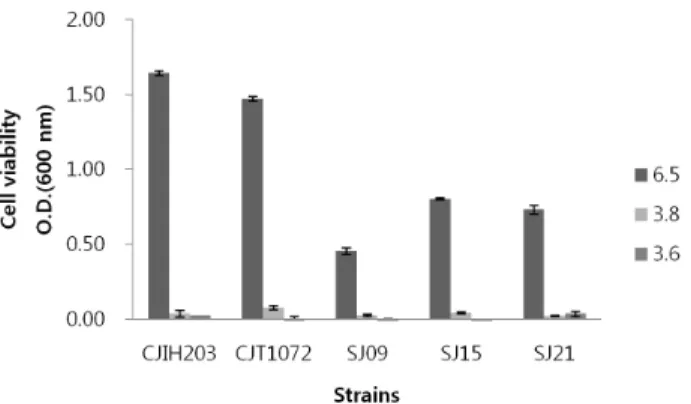
균주는 pH 4.2~4.0 이하에서 생장성이 저하되는 특성으 로 pH 내성이 약하다. 그래서 모든 대상 균을 MRS broth에 서의 생장가능 pH 하한 범위를 확인하였다(Fig. 1). 모든 균 주가 pH 3.8에서 0.3 미만이 해당하였고, 적합하다고 판단 하였다.
2. 생육 온도 특성 실험
유통환경을 감안하여 낮은 온도(10℃, 15℃)에서 생장성 이 낮아 열악유통조건에서도 후산생성이 적어질 것으로 판 단하여 관찰하였다(Fig. 2). 모든 균주가 10℃, 3일차에 0.3 미만이며, 10℃ 6일차에 0.5 미만에 해당하여 적합하다고 판 단하였다.
3. CO2 생성 확인 실험
유산 발효의 형식 중 하나인 이상발효(Hetero-fermentation) 를 확인하기 위해서 pH 6.5(control 배지), pH 4.2, pH 3.6에
Fig. 1. The characterization of cell viability in medium with pH 6.5, pH 3.8, and pH 3.6.
Fig. 2. Cell viability of lactic acid bacteria strains at 15℃ for
3 days.
Fig. 3. Cell viability of lactic acid bacteria strains at 10℃ for 6 days.
Table 1. The formation of CO
2during the growth of lactic acid bacteria strains
CJIH203 CJT1072 SJ09 SJ15 SJ21
pH 6.5 - - - - -
pH 4.2 - - - - -
pH 3.6 - - - - -
* +: positive -: negative
durham tube를 넣어 gas 생성 여부를 확인하였다(Table 1).
모든 균에서 CO2를 생성하지 않았다.
4. 발효 풍미 적합 균주 선발 기준
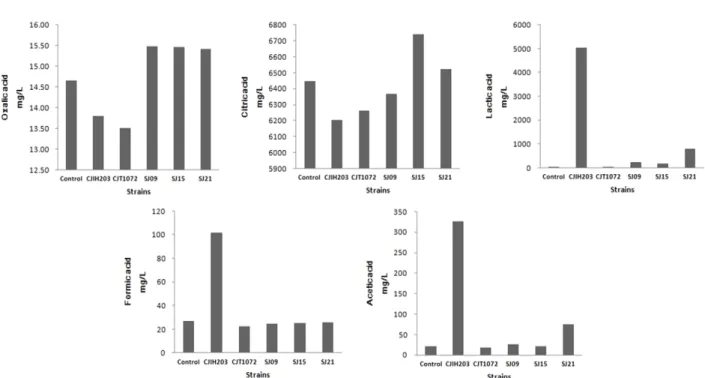
Fig. 5. Production organic acid in grapefruit extract fermented by lactic acid bacteria strains.
1) 생균수 측정
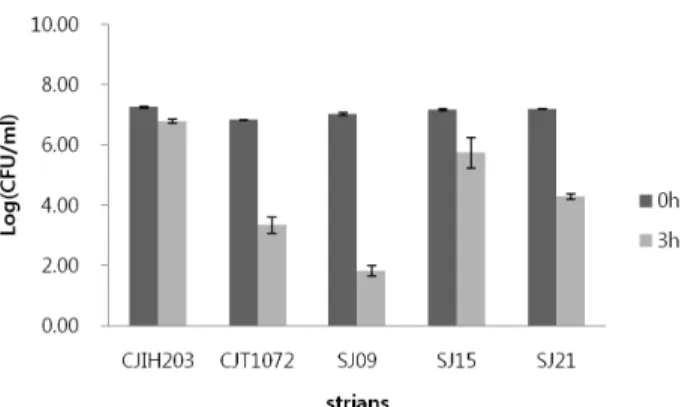
15℃, 5일차, 12일차에 자몽 추출물에서 균주의 생장성 을 측정하였다(Fig. 4). CJT1072를 제외한 4 균주는 107~108 CFU/mL 수준을 보였으며, 5일차에 비해 12일차에 생장이 증가된 것을 확인할 수 있었다. 특히 Lactobacillus plantarum CJIH203은 8.41±0.07, 8.47±0.12 CFU/mL 높은 생장을 보였다.
2) 유기산 함량
15℃에서 12일간 유산균을 적용시킨 자몽 추출물에 존 재하는 비 휘발성 유기산은 oxalic acid, citric acid, lactic acid 등이며, 휘발성 유기산 formic acid, acetic acid 등으 로 발효 과정 중 유기산의 함량 변화를 Fig. 5에 나타냈다.
Fig. 4. Changes of the number of viable cells of lactic acid
bacteria strain in 5 days and 12 days.
Cirtric acid의 함량이 가장 높았고, oxalic acid, lactic acid, formic acid, acetic acid가 검출되었다. 특히, Lactobacillus
plantarum CJIH203
은 lactic acid의 함량이 특히 높은 것을 확인할 수 있다. 이는 산도와 숙성 정도에 영향을 미쳤다는 것을 추측해 볼 수 있다.3) 관능평가
5일, 12일차 15℃에서 저장한 샘플에 대한 향미 프로필을 적용하여 평가하였다(Fig. 6). 선발된 균주 모두 수용 가능 하였다. 또한 기간 동안 이미와 이취는 모두 발생하지 않았 다. CJT1072의 경우, 5일차에 신맛이 강하다고 평가하였으 나, 12일차는 수용 가능한 것으로 판단하였다. 특히, Lactobacillus
plantarum CJIH203와 Lactococcus lactic SJ09가 12일차에 신
맛이 눈에 띄게 증가하는 것을 관찰할 수 있다.5. 인공 위액 및 담즙산에 대한 내성
유산균이 프로바이오틱스가 되기 위한 필수조건 중 하나 인 위장관 상부의 산성 조건 및 소화효소가 많은 담즙이 존 재하는 환경에서의 생존 조건이 요구된다. 그래서 5 균주의 유산균의 내 산성 및 내 담즙성을 확인한 결과는 Fig 7,8와 같다. Pensin을 첨가하여 pH 2.5로 맞춘 인공 위액 환경하 에서 실험 균주를 3시간 배양시킨 결과, Lactobacillus plantarum CJIH203 균주는 다른 균주에 비하여 높은 저항성을 나타났다. 1 log cycle 이하 정도만 균수가 감소되었다. 하지만 Pendiococcus
Fig. 6. Sensory evaluations of grapefruit extract fermented by lactic acid bacteria strains on 5 days and 12 days.
Fig. 7. Acid tolerance activity of lactic acid bacteria strains (pH 2.5, pepsin 1,000 units, 3 h).
Fig. 8. Bile acid tolerance of lactic acid bacteria strains (0.3
% Oxgall, 24 h).
pentosaceus CJT1072. SJ09. SJ21
은 3 log cycle 이상의 균 수가 감소되어 낮은 pH 하에서 비교적 낮은 저항성을 보였 다. 0.3% oxgall가 있는 배지 상에서 24시간 동안 실험 균주 를 배양시킨 결과, 인공 담즙산에 대한 내성은 Lactobacillusplantarum CJIH203, Pendiococcus pentosaceus CJT1072
은 1 log cycle 이상으로 균수가 증가하는 것으로 보였다. 반면 에 Lactococcus lactis SJ09, Lacotococcus raffinolactis SJ15,Lactobacillus plantarum SJ21은 1 log cycle 이하로 감소하
는 것을 확인할 수 있었다. 따라서 Lactobacillus plantarum CJIH203 균주는 인체 내에 들어왔을 때 위산과 담즙산 하 에서도 비교적 많은 균수(105 CFU/mL 이상)이 생존하여 소장에 도달할 것으로 판단된다.6. 장내 점착능 측정
프로바이오틱스가 되기 위한 조건으로 또한 장내에 유산 균주가 부착하여 군락을 형성해 생존하여야 비 생존 유산 균에 비하여 면역활성 증진 및 항암 효과가 크다고 보고되 었다(Ouwehand et al., 1999). 5균주의 장내 부착능을 확인
Fig. 9. Adhesion activity of lactic acid bacteria strains to human intestinal epithelial cells (HT-29 cell line).The strains were added at 1×10
8CFU/mL to HT-29 cells and incubated for 2 h.
하였다. HT-29 세포에 부착된 균수가 Lactobacillus rhamnosus GG(6.46±0.01, 79.17%)와 비슷한 부착률을 보인 SJ09(6.07±
0.02, 74.94%)로 확인되었다(Fig. 9).
7. 기능성 당류인 Tagatose 이용능
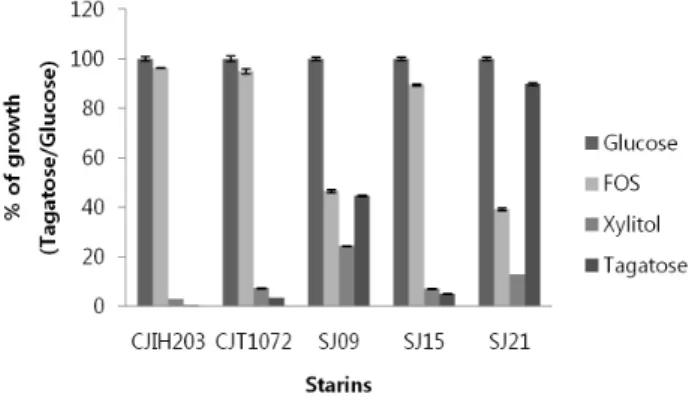
선행 연구에서 prebiotics 기질의 이용능은 Lactobacillus 종 이나 균주마다 다르다고 보고했다(Ann et al., 2007). 그래서 이번 연구에서도 선발된 5 균주의 tagatose 이용한 생장능 력을 확인하기 위해서 glucose, FOS, xylitol에서도 관찰하였 다(Fig. 10). 5 균주 모두 glucose는 잘 이용하였고, xylitol를 이용하지 않았다. Lactobacillus plantarum CJIH203, CJT1072 는 다른 균주에 비하여 FOS 이용 능력을 확인할 수 있었 다. Lactobacillus plantarum SJ21은 Tagatose에서 생장 능 력을 볼 수 있었다.
8. 안정성 검사
선정된 균주를 이용했을 때 인체에 안전한지를 검사하였 다(Table 2). 선정된 균 모두 베타 용혈성을 나타내지 않았
Fig. 10. Utilization of prebiotics by lactic acid bacteria strains.
Table 2. Determination of haemolytic activity, production of harmful metabolites urease activity of lactic acid bacteria strains
CJIH203 CJT1072 SJ09 SJ15 SJ21
Hemolysis γ γ γ γ γ
Gelatin hydration - - - - -
Urease - - - - -
*α, γ: negative, γ: positive, +: positive -: negative
고 모든 실험 항목에서 음성으로 나타났다. 따라서 5 균주 산업적으로 사용하여도 안전한 것으로 나타났다.
고 찰
pH, 온도, CO2 생성 여부의 3가지 조건에서 1차적으로 균을 선별하였다. pH 조건은 pH 3.8이며, 온도조건은 3일 10℃에서 cell viability를 나타낸 O.D, 값이 0.15이상 0.3미 만보다 미만인 조건과 온도 10℃, 6일에서의 cell viability가 0.3이상 0.5미만 범위보다 이하, CO2는 생성하지 않는 균주 를 선별하였다. 이 조건을 모두 만족시킨 균주는 총 5 균주 로 Lactobacillus plantarum CJIH203, Pendiococcus pentosaceus CJT1072, Lactococcus lactis SJ09, Lactococcus raffinolactis SJ15, Lactobacillus plantarm SJ21이었다. 선발된 균주를 자몽 추출물에 발효하여 생균수, 관능평가, 유기산 함량을 관찰하였다. 그 결과, Lactobacillus plantarum CJIH203가 다 른 균주와 비교했을 때 15℃, 12일차에서 생균수는 높고 신 맛이 강하며, 유기산 함량에서는 lactic acid가 눈에 띄게 높 다는 것을 확인할 수 있었다. 이와 더불어 선발된 균주를 microencapsulation, stress adaptation, co-culture 방법에 좀 더 적용할 필요성이 있다고 판단된다. Microencapsulation를 이용하면 프로바이오틱스는 기능성 식품, 제약이나 보충 산 업에서 중요한 요소가 될 수 있다(Del Piano et al., 2006).
microencapsulation이란 1950년대 미국에서 개발된 기술로 써 크기의 기준은 없지만, 액체, 고체 또는 기체의 분자를 수 백 마이크로미터 정도까지 미세한 용기 셀로 봉한 것을 의 미한다. 이 기술은 현재도 개발되고 있으며, 외부 환경에 의 한 세포 손상을 방지하기 위해 다양하게 적용되고 있다(Del Piano et al., 2006). 프로바이오틱스 박테리아의 경우, 보호 코팅함으로써 외부 환경에서 분리될 수 있다. 산에 민감한
Bifidobaceterium
과 Lactobacillus에 보호하기 위해 젤라틴 이나 야채 껌을 사용하여 microencapsulation 이용한다고 선 행 연구에서 보고한 바가 있다(Chandramouli et al., 2004; Leeet al., 2004; O’Riordan, Andrews et al., 2001; Sultana et al.,
2000). 또 stress adaptation이다. 이것은 균주를 생존이 어려 운 조건에서 노출 후, 생존한 균주를 일반적인 산성 조건에처리하여 생존율을 높이는 방법이다. 이는 새로운 산도 항 상성 시스템의 유도와 스트레스 단백질로 알려진 새로운 단 백질의 생산에 의한 것으로 보고되고 있다(Foster, 2003).
마지막으로 co-culture 이용하는 것이다. 선행 연구에 따르 면 Lactobacillus acidophilus가 Bifidobacterium보다 산 조건 에서 더 많은 저항성을 가지며, Lactobacillus acidophillus와
Bifidobacterium fidobacterium
를 co-culture 했을 때, 성장을 증진시키는 시너지 효과가 있다는 보고도 있다(Luc De Vuyst, 2000). 따라서, Lactobacillus acidophilus과 같은 내 산성이 일반적으로 좋다고 알려진 균주(Hood and Zottola, 1988)를 이용하여 Co-culture를 진행함으로써 산성 조건에서 안정적 으로 성장시킬 수 있을 것으로 예측된다. 또 프로바이오틱 스 균주 특성 및 안전성 실험도 확인하였다. 프로바이오틱 스를 균주를 선발할 때에는 안전성(safety), 기능적인 측면 (생존력, 부착능, 정착성, 항균물질 생성능, 면역력 강화능, 유해균 억제능 등), 기술적인 측면(우유에서의 생장, 관능 적 특성, 생산 고정 및 유통 중의 안전성과 생존력 등)을 고 려해야 한다고 알려져 있다(Holzapfel WH, 2002). 본 실험 에서는 프로바이오틱스의 기능적인 측면과 안전성 실험을 진행하였다. 그 결과, 모든 균주에서 안정성을 가지는 것은 확인이 되었고, 내 산성, 내 담즙성은 Lactobacillus plantarum CJIH203이 우수하고, Lactococcus lactis SJ09는 장 부착능 이 우수하며, Lactobacillus plantarum SJ21이 Tagatose 이 용능력이 다른 균주에 비해 우수하였다.따라서 향후 선발된 균주를 과채 음료에 적용시킬 수 있으 며, 프로바이오틱스 기능성 제품에 이용될 것으로 판단된다.
감사의 글
본 논문은 2012년 주식회사 CJ 제일제당의 지원에 의하 여 수행된 건강 지향식 적합 균주 선발 연구 결과이며, 이 에 감사드립니다.
참고문헌
1. Berner, L. and O_Donnell, J. 1998. Functional foods and health claims legislation: applications to dairy foods. Int.
Dairy J. 8:355-362.
2. Chandramouli, V., Kailasapathy, K., Peiris, P. and Jones, M. 2004. An improved method of microencapsulation and its evaluation to protect Lactobaillius spp. in simulated gastric conditions. J. Microbiol. Methods 56:27-35.
3. Del Piano, M., Morelli, L., Strozzi, G. P., Allesina, S., Barba, M. and Deidda, F., 2006. Probiotics: From research
to consumer. Digestive Liver Dis. 38(suppl 3):S248-S255.
4. Fuller, R. 1989. Probiotics in man and animals. J. Appl.
Bacteriol. 66:365-378.
5. Heenan, C. N., Adams, M. C., Hosken, R. W. and Fleet, G. H. 2004. Survival and sensory acceotability of probiotic microorganisms in a nonfermented frozen vegesterian dessert. Lebensm-Wiss Technol. 37:461-466.
6. Han, E. H., Lee, T. S., Noh, B. S. and Lee D. S. 1997.
Quality characteristics in mash of takju prepared by using different nuruk during fermentation. Korean J. Food Sci.
Technol. 29:555-562.
7. Hood, S. K. and Zottola, M. L. 1988. Effect of low pH on the ability of Lactobacillus acidophilus to survive and adhere to human intestinal cell. J. Food Sci. 53:
1514-1516.
8. Holzapfel, W. H. and Schillinger, U. 2002. Introduction to prebiotic and probiotic. Food Res. Int. 35:109-116.
9. Keane, P. 1992. The flavor profile in manual on descriptive analysis testing, ASTM Manul series: MNL 13, R.C.
Hootman, ed., American Society for Testing and Materials, Philadelphia.
10. Koh, J. H., Choi, S. H., Park, S. W., Choi, N. J., Kim, Y. H. and Kim, S. H. 2013. Synbiotic impact of tagatose on viability of Lactobacillus rhamnosus strain GG mediated by the phosphotransferase system. Food Microbiol. 36(1):
7-13.
11. Lim, K. S. 2007. Current market trends and prospects of functional fermented milk products in Korea. J. Korean Soc. Food Sci. Nutr. 12(2):20-28.
12. Lee, J. S., Cha, D. S. and Park, H. J. 2004. Survival of freeze-dried Lactobaillus bulgarisus KFRI673 in chitosan- coated calcium alginate microparticles. J. Agric. Food Chem. 52:7300-7305.
13. Lee, Y. H. 2004. Development of lactic acid bacteria with new function. The first symposium of Korean Society for Lactic Acid Bacteria, May. pp. 53-67.
14. Lee, J., Yun, H. S., Cho, K. W., Oh, S. J, Kim, S. H., Chun, T. H., Kim, B. J. and Whang, K. Y. 2011. Evaluation of probiotic characteristics of newly isolated Lactobacillus spp.:
Immune modulation and longevity. Int. J. Food Microbiol.
148:80-86.
15. Luckow, T. and Delahunty, C. 2004. Which juice is ‘healthiter’?
A consumer study of probiotic non-dairry juice drinks.
Food Qual. Prefer. 15:751-759.
16. Luc De Vuyst. 2000. Technology aspects related to the application of functional starter cultures. Food Technol.
Biotechnol. 38(2):105-112.
17. McNaught, C. E. and MacFie, J. 2001. Probiotics in clinical practice: a critical review of the evidence. Nutr. Res. 21:
343-353.
18. Ouwehand, A. C., Grasten, S., Niemi, P., Mykkanen, H. and Salminen, S. 2000. Wheat or rye supplemented diets do not affect feacal mucus concentration or the adhesion of probiotic micro-organisms to faecal mucus. Lett. Appl.
Microbiol. 21:30-33.
19. O’ Riordan, K., Andrews, D., Buckle, K. and Conway, P.
2001. Evaluation of microencapsulation of a Bifodobacterium with starch as an approach to prolonging viability during storage. J. Appl. Microbiol. 91:1059-1066.
20. Rafter, J. 2003. Probiotics and colon cancer. Best Pract.
Res. Cl. Ga. 17(5):849-859.
21. Sindhu, S. C. and Khetarpaul, N. 2001. Probiotic fermentation of indigenous food mixture: effect on antinutrients and digestibility of starch and protein J. Food Comp. Anal.
14:601-609.
22. Shah, N. P. and Jelen, P. 1990. Survival of lactic acid bacteria and their lactase under acidic conditions J. Food Sci. 15:506-509.
23. Shah, N. P. 2000. Symposium: probiotic bacteria, probiotic bacteria: selective enumeration and survival in dairy foods.
J. Diary Sci. 83:894-907.
24. Shah, N. P. 2001. Functional foods from probiotics and prebiotics. Food Technol. 55(11):46-53.
25. Saarela, M., La¨hteena¨ki, L., Crittenden, R., Salminen, S., and Mattila-Sandholm, T., 2002. Gut bacteria and health foods- the European perspective. Int. J. Food Microbiol.
78:99-117.
26. Sultana, K., Godward, G., Reynolds, N., Arumugaswamy, R., Peiri, P. and Kailaspathy, K. 2000. Encapsulation of probiotic bacteria with alginate-starch and the evlaution of survival in simulated gastrointestinal conditions and in yoghurt. Int. J. Food Microbiol. 62:47-55.
27. Yoon, K. Y., Woodams, E. E. and Hang, Y. D. 2006. Pro- duction of probiotic cabbage juice by lactic acid bacteria.
Bioresour. Technol. 97:1427-1430.
(Received: May 15, 2013 / Accepted: June 10, 2013)