• 검색 결과가 없습니다.

Biotransformation of Ginsenosides by Eoyukjang-derived Lactic Acid Bacteria in Mountain-cultivated Ginseng

N/A
N/A
Protected

Academic year: 2021

Share "Biotransformation of Ginsenosides by Eoyukjang-derived Lactic Acid Bacteria in Mountain-cultivated Ginseng"

Copied!
10
0
0

로드 중.... (전체 텍스트 보기)

전체 글

(1)

Biotransformation of Ginsenosides by Eoyukjang- derived Lactic Acid Bacteria in Mountain-cultivated Ginseng

Hyojin Lee

1†

, Seung Il Ahn

1†

, Byung Wook Yang

2

, Jong Dae Park

3

, Wang Soo Shin

3

, Sung Kwon Ko

4

, and Young Tae Hahm

1

*

1

Department of Systems Biotechnology, Chung-Ang University, Anseong 17546, Republic of Korea

2

School of Industrial Bio-Pharmaceutical Science (LINC+ Project), Semyung University, Jecheon 27136, Republic of Korea

3

Central Research Institute, Korean Ginseng Research Co., Ltd., Yangpyeong 12513, Republic of Korea

4

The Department of Oriental Medical Food and Nutrition, Semyung University, Jecheon 27136, Republic of Korea

Received: October 2, 2018 / Revised: November 26, 2018 / Accepted: December 3, 2018

Introduction

Korean ginseng (Panax ginseng C. A. Meyer) is a medicinal herb widely used to improve health conditions for thousands of years [1, 2]. The major active pharmaco- logical compound of ginseng is called ginsenoside and is only found in ginseng species [3]. Ginsenosides, of the steroid-like saponins, are mainly involved in metabolic adjustments through altering the signal transduction and gene expression of downstream targets [4]. The pharmacological effects of ginsenosides have been stud- ied in the reduction of cardiovascular disease, anti-can-

cer activity, neuro-protective effect against oxidative stress, immunostimulation, and anti-inflammation effects [5 −9].

The pharmacological and biological activities vary through the different cultivation and processing meth- ods of fresh ginseng. Mountain-cultivated ginseng (MCG) raised in a wild forest has attracted considerable interest, because it provides higher saponin content and includes less use of pesticide sprays compared to field- cultivated ginseng (FCG) [1, 10]. Fresh ginseng is exposed to the traditional preparation method of repeated steaming and drying to become red ginseng, and it then has more bioactivity and different chemical profiles than fresh ginseng [2].

Even though the cultivation and processing methods of fresh ginseng improves the level of ginsenosides, the bioavailability of ginsenosides remains poor because of Biotransformation of ginsenosides by microorganisms alters the absorption and bioavailability of ginseng as a medicinal herb. In this study, we isolated two kinds of fermenting microorganisms from Eoyukjang, which is a traditional Korean fermented food made from soybean. Next, we identified and detected their ability to convert major ginsenosides to compound K. The two microorganisms, referred to as R2-6 and R2- 15, had 100% similarity with Lactobacillus plantarum subsp. plantarum ATCC 14917

T

and Lactobacillus rhamnosus JCM 1136

T

, respectively. The optimal pH and growth temperature of the isolates were deter- mined to be pH 6 -7 and 30℃. After fermentation for 30 days, the major ginsenosides in the mountain-culti- vated ginseng were transformed to the highly bioactive ginsenoside, compound K, in the final product.

Keywords: Lactobacillus plantarum, Lactobacillus rhamnosus, ginsenoside, ginseng, biotransformation

*Corresponding author

Tel: + 82-43-670-3064, Fax: +82-43-670-3064 E-mail: [email protected]

These authors contributed equally to this work.

© 2019, The Korean Society for Microbiology and Biotechnology

(2)

their low intestinal permeability and absorption rate [11]. The structural information of ginsenosides indi- cates the bioavailability is negatively dependent on the number of glucose moieties in the ginsenosides. The orally-administered protopanaxadiol type ginsenosides Rb1, Rb2, Rc, and Rd are poorly absorbed in the intes- tine, but the major metabolite, compound K (CK), which is hydrolyzed sugar moieties by intestinal bacteria, shows higher absorbance and more pharmacological effects such as in anticancer, antidiabetes, anti-inflam- mation, and immune stimulation than its parental metabolites [12, 13].

The intestinal lactic acid bacteria having ginsenoside β-glucosidase hydrolyze the glucose moiety from the gin- senosides [14, 15]. This method is expected to be a safe and site-specific mechanism compared to chemical or heat treatment. Therefore, the screening and characteri- zation of the microorganisms involved in the biotransfor- mation of ginsenosides is of interest. In this report, we isolated microorganisms from a new source, Eoyukjang.

Eoyukjang is a Korean traditional fermented food that has plenty of microorganisms as it is a fermented prod- uct of beef, chicken, and fish using Meju, which is also a fermented soybean [16]. Mountain-cultivated ginseng and red ginseng extract were fermented with two iso- lates from Eoyukjang and had their properties analyzed, in particular the levels of biotransformation of ginseno- sides.

Materials and Methods

Preparation of materials

10-year-old mountain-cultivated ginseng (MCG) obtained from Baejae farm (Korea), Korean red ginseng extract from Ginseng research corporation (Korea), and Eoyukjang provided from Sangchon Food Corporation (Korea) were used. Initially, 29 samples were isolated from Eoyukjang, and 10 samples that were grown in Lactobacilli MRS broth (USA) with MCG powder as a carbon source were chosen. The two microorganisms were selected by β-glucosidase activity using the esculin agar method [14].

Microbial identification

Identification of microorganism was performed by 16S rRNA sequence analysis using a SolGent Co., Ltd. PCR

machine, an ABI 9700 PCR sequencer (Applied Bio- systems, USA), and an ABI 3730XL DNA Analyzer (Applied Biosystems). 16S rRNA gene sequences of closely related organisms as identified by Ez-Taxon analysis were made by the Clustal W program using MEGA ver. 6.06. Phylogenetic analyses were conducted using the Jukes and Cantor algorithm and the neighbor- joining method. In order to determine the stability of our phylogenetic tree, the sequence data were replicated 1,000 times for bootstrap analysis using Mega version 6.06. The isolated microorganisms from Eoyukjang were Lactobacillus plantarum and Lactobacillus rhamnosus, referred to as R2-6 and R2-15, respectively.

Optimal temperature and pH

The precultured L. plantarum R2-6 and L. rhamnosus R2-15 were grown under anaerobic conditions in 5 ml of MRS broth (BD Difco, USA) for 24 h at 37 ℃. In search- ing for the optimal temperature, L. plantarum R2-6 and L. rhamnosus R2-15 was incubated under anaerobic con- ditions in MRS broth at 25, 30, 37, and 45 ℃ for 48 h (pH 6.5). In searching for the optimal pH, two strains incu- bated in MRS broth were adjusted to pH 4, 5, 6, 7, 8, 9, and 10 at 37 ℃ for 48 h. The optical density of each strain in different conditions was measured every six hours.

Absorbance was measured at 600 nm by spectrophotom- eter (Optizen 3220UV, Mecasys, Korea).

β-glucosidase activity

β-glucosidase activity was measured by the modified Peralta Method [17]. The 1 ml of 5 mM p-nitrophenyl- β- D-glucopyranoside (Sigma Chemical Co., USA) in 50 mM potassium phosphate buffer (pH 7.0) was reacted with 0.2 ml of cell-free microbial sample broth, and after 30 min at 37 ℃, 2 ml of 1 M sodium carbonate solution was added in order to stop the reaction. Absorbance was measured at 405 nm (Optizen 3220UV, Mecasys, Korea).

The p-nitrophenol was used as the standard. One unit of β-glucosidase is the amount of enzyme that produces 1 nmole of p-nitrophenol per minute.

Tolerance to artificial gastric juice and artificial bile acid

Analysis of tolerance to artificial digestive fluid was

conducted using the method outlined by Lee [18]. For

the treatment of artificial gastric juice, the L. plantarum

R2-6 and L. rhamnosus R2-15 in stationary phase were

(3)

harvested by centrifugation at 10,000 ×g for 3 min, then suspended in MRS broth containing 1% (w/v) pepsin (adjusted to pH 2.5) and cultured for 1 and 2 h at 37 ℃.

For the treatment of bile acid, the cells treated with two hours of artificial gastric juice were harvested by centrif- ugation at 10,000 ×g for 3 min, then incubated in MRS broth containing 0.1% (w/v) bile salts (Sigma, USA) for 12 and 48 h at 37 ℃. The viable bacterial counts were determined with MRS agar plates after 48 h of anaerobic condition at 37 ℃.

Conversion of ginsenoside contents

L. plantarum R2-6 and L. rhamnosus R2-15 were pre- cultured under anaerobic culture in 5 ml of MRS broth for 24 h, and 0.1 ml culture medium was inoculated in the MRS broth mixed with MCG powder and the Korean red ginseng extract. One g of MCG powder and 5 g of red ginseng extract was mixed with 100 ml of MRS broth was used for anaerobic fermentation at 37 ℃ for 30 days.

During fermentation, ginsenoside contents were mea- sured every five days.

Ten ml of MRS broth containing MCG powder was extracted with 50 ml 70% aqueous methanol at 70 −80℃

for one hour. The sample was then cooled and centri- fuged at 1,000 ×g for 10 min. The supernatant was col- lected and dried in a vacuum evaporator flask. The concentrate was then dissolved in 5 ml of HPLC-grade distilled water and loaded on an activated Sep-pak C18 cartridge (Waters Inc., USA). Next, the cartridge was washed twice with 5 ml HPLC-grade distilled water.

The sample was then eluted with HPLC-grade MeOH and filtered with 0.45-µm membrane filter for HPLC analysis.

Ginsenosides were analyzed with a Shimadzu 10 Avp HPLC system (Japan) equipped with a UV detector (SPD-10 Avp, Shimadzu, Japan) and a gradient pump.

The detection wavelength was 203 nm. A Gracesmart column (250 mm × 4.6 mm, 5 µm; Grace, USA) was used at 40 ℃. A 10 µl aliquot of sample was injected, and a mixed mobile phase of distilled water (solvent A) and acetonitrile (solvent B) was used under gradient condi- tions. The gradient elution was: 0 −10 min, 20% B; 10−42 min, 20 −30% B; 42−67 min, 30−40% B; 67−70 min, 40−

47% B; 70 −80 min, 47−80% B; 80−93 min, 80% B; 93−95 min, 80 −20% B; and 95−115 min, 20% B. The flow rates of solvents A and B were both 1.2 ml/min.

Sixteen ginsenosides, specifically ginsenoside Rg1, Re, Rf, Rg2(S), Rb1, Rh1(S), Rg2(R), Rc, Rb2, Rb3, Rd, 20(S)- ginsenoside Rg3, and 20(R)-ginsenoside Rg3, Rg5, Rk1, and compound-K were used as standards. Ginsenoside standards were purchased from Chromadex (USA).

Results

Isolation and identification of microorganism for fermen- tation

In this study, we isolated microorganisms from fer- mented soybean food, Eoyukjang. From the 29 isolates, 10 strains were selected by growing ability in Lactobacilli MRS broth (BD, USA) with mountain-cultivated ginseng (MCG) powder. The two strains showing strong β-gluco- sidase activity on esculin agar medium were selected and used to ferment MCG and red ginseng extract. Their lengths of sequence by 16S rRNA were 1,427 bp and 1,419 bp. The two samples had 100% similarity with Lactobacillus plantarum subsp. plantarum ATCC 14917

T

, and Lactobacillus rhamnosus JCM 1136

T

, respectively. The isolates were referred to as L. planta- rum R2-6 and L. rhamnosus R2-15. The result of 16S rRNA and phylogenetic tree through neighbor joining is shown in Fig. 1.

Optimal temperature and pH

To adjust the optimal fermentation conditions, the growth curves of L. plantarum R2-6 and L. rhamnosus R2-15 were observed under a range of temperatures and pHs. In 25, 30, and 37 ℃ conditions, L. plantarum R2-6 reached the exponential phase faster than L. rhamnosus R2-15, but the growth eventually converged (Fig. 2).

During the culture at 45 ℃, no progressed growth was shown in either strains. In the pH condition test, L.

plantarum R2-6 showed more tolerance than L. rhamno- sus R2-15 in acidifying conditions at pH 4 and 5, but the growth reached the peak of exponential phase at the same time at pH 6 and 7 in both strains (Fig. 3). In con- clusion, the optimal culture conditions of L. plantarum R2-6 and L. rhamnosus R2-15, 30 ℃ and 30 h at pH 6−7, were retained for fermentation of MCG and red ginseng extract.

β-glucosidase activity

The β-glucosidase activity is crucial in the bioconver-

(4)

Fig. 1. Phylogenetic trees of Lactobacillus plantarum R2-6 and Lactobacillus rhamnosus R2-15 with the 16S rRNA gene by

neighbor-joining method.

(5)

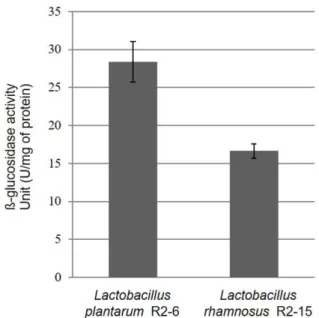
sion of ginsenoside, which removes the glycosyl residue from ginsenosides in order to make the downstream metabolites [19]. Both L. plantarum R2-6 and L. rham- nosus R2-15 had β-glucosidase activity in esculine agar, and we tested their β-glucosidase activity in vitro (Fig.

4). The β-glucosidase activity was higher in L. planta- rum R2-6 than in L. rhamnosus R2-15. The L. planta- rum R2-6 may have a better fermentation capability of ginseng than L. rhamnosus R2-15.

Ginsenoside contents

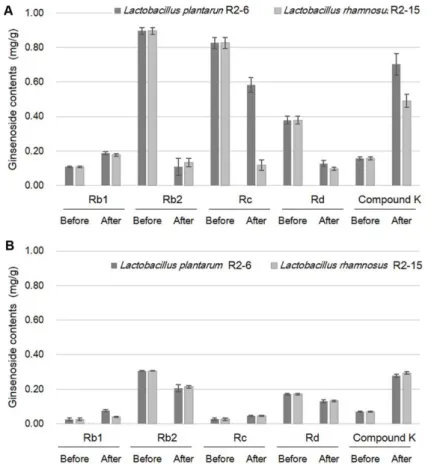
Usually, ginsenoside is converted to the followed metabolites through the digestive process of bacteria [20]. Ginsenosides Rb1, Rb2, Rc and Rb3 are trans- formed to ginsenoside Rd. Ginsenoside Rd is trans- formed to ginsenoside F2, and then the ginsenoside F2 is transformed to the final metabolite, compound K. Fig. 5 shows changes of ginsenosides in MCG after the bio- transformation by L. plantarum R2-6 and L. rhamnosus R2-15. The contents of ginsenoside Rb1 were barely changed, but ginsenoside Rb2, Rc, and Rd which are the

upstream materials of ginsenoside metabolism were gradually decreased in both strains and the compound K was significantly increased during the fermentation.

The production of the final metabolite of biotransforma- tion, compound K, was more in L. plantarum R2-6 than in L. rhamnosus R2-15 (Fig. 5). This correlates the result of the higher β-glucosidase activity in L. plantarum R2-6 than in L. rhamnosus R2-15 (Fig. 4).

The changing pattern of ginsenosides from Korean red ginseng extract by those microorganisms was similar to the MCG (Fig. 6). However, the absolute concentrations of ginsenosides Rb1, Rb2, Rc, Rd and compound K from red ginseng extract are much lower than MCG, so hard to tell the difference between the two strains.

After 30 days of fermentation, the final level of ginse-

noside Rb2, Rc, and Rd from MCG were decreased from

the beginning in both strains. The Rb2 contents were

detected 7 fold lower and the Rd was decreased about 3

fold after 30 days of fermentation in both strains, but the

decreased level of ginsenoside Rc in L. rhamnosus R2-15

is more than in L. plantarum R2-6 (Fig. 7). The final con-

Fig. 2. Growth curves of the strain L. plantarum R2-6 and L. rhamnosus R2-15 under various temperatures at (A) 25℃, (B) 30℃,

(C) 37 ℃, and (D) 45℃. (

Lactobacillus plantarum R2-6,

Lactobacillus rhamnosus R2-15)

(6)

centration of compound K was increased by >3 times from the beginning in both strains, and this pattern was shown in both MCG and red ginseng extract.

Tolerance to artificial gastric acid and bile acid

Probiotic bacteria have tolerance under the acidic and bile salt environment in the gastrointestinal tract. In this study, the viable Lactobacillus were counted after one and two hours of artificial gastric juice, and after 12 and 48 h of artificial bile acid treatment. Table 1 shows both L. plantarum R2-6 and L. rhamnosus R2-15 were

significantly retarded after one and two hours of artifi- cial gastric juice conditions, but the number of viable cells were recovered during the artificial bile juice condi- tions.

Discussion

In this study, microorganisms isolated from Eoyuk-

jang were identified as L. plantarum and L. rhamnosus

and optimal growth conditions were investigated before

being used for fermentation of ginseng. Since the strains

Fig. 3. Growth curves of the strain L. plantarum R2-6 and L. rhamnosus R2-15 under various pH conditions at (A) pH 4, (B)

pH 5, (C) pH 6, (D) pH 7, (E) pH 8, (F) pH 9, and (G) pH 10. (

Lactobacillus plantarum R2-6,

Lactobacillus rhamnosus R2-15)

(7)

are not pathogenic and are not toxic bacteria, those strains have potential as functional food supplements to enhance the absorption of ginsenosides from various gin- seng products. The strains L. plantarum and L. rhamno-

sus are previously reported having adaptability in bile and acidic conditions [21, 22]. In here, the test of envi- ronmental conditions confirm that both L. plantarum R2-6 and L. rhamnosus R2-15 show rapid growth in the most temperature conditions and low pH tolerance.

This study also found that ginsenosides in mountain- cultivated ginseng (MCG) are converted by L. plantarum R2-6 and L. rhamnosus R2-15. Several L. plantarum and L. rhamnosus strains are previously reported to par- ticipate in the biotransformation of ginsenosides from ginseng extracts, but no evidence was found in the type strains of Lactobacillus plantarum subsp. plantarum ATCC 14917

T

and Lactobacillus rhamnosus JCM 1136

T

[23 −25]. The contents of major ginsenoside Rb2, Rc, and Rd were decreased with the fermentation process by L.

plantarum R2-6 and L. rhamnosus R2-15, and the highly bioactive ginsenoside compound K contents were increased in the final product. The changing pattern of ginsenoside contents were similar in both strains, but the level of ginsenoside Rc was decreased differentially in each strain. The reduction of ginsenoside Rc in L.

rhamnosus R2-15 have occurred more in the fermenta- tion period compare to the L. plantarum R2-6. This is Fig. 4. β-glucosidase activity of L. plantarum R2-6 and L.

rhamnosus R2-15.

Fig. 5. Transformation of ginsenosides (A) Rb1, (B) Rb2, (C) Rc, (D) Rd, and (E) compound K contents from mountain-cultivated

ginseng (MCG) by L. plantarum R2-6 and L. rhamnosus R2-15 in 30 days. (

Lactobacillus plantarum R2-6,

Lactobacillus

rhamnosus R2-15)

(8)

Fig. 6. Transformation of ginsenosides (A) Rb1, (B) Rb2, (C) Rc, (D) Rd, and (E) compound K contents from Korean red ginseng extract by L. plantarum R2-6 and L. rhamnosus R2-15 in 30 days. (

Lactobacillus plantarum R2-6,

Lactobacillus rhamnosus R2-15)

Fig. 7. Changes of ginsenoside Rb1, Rb2, Rc, Rd, and compound K contents after 30 days of fermentation by L. plantarum

R2-6 and L. rhamnosus R2-15 from (A) MCG (Mountain Cultivated Ginseng) and (B) red ginseng extract.

(9)

disconnected result that L. plantarum R2-6 has more β- glucosidase activity and the final concentration of com- pound K than L. rhamnosus R2-15. The Rc of MCG could be turned into other intermediates before it trans- forms to the compound K by the strain of L. rhamnosus R2-15 as there are several intermediates and enzymes in this pathway [26]. Further study is needed to compare the exact mechanisms of these two strains.

The bile and acidic environmental tolerances and the biotransformation ability of L. plantarum R2-6 and L.

rhamnosus R2-15 show the strong possibility of their use in the biotransformation of ginsenosides not only in the food industry, but for the living animals.

Acknowledgments

This research was supported by Korea Institute of Planning and Evaluation for Technology in Food, Agriculture, Forestry and Fisheries (IPET) through Export Promotion Technology Development Program, funded by Ministry of Agriculture, Food and Rural Affairs (MAFRA). (No.

316014-03) and by the Chung-Ang University Research Grant in 2018.

Conflict of Interest

The authors have no financial conflicts of interest to declare.

References

1. Choi KT. 2008. Botanical characteristics, pharmacological effects and medicinal components of Korean Panax ginseng C. A. Meyer.

Acta Pharmacol. Sin. 29: 1109-1118.

2. Lee SM, Bae BS, Park HW, Ahn NG, Cho BG, Cho YL, et al. 2015.

Characterization of Korean Red Ginseng (Panax ginseng Meyer):

History, preparation method, and chemical composition. J. Ginseng Res. 39: 384-391.

3. Hasegawa H. 2004. Proof of the mysterious efficacy of ginseng:

basic and clinical trials: metabolic activation of ginsenoside:

deglycosylation by intestinal bacteria and esterification with fatty acid. J. Pharmacol. Sci. 95: 153-157.

4. Mohanan P, Subramaniyam S, Mathiyalagan R, Yang DC. 2018.

Molecular signaling of ginsenosides Rb1, Rg1, and Rg3 and their mode of actions. J. Ginseng Res. 42: 123-132.

5. Lee CH, Kim JH. 2014. A review on the medicinal potentials of ginseng and ginsenosides on cardiovascular diseases. J. Ginseng Res. 38: 161-166.

6. Wang W, Zhao Y, Rayburn ER, Hill DL, Wang H, Zhang R. 2007. In vitro anti-cancer activity and structure-activity relationships of natural products isolated from fruits of Panax ginseng. Cancer Chemother. Pharmacol. 59: 589-601.

7. Hwang YP, Jeong HG. 2010. Ginsenoside Rb1 protects against 6- hydroxydopamine-induced oxidative stress by increasing heme oxygenase-1 expression through an estrogen receptor-related PI3K/Akt/Nrf2-dependent pathway in human dopaminergic cells. Toxicol. Appl. Pharmacol. 242: 18-28.

8. Yang WS, Yi YS, Kim D, Kim MH, Park JG, Kim E, et al. 2017. Nuclear factor kappa-B- and activator protein-1-mediated immunostim- ulatory activity of compound K in monocytes and macrophages.

J. Ginseng Res. 41: 298-306.

9. Nag SA, Qin JJ, Wang W, Wang MH, Wang H, Zhang R. 2012. Gin- senosides as anticancer agents: In vitro and in vivo activities, structure-activity relationships, and molecular mechanisms of action. Front. Pharmacol. 3: 25.

10. Kim C, Choo GC, Cho HS, Lim JT. 2015. Soil properties of cultiva- tion sites for mountain-cultivated ginseng at local level. J. Ginseng Res. 39: 76-80.

11. Kim EO, Cha KH, Lee EH, Kim SM, Choi SW, Pan CH, et al. 2014. Bio- availability of ginsenosides from white and red ginsengs in the simulated digestion model. J. Agric. Food Chem. 62: 10055-10063.

12. Bae EA, Han MJ, Choo MK, Park SY, Kim DH. 2002. Metabolism of 20(S)- and 20(R)-ginsenoside Rg3 by human intestinal bacteria and its relation to in vitro biological activities. Biol. Pharm. Bull.

25: 58-63.

13. Bae EA, Han MJ, Kim EJ, Kim DH. 2004. Transformation of ginseng saponins to ginsenoside Rh2 by acids and human intestinal bac- teria and biological activities of their transformants. Arch. Pharm.

Res. 27: 61-67.

14. Kim SH, Min JW, Quan LH, Lee S, Yang DU, Yang DC. 2012. Enzy- matic Transformation of Ginsenoside Rb1 by Lactobacillus pento- sus Strain 6105 from Kimchi. J. Ginseng Res. 36: 291-297.

15. Park B, Hwang H, Lee J, Sohn SO, Lee SH, Jung MY, et al. 2017.

Evaluation of ginsenoside bioconversion of lactic acid bacteria isolated from Kimchi. J. Ginseng Res. 41: 524-530.

Table 1. Survival of Lactobacillus plantarum R2-6 and Lactobacillus rhamnosus R2-15 following artificial gastric acid and bile acid treatment. The data represent the means of three independent experiments.

Artificial gastric juice Artificial bile juice

0 h log CFU/ml

1 h log CFU/ml

2 h log CFU/ml

12 h log CFU/ml

48 h

log CFU/ml

Lactobacillus plantarum R2-6 10.59 ± 0.01 8.72 ± 0.21 8.57 ± 0.03 9.36 ± 0.14 9.87 ± 0.53

Lactobacillus rhamnosus R2-15 9.81 ± 0.03 7.68 ± 0.68 6.97 ± 1.21 6.77 ± 0.92 9.77 ± 0.42

(10)

16. Oh EJ, Oh MH, Lee JM, Cho MS, Oh SS. 2008. Characterization of microorganism in Eoyukjang. Korean J. Food Sci. Technol. 40: 656- 660.

17. Peralta RM, Kadowaki MK, Terenzi HF, Jorge JA. 1997. A highly thermostable β-glucosidase activity from the thermophilic fun- gus Humicola grisea var. thermoidea: purification and biochemi- cal characterization. FEMS Microbiol. Lett. 146: 291-295.

18. Lee SH, No MJ. 1997. Viability in artificial gastric and bile juice and antimicrobial activity of some lactic acid bacteria isolated from Kimchi. J. Microbiol. Biotechnol. 6: 617-622.

19. Chang KH, Jo MN, Kim KT, Paik HD. 2014. Evaluation of glucosi- dases of Aspergillus niger strain comparing with other glucosi- dases in transformation of ginsenoside Rb1 to ginsenosides Rg3.

J. Ginseng Res. 38: 47-51.

20. Helms S. 2004. Cancer prevention and therapeutics: Panax gin- seng. Altern. Med. Rev. 9: 259-274.

21. Succi M, Tremonte P, Reale A, Sorrentino E, Grazia L, Pacifico S, et al. 2005. Bile salt and acid tolerance of Lactobacillus rhamnosus strains isolated from Parmigiano Reggiano cheese. FEMS Microbiol.

Lett. 244: 129-137.

22. Hassanzadazar H, Ehsani A, Mardani K, Hesari J. 2012. Investiga- tion of antibacterial, acid and bile tolerance properties of lacto- bacilli isolated from Koozeh cheese. Vet. Res. Forum. 3: 181-185.

23. Jung J, Jang HJ, Eom SJ, Choi NS, Lee NK, Paik HD. 2017. Fermen- tation of red ginseng extract by the probiotic Lactobacillus plan- tarum KCCM 11613P: ginsenoside conversion and antioxidant effects. J. Ginseng Research. 43: 20-26.

24. Kim BG, Shin KS, Yoon TJ, Yu KW, Ra KS, Kim JM, et al. 2011. Fer- mentation of Korean red ginseng by Lactobacillus plantarum M-2 and its immunological activities. Appl. Biochem. Biotechnol. 165:

1107-1119.

25. Ku S, You HJ, Park MS, Ji GE. 2016. Whole-cell biocatalysis for pro- ducing ginsenoside Rd from Rb1 using Lactobacillus rhamnosus GG. J. Microbiol. Biotechnol. 26: 1206-1215.

26. Wan JY, Liu P, Wang HY, Qi LW, Wang CZ, Li P, et al. 2013. Biotrans- formation and metabolic profile of American ginseng saponins with human intestinal microflora by liquid chromatography quadrupole time-of-flight mass spectrometry. J. Chromatogr. A.

1286: 83-92.

수치

Fig. 1. Phylogenetic trees of  Lactobacillus plantarum R2-6 and Lactobacillus rhamnosus R2-15 with the 16S rRNA gene by neighbor-joining method
Fig. 5. Transformation of ginsenosides (A) Rb1, (B) Rb2, (C) Rc, (D) Rd, and (E) compound K contents from mountain-cultivated ginseng (MCG) by  L
Fig. 7. Changes of ginsenoside Rb1, Rb2, Rc, Rd, and compound K contents after 30 days of fermentation by  L
Table 1. Survival of  Lactobacillus plantarum R2-6 and Lactobacillus rhamnosus R2-15 following artificial gastric acid and bile acid treatment

참조

관련 문서