• 검색 결과가 없습니다.

Budd-Chiari syndrome with antiphospholipid syndrome and systemic lupus erythematosus in a patient with Klinefelter's syndrome

N/A
N/A
Protected

Academic year: 2021

Share "Budd-Chiari syndrome with antiphospholipid syndrome and systemic lupus erythematosus in a patient with Klinefelter's syndrome"

Copied!
5
0
0

로드 중.... (전체 텍스트 보기)

전체 글

(1)

Yeungnam Univ J Med 2017;34(2):260-264

Budd-Chiari syndrome with antiphospholipid syndrome and systemic lupus erythematosus in a patient with Klinefelter’s syndrome

Mingee Lee

1

, Jin-Young Huh

1

, Ji-Hyang Lee

1

, Sun-myoung Kang

1

, Jae-Yong Lee

1

, Oh-Chan Kwon

1

, Eun Na Kim

2

, Jihun Kim

2

, Danbi Lee

1

Departments of

1

Internal Medicine and

2

Pathology, Asan Medical Center, University of Ulsan College of Medicine, Seoul, Korea

Klinefelter’s syndrome is the most common congenital abnormality that causes primary hypogonadism. It is associated with diseases that predominantly affect women, such as systemic lupus erythematosus (SLE), and it can sometimes cause veno-occlusive disease. We experienced a case of Budd-Chiari syndrome (BCS) in a 33-year-old man with Klinefelter’s syndrome presented with hematemesis and edema in both lower ex- tremities. The clinical and laboratory findings were compatible with SLE, antiphospholipid syndrome, and BCS. To the best of our knowledge, this is the first case report to describe a simultaneous presentation of these four clinical syndromes in a single patient.

Keywords: Klinefelter’s syndrome; Systemic lupus erythematosus; Antiphospholipid syndrome; Budd-Chiari syndrome; Liver cirrhosis

Copyright ©2017 Yeungnam University College of Medicine

This is an Open Access article distributed under the terms of the Creative Commons Attribution Non-Commercial License (http://creative- commons.org/licenses/by-nc/4.0/) which permits unrestricted non-commercial use, distribution, and reproduction in any medium, provided the original work is properly cited.

Received: July 6, 2016, Revised: August 28, 2016 Accepted: August 30, 2016

Corresponding Author: Danbi Lee, Division of Gastroenterology, Department of Internal Medicine, Asan Medical Center, University of Ulsan College of Medicine, 88 Olympic-ro 43-gil, Songpa-gu, Seoul 05505, Korea

Tel: +82-2-3010-3907, Fax: +82-2-476-0824 E-mail: [email protected]

INTRODUCTION

Klinefelter’s syndrome is the most common congenital hy- pogonadal disease, occurring in 1 in 1,000 live male births.

The association between Klinefelter’s syndrome and auto- immune disease — particularly systemic lupus erythematosus (SLE) — has been reported several times since it was first des- cribed by Oritz-Neu and LeRoy in 1969 [1]. SLE is a typical autoimmune disease characterized by multisystem involve- ment and is associated with antiphospholipid syndrome (APS) in about 36% of patients [2]. APS is characterized by recurrent events of arterial and venous thrombosis, fetal loss, and throm- bocytopenia. Budd-Chiari syndrome (BCS) secondary to APS

has also been reported [3]. Herein, we report a rare case of a single 33-year-old male patient with Klinefelter’s syndrome presenting with BCS secondary to APS.

CASE

A 33-year-old man presented at our emergency room with massive hematemesis. He had been diagnosed with Klinefelter’s syndrome (Fig. 1) at the age of 14, for which he had received testosterone replacement therapy. Although he decided to discontinue this treatment 3 years prior to admission, he had resumed it 6 months before coming to our hospital. Three months before admission, he was diagnosed with SLE due to the occurrence of alopecia, oral ulcer, proteinuria, ANA, and anti-ds-DNA; he had started taking hydroxychloroquine.

He claimed that he did not take any other medications, inclu- ding herbal medications, and he did not consume alcohol on a regular basis.

He had hepatosplenomegaly and pretibial pitting edema.

His laboratory results were as follows: white blood cell count,

(2)

Fig. 1. Chromosome analysis of the patient with Klinefelter’s syndrome. The karyotype in this case was 47, XXY.

Fig. 2. Esophagogastroduodenoscopy. (A, B) Four strands of large beaded venous distensions extended up to the upper esophagus with red color signs. (C, D) Four rubber bands were tightly applied.

6,900/mm

3

(neutrophil 63.9%, lymphocyte 22.7%); hemo- globin, 7.3 g/dL; and platelet count, 136,000/mm

3

. His aspar- tate aminotransferase level was 33 IU/L, alanine aminotrans- ferase was 14 IU/L, alkaline phosphatase was 82 IU/L, total bilirubin was 4.1 mg/dL, direct bilirubin was 3.1 mg/dL, serum creatinine was 0.69 mg/dL, and albumin was 2.2 g/dL. The prothrombin time was 17.9 s (range, 10-13 s).

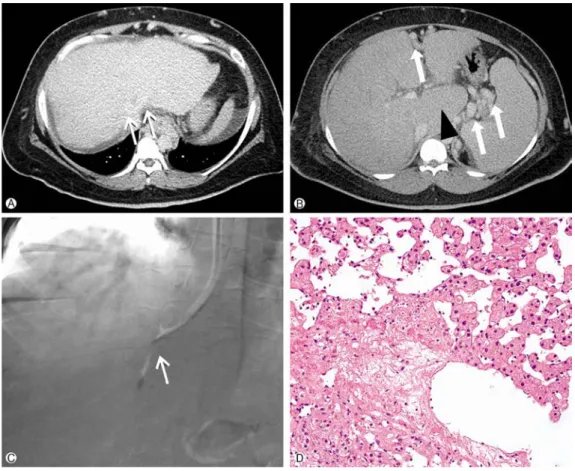
To clarify the cause of hematemesis, we performed esoph- agogastroduodenoscopy and abdominal computed tomog- raphy (CT). The esophageal endoscopy showed tortuous vari- ces with blood clots and red color signs. We, therefore, trea- ted esophageal varices with band ligation (Fig. 2). Abdominal CT (Fig. 3A, 3B) showed hepatomegaly with liver cirrhosis, splenomegaly, poor opacification of hepatic veins, and exten- sive portosystemic shunting.

We performed an additional diagnostic work-up to deter-

mine the cause of liver cirrhosis. According to the laboratory

findings, viral hepatitis, such as hepatitis B or hepatitis C,

(3)

Fig. 3. Representative radiologic and pathologic images of the study patient. (A, B) Contrast-enhanced trans- verse computed tomography obtained during the delayed phase showed poor opacification of the hepatic vein (black arrow), enlarged caudate lobe (black arrow head), and collateral vessels (white arrow). (C) Cavo- graphy via the internal jugular vein. A transjugular liver biopsy was attempted by three radiologists, but could not be performed, possibly due to proximal hepatic vein stenosis or occlusion. (D) A liver needle biopsy shows a diffuse sinusoidal dilatation surrounding the central vein.

was ruled out because serum hepatitis B surface (HBs) antigen and anti-HBs were negative and positive, respectively, and anti-hepatitis C virus was negative. The immunologic marker results were negative for anti-mitochondrial antibody, anti- smooth muscle antibody, and anti-liver kidney microsome an- tibody [1]. However, anti-nuclear antibody was positive (nu- cleolar type, 1:640). The anti-ds-DNA antibody level was 8.0 IU/mL (range, 0-7 IU/mL). The serum compliment 3 (C3) and C4 levels were 63.6 mg/dL (range, 90-180 mg/dL) and 11.3 mg/dL (range, 10-40 mg/dL), respectively. The level of anti- cardiolipin antibody immunoglobulin G(IgG) was 78 IgG pho- spholipid units (GPL)/mL (range, <20 GPL/mL). The lupus anticoagulant and direct coombs test results were both posi- tive. The anti-beta-2-glycoprotein I IgG and IgM readings were 114 (range, <20 G units) and 66 (range, <20 M units), respec- tively. Moreover, anti-SSA (Ro) was positive, but the other

anti-ENAs were all negative. These results confirmed the ini- tial SLE diagnosis. In addition, we also considered the diag- nosis of autoimmune hepatitis.

We performed a transjugular liver biopsy (TLB) due to the prothrombin time prolongation. We tried to obtain a liver histologic finding and to measure the hepatic venous pressure gradient to exclude the possibility of autoimmune hepatitis and non-cirrhotic portal hypertension. However, TLB failed because cavography revealed hepatic vein occlusion (Fig. 3C).

Thus, we attempted a liver biopsy via the transhepatic app- roach. The subsequent histologic findings (Fig. 3D) revealed reversed lobulation cirrhosis, diffuse sinusoidal dilatation, and perivenular sclerosis, indicating venous outflow obstruction.

These findings are consistent with BCS with secondary APS.

In conclusion, our patient originally had Klinefelter’s syn-

drome and SLE. His secondary APS caused BCS, which led

(4)

to liver cirrhosis with esophageal varices. He is awaiting a liver transplantation due to a deteriorating hepatic function and recurrent esophageal variceal bleeding.

DISCUSSION

BCS is a rare, but potentially lethal, disease affecting 1 per million individuals. It is characterized by an obstruction of the hepatic venous outflow. The syndrome usually presents with abdominal pain, hepatomegaly, and ascites. Various causes have been identified, and commonly acquired causes are mye- loproliferative disorders, paroxysmal nocturnal hemoglobi- nuria, APS, cancer, and pregnancy [4].

APS is an autoimmune disease characterized by arterial and venous thromboembolic events and pregnancy morbidity. Al- though antiphospholipid antibodies are rarely found in patie- nts with Klinefelter’s syndrome, they can be found in associa- tion with SLE. The association between Klinefelter’s syndrome and SLE has been well established. In 2008, Scofield et al.

[5] reported an incidence of SLE in patients with Klinefelter’s syndrome as approximately 1 in 960. Another report reviewed 43 patients with BCS secondary to APS [6], and two-thirds of patients were female and had BCS as a first clinical mani- festation of APS.

An increased rate of veno-occlusive disease (VOD) has also been reported in patients with Klinefelter’s syndrome. Camp- bell and Price [7] found that the risk of deep venous thrombo- sis or pulmonary embolism was 5-20 times higher in patients with Klinefelter’s syndrome.

The high incidence of autoimmune disorder and VOD in Klinefelter’s syndrome is attributed to an altered hormone level and is explained by an X chromosome gene dose effect.

Some studies showed that the androgen replacement treat- ment for Klinefelter’s syndrome can suppress immunological parameters, reduce the severity of SLE, and resolve recurrent hypostatic lower extremity ulcerations [8-10]. Other studies have revealed an association between low testosterone levels and high incidence of autoimmune disease [11,12]. In the case of our patient, he had been taking testosterone undecanoate since he was 14 years old with no significant side effects.

However, he arbitrarily stopped taking this medication and was lost to follow up for 2 years, which may have contributed to the development of autoimmune disease.

In summary, we report the first case of BCS with secondary

APS and SLE in a Kline-felter’s syndrome patient. Autoimmune disorder and VOD are more prevalent, and careful evaluation is necessary in these patients. Additionally, androgen supple- ment may be considered as a possible preventive and ther- apeutic option for autoimmune disease.

CONFLICT OF INTEREST

No potential conflict of interest relevant to this article was reported.

ORCID

Mingee Lee, https://orcid.org/0000-0002-0106-2428 Danbi Lee, https://orcid.org/0000-0002-8336-0006

REFERENCES

1. Ortiz-Neu C, LeRoy EC. The coincidence of Klinefelter’s syn- drome and systemic lupus erythematosus. Arthritis Rheum 1969;12:241-6.

2. Love PE, Santoro SA. Antiphospholipid antibodies: anticar- diolipin and the lupus anticoagulant in systemic lupus erythe- matosus (SLE) and in non-SLE disorders. Prevalence and clin- ical significance. Ann Intern Med 1990;112:682-98.

3. Pelletier S, Landi B, Piette JC, Ekert P, Coutellier A, Des- moulins C, et al. Antiphospholipid syndrome as the second cause of non-tumorous Budd-Chiari syndrome. J Hepatol 1994;21:76-80.

4. Menon KV, Shah V, Kamath PS. The Budd-Chiari syndrome.

N Engl J Med 2004;350:578-85.

5. Scofield RH, Bruner GR, Namjou B, Kimberly RP, Ramsey- Goldman R, Petri M, et al. Klinefelter's syndrome (47, XXY) in male systemic lupus erythematosus patients: support for the notion of a gene-dose effect from the X chromosome.

Arthritis Rheum 2008;58:2511-7.

6. Espinosa G, Font J, García-Pagan JC, Tàssies D, Reverter JC, Gaig C, et al. Budd-Chiari syndrome secondary to antipho- spholipid syndrome: clinical and immunologic characteristics of 43 patients. Medicine (Baltimore) 2001;80:345-54.

7. Campbell WA, Price WH. Venous thromboembolic disease in Klinefelter’s syndrome. Clin Genet 1981;19:275-80.

8. Koçar IH, Yesilova Z, Ozata M, Turan M, Sengül A, Ozdemir I. The effect of testosterone replacement treatment on immu- nological features of patients with Klinefelter’s syndrome.

Clin Exp Immunol 2000;121:448-52.

9. Igawa K, Nishioka K. Leg ulcer in Klinefelter’s syndrome.

J Eur Acad Dermatol Venereol 2003;17:62-4.

10. Bizzarro A, Valentini G, Di Martino G, DaPonte A, De Bellis

A, Iacono G. Influence of testosterone therapy on clinical and

(5)

immunological features of autoimmune diseases associated with Klinefelter’s syndrome. J Clin Endocrinol Metab 1987;

64:32-6.

11. Spector TD, Ollier W, Perry LA, Silman AJ, Thompson PW, Edwards A. Free and serum testosterone levels in 276 males:

a comparative study of rheumatoid arthritis, ankylosing spon-

dylitis and healthy controls. Clin Rheumatol 1989;8:37-41.

12. Jiménez-Balderas FJ, Tápia-Serrano R, Fonseca ME, Arellano

J, Beltrán A, Yáñez P, et al. High frequency of association

of rheumatic/autoimmune diseases and untreated male hypo-

gonadism with severe testicular dysfunction. Arthritis Res

2001;3:362-7.

수치

Fig. 1. Chromosome analysis of the patient with Klinefelter’s syndrome. The karyotype in this case was 47, XXY.
Fig. 3. Representative radiologic and pathologic images of the study patient. (A, B) Contrast-enhanced trans-  verse computed tomography obtained during the delayed phase showed poor opacification of the hepatic vein (black arrow), enlarged caudate lobe (b

참조

관련 문서

루푸스 환자에서 채혈 당시의 임상 양상과 검사실 검사 결과를 확인하여 systemic lupus erythematosus disease activity index (SLEDAI)와 systemic

Prevalence of cervical human papillomavirus infection in women with systemic lupus erythematosus.. An overview of human papil- lomavirus infection for the

A patient with asymptomatic primary biliary cirrhosis in association with Sjogren’s syndrome developing feature of systemic lupus ery- thematosus.. Triple autoimmune

Down-regulation of CD40 and CD80 on B cells in patients with life-threatening systemic lupus erythematosus after successful treatment with rituximab.. B-cell

Subacute abdominal pain requiring hospitalization in a systemic lupus erythematosus patient: a retrospective analysis and review of the literature.. CT imaging of

12 ) Moidel RA, Good AE. Coexistent gout and systemic lupus erythematosus. Gout in patients with systemic lupus erythematosus. Gout and hyperuricemia in systemic lupus erythemato-

Objectives: This study aimed to elucidate the potential of serum, urine, and saliva S100 calcium-binding protein A8 protein (S100A8) levels as biomarkers for

A case of toxic epidermal necrolysis-like skin lesions with systemic lupus erythematosus and review of the literature. Boontaveeyuwat E, Silpa-archa N,