토마토 과실주의 알코올발효조건에 따른 이화학적 특성 변화
김옥미1․장세영2․우승미2․조용준2․최명숙3․정용진2†
1
(주)KIWI
2
계명대학교 식품가공학과
3
경북대학교 식품영양학과
Changes in the Physicochemical Properties of Tomato Wine by Alcohol Fermentation
Ok-Mi Kim1, Se-Young Jang2, Seung-Mi Woo2, Yong-Jun Jo2, Myung-Sook Choi3, and Yong-Jin Jeong2†
1Korea International Wine Institute Co., Ltd., Daegu 706-011, Korea
2Dept. of Food Science and Technology, Keimyung University, Daegu 704-701, Korea
3Dept. of Food Science and Nutrition, Kyungpook National University, Daegu 702-701, Korea
Abstract
This study was conducted to investigate the physicochemical and quality characteristics of alcohol fermentation of tomato. For yeast, Saccharomyces bayanus Lalvin EC-1118 displayed the highest alcohol content (11.8%), whereas titratable acidity and pH did not differ significantly between different yeasts. Alcohol fermentation conducted at higher temperature (25
oC) resulted in higher alcohol content and lower sugar level.
The highest alcohol content was produced using 11.4% sucrose and 11.1% fructo-oligosaccharide. These two saccharides were suitable for tomato alcohol fermentation. Lycopene levels were similar regardless of sugar ty pe, and were approximately 4.2 mg%. To improve lycopene content, three types of fruit wine with low-dose lycopene (LDL), medium-dose lycopene (MDL), and high-dose lycopene (HDL) were made. Their alcohol contents were not significantly different (10.0~10.8%). Lycopene contents of LDL, MDL, and HDL wine were 4.25 mg%, 11.40 mg%, and 20.45 mg%, respectively. Therefore, HDL tomato wine should be manufactured.
Key words: tomato, lycopene, alcohol fermentation, wine, yeast
†
Corresponding author. E-mail: [email protected]
†
Phone: 82-53-580-5557, Fax: 82-53-580-6477
서 론
토마토는 가지과(
Lycopersicon esculentumMill)에 속하 는 일년생 작물로써 남미의 서부 고원지대가 원산지이며, 우리나라 기후풍토에도 적합하여 전국적으로 재배되고 있 다(1). 토마토에는 구연산이 0.5~2.1%, 비타민 A는 딸기에 비하여 8배 이상, 비타민 C는 채소작물 가운데 가장 많은 양이 함유되어있다. 유리아미노산은 0.07~0.09% 함유되어 독특한 맛을 주고 노화방지, 퇴행성 질환 억제, 인체면역기 능 강화, 루틴 성분으로 인해 혈압강하작용(2), 니코틴의 해 독과 함께 숙취에도 효과적인 것으로 알려져 있으며(3), 풍 부한 식이섬유는 육류 등의 지질을 많이 섭취하게 되는 현대 인의 건강 유지에도 중요한 역할을 한다(4). 미국 타임지 선 정 ‘몸에 좋은 10가지 식품’ 중 하나로 토마토는 카로티노이 드류 중 라이코펜(lycopene)이 다량 함유되어있어 세포의 산화를 막아 노화를 억제하고, 항암효과(전립선암), 심혈관
질환 예방 및 혈당저하 효과가 있는 것으로도 알려져 있다 (5). 국내 토마토의 생산량은 2001년 이후 급격히 증가하여 2007년에는 479,851톤으로 전년보다 10.7% 증가하였고, 특 히 대구광역시의 토마토 생산량도 2004년 8,143톤에서 2007 년 20,059톤으로 2배 이상 증가하였으나(6), 토마토의 수출 은 국내가격 상승 및 일본 내 식품안정성 문제로 인하여 2004년 4,069톤에서 2008년 1,745톤으로 감소하는 추세로 나 타났다(7). 토마토는 수확 후 에틸렌 생성량 증가, 호흡상승, 과육연화, 전분분해 및 당 증가, 유기산의 감소 등 다양한 생리활성 현상이 진행되는 호흡 상승형 과실로서 유통 중 부패 및 연화로 인해 품질저하 문제점으로 인해 대부분 생과 형태로 소비되고 있으며(8), 주스, 페이스트, 퓨레, 케첩 등의 가공품으로 일부 소비되고 있어(1), 토마토의 소비 확대와 신수요 창출을 위하여 기능성이 강화된 다양한 토마토 가공 품의 연구 개발이 요구된다.
와인은 과실주로서 포도뿐만 아니라 과실이나 열매의 즙
을 발효시켜 양조한 알코올성 음료이다(9). 최근 국내의 웰 빙을 추구하는 문화는 와인과 같은 저알코올성 주류의 소비 를 증가시키고 있다(10). 국내에서 다양한 과실을 이용한 알 코올발효 및 주류제조에 관한 연구가 활발히 이루어지고 있 으나(11-14) 토마토의 알코올발효에 관한 연구는 미미한 실 정으로 토마토를 이용한 독창성 있는 주류의 개발이 기대된 다. 본 연구자들은 전보에서 토마토의 알코올발효조건을 확 립하였으며(15), 발효조건에 따른 다양한 특성이 규명되면, 국내산 와인 생산제조 개발에 기여하여 수입대체효과 및 신 수요 창출이 가능할 것으로 기대하고 있다.
따라서 본 연구에서는 토마토의 알코올발효조건에 따른 이화학적 특성 및 토마토 과실주의 품질특성을 비교 조사하 여 토마토 과실주 제조공정 개발의 기초자료로 활용하고자 하였다.
재료 및 방법
재료 및 사용균주
본 실험에 사용된 토마토(당도 4.5
oBrix, pH 4.2, 적정산도 0.45%)는 대구광역시 달성군에서 2009년 수확된 것을 구입 하여 사용하였다. 토마토 과실주 제조에 사용된 혼합산은 (주)와인킷코리아(Winekit Korea Co., Ltd., Seoul, Korea) 에서, 효모
Saccharomyces cerevisiaeFermivin(A)은 DSM 사(DSM Food Specialties, Seclin, France)에서,
Saccha- romyces cerevisiaeLalvin ICV D-47(B),
Saccharomyces cerevisiaeLalvin RC-212(C),
Saccharomyces cerevisiaeLalvin K1-V1116(D),
Saccharomyces bayanusLalvin EC-1118(E) 및
Saccharomyces cerevisiaeEnoferm(F) 5종 은 Lalvin사(Lallemand, Inc., Montreal, Canada)에서 구입 하여 사용하였다.
Starter 및 주모 배양
시판효모 6종(A~F)을 YPD 배지(yeast extract 1%, pep- tone 2%, glucose 2%, pH 6.0)에 0.02%(w/v)씩 각각 접종하 여 30
oC, 24시간 배양한 후 starter로 사용하였다. 주모 배양 은 토마토 마쇄액 200 g에 10
oBrix가 되도록 설탕으로 보당 하고 autoclave(121
oC, 15분)한 후 starter를 각각 5%(v/v)를 접종하였으며, 항온배양기(HB-103-2H, Hanbaek Scientific Co., Bucheon, Korea)에서 30
oC, 24시간 동안 정치배양 시켜 사용하였다.
효모 종류, 발효온도 및 당 종류에 따른 알코올발효 특성 효모 종류에 따른 알코올발효 특성을 조사하기 위해 꼭지 가 제거된 완숙 토마토 마쇄액 1 kg에 설탕으로 22
oBrix가 되도록 보당하고, 혼합산을 이용하여 초기산도를 0.45%로 보산 후 A~F 주모 6종을 각각 5%(v/v) 접종하여 25
oC 항온 배양기(HB-103-2H, Hanbaek Scientific Co.)에서 3일 동안 정치배양 시켰다. 발효온도에 따른 영향을 조사하기 위해
토마토 마쇄액 1 kg(22
oBrix, 초기산도 0.45%)에 상기조건에 서 선발된
S. bayanusLalvin EC-1118 주모 5%(v/v)를 접종 하여 15, 20, 25 및 30
oC에서 3일 동안 정치배양 시켰다. 당 종류에 따른 영향은 설탕, 과당, 꿀, 말토올리고당 및 프락토 올리고당으로 22
oBrix가 되도록 각각 보당하고, 혼합산으로 보산 후
S. bayanusLalvin EC-1118 주모 5%(v/v)를 접종하 여 25
oC에서 3일 동안 정치배양 시켰다. 알코올발효 종료 후 부직포로 1차 여과한 다음 13,000 rpm으로 5분 동안 원심 분리 시킨 상등액을 분석시료로 사용하였다.
토마토 퓨레 첨가에 따른 토마토 과실주의 품질특성 선행 실험 결과에 준하여 라이코펜 함량의 강화 방법으로 꼭지를 제거한 완숙 토마토 마쇄액 1 kg을 설탕으로 20
oBrix 가 되도록 보당하고, 혼합산으로 초기산도를 0.45%로 보산 하여 토마토 머스트(tomato must, TM)를 제조하였다. TM 에
S. bayanusLalvin EC-1118 주모 5%(v/v)를 접종하여 항온배양기(HB-103-2H, Hanbaek Scientific Co.)에서 25
oC, 3일 동안 정치배양 시켜 low-does lycopene(LDL) type의 토마토 과실주를 제조하였다. 상기 제조된 LDL type의 토마 토 과실주에 토마토 퓨레를 각각 10 및 20%(w/v) 첨가하여 5
oC 이하에서 24시간 방치한 후 13,000 rpm으로 5분 동안 원심분리 시켜 라이코펜이 강화된 medium-dose lycopene (MDL) 및 high-dose lycopene(HDL) type의 토마토 과실주 를 제조하여 품질특성 및 라이코펜 함량을 조사하였다.
알코올 함량 및 당도
알코올함량은 시료 100 mL를 취하여 증류한 다음 주정계 를 이용하여 측정하였으며 Gay Luccac Table을 이용하여 15
oC로 보정하여 측정하였으며(16), 당도는 digital refrac- tometer (PR-101, ATAGO Co., Tokyo, Japan)를 사용하여 측정하였다.
적정산도 및 pH
적정산도는 시료 l mL에 1% phenolphthalein 지시약을 2~3방울 떨어뜨린 다음 0.1 N NaOH로 중화 적정하여 citric acid(%)로 환산하여 나타내었고, pH는 pH meter(Metrohm 691, Metrohm, Herisau, Switzerland)로 실온에서 측정하였다.
라이코펜 함량
라이코펜 분석은 Charoensiri 등(17)의 방법을 변형하여 high performance liquid chromatography(HPLC, Waters 2487, Waters Co., Milford, USA)로 분석하였다. 분석 col- umn은 Symmetry C
18column(5 μm, 4.6×250 mm, Waters Co.)이며, mobile phase는 methanol과 acetonitrile를 15:85 의 비율로 사용하였고, flow rate는 1.0 mL/min, injection volume은 20 μL로 하여 UV detector(407 nm)로 분석하였다.
통계처리
토마토 알코올발효 조건설정을 위한 발효액의 성분분석
은 3회 반복하여 측정한 평균과 표준편차로 나타내었고, 라
0 2 4 6 8 10 12 14
A B C D E F
Yeasts
A lc o h o l c o n te n t (% ) & s u g a r c o n te n t (° B ri x ) . Alcohol content Sugar content
Fig. 1. Alcohol and sugar content of tomato wine fermented with different yeasts at 25
oC for 3 days. A: S. cerevisiae Fermivin, B: S. cerevisiae Lalvin ICV D-47, C: S. cerevisiae Lalvin RC-212, D: S. cerevisiae Lalvin K1-V1116, E: S. baya- nus Lalvin EC-1118, F: S. cerevisiae Enoferm. Values are mean±SD (n=3).
0 1 2 3 4 5 6
A B C D E F
Yeasts
T it ra ta b le a ci d it y (% ) & p H .
Titratable acidity pH
Fig. 2. Titratable acidity and pH of tomato wine fermented with different yeasts at 25
oC for 3 days. A~F: Refer to Fig.
1. Values are mean±SD (n=3).
0 2 4 6 8 10 12 14
15 20 25 30
Temperature (℃)
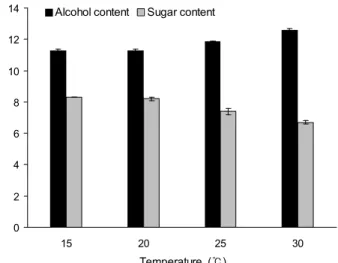
A lc o h o l c o n te n t (% ) & s u g a r c o n te n t (° B ri x ) . Alcohol content Sugar content
Fig. 3. Alcohol and sugar content of tomato wine fermented with S. bayanus Lalvin EC-1118 at different temperature for 3 days. Values are mean±SD (n=3).
0 1 2 3 4 5 6
15 20 25 30
Temperature (℃)
T it ra ta b le a ci d it y ( % ) & p H .
Titratable acidity pH
Fig. 4. Titratable acidity and pH of tomato wine fermented with S. bayanus Lalvin EC-1118 at different temperature for 3 days. Values are mean±SD (n=3).
이코펜 함량 분석은 1회 측정한 값으로 나타내었다.
결과 및 고찰
효모 종류에 따른 토마토의 알코올발효 특성
시판 와인효모 6종에 따른 토마토의 알코올발효 특성을 조사한 결과를 Fig. 1과 2에 나타내었다. 알코올 함량은 E에 서 11.8%로 가장 높게 나타났고 A 11.7%, F 11.5%, C 11.0%, B 10.2%, D 5.9% 순으로 나타났으며, 발효 후 당도는 알코올 도수가 높을수록 낮은 경향을 나타내었다. 이러한 결과는 Jeong 등(18)이 효모 종류에 따른 참외 알코올발효 특성을 조사한 결과
S. cerevisiaeLalvin K1-V1116에서 알코올 함 량이 5.6%로 낮게 나타나 참외 와인 제조에는 적합하지 않
았다는 결과와 유사하였으나, Roh 등(19)이 포도주를 제조 할 때
S. cerevisiaeFermivin을 포함한 효모 12종 모두 알코 올 함량이 약 12% 내외로 효모 종류에 따른 큰 차이가 없었 다고 보고한 것과는 다른 경향으로, 발효원료에 따라 효모의 알코올 생성능은 다르게 나타나는 것으로 생각된다. 적정산 도는 A, C, E 및 F에서는 0.7% 이하로 나타났고 B는 약 0.9%, D는 1.2% 이상으로 나타났다. pH는 D에서는 pH 3.4 를 나타내었으며, 다른 효모에서는 pH 3.8~3.9 범위로 큰 차이를 보이지 않았다. 따라서 본 연구에서는 알코올 생성능 이 가장 우수한
S. bayanusLalvin EC-1118을 이용하여 알 코올발효 특성을 조사하였다.
발효온도에 따른 토마토의 알코올발효 특성
발효온도에 따른 토마토 알코올발효 특성을 조사한 결과
는 Fig. 3, 4와 같다. Fig. 3과 같이 발효온도 15
oC와 20
oC에서
알코올 함량은 11.3%로 나타났으며, 25
oC에서는 11.9%,
0 2 4 6 8 10 12 14
Sucrose Fructose Honey Maltooligo. Fructooligo.
Sugars
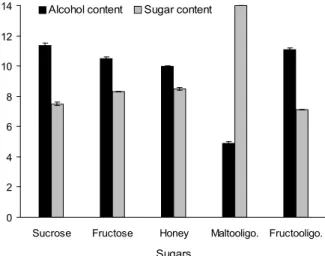
A lc o h o l c o n te n t (% ) & s u g a r c o n te n t (° B ri x ) . Alcohol content Sugar content
Fig. 5. Alcohol and sugar content of tomato wine fermented with S. bayanus Lalvin EC-1118 and different sugars at 25
oC for 3 days. Values are mean±SD (n=3).
0 1 2 3 4 5 6
Sucrose Fructose Honey Maltooligo. Fructooligo.
Sugars
T it ra ta b le a ci d it y ( % ) & p H .
Titratable acidity pH
Fig. 6. Titratable acidity and pH of tomato wine fermented with S. bayanus Lalvin EC-1118 and different sugars at 25
oC for 3 days. Values are mean±SD (n=3).
30
oC에서는 12.6%로 발효온도가 높아질수록 알코올 함량은 높아지고 발효 후 당도는 낮게 나타났다. 적정산도와 pH는 발효온도에 따른 큰 차이는 없었다(Fig. 4). 이러한 결과는 Choi 등(20)이
S. bayanu가 25∼30
oC에서 최대 알코올 생성 량을 나타내었다고 보고한 것과 유사한 경향을 나타내었다.
Cho 등(21)은 단감을 30
oC에서 발효시킬 경우 과즙의 갈변 도가 증가한다고 보고하였으며, Rhim 등(22)은 발효온도가 높으면 알코올 생성속도가 증가하지만 알코올 수율은 낮아 진다고 보고한 바 있다. 그러나 와인의 알코올발효 온도는 단순 알코올 함량보다는 관능적 품질에 미치는 요인들이 많 지만 일단 발효온도를 25
oC로 설정하여 실험을 진행하기로 하였다. 한편 Kim 등(23)은 오디 와인의 경우 20 및 26
oC에 서는 발효 4일째, 15
oC에서는 발효 6일째 알코올 함량이 급 격히 증가한다고 보고한 바 있어 낮은 온도에서는 발효기간 을 연장시키면 알코올 함량은 증가할 것으로 생각된다.
당 종류에 따른 토마토 알코올발효 특성
토마토 마쇄액에 설탕, 과당, 꿀, 말토올리고당 및 프락토 올리고당으로 각각 보당하여 당 종류에 따른 알코올발효 특 성 및 라이코펜 함량을 조사하였다. Fig. 5와 같이 알코올 함량은 설탕 첨가구간에서 11.4%로 가장 높게 나타났으며, 프락토올리고당 11.1%, 과당 10.5%, 꿀 10.5%, 말토올리고 당 4.9% 순으로 나타났다. 발효 후 당도는 설탕과 프락토올 리고당 첨가구간에서는 8.0
oBrix 이하로 나타났으며, 과당과 꿀 첨가구간에서는 8.3~8.5
oBrix, 말토올리고당에서는 14.0
o
Brix로 알코올 함량과 반대의 경향으로 나타나 말토올리고 당은 토마토 과실주 제조에 적합하지 않은 것으로 나타났다.
이러한 결과는 Jung 등(24)이 보당 종류에 따른 살구와인의 특성을 조사한 결과 설탕이 다른 당보다 알코올 함량이 조금 높게 나타났다고 보고한 것과 유사한 경향이었으나 Kim 등 (25)이 Campbell Early 포도주에서는 포도당에서 알코올 함 량이 가장 높았다는 결과와는 다른 경향으로 발효원료에 따
라서 당 이용정도가 조금씩 차이가 나는 것으로 판단된다.
따라서 토마토를 이용하여 알코올발효 할 때는 설탕과 프락 토올리고당이 적합한 것으로 나타났으며, 향후 관능적인 특 성에 대한 보완 연구가 필요할 것으로 생각된다. 적정산도와 pH는 당 종류에 따라 큰 차이가 없는 것으로 나타났다(Fig. 6).
보당 종류에 따른 라이코펜 함량을 조사한 결과 Table 1과 같이 모든 구간에서 약 4.2 mg%로 비슷한 함량을 나타 내었다. Kim 등(26)은 토마토 및 토마토 가공품의 라이코펜 함량을 분석한 결과 완숙 토마토에서는 1.14~3.87 mg%, 토 마토소스 12.39~19.85 mg%, 토마토케첩 9.38~13.20 mg%, 토마토주스 0.61~6.13 mg% 함유되어 있다고 보고한 바 있 어 토마토 알코올발효액의 라이코펜 함량은 완숙 토마토 및 주스와 비슷하여 알코올발효과정에 따른 변화는 크지 않았 으나 이에 대한 보완 연구가 또한 요구되었다.
토마토 퓨레 첨가에 따른 토마토 과실주의 품질특성
라이코펜 함량을 강화하기 위한 방법으로 LDL, MDL 및
HDL type의 토마토 과실주 3종을 제조하여 품질특성 및 라
이코펜 함량을 조사하였다. LDL, MDL 및 HDL의 알코올함
량은 Fig. 7과 같이 각각 10.8, 10.5 및 10.0%로 나타났으며,
당도는 알코올 함량과 반대의 경향을 나타내었다. 적정산도
는 LDL에서 0.68%, MDL 0.74% 및 HDL 0.86%로 나타났으
며, pH는 LDL에서 pH 3.7, MDL 및 HDL에서 pH 4.0∼4.1로
구간들 간에 큰 차이는 없는 것으로 나타났다(Fig. 8). 라이
코펜 함량은 Table 1과 같이 토마토 마쇄액에 보산 및 보당
한 토마토 머스트(tomato must, TM)에서는 6.30 mg%로
나타났으며, LDL에서는 4.25 mg%로 알코올발효를 거치면
서 조금 감소하는 것으로 나타났다. MDL 및 HDL에서는
각각 11.40 및 20.45 mg%로 LDL에 비해 약 3배에서 5배
이상 높은 것으로 나타났다. 이러한 결과는 Kim 등(26)이
토마토 종류 및 숙성별 라이코펜 함량을 비교한 결과 완숙
토마토에서 1.14~3.87 mg%로 가장 높게 나타났다고 보고
0 2 4 6 8 10 12 14
LDL MDL HDL
Types of tomato wine
A lc o h l c o n te n t (% ) & s u g a r c o n te n t (° B ri x ) . . Alcohol content Sugar content
Fig. 7. Alcohol and sugar content of tomato wine fermented with S. bayanus Lalvin EC-1118 and different puree addi- tions at 25
oC for 3 days. LDL: low-dose lycopene wine, MDL:
medium-dose lycopene wine, HDL: high-dose lycopene wine.
Values are mean±SD (n=3).
0 1 2 3 4 5 6
LDL MDL HDL
Types of tomato wine
T it ra ta b le a ci d it y ( % ) & p H .
Titratable acidity pH
Fig. 8. Titratable acidity and pH of tomato wine fermented with S. bayanus Lalvin EC-1118 and different puree addi- tions at 25
oC for 3 days. LDL: low-dose lycopene wine, MDL:
medium-dose lycopene wine, HDL: high-dose lycopene wine.
Values are mean±SD (n=3).
Table 1. Lycopene content of tomato must and tomato wine fermented with S. bayanus Lalvin EC-1118 at 25
oC for 3 days
Samples Lycopene
content (mg%) Tomato wine
fermented with different sugars
Sucrose Fructose Honey
Maltooligosaccharide Fructooligosaccharide
4.21 4.20 4.22 4.19 4.21 Tomato wine
fermented with different puree additions
1)TM LDL MDL HDL
6.30 4.25 11.40 20.45
1)
TM: tomato must, LDL: low-dose lycopene wine, MDL: me- dium-dose lycopene wine, HDL: high-dose lycopene wine.
한 것보다 TM의 라이코펜 함량이 2배 이상 높게 나타나 토마토 품종과 재배지역에 따라 차이가 나는 것으로 생각된 다. 라이코펜은 잘 익은 토마토의 천연색소(27)로 항산화능 이 높고(28) 항암(29) 및 노화방지(30)에 효과가 있다. 토마 토 과실주에 토마토 퓨레를 첨가함으로써 라이코펜 함량을 강화할 수 있어 기능성이 우수한 토마토 과실주의 개발이 가능할 것으로 생각되며 향후 저장, 숙성 중 라이코펜의 함 량변화 및 관능적인 특성에 대한 연구를 진행하고자 한다.
요 약
본 연구에서는 토마토의 알코올발효 조건에 따른 이화학 적 특성 및 토마토 과실주의 품질특성을 조사하였다. 효모 종류에 따른 영향을 조사한 결과
S. bayanusLalvin EC- 1118 에서 알코올 함량이 11.8%로 가장 높게 나타났으며, 적정산도와 pH는 효모 종류에 따른 큰 차이는 없었다. 알코 올발효 온도가 높을수록 알코올 함량은 높게, 당도는 낮게 나타나는 경향으로, 토마토의 알코올발효 온도를 25
oC로 설 정하였다. 당 종류에 따른 영향을 조사한 결과, 설탕 첨가구 간에서 알코올 함량은 11.4%로 가장 높았고 프락토올리고 당에서는 11.1%로 두 가지 종류의 당이 토마토 알코올발효 에 적합한 것으로 나타났으며, 라이코펜의 함량은 당 종류에 따른 차이 없이 약 4.2 mg%로 비슷한 함량을 나타내었다.
라이코펜 함량 강화를 위해 low-does lycopene(LDL), medium-dose lycopene(MDL) 및 high-dose lycopene(HDL) type의 과실주 3종을 제조한 결과, 알코올 함량은 10.0~
10.8%로 과실주간에 큰 차이는 없었다. 라이코펜 함량은 LDL에서 4.25 mg%, MDL 11.40 mg% 및 HDL 20.45 mg%
로, LDL에 비해 MDL은 약 3배, HDL은 약 5배 이상 높아서 라이코펜 함량이 강화된 토마토 과실주의 제조가 가능한 것 으로 기대되었다.
문 헌