LED irradiation이 Muscat bailey A 와인의 발효 및 페놀성 화합물의 변화에 미치는 영향
김상욱, 한기동*
영남대학교자연자원대학식품공학과
Received: August 5, 2015 / Revised: September 19, 2015 / Accepted: October 22, 2015
서 론
Hormesis는 Arndt-Schulz rule로알려져있으며 Luckey [13]는 ‘잠재적으로는위험한수단이지만낮은용량으로주 는자극’이라고정의하였다. 이는유해수준이하의자극은
긍정적 결과를 유발할 수 있다는 것을 의미하며, 1888년
Hugo schulz에의해처음그개념이도입된후다양한방면 으로 연구가 진행되고 있다. 최근 UV-light나 LED(Light Emitting Diode)와같은 light stimulation이메밀 새싹의 항산화물질및항산화활성을높이거나[12], UV-hormesis이 딸기생육중 phenol성화합물함량을증대[7]시키는것으로 나타났으며, LED irradiation이큰느타리버섯의갓크기나 원기의형성은물론에르고스테롤의생성에도영향을미치 는 것으로 보고되었다[11]. 또한 Aspergillus 속[6]이나
Neurospora 속에관한연구[17]에서도 LED가 mycelium 및 conidial 형성에영향을미치는것으로나타났다. 이처럼 light stimulation이진균류나식물의생장에 hormesis를유발한 다는사실은다각적으로밝혀진바있으나발효중적용사례 에관한연구는아직알려진바가없다. 이에본실험에서는
Must에상업용효모를접종한후발효액에 LED를조사하
여 Must의발효특성과생리활성물질함량 변화를확인하
고, 와인발효중 LED에의한 hormesis의유발과이의적용 가능성을모색하고자하였다.
재료 및 방법
사용균주 및 와인의 제조
본 실험에 사용된 균주는 상업용 S. bayanus EC-1118 (Lallemand Inc., Canada)을 YPD broth medium(Yeast extract 1%, peptone 2%, glucose 2%)에 48시간 150 rpm 으로진탕배양하여 4000 rpm에서 20분 centrifuging 후상 징액을 제거하여 사용하였다. Must는 경산에서 재배한 MBA(Muscat bailey A) 파쇄액 1000 ml에잡균의 번식을 Changes in Fermentation Properties and Phenolic Contents of Muscat Bailey A Wine by LED Irradiation Treatment Sang Wook Kim and Gi Dong Han*
Department of Food Science and Food Service Industry, Yeungnam University, Gyeongsan 712-749, Republic of Korea There have been several studies on role of hormesis with light stimulation, however, the influence of light on fermentation is still poorly understood. In this study the relationship between LED (light emitting diode) hormesis and ethanol fermentation for Muscat bailey A wine was investigated. Two LEDs, one blue (453± 4 nm) and one green (522 ± 3 nm), were used. Both LED groups showed an inhibited production of lactic acid. The blue LED stimulated the growth of the yeast in early stage of the fer- mentation. Polyphenolic compounds and their antioxidant abilities were significantly increased by the green LED. These results demonstrate that LED irradiation must bring about hormesis and affect the growth rate of yeast in the early stage of the fermentation, and the contents of phytochemicals during fermentation. These findings indicate the possible application of LED hormesis for the wine fermentation. Further studies are needed to understand how LED irradiation induces hormesis effects during the fermentation process.
Keywords: Wine, LED, fermentation, hormesis, antioxidant
*Corresponding author
Tel: +82-53-810-2957, Fax: +82-53-810-4662 E-mail: [email protected]
© 2015, The Korean Society for Microbiology and Biotechnology
막기위해 100 ppm의 Potassium metabisulfite를투입하였 으며투입후 4시간동안안정화시간을거친다음, 배양한 균주를 1.5×10⁵ cells/ml 접종하였다. 접종이완료된 Must 는빛이조사되지않는 control group과각각 453±4 nm 파 장의 Blue LED, 522±3 nm 파장의 green LED를조사하 며 30oC에서 10일간 속성발효하였고 1, 2, 3, 5, 10일차의 sample을채취하여실험에사용하였다.
LED irradiation장치
LED에의한 hormesis를유발하기 위해 실험에사용된
453±4 nm(blue), 522±3 nm(green) 파장의 LED는 X.H.Y OPTOELECTRONICS(GX-HP10W-B, China)에서 생산된 제품으로 각 chamber의 크기가 59×67×38 cm3인 four- chamber incubator 상부에설치하였으며, 열발생에따른그 룹간온도변화가없도록 하기위하여 cooling fan과 heat sink가부착되어설정된온도가유지되도록하였다. 전류전 원은 AC adapter(0−2 A, 0−12 V)를이용하여공급하였다.
발효 중 생균수변화
생균수는 YPD agar 배지(Yeast extract 1%, peptone 2%, glucose 2%, agar powder 1.5%)를 이용하여 spread plate method로도말한후차광하여 30oC에서 48시간배양 하고나타난집락을효모의생균수로계수하였다.
고형분 및 환원당 함량
발효액의고형분함량측정은 AOAC 방법에따라[1] 실온 에서 Refractometer(Master-M, ATAGO, Japan)를사용하 여측정하였다. 환원당함량은 DNS(dinitrosalicyclic acid)법 으로시료 250 μl에 DNS 시약 250 μl를첨가하여 95oC에서
5분간반응시킨다음증류수를 1 ml 첨가하여분광광도계
(UV 1601PC, Shimadzu Co., Kyoto, Japan)를 사용하여 546 nm에서흡광도를측정하고 glucose 표준곡선으로부터 환원당함량을환산하였다.
유기산 함량
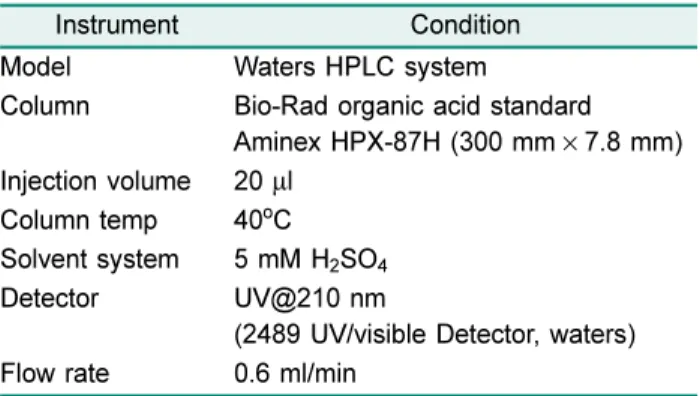
유기산함량은고속액체크로마토그래피(High Performance Liquid Chromatography)를사용하여측정하였다. 표준용 액은 citric acid, lactic acid, malic acid, tannic acid, tartaric acid(Sigma aldrich, USA)를 5 mM H2SO4에농도 별로희석하여 4000 rpm에서 20분 centrifuging하고 0.2µm membrane filter에여과한후표준검량곡선을작성하여사 용하였으며, 유기산함량 HPLC 분석 조건은다음과같다 (Table 1).
메탄올 함량
메탄올함량은국세청주류분석규정[15]에따라알코올분 을 5±1%로조정한시료 5 ml을시험관에넣고 KMnO4용 액 2 ml을가하여 30oC에서 15분간방치한후 C2H2O4용액 2 ml를가하여탈색하고 C20H19N3·H2SO3용액 5 ml를가하 여잘혼합한후 30oC에서 30분간온도를유지하였다. 같은 방법으로처리한메틸알코올표준용액계열과비색하여그 수치에묽게한배수를곱하여메틸알코올함유량(mg/ml)으 로하며 590 nm에서측정하였다.
Fusel oil 함량
퓨젤유함량은국세청주류분석규정[15]에따라물로적당 히묽게한시료 1 ml을시험관에넣고 0.5% C8H8O3·H2SO4 2 ml을가하여혼합한후, 100oC에서 3분간가열하고증류 수 1 ml을가한다. 15분후표준용액 1 ml을같은방법으로 처리한표준용액계열과비색하여퓨젤유함량(v/v%)으로하 였으며, 500 nm에서측정하였다.
총 폴리페놀 함량
폴리페놀함량은 Gutfinger의방법[9]을변형하여, Folin- Ciocalteu reagent가추출액의폴리페놀화합물에의해환 원된결과몰리브덴청색으로발색하는것을원리로측정하 였다. 즉, 추출액 0.2 ml에 Folin-Ciocalteu's reagent(Sigma, USA) 1 ml를가하여 3분간반응시키고여기에 10% 탄산나 트륨 0.8 ml를첨가한후 1시간 동안 실온에서방치한후 765 nm에서흡광도를측정하였으며폴리페놀함량은 Tannic
acid 용액표준곡선을이용하여나타내었다.
총 플라보노이드 함량
총플라보노이드는 Zhuang 등의방법[19]을변형하여, 시 료 0.2 ml에 ethanol 0.8 ml를넣고혼합한후 2%의 AlCl3
용액을 1 ml 첨가하고 1시간반응시킨후 420 nm에서흡광 도를측정하였으며플라보노이드함량은 quercetin 용액표 준곡선을이용하여나타내었다.
Table 1. HPLC condition to analysis for organic acid.
Instrument Condition
Model Waters HPLC system
Column Bio-Rad organic acid standard Aminex HPX-87H (300 mm× 7.8 mm) Injection volume 20 µl
Column temp 40oC Solvent system 5 mM H2SO4
Detector UV@210 nm
(2489 UV/visible Detector, waters) Flow rate 0.6 ml/min
총 안토시아닌 함량
시료의안토시아닌정량은 Hosseinian 등의 pH differential method [10]에 따라 측정하였다. 시료 1 ml에 0.025 M Potassium chloride buffer(pH 1.0) 1 ml 혹은 0.4 M sodium acetate buffer(pH 4.5) 1 ml을각각혼합하여반응액의흡광 도 값을 510 nm와 700 nm에서 측정한 후 cyanidin-3- glucoside의몰흡광계수(ε= 26,900 M-1cm-1)를이용하여아 래의식에의해안토시아닌함량을산출하였다.
Total anthocyanin contents(mg/l) = (A×MW×D×1000) / (ε ×V)
A(absorbance value): (A510nm−A700nm)pH 1.0
−(A510nm−A700nm)pH 4.5
MW (molecular weight of cyanidin-3-glucoside): 449.2 D (dilution factor): dilution ratio of sample
ε (cyanidin-3-glucoside molar absorbance): 26,900 M-1cm-1 V: final volume of sample
FRAP 측정
FRAP assay는 Benzie & Strain의방법[3]을사용하였다. FRAP 실험을위해반응액은 acetate buffer(pH 3.6, 300 mM):
10 mM의 TPTZ(2,4,6-tripyridyl-s-triazine, Sigma, USA) : 20 mM의 FeCl3· 6H2O를 10 : 1 : 1의비율로혼합하여사용 하였으며, 반응용액과시료를혼합하여 30분반응시킨후, 593 nm에서측정하였다. 측정된흡광도는 Ascorbic acid를 표준품으로이용하여만든표준검량곡선에대입하여 Ascorbic acid equivalent mM로표시하였다.
DPPH radical scavenging 활성
DPPH radical에대한소거활성측정은 Blois 등의방법[4]
을 변형하여 시료 1 ml에 60μM DPPH(1,1-diphenyl-2- picrylhydrazyl) 용액 1.5 ml를가하여 30분간반응시킨후 517 nm에서흡광도를측정하고 DPPH 첨가구와 ethanol 첨 가구의흡광도차이를비교한후, 아래의식을이용하여계 산하였다.
DPPH radical scavenging activity(%) = (1−(A−B)/C)×100 A: sample + DPPH absorbance
B: sample + ethanol absorbance C: DW + DPPH absorbance
통계조사
실험결과는모두 3회반복하여평균과표준편차로나타내 었으며, 통계처리는 SPSS 21.0(Statistical Package for the
Social Sciences, Spss Inc., Chicago, IL, USA) 프로그램을 이용하여 실시하였다. 각 군에 따른 유의성은 분산분석 (analysis of variance, ANOVA) 후, Duncan’s multiple range test를실시하여 p < 0.05 수준에서검증하였다.
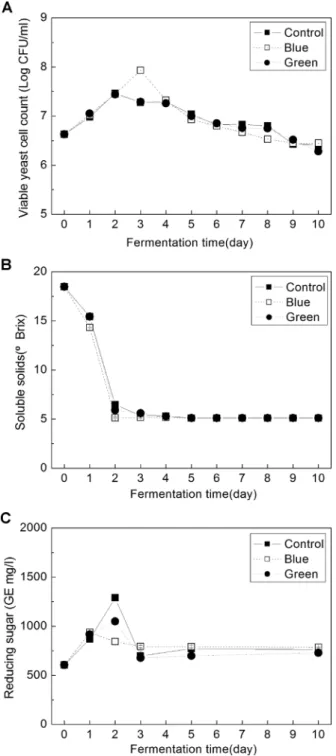
Fig. 1. Changes in the yeast viable counts (A), Soluble solids (B) and Reducing sugar (C) during fermentation of must by Saccharomysces bayanus EC-1118 with LED irradiation. All values are expressed as mean± SD in triplicates.
결과 및 고찰
발효 중 효모의 생장 및 이화학적 특성
LED irradiation에의한 Must의발효속도변화를탐색 하기위하여총균수와발효액의고형분함량, 환원당함량 을확인한결과는 Fig. 1과같다. Control과 green group에 비해 Blue 파장을 irradiate한 group의발효초기인 2일에 서 3일사이생균수가많고지연기에접어드는속도도느린 것으로나타났으며(Fig. 1A), 발효중당소모속도도 Blue group이다른 group에비해빠른것으로나타났다. 환원당 함량은발효초기에일시적으로증가하였다가 발효가진행 됨에 따라 감소하는 경향을 보였다. LED를 irradiate한 group이 control group에비해발효초기에낮은환원당함 량과고형분함량을나타냈는데, 이는 LED irradiate로인 해 초기 발효속도가 촉진되어 더 많은 양의 환원당이 ethanol로전환되었기때문인것으로보인다(Fig. 1B,C). 이 는 LED에의해 Malassezia 효모의 생육이 저해되었다는 Wi 등의연구[18]와상반되었으며, 이같은결과는 yeast의
생장에필요한 medium의영양원조성차이와짙은적색의
포도 Must에의한 LED 파장의굴절및분산에의한것으 로사료된다.
색차변화
발효를 진행하지 않은 normal group과 일반 발효한
control group, 그리고발효중 LED를처리한 group의색도 를비교해본결과, 명도를나타내는 L-value와적색도를나 타내는 a-value의유의적인차이는나타나지않았으며, 황색 도를나타내는 b-value가감소하는경향을보였으나 control group과 LED를 irradiate한 group 간의차이는나타나지않 았다(Table 2). LED irradiation 처리가발효중 Must의색 상에영향을미치지않는것으로나타났다.
유기산 함량
Must의 Tannic acid 함량은모든 group간에유의적인차 이가 없었으나, Citric acid, Tartaric acid, Malic acid와 Lactic acid는 control group에 비해 LED를 irradiate한 group이적은 함량을나타냈다(Table 3). 특히 Lactic acid 함량의차이가크게나타났는데, 이는광펄스처리에의해 Lactobacillus plantarum, Lactobacillus brevis, Lactobacillus mesenteroides의생육이억제되었다는연구[2, 8, 16]와일 치하였으며, LED irradiation에의해 발효중젖산균의생 육이저해되어 Lactic acid 함량이낮게 나타난것으로사 료된다.
Table 2. Hunter value of fermented must by Saccharomysces bayanus EC-1118 with LED irradiation.
Normal1) Control Blue Green
L-value 025.3± 3.55a 23.88± 0.36a 24.05± 0.03a 23.24± 0.05a
a-value 11.29± 0.77a 11.32± 1.14a 10.61± 0.06a 10.05± 0.03a
b-value 03.99± 0.81b 00.09± 0.31a 0-0.23± 0.04a 0-0.45± 0.04a
1)Normal: non-fermented, Control: Must fermented in darkness, Blue: Must fermented with treatment of Blue (453± 4 nm) LED, Green: Must fermented with treatment of Green (522± 3 nm) LED
2)All values are expressed as mean± SD in triplicates
3)Means with different letters in a row are significantly different at p < 0.05 by Duncan's multiple range test
Table 3. Contents of organic acids in the fermented must by Saccharomysces bayanus EC-1118 with LED irradiation.
Control1) Blue Green
Tannic acid 0.2133± 0.0003a2)3) 0.2133± 0.0005a 0.2133± 0.0002a
Citric acid 0.0706± 0.0003c 0.0692± 0.0008b 0.0629± 0.0007a
Tartaric acid 0.4191± 0.0002b 0.4195± 0.0002b 0.3891± 0.0010a
Malic acid 0.5381± 0.0018c 0.5138± 0.0030b 0.4827± 0.0026a
Lactic acid 0.7607± 0.0010c 0.5715± 0.0064a 0.6051± 0.0049b
Total 2.0017± 0.0034c 1.7872± 0.0099b 1.7531± 0.0053a
1)Control: Must fermented in darkness, Blue: Must fermented with treatment of Blue (453± 4 nm) LED, Green: Must fermented with treatment of Green (522± 3 nm) LED
2)All values are expressed as mean± SD in triplicates
3)Means with different letters in a row are significantly different at p < 0.05 by Duncan's multiple range test
고급알코올 함량
이연구에서는상업적으로많이사용되는 Saccharomysces bayanus EC-1118를이용하여포도주를제조하였으며, 데이 터로나타내지는않았지만연구자는향, 맛등관능적특성
을확인하여모든 group이모두정상적으로알코올발효가
이루어진것을확인하였다. 또한포도주이상발효의지표가 되는 methanol과 fusel oil의함량을분석하였다. 알코올발
효의비정상적산물인 methanol은펙틴이분해되어생성되
며와인이상발효의지표로사용되는것으로알려져있으며,
fusel oil은와인에복합적인향미를부여하지만농도가높아
지면오히려와인에이취를유발한다. 발효중 LED 파장을
irradiate한 must의고급알코올함량은 Table 2와같다. 모 든 group에서 methanol 함량이국내기준인 1,000 ppm 이 하로나타나정상적인알코올발효가진행되었음을확인할 수있었으며, 각 group간의유의적인차이는나타나지않았 지만, 메탄올함량은 control group이, Fusel oil 함량은 blue group이가장낮은경향을보였다(Table 4).
페놀성 화합물 함량
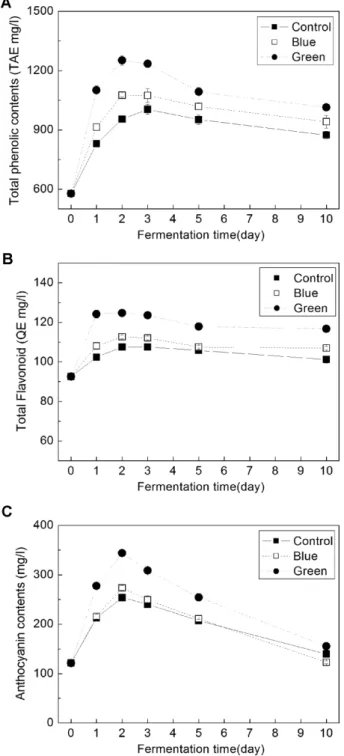
Must 발효중 Antioxidants의함량변화를비교분석한결 과 LED light를 irradiate한 group이 발효초기에 total phenolics, flavonoid, anthocyanin 모두 control group에 비해 높은 함량을 나타냈으며, 특히 green group이 다른 group에비해높은함량을보였다(Fig. 2). 발효가진행됨에 따라모든 group의함량이점차감소하였는데, 이는와인발 효초기에 flavonols, anthocyanins, phenolics가증가하였다 가발효가진행되면서점차감소한다는 Burns의연구[5]와 유사한경향을나타내었다.
항산화 활성
522±3 nm 파장을 irradiate한 green group이발효초기 에다른 group에비해높은 FRAP 활성과 DPPH 라디컬소
거능을나타냈으며, 발효가진행됨에따라점차모든 group 에서활성이낮아져페놀성화합물의함량변화결과와유 사하게나타났다(Fig. 3). 이는발효중산화가이루어짐에따 Table 4. Contents of methanol and fusel oil in the fermented
must by Saccharomysces bayanus EC-1118 with LED irradia- tion.
Item (mg/l) Sample1)
MeOH Fusel oil
Control 837.00± 26.462) 414.21± 53.27 Blue 945.67± 21.39 375.31± 66.35 Green 996.33± 140.46 429.38± 12.78
1)Control: Must fermented in darkness, Blue: Must fermented with treatment of Blue (453± 4 nm) LED, Green: Must fer- mented with treatment of Green (522± 3 nm) LED
2)All values are expressed as mean± SD in triplicates
Fig. 2. Changes in the total phenolic contents (A), total flavo- noid (B) and total anthocyanin (C) during fermentation must by Saccharomysces bayanus EC-1118 with LED irradiation.
All values are expressed as mean± SD in triplicates.
른것으로사료되며, 와인발효초기에항산화활성이증가 하다가 5일차에서감소하기시작한다는 No 등의연구[14]와 유사한경향을나타내었다.
요 약
이연구에서는 Muscat Bailey A wine 제조에있어알코올 발효중 LED hormesis의영향을확인하고자하였다. 453± 4 nm, 522±3 nm 파장의 LED를 must에 irradiate하며발 효특성및페놀성화합물함량과항산화활성을 control group 과비교하였다. Control group에비해 LED를 irradiate한 group의유기산조성중 Lactic acid 함량이낮게나타났는 데, 이는 LED 파장의젖산균생육저해효과에따른것으로 사료된다. 발효 중 yeast의 균수증가와 당 소모는 453± 4 nm 파장의 blue LED를 irradiate한 group이다른 group 에비해발효초기빠른경향을보였으나 3일후에부터는다
른 group과큰차이를보이지않았다, 522±3 nm 파장의 green LED는발효초기에다른 group에비해높은항산화 활성을나타냈다. 이는 LED irradiation이발효중 hormesis
를유발하여 yeast의생육속도와발효액내생리활성물질
을증가시킨것으로사료된다. 위결과를통해와인발효중 LED 자극에의한 hormesis의적용가능성을확인할수있 었으며, 향후 LED hormesis가 어떤 기작에 의해 발효중
yeast의생육속도를향상시키고포도발효액내의생리활성
물질을증가시키는지에대한추가적인연구가필요할것으 로보인다.
References
1. A.O.A.C. 2000. Official Methods of Analysis 17th ed. Method 69-74. Association of Official Analytical Chemists, Washington DC, USA.
2. Barbosa CGV, Schaffner D, Pierson MD, Howard ZQ. 2000.
Pulsed light technology. J. Food Sci. Special Supplement.
3. Benzie IF, Strain JJ. 1996. The ferric reducing ability of plasma (FRAP) as a measure of “antioxidant power”: the FRAP assay. Anal Biochem. 239: 70−76.
4. Blois MS, Shigenara MK, Hagen TM. 1993. Oxidants, antioxi- dants, and the degenerative diseases of aging. Proc. Natl.
Acad. Sci. 90: 7915−7922.
5. Burns J, Gardner PT, Matthews D, Duthie GG, Lean MEJ, Crozier A. 2001. Extraction of phenolics and changes in anti- oxidant activity of red wines during vinification. J. Agric. Food Chem. 49: 5797−5808.
6. Chien WC, Ching KC, Chih JC, Liang YC. 2012. Effect of colour LEDs on mycelia growth of Aspergillus ficuum and phy- tase production in photo-fermentations. J. Photochem. Photo- biol. 106: 81−86.
7. Cho YJ, Kim CJ, Kim JT, Kim TE, Bae KS, Kihl JY, et al. 2008.
Effect of UV hormesis on phenolic contents in strawberries.
Food Eng. Prog. 12: 143−148.
8. Dunn J, Ott T, Clark W. 1995. Pulsed light treatment of food and packaging. Food Technol. 49: 95−98.
9. Gutfinger T. 1958. Polyphenols in olive oil. J. Am. Oil Chem.
Soc. 58: 966−968.
10. Hosseinian FS, Li W, Beta T. 2008. Measurement of anthocy- anins and other phytochemicals in purple wheat. Food Chem.
109: 916−924.
11. Jang MJ, Lee YH, Kim JH, Ju YC. 2011. Effect of LED light on primordium formation, morphological properties, ergosterol content and antioxidant activity of fruit body in Pleurotus eryngii.
Korean J. Mycol. 39: 175−179.
12. Lee SM, Jang JH, Nam TG, Kim DO, Kang H, Lee SW, et al.
2011. Effects of light emitting diode to seedling growth and phytochemical properties in buckwheat. Korean J. Hort. Sci.
Technol. 29: 67−67.
13. Luckey TD. 1980. Hormesis with Ionizing Radiation. Boca Fig. 3. Changes in the Ferric reducing ability of plasma (A)
and DPPH radical scavenging ability (B) during fermentation must by Saccharomysces bayanus EC-1118 with LED irradi- ation. All values are expressed as mean± SD in triplicates.
Raton: CRC Press, Inc.
14. No JD, Lee DH, Hwang YS, Lee SH, Lee JS. 2008. Changes of physicochemical properties and antioxidant activities of red wines during fermentation and post-fermentation. Korean J.
Microbial. Biotechnol. 36: 67−71.
15. NTS Liquors Licence Aid Center. 2010. Code of liquor analy- sis. pp 39, 104−202. NTS, Seoul, Korea.
16. Song YA. 2001. A study on inactivation of Lactobacilli using intense light pulse. Department of Agricultural Chemistry, The Graduate School Wonkwang University, Iksan, Chonbuk,
Korea, MS Thesis.
17. Talora C, Franchi L, Linden H, Ballario P, Macino G. 1999.
Role of a white collar-1-white collar-2 complex in blue-light signal transduction. The EMBO J. 18: 4961−4968.
18. Wi HS, Na EY, Yun SJ, Lee JB. 2012. The antifungal effect of light emitting diode on Malassezia yeasts. J. Dermatol. Sci.
67: 3−8.
19. Zhuang XP, Lu YY, Yang GS. 1992. Extraction and determina- tion of flavonoid in ginkgo. Chinese Herbe Med. 23: 122−124.