Effects of the Mixed Fermentation of Torulaspora delbrueckii and Saccharomyces cerevisiae on the Non-Volatile and Volatile Compounds and the Antioxidant Activity in Golden Dried Longan Wine
Kanokchan Sanoppa1, Tzou-Chi Huang2, and Ming-Chang Wu1*
1Department of Food Science, College of Agriculture, 2Department of Biological Science and Technology, College of Agriculture, National Pingtung University of Science and Technology, Shuefu Road, Neipu, Pingtung 91201, Taiwan
Received: July 10, 2019 / Revised: November 7, 2019 / Accepted: November 21, 2019
Introduction
Longan (Dimocarpus longan Lour) is a tropical fruit grown in the Asia Pacific region, especially Thailand.
Longan can be served fresh or processed as dried longan, wine, and jam. Dried fruit is a favorite product for con- sumers because of its unique flavor. Dried longan has been found to contain glucose, sucrose, and fructose, and also free amino acids that have been found to be associated
with flavor precursors in winemaking. The major volatile compounds from dried longan include ocimenes, furfural, 5-methyl furfural, isoamyl alcohol, linalool oxide, trans geraniol, benzenemethanol, ethyl hexadecanoate, 2-acetyl- furan, 2-furancarboxylic acid, and 2, 5 dihydrofuran [1].
The use of non-Saccharomyces species has attracted interest for commercial winemaking as several studies have shown the potential production of a greater diver- sity of aromatic compounds in wine [2]. One of the non- Saccharomyces yeasts, Torulaspora delbrueckii, is already currently used in commercial winemaking [3], as this yeast has been reported to have a positive impact on the taste and aroma of wine together with a decreased The aim of this study was to investigate the effects of Torulaspora delbrueckii and Saccharomyces cerevisiae, as pure fermenters and mixed fermenters (simultaneous and sequential culture), on the production of non- volatiles and volatiles, and on the antioxidant activity in Golden Dried Longan juice and Golden Dried Longan wines. Alanine, arginine, glutamic acid, leucine, proline, and gamma-aminobutyric acid (GABA) were the most prominent amino acids that were found in these wines. The Golden Dried Longan Wine fermented with monocultures of S. cerevisiae and T. delbrueckii produced a total volatile aroma content of 393.21 mg/l and 383.20 mg/l, respectively. Simultaneous culture of the two organisms produced the highest total volatile aroma content, that affected most volatile compounds including isobutanol, ethyl acetate, ethyl decanoate, ethyl heptanoate, ethyl hexanoate, ethyl pentanoate, isoamyl acetate, and isobutyl acetate. Of the four treatments, the sequential culture possessed the highest total phenolic content (5.80 mg gallic acid equivalents (GAE)/ml). In addition, the total phenolic content significantly correlated with the antioxidant activity of the Golden Dried Juice and Golden Dried Longan Wine. These results suggest that co-cultures of the two organisms used in the production of the Golden Dried Longan Wine may improve the intensity and complexity of its aroma.
Keywords: Torulaspora delbrueckii, Saccharomyces cerevisiae, simultaneous, sequential, antioxidant activity
*Corresponding author
Tel: +886-9-32775187, Fax: +886-8-7740378 E-mail: [email protected]
© 2020, The Korean Society for Microbiology and Biotechnology
production of undesirable compounds [4]. However, Hensen et al. [5] reported that T. delbrueckii had less tolerance to limited oxygen conditions compared to S.
cerevisiae. Hence, the mixed inoculation of S. cerevisiae and T. delbrueckii could improve the aroma complexity and intensity of wine, including from phenylethanol, iso- amyl acetate, isobutyl acetate, ethyl hexanoate, 3- hydroxybutanoate, ethyl decanoate, and terpenes [6, 7].
Golden dried longan is a processed agricultural product of longan fruit, which is an important economic crop of Thailand [8]. Most research into longan wines have focused only on longan wines made from fresh longan [9−11]. In the present research, golden dried longan was chosen as a raw material for winemaking because it is considered to have a rich amount of amino acids and sugar suitable for yeast culture [1, 9]. Furthermore, most studies on longan wine to date have focused on the characteristic flavor of fresh longan wine, and a few research studies have evaluated the total phenolic content and the antioxidant activity [11].
The main objective of the present research was to determine the effect of S. cerevisiae in association with T. delbrueckii by mono, simultaneous, and sequential cultures on the aroma and amino acids, and to analyze the functional activity (total phenolic content and the antioxidant activity as determined by DPPH, ABTS, and FRAP methods) of golden dried longan wines.
Materials and Methods
Yeast strains and preparation
S. cerevisiae strain C12 L.A. Bayanus and T. delbrueckii ATCC 20100; I AM 4383 were obtained from Blue H2O Filtration Pty Ltd. (Australia) and the Bioresource Col- lection and Research Center (Taiwan), respectively. The freeze-dried yeasts were propagated in a sterile nutrient broth (0.25% w/v yeast extract, 2% w/v glucose, 0.25% w/v malt extract, and 0.25% w/v bacteriological peptone at pH 5.0) under static conditions at 25℃ for up to 48 h, and finally stored at -80℃ in YM medium with adding glycerol 20% v/v before use.
Materials and fermentation conditions
Golden dried longan was obtained from a local market at Lamphun, Thailand, which was further dried by a hot air dryer at 70℃ for 8 h, with the shell and seed removed
before the drying. The dried longan was finally stored at 4℃ until analysis was performed.
Pretreatment and fermentation process of dried longan juice
First, 100 g of golden dried longan was placed into a flask and 300 ml of distilled water was added. The sample was homogenized to form longan juice using a blender and then passed through a filter. The longan juice was acidified to pH 3.5 with 50% w/v DL-malic acid (Canada) and the oBrix adjusted to 20.0% with pure sucrose [12].
Multiple fermentations of the sterile longan wine were conducted at 25℃ under static conditions for 14 days:
two with the monocultures and two with the two co-cul- tures (simultaneous and sequential). The monocultures and co-cultures were inoculated with 1 × 10⁶ CFU/ml for both T. delbrueckii and S. cerevisiae. The simultaneous inoculation involved inoculating with T. delbrueckii and S. cerevisiae at the same time. The sequential inocula- tion involved inoculating with T. delbrueckii first, followed by inoculating with S. cerevisiae after 24 h.
Analysis of the amino acids
Alanine, arginine, aspartic acid, GABA, glutamic acid, glycine, isoleucine, leucine, lysine, phenylalanine, proline, serine, threonine, tyrosine, and valine were supplied by Sigma Chemicals (USA). AccQ-Flour reagent kits con- taining reagent powder, borate buffer, and acetonitrile were supplied by Waters Co. Ltd. (Milford, USA).
Amino acids analysis was performed using an HPLC system (Water Alliance 2695 with heater, USA) based on the method developed by Water AccQ-Tag [13] and as used according to Zeng et al. [14]. Chromatographic sep- aration by reversed-phase HPLC was performed using a Hypersil GOLD™ Column C18 (4.6 mm × 150 mm, 3 µm) (Thermo Fisher Scientific, USA) equipped with a fluorescence detector (excitation, 250 nm; emission, 395 mm). The column thermostat was set at 37℃. The injection volume was 5 µl and the flow rate was 1.0 ml/min. The mobile phase was 10% AccQ-Tag eluent A (A), acetonitrile (B), and Milli-Q water (C).
Analysis of the volatile compounds
The volatiles were analyzed by the headspace (HS) solid-phase microextraction (SPME) method with 30/
50 µm DVB/CarboxenTM/PDMS StableFlexTM fiber
(Supelco: 57348-U, Sigma Aldrich, Spain) coupled with GC-MS. GC-MS analysis was performed with an Agilent 7890B system, equipped with a DB-Wax UI column (60 m × 0.25 mm coated with 0.25 µm film thickness).
The operation conditions were according to Liu et al.
[11]. The program consisted of swirling the vial at 250 rpm for 10 min at 40℃, inserting the fiber to adsorb at 40℃ for 10 min at 250 rpm, and then transferring the fiber for desorption at 230℃ for 3 min.
The odor activity values (OAVs) were calculated as the ratio between the average of the analytical concentra- tions and the odor thresholds.
Total phenolic content
The total phenolic contents were determined using the Folin-Ciocalteu method as adapted for wine analysis [11]. The results are expressed herein as mg gallic acid equivalents per milliliter of wine (mg GAE/ml).
2,2-Diphenyl-1-Picrylhydrazyl (DPPH) radical scavenging activity
The scavenging activity of these wines was deter- mined by DPPH assay, also slightly modified from the procedure by Nuengchamnong and Ingkaninan [15].
First, 0.1 ml golden longan wine was mixed with 2.9 ml of 0.1 mM DPPH methanolic solution, with the solution then kept in the dark at room temperature for 30 min before the absorbance was measured at 515 nm with a spectrophotometer.
2,2'-azino-bis 3-ethylbenzthiazoline-6-sulfonic acid (ABTS) radical scavenging activity
The ABTS assay was performed according to Buyuk- tuncel et al. [16]. Stock solutions were produced by mixing 7 mM ABTS solution and 2.4 mM potassium persulfate solution and were then kept for 14 h at room temperature in the dark. The solution was diluted by mixing 1 ml ABTS solution with 60 ml methanol to obtain an absorbance of 0.7± 0.02 as measured at 734 nm using a spectrophotometer. Then, 0.1 ml of golden longan wine was added to 2.4 ml ABTS solution.
After a further 6 min, the absorbance was measured.
Ferric Reducing Antioxidant Power (FRAP)
The FRAP assay was performed based on a previously published method by Buyuktuncel et al. [16]. The stock
solution was prepared by mixing 300 mM acetate buffer, 10 mM 2,4,6-tripyridyl-s-triazine (TPTZ) in 40 mM HCl, and 20 mM FeCl3· 6H2O in the proportion of 10:1:1 at 37℃. The FRAP reagent was prepared fresh. Next, 15 ml of golden longan wine was mixed with 2.85 ml FRAP solution. Then the absorbance was measured at 593 nm after 30 min.
The values of the three antioxidant activity methods are expressed herein as a trolox-equivalent antioxidant capacity (TEAC).
Statistical analysis
The results were compared by ANOVA using the SPSS 20.0 software (SPSS Inc., USA) at p < 0.05. Princi- ple component analysis was performed on the volatile compounds using Minitab. Correlations were computed using Pearson's correlation coefficient (r) by SPSS.
Results and Discussion
Amino acids
In total, 14 amino acids were detected in the golden dried longan wines (Table 1). The main amino acids in the juice were alanine, proline, and glutamic acid, while proline was found to be the highest in wines. Proline, alanine, glutamic acid, leucine, and GABA were revealed as the main amino acids in the four fermented wines, at concentrations over 1 mg/100 ml, similar to the result found by Liu et al. [11]. The utilization of nitrogen was the highest by the T. delbrueckii monoculture, fol- lowed by S. cerevisiae culture, and then the sequential and simultaneous cultures. Proline was the major resid- ual amino acid in the golden dried longan wines. Similar results in lychee wines were reported by Chen and Liu [12] and Chen and Liu [17]. Proline is the least preferred nitrogen source for yeast strains and is not utilized by yeast under low oxygen conditions [18]. However, pro- line can be synthesized by yeast cells from glutamic acid in the cytoplasm, which consists of three enzymes, namely, γ-glutamyl kinase (the product of the PRO1 gene), γ-glutamyl phosphate reductase (the product of the PRO2 gene), and Δ1-pyrroline-5-carboxylate (P5C) reductase (the product of the PRO3 gene) [19, 20], which also convert excess proline to glutamic acid in the mito- chondria in two steps by proline oxidase (the product of the PUT1 gene) and P5C dehydrogenase (the product of
the PUT2 gene) [21, 22]. Furthermore, proline can be synthesized from arginine by two enzymes, namely, arginase (the product of the CAR1 gene) and ornithine transaminase (the product of the CAR2 gene) [23, 24].
Volatile compounds
A total of 27 volatile compounds were detected in golden dried longan wines, including alcohols, ester, ter- penes, and acid (Table 2). Dried longan wine cultured simultaneously using T. delbrueckii and S. cerevisiae had the highest the concentration of total volatile com- pounds (471.64 mg/l) due to the production of high con- tents of alcohols and esters, followed by sequential, T.
delbrueckii and S. cerevisiae cultures, respectively.
Similar previous studies found that a co-culture with T.
delbrueckii and S. cerevisiae could improve the aroma intensity and complexity of wine. Different chemical hydrolysis rates or enzymatic hydrolysis and synthesis affect the evolution of volatile compounds [6, 7]. Alcohols were the most abundant of the volatile compounds in golden dried longan wines. Ethanol, ethylhexanol, isobu- tanol, isoamyl alcohol, methionol, and 2-phenylethanol were the main alcohols produced by the four fermented wines. Ethanol was the most prominent alcohol, with the S. cerevisiae monoculture producing the significantly
highest ethanol content, followed by T. delbrueckii, and the simultaneous and sequential cultures, respectively.
S. cerevisiae can quickly grow under low oxygen condi- tions and is tolerant to a high ethanol production, whereas T. delbrueckii slowed down fermentation and produced less ethanol [6, 17, 25]. On the other hand, the co-culture could improve the levels of isobutanol and iso- amyl alcohol, which was similar to the results reported by Chen and Liu [17], who found that the highest con- centration of isobutanol and isoamyl alcohol in lychee wines was from cultures with a co-culture compared with different yeast monocultures, which was also simi- lar to research published by Arslan et al. [25] in Narince wines. The production of 2-phenylethanol did not show significant differences among the four fermented wines.
In addition, the results found methionol in dried longan wines, which gives a cauliflower and cooked potato flavor, and its content exceeded its threshold value of 1 mg/l in the wine cultured with T. delbrueckii [25], while T. delbrueckii also increased the content of methionol in Chardonnay wines [3]. Higher alcohols, such as 2-phenylethanol, isobutanol, and isoamyl alcohol were produced via the Ehrlich pathway, which involves the utilization of amino acids. Aromatic amino and branched-chain amino acids are important precursors of Table 1. Amino acid content (mg/100 ml) of golden dried longan wines.
Amino acids Juice Wines
S. cerevisiae T. delbrueckii Simultaneous Sequential
Asp 7.03 ± 0.17a 0.50 ± 0.03c 0.45 ± 0.02c 0.72 ± 0.03b 0.57 ± 0.02c
Ser 5.54 ± 0.08a 0.50 ± 0.01cd 0.45 ± 0.02d 0.56 ± 0.05bc 0.62 ± 0.03b
Glu 20.61 ± 0.64a 0.87 ± 0.03c 0.74 ± 0.03c 1.52 ± 0.02b 1.05 ± 0.08bc
Gly 0.91 ± 0.04a 0.72 ± 0.06bc 0.76 ± 0.02b 0.79 ± 0.06b 0.65 ± 0.06c
Arg 4.38 ± 0.17a 0.70 ± 0.06c 0.66 ± 0.03c 0.78 ± 0.01bc 0.94 ± 0.16b
Thr 5.08 ± 0.13a 0.35 ± 0.10bc 0.33 ± 0.02c 0.48 ± 0.03b 0.47 ± 0.05bc
Ala 40.95 ± 0.70a 1.51 ± 0.04c 1.43 ± 0.06c 2.51 ± 0.03b 1.65 ± 0.15c
Pro 26.13 ± 0.84a 21.80 ± 1.41b 21.92 ± 1.59b 19.78 ± 0.22c 20.51 ± 0.17bc
GABA 3.01 ± 0.15a 0.81 ± 0.09c 0.62 ± 0.04d 1.17 ± 0.08b 1.07 ± 0.20b
Tyr 0.91 ± 0.19a 0.42 ± 0.03c 0.33 ± 0.03c 0.65 ± 0.02b 0.42 ± 0.07c
Val 2.58 ± 0.13a 0.72 ± 0.12bc 0.64 ± 0.05c 0.81 ± 0.03b 0.83 ± 0.03b
Ile 0.76 ± 0.07a 0.32 ± 0.08cd 0.26 ± 0.02d 0.46 ± 0.01b 0.39 ± 0.04bc
Leu 2.90 ± 0.08a 1.07 ± 0.20cd 0.92 ± 0.03d 1.32 ± 0.02b 1.27 ± 0.15bc
Phe ND 0.77 ± 0.11b 0.60 ± 0.05c 0.96 ± 0.10a 0.86 ± 0.06ab
Values of different superscripts in the same row are significantly different (p < 0.05) ND not detected
aromatic profiles in wine. Phenylalanine, valine, and leucine were utilized and derived 2-phenylethanol, isobutanol, and isoamyl alcohol [26]. Higher alcohols are necessary precursors for the synthesis of some esters, which is desirable as an increased concentration of
esters enhances the wine flavor [27].
Esters are one of the most important volatile com- pounds and are largely responsible for the fruity aroma in wine [26]. A total of 14 esters were identified in golden dried longan wines (Table 2). Among the identified Table 2. Volatile compounds content (mg/l) in golden dried longan wines.
Compounds Golden dried
longan juice
Golden dried longan wines
S. cerevisiae T. delbrueckii Simultaneous Sequential Alcohols
Ethanol 14.38 ± 4.82c 160.03 ± 3.51a 146.76 ± 8.24b 143.80 ± 4.75b 142.80 ± 5.01b
Ethylhexanol ND 0.71 ± 0.10b 1.14 ± 0.13a ND ND
Isobutanol ND 10.20 ± 0.63b 7.61 ± 1.16c 21.54 ± 0.53a 20.45 ± 0.77a
Isoamyl alcohol ND 67.14 ± 3.09b 60.59 ± 4.70b 97.59 ± 6.60a 102.41 ± 6.88a
Methionol ND 1.04 ± 0.14c 1.35 ± 0.11a 1.29 ± 0.06ab 1.12 ± 0.06bc
2-Phenylethanol ND 27.08 ± 1.22NS 29.73 ± 0.69NS 29.18 ± 2.90NS 29.21 ± 1.06NS
Sum 14.38 ± 4.82d 266.21 ± 2.67b 247.19 ± 12.66c 293.41 ± 11.18a 296.00 ± 11.59a Esters
Ethyl acetate ND 7.56 ± 0.59b 8.05 ± 0.70b 12.93 ± 0.66a 13.57 ± 0.59a
Ethyl butanoate ND ND ND 1.16 ± 0.08NS 1.24 ± 0.12NS
Ethyl decanoate ND 11.15 ± 0.62c 14.00 ± 1.28ab 14.42 ± 0.46a 12.41 ± 0.87bc
Ethyl 9-decenoate ND ND ND ND 0.95 ± 0.10
Ethyl dodecanoate ND 2.12 ± 0.12b 2.13 ± 0.07b 2.15 ± 0.12b 2.40 ± 0.12a
Ethyl heptanoate ND 1.93 ± 0.08c 2.10 ± 0.10bc 2.76 ± 0.15a 2.21 ± 0.08b
Ethyl hexanoate ND 16.21 ± 0.41c 12.62 ± 0.77d 26.45 ± 0.48a 18.29 ± 0.84b
Ethyl nonanoate ND 0.95 ± 0.04b 1.53 ± 0.07a 0.74 ± 0.07c 0.66 ± 0.04c
Ethyl octanoate ND 31.13 ± 1.36b 39.28 ± 1.28a 38.64 ± 6.19a 32.97 ± 2.52b
Ethyl pentanoate ND ND 0.65 ± 0.06c 1.32 ± 0.04a 1.07 ± 0.08b
Isoamyl acetate ND 33.27 ± 4.12b 33.57 ± 3.91b 50.40 ± 5.50a 45.16 ± 2.82a
Isobutyl acetate ND 1.04 ± 0.09c ND 3.21 ± 0.27a 1.71 ± 0.03b
Phenylethyl acetate ND ND ND 2.26 ± 0.10NS 2.36 ± 0.09NS
Isoamyl propionate ND ND ND 0.64 ± 0.09 ND
Sum ND 105.35 ± 5.18d 113.94 ± 7.35c 157.10 ± 1.32a 135.01 ± 4.58b
Miscellaneous
1, 3, 6-Octatriene, 3, 7-dimethyl-, (E)- 0.42 ± 0.32c 6.22 ± 0.49b 8.72 ± 0.64a 8.59 ± 0.38a 6.24 ± 0.63b 1, 3, 7-Octatriene, 3, 7-dimethyl-, (E)- ND 0.63 ± 0.04NS 0.70 ± 0.11NS ND ND
2,3-Butanediol 0.15 ± 0.15 ND ND ND ND
Acetic acid 0.74 ± 0.86b 8.21 ± 0.19a 8.13 ± 0.63a 8.40 ± 0.33a 8.25 ± 0.17a
D-Limonene ND ND ND 0.64 ± 0.04 ND
Linalool ND 0.80 ± 0.08NS ND 0.93 ± 0.07NS ND
Oxime-, methoxy-phenyl- ND 1.84 ± 0.02NS 1.93 ± 0.06NS ND ND
Sum 1.76 ± 0.64c 21.66 ± 0.97a 22.10 ± 0.22a 21.12 ± 0.64a 15.82 ± 0.64b
Total 15.69 ± 4.59d 393.21 ± 6.81c 383.20 ± 4.59c 471.64 ± 12.01a 446.82 ± 16.52b Values of different superscripts in the same row are significantly different (p < 0.05)
ND not detected.
esters, isoamyl acetate, ethyl acetate, ethyl decanoate, ethyl hexanoate, and ethyl octanoate were the most prominent esters in these wines, and also contribute to the fruity and floral flavor. Similar research publication was reported by Zhang et al. [7], who found five esters had contents above their thresholds, and the results were also found to be consistent with research on com- mercial wine, which found that the esters have an effect on the aromatic profiles of the wines [26]. The simulta- neous culture led to a higher production of most of the esters compared to the other cultures and exhibited the highest total volatile aroma content (471.64 mg/l), which was in agreement with previous findings [7, 11, 25].
Two major groups of esters are synthesized during fermentation by yeasts: acetate esters and ethyl esters [26]. Acetate esters are formed from an alcohol (complex alcohol derived from amino acid metabolism or ethanol) and an acetyl-CoA [28]. Most acetate esters (isoamyl ace- tate, ethyl acetate, isobutyl acetate, isoamyl propionate, and phenylethyl acetate) in golden dried longan wine cultures with a co-culture had a higher level than in the monocultures, similar results were observed by Zhang et al. [7] and Arslan et al. [25]. Among the acetate esters, isoamyl acetate (banana note) was detected in the larg- est amount by the co-culture in wines, in which the yeast was associated with an overexpression of IAH-encoded ester degrading enzyme and related with the branched- chain amino acid transferase gene BAT1, which is cor- related with an enhanced production of isoamyl alcohol, which is the precursor of isoamyl acetate [29]. The con- centration of alcohol and acetyl-CoA and the activity of the alcohol acetyltransferase (AAT) affect the formation of acetate esters [28]. These acetate esters are important as they are associated with desirable floral and fruity flavors in wine [27].
Among the identified esters, ethyl esters provide a pleasant fruity and floral note and are formed from an alcohol (ethanol) and a short or medium-chain fatty acyl- CoA derivative via an alcoholysis mechanism. Alcoholy- sis is a transferase reaction, in which the acyl moiety of acyl-CoA is transferred to an alcohol [30, 31]. The major ethyl esters identified in golden dried longan wines pro- duced from the pure and co-cultures were ethyl deca- noate, ethyl hexanoate, and octanoate, with their content ranging from 7 to 50 mg/l. The co-culture pre- sented significantly more higher ethyl esters than the
other cultures, possibly due to the fermentation anaero- bic conditions, whereby medium chain fatty acyl-CoAs accumulate, which results in increased ethyl ester syn- thesis [32]. Additionally, the significantly highest con- centrations of ethyl nonanoate and ethyl octanoate were in the T. delbrueckii culture. This finding was in agree- ment with recent researches that reported the concen- tration of ethyl esters depends on the concentration of the fatty acid precursor [31] and that a significant amount of medium chain (C4−C10) fatty acids accumu- late with a T. delbrueckii culture [2].
In addition, others volatiles including terpenes and acids, were also detected in these wines. Terpenes pro- vide the main floral and fruity character of wine and have low odor thresholds [7]. Terpenes, including 1,3,6- octatriene, 3,7-dimethyl-, (E)-, 1,3,7-octatriene, 3,7- dimethyl-, (E)-, D-limonene, and linalool, were identified in these wines (Table 2). These compounds present in glycoside form can be released by yeast hydrolytic enzymes via acid-induced hydrolysis [33]. Linalool (citrus-like notes) was found in the S. cerevisiae pure culture and the simultaneous culture. Other volatile compounds detected in these wines included acetic acid and oxime-, methoxy-phenyl.
Odor activity values (OAVs) and principal component analysis (PCA)
The OAVs is a measure of the importance of a specific compound to the odor of a food sample [3]. Volatile com- pounds with an OAVs higher than 1 provide a pleasant wine aroma [17]. As seen in Table 3, twelve odorants were selected and quantified (Isoamyl alcohol, 2-pheny- lethanol, ethyl acetate, ethyl butanoate, ethyl decanoate, ethyl hexanoate, ethyl octanoate, isoamyl acetate, isobutyl acetate, phenylethyl acetate, D-limonene and linalool).
Ethyl octanoate showed a higher OAVs than the other odorants, which contribute to the floral and fruity odors in a concentration ranging from 15565 to 16485 mg/l.
Similar results were observed by Chen and Liu [12] and Chen and Liu [17] in lychee wines, in which they found that ethyl hexanoate and ethyl octanoate were the major compounds in their four treated wines and also that ethyl hexanoate and ethyl octanoate had higher OAVs.
The OAVs of ethyl octanoate in the T. delbrueckii cul- ture was the highest, but there was no significant differ- ence with the culture with simultaneous inoculation.
However, the co-culture presented significantly higher levels of isoamyl alcohol, ethyl acetate, ethyl decanoate, ethyl hexanoate, and isoamyl acetate. These results let us hypothesize that mixed fermentation can improve and enhance the wine quality, as has been confirmed by several researchers, who have reported that co-cultures (i.e., T. delbrueckii and S. cerevisiae) can produce more higher esters, which contribute more to the aroma in wine.
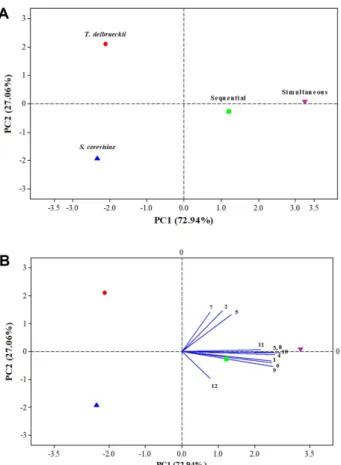
PCA was applied to assess the differences between dif- ferent fermentations and these aromatic compounds.
The first two principal components accounted for 83.67%
of the total variance in the wines, with PC1 accounting for 72.94% of the total variance and PC2 27.06% (Fig. 1).
The wines obtained from both pure and mixed cultures could be clearly separated, possibly due to the different formation paths of the aroma compounds in these wines (Fig. 1A). The simultaneous and sequential cultures were in the positive part of PC1, and there was high levels of alcohol and esters in these wines, which were cor- related to the high concentration of OAVs in the co- cultures (Table 3). This finding was in agreement with Table 3. The odor activity values (OAVs) in golden dried longan wines cultured with different yeast strains.
Compounds Longan
juice S. cerevisiae T. delbrueckii Simultaneous Sequential Odor Threshold
(mg/l) References Alcohols
Ethanol - - - -
Ethylhexanol - - - -
Isobutanol - 0.26 0.19 0.54 0.51 40 [45]
Isoamyl alcohol - 2.24 2.02 3.25 3.41 30 [45]
Methionol - - - -
2-Phenylethanol - 2.71 2.97 2.92 2.92 10 [45]
Esters
Ethyl acetate - 1.01 1.07 1.72 1.81 7.5 [45]
Ethyl butanoate - - - 58 62 0.02
Ethyl decanoate - 55.75 70.00 72.10 62.05 0.2 [46]
Ethyl 9-decenoate - - - -
Ethyl dodecanoate - 0.36 0.36 0.36 0.41 5.9 [45]
Ethyl heptanoate - - - -
Ethyl hexanoate - 3242.00 2524.00 5290.00 3658.00 0.005 [12]
Ethyl nonanoate - - - -
Ethyl octanoate - 15565.00 19640.00 19320.00 16485.00 0.002 [45]
Ethyl pentanoate - - - -
Isoamyl acetate - 1109.00 1119.00 1680.00 1505.33 0.03 [17]
Isobutyl acetate - 0.65 - 2.00 1.07 1.6 [46]
Phenylethyl acetate - - - 9.04 9.44 0.25 [46]
Isoamyl propionate - - - -
Miscellaneous
1, 3, 6-Octatriene, 3, 7-dimethyl-, (E)- - - -
1, 3, 7-Octatriene, 3, 7-dimethyl-, (E)- - - -
2,3-Butanediol - - - -
Acetic acid - 0.04 0.04 0.04 0.04 200 [45]
D-Limonene - - - 42.67 - 0.015 [47]
Linalool - 53.33 - 62.00 - 0.015 [45]
Oxime-, methoxy-phenyl- - - -
recent research demonstrating that the co-culture fer- mentation of T. delbrueckii and S. cerevisiae generated remarkably more of the desired aroma compounds [7].
The biplot of Isoamyl alcohol, ethyl acetate, ethyl
butanoate, ethyl hexanoate, isoamyl acetate, isobutyl acetate, phenylethyl acetate and D-limonene were positioned in the positive part of PC1 and were also found between both the co-culture plots, suggesting that these volatile compounds could be produced at a high level from both co-cultures (Fig. 1B). Furthermore, the biplot of 2-phenylethanol, ethyl octanoate, and ethyl decanoate were located between the T. delbrueckii plot and the simultaneous culture plot in the positive part of PC2, which could explain why their odors obtained from the T. delbrueckii and the simultaneous culture showed higher values. Additionally, linalool was found in the positive part of PC1 and the negative part of PC2, which were also positioned between the sequential culture plot and S. cerevisiae.
Total phenolic content and antioxidant activity
It is well accepted that wine is rich in oxidants. Sev- eral researchers have reported that wine phenolics have health-protective properties, such as against diabetes, osteoporosis, obesity, allergies, neurodegenerative dis- eases, cardiovascular diseases, and some cancers [34].
As a result, the total phenolic content of golden dried longan juice was significantly higher than for the other wines (17.807 mg GAE/ml), followed by the sequential, simultaneous, S. cerevisiae, and T. delbrueckii cultures, with values of 5.80, 5.34, 5.20, and 4.95 mg/ml, respec- tively (Table 4). These results were higher than those reported in red wine, which varied from 1.207−4.263 mg/
ml, while only a few phenolics were found in fresh longan wine (0.781 mg/ml) [11]. Furthermore, the total phenolic content of the juice was about three-fold higher than for the other wines. Similarly, Kelebek and Selli [35] found that the total phenolic content of mandarin juice was two-fold higher than for the other wines, possibly due to Fig. 1. The principal component analysis for selected volatiles
in golden dried longan wines fermented with four cultures.
Score plot of the yeast strains (A) Biplot between the yeast strains and volatile compounds (B): Isoamyl alcohol (1); 2- Phenylethanol (2); Ethyl acetate (3); Ethyl butanoate (4); Ethyl decanoate (5); Ethyl hexanoate (6); Ethyl octanoate (7); Isoamyl acetate (8); Isobutyl acetate (9); Phenylethyl acetate (10); D-Lim- onene (11); Linalool (12).
Table 4. The total phenolic content and the antioxidant activity of golden dried longan juice and wines.
Total phenolics (mg GAE/ml)
DPPH (mg TEAC/ml)
ABTS (mg TEAC/ml)
FRAP (mg TEAC/ml)
Juice 17.807 ± 0.535a 11.180 ± 0.169a 47.314 ± 1.844a 8.788 ± 0.371a
S. cerevisiae 5.20 ± 0.19c 4.43 ± 0.10d 24.54 ± 0.23c 5.14 ± 0.40c
T. delbrueckii 4.95 ± 0.12c 4.49 ± 0.09d 23.53 ± 0.39c 5.12 ± 0.13c
Simultaneous 5.34 ± 0.10bc 4.98 ± 0.10c 24.97 ± 0.35c 5.26 ± 0.21c
Sequential 5.80 ± 0.16b 6.80 ± 0.23b 28.06 ± 0.38b 5.97 ± 0.22b
Values of different superscripts in the same column are significantly different (p < 0.05)
the transformation of phenolic compounds into con- densed forms that possessed slightly different chemi- cal properties, as was also confirmed by Akalin et al.
[36] in pomegranate juice and wines.
The antioxidant capacity of golden dried longan wines was estimated by three methods namely, DPPH, ABTS, and FRAP. DPPH is an assay method that measures changes in the concentration of stable free radicals according to the electron-donating ability of the sample [37]. The oxidation activity of the wines ranged from 4.43 to 6.80 mg TEAC/ml, and 11.18 mg TEAC/ml for the juice. Here, the golden dried longan wines had a markedly higher antioxidant capacity (DPPH) than reported in the previous studies of Kelebek and Selli [35]
and Lorenzo et al. [38].
The antioxidant capacity values of the wines from different cultures decreased in the order: golden dried longan juice > sequential > simultaneous > T. delbrueckii
> S. cerevisiae. The decrease in the antioxidant capacity values of dried longan juice was possibly due to the for- mation and oxidation of phenolic compounds [35].
In ABTS, a radical cation is synthesized in the stable form using potassium persulphate [39]. The antioxidant activity of the wines by the ABTS assay ranged from 23.53−28.06 mg TEAC/ml. Among the four treatments, the sequential culture had the highest antioxidant capacity, followed by the simultaneous, S. cerevisiae, and T. delbrueckii cultures. However, the antioxidant capac- ity of dried longan juice was higher than for the wines, confirming earlier findings [35].
The FRAP assay determines the reducing potential of an antioxidant reacting with an Fe3+-TPTZ complex to producing Fe2+-TPTZ [39]. The FRAP values ranged from a minimum of 5.12 to a maximum of 8.79 mg TEAC/ml in wines fermented with T. delbrueckii and dried longan juice, respectively. Dried longan wine prepared by the sequential culture between S. cerevisiae and T. delbrueckii had the highest FRAP value (5.97 mg TEAC/ml) among the four fermented.
The Pearson’s correlation coefficients of total phenolic content with the DPPH, FRAP, and ABTS assays were 0.954, 0.992, and 0.974, respectively. The differences among the three antioxidant activity assays, namely the DPPH, ABTS, and FRAP, results depended on the chemical reagent involved. However, these results also showed a strong correlation between total phenolic con-
tent and the three methods used for testing the antioxi- dant capacity, confirming that phenolic compounds may affect the radical scavenging activity of golden dried lon- gan juice and wine, corroborating the results in the wines tested by other researchers [16, 35, 38].
Amino acids are synergistic antioxidants. Their mech- anism can be enhanced by the chelation of pro-oxidative metal traces and by regeneration of the oxidized primary antioxidants [40]. Additionally, it was previously reported that proline functions as an antioxidant, and also it was suggested it scavenges intracellular reactive oxygen species (ROS) to protect cells from oxidative damage [41]. β-Alanine functions (at least in part) by combining with histidine to generate carnosine by the enzyme car- nosine synthase, in which carnosine is a non-enzymatic free radical scavenger and natural antioxidant [42, 43].
Furthermore, other researchers have demonstrated that GABA is produced primarily by the decarboxylation of L-glutamic acid and catalyzed by glutamate decarboxy- lase and also that it functions as a bioactive compound.
This bioactive compound could potentially protect against or ameliorate the oxidative stress induced by nephrectomy or chronic kidney disease [44]. As seen in Table 1, proline, alanine, glutamic acid, leucine, and GABA were identified as the main amino acids in golden dried longan wines. These results let us hypothesize that the residues of amino acids, especially the most abun- dant amino acids, are correlated to the total phenolic content and related to the antioxidant activity in golden dried longan juice and wines.
Acknowledgments
This research was financially supported by National Pingtung Uni- versity of Science and Technology.
Conflict of Interest
The authors have no financial conflicts of interest to declare.
References
1. Chang CY, Chang CH, Yu TH, Lin LY, Yen YH. 1998. The effect of drying treatment on the flavour and quality of longan fruit. Food Flavours: Formation Analysis and Packaging Influences 40: 353- 367.
2. Azzolini M, Fedrizzi B, Finato F, Vagnoli P, Scrinzi C. 2012. Effects of
Torulaspora delbrueckii and Saccharomyces cerevisiae mixed cul- tures on fermentation and aroma of Amarone wine. Eur. Food Res.
Technol. 235: 303-313.
3. Azzolini M, Tosi E, Lorenzini M, Finato F, Zapparoli G. 2015. Contri- bution to the aroma of white wines by controlled Torulaspora delbrueckii cultures in association with Saccharomyces cerevisiae.
World J. Microbiol. Biotechnol. 31: 277-293.
4. Renault P, Miot-Sertier C, Marullo P, Hernández-Orte P, Lagarrigue L, Lonvaud-Funel A, et al. 2009. Genetic characterization and phenotypic variability in Torulaspora delbrueckii species: Poten- tial applications in the wine industry. Int. J. Food Microbiol. 134:
201-210.
5. Hansen EH, Nissen P, Sommer P, Nielsen JC, Arneborg N. 2001.
The effect of oxygen on the survival of non-Saccharomyces yeasts during mixed culture fermentations of grape juice with Saccharomyces cerevisiae. J. Appl. Microbiol. 91: 541-547.
6. Renault P, Coulon J, Barbe JC, Bely M. 2015. Increase of fruity aroma during mixed T.delbrueckii/S.cerevisiae wine fermentation is linked to specific esters enhancement. Int. J. Food Microbiol.
207: 40-48.
7. Zhang BQ, Luan Y, Duan CQ, Yan GL. 2018. Use of Torulaspora del- brueckii Co-fermentation with two Saccharomyces cerevisiae strains with different aromatic characteristic to improve the diversity of red wine aroma profile. Front. Microbiol. 9: 606.
8. Surin S, Thakeow P, Seesuriyachan P, Angeli S, Phimolsiripol Y.
2014. Effect of extraction and concentration processes on prop- erties of longan syrup. J. Food Sci. Technol. 51: 2062-2069.
9. Trinh TTT, Woon WY, Yu B, Liu SQ. 2010. Effect of L-isoleucine and L-phenylalanine addition on aroma compound formation during longan juice fermentation by a co-culture of Saccharomyces cere- visiae and Williopsis saturnus. S. Afr. J. Enol. Vitic. 31: 116-124.
10. Trinh TTT, Yu B, Curran P, Liu SQ. 2012. Formation of aroma com- pounds during longan juice fermentation by Williopsis saturnus var. saturnus with the addition of selected amino acids. J. Food Process Preserv. 36: 198-206.
11. Liu G, Sun J, He X, Tang Y, Li J, Ling D, et al. 2018. Fermentation process optimization and chemical constituent analysis on lon- gan (Dimocarpus longan Lour.) wine. Food Chem. 256: 268-279.
12. Chen D, Liu SQ. 2014. Chemical and volatile composition of lychee wines fermented with four commercial Saccharomyces cerevisiae yeast strains. Int. J. Food Sci. Tech. 49: 521-530.
13. Waters C. 1993. Waters AccQ. Tag Chemistry Package (Instruction Manual), pp. 1-5. Ed. Millipore Corporation, Milford, MA, USA.
14. Zeng F, Ou J, Huang Y, Li Q, Xu G, Liu Z, et al. 2015. Determination of 21 free amino acids in fruit juices by HPLC using a modification of the 6-aminoquinolyl-N-hydroxysuccinimidyl carbamate (AQC) method. Food Anal. Methods 8: 428-437.
15. Nuengchamnong N, Ingkaninan K. 2010. On-line HPLC-MS- DPPH assay for the analysis of phenolic antioxidant compounds in fruit wine: Antidesma thwaitesianum Muell. Food Chem. 118:
147-152.
16. Buyuktuncel E, Porgalı E, Colak C. 2014. Comparison of total phe- nolic content and total antioxidant activity in local red wines
determined by spectrophotometric methods. Food Nutr. Sci. 5:
1660-1667.
17. Chen D, Liu SQ. 2016. Impact of simultaneous and sequential fer- mentation with Torulaspora delbrueckii and Saccharomyces cere- visiae on non-volatiles and volatiles of lychee wines. LWT-Food Sci. Technol. 65: 53-61.
18. Ingledew WM, Magnus CA, Sosulski FW. 1987. Influence of oxy- gen on proline utilization during the wine fermentation. Am. J.
Enol. Vitic. 38: 246-248.
19. Brandriss MC, Falvey DA. 1992. Proline Biosynthesis in Saccharo- myces cerevisiae: Analysis of the PRO3 gene, which encodes Δ1- Pyrroline-5-carboxylate reductase. J. Bacteriol. 174: 3782-3788.
20. Tomenchok DM, Brandriss MC. 1987. Gene-enzyme relationships in the proline biosynthetic pathway of Saccharomyces cerevisiae.
J. Bacteriol. 169: 5364-5372.
21. Brandriss MC. 1983. Proline utilization in Saccharomyces cerevisiae:
Analysis of the cloned PUT2 gene. Mol. Cell. Biol. 3: 1846-1856.
22. Takagi H. 2008. Proline as a stress protectant in yeast: physiological functions, metabolic regulations, and biotechnological applica- tions. Appl. Microbiol. Biotechnol. 81: 211-223.
23. Degols G, Jauniaux JC, Wiame JM. 1987. Molecular characteriza- tion of transposable-element-associated mutations that lead to constitutive L-ornithine aminotransferase expression in Saccha- romyces cerevisiae. Eur. J. Biochem. 165: 289-296.
24. Sumrada RA, Cooper TG. 1984. Nucleotide sequence of the Saccharomyces cerevisiae arginase gene (CAR1) and Its transcription under various physiological conditions. J. Bacteriol. 160: 1078-1087.
25. Arslan E, Celik ZD, Cabaroglu T. 2018. Effects of pure and mixed autochthonous Torulaspora delbrueckii and Saccharomyces cerevisiae on fermentation and volatile compounds of narince wines. Foods 7: 1-12.
26. Swiegers JH, Bartowsky EJ, Henschke PA, Pretorius IS. 2005. Yeast and bacterial modulation of wine aroma and flavour. Aust. J.
Grape Wine Res. 11: 139-173.
27. Lee PR, Ong YL, Yu B, Curran P, Liu SQ. 2010. Evolution of volatile compounds in papaya wine fermented with three Willopsis saturnus yeasts. Int. J. Food Sci. Techol. 45: 2032-2041.
28. Zhang J, Zhang C, Qi Y, Dai L, Ma H, Guo X, et al. 2014. Acetate ester production by Chinese yellow rice wine yeast overexpress- ing the alcohol acetyltransferase-encoding gene ATF2. Genet.
Mol. Res. 4: 9735-9746.
29. Lilly M, Bauer FF, Lambrechts MG, Swiegers JH, Cozzolino D, Pre- torius IS. 2006. The effect of increased yeast alcohol acetyltrans- ferase and esterase activity on the flavour profiles of wine and distillates. Yeast 23: 641-659.
30. Saerens SMG, Delvaux FR, Verstrepen KJ, Thevelein JM. 2010.
Production and biological function of volatile esters in Saccha- romyces cerevisiae. Microbe. Biotechnol. 3: 165-177.
31. Saerens SMG, Verstrepen KJ, Van Laere SDM, Voret ARD, Dijck PV, Delvaux FR, et al. 2005. The Saccharomyces cerevisiae EHT1 and EEB1 genes encode novel enzymes with medium-chain fatty acid ethyl ester synthesis and hydrolysis capacity. J. Biol. Chem. 281:
4446-4456.
32. Äyräpää T, Lindström I. 1977. Aspects of the influence of exogenous fatty acids on the fatty acid metabolism of yeast. Proc. Eur. Brew Conv. 16: 507-517.
33. Moreno-Arribas MV, Polo M. 2009. Wine Chemistry and Biochemistry.
pp. 463-496. Ed. Springer, New York.
34. Fernandes I, Pérez-Gregorio R, Soares S, Mateus N, Freitas V. 2017.
Wine flavonoids in health and disease prevention. Molecules 22:
292.
35. Kelebek H, Selli S. 2014. Identification of phenolic compositions and the antioxidant capacity of mandarin juices and wines. J.
Food Sci. Technol. 51: 1094-1101.
36. Akalin AC, Bayram M, Anli RE. 2017. Antioxidant phenolic com- pounds of pomegranate wines produced by different macera- tion methods. J. Inst. Brew. 124: 38-44.
37. Rahman MM, Islam MB, Biswas M, Khurshid Alam AH. 2015. In vitro antioxidant and free radical scavenging activity of Nardo- stachys jatamansi DC. J. Acupunct. Meridian Stud. 3: 112-118.
38. Lorenzo CD, Badea M, Colombo F, Orgiu F, Frigerio F, Pastor RF, et al. 2017. Antioxidant activity of wine assessed by different in vitro methods. BIO Web of Conferences. 9: 1-6.
39. Rajurkar NS, Hande SM. 2011. Estimation of phytochemical con- tent and antioxidant activity of some selected traditional indian medicinal plants. Ind. J. Pharm. Sci. 73: 146-151.
40. Marcuse R. 1960. Antioxidative effect of amino-acids. Nature 186:
886-887.
41. Takagi H, Taguchi J, Kaino T. 2016. Proline accumulation protects Saccharomyces cerevisiae cells in stationary phasefrom ethanol stress by reducing reactive oxygen specie. Yeast 33: 355-363.
42. Mocchegiani E, Straub RH. 2004. Possible new anti-ageing strate- gies related to neuroendocrine-immune interactions. NeuroIm- mune Biol. 4: 399-407.
43. Schnuck JK, Sunderland KL, Kuennen MR, Vaughan RA. 2016.
Characterization of the metabolic effect of β-alanine on markers of oxidative metabolism and mitochondrial biogenesis in skele- tal muscle. J. Exerc. Nutr. Biochem. 20: 34-41.
44. Diana M, Quílez J, Rafecas M. 2014. Gamma-aminobutyric acid as a bioactive compound in foods: a review. J. Funct. Foods 10: 407- 420.
45. Guth H. 1997. Quantitation and sensory studies of character impact odorants of different white wine varieties. J. Agric. Food Chem. 45: 3027-3032.
46. Cullere L, Escudero A, Cacho J, Ferreira V. 2004. Gas chromatography- olfactometry and chemical quantitative study of the aroma of six premium quality spanish aged red wines. J. Agric. Food Chem. 52:
1653-1660.
47. Casassa LF, Sari SE, Bolcato EA, Diaz-Sambueza MA, Catania AA, Fanzone ML, et al. 2019. Chemical and sensory effects of cold soak, whole cluster fermentation, and stem additions in pinot noir wines. Am. J. Enol. Vitic. 70: 19-33.