KOREAN J. FOOD SCI. TECHNOL. Vol. 42, No. 6, pp. 739~742 (2010)
739
©The Korean Society of Food Science and Technology
활성건조효모를 이용한 오미자 발효주의 이화학 및 관능 특성
이시형
1·박혜경·김명희*
영남대학교 식품공학과, 1농림수산식품기술기획평가원 기술기획실
Physicochemical Characteristics and Sensory Properties of
Omija Wines Fermented by Active Dry Yeast Strains
Sihyung Lee, Hae-Kyung Park, and Myunghee Kim* Department of Food Science and Technology, Yeungnam University
1Technology Planning Office, Korea Institute of Planning and Evaluation for
Technology in Food, Agriculture, Forest and Fisheries
Abstract In order to select a superior yeast, 8 kinds of commercial active dry yeasts (Lalvin 1116, Lalvin 1118, Lalvin D-47, Lalvin Bourgovin, Parisienne, Fermivin, Red Star Monrachet, and Red Star Premier Cuvee) were utilized for omija wine fermentation. During fermentation, the physicochemical characteristics and sensory properties of the various omija wines were evaluated. According to the results, pH and titratable acidity were in ranges of 3.0-3.3% and 1.8-2.4%, respectively. Sugar content was 24oBx at early fermentation and changed to 8.4-10.2oBx at 24 days of fermentation. While the omija wines fermented by Lalvin D-47 and Red Star Premier Cuvee showed the highest alcohol contents (13.0%), the omija wine fermented by Parisienne showed the lowest alcohol content (10.8%). The omija wine fermented by Lalvin 1118 had an alcohol content of 12.0% and showed the lowest yeast count of 5.8 log CFU/mL. Hunter's values (L, a, and b) were all different among the 8 omija wines. Moreover, the omija wine fermented by Lalvin 1118 showed the highest scores for taste (6.75±1.68), swallowing (6.65±1.50), and overall acceptability (6.70±1.34). It is concluded that Lalvin 1118 was the best yeast among 8 tested commercial active dry yeasts, having a high potential for omija wine fermentation.
Key words: active dry yeast, Lalvin 1118, omija, physicochemical characterization, sensory evaluation
서
론
오미자는 단맛, 신맛, 쓴맛, 떫은 맛, 짠맛 등의 5가지 맛과 특 이한 방향을 가지고 있어 옛날부터 오미자차, 오미자술 등의 기호 식품으로 많이 애용되어 왔으며(1), 한방에서는 진정, 진해, 해열 등의 작용과 혈당강하(2) 및 알코올 해독 작용 등(3)에 도움이 된 다 하여 약용으로도 효용이 인정되어 왔다. 이와 같이 오미자의 생리활성물질과 일반성분에 대한 연구는 많은 사람들에게 관심의 대상이 되어 오미자의 생리활성물질인 lignan 화합물에 대해 Nakajima 등(4), Sohn과 Bock(5), Kim 등(6)이 보고하였고, Kim 등 (7)은 오미자의 휘발성 성분, Lee와 Lee(8) 그리고 Oh 등(9)은 오 미자의 유리당, 지질, 유기산, 총아미노산, 유리아미노산, Hyun 등 (10)은 오미자의 일반 성분을 비롯하여 유리 페놀산, 페놀 ester와 같은 특수성분까지 포괄적인 분석을 실시하였다. Lee 등(11)은 오 미자의 부위별 일반성분 및 무기질 함량을 발표하는 등 수많은 연 구자들에 의해 오미자 일반성분에 대한 보고들이 활발히 이루어 졌다. 이 외에도 오미자의 기능성에 대한 많은 연구들(12,13)이 속 속 발표되면서 오미자 가공기술의 발달에 따라 약효적·생화학적 특성과 기능성이 뛰어난 오미자 발효주에 대한 관심이 대두되었다. 일반적으로 오미자를 이용하여 제조된 술은 침출주와 발효주 로 구분되는데, 술의 제조과정 중 첨가물(보당원 등)이 용이한 침 출주 제조 형태와, 침출주에 비해 상대적으로 알코올의 함량이 낮고, 첨가물의 처리가 용이하지 않는 발효주의 제조 형태가 있 다(14). 오미자 침출주는 기호성이 우수하지만 오미자의 기능성 을 효과적으로 구현할 수 없는 단점을 가지고 있는 반면, 오미자 발효주는 술의 제조 공정 중 보당원 등과 같은 첨가물이 용이하 지 않아 침출주에 비해 기호성은 낮으나 우수한 기능성을 가지 고 있다. 오미자 발효주의 기호성 향상과 오미자의 기능성에 대 한 효과적 구현과 오미자 발효주의 품질 및 제조 공정 개선에 대 한 노력들의 일환으로 오미자 건과 또는 생과에다 발효성 당과 물 및 효모를 첨가하여 오미자 발효주 제조를 개선한 방법(14)과 오미자의 씨를 제거한 후 건조한 오미자 과육과 선별 균주를 이 용한 오미자 발효주의 품질 개선방법(15)이 제시되었다. 또한 오 미자 발효주의 제조 공정을 바탕으로 제조 방법에 따른 오미자 발효주의 이화학 특성과 관능적 특성(16)에 관해 보고된 바 있다. 효모를 이용한 양조주 최적화 시도를 위하여 활성건조효모를 이용한 포도주 양조에 대한 품질 개선(17-19), 활성건조효모를 이 용한 적포도주의 발효 특성에 대한 연구(20)가 보고된 바 있으나 효모를 이용한 오미자 양조주 최적화에 대한 연구는 아직 이루 어지지 않고 있다. 그러므로 본 연구에서는 오미자 발효주에 있 *Corresponding author: Myunghee Kim, Department of FoodSci-ence and Technology, Yeungnam University, Gyeongsan, Gyeong-buk 712-749, Korea
Tel: 82-53-810-2958 Fax: 82-53-810-4662 E-mail: [email protected]
Received October 29, 2010; revised November 22, 2010; accepted November 22, 2010
740 한국식품과학회지 제 42 권 제 6 호 (2010) 어서 중요한 효모 발효의 최적화를 위하여 시중에서 판매되고 있 는 다양한 활성건조효모를 이용하여 오미자 발효주를 제조한 후 오미자 발효주의 이화학적 특성과 관능적 특성을 규명함으로써 오미자 양조의 최적화를 시도하고자 하였다.
재료 및 방법
재료 2007년 가을에 경상북도 문경시에서 수확한 오미자를 냉동 보 관하여 사용하였으며, 활성건조효모는 Lalvin사(Beaverbank, Can-ada)에서 구입한 Lalvin 1116, 1118, D-47 및 Bourgovin 4종과 Parisienne(Moulins de Granges, Granges-près-Marnand, Switzer-land), Fermivin(DSM, Zac, France), Red Star Monrachet(Red Star, Milwaukee, WI, USA), Red Star Premier Cuvee(Red Star) 총 8종을 구입하여 사용하였다. 오미자 발효주 제조 오미자 25 g, 설탕 150 g, 증류수 500 mL을 삼각플라스크에 담 아 고무마개에 air lock으로 고정한 다음 70oC에서 30분간 저온 살균하여 실온에서 냉각시킨 후 건조효모 0.5 g을 접종하였다. 발 효온도 및 발효기간은 각각 25oC, 24일간 발효시켜 8종의 오미 자 발효주를 제조하였다. 화학적 특성 분석 pH, 총산도, 당도 및 알코올 함량 측정 시판 활성건조효모 8종 으로 제조한 오미자 발효주의 pH는 pH meter(Thermo Co., Bev-erly, MA, USA)로 측정하였고, 산도 측정은 AOAC법(21)에 의하 여 오미자즙 20 mL을 pH가 8.3에 도달할 때까지 0.1 N NaOH 용 액으로 적정한 후 0.1 N NaOH 소요량을 lactic acid(%) 함량으로 환산하였다. 당도 측정은 8종의 오미자 발효주를 채취하여 당도 계(Atago, Tokyo, Japan)를 사용하여 당도를 측정하였다(16). 알코 올 함량 측정은 시료 100 mL를 증류한 후 상온에서 주정계 (Daekwang Inc., Seoul, Korea)를 이용하여 국세청기술연구소 주 류분석규정에 따라 부칭법으로 측정한 후 15oC에서 Gay-Lussac의 주정환산표로 보정하였다(22). 효모수 측정
효모수 측정은 식품공전(23)에 따라 오미자 발효주 10 mL을 무 균적으로 취하여 표준평판법에 준하여 각 희석액 1 mL씩을 취하 여 YM(Difco, Sparks, MD, USA) 평판배지에 분주하고 35oC에서
48시간 배양하였으며, 각 배지에 형성된 집락을 계수하여 log colony forming unit(log CFU/mL)로 나타내었다.
색도 분석
8종의 시판 활성건조효모를 이용하여 제조한 오미자 발효주의 색도 측정은 발효 후 여과한 시료를 색차계 CR-200(Minolta, Osaka, Japan)을 이용하여 Hunter value(L, lightness; a, redness; b, yellowness)로 표시하였으며, 표준색판은 L=96.43, a=+0.03, b= +1.79이었다. 관능검사 및 통계분석 8종의 시판 활성건조효모를 이용하여 제조한 오미자 발효주의 관능검사를 위해 20명을 선정하여 훈련시켰으며, 이들의 연령은 20-34세로 분포되었다. 관능평가 방법은 오미자 발효주의 색, 향, 맛, 목넘김, 종합적 기호도에 대해 9점 척도법을 사용하여 가장 싫다 1, 가장 좋다 9의 점수로 표시하였다. 각 시험군의 평균과 표준편차는 SPSS Ver. 14.0 package program(SPSS Inc. Chicago, IL, USA)을 이용하여 산출하였으며, Duncan의 다중범위분석법으 로 각 시험구간의 유의차를 5%(p<0.05) 유의수준에서 검증하였다.
결과 및 고찰
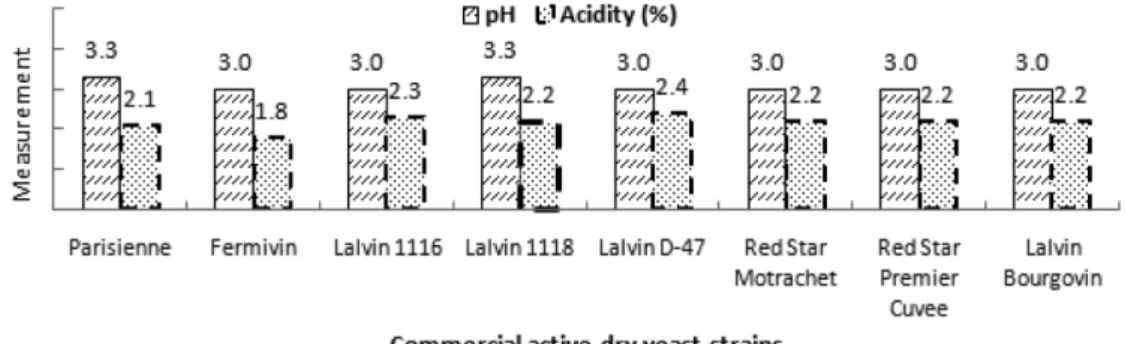
pH 및 총산도 측정 8종의 활성건조효모를 이용한 오미자 발효주의 pH와 총산도를 비교한 결과, Fig. 1에 나타난 바와 같이 pH는 3.0-3.3, 산도는 1.8-2.4%로 나타났다. Park 등 (24)의 연구에서 시판 포도 와인의 pH는 3.61-3.86으로 오미자 발효주 pH인 3.0-3.3보다 높게 나타났는데, 8가지 오미자 발효주의 pH가 포도주 와인보다 낮게 나타난 것은 오미자 과일 자체의 낮은 pH 때문이라 사료된다. 8종의 활성건조효모를 이용한 오미자 발효주의 산도는 1.8-2.4% 로 나타났다. Moon 등(18)의 연구에서 포도주 발효주의 산도는 0.1%로 나타났으나 오미자를 사용한 발효주의 경우 산도가 높은 것은 오미자 자체의 신맛이 포도에 비해 강하기 때문이라 사료 된다. 일반적으로 산도는 발효주의 품질에 중요한 영향을 미치는 데 특히 총산도가 높으면 신맛이 강하기 때문에 부재료를 가하 여 총산도를 낮추거나 calcium carbonate 등을 이용한 화학적 중 화법으로 총산도를 낮추는 방법이 사용되기도 한다(25). 당도 및 알코올 함량 측정 활성건조효모를 이용한 오미자 발효주의 당도와 알코올 함량 을 비교한 결과를 Fig. 2에 나타내었다. 당도는 발효초기 24oBx 에서 24일 후 8.4-10.2oBx로 나타났다. 다른 선행 보고에서는 단 감, 수박을 이용한 발효주의 경우 발효초기는 24oBx로 나타났으 나 발효 후기는 4.6-8.6oBx로 모두 감소하는 것으로 나타났다활성건조효모를 이용한 오미자 발효주의 이화학 및 관능 특성 741 (26,27). 발효 초기와 발효 후기에서 당도의 급격한 변화는 효모 가 에너지원으로 당을 사용함으로써 감소된 것이다(28,29). 활성 건조효모를 이용한 오미자 발효주 8 종류의 알코올 함량을 측정 한 결과, 오미자 발효주의 알코올 함량은 10.8-13.0%로 나타났는 데, 이는 각각 효모의 오미자에 대한 발효력이 상이하여 알코올 함량 차이를 보인 것으로 사료된다. 효모수 측정
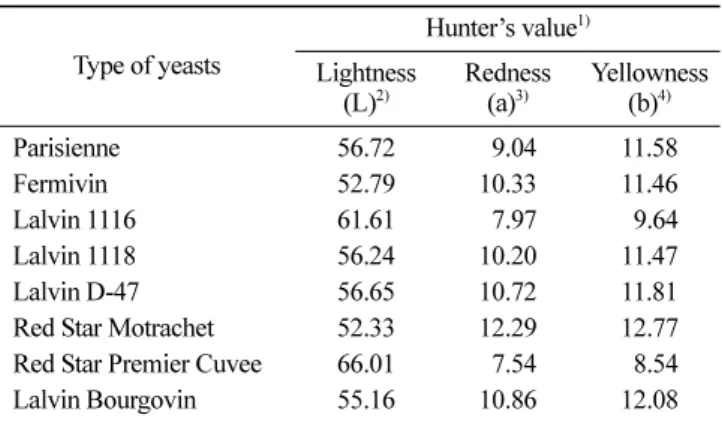
Parisienne, Fermivin, Lalvin 1116, Lalvin 1118, Lalvin D-47, Red Star Motrachet, Red Star Premier Cuvee, Lalvin Bourgovin 을 이용하여 제조한 8종의 오미자주의 총 균수는 각각 7.0±0.3 log CFU/mL, 7.4±0.1 log CFU/mL, 7.7±0.2 log CFU/mL, 5.8±0.4 log CFU/mL, 7.4±0.4 log CFU/mL, 7.4±0.1 log CFU/ mL, 7.4±0.5 log CFU/mL, 7.5±1.0 log CFU/mL로 나타났다. Lalvin 1118로 제조한 오미자 발효주의 총 균수는 5.8 log CFU/ mL로 가장 낮게 나타났고, 그 외 7종으로 제조한 오미자 발효주 의 총 균수는 비슷하게 나타났다. 색도 분석 활성건조효모를 이용한 오미자 발효주의 색도를 비교한 결과, Table 1에 나타난 바와 같이 오미자 발효주 8 종류의 색도는 밝 은 정도를 나타내는 L 값이 52.33-66.01이었으며, 적색도를 나타 내는 a 값은 7.54-12.29로 나타났고, 황색도를 나타내는 b 값은 8.54-12.77로 나타났다. Lee 등(30)의 연구에 의하면 인삼박을 첨가한 약주 제조 시 원 료와 발효제의 변화에 의해 색상의 변화가 있다고 보고된 바 있 어, 본 연구 결과 8종의 효모 종류에 따라 L, a, b 값에 모두 변 화가 있는 것으로 나타났으므로 활성효모의 종류에 따라 색상에 영향을 주는 이화학적·생화학적 mechanism에 대한 연구가 더 많이 필요하리라 사료된다. 관능평가 활성건조효모 8종을 이용한 오미자 발효주의 맛, 향, 색, 목넘 김, 종합적 기호도는 Table 2에 나타내었다. Lalvin 1118을 사용 한 오미자 발효주의 맛에 대한 기호도는 6.75로 가장 높게 나타 났으며, Fermivin을 사용한 오미자 발효주의 맛에 대한 기호도가 3.75로 가장 낮게 나타났다. 활성건조효모 8종을 이용한 오미자 발효주의 향과 색의 기호 도는 각각 4.90-5.75, 5.25-6.05로 8종의 효모를 이용한 오미자 발 Fig. 2. Sucrose and alcohol contents of omija wines fermented by various commercial active dry yeast strains.
Table 1. Color values of omija wines fermented by various commercial active dry yeast strains
Type of yeasts Hunter’s value1) Lightness (L)2) Redness (a)3) Yellowness (b)4) Parisienne 56.72 09.04 11.58 Fermivin 52.79 10.33 11.46 Lalvin 1116 61.61 07.97 09.64 Lalvin 1118 56.24 10.20 11.47 Lalvin D-47 56.65 10.72 11.81 Red Star Motrachet 52.33 12.29 12.77 Red Star Premier Cuvee 66.01 07.54 08.54 Lalvin Bourgovin 55.16 10.86 12.08 1)L, lightness 0-100 (black:1, white: 100); a, redness (-: green, +: red);
b, yellowness (-: blue, +: yellow).
2)Standard L:96.43, 3)standard a:+0.03, 4)standard b:+1.79.
Table 2. Sensory evaluation of omija wines fermented by various commercial active dry yeast strains
Type of yeasts Sensory characteristics Overall
acceptability
Taste Aroma Color Swallowing
Parisienne 5.40±1.46b1) 5.75±1.29a 5.40±1.36a 5.90±1.79ab 5.60±1.07b
Fermivin 3.75±1.69d 5.75±1.67a 5.25±1.67a 4.55±1.99d 4.00±1.45d
Lalvin 1116 4.90±1.70bc 4.90±2.17a 6.05±1.77a 5.80±1.78abc 5.05±1.86bc
Lalvin 1118 6.75±1.68a 4.95±1.43a 5.80±1.36a 6.65±1.50a 6.70±1.34a
Lalvin D-47 4.90±1.33bc 5.50±1.23a 5.65±1.63a 5.20±1.74bcd 5.35±1.50bc
Red Star Motrachet 5.45±1.36b 5.00±2.20a 5.95±1.39a 5.85±1.04abc 5.40±1.39b
Red Star Premier Cuvee 3.95±1.10cd 5.00±1.52a 5.95±1.54a 4.70±1.53cd 4.35±1.46cd
Lalvin Bourgovin 4.95±1.43bc 5.45±1.50a 5.75±1.21a 5.20±1.36bcd 5.20±1.32bc
1)Mean±SD; Superscripts in the same column not sharing a common superscript are significantly different at α=0.05 by Duncan’s multiple range
742 한국식품과학회지 제 42 권 제 6 호 (2010) 효주의 향과 색에 대한 관능적 평가는 5% 수준에서 유의적 차 이를 나타내지 않았다. Lalvin 1118을 사용한 오미자 발효주의 목넘김은 6.65로 8종의 효모를 이용한 오미자 발효주 중 가장 높게 나타났으며, Fermivin 을 사용한 오미자 발효주가 4.55로 가장 낮게 나타났다. 위의 실험을 통하여 Lalvin 1118을 사용한 오미자 발효주는 맛, 목넘김, 종합적 기호도에 있어서 7종의 다른 효모를 이용한 오미자 발효주 중 가장 높게 나타났으므로 다양한 시판 활성건 조효모 중 Lalvin 1118이 오미자주 제조에 가장 적합한 것으로 사료된다.
요
약
오미자주 양조에 있어서 중요한 효모 발효의 최적화를 위하여 시중에서 판매되고 있는 다양한 활성건조효모 8종(Lalvin 1116, Lalvin 1118, Lalvin D-47, Lalvin Bourgovin, Parisienne, Fer-mivin, Red Star Monrachet, Red Star Premier Cuvee)을 선정하여 오미자주의 이화학 및 관능특성을 연구한 결과, pH 및 산도는 각 각 3.0-3.3, 1.8-2.4%였으며, 당도는 발효초기 24oBx에서 24일 후8.4-10.2oBx이었다. 활성건조효모 8종을 이용하여 제조한 오미자주
의 알코올 함량은 10.8-13.0%로 나타났으며 Lalvin D-47과 Red Star Premier Cuvee로 제조한 오미자 발효주의 알코올 함량(13.0%) 이 가장 높게 나타났다. 효모수는 Lalvin 1118로 제조한 오미자 발 효주가 5.8 log CFU/mL로 가장 낮게 나타났고, 7종의 효모수는 7.0-7.7 log CFU/mL로 비슷하게 나타났다. 색도는 효모의 종류에 따라 L, a, b 값에 모두 변화가 있는 것으로 나타났다. Lalvin 1118 을 사용한 오미자 발효주의 맛에 대한 기호도는 6.75로 가장 높 았으며, 활성건조효모 8종을 이용한 오미자 발효주의 향과 색의 기호도는 각각 4.90-5.75, 5.25-6.05로 5% 수준에서 유의적 차이를 나타내지 않았고, Lalvin 1118을 사용한 오미자 발효주의 목넘김 은 6.65로 가장 높게 나타났다. 위의 결과를 바탕으로, Lalvin 1118 을 사용한 오미자 발효주는 알코올 함량(12.0%), 맛(6.75±1.68), 목 넘김(6.65±1.50), 종합적 기호도(6.70±1.34)에서 우수한 관능적 특성 과 과실주로서의 적절한 알코올 함량을 나타냈으므로 Lalvin 1118 은 오미자주 발효에 가장 적합한 것으로 사료된다.
문
헌
1. Kang KC, Park JH, Baek SB, Jhin HS, Rhee KS. Optimization of beverage preparation from Schizandra chinensis Baillon by response surface methodology. Korean J. Food Sci. Technol. 24: 74-81 (1992)
2. Kim SI, Sim KH, Ju SY, Han YS. A study of antioxidative and hypoglycemic activities of omija (Schizandra chinensis Baillon) extract under variable extract conditions. Korean J. Food Nutr. 22: 41-47 (2009)
3. Lee. JS, Lee SW. Effects of extracts in fruits of omija (Schizan-dra chinensis Baillon) on alcohol metabolism. Korean J. Diet. Culture 5: 259-263 (1990)
4. Nakajima K, Tauchi H, Ikeya Y, Endo, T, Yosioka I. The constit-uents of Schizandra chinensis Baillon. Quantitative analysis of lignans in the fruits of Schizandra chinensis Baillon. by high per-formance liquid chromatography. Jpn. J. Pharm. Soc. 103: 743-749 (1983)
5. Sohn HJ, Bock JY. Identification of lignan compounds in fruits of Schizandra chinensis Baillon by gas chromatography/mass spec-trometry. J. Korean Agric. Chem. Soc. 32: 344-349 (1989)
6. Kim KS, Ryu SN, Kang SS. Quantitative analysis of lignans from fruits of Schizandra chinensis. Korean J. Pharmacogn. 33: 272-276 (2002)
7. Kim KS, Song JS, Bang JK. Changes in volatile compounds of
Schizandra chinensis fruits according to drying and extracting methods. Korean J. Medicinal Crop. Sci. 8: 49-57 (2000)
8. Lee JS, Lee SW. A study on the composition of fee sugars, lip-ids, and non-volatile organic aicds in parts of omija (Schizandra chinensis Baillon). Korean J. Diet. Culture 4: 177-179 (1989) 9. Oh SL, Kim SS, Min BY, Chung DH. Composition of free
sug-ars, free amino acids, non-volatile organic acids and tannins in the extracts of L. chinensis M, A. acutiloba K, S. chinensis B. and A. sessiliflorum S. Korean J. Food Sci. Technol. 22: 76-81 (1990)
10. Hyun KH, Kim HJ, Jeong HC. A study on determining chemical composition of Schizandra chinensis. Korean J. Plant. Res. 15: 1-7 (2002)
11. Lee JS, Lee MG, Lee SW. A study on the general components and minerals in parts of omija (Schizandra chinensis Baillon). Korean J. Diet. Culture 4: 173-176 (1989)
12. Lee SH, Lee YC, Yoon SK. Isolation of the antimicrobial com-pounds from omija (Schizandra chinensis) extract. Korean J. Soc. Food Sci. Technol. 35: 483-487 (2003)
13. Kim JS, Choi SY. Physicochemical properties and antioxidative activities of omija (Schizandra chinensis Baillon). Korean J. Food Nutr. 21: 35-42 (2008)
14. Park YS, Baek YH, Lee YB, Park GJ, Oh JH, Jang EJ, Kim YB. Method of omija wine. Korean Patent 1990-0000468 (1990) 15. Jung MJ, Lee HY. Method of omijaju. Korean Patent 10-0566939
(2006)
16. Lee S, Kim M. Comparison of physicochemical and organoleptic characteristics of omija wines made by different methods. J. Korean Soc. Food Sci. Nutr. 38: 182-187 (2009)
17. Moon YJ, Lee MS, Sung CK. Contents of amino acids in rasp-berry wine using active dry yeast strains. Korean J. Food Nutr. 19: 392-397 (2006)
18. Moon YJ, Lee MS, Sung CK. The fermentation properties of red wine using active dry yeast strains. Korean J. Food Nutr. 17: 450-457 (2004)
19. Lee MS, Moon YJ, Sung CK. Physicochemical properties of red wine using active dry yeast strains. Korean J. Food Nutr. 16: 203-208 (2003)
20. Kim, JS, Sim JY, Yook C. Development of red wine using domestic grapes, campbell early. Part (i) - Characteristics of red wine fermentation using campbell early and different sugars -Korean Soc. Food Sci. Technol. 33: 319-326 (2001)
21. AOAC. Official Methods of Analysis. 17th ed. Association of
Official Analytical Chemists, Washington DC., USA. p. 942 (2000)
22. NTSTSI. Official Analysis Methods of NTSTSI. National Tax Service Technical Service Institute, Seoul, Korea. pp. 37-38, pp. 103-115 (2008)
23. KFDA. Food Code. Korea Food & Drug Administration, Seoul, Korea. p. 689 (2006)
24. Park MH, Lee JO, Kim EJ, Kim JW, Lee HH, Kim HH, Lee SI, Kim YH, Ryu CH. Establishment of tannin enhancement condi-tions for development of high quality wild grape wine. J. Korean Soc. Food Sci. Nutr. 37: 1-7 (2008)
25. Iverson J. Home Wine Making Step; A Guide to Fermenting Wine Grapes. 3rd ed. Stonemark Publishing Co., Medford, MA,
USA (2000)
26. Cho KM, Lee JB, Kahng GG, Seo WT. A study on the making of sweet persimmons (Diospyros kaki T) wine. Korean J. Food Sci. Technol. 38: 785-792 (2006)
27. Hwang Y, Lee KK, Jung GT, Ko BR, Choi DC, Choi YG, Eun JB. Manufacturing of wine with watermelon. Korean J. Food Sci. Technol. 36: 50-57 (2004)
28. So MH, Lee YS, Noh WS. Change in microorganisms and main components during takju brewing by modified nuruk. Korean J. Food Nutr. 12: 226-232 (1999)
29. Han EH, Lee TS, Noh BS, Lee DS. Quality characteristics in mash of takju prepared by using different nuruk during fermenta-tion. Korean J. Food Sci. Technol. 29: 555-562 (1997)
30. Lee IS, Yang EJ, Jeong YJ, Seo JH. Fermentation process and physiochemical characteristics of yakju with addition of ginseng powder. Korean J. Postharv. Sci. Technol. 6: 463-468 (1999)