Expanded, Dual, Coaxial Jet
Lee Kwon-Hee
†, Setoguchi Toshiake*, and Kim Heuy-Dong**
노즐 형상이 부족팽창 동축제트 근접 유동장에 미치는 영향
이 권희, 세토구치 토시아키, 김 희동
Key Words : Nozzle-Lip Thickness(노즐 끝단 두께), Secondary Stream Thickness(이차 유동 두께), Dual Coaxial Nozzle(이중 동축 노즐), Mach Disk(마하디스크), Annular Shock Wave(환 형충격파)
Abstract
The near field structures of an under-expanded, dual, coaxial, jets issuing from the coaxial nozzles with four different geometries are visualized by using a shadowgraph optical method. Experiments are conducted to investigate the effects of the nozzle-lip thickness, secondary stream thickness, the nozzle pressure ratio and the secondary swirl stream on the characteristics of under-expanded jets. The results show that the presence of secondary annular swirling stream causes the Mach disk to move further downstream and increases its diameter, which decreases with a decrease in the nozzle-lip thickness. The secondary stream thickness has an influence on the location of an annular shock wave.
1. Introduction
Under-expanded, dual, coaxial jet has many engineering applications in a various industrial fields, such as to deliver pressure on a work piece (1), to reduce exhaust jet noise(2), and to enhance the mixing effects between two streams(3), etc. The comprehension on the detailed near field structures of the dual coaxial jet is required for the purpose of practical engineering applications.
Since Love et al.(4) reports the features of the dual coaxial jets with the absence of shock waves in external flow, several workers have studied the structure of the supersonic coaxial jet. Buckely(5) presented that since the axial Mach number of distribution upstream of the Mach disk is independent of the external conditions, the axial location of the Mach disk is essentially independent of the Mach number in the external flow. However, Masuda and Moriyama(6) and D`Attorre and
Harchbarger(7) reported that the structure of the shock wave is strongly dependent on the pressure ratio of the secondary annular stream, and the presence of the secondary annular stream has a significant effect for reducing the diameter of the Mach disk. Narayanan and Damodaran(8) and Rao et al.(9) indicated that the Mach disk location and its diameter will increase with pressure ratio of the secondary annular jet, and the secondary annular stream will significantly change the Mach number distribution upstream of the Mach disk. This is contrast to the argument made by Buckley(5). Rao et al. (9) also reported that the angle of the secondary annular jet to the primary jet does not significantly affect the structures of the dual coaxial jets, while Masuda and Moriyama(6) found that the shock structure in the coaxial jet depends strongly on the ejection angle of the secondary annular jet. Beside the above discrepancy, Dosnajh(10), and Tanna et al.(11) studied on the effects of the supersonic coaxial jets on jet noise and found that the external stream have an effect for reducing jet noise and there exist a minimum noise conditions. However, their results do not coincide in the minimum noise conditions. Yu et al.(12) shows that for the coaxial jet shear layer the nozzle-lip thickness has a strong influence on the coherent structure wavelength which play a central role in the compressible mixing layer.
† Saga National Uni. (Japan) E-mail : [email protected] TEL : (054)860-5622 * Saga National Uni. (Japan)
** Andong National Uni.
Gutmark et al.(13) , Kumar et al.(14) and Hari et al.(15) have investigated the secondary annular stream effect on supersonic primary jet flow and compared it with a single supersonic jet and non circular jets. They have reported that the supersonic dual coaxial jet leads to a considerable increase in the shear-layer growth and the mixing efficiency is closely related to the Mach number decay of the dual, coaxial jet. Authors(16,17) also previously reported that the secondary annular stream with swirl move the Mach disk further downstream, and increase the diameter of the Mach disk, compared with the secondary stream with no swirl. To date, however, a little works have been done on the structure of the supersonic coaxial jets, especially on the effect of the nozzle geometry and the detailed flow structures of supersonic, dual, coaxial jet are not yet understood well since the secondary stream leads to a highly complicated flow fields due to the strong interaction between both streams.
The aims of this study are to investigate the effects of the primary nozzle-lip thickness (tn), secondary stream thickness (ts), and the swirl of the secondary annular stream on the near field structure of an under-expanded dual coaxial jet with various nozzle pressure ratios(NPR) of the primary jet and secondary annular jet. The flow fields are quantified by a Pitot impact pressure and are visualized by using a shadowgraph optical method.
2. Experimental Apparatus and Method
The experiment is conducted using a coaxial jet test rig(16). The details of the dual, coaxial nozzles employed
are indicated in Fig. 2 and Table 1. The primary inner circular nozzle has a convergent part followed by a straight section with a length of 10mm, and its exit diameter Dp is fixed by 8.0 mm. The nozzle-lip thickness, tn, is varied from 0.5mm to 1.5mm, and the secondary jet thickness, ts, is changed between 1mm and 3mm. The secondary annular outer nozzle has four tangential inlet ports for swirling streams and four axial inlet ports for no swirling stream, respectively. These inlet ports are connected with the plenum chambers. For the secondary swirling stream, the axial inlet ports are closed using a dummy plug, while for the secondary no swirling stream, the tangential inlet ports are closed.
In this study, the stream for the swirling jet is generated only in the tangential inlet, then the geometric swirling number(18) is fixed values, Sg=0.41. For this reason the swirl number does not play an important role in the present work although swirling jets are defined. The nozzle pressure ratio (NPR) of both jets is varied in the range between 1.0 and 7.0.
The pressure ratios of two streams are given as p0P/pa
(defined as NPRp)and p0S/pa, (defined as NPRs), where pa is the ambient pressure. Thus, in the case of NPRs=1.0, there is no secondary stream. Careful experiments are conducted to measure the pressure losses generated in the pipe system between the plenum chambers and nozzles. The near flow fields of an under expanded, dual, coaxial jet is visualized by means of the Schlieren optical system. Calibrations of the pressure transducers are made prior to each test. The uncertainty in pressure measurements is estimated to be less than ±1.0%, while it is estimated to be about ±3.5% for flow rate measurements.
3. Results and Discussions
Figure 2 shows shadowgraph pictures of the supersonic free jets without the secondary annular streams. For NPRp=2.0, the jet is close to a nearly correct expansion
10 Dp Dsi Dso 20 30
5
(Unit: mm)
Axial inlet for primary jet Axial inlet for secondary jet
Tangential inlet for secondary swirling jet A
A Dt=8
rp=10 rs=25
o
1
3 2
3 1 2
③
Section A-A 21
Fig.1 Configuration of the coaxial nozzle.
Table.1. Details of dimensions of the coaxial nozzles.
Nozzle
type Dp Dsi Dso
tn (nozzle- lip thickness)
ts (secondary jet thickness)
Nozzle I 9 13 0.5 2
Nozzle Ⅱ 11 13 1.5 1
Nozzle Ⅲ 11 15 1.5 2
Nozzle Ⅳ 8
11 17 1.5 3
(a) NPRp=2.0 (c) NPRp=5.0
(b) NPRp=3.0 (d) NPRp=7.0 Fig.2. Shadowgraph pictures showing the
single jets.
state at the exit of nozzle. Any clear shock system is not visible. For NPRp=3.0, the jet is moderately under- expanded and the very weak oblique shock waves are formed at the exit of nozzle, as shown in Fig. 2(b). The shock waves intersect on the jet axis and reflect from the jet boundaries, causing the repeated oblique shock waves that interact with the turbulent eddies convected along the jet. These have been known as a major source of the shock-associated noise(19). For higher NPRp, the jet is strongly under-expanded at the exit of nozzle, the barrel shock waves are clearly visible and these reflect on the jet axis, resulting in a Mach disk, as shown in Fig. 2(c).
It is found that the diameter of the Mach disk increases and the location moves downstream with an increase in NPRp. The slip lines are formed downstream of the Mach disk. The present results show that the formation of a Mach disk is obtained as NPRp is over about 4.0, as found in previous work (20).
3.1 Effect of the nozzle pressure ratio (Nozzle Ⅰ)
The effects of the secondary annular stream with no swirl on the near field structure of the under-expanded coaxial jet issuing from Nozzle I are shown in Fig. 3 with several values of the NPRp and NPRs. It seems that the secondary annular stream can strongly change the shock
cell structures of the primary jet. For NPRp=3.0, the inclination of the oblique shock wave becomes higher with an increase in NPRs, compared with the single jet.
And it should be note that a small Mach disk is formed, but it does not occur in the single stream case, as shown in Fig. 2(b). Interestingly, when the value of the NPRs is over 4.0, here, the secondary Mach disk is formed at downstream of the first Mach disk and moves further downstream with an increase in NPRs. For NPRp=5.0, Mach disk observed in Fig. 2(c) almost disappear in Fig.
3(B) regardless of the value of the NPRs. In case of the NPRp=7.0, the diameter of the Mach disk is reduced by the presence of the secondary stream and the second Mach disk is generated when the value of the NPRs is over 2.0. It is believed for this reason that the secondary annular stream may compress the boundary of the primary jet, which leads to suppress the formation of Mach disk and the jet structure becomes very complicated due to the interaction of two streams.
However, it can be clearly seen that the secondary annular stream has effects for reducing the diameter of the Mach disk.
3.2 Effect of swirl of the secondary stream (Nozzle Ⅰ)
The effect of the swirl of the secondary stream on the (a) NPRs=1.5
(b) NPRs=2.0
(c) NPRs=4.0
(d) NPRs=5.0
(A) NPRp=3.0 (B) NPRp=5.0 (C) NPRp=7.0 Fig.3 Shadowgraph pictures showing coaxial jet
(Nozzle Ⅰ, Without swirl).
(a) NPRs=1.5
(b) NPRs=2.0
(c) NPRs=4.0
(d) NPRs=5.0
(A) NPRp=3.0 (B) NPRp=5.0 Fig.4 Shadowgraph pictures showing coaxial jet
(Nozzle Ⅰ, With swirl).
structure of the dual coaxial jets issuing from the nozzle I is shown in Fig. 4 with NPRp of 3.0, 5.0 and various NPRs. As shown in Figures, the near field structure of the coaxial jets is quietly different from that of the case of the secondary stream with no swirl, especially in case of NPRp=5.0. For NPRp=3.0, it seems that the inclination of the oblique shock wave is lesser and The Mach disk is not observed, compared with the case of the secondary stream with no swirl(see Fig. 3(a)). For NPRp=5.0, interestingly, the diameter of the Mach disk becomes larger in case of NPRs=1.5 than that of a single jet (see Fig. 2(c)), and thereafter decreases with an increase in NPRs. In this case, the second Mach disk also is observed for NPRs over a certain value. For no primary jet of NPRp=1.0, Fig. 5 shows the impact pressure distributions along the nozzle axis. For the case of the secondary stream with no swirl, the impact pressure distributions suddenly increase to a certain positive value which is higher than the atmospheric pressure, while in the case of the secondary stream with swirl it has a negative pressure value up to about x/Dp
=5.0, which means a reverse flow. It is believed that the secondary annular stream can act as the pressure boundary conditions surrounding the primary jet, influencing the spreading of the primary jet. And then, the difference in the pressure distributions has a significant effect on the near field structure of the coaxial jet. The present flow visualizations obviously show that the presence of the secondary stream and NPRs have a significant influence on the major characteristics of the primary jet. Moreover, the effect of swirl of the secondary stream on the primary jet changes the near field structures of the dual coaxial jet. However, these effects are strongly independent on the pressure ratio of the primary jet, i.e., the expansion extent of the primary jet at the exit of nozzle.
3.3 Effect of the nozzle-lip thickness, tn (Nozzle Ⅲ)
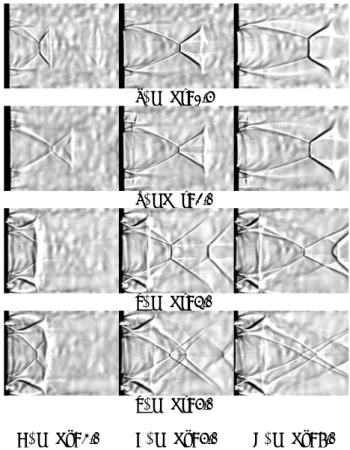
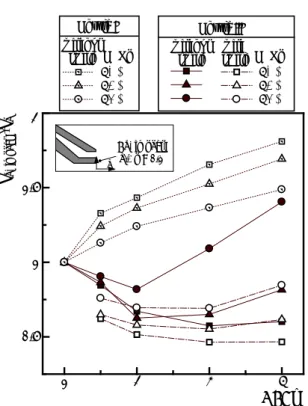
Figure 6 shows the shadowgraph pictures of the coaxial jet issuing from the nozzle Ⅲ with tn=1.5mm to investigate the effect of the nozzle-lip thickness on the features of the coaxial jet with the secondary stream with no swirl. The near field structures are very different from that of the nozzle I that has tn of 0.5mm. For the NPRp=5.0, the Mach disk is observed in all NPRs applied, but it is not visible in the case of Nozzle I(see Fig. 3(B) ) and the diameter of the Mach disk is reduced with an increase in NPRs. It is believed for this reason that the nozzle-lip thickness has an influence on base pressure, which is measured at the vicinity of the nozzle exit and has played a major role in determining the expansion ratio of the jet, and changes the real expansion ratio of the primary jet. That is, the effect of the change in base pressure on the expansion of jet boundary may be stronger than the effect of the suppression caused by the secondary stream. Figure 7 shows the base pressure distributions measured by the Pitot tube at the vicinity of the nozzle-lip, x/Dp=0.1. As seen in the Figure, the values of the base pressure are less in the case of nozzle
Ⅲ than in the case of the nozzle I. And also less in the case of the secondary swirl stream than in case of the secondary no swirl stream, and become higher with an pimpact / p0S
x /D p
0 2 4 6 8 10 12 14 16 18
-0.4 -0.2 0 0.2 0.4 0.6 0.8
Fig. 5 Pitot impact pressure distributions along the nozzle center (NPRp=1.0)
(a) NPRs=1.5
(b) NRPs=2.0
(c) NPRs=4.0
(d) NPRs=5.0
(A) NPRp=3.0 (B) NPRp=5.0 (C) NPRp=7.0 Fig. 6 Shadowgraphs pictures showing coaxial jet
(Nozzle Ⅲ, Without swirl).
increase in NPRp. It is noted that for the secondary swirl, stream the base pressure in all tested NPR is less than atmospheric pressure. It is believed that the nozzle-lip thickness and the pattern of the secondary stream affect the base pressure, which results in changing the real expansion ratio of the primary jet. For NPR=7.0, the increase in NPRs leads to reduce the diameter of the Mach disk monotonically. Fig. 8 shows the effect of the nozzle-lip thickness on the Pitot impact distributions along the nozzle axis issuing from the nozzle I and III with NPRp of 1.5 and 4.0, respectively. It is found that the impact pressures strongly depend on NPRs and the nozzle-lip thickness. It seems that an increase in the nozzle-lip thickness and NPRs reduces the fluctuation of the impact pressure in the coaxial jets. It is believed that reduction of the fluctuation in the case of Nozzle III is due to the presence of the Mach disk formed in coaxial jet as shown in Fig. 6.
3.4 Effect of the secondary stream thickness, ts
(Nozzle Ⅱ and Nozzle Ⅳ)
Figure 9 shows the shadowgraphs of the coaxial free jets with the secondary no swirl stream issuing from Nozzle
Ⅱ and Nozzle Ⅳ with a fixed value of NPRp=5.0 and several value of NPRs. The two nozzles have the same dimension with the nozzle Ⅲ, except the secondary stream thickness, ts,. The thickness of the secondary stream, ts, is 1mm for nozzle I, and 3mm for nozzle Ⅳ,
while 2 mm for nozzle Ⅲ.
It seems that for the case of nozzle Ⅱ an increase in NPRs reduces the Mach disk diameter and moves further upstream, while for the case of nozzle Ⅳ the diameter of the Mach disk increases up to the NPRs=3.0. It seems that two nozzles are much different in annular shock structure. It is believed that an annular shock wave strongly interact with the boundary of primary jet and then the location of an annular shock wave may play an important role in the strength of the interaction between two streams. Although not shown here, the effect of the secondary stream thickness is likely to be more
Pb, impact, x/Dp = 0.1 x
, , ,
NPRs
NPRp
pb, impact /pa
Nozzle I
: 2.0 : 3.0 : 5.0
: 2.0 : 3.0 : 5.0 NPRp Nozzle III without with swirl, swirl, without
swirl,
1 2 3 4
0.5 1 1.5 2
Fig. 7 Base pressure distributions at the vicinity of the nozzle-lip, x/Dp=0.1
: 1.0 : 1.5 : 4.0 NPRs
Pimpact/P0P
x/Dp
}
: 1.5 : 4.0}
Nozzle I Nozzle III
0 2 4 6 8 10 12 14 16 18
0.2 0.4 0.6 0.8 1
Fig. 8 Pitot impact pressure distributions along the nozzle axis(NPRp=5.0).
(a) NPRs=1.5
(b) NPRs=3.0
(c) NPRs=4.0
(A) Nozzle Ⅱ (B) Nozzle Ⅳ Fig. 9 Shadowgraph pictures showing coaxial jet
(Without swirl, NPRp=5.0).
significant in case of the secondary stream with swirl, compared with the case of no swirl. However, it seems that in case of the nozzle Ⅱ, the effect of the swirl is not significant, compared with the nozzle Ⅳ.
4. CONCLUSION
The present study describes an experimental work to investigate the effects of the nozzle-lip thickness, secondary stream thickness, nozzle pressure ratio, and the swirl of the secondary stream on the near field structure of under-expanded coaxial jets. It was found that the secondary annular stream has a significant influence on the near field structures of the coaxial jet.
However, these effects are quite dependent on the nozzle pressure ratios of the primary jet and the nozzle-lip thickness. The swirl of the secondary stream also significantly affects the diameter of The Mach disk.
Although the secondary stream thickness does not have a significant influence on the features of The Mach disk, compared with the nozzle-lip thickness, the effect is more significant in the case of the secondary swirl stream, compared with the case of secondary stream with no swirl. These results may provide a good data to design the nozzle used in the manufacturing fields.
References
(1) Niu, K., 1996, “Shock Waves in Gas and Plasma,”
Laser and Particle Beams, vol. 14, pp. 125-132.
(2) Papamoschou, D., 1997, “Mach Wave Elimination from Supersonic Jets,” AIAA J., vol. 35, pp 1604-1609.
(3) Sujith, R. I., Ramesh, R., Pradeep, S., Sriram, S., and Muruganandam, T. M., 2001, “Mixing of High Speed Coaxial Jets,” Experiments in Fluids, vol. 30, pp.
339-345.
(4) Love, E. S., Grigsby, C. E., Lee, L. P. and Woodling, M. S., 1959, “Experimental and Theoretical Studies of Axisymmetric Free Jets,” NASA TR R-6.
(5) Buckley, F., 1975, “Mach Disk Location in Jet in Co-Flowing Airstreams,” AIAA J., vol. 13, pp. 105-106.
(6) Masuda, W. and Moriyama, E., 1994, “Aerodynamic Characteristics of Under Expanded Coaxial Impinging Jets,” J. JSME Int. Series B, vol. 37, pp. 769-775.
(7) D’Attorre, L. and Harshbarger, F., 1965,
“Parameters Affecting the Normal Shock Location in Under Expanded Gas Jets,” AIAA J., vol. 3, pp. 530- 531.
(8) Narayanan, A. K. and Damodaran, K. A., 1993,
“Mach Disk of Dual Coaxial Axisymmetric Jets,”
AIAA J., vol. 31, pp. 1343-1345.
(9) Rao, T. V. R., Kumar, P. R. and Kurian, J., 1996,
“Near Field Shock Structure of Dual Co-Axial Jets,” J.
Shock Waves, vol. 6, pp. 361-366.
(10) Dosanjh, D. AS., Yu, J. C. and Abdelhamid, A. S., 1971, “ Reduction of Noise from Supersonic Jet Flows,” AIAA J., vol. 9, pp. 2346-2353.
(11) Tanna, H. K and Morris, P. J., 1985, “The Noise from Normal-Velocity-Profile Coannular Jets,” J.
Sound and Vibration, vol. 98, pp. 213-234.
(12) Yu, K., Gutmark, E. and Schadow, K/ C., 1993,
“Passive Control of Coherent Vortices in Compressible Mixing Layers,” AIAA Paper93-3262, AIAA Shear Flow Conference(Orando, FL)
(13) Gutmark, E., Schadow, K. C. and Wilson, K. J., 1991, “Effect of Convective Mach Number on Mixing of Coaxial Circular and Rectangular Jets,” Phys.
Fluids A, vol. 3, pp. 29-35.
(14) Kumar, R. R. and Kurian, J., 1996, “Coaxial Jets from Lobed-Mixer Nozzles,” AIAA J., vol. 34, pp.
1822-1828.
(15) Hari, S. and Kurian, J., 2000, “Mixing Augmentation of Supersonic Streams,” Journal of Thermal Science , vol. 10, pp. 325-330.
(16) Lee, K. H., Setoguchi, T., Matsuo S. and Kim, H. D., 2003, “An Experimental Study of Underexpanded Sonic, Coaxial, Swirl Jets,” J. Mechanical Engineering Science, vol. 218 Part C, pp. 93-103.
(17) Lee, K. H., Setoguchi, T., Matsuo, S. and Kim, H. D., 2003, “The Effect of the Secondary Annular Stream on Supersonic Jet,” KSME International J., vol. 17, pp.
1793-1800.
(18) Yu, Y. K. and Chen, R. H., 1997, “A Study of Screech Tone Noise of Supersonic Swirling Jets,” J.
Sound and Vibration, vol. 205, pp. 698-705.
(19) Tam, K. W., 1990, “Broadband Shock-Associated Noise of Moderately Imperfectly Expanded Supersonic Jets,” J. Sound and Vibration, vol. 140, pp. 55-71.
(20) Addy, L., 1981, “Effects of Axisymmetric Sonic Nozzle Geometry on Mach Disk Characteristics,”
AIAA J., vol. 19, pp. 121-122.