• 검색 결과가 없습니다.

Information and Communications Technology, Economic Growth, and Carbon Emission Levels: The Case of South Korea

N/A
N/A
Protected

Academic year: 2021

Share "Information and Communications Technology, Economic Growth, and Carbon Emission Levels: The Case of South Korea"

Copied!
9
0
0

로드 중.... (전체 텍스트 보기)

전체 글

(1)

Abstract

The paper deals with the impact of information and communi- cations technology on carbon emissions and economic growth in South Korea. The quarterly time series data from the first quarter of 1970 to the third quarter of 2010 (163 observations) are collected and retrieved from the Bank of Korea database. The paper examines long-run equilibrium relationships using cointegration techniques and Granger causality with vector error correction models. In directional causality tests, information and communications technology shows highly significant positive effects on economic growth and marginal effect on carbon emissions. Carbon emissions and economic growth exhibit an inverse relationship with each other; that is, carbon emissions have an inverse relation to economic growth and economic growth does not significantly affect carbon emissions in South Korea. We also note possible implications regarding growth policies and the information communications technology and “green”

technology sectors for economies in the range represented by Korea’s 1970 - 2010 data.

Keywords : green growth, green-tech, environmental management, information communications technology, economic growth, carbon emissions

JEL Classifications : O25, O33, O38, O41, O44

Ⅰ. Introduction

Since the early 1970s, South Korea has built up a remarkable re- cord of economic growth and integration into the high-tech modern and knowledge economy. A competitive education system, a highly

* Corresponding Author, Administrative Sciences Department, Boston University 808 Commonwealth Avenue, Boston, MA 02215, the United States

Tel: +1-617-358-5627, E-mail: [email protected]

** Administrative Sciences Department, Boston University, 808 Commonwealth Avenue, Boston, MA 02215, the United States, E-mail:

[email protected]

skilled and dedicated workforce, and the advance of information and communications technology are widely acclaimed as the key factors driving this knowledge economy. In recent years, however, a rapidly ageing population, international pressure for an environmental sus- tainability initiative, and widening gaps between and within in- dustries are becoming increasingly apparent. Finding best solutions to these problems is one of the greatest challenges faced by the policymakers of South Korea today.

Economic growth is the increasing ability of a nation to produce more goods and services. Growth can occur in many different ways:

for example, the increased use of land, labor, capital, and business resources and increased productivity of existing resources. The use of information and communications technology can facilitate the pro- duction of goods and services more efficiently and rapidly.

Information and communications technology infrastructure provides the framework for the efficient delivery of goods and services, im- proves communications between firms, and spreads to other industries. This further improves the impact of information and com- munications technology in contributing to the economic growth of a country. The increased economic importance of information and communications technology raises new questions for governments re- garding the best policy frameworks to adopt in order to encourage information and communications technology-led green growth.

This paper therefore considers the sustainable growth prospects for South Korea. Does the growth of the information communica- tions technology sector affect economic growth? Does the growth of the information communications technology sector cause the increase of carbon emissions? These are vital questions if we are explicitly to disentangle the effect of information and communications technol- ogy on both environmental sustainability and economic growth in South Korea.

Ⅱ. Literature Review

2.1. Information Communications Technology and Economic Growth

Economic growth reflects the ability of a nation to produce more goods and services. The use of information communications technol-

Information and Communications Technology, Economic Growth, and Carbon Emission Levels: The Case of South Korea

1) Jung-wan Lee*, Barry Unger**

(2)

ogy infrastructure and productsenables goods and services to be pro- duced and provided more efficiently and rapidly (Lam & Shiu, 2010). Information communications technology infrastructure and products provide a framework for the efficient delivery of goods and services, improve communications between firms, and spread to other industries, thereby contributing to overall economic growth (Koutroumpis, 2009). They ease in the trade of goods and services and the creation of new businesses and jobs (Arvanitis & Loukis, 2009; Carayannis & Popescu, 2005). Their diffusion has not only facilitated market competition but also attracted a lot of domestic and foreign investment into the economy. It has been recognized that the advancement of information communications technology is one of the driving forces of globalization and the rapid growth of the world's new economy (Al-mutawkkil et al., 2009; Meng & Li, 2002; Van Ark, 2002). Hence, the information communications tech- nology sectorin many countries continues to attract the interest of their governments in view of its potential to contribute to economic growth.

Many studies have reported that the information communications technology sector is one of the main drivers of better economic growth and sustainable growth (Daveri & Silva, 2004; Lipsey &

Carlaw, 2004) and higher productivity (Laursen, 2004; Plepys, 2002). Thompson and Garbacz (2007) reported that the growth of the information communications technology sector has a significant positive impact on productivity growth for the world as a whole by improving the efficiency of how it and other resources are used.

The broad conclusion of these studies is that a positive and sig- nificant link exists between the information communications technol- ogy sector and economic growth on the country level.

Many studies have reported that the information communications technology sector plays an important role in economic growth, in particular, in the United States (Cronin et al., Gold, 1991 Wolde-Rufael, 2007) and in South Korea (Yoo & Kwak, 2004).They find that although causality is generally in both directions, the in- formation communications technology sector more strongly precedes the economic growth of the nation. They report that the growth of the information communications technology sector plays an important role in economic growth. To conclude, this study expects that the information communications technology sector will play an important role in economic growth. Accordingly, the following hypothesis is considered:

Hypothesis 1: The information communications technology sector leads to economic growth.

2.2. Economic Growth and Carbon Emissions

Is there a relationship between carbon emissions and economic development? The question is whether or not emission levels are connected with development levels. This line of research argues that

the relationship between economic activity and carbon emissions may change as the economy moves through different stages of development. Economic activity may be a key driver of carbon emissions. Economic growth is often associated with high carbon emissions per unit of output. Many studies have examined the time-series dynamics between economic growth and carbon emissions to infer the direction of causality cross-country (Coondoo & Dinda, 2008; Lee & Lee, 2009; Luzzati &Orsini, 2009). The general con- sensus of these studies is that there is a close correlation between economic growth and environmental degradation: when an economy grows, the quality of the environment declines.

This trend can be demonstrated by charts of human population, economic growth, and environmental indicators. A plethora of liter- ature (Schneider et al., 2000; Swart et al., 2003; Wilbanks, 2003) introduced the relationship between sustainable development and cli- mate change with the emphasis on the degree to which climate change mitigation can have so-called co-benefits. These effects con- tribute to the sustainable development goals of the economy in question.

However, a theory of how economic growth does not always contribute to environmental degradation is proposed. Grossman and Krueger (1995) propose the environmental Kuznets curve hypothesis that postulates that the relationship between economic development and the environment resembles an inverted U-curve. Many re- searchers provide extensive reviews and empirical studies of the hy- pothesis (Dinda, 2004; Martinez-Zarzoso & Bengochea-Morancho, 2004; Soytas & Sari, 2009; Stern, 2004), especially in the United States (Soytas et al., 2007), in Turkey (Akbostanci et al., 2009) and in India (Managi &Jena, 2008). However, the empirical evidence re- mains mixed and is still inconclusive to date because a higher na- tional income does not necessarily warrant greater efforts to contain the emissions of pollutants.

Some researchers have examined the time-series dynamics be- tween economic growth and carbonemissions to infer the direction of causality. This question has been formulated in terms of causality and different econometric techniques have been used to examine the possible causal linkages between these two variables, for example, in the Commonwealth of Independent States (Apergis & Payne, 2010) and in developed countries (Coondoo & Dinda, 2002). However, the empirical results of the relationship between economic growth and carbon emissions are mixed.

In this regard, many researchers employ a combined approach by

examining the dynamic relationships between economic growth, en-

ergy resource use, and carbon dioxide (CO

2)

emissions together, es-

pecially in the EU (Keppler &Mansanet-Bataller, 2010), in Asian-

Pacific countries (Niu et al., 2011), in France (Ang, 2007), in India

(Ghosh, 2010) and in China (Zhang &Cheng, 2009). They find that

economic growth is closely related to CO

2

emissions, especially in

the recent decade in emerging economies. In sum, it is expected

(3)

that higher economic growth may require greater energy resource use and thus result in high CO

2

emissions. Given all these existing findings, the following hypothesis is considered:

Hypothesis 2 : Economic growth is related to an increase in CO

2

emissions.

2.3. Information Communications Technology and Carbon Emissions

The relationship between the information communications technol- ogy sector and CO

2

emissions may be jointly determined because higher growth of the information communications technology sector- requires more energy consumption. A combined approach of the joint impact of energy consumption and environmental degradation on economic growth has emerged to examine dynamic relationships between economic growth, energy consumption,and environmental degradation (Bowden & Payne, 2009; Pao & Tsai, 2010). The re- sults of the links are however inconclusive. The results of those studies show that there are different causal links between energy consumption, economic growth and CO

2

emissions at different stages of economic development in different countries (Dinda & Coondoo, 2006; Huang et al., 2008; Soytas & Sari, 2009).

The relationship between energy consumption with the particular sectors of the economy and environmental degradation has not gained much attention. The information communications technology sector is one of them. So far, there is no systematic time series that analyses the relationship between the information communications technology sector, CO

2

emissions and economic growth. The develop- ment of information communications technology infrastructure and the use of information communications technology products can con- tribute to economic growth while leading to an increase in energy consumption. For example, the increased use of information commu- nications technology products and the development of information communications technology infrastructure result in higher demand for energy which may lead to an increase in CO

2

emissions. Hence, the following hypotheses are formulated:

Hypothesis 3: The growth of the information communications technology sector is related to an increase in CO

2

emissions.

Hypothesis 4: There is a long-run equilibrium relationship be- tween the information communications technology sector, economic growth and CO

2

emissions.

Ⅲ. Methodology 3.1. Data

This section describes data and outlines the methodology used in the development or selection of indicators and the normalization of data.

CO

2

. CO

2

emissions are those stemming from the burning of fossil fuels and the manufacture of cement in million metric tons. They include carbon dioxide produced during consumption of solid, liquid, and gas fuels, and gas flaring. These statistics are collected and published by the International Energy Agency. The data used in the model are on a quarterly basis, transformed from the annual data re- ported by the International Energy Agency.

GDP. GDP is used to measure economic growth. GDP represents gross domestic product at market prices in billion Korean won.These statistics are collected and published quarterly by the Bank of Korea.

Information communications technology. Information communica- tions technology represents the economic output of the information communications technology industry at market prices in billion Korean won, including communication and publishing, broadcasting, film, and information services. These statistics are collected and pub- lished quarterly by the Bank of Korea.

Electricity. Electricity represents the economic output of electricity supply at market prices in billion Korean won. These statistics are collected and published quarterly by the Bank of Korea.

Manufacturing.Manufacturing represents the economic output of manufacturing sectors at market prices in billion Korean won, in- cluding production of food, beverages, and tobacco; textiles and leather; wood, paper, publishing, and printing; petroleum, coal, and chemicals; non-metallic mineral products except petroleum and coal;

metal, fabricated metal products; machinery equipment; electrical and electronic equipment; precision instruments; transport equipment; and furniture and other manufacturing industries. These statistics are col- lected and published quarterly by the Bank of Korea.

The two series of electricity and manufacturing are included in the model as control variables. All five series of economic data are collected and retrieved from the Bank of Korea Economic Statistics System database (http://ecos.bok.or.kr/). The sample is restricted to those periods in which quarterly data are available from the first quarter of 1970 to the third quarter of 2010 (163 observations).

Normalization of the data is necessary before any aggregation can

be made. It is important to transform the values to the same unit of

measurement as CO

2

emissions are expressed as a metric ton where-

as the other indicators are expressed as billion Korean won. In addi-

tion, the time series are seasonally unadjusted. Therefore, trans-

formation into a natural log mitigates any possible distortions of dy-

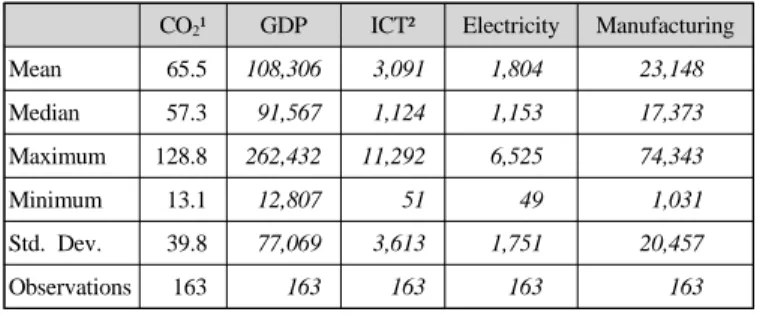
namic properties of the series. Table 1 displays descriptive statistics

along with various summary statistics for the time series. Figure 1

displays the line chart of growth trends of major indicators. Table 2

displays the results of Pearson correlation analysis among the time

series.

(4)

Table 1. Descriptive Statistics of Data

CO

2

¹ GDP ICT² Electricity Manufacturing

Mean 65.5 108,306 3,091 1,804 23,148

Median 57.3 91,567 1,124 1,153 17,373

Maximum 128.8 262,432 11,292 6,525 74,343

Minimum 13.1 12,807 51 49 1,031

Std. Dev. 39.8 77,069 3,613 1,751 20,457

Observations 163 163 163 163 163

Note: All units are in billion Korean won. ¹ CO

2

is in million metric tons. ²ICT refers to information and communications technology.

Figure 1. Line Chart of Growth Trends of Major Indicators (Logarithmic scale in X axis)

Table 2. Results of Pearson Correlation Analysis

GDP CO

2

ICT Electricity Manufacturing

GDP 1.000

CO

2

0.991*** 1.000

ICT 0.993*** 0.992*** 1.000

Electricity 0.993*** 0.992*** 0.938*** 1.000

Manufacturing 0.995*** 0.991*** 0.982*** 0.993*** 1.000 Note: ***, p-value < 0.01, Correlation is significant at the 0.01 level

(2-tailed).

3.2. Unit Root Test

A time series is said to be stationary if the autocovariances of the series do not depend on time. The formal method for testing the stationarity of a series is the unit root test. There are several well-known tests for this purpose which are based on individual time series. They are the augmented Dickey-Fuller (1979), Phillips- Perron (1988), the GLS-detrended Dickey-Fuller (Elliott et al., 1996) and Ng-Perron's (2001) unit root tests. The unit root tests described above test the null hypothesis: a series has a unit root (non-sta- tionary). The optimal lag in the augmented Dickey-Fuller test is au- tomatically selected based on the Schwarz information criterion and the bandwidth for the Phillips-Perron test is automatically selected based on theNewey-West estimator (Newey & West, 1994) using the Bartlett kernel function. Kwiatkowski et al. (1992) propose a differ-

ent approach from the unit root tests described above in that the series is assumed to be stationary under the null hypothesis.

3.3. Cointegration Test

Engle and Granger (1987) point out that a linear combination of two or more non-stationary series may be stationary. If such a sta- tionary linear combination exists, the non-stationary time series are said to be cointegrated. The stationary linear combination is called the cointegrating equation and may be interpreted as a long-run equilibrium relationship betweenthe variables. There are several tools for testing for the presence of cointegrating relationships among non-stationary variables in a multivariate setting. They are the Johansen (1991) cointegration test, and the Engle-Granger (1987) and Phillips-Ouliaris (1990) residual-based cointegration tests.

The Johansen procedure uses two ratio tests, a trace test and a maximum eigenvalue test, to test the number of cointegration relationships. Both can be used to determine the number of co- integrating vectors present, although they do not always indicate the same number of cointegrating vectors. If trace statistics and max- imum eigenvalue statistics yield different results, the result of the maximum eigenvalue test is preferred because of the benefit of car- rying out separate tests on each eigenvalue.

3.4. Granger Causality Test

The conventional modeling techniques for testing the direction of Granger causality in a multivariate setting employ vector autore- gressive and vector error correction models. Engle and Granger (1987) and Granger (1988) report that if two or more variables are cointegrated, there always exists a corresponding error correction representation in which the short-run dynamics of the variables in the system are influenced by the deviation from equilibrium. The vector error correction model is a technique that captures both the dynamic and the interdependent relationships of regressors, and cor- rects a disequilibrium that may shock the whole system.

The vector error correction model can distinguish between

short-run and long-run Granger causality because it can capture both

the short-run dynamics between the time series and their long-run

equilibrium relationship. The long-run causality is implied through

the significance of the t-statistics of the lagged error correction

terms. The short-run Granger causality in the vector error correction

model can be tested by the Wald test. The Block exogeneity Wald

test in the vector error correction system provides Chi-squared sta-

tistics of coefficients on the lagged endogenous variables, which are

used to interpret the statistical significance of coefficients of the

regressors. The hypothesis in this test is that lagged endogenous var-

iables do not Granger-cause the dependent variable.

(5)

Ⅳ. Results of Hypothesis Testing

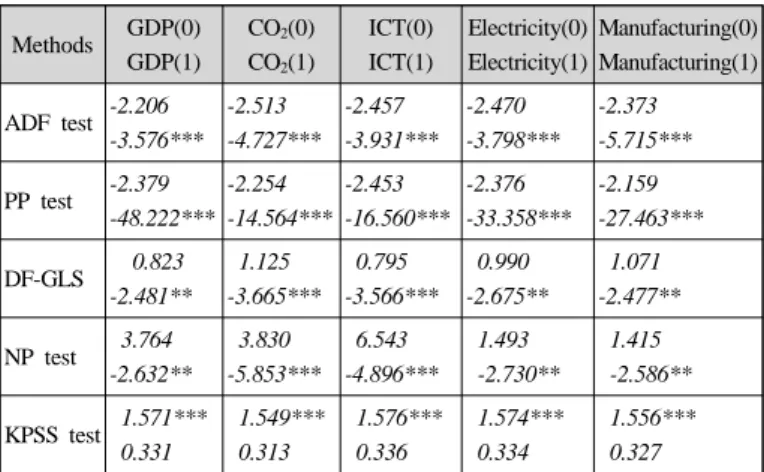
Table 3 reports the results of unit root tests. The null hypothesis of a unit root cannot be rejected in the level of the series, but all null hypotheses of a unit root are rejected in the first difference of the series. The results in Table 3 unanimously confirm that all ser- ies are integrated in the order of one (1).

Table 3. Results of Unit Root Test

Methods GDP(0) GDP(1)

CO

2

(0) CO

2

(1)

ICT(0) ICT(1)

Electricity(0) Electricity(1)

Manufacturing(0) Manufacturing(1)

ADF test -2.206 -3.576***

-2.513 -4.727***

-2.457 -3.931***

-2.470 -3.798***

-2.373 -5.715***

PP test -2.379 -48.222***

-2.254 -14.564***

-2.453 -16.560***

-2.376 -33.358***

-2.159 -27.463***

DF-GLS 0.823 -2.481**

1.125 -3.665***

0.795 -3.566***

0.990 -2.675**

1.071 -2.477**

NP test 3.764 -2.632**

3.830 -5.853***

6.543 -4.896***

1.493 -2.730**

1.415 -2.586**

KPSS test 1.571***

0.331

1.549***

0.313

1.576***

0.336

1.574***

0.334

1.556***

0.327

Note: In the ADF, PP, and DF-GLS tests, probability values for rejection of the null hypothesis are employed at the 0.05 level based on MacKinnon (1996) one-sided p-values. In the NP test, probability values for rejection of the null hypothesis are based on the Ng and Perron (2001) p-values. In the KPSS test, probability values for rejection of the null hypothesis are based on the Kwiatkowski, Phillips, Schmidt, and Shin (1992) LM statistic p-values (***, p-value < 0.01 and **, p-value < 0.05).

Table 4 reports the results of the Johansen cointegration test and reports that the trace statistic and the maximum eigenvalue statistic are larger than the critical values; the trace test indicates at least three cointegrating vectors at the 0.05 level whereas the maximum eigenvalue test indicates at least one cointegrating vector at the 0.05 level. The results indicate that there exists at least one cointegrating relationship among the variables at the 0.05 level. Therefore, Hypothesis 4 that there is a long-run equilibrium relationship be- tween the information communications technology sector, CO

2

emis- sions, and economic growth is supported.

Table 4. Results of Johansen Cointegration Test Number of cointegrating

equations ( r ) Trace statistic Maximum eigenvalue statistic

r = 0 114.196*** 54.621***

r ≤ 1 59.574*** 24.234

r ≤ 2 35.340** 18.159

r ≤ 3 15.181* 10.609

r ≤ 4 3.140 3.140

Note: The probability value for rejection of the null hypothesis of no co- integration is based on the MacKinnon-Haug-Michelis (1999) p-val- ues (***, p-value < 0.01, **, p-value < 0.05, *, p-value < 0.1).

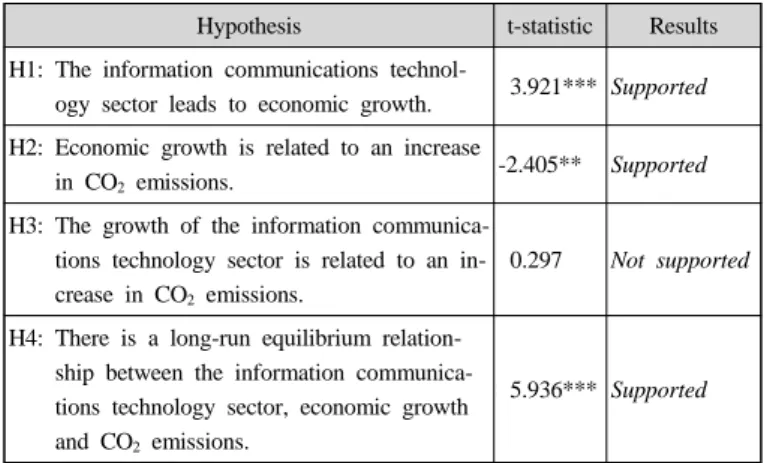
Table 5 and 6 report the results of Granger causality tests using vector error correction models. In testing Hypothesis 1 that the in- formation communications technology sector leads to economic growth, Table 5 and 6 show that the information communications technology sector has a positive effect on economic growth and is statistically significant at the 0.01 level. It also suggests that a 1%

increase in the information communications technology output in- creases economic growth by 0.233%.

Hypothesis 2 tests whether there is directional causality between economic growth and CO

2

emissions. The results indicate that there exists an inverse relationship between CO

2

emissions and economic growth. For example, a 1% increase in economic growth increases CO

2

emissionsby -0.331%. This finding confirms the environmental Kuznets inverted U-curve hypothesis that when rising incomes pass beyond a turning point environmental pollution levels begin to de- cline as higher national income warrants greater efforts to control the emissions of pollutants.

Hypothesis 3 that the growth of the information communications technology sector leads to the increase of CO

2

emissions is not sup- ported and is not statistically significant. A negative effect of the information communications technology sector on CO

2

emissions shows that a 1% rise in the information communications technology output reduces CO

2

emissions by 0.010%.

Table 5. Results of Granger Causality Test

"X"/ "Y" GDP CO

2

Long-run dynamics ECT -0.774 (6.551)*** 0.416 (5.936)***

Short-run dynamics

GDP -0.109 (1.725)

CO

2

-0.331 (2.405)**

ICT 0.233 (3.921)*** -0.010 (0.297) Electricity 0.317 (6.308)*** -0.003 (0.103) Manufacturing 0.536 (4.965)*** 0.030 (0.471)

Adjusted R-squared 0.803 0.318

F-statistic 109.995 13.439

Note: The probability value for rejection of the null hypothesis is em- ployed at the 0.05 level (***, p-value < 0.01 and **, p-value <

0.05).

Ⅴ. Discussion and Policy Implications

The results indicate that information and communications technol-

ogy has played a leading role in fostering environmental and social

sustainability within both its own sector and the overall economy

and at the same time is an important contributor to the sustainable

growth of South Korea. On the other hand, economic growth may

drive technological change, increase efficiency, and foster the devel-

opment of institutions and preferences more conducive to environ-

mental protection and emission mitigation. Comparing the trends in

(6)

the efficiency of energy use by the information communications technology sector and CO

2

emissions per unit GDP change in South Korea, this study demonstrated the importance of technological prog- ress in the path of energy saving and CO

2

emission reduction, there- by facilitating useful policy decisions.

Specifically, the results of this study suggest there may be an al- ternative “way out” of what may be a false dilemma of having to choose between economic growth or environmental protection, at least for countries in similar economic range as represented by the last forty years of Korea.

Conventional thinking:

Generalized economic growth is produced as a result of making increased carbon emissions, an undesirable environmental effect.

Therefore a painful choice must be made to protect environment by slowing or stopping generalized economic growth via government policy.

New thinking:

Generalized economic growth can be produced by making de- creased carbon emissions, a desirable environmental effect, plus the presumed benefits of economic growth itself. Therefore a choice does not have to be made between generalized economic growth and environmental protection. Growth of the information communica- tions technology sector may be an especially effective tool to ramp economic growth in addition to its other presumed benefits, with proven marginal effect on carbon emissions.

The study’s results should be seen as neither supporting nor dis- confirming the environmental Kuznets curve (“inverted U-curve”) proposed by Grossman and Kreuger (1995) and others and with mixed empirical support to date. Because the study looked only at data representing Korea from 1970 – 2010, the possibility still exists that a study of earlier data from Korea’s economy would have

found a positive relationship between carbon emissions and econom- ic growth, which would be consistent with an interpretation that Korea’s economy for some period prior to 1970 demonstrated the claimed first part of the Kuznets curve where environment worsens as the economy grows.

What is clear for however for the 1970 – 2010 range studied is that there is a positive relation between generalized national eco- nomic growth in Korea and less carbon emissions. The study shows as well that an information communications technology policy should be considered a leading area to address for achieving twin goals of continued economic growth (and its related aspects such as quality employment and positive trade balances) and environmental quality.

Furthermore, given the Korean experience with information and communications technology as shown in this study, and given that its effects on environment and economic growth can also be logi- cally envisioned, it may that the support of other forms of technol- ogy whose impact can be similarly envisioned, should also be con- sidered as part of a unified national policy in this area, and their impact closely studied. This might especially include so called

“green-tech” such as advanced solar cells, light emitting diodebased lighting, better batteries, better insulating materials, and software op- timization of power conservation.

Certainly in the area of information and communications technol- ogy, and related fields such as semiconductor and materials science, the world is currently entering what is commonly referred to as the knowledge society, which is driven by information and intellectual products as the raw materials. In this context, the ability to transmit information over the information and communications technology in- frastructure is a key resource for every nation's effective partic- ipation in the global information society and for addressing the en- vironmental challenges. The information communications technology sector in South Korea could be an important enabler of sustainable and green growth in such a context. Its unique function as a key element of infrastructure for efficient industries and as a critical pro- ductivity enhancer is crucial for sustaining growth and laying the foundations for theeconomy that should be competitive in the long term. As an important contributor to the sustainable growth of South Korea, the information and communications technology sector seems to have played a leading role in fostering environmental and eco- nomic sustainability both within its own sector and as an in- dustry-wide infrastructure.

Societies, businesses and citizens should all be scrambling for a more efficient and greener way to operate and grow. Supporting this pressing need is a growing consumer population and a proliferation of innovative services. Information and communications technology lends itself to new models of profitable services so businesses will find it lucrative to innovate in this space. The green use of in- formation and communications technology, coupled with innovative business models and progressive policymaking, will play a critical

Hypothesis t-statistic Results

H1: The information communications technol-

ogy sector leads to economic growth. 3.921*** Supported H2: Economic growth is related to an increase

in CO

2

emissions. -2.405** Supported

H3: The growth of the information communica- tions technology sector is related to an in- crease in CO

2

emissions.

0.297 Not supported

H4: There is a long-run equilibrium relation- ship between the information communica- tions technology sector, economic growth and CO

2

emissions.

5.936*** Supported

Note: The probability value for rejection of the null hypothesis is employed at the 0.05 level (***, p-value < 0.01 and **, p-value < 0.05).

Table 6. Results of Hypothesis Test

(7)

role in the reduction of carbon emissions. Information and communi- cations technology offerings could address environmental sustain- ability concerns in ways that can also be aligned with social and economic goals.

There is a growing role for the information communications tech- nology sector in the pursuit of green or sustainable goals because government and local authorities alike are increasingly expected to focus on environmental sustainability. Goals include efficiency and social inclusion measures that can make a considerable contribution to the sustainability of programs and initiatives. Information and communications technology can facilitate smart energy and re- sourcemanagement and lead to the creation of new services that benefit company, society and government. Therefore, the government must design strategies that will allow the nation to move from its present processes of growth onto a path of green growth.

The discussion above implies that actors and actor coalitions are im- portant and that there is increasing evidence of multilevel patterns of governance and transnational networks of influence on global en- vironmental issues. Emphasis should be placed on sectors with high potential for green job creation or employment that contributes to protecting and preserving the environment (see above regarding

“green-tech” sector). It is criticalto identifying how these activities can accelerate the transition to green growth. Although several so- cial, economic and technological policies would produce an emission reduction, actual mitigation will require the implementation of poli- cies to reduce CO

2

emissions.

Ⅵ . Conclusions

This study investigated a long-run equilibrium relationship and Granger causality between the information communications technol- ogy sector, CO

2

emissions, and economic growth in South Korea.

The results indicate that the information communications technology sector has played a leading role in fostering environmental and so- cial sustainability within both its own sector and the overall econo- my of South Korea. Comparing the trends in the efficiency of en- ergy use by the information communications technology sector and CO

2

emissions per unit GDP change in South Korea, this study demonstrated the importance of technological progress in the path of energy saving and CO

2

emission reduction, thereby facilitating useful policy decisions.

New policies may be different from those pursued in the past as they not only have to lead to high growth rates but must also lead to rapid and sustained employment generation and structural changes in the industriesof the economy. Simultaneously, the challenge facing South Korea is how to develop policy responses to counter the ef- fects of the current environmental problems and climate change and lay the foundations for robust and sustainable growth that generates

employment and at the same time reduces CO

2

emissions from industries. In order for such an approach to be implemented, empiri- cal analyses are needed to estimate future associated emissions and the current and future mitigation potential of development actions.

Policymakers can then weigh the emissions reduction potential against other sustainability aspects of the action when choosing the appropriate policy to implement.

Received: April 21, 2012.

Revised: April 29, 2012.

Accepted: June 18, 2012

References

Akbostanci, E., Turut-Asik, S. & Tunc, G. I. (2009), “The relation- ship between income and environment in Turkey: Is there an environmental Kuznets curve?”, Energy Policy, 37, 861–867.

Al-mutawkkil, A., Heshmati, A. & Hwang, J.-S. (2009), “Develop- ment of telecommunication and broadcasting infrastructure indices at the global level”, Telecommunications Policy, 33, 176-199.

Ang, J. B. (2007), “CO

2

emissions, energy consumption, and output in France”, Energy Policy, 35, 4772-4778.

Apergis, N. & Payne, J. E. (2010), “The emissions, energy con- sumption, and growth nexus: Evidence from the Common- wealth of Independent States”, Energy Policy, 38, 650–655.

Arvanitis, S. & Loukis, E. N. (2009), “Information and communica- tion technologies, human capital, workplace organization and labour productivity: A comparative study based on firm-level data for Greece and Switzerland”, Information Economics and Policy, 21, 43-61.

Bowden, N. & Payne, J. E. (2009), “The causal relation-ship between U.S. energy consumption and real output: A disaggregated analysis”, Journal of Policy Modeling, 31, 180-188.

Carayannis, E. G. & Popescu, D. (2005), “Profiling a methodology for economic growth and convergence: learning from the EU e-procurement experience for central and eastern European countries”, Technovation, 25, 1-14.

Coondoo, D. & Dinda, S. (2002), “Causality between income and emission: A country group specific econometric analysis”, Ecological Economics, 40, 351-367.

Coondoo, D. & Dinda, S. (2008), “The carbon dioxide emission and income: A temporal analysis of cross-country distributional patterns”, Ecological Economics, 65, 375–385.

Cronin, F. J., Parker, E. B., Colleran, E. K. & Gold, M. A. (1991),

“Telecommunications infrastructure and economic growth. An

(8)

analysis of causality”, Telecommunications Policy, 15, 529–

535.

Daveri, F. & Silva, O. (2004), “Not only Nokia: what Finland tells us about new economy growth”, Economic Policy, 19, 117-163.

Dickey, D. A. & Fuller, W. A. (1979), “Distribution of the estima- tors for autoregressive time series with a unit root”, Journal of the American Statistical Association, 74, 427–431.

Dinda, S. & Coondoo, D. (2006), “Income and emission: a panel data-based cointegration analysis”, Ecological Economics, 57, 167–181.

Dinda, S. (2004), “A theoretical basis for the environmental Kuznets curve”, Ecological Economics, 53, 403–413.

Elliott, G., Rothenberg, T. J. & Stock, J. H. (1996), “Efficient tests for an autoregressive unit root”, Econometrica, 64, 813-836.

Engle, R. F. & Granger, C. W. J. (1987), “Cointegration and error correction: representation, estimation and testing”, Econometrica, 55, 251–276.

Ghosh, S. (2010), “Examining carbon emissions economic growth nexus for India: A multivariate cointegration approach”, Energy Policy, 38, 3008-3014.

Granger, C. W. J. (1988), “Some recent developments in a concept of causality”, Journal of Econometrics, 39, 199–211.

Grossman, G. M. & Krueger, A. B. (1995), “Economic growth and the environment”, Quarterly Journal of Economics, 110, 353-377.

Huang, B.-N., Hwang, M.-J. & Yang, C.-W. (2008), “Causal rela- tionship between energy consumption and GDP growth re- visited: a dynamic panel data approach”, Ecological Economics, 67, 41–54.

Johansen, S. (1991), “Estimation and hypothesis testing of cointegra- tion vectors in Gaussian vector autoregressive models”, Econometrica, 59, 1551–1580.

Keppler, J. H. & Mansanet-Bataller, M. (2010), “Causalities between CO

2

, electricity, and other energy variables during phase I and phase II of the EU ETS”, Energy Policy, 38, 3329-3341.

Koutroumpis, P. (2009), “The economic impact of broadband on growth: A simultaneous approach”, Telecommunications Policy, 33, 471-485.

Kwiatkowski, D., Phillips, P. C. B., Schmidt, P. & Shin, Y.-C.

(1992), “Testing the null hypothesis of stationary against the alternative of a unit root”, Journal of Econometrics, 54, 159-178.

Lam, P.-L. & Shiu, A. (2010), “Economic growth, telecommuni- cations development and productivity growth of the tele- communications sector: Evidence around the world”, Telecommunications Policy, 34, 185-199.

Laursen, K. (2004), “New and old economy: The role of ICT in structural change and economic dynamics”, Structural Change and Economic Dynamics, 15, 241-243.

Lee, C.-C. & Lee, J.-D. (2009), “Income and CO

2

emissions:

Evidence from panel unit root and cointegration tests”, Energy Policy, 37, 413–423.

Lipsey, R. G. & Carlaw, K. I. (2004), “Total factor productivity and the measurement of technological change”, Canadian Journal of Economics, 37, 1118 -1150.

Luzzati, T. & Orsini, M. (2009), “Natural environment and econom- ic growth: Looking for the energy-EKC”, Energy, 34, 291–

300.

Mackinnon, J. G. (1996), “Numerical distribution functions for unit root and co-integration tests”, Journal of Applied Economet- rics, 11, 601-618.

Mackinnon, J. G., Haug, A. A. & Michelis, L. (1999), “Numerical distribution functions of likelihood ratio tests for co-in- tegration”, Journal of Applied Econometrics,14, 563-577.

Managi, S. & Jena, P. R. (2008), “Environmental productivity and Kuznets curve in India”, Ecological Economics, 65, 432–440.

Martinez-Zarzoso, I. & Bengochea-Morancho, A. (2004), “Pooled mean group estimation of an environmental Kuznets curve for CO

2

”, Economics Letters, 82, 121–126.

Meng, Q. & Li, M. (2002), “New economy and ICT development in China”, Information Economics and Policy, 14, 275-295.

Newey, W. & West, K. (1994), “Automatic lag selection in co- variance matrix estimation”, Review of Economic Studies, 61, 631-653.

Ng, S. & Perron, P. (2001), “Lag length selection and the con- struction of unit root tests with good size and power”, Econometrica, 69, 1519-1554.

Niu, S., Ding, Y., Niu, Y., Li, Y. & Luo, G. (2011), “Economic growth, energy conservation and emissions reduction: A comparative analysis based on panel data for 8 Asian-Pacific countries”, Energy Policy, 39, 2121-2131.

Pao, H.-T. & Tsai, C.-M. (2010), “CO

2

emissions, energy con- sumption and economic growth in BRIC countries”, Energy Policy, 38, 7850-7860.

Phillips, P. & Perron, P. (1988), “Testing for a unit root in time series regression”, Biometrica, 75, 335–346.

Phillips, P. & Ouliaris, S. (1990), “Asymptotic properties of residual based tests for cointegration”, Econometrica, 58, 165–193.

Plepys, A. (2002), “Sustainability in the Information Society: The grey side of ICT”, Environmental Impact Assessment Review, 22, 509-523.

Schneider, S. H., Easterlig, W. & Mearns, L. O. (2000),

“Adaptation: Sensitivity to natural variability, agent assump-

(9)

tions and dynamic climate changes”, Climatic Change, 45, 203-221.

Soytas, U. & Sari, R. (2009), “Energy consumption, economic growth, and carbon emissions: Challenges faced by an EU candidate member”, Ecological Economics, 68, 1667–1675.

Soytas, U., Sari, R. & Ewing, B. T. (2007), “Energy consumption, income, and carbon emissions in the United States”, Ecological Economics, 62, 482–489.

Stern, D. I. (2004), “The rise and fall of the environmental Kuznets curve”, World Development, 32, 1419–1439.

Swart, R., Robinson, J. & Cohen, S. (2003), “Climate change and sustainable development: expanding the options”, Climate Policy, 3(S1), S19-S40.

Thompson, H. G., Jr. & Garbacz, C. (2007), “Mobile, fixed line and Internet service effects on global productive efficiency”, Information Economics and Policy, 19, 189-214.

Van Ark, B. (2002), “Measuring the New Economy: An International Comparative Perspective”, Review of Income and Wealth, 48, 1- 14.

Wilbanks, T. (2003), “Integrating climate change and sustainable de- velopment in a place-based context”, Climate Policy, 3(S1), S147-S154.

Wolde-Rufael, Y. (2007), “Another look at the relationship between telecommunications investment and economic activity in the United States”, International Economic Journal, 21, 199–205.

Yoo, S.-H. & Kwak, S.-J. (2004), “Information technology and eco- nomic development in Korea: A causality study”, Internatio- nal Journal of Technology Management, 27, 57–67.

Zhang, X.-P. & Cheng, X.-M. (2009), “Energy consumption, carbon

emissions, and economic growth in China”, Ecological

Economics, 68, 2706-2712.

수치

Table 1. Descriptive Statistics of Data
Table 3 reports the results of unit root tests. The null hypothesis  of a unit root cannot be rejected in the level of the series, but all  null hypotheses of a unit root are rejected in the first difference of  the series
Table 6. Results of Hypothesis Test

참조

관련 문서

adio Frequency Identification Tech- nology (RFID) is the state-of-the-art information and communication tech- nology(ICT) that uses radio waves for

이하선의 실질 속에서 하악경의 후내측에서 나와 하악지의 내측면을 따라 앞으로 간다. (귀밑샘 부위에서 갈라져 나와

&#34;Beyond Computation: Information Technology, Organizational Transformation and Business Practices” shows the relationship between IT stock and productivity for a large sample

 Students needing additional information about grading policies and procedures should meet with their faculty advisor, Executive Director/Chairperson or a

Ministry of Economic Affairs, R.O.C. Innovation and Incubation Center, National Kaohsiung University of Science and Technology 、 Institute For Information

It considers the energy use of the different components that are involved in the distribution and viewing of video content: data centres and content delivery networks

Basic aspects of AUTOSAR architecture and methodology Safety mechanisms supported by AUTOSAR.. Technical safety concepts supported by AUTOSAR Relationship to ISO

GDP impact of COVID-19 spread, public health response, and economic policies. Virus spread and public