ISSN 0377-9556 (PRINT) ISSN 2383-9457 (ONLINE) 약학회지 제 61 권 제 5 호 260~266 (2017)
Yakhak Hoeji Vol. 61, No. 5 DOI 10.17480/psk.2017.61.5.260
새로운 메틸 3,4-디알킬카보닐옥시-5-메톡시벤조에이트 유도체의 합성 및 항산화와 세포증식억제 작용
김채원 · 신다혜 · 정하숙* · 박명숙#
덕성여자대학교 약학대학, *덕성여자대학교 자연과학대학 식품영양학과
(Received August 22, 2017; Revised October 11, 2017; Accepted October 12, 2017)
Antioxidant, Antiproliferative Activity and Synthesis of Novel Methyl 3,4- Dialkylcarbonyloxy-5-methoxybenzoate Derivatives
Chaewon Kim, Da Hae Shin, Hasook Jung*, andMyung-Sook Park# College of Pharmacy, Duksung Women’s University, Seoul 01369, Korea
*Department of Food and Nutrition, College of Natural Sciences, Duksung Women’s University, Seoul 01369, Korea
Abstract — The antiproliferative and antioxidative properties of novel polyphenolic acid derivatives, structurally related with the natural model gallic acids, have been tested in cancer cell lines (MCF-7, Hep3B, RKO) and lipid peroxidation. A new series of methyl 3,4-dialkylcarbonyloxy-5-methoxybenzoate 4a~4e was synthesized by acylation from O-methyl gal- licin 3 for search of bioactive compounds. The structures of the synthetic compounds were characterized using 1H, 13C NMR and HRMS spectroscopy. Two target compounds (4c, 4d) showed higher potency than propyl gallicin or drumstick-tree (Moringa oleifera Lam.) extracts for inhibiting the growth of cancer cell lines (MCF-7, Hep3B, RKO). The antioxidative prop- erties of 4b among synthetic compounds was similar to the antioxidant propyl gallate and α-tocopherol.
Keywords Methyl gallicins, Methyl 3,4-dialkylcarbonyloxy-5-methoxybenzoates, Acylation, Antioxidant, Antiproliferative activity
갈산 또는 몰식자산으로 알려진 gallic acid는 오배자, 옻나무, 차엽 등 여러가지 식물에 함유되어있는 일종의 유기산 성분으로 잉크, 염료, 제약산업의 원료물질 등으로 이용되어 왔다.1) Gallic acid의 alkyl ester 유도체는 주로 약리적인 관점에서 연구자들의 많은 관심을 끌어왔는데, 특히 항암제로서의 연구가 활발하게 보 고되었다.2) 그 밖에 ethyl gallate의 항혈전작용,3) propyl gallate 의 세포독성작용과4)항산화작용,5) octyl gallates의 항암작용 등 이 연구되었다.6)
본 연구에서는 기존 항암제의 부작용으로 인한 항암치료의 문 제점을 개선하고자 독성을 감소시킨 새로운 항암물질의 창출이
시급하다는 것에 착안점을 두었다. 이를 위하여 다양한 식물에 서 발견되어 여러가지 생리활성 작용을 나타내고 있는 gallic acid 유도체를 주목하게 되었다.
본 연구에서는 항산화제로 알려져 있는 propyl gallate의 구조 를 변형하여 새로운 화합물의 창출과 그의 활성을 탐색하려고 한 다. 최근까지 항암성 gallic acid 유도체를 찾기 위한 연구들이 보 고 되었지만 보다 획기적으로 구조가 변화된 항암성 유도체들에 대한 것은 없다. 본 연구에서는 Fig. 1에서 보는 바와 같이 propyl gallate의 ester기인 propyl기 대신에 methyl기를 갖는 ester인 gallicin 구조를 기본골격으로 설계하였다. 본 연구에서 methyl기 구조를 기본골격으로 삼은 것은 의약시장에서 간장질환 치료제 로 사용되고 있는 닛셀(Nissel@, 파마킹)의 성분인 biphenyl dimethyl dicarboxylates의 구조를 응용하였기 때문이다. 그리고 세개의 페놀성 hydroxyl group에 변화를 주고자 우선 벤젠 고리 의 5-위치의 hydroxyl group를 선택적인 monomethylation반응 으로 O-methyl기를 도입하고, 다음으로 3, 4-위치의 hydroxyl
#
Corresponding Author Myung-Sook Park
College of Pharmacy, Duksung Women’s University, Seoul 01369, Korea
Tel.: 02-901-8395 Fax.: 02-901-8386
E-mail: [email protected]
Short Report
종설group을 acylation반응으로 각각 O-alkylcarbonyl기로 치환하기로 하였다.
본 연구에서는 설계 및 합성한 acylated O-methyl gallicin유 도체들의 항산화효과와 세포증식억제효과 실험들을 수행하였다.
또한, 항산화물질인 propyl gallate 뿐만 아니라 모링가 추출물이 세포증식 억제효과가 있다는 최근의 연구와7, 13-16)접목하였다.
새로운 합성 화합물들을 모링가 추출물 등을 이용하여 항암성질 을 비교해보고 새로운 항암성 및 항산화성 물질 창출에 대한 유 의한 지견을 얻었기에 보고하고자 한다.
실험방법 (Experimental Methods)
시약 및 분석기기
시약은 Sigma-Aldrich, TCI 등에서 구입했고, 융점 측정은 Büchi 545 Melting Point apparatus를 이용하였다. Bruker사의 300 MHz NMR spectrometer로 1H 및 13C NMR data를 측정 하였다. TMS를 기준으로 하여 ppm단위로 chemical shift 값을 기록했다. Silica gel 60F 254로 피막된 TLC plate를 이용하여 반응의 진행을 확인하였다. 전개용매로 n-hexanes: ethyl acetate (3/1, 2/1, 1/1 등)를 사용하였다. HRMS는 JMS-700 Mass spectrometer에서 측정하였다. 흡광도 측정을 위한 ELISA reader 는 ASYS Biotech, Cambridge, UK를 사용하였다.
모링가 추출물 제조
본 실험에 사용한 모링가는 탄자니아(2013년, 9월) Dar es Saalam에서 채집하여 부위별로 추출하였다. 건조한 모링가 잎과 열매의 추출 방법은 70% 에탄올에 담구어 3시간 동안 실온에서
sonication 하였다. 추출액을 여과하여 60oC에서 감압 농축한 다 음 건조하여 −20oC에 보관하였다가7)본 연구의 CCK-8 assay에 사용하였다.
합성
General synthetic procedure for the methyl 3,4- dihydroxy-5-methoxybenzoate (3)
Na2B4O7· 10H2O (17.2 g, 45 mmol)을 물(160 ml)에 녹여 5%
수용액으로 만들고, gallicin 2 (5.5 g, 30 mmol)을 용해시킨 후 실온에서 2시간동안 교반하였다. 이 용액에 dimethyl sulfate (7 ml, 75 mmol)와 sodium hydroxide (3.0 g, 75 mmol)의 포화 수용액을 적가하였다. 반응액은 22시간 동안 교반하면서 흑갈색 으로 변했다. 과량의 dimethyl sulfate를 분해하기 위하여 c- NH4OH (5 ml) 용액을 가하여 교반하고, 황산을 가해 산성용액 (pH 2~3)으로 만든 다음, ethyl acetate (25 ml×4회)로 추출하였 다. 유기층을 모아 물로 세척하고 무수 sodium sulfate로 건조하 여 감압 농축하였다. 용매를 제거하고 얻은 수지상 물질을 methanol로 재결정하여 미황색의 결정 3 (mp: 118~120oC)을 얻었다. 물질의 NMR data를 이용하여 새로운 O-methyl기의 도 입을 확인하였고, 그 결과 문헌과 일치하였다.8)
Method A. General synthetic procedure for the methyl 3,4-diethylcarbonyloxy-5-methoxybenzoate (4a, 4b)
Methyl 3,4-dihydroxy-5-methoxybenzoate 3 (1.0 g, 5 mmol) 에 propionic anhydride 10 μl (78 mmol)을 가하여 혼합한 다음, 반응 용액을 heating mantle에서 100~120℃를 유지하며 약 1시 간동안 교반하면서 반응시켰다. 반응 용액의 색깔은 처음 갈색
Fig. 1 − Reported antioxidant propyl gallate, liver-protective biphenyl dimetnyl dicarboxylates, and target compounds 4a~4e.
262 김채원 · 신다혜 · 정하숙 · 박명숙
에서 점점 노란색으로 변화하였다. 반응 종결 후 실온까지 냉각 시킨 반응 혼합액에 diethyl ether 50 ml를 가하여 녹이고, 5%
Na2CO3수용액 20 ml로 2회 추출한다. 계속하여, diethyl ether 층을 정제수 15 ml로 2회 세척한다. Ether 층을 취해 magnesium sulfate를 이용하여 건조하였고, 여과 후 감압농축하여 용매를 제 거하였다. 그 결과 연한 노란색의 oil상 물질을 얻었다. 이 잔류 물을 column chromatography (silicagel, solvent; n-hexane:
ethyl acetate = 1: 1)로 분리하여 4b를 얻었다.
Methyl 3,4-dimethylcarbonyloxy-5-methoxybenzoate (4a): Yield: 93%, mp.: 91-94oC, TLC [n-hexane: ethyl acetate (1:1)] Rf 0.50. 1H NMR(CDCl3) δ 7.54(s, 1H, phenyl), 7.49(s, 1H, phenyl), 3.90(s, 3H, OCH3), 3.88(s, 3H, OCH3), 2.31(s, 3H, CH3), 2.29(s, 3H, CH3). 13C NMR(CDCl3) δ 167.92, 167.16, 165.63(carbonyl), 152.40, 143.27, 135.94, 128.25(phenyl), 116.94, 110.84(acetyl), 56.45, 52.38(methoxy). HRMS(m/z) (FAB, M+Na) Calcd for 305.0637, found 305.0627.
Methyl 3,4-diethylcarbonyloxy-5-methoxybenzoate (4b):
Yield: 38%, oil, TLC [n-hexane: ethyl acetate (1:1)] Rf 0.80.
1H NMR(CDCl3) δ 7.53(s, 1H, phenyl), 7.49(s, 1H, phenyl), 3.89(s, 3H, OCH3), 3.87(s, 3H, OCH3), 2.60(t, J=7.6 Hz, 2H, CH2), 2.55(t, J=7.6 Hz, 2H, CH2) 1.25(tt, J=7.5 Hz, 6H, CH3).
13C NMR(CDCl3) δ 171.44, 170.70, 165.71(carbonyl), 152.44, 143.38, 136.05, 128.10(phenyl), 116.96, 110.75(methylene), 56.45, 52.34(methoxy), 27.38(ethyl). HRMS(m/z) (FAB, M+H) Calcd for 310.1053, found 310.1054.
Method B. General synthetic procedure for the methyl 3,4-dipropylcarbonyloxy-5-methoxybenzoate (4c~4e)
Methyl 3,4-dihydroxy-5-methoxybenzoate 3 (1.0 g, 5 mmol) 를 toluene 10 ml에 가하고, butyric anhydride 2.5 ml (15 mmol)을 더 해 1시간 동안 환류하면서 반응하였다. Methyl 3,4-dihydroxy-5- methoxybenzoate 3은 온도가 올라가면서 toluene에 잘 녹아 갈 색 용액이 되었고, 반응이 진행될수록 반응 용액의 색깔이 점점 연해져서 투명한 주황색으로 변화하였다. 반응이 종결된 후 반 응 용매인 toluene을 감압농축하여 제거하고, diethyl ether 50 ml 과 5% Na2CO3 15 ml로 총 2회 추출하였다. 다시, ethyl ether 층을 정제수 10 ml로 2회 세척한다. Ether 층을 취해 magnesium sulfate를 이용하여 건조하였고, 여과 후 감압농축하여 유기용매 를 제거하였다. 그 결과 연한 노란색의 oil상 물질을 얻었다. 이 잔류물을 column chromatography (silica gel, solvent; n-hexane:
ethyl acetate = 3: 1)로 분리하여 4c를 얻었다.
Methyl 3,4-di-n-propylcarbonyloxy-5-methoxybenzoate (4c): Yield: 31%, oil, TLC [n-hexane: ethyl acetate (1:1)] Rf
0.80. 1H NMR(CDCl3) δ 7.55(s, 1H, phenyl), 7.49(s, 1H, phenyl), 3.91(s, 3H, OCH3), 3.89(s, 3H, OCH3), 2.56(t, J=7.2 Hz, 2H, CH2), 2.53(t, J=7.2 Hz, 2H, CH2), 1.83- 1.74(m, 4H, CH2), 1.04(tt, J=7.3 Hz, 6H, CH3). 13C NMR (CDCl3) δ 170.63, 169.87, 165.72(carbonyl), 152.41, 143.37, 136.09, 128.08(phenyl), 117.00, 110.72(methylene), 56.41, 52.34(methoxy), 35.80, 35.59, 18.45, 13.49(propyl). HRMS(m/
z) (FAB, M+H) Calcd for 338.1366, found 338.1366.
Methyl 3,4-di-n-butylcarbonyloxy-5-methoxybenzoate (4d): Yield: 11%, oil, TLC [n-hexane: ethyl acetate (1:1)] Rf 0.65. 1H NMR(CDCl3) δ 7.55(s, 1H, phenyl), 7.49(s, 1H, phenyl), 3.91(s, 3H, OCH3), 3.89(s, 3H, OCH3), 2.58(t, J=7.5 Hz, 2H, CH2), 2.53(t, J=7.5 Hz, 2H, CH2), 1.80- 1.69(m, 4H, CH2), 1.52-1.35(m, 4H, CH2), 0.97(tt, J=7.3 Hz, 6H, CH3). 13C NMR(CDCl3) δ 170.79, 70.02, 165.72 (carbonyl), 152.43, 143.39, 136.11, 128.08(phenyl), 117.01, 110.72(methylene), 56.42, 52.33(methoxy), 33.68, 26.95, 22.18, 13.60(butyl). HRESIMS(m/z) (FAB, M+Na) Calcd for 389.1576, found 389.1564.
Methyl 3,4-di-n-pentylcarbonyloxy-5-methoxybenzoate (4e): Yield: 35%, oil, TLC [n-hexane: ethyl acetate (3:1)] Rf 0.51. 1H NMR(CDCl3) δ 7.52(s, 1H, phenyl), 7.47(s, 1H, phenyl), 3.89(s, 3H, OCH3), 3.87(s, 3H, OCH3), 2.56(t, J=7.5 Hz, 2H, CH2), 2.53(t, J=7.5 Hz, 2H, CH2), 1.78-1.59(m, 6H, CH2), 1.48-1.34(m, 6H, CH2), 0.95(tt, J=7.3 Hz, 6H, CH3).
13C NMR(CDCl3) δ 170.80, 169.56, 165.72(carbonyl), 152.41, 143.38, 136.09, 128.07(phenyl), 117.00, 110.71(methylene), 56.41, 52.34(methoxy), 34.96, 33.68, 26.95, 22.11, 13.61 (pentyl). HRESIMS(m/z) (FAB, M+Na) Calcd for 417.1889, found 417.1891.
지질과산화 억제(Inhibition of lipid peroxidation) 실험 지질과산화 억제율을 Koleva등의9, 10)β-carotene/linoleic acid system을 응용하여 측정하였다. β-Carotene용액 (400 μg/ml in chloroform) 3 ml에 linoleic acid (20 mg), Tween 40 (200 mg) 을 천천히 첨가하여 잘 섞고 chloroform을 N2 gas를 이용하여 완전히 제거한다. 잔사에 증류수 50 ml을 천천히 넣으면서 격렬 하게 잘 섞어준 후 희석 용액을 만든다. 합성 화합물 4a~4e 을 증류수로 용해한 용액이 들어있는 시험관(ep tube)에 희석 용액 (emulsion) 900μl 를 첨가하였다. 시험관(ep tube)의 내용물 (200μl)을 96 Well 배양 접시에 옮기고 ELISA reader를 이용하 여 470 nm에서 흡광도(Ac)를 측정하였다. 배양 접시를 50oC incubator에서 2 시간 반응 한 후 다시 흡광도(As)를 구하였다.
합성 화합물 4a~4e의 antioxidant activity(AA) (%)은 [(control
Ac – control Ac) – (sample As – sample As)]/(control Ac – control Ac)×100의 식으로 구하여 비교하였다.
CCK-8 (cell counting kit-8) assays
4a~4e에 대한 항암 활성을 측정하기 위하여 CCK-8 Kit (Dojindo, Kumamoto, Kyushu, Japan) assay방법을 이용하였다.11) 본 연구의 활성 검색에 사용된 3종의 암세포(MCF-7, Hep3B, RKO 세포)는 ATTC (Manassas, USA)에서 구입하였다. 96 Well 배양 접시에 각 세포를 5×10³ cells/well로 분주하여 CO2 incubator (37oC, 5% CO2)에서 24 시간 동안 보관하였다. 24시 간 후에 배지를 갈아주고, 미리 정한 0.1, 1, 10, 100, 1000 μg/
ml 의 농도로 화합물 4a~4e를 처리하여 각각 48시간 동안 배 양하였다. 합성한 화합물 4a~4e을 처리한 세포에 Kit-8 시약 10μl를 넣고 3시간 동안 반응시킨 후 ELISA reader(ASYS Biotech, Cambridge, UK)로 450 nm에서 흡광도(A450)를 측정하 였다. 세포생존율은 다음과 같이 계산하였다: Cell viability = (test group A450/ control group A450)×100%, IC50 값은 세번의 독립적인 실험값으로 결정하였다.
결과 및 고찰 (Results and Discussion)
본 연구에서는 상업적으로 이용 가능한 gallic acid·10H2O을 출 발 물질로 사용하였다. 최종 화합물은 esterification, methylation, 그리고 acylation12)의 합성 방법을 이용하여 제조하였다(Scheme 1). 출발 물질을 황산 촉매 하에서 메탄올과 esterification반응 으로 methyl ester화합물 2로 전환시켰다. 다음으로 온화한 반
응조건하에서 세개의 hydroxyl group를 갖고있는 methyl gallate 2의 구조에서 선택적으로 한 개의 hydroxyl group만 methyl ether 3로 바꾸었다. 즉, borax 150 mol%를 사용하여 saltation 을 완성하고, methyl화제로서 dimethyl sulfate (250 mol%)와 NaOH수용액을 실온에서 22시간동안 반응시켰다.
벤젠 고리의 3, 4-위의 hydroxyl기에 아실기 도입을 위한 시약 으로는 carboxylic acid anhydride 를 이용하였다. Alkylcarbonyl기 의 도입을 위해 이용된 alkyl기는 methyl, ethyl, n-propyl, n-butyl, n-pentyl 기의 5종 이었고, acetic anhydride, propionic anhydride, butyric anhydride, valeric anhydride, hexanoic anhydride와 같은 acyclic acid anhydride 시약을 구입하여 이용하였다. 화합물 4a와 4b는 용매없이 과량의 anhydride를 사용하는 method A 방법으로 합성하였으나, alkyl 기의 길이가 길어지면서 반응의 수득율이 아 주 떨어지는 결과를 얻게 되었다. 아실화 반응의 효율성을 위하 여 화합물 4c~4e는 anhydride (300 mol%)와 toluene을 용매로 사용하는 method B 방법으로 제조하였다.
O-acylation 반응에서는 anhydride의 carbonyl기에 3,4-위의 페 놀성 hydroxyl기가 첨가 되면서 zwitterionic 중간체가 형성되었 다가, 다음으로 분해가 일어나 alkylcarbonyloxy 화합물 4a~4e 과 carboxylic acid로 전환되었다. 최종 화합물의 구조는 1H NMR, 13C NMR과 HRMS의 data로 확인하였다.
지질과산화 현상은 자유라디칼에 의해서 세포막의 손상으로 발생한다. 항산화효과는 지질과산화 억제의 정도로 측정할 수 있 다. 본 연구에서의 합성화합물들은 항산화제인 propyl gallate와 구조적으로 유사하다. 항산화제로서의 개발 가능성을 타진해 보 기 위해서 합성화합물의 지질과산화 억제 실험을 수행하였다. 합 성 화합물 4a~4e의 지질 과산화반응의 억제(항산화)율은 Fig.
2에서 보는 바와 같이 항산화제로 사용되고 있는 α-tocopherol, propyl gallate의 항산화율과 비교하였다. 4b는 농도의존적으로 α-tocopherol 값과 유사한 항산화 억제 효과를 보였다. 또한, 합 성 화합물과 구조적으로 유사한 산화제인 propyl gallate와 4b 의
Fig. 2 − Antioxidant activities of five synthetic compounds, propyl gallate, and α-tochopherol (β-carotene-linoleic acid test).
Values of each curve are means±SD (n=2).
Scheme 1. Synthetic route of target O-acylated O-methyl gallicins;
methyl 3,4-dialkylcarbonyloxy-5-methoxybenzoates
4a~4e.
264 김채원 · 신다혜 · 정하숙 · 박명숙
활성을 비교하였을 때, 저농도(10, 20 μg/ml)에서 비슷한 억제율 을 나타내어 항산화제로의 가능성을 보였다. 4d, 4e 에서도 α- tocopherol과 비슷한 추세선을 보이고 있어서 약한 항산화 작용 을 가지고 있는 것으로 생각된다.
최근 열대지방에 널리 분포되어있는 식의약용 나무인 모링가
(drumstick-tree)에 대한 관심이 높아져 그 성분에 대한 연구가 활발하다. 암세포 증식억제실험의 비교물질로서 사용한 모링가 (Moringa oleifera Lam.) 잎의 추출물은 암세포의 apoptosis와 antiproliferation 효과가 있다고 보고 되었다.13)모링가 잎 추출 물은 항산화효과가 크고, 동물 모델의 실험에서 안전성이 높은
Fig. 3 − Antiproliferative activities of five synthetic compounds, propyl gallate, and Moringa oleifera extracts (ML, MF) in RKO human colon
carcinoma cells (CCK-8 assays). Values of each curve are means±SD (n=3).
Fig. 4 − Antiproliferative activities of five synthetic compounds, propyl gallate, and Moringa oleifera extracts (ML, MF) in MCF-7 human breast cancer cells (CCK-8 assays). Values of each curve are means±SD (n=3).
Fig. 5 − Antiproliferative activities of five synthetic compounds, propyl gallate, and Moringa oleifera extracts (ML, MF) in Hep3B hepatocellular
carcinoma cells (CCK-8 assays). Values of each curve are means±SD (n=3).
것으로 평가되어 왔다.14)모링가 뿌리 추출물은 암세포 침투 및 전이 과정의 주요한 인자인 MMP-9에 대한 억제효과를 보고되 어 있다.15)모링가의 잎 뿐만 아니라 나무껍질의 추출물에서도 유방암과 대장암에 항암효과를 보였다는 연구결과가 보고 된 바 있다.16)본 연구에서는 gallicin 유도체의 구조를 기반으로 한 저 분자 화합물들을 합성하였고, 그의 세포증식억제효과를 모링가 의 잎과 열매의 추출물과 함께 비교하였다. 세포증식억제효과는 약물 처리 후 48시간 배양하여 그 결과를 얻었다.
Fig. 3에서 보는 바와 같이 대장암세포인 RKO cell에서의 CCK- 8 실험에서는 5종의 합성화합물 4a~4e과 비교물질로 항산화제 propyl gallate 그리고 두 종류의 모링가 추출물(잎, 열매)의 세포 증식억제작용을 비교하였다. 4a~4e는 미리 정한 0.1, 1, 10, 100, 1000μg/ml의 농도에서 농도의존적으로 높은 억제율을 나타내었 다. 이 합성화합물들 중 특히 4c가 가장 높은 억제율을 보였다.
유방암세포인 MCF-7 cell에서의 CCK-8 실험에서는 4d와 4e가 높은 억제율을 나타내었다(Fig. 4). 간암세포인 Hep3B cell에서는 4c와 4d가 우수한 세포증식억제율을 보였다(Fig. 5).
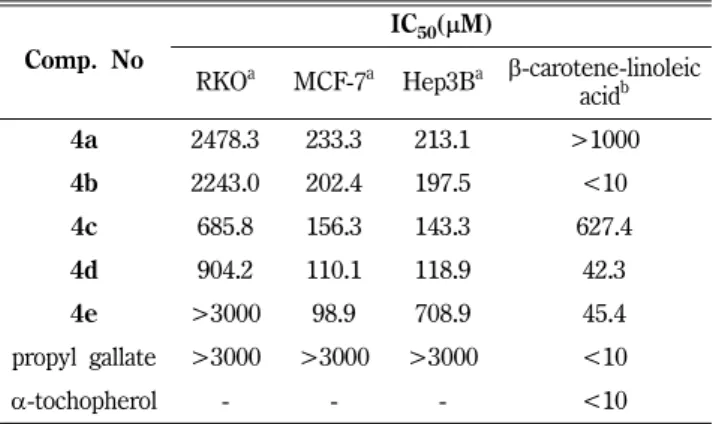
Table I에서 보는 바와 같이 항산화효과 실험에서는 4b가 α- tochopherol 및 propyl gallate와 비슷한 정도로 우수한 활성을 가 졌다. 암세포 증식억제효과 실험에서는 5종의 합성화합물 4a~4e 모두가 암세포(MCF-7, Hep3B, RKO cells)에서 모링가추출물(MF, ML)과 propyl gallate 보다 좋은 활성을 나타내었다. 특히, 4c와 4d 에서 우수한 세포증식억제작용을 보였다.
결 론 (Conclusion)
본 실험에서는 치환된 O-methyl gallicin 유도체 4a~4e 5종을 합성하였고, 목표 화합물을 얻기 위한 합성 경로로 esterification, methylation과 acylation을 이용하였다. 합성 화합물 중 4b의 항산
화효과가 항산화제인 α-tochopherol 및 propyl gallate와 유사하게 나타났다. 화합물 4c, 4d은 3종(MCF-7, Hep3B, RKO cells) 암 세포에서 세포증식억제작용을 보이기는 했으나 IC50상으로는 그 효과가 크지는 않았고, 비교물질 모링가 추출물(MF, ML)보다는 좋은 활성을 나타내었다. 구조활성관계를 기반으로 한 생리활성 이 높은 유도체 탐색에 대한 연구는 추후 보고할 예정이다.
References
1) Ow, Y. Y. and Stupans, I. : Gallic acid and gallic acid derivatives:
effects on drug metabolizing enzymes. Curr. Drug Metab. 4, 241 (2003).
2) Locatelli, C., Filippin-Monteiro, F. B. and Creczynski-Pasa, T. B. : Alkyl esters of gallic acid as anticancer agents: A review. Eur. J.
Med. Chem. 60, 233 (2013).
3) Yun, H. S., Kang, S. S., Kim, M. H. and Jung, K. H. : Anti- thrombotic effects of analogs of procatechuic acid and gallic acid. Yakhak Hoeji 37, 453 (1993).
4) Jacobi, H., Eicke, B. and Witte, I. : DNA strand break induction and enhanced cytotoxicity of propyl gallate in the presence of copper(II). Free Radic. Biol. Med. 24, 972 (1998).
5) Massoni, M., Clavijo, T., ColinapVegas, L., Villarreal, W., Dias, J. S. M., Silva, G. A. F., Ionta, M., Soares, M., Ellena, J., Dorigueto, A., Barbosa, M. and Batista, A. A. : Propyl gallate metal complexes: circular dichroism, BSA-binding, antioxidant and cytotoxic activity. Polyhedron 129, 214 (2017).
6) Fiuza, S. M., Gomes, C., Teixeira, J., Girao-Cruz, M. T., Cordeiro, M. N. D. S., Milhazes, N., Borges, F. and Marques, M. P. M. : Phenolic acid derivatives with potential anticancer properties a structure activity relationship study. Part 1: methyl, propyl and octyl esters of caffeic and gallic acids. Bioorg. Med. Chem. 12, 3581 (2004).
7) Guon, T. E. and Chung, H. S. : Moringa oleifera fruit induce apoptosis via reactive oxygen species-dependent activation of mitogen-activated protein kinases in human melanoma A2058 cells. Oncol. Lett. 14, 1703, (2017).
8) Park, M. S. and Kwon, S. K. : Selective methylation of phenolic hydroxyl group; optimal condition for synthesis of methyl 3,4- dihydroxy-5-methoxy benzoate. Duk-Sung Bull Natural Sci. 3, 29 (1997).
9) Koleva, I. I., Beek, T. A., Linssen, J. P. H., Groot, A. and Evstatieva, L. N. : Screening of plant extracts for antioxidant activity: a comparative study on tree testing methods. Phytochem.
Anal. 13, 8 (2002).
10) Wu, N., Fu, K., Fu, Y. J., Zu, Y. G., Chang, F. R., Chen, Y. H., Liu, X. L., Kong, Y., Liu, W. and Gu, C. B. : Antioxidant activities of extracts and main components of pigeonpea [Cajanus cajan (L.) Millsp.] leaves. Molecules 14, 1032 (2009).
Table I − IC
50values of synthesized compounds 4a~4e, propylgallate, and α-tochopherol against cancer cell lines for 48 h and β- carotene-linoleic acid test.
Comp. No
IC
50(µM)
RKO
aMCF-7
aHep3B
aβ-carotene-linoleic acid
b4a 2478.3 233.3 213.1 >1000
4b 2243.0 202.4 197.5 <10
4c 685.8 156.3 143.3 627.4
4d 904.2 110.1 118.9 42.3
4e >3000 98.9 708.9 45.4
propyl gallate >3000 >3000 >3000 <10
α-tochopherol - - - <10
a
CCK-8 assay
b
β-carotene-linoleic acid test
266 김채원 · 신다혜 · 정하숙 · 박명숙
11) Kim, C., Kim, S. B., Jung J. andPark, M. S. : Design, synthesis and biological evaluation of selenium-incorporated aminopyridazines as anticancer agents. Bull. Korean Chem. Soc. 36, 1669 (2015).
12) Park, E. H. and Park, M. S. : Acylation of pyridazinylamines by acyclic anhydrides: synthesis of N-substituted 3-amino-6- chloropyridazines. Yakhak Hoeji 49, 56 (2005).
13) Sreelatha, S., Jeyachitra, A. and Padma, P. R. : Antiproliferation and induction of apoptosis by Moringa oleifera leaf extract on human cancer cells. Food Chem. Toxicol. 49, 1270 (2011).
14) Stohs, S. and Hartman, M. J. : Review of the safety and efficacy of Moringa oleifera. Phytother. Res. DOI: 10.1002/ptr.5325 (2015).
15) Cho, H. J. and Chang, Y. C. : Extract of Moringa root inhibits PMA-induced invasion of breast cancer cells. J. Lif. Sci. 24, 8 (2014).
16) Al-Asmari, A. K., Albalawi, S. M., Athar, M. T., Khan, A. Q., Al- Shahrani, H. and Islam, M. : Moringa oleifera as an anti-cancer agent against breast and colorectal cancer cell lines. PLOS ONE 10, DOI:10.1371/pone.0135814 (2015).