Manuscript received February 19, 2017, accepted August 21, 2017
ISSN 2465-8111(Print), 2466-0124(Online), DOI http://dx.doi.org/10.18770/KEPCO.2017.03.02.113
A Study on Insulation Properties of Global VPI Type Generator through Replacement of Stator Windings
Taesik Kong
*, Heedong Kim
*†, Sooho Lee
*, Jaehyun Park
***
KEPCO Research Institute, Korea Electric Power Corporation, 105 Munji-ro Yuseong-gu, Daejeon 34056, Korea
**
Korea Midland Power Corporation, 160 Boryeongbuk-ro Boryeong-si Chungcheongnam-do, Korea
† [email protected]
Abstract
As the competition in the manufacturing market for small and medium sized generators is intensifying, there is increasing pressure to reduce production cost. Manufacturing the generator stator windings with global vacuum pressure impregnation (GVPI) is a very effective way to reduce costs. However, the stator winding has a fatal disadvantage in that the insulation wears due to vibration in the slot. KEPRI (KEPCO Research Institute) conducted insulation diagnosis for three generators in KOMIPO (Korea Midland Power Co., Ltd.) which were manufactured by GVPI and operated for about 17 years. Insulation diagnosis showed that deterioration of insulation has progressed significantly. Therefore, KEPRI recommended replacing the stator windings of all three generators. In this paper, the insulation properties of the generator stator winding with global GVPI are described by comparing and analyzing the insulation diagnosis results and visual inspection for stator windings.
Key words : Generator, Global Vacuum Pressure Impregnation, GVPI, Stator Windings, Insulation, Vibration, Abrasion
I. INTRODUCTION
Recently, the demand for the reduction of generator production cost is increasing due to the rising popularity of small and medium-sized generators, which are mainly used in combined cycle power generation, and intensifying competition among generator manufacturers in the market. As a result, several manufacturing methods for cost reduction are being adopted.
First, the use of air cooling method for generators, which has a simpler structure and is easier to produce than water- or hydrogen-cooling methods, is increasing [1]-[3]. This method, however, has a shortcoming in that partial discharge can occur easily because the insulation strength of air is lower than that of high-pressure hydrogen. Furthermore, air cooling has a lower cooling efficiency compared to water cooling. These reasons make it impossible to apply air cooling to high output generators.
Second, the thickness of stator winding insulator can be reduced as the electrical insulation strength of insulator has increased with technical development. Thus, the overall material cost can be reduced by roughly 20% compared to the conventional insulators because the reduced thickness of insulator allows smaller cores [4]. Another advantage of the reduced thickness of insulator is that deterioration by heat can be delayed because it becomes easier to discharge the Joule’s heat generated from the copper conductor to the core. If the thickness of insulator decreases, the physical distance between copper conductor and core is reduced and this makes the insulator vulnerable to mechanical abrasion.
Third, the manufacturing time and labor can be greatly reduced by manufacturing all cores with stator windings with global vacuum pressure impregnation (GVPI) while attaching the stator windings close to the slot and omitting the ripple springs and pressure wedges for preventing vibration. This method is
mainly used for high-pressure motors. With this method, however, the stator windings are fixed in the slot by resin that penetrates and hardens between the winding and slot by impregnation instead of ripple springs. The stator windings and core repeatedly undergo thermal expansion and contraction due to frequent starting and stopping of the gas turbine generator and this separates the resin that fixes the windings in the slot. If a gap is generated between the winding and slot in this manner, the stator windings in the slot vibrate at 120 Hz due to the force induced by the stator current. As a result, the semiconductive layer on the surface of the stator windings is damaged, causing partial discharge. When the abrasion of insulator worsens, the dielectric strength is weakened and this ultimately leads to dielectric breakdown.
KEPCO Research Institute (KEPRI) has been carrying out insulation diagnosis to assess the insulation conditions of major electric facilities of power plants such as generators and medium voltage motors since 1998 and has rich experience in insulation diagnosis for over 900 generators and over 13,000 high-pressure motors in and outside the country.
KEPRI conducted insulation diagnosis for three air-cooled global VPI type generators that have been operated for 17 years in Korea Midland Power Co., Ltd. (KOMIPO). As a result, they found that the deterioration of insulation has progressed to a considerable degree and replaced the stator windings. Instead of global VPI method, the replacement winding was constructed in a typical method using side ripple springs and pressure wedges.
In this study, the correlation between the insulation
diagnosis test results and the abrasion of stator windings was
analyzed through this case. Furthermore, the insulation
characteristics of the generator stator windings produced by the
GVPI were examined by comparing the insulation diagnosis test
results before and after the replacement of the stator windings.
II. TEST METHOD
Diagnosis tests and inspections were performed for the stator windings of three 18 kV air-cooled gas turbine generators that have been operated in a power plant and their insulation conditions were evaluated. First, the appearance of stator windings was visually examined before the insulation diagnosis tests. The circuit for insulation diagnosis tests was configured in such a way that no potential difference will be generated between phases as well as between phase and ground by connecting the other two phases to the ground when a test voltage is applied to one phase.
Insulation resistance and polarization index were measured by applying DC 5 kV between the stator windings and the ground using an insulation resistance meter (S1-5010, AVO International).
An insulation diagnosis system (MIDAS2880, Haefely Test AG) was used for the dissipation factor test which are AC high- voltage tests. In addition, a partial discharge meter (DDX-9101, Haefely Test AG) was used to measure the partial discharge activity.
As a result of visual inspection and various tests, it was determined to rewind the stator windings of all three generators.
For this replacement, the conditions of the stator windings removed from the slot were examined again to actually confirm the reliability of the insulation diagnosis test results and the characteristics of the generator stator winding GVPI.
III. TESTS RESULT AND DISCUSSION
The three generators in the Incheon Thermal Power Plant of KOMIPO, which were tested in this study, are air-cooled generators manufactured with GVPI by immersing the entire core with stator windings inserted in epoxy resin in an impregnation furnace. The important ratings an specifications of these generators are listed in Table 1.
A. Insulation Diagnosis Tests
The insulation diagnosis tests for generator stator windings
typically include insulation resistance, polarization index, dissipation factor, and partial discharge tests, after separating the neutral points of generators and applying voltage to the insulation system between each phase and ground [5].
The insulation resistance and polarization index values decrease if the stator windings absorb moisture or are contaminated. The measurement of these values is a basic test for checking the minimum dielectric strength for normal operation and high-voltage tests.
The dissipation factor test measures the AC value and the dielectric loss tangent value that appears in the entire insulation system when the test voltage is applied. These values are used to identify the average condition of the entire insulator.
The partial discharge test measures the discharge pulses that occur when the voltage is gradually increased to the phase voltage, which is the largest of the discharge pulses that appear at every instant of time. The largest discharge pulse is estimated to be generated from the largest defect. Thus, this is useful for estimating the degree of the largest defect in the total insulation system.
In this study, all the stators and cores were manufactured by GVPI and the insulation characteristics of the three generators that have been operated for 17 years were acquired by performing insulation diagnosis. Insulation diagnosis was conducted after replacing the stator windings in a general method that fixes the windings by inserting ripple spring and pressure wedge in the slot instead of the GVPI.
For the insulation diagnosis test, the insulation resistance and polarization index were measured, and dissipation factor and partial discharge tests were conducted. The measurements of insulation resistance and polarity index were higher than the standard values in each phase for all the three generators as shown in Table 2. Thus, dissipation factor and partial discharge tests, which are AC high-voltage tests, were conducted [6].
As shown in Fig. 1, the dielectric loss tangent test is conducted to see how much the dissipation factor (tanδ) value increases compared to the initial test voltage as shown in Fig. 1.
The increase rate of dielectric loss tangent (Δtanδ) is closely associated with partial discharge. No discharge occurs at low voltages and when the test voltage is raised, partial discharge begins to occur in the insulation system, which increases the AC and dielectric loss tangent values. Because the leakage current and dissipation factor values are measured for the entire insulator at the test voltage, they are used to examine the average deterioration condition of the total insulator.
The test voltage was increased up to 13 kV or 125% of the
Table 1. Ratings and specifications of the tested generators
Capacity 208 [MVA] RPM 3,600 [rpm]
Rated voltage 18 [kV] Power factor 0.9
Rated current 6,672 [A] Insulation grade F
Number of poles 2 Manufactured year 1997
Table 2. Measurement results of insulation resistance and polarity index Test items Insulation resistance [MΩ] Polarization index
Test voltage DC 5,000V DC 5,000V
Criteria for success 100 or higher 2.0 or higher Division Before
replacement
After replacement
Before replacement
After replacement Gen
No.1
A phase 2,820 5,030 6.23 5.17
B phase 2,610 5,230 7.12 5.14
C phase 2,580 4,980 6.62 5.22
Gen No. 2
A phase 2,780 3,940 6.97 6.70
B phase 2,920 3,880 6.91 7.25
C phase 2,980 4,060 6.62 7.93
Gen No. 3
A phase 2,300 3,580 4.31 3.02
B phase 2,310 4,170 5.25 6.16
C phase 2,100 3,950 5.45 5.54
Fig 1. Dielectric loss tangent test.
phase voltage which is the maximum voltage applied between the stator windings and the ground during normal operation. The test results showed that the increase rate of dissipation factor (Δtanδ) is not large. Thus, the values before and after the replacement of the stator windings were similar as shown in Table 3.
The increasing rate of dissipation factor (Δtanδ) is a manufacturing characteristic of insulation system, and is used to check the insulation condition by recording a tendency of increasing rate rather than by judging from the absolute value.
Prior to the replacement of winding, the test results were increased in 2015 compare to 2000. After the replacement, the test results were first measured, and it is necessary to be tested periodically.
The partial discharge test measures the discharge inception voltage, maximum pulse amplitude, and discharge pattern while gradually increasing the voltage to the phase voltage (10.4 kV) and the test results are shown in Table 4. The PD pulse amplitude of all three generators exceeded the failure criterion (50,000 pC) before replacement of windings. After replacement, however, they were sufficiently lower than the criterion (30,000 pC), indicating good conditions.
The criteria of partial discharge test varies depending on the generator manufacturer and the test agency. As shown Table 4, KEPRI used the result obtained through the acceleration deterioration R&D project for the generator stator windings as test criteria.
Before replacement of windings, the partial discharge inception voltage was between 3.4 kV and 4.4 kV. Thus, discharge started at a voltage lower than 5.2 kV which is 50% of the phase voltage, and partial discharge occurred between the
winding surface and the slot. After replacement, however, the PD inception voltage was high between 6 kV and 9.4 kV, indicating normal condition.
The measurement screens of partial discharge pulse pattern with respect to the phase of test voltage are shown in Table 5. The positive half cycle is shown in the right hand side of the oval (0°- 180°) and negative half cycle is shown in the left hand side of the oval (180°-360°). The PD magnitude of Y-axis is automatically adjusted and displayed in numerical value below the PD pattern graph.
Partial discharge is indicated by the pulses on the test voltage phase plots. Before replacement of the stator windings, the discharge pulses at 180°-270° section where the test voltage increases in the negative direction is greater and the number is larger than the discharge pulses in the 0° to 90° section. This typical pattern could be observed in all the three models. After replacement of windings, however, internal discharge pattern is shown, which is the most general discharge pattern where the size and number of positive a negative discharge pulses are similar [7].
Therefore, the partial discharge test results show that the discharge pattern is slot discharge type, and the discharge inception voltage is less than 50% of the phase voltage. This suggests that discharge often occurs from the surface of the stator windings, because many discharges occur on the surface. Hence, the abrasion of the fixed surface of the stator winding must have progressed to a considerable degree, which is a problem of generators manufactured by the global VPI method.
B. Visual Inspection
The inspection of the stator windings revealed many efflorescence spots near the slot withdrawal unit of stator windings as shown in Figs. 2 and 3. Efflorescence refers to the appearance of white powders after the insulator is burned. This is evidence that partial discharge was occurring continuously
Table 3. Results of the dissipation factor test Test items Dissipation factor (Δtanδ) [%]
Test voltage AC13kV (1.25E/√3)
Criteria for success Lower than 2.5
Division Before replacement After replacement 2000 year 2015 year 2016 year Gen
No1
A phase 0.36 0.41 0.43
B phase 0.50 0.53 0.60
C phase 0.40 0.55 0.54
Gen No2
A phase 0.39 0.49 0.50
B phase 0.46 0.66 0.50
C phase 0.51 0.57 0.60
Gen No3
A phase 0.23 0.37 0.60
B phase 0.23 0.50 0.70
C phase 0.32 0.40 0.50
Table 4. Results of partial discharge test Test items Discharge inception voltage
[kV]
Maximum partial discharge amplitude [pC]
Test voltage - AC 10.4kV (1.25E/√3)
Criteria for
success AC 5.2kV(√3/2) or lower
Good < 30,000
≤ Need attention < 50,000
≤ Bad Discharge Before
replacement
After replacement
Before replacement
After replacement Gen
No. 1
A phase 3.8 6.0 100,000 5,600
B phase 4.1 6.0 100,000 5,400
C phase 3.4 7.0 71,000 5,500
Gen No. 2
A phase 4.3 5.8 40,600 4,000
B phase 4.4 5.7 45,700 4,000
C phase 4.2 8.0 58,000 3,000
Gen No. 3
A phase 4.3 9.4 35,600 2,300
B phase 3.4 8.6 74,800 2,480
C phase 4.4 8.1 27,500 2,100
Table 4. Results of partial discharge test Division Before replacement After replacement
Gen No. 1
Gen No. 2
Gen No. 3
during operation.
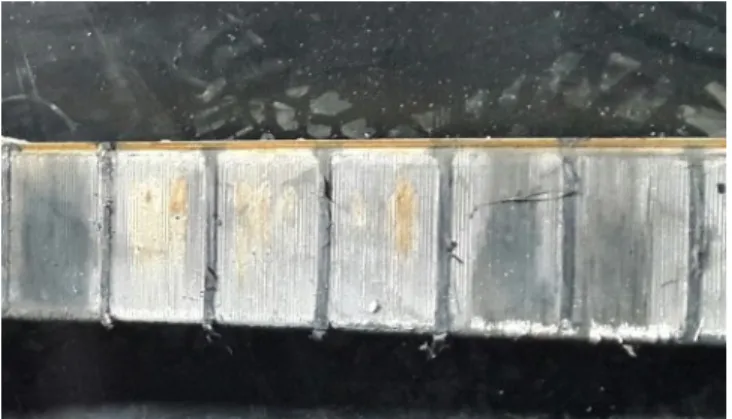
The condition of the stator windings withdrawn from the slot for replacement with new windings indicated severe abrasion of the winding surface as shown in Fig. 4. In particular, a part of the semiconductive layer, which reduces discharge by decreasing the potential difference between the stator winding surface and the slot, has been worn out by abrasion, suggesting that many discharges occurred between the windings and the slot [8].
The black bands in fixed intervals are air cooling paths.
Abrasion of the winding surface indicates that the resin that fixed the stator windings in the slot were separated, leaving a gap between the windings and the slot. This is due to the constant vibrations by the electromagnetic force of the stator.
As the abrasion condition of the insulator of stator windings was verified, the insulation condition was determined to be bad by the insulation diagnosis test and visual inspection. Therefore, the decision to replace all the stator windings was proven to be an appropriate judgment. If the abrasion of the stator windings continued in this condition, insulation failure could have occurred during operation, resulting in enormous economic damage due to the interruption of power production for a long period.
IV. CONCLUSION
In this study, insulation diagnosis tests and visual inspection were performed for three generators that had been manufactured by GVPI and operated for 17 years. As a result, the deterioration of stator windings was found to have progressed to a considerable degree. Finally, a rewind was recommended and the condition of the rewound stator winding was tested. Consequently, the insulation diagnosis test results coincided with that of visual
inspection. The conclusions of this study can be summarized as follows.
The severe abrasion of the surface of the stator windings removed for replacement with new windings was actually verified, thus proving that generators manufactured by GVPI method has the disadvantage of abrasion due to mechanical vibration in the slot.
The abrasion condition of the surface of stator windings showed no significance difference in the dielectric loss tangent (Δtanδ), which indicates the average insulation condition of the total insulation system, before and after replacement of windings.
However, the value of 2015 increased compared to 2000, so recording the trend of increasing rate of dielectric loss tangent (Δtanδ) is more important than judging by the absolute value.
In the partial discharge test results, however, the number and maximum amplitude of PD pulses, discharge inception voltage and pattern showed clear differences. This result suggested that partial discharge test is much more useful than the dielectric loss tangent test for determining winding abrasion due to vibration.
Furthermore, when the surface of the stator windings was worn out, the partial discharge value greatly exceeded the standard value providing reliable assessment of the winding condition. In this case, discharge inception voltage was low and the discharge pulses mainly appeared in the negative cycle (180°-270°) of test voltage.
Furthermore, visual inspection showed that efflorescence phenomenon appeared in the slot exit and terminal end endwindings.
Therefore, the generators manufactured by GVPI has the disadvantage of the stator windings surface abrasion. Resin can be inserted into the gap between the windings and the slot, thereby reducing the size of the vibration and partial discharge of the windings. Furthermore, efforts should be made to change the load as slowly as possible because a rapid load change can cause the separation of resin due to thermal expansion stress between the windings and slot.
REFERENCES
[1] G.Ruelle, "Development of Large Air-Cooled Generators for Gas Turbines and Combined Cycles" CIGRE 1992 Session, pp. 1-6, 1992.
[2] A. P. Kopp, P. Rohn, B. Bislin, E. Mannisto, "Comparison of Maximum Rated Air- Cooled Turbo Generators with Modern Hydrogen Cooled Generators- Design and Experience", CIGRE 1992 Session 30, 1992.
Fig 2. Efflorescence near the winding slot withdrawal part.
Fig. 3. Efflorescence of the terminal windings.
Fig 4. Abrasion condition of the surface of stator windings.
![Table 2. Measurement results of insulation resistance and polarity index Test items Insulation resistance [MΩ] Polarization index](https://thumb-ap.123doks.com/thumbv2/123dokinfo/4900529.291475/2.936.516.799.86.312/measurement-results-insulation-resistance-polarity-insulation-resistance-polarization.webp)
![Table 3. Results of the dissipation factor test Test items Dissipation factor (Δtanδ) [%]](https://thumb-ap.123doks.com/thumbv2/123dokinfo/4900529.291475/3.936.483.869.88.492/table-results-dissipation-factor-test-dissipation-factor-δtanδ.webp)