Prognostic Value of Serum Growth
Differentiation Factor-15 in Patients with Chronic Obstructive Pulmonary Disease Exacerbation
Miyoung Kim, M.D.
1, Seung-Ick Cha, M.D.
1, Keum-Ju Choi, M.D.
1, Kyung-Min Shin, M.D.
2, Jae- Kwang Lim, M.D.
2, Seung-Soo Yoo, M.D.
1, Jaehee Lee, M.D.
1, Shin-Yup Lee, M.D.
1, Chang-Ho Kim, M.D.
1, Jae-Yong Park, M.D.
1and Dong Heon Yang, M.D.
1Departments of
1Internal Medicine and
2Radiology, Kyungpook National University School of Medicine, Daegu, Korea
Background: Information regarding prognostic value of growth differentiation factor 15 (GDF-15) and heart-type fatty acid-binding protein (H-FABP) in patients with chronic obstructive pulmonary disease (COPD) exacerbation is limited.
The aim of this study was to investigate whether serum levels of GDF-15 and H-FABP predict an adverse outcome for COPD exacerbation.
Methods: Clinical variables, including serum GDF-15 and H-FABP levels were compared in prospectively enrolled patients with COPD exacerbation that did or did not experience an adverse outcome. An adverse outcome included 30- day mortality and need for endotracheal intubation or inotropic support.
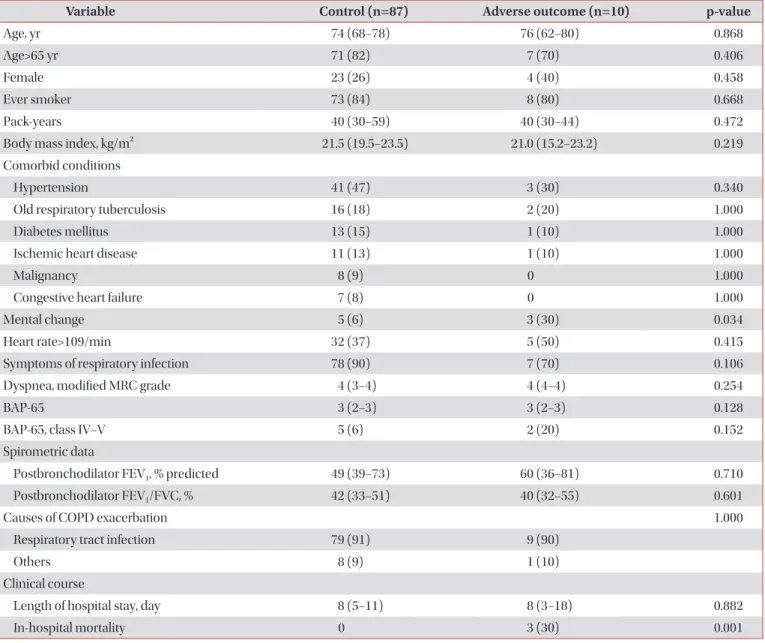
Results: Ninety-seven patients were included and allocated into an adverse outcome (n=10) or a control (n=87) group.
Frequencies of mental change and PaCO
2>37 mm Hg were significantly higher in the adverse outcome group (mental change: 30% vs. 6%, p=0.034 and PaCO
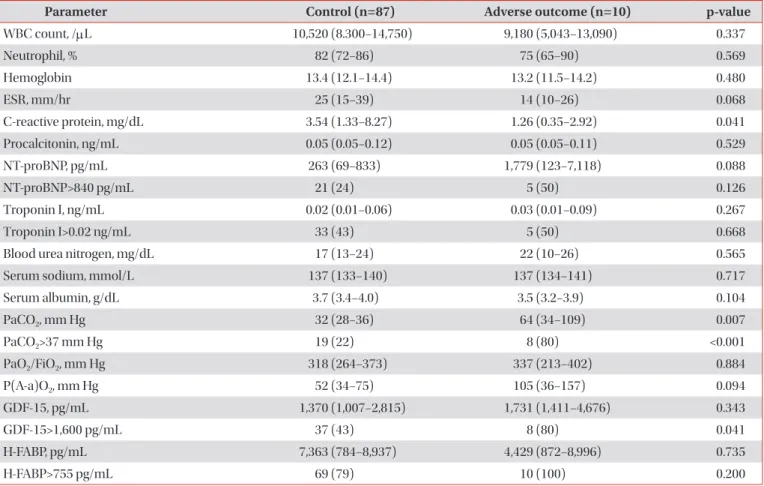
2>37 mm Hg: 80% vs. 22%, p<0.001, respectively). Serum GDF-15 elevation (>1,600 pg/mL) was more common in the adverse outcome group (80% vs. 43%, p=0.041). However, serum H-FABP level and frequency of serum H-FABP elevation (>755 pg/mL) did not differ between the two groups. Multivariate analysis showed that an elevated serum GDF-15 and PaCO
2>37 mm Hg were significant predictors of an adverse outcome (odds ratio [OR], 25.8; 95% confidence interval [CI], 2.7−243.8; p=0.005 and OR, 11.8; 95% CI, 1.2−115.3; p=0.034, respectively).
Conclusion: Elevated serum GDF-15 level and PaCO
2>37 mm Hg were found to predict an adverse outcome independently in patients with COPD exacerbation, suggesting the possibility that serum GDF-15 could be used as a prognostic biomarker of COPD exacerbation.
Keywords: Pulmonary Disease, Chronic Obstructive; Disease Progression; Growth Differentiation Factor 15; FABP3 Protein, Human
Copyright © 2014 The Korean Academy of Tuberculosis and Respiratory Diseases. All rights reserved.
Address for correspondence: Seung-Ick Cha, M.D.
Department of Internal Medicine, Kyungpook National University Hospital, 130 Dongdeok-ro, Jung-gu, Daegu 700-721, Korea Phone: 82-53-200-6412, Fax: 82-53-426-2046, E-mail: [email protected]
Received: Jul. 2, 2014 Revised: Aug. 1, 2014 Accepted: Sep. 16, 2014
cc It is identical to the Creative Commons Attribution Non-Commercial License (http://creativecommons.org/licenses/by-nc/3.0/).
![Figure 1. Causes of chronic obstructive pulmonary disease exacer- exacer-bation. The most common cause was tracheobronchitis (60% [n=6]](https://thumb-ap.123doks.com/thumbv2/123dokinfo/4862972.286251/3.918.480.842.721.989/figure-causes-chronic-obstructive-pulmonary-disease-exacer-tracheobronchitis.webp)