․교신저자: 장인수 전북 전주시 완산구 중화산동2-5 우석대부속한방병원
파킨슨병의 침구치료 동향에 대한 고찰
이 은1, 강기완1, 김락형2, 강세영3, 선승호4, 한창호5, 장인수3 우석대학교 한의과대학 한의학과1, 한방신경정신과학교실2, 한방내과학교실3 상지대학교 한의과대학 한방내과학교실4, 동국대학교 한의과대학 한방내과학교실5
A Review of Acupuncture and Moxibustion for the Treatment of Parkinson’s Disease
Eun Lee1, Ki-wan Kang1, Lak-hyung Kim2, Sei-young Kang3, Seung-ho Sun4, Chang-ho Han5, In-soo Jang3
1Dept. of Korean medicine, 2Dept. of Neuropsychiatry,
3Dept. of Internal medicine, College of Korean medicine, Woo-Suk University,
4Dept. of Internal Medicine, College of Korean Medicine, Sang-Ji University,
5Dept. of Internal Medicine, College of Korean Medicine, Dong-Guk University
ABSTRACT
Objectives : The purpose of this study was to report possibility of acupuncture or moxibustion for the treatment of Parkinson's disease (PD) by reviewing literature about its effectiveness.
Methods : In this review, PubMed, SCOPUS, Science Direct and CINAHL of EBSCOhost were used to search medical journals, using keywords “Parkinson's disease and acupuncture” and “Parkinson's disease and moxibustion". The search range included randomized controlled trials (RCT) about Parkinson’s disease combined with another disease and other treatments with acupuncture or moxibustion. Non-randomized controlled trial (nRCT), case study, animal experiment, human experiment, review, survey, essay, letter, and protocol for review were excluded.
Results : From 311 studies, 111 were selected during the title and the abstract screening. Finally, 16 RCTs (15 for acupuncture research and one for moxibustion) were included in this review, after scanning and matching the inclusion and exclusion criteria. The number of patients varied between 5 and 88. A total of 12 studies using electroacupuncture (EA) were classified into acupuncture studies. The body acupuncture studies numbered 4, scalp acupuncture 4, body and scarp acupuncture mixed studies 4, and bee venom, ear and abdomen acupuncture were each one study. In evaluation methods, total effective rate method was used in 9 studies, the Unified Parkinson's Disease Rating Scale (UPDRS) was used in 8, and the Webster score in 2. In addition, the Berg balance scale (BBS), 30 m walking time, steps to walk 30 m, PD motor function score, and Motor Performance Series by Schoppe (MLS) method were used for evaluation.
In 15 of the 16 studies, the verum acupuncture group showed significant improvement compared with the control. In 9 studies using total effective rate method, the effective rate was reported as 80.0-97.3% in verum acupuncture groups and 52.6-86.4% in controls.
Conclusions : Acupuncture may be a plausible alternative method to care for the long term symptoms and treat movement impairment of Parkinson’s disease. However, to confirm this result, high quality studies including randomized, placebo-controlled double-blind trials are warranted.
Key words : Parkinson's disease, acupuncture, moxibustion, Korean medicine, review
Ⅰ. 서 론
제임스 파킨슨이 처음 기술하고 Charcot에 의해 명명된 신경계 질환으로 주로 뇌내 흑색질의 신경 세포 파괴로 도파민 생성에 문제가 생겨 발병한다 고 보고되고 있다
1. 주요 증상으로는 진전(tremor), 강직(rigidity), 운동완서(bradykinesia), 자세이상 (postural abnormality) 등이 있으며, 국내 유병률 에 대한 정확한 통계 자료는 없으나, 2007년 강릉 지역을 대상으로 한 지역조사에 따르면 65세 이상 노령인구의 약 2-3%가 파킨슨병을 앓고 있는 것으 로 파악되었다
2. 현재 파킨슨병의 치료는 Levodopa 복용이 일반적이나, 병세가 진행된 파킨슨 병 환자 들에게서는 치료의 한계를 보이고, 장기간 투여시 레보도파 치료와 연관된 부작용이 흔하게 나타난 다. 또한 운동 완서와 강직에는 효과적이지만 진전에 대해서는 별로 효과가 없어, 최근에는 amantadine 이나 monoamine oxidase B inhibitor(MAO-B억제제), 항콜린제 및 catechol-O-methyltransferase inhibitor (COMT 억제제) 등의 진전 및 이상 운동 등의 보 조 치료제를 함께 쓰고 있다
3.
파킨슨병은 한의학적으로 震顫, 痓, 痙, 瘈瘲, 攣 과 中風의 偏枯, 癱瘓, 中腑證의 병증과 유사하다.
병인은 주로 風火痰瘀 및 肝脾腎心虛이고, 이에 따 라 肝腎陰虛, 氣血兩虛, 痰熱內阻, 氣滯血瘀의 임상 유형으로 분류할 수 있다
4.
최근 10년간 한국과 중국을 중심으로 파킨슨병 치료에 대한 한의학적 접근이 다양하게 이루어지 고 있다. 국내에서는 파킨슨병의 침치료 효과에 대 한 임상연구
5, 뜸치료 효과에 대한 임상연구
1,6, 한 방치료 증례보고
7등이 있었다. 또한 이 등
8,9은 파 킨슨병의 두침치료 및 침치료 효과에 대한 무작위 대조군실험의 체계적 고찰을, 저자들은
10,11은 중국 에서의 파킨슨병 두침치료 및 침치료 임상연구 동 향을 국내학술지에 보고한 바 있다. 그러나 연구범 위가 주로 두침치료나 중국문헌에 국한되었으며, 최근 파킨슨의 침구치료 효과에 대한 여러 임상연 구가 이루어졌으나 이에 대한 고찰이나 분석이 없 었다.
이에 저자들은 본 고찰을 통해, 파킨슨병 침구치 료에 대한 임상연구 동향과 유효성을 살펴보고 향 후 파킨슨병 치료와 임상연구의 기초자료를 제시 하고자 한다.
Ⅱ. 문헌 검색
1. 논문의 검색 및 임상논문의 선별
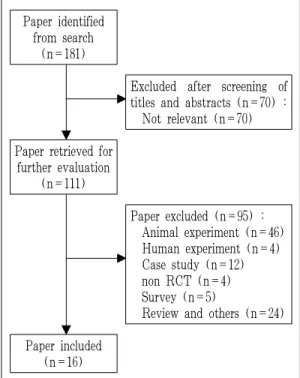
파킨슨병의 침구치료에 대한 연구동향을 고찰하 기 위해, PubMed와 Elsevier에서 제공하는 Scopus와 Science Direct, EBSCOhost의 CINAHL을 이용하 여 ‘Parkinson's disease and acupuncture', ‘Parkinson’s disease and moxibustion’의 키워드로 2013년 7월까 지 전자출판된 의학문헌을 검색하였다. 위의 검색 어로 검색된 문헌에 대하여 1단계로 제목과 초록 을 검토한 뒤 문헌을 선별하였고, 2단계로 본문을 조사하여 연구방법을 확인한 다음 재차 선별하였 다(Fig. 1).
Paper identified from search
(n=181)
Excluded after screening of titles and abstracts (n=70) : Not relevant (n=70) Paper retrieved for
further evaluation (n=111)
Paper excluded (n=95) : Animal experiment (n=46) Human experiment (n=4) Case study (n=12) non RCT (n=4) Survey (n=5)
Review and others (n=24) Paper included
(n=16)
Fig. 1. Flow chart of the trial selection process.
First author (year)
Combined disease, Sample size (randomised/analyzed),
Gender (M/F), Average age, Time since diagnosis
(years), Hoehn &
Yahr or UPDRS score Main acupoints
Experimental intervention
Control intervention
Outcome
assessment Results Adverse
events
Xia12 (2012)
Depression (24>HAMD>7), 60/60, 42/18, (A) 72±7; (B) 72±8, (A) 6.7±3.0; (B) 5.8±4.0, n.r.
GV20, Ex-HN1, Ex-HN3, LR3, SP6
(A) EA (30min×every other day for 3months, n=30) plus medication (same as B)
(B) Medication only (Madopar : L-dopa 200 mg, benserazide 50 mg×3/day×
3months plus Prozac : 20 mg
×1/day×3months, n=30)
1) BDNF level in serum 2) HAMD
score 3) Effective
rate
1) Score in A increased than in B (p<0.05)
2) Score in A decreased than in B (p<0.05)
3) A: TE 90.0%, B: TE 83.3%
(p<0.05)
n.r.
Cho13 (2012)
None, 43/35, 13/22 (A) 57.0; (B) 55.0;
(C) 57.0, (A) 5.0;
(B) 6.0; (C) 5.0, Total UPDRS (I-V) : (A) 32.0; (B) 40.0;
(C) 32.0
GB20, LI11, GB34, ST36, LR3
(A) BVA (0.005% BV 0.1 mL/point×
2/week for 8weeks, n=13) (B) acupuncture
(20min×2/week for 8weeks, n=13)
(C) Did not receive any treatment (n=9)
1) UPDRS 2) BBS 3) 30 m
walking time (s) 4) Steps to
walk 30 m 5) PDQL 6) BDI
1) total score : A : 32.0 → 24.0, B : 40.0 → 33.0, C : 32.0 → 38.0 total score (group A, B) part Ⅱ (A), Ⅲ (A, B) is decreased than in group C (p<0.05).
2), 3) improved in A (p<0.05) 4), 5) no difference 6) improved in B (p<0.05)
One subject in the BVA group complained of itchiness and was eliminated from the study
Chen14 (2012)
OAB, 60/60, 36/24, (A) 65.60±3.79;
(B) 61.93±3.67, (A) 5.40±1.75;
(B) 6.40±2.15, H&Y : (A) 2.18±0.26;
(B) 2.04±0.30, UDPRS Ⅲ : (A) 34.88±8.49;
(B) 34.13±9.87
GV20, Ex-HN1, Ex-HN3
(A) EA (1h×6/week×
6weeks) plus medication (Madopar basic doses plus Tolterodine 1 mg/1회×2/day×
6weeks, n=30)
(B) Medication only (Madopar basic doses plus Tolterodine 2 mg/1회×
2/day×6weeks, n=30)
1) General assessment 2) urination
state 3) UPDRS Ⅲ
1) no difference 2) mean urinary frequency
and incontinence in 24h are improved in A than B (p<0.05).
3) A: 34.88±8.49 → 29.98±8.26 B: 34.13±9.87 → 33.58±8.59, decreased in A than B (p<0.05)
・Group A (3 case)<B (12 case)
・group A:
dry mouth, xerophthalmia, blurred vision, decreased reaction ability, intelligence, and activity in the elderly
Table 1. Summary of RCTs of Acupuncture and Moxibustion for Treatment of Parkinson's Disease.
파킨슨병의 침구치료에 대한 임상 논문을 선별 하는 과정에서, 기타병증을 동반한 파킨슨병 환자를 대상으로 시행한 연구, 침구치료와 기타치료를 병행 한 논문을 포함하였다. 검색된 논문에서 사람을 대 상으로 하는 무작위배정 대조군 연구(randomized controlled trial, RCT)를 찾고자 하였으며, 비무작 위배정 대조군 연구(non-randomized controlled trial, nRCT), 증례보고(case study), 동물대상 실험연구 (animal experiment), 사람대상 실험연구(human
experiment), review 연구, 설문조사 연구(survey), essay, letter, review를 위한 protocol은 제외하였다.
2. 자료의 정리
이상의 기준으로 선택된 파킨슨병의 침구치료에
관한 논문을 정독하여 무작위배정대조군 연구 논
문에 대해 연구의 설계, 연구대상 수 및 특성, 치료
군과 대조군의 처치내용, 치료간격 및 기간, 유효성
평가기준, 결과, 부작용을 요약하였다(Table 1).
Huang15 (2010)
None, 10/10, 3/7, (A) 59-75; (B) 40-72, (A) 5.40±1.54;
(B) 6.04±4.38, H&Y : (A) 2.00±0.34;
(B) 2.00±0.34
MS6, MS4, MS8, MS9, MS14
(A) Scalp EA (30min
×6/week×5weeks, n=5) plus levodopa (same as B)
(B) Levodopa only (125-250 mg, if clinically indicated×1/day
×5weeks, n=5) 1) rCBF 2) basal ganglia DAT
1) rCBF is increased in the most affected hemisphere of brain in A (frontal, occipital, cerebellum: p<0.05, basal ganglia: p<0.01), no difference in B.
2) no difference in A, DAT is increased in the most affected hemisphere of brain in B (p<0.05).
n.r.
Huang16 (2009)
None, 150/150, 95/55, (A) 60.5±20.3;
(B) 60.8±22.1;
(C) 61.6±8.0;
(D) 60.7±14.9, (A) 5.2±4.7;
(B) 4.2±3.1;
(C) 6.0±3.6;
(D) 6.0±2.8, n.r.
・Body point:
GV20, GV15, Ex-B2
・Scalp area:
Chorea trembling control area (parallel with and 1.5 cm anterior to MS6)
(A) Scalp EA (30-40min
×10treatments /course×3courses for 3months) plus herbal formulae (2/day), (n=88) (B) EA only (same as
A, n=20) (C) herbal formulae
only (same as A, n=20)
(A), (B), (C) continued their compound dopa dosage first, but gradually declined in accordance with the relief of clinical symptoms
(D) Levodopa only (compound dopa drugs, n=22)
Effective rate
A: TE 89.9%, B: TE 80.3%, C: TE 65.0%, D: TE 86.4%, A is significantly different than B, C, D.
n.r.
Chang17 (2008)
None, 60/60, 37/23, (A) 58.2±12.3;
(B) 57.6±11.9, (A) 3.4±1.3;
(B) 3.6±1.5, modified UPDRS : (A) 62.29±22.36;
(B) 64.54±21.45
・Body point:
GV20, GV24, Ex-HN1, GB20, KI3, LR3, LI4, GB34, ST40
・Scalp area:
Chorea trembling control area
(A) EA (30min×1/day
×30days, n=30) plus Madopar (same as B)
(B) Madopar only (250 mg×
30days, n=30)
1) Effective rate 2) modified
UPDRS
1) A: TE 80.0%, B: TE 60.0%
A is significantly effective than B (p<0.05).
2) A: 62.29±22.36 → 31.76±7.27 B: 64.54±21.45 → 44.25±9.43 The score of group A is significantly decreased than B (p<0.05).
n.r.
Chen18 (2007)
None, 60/60, 27/33, (A) 64.34±9.32;
(B) 64.23±8.97, (A) 4.85±1.32;
(B) 4.65±3.02, n.r.
CV12, CV10, CV6, CV4, KI13, KI17, ST24
(A) Abdominal acupuncture (30min×1/day×
10days/course×
3courses, n=30) plus Madopar (same as B)
(B) Madopar only (first week : 125 mg×2/day, after then increase in 125 mg per every week, divide in 3-4 times/day, n=30)
Effective rate
A: TE 90.0%, B: TE 83.3%
A is significantly effective than B (p<0.05), A is significantly decreased than B in the GI tract symptom and the on-off phenomenon (p<0.05).
n.r.
Yang19 (2006)
None, 38/38, 24/14, 63, 8month-6years and 1month, UPDRS : (A) 49.9±16.8;
(B) 51.6±19.8
・Body point : points according to the symptom
・Scalp area:
額中線, 頂中線, 頂顳前斜線
(A) EA (30min×once every two days×
10/course× 4courses, 2courses treatment, 7days rest, n=19) plus Benserazide -Levodopa (same as B)
(B) Benserazide- Levodopa (62.5~500 mg
×2~4/day, n=19)
1) Effective rate 2) UPDRS 3) Activity
of SOD and LPO level in plasma and RBC
1) A: TE 89.4%, B: TE 52.6%
A is significantly effective than B (p=0.03).
2) A is significantly decreased than B after 4 courses treatment (p<0.05).
3) A is significantly increased in SOD activity and decreased in LPO level than B (p<0.05).
n.r.
Wang20 (2006)
None, 76/76, 46/30, (A) 56.3; (B) 58.1, (A) 1-3.4; (B) 1.3-3, H&Y :
(A, B) 2-3
前神總透懸釐, 前頂透懸顱, 腦戶透風府, 玉枕透天柱, 腦空透風池, 風池透風池
(A) EA (30min×1/day
×every day for a month, n=37) plus Madopar (same as B)
(B) Madopar only (same dose as usual×a month, n=39)
1) Effective rate 2) PD motor
function score 3) SOD,
LPO
1) A: TE 97.3%, B: TE 61.5%
A is significantly effective than B (p<0.01).
2) all score is significantly decreased than before in A (p<0.01) and B (p<0.05).
3) It is significantly increased in SOD activity and decreased in LPO level in A (p<0.01) and B (p<0.05).
n.r.
Huang21 (2006)
None, 10/10, 5/5, (A) 65.6±3.78;
(B) 60.8±2.14, (A) 5.40±1.75;
(B) 6.40±2.14, H&Y : (A) 2.20±0.49;
(B) 1.80±0.57
MS6, MS4, MS8, MS9, MS14
(A) Scalp EA (30min
×1/day×5/week×
6weeks, n=5)
(B) Madopar only (125 mg×3/day (mild); 250 mg×
3/day (moderate);
250 mg×4/day (severe) for 6weeks, n=5)
SPECT image:
activity of DAT by the ratio BG/OC
・A: No significant
・B: DAT by the ratio BG/OC in healthy hemisphere of the brain is increased (p<0.05).
n.r.
Jiang22 (2006)
None (Pallidotomy 2 case, adverse drug reaction 6 case), 30/30, 14/16, (A) 65.60±3.78;
(B) 60.80±3.63, (A) 5.40±1.75;
(B) 6.4±2.14, H&Y : (A) 2.20±0.34;
(B) 2.00±0.32
MS6, MS4, MS8, MS9, MS14
(A) Scalp EA (30min
×1/day×5/week×
6weeks, n=15) plus madopa (same as B)
(B) Madopar only (125 mg 3/day (mild); 250 mg 3/day (moderate);
250 mg×4/day (severe) for 6weeks, n=15)
1) Effective rate 2) symptom
score 3) UPDRS
motor function
1) A: TE 80.0%, B: TE 66.6%
All score is significantly decreased than before in A (p<0.05) and B (p<0.05), and no difference between groups.
2) Stiffness, sweating, constipation are improved in group A (p<0.05), and tremor is improved in group B (p<0.05).
3) A: 10.8±3.27, B: 6.90±2.71 All score in A and B is significantly decreased than before (p<0.05), and A is more decreased than B with significant (p<0.05).
one case is reported pain at the acupuncture area
Zhang23 (2005)
None, 90/90, 49/41, (A) 66.8; (B) 66.3, (A) 2-9; (B) 1-11, modified UPDRS : (A) severe (3) moderate (21) mild (30);
(B) severe (3) moderate (12) mild (21)
CV8
(A) herbs partitioned moxibustion (20장
×once every two days×15/course×
2courses, n=54) plus medication (same as B)
(B) medication only (Artane, Amantadine, Piribedil, Madopar each single or mixed use, n=36)
1) Effective rate 2) modified
UPDRS score
1) A: TE 83.3%, B: TE 58.3%, A is significantly effective than B (p<0.01).
2) A: 74.1% decreased, B: 16.7% decreased A is significantly decreased than B (p<0.01).
n.r.
Cristian24 (2005)
None, 14/14, 14/0, (A) 74.4; (B) 71.9, n.r.,
H&Y : (A, B) 2-3
KI3, KI10, BL60, LR3, ST41, ST36, GB34, EX-LE10, PC6, LI4, GV20 (muscle)
・control group:
Non-acupoints on head and extremities, skin puncture only
(A) EA (20 min×
5 sessions for 2 weeks, n=7)
(B) non- EA protocol (same as A, n=7)
1) UPDRS motor score 2) PDQ-39
and PDQ-8 summary index 3) Geriatric
Depression Scale
No significant results n.r.
Fu25 (2004)
None, 64/64, 42/22, 62.4, 7 month-4 yr 2 month, n.r.
・Body point:
GV23, GV24, GV20, Ex-HN3, GV12, GV10, GV5, GV6, GV3, GB34
・Scalp area:
前神總透懸釐, 前頂透懸顱, 腦戶透風府, 天柱透玉枕, 風池透腦空, 運動區
(A) EA (25min×1/day
×15days/course×
4courses, n=36) plus Madopar (same as B)
(B) Madopar only (250 mg×0.5 Tab.
×3 times/day, after then increase the dose per every week, Last week 750 mg/day, n=28)
1) Effective rate 2) Webster
score 3) 10 major
symptom score of PD
1) A: TE 86.1%, B: TE 60.7%
A is significantly effective than B (p< 0.05).
2) A is significantly decreased than B (p<0.01).
3) All score is significantly decreased than before in A and B, and no difference between groups.
n.r.
Teshmar26 (2004)
None, 60/53, 34/26 (randomized), 42-76, n.r., H&Y : 2-4
n.r.
(A) Ear implant (only 5th week during 9 weeks, n=26) plus medication group1 UPDRS score 0-19, n=0 group2 UPDRS score 20-39, n=9 group3 UPDRS score 40-59, n=14 group4 UPDRS score 60, n=3
(B) Medication only (9 weeks, n=27)
1) UPDRS 2) MLS 3) PDQ-39
1) In group 2, group 4, the score is improved.
2) In group 2, the score of right arm is improved (p<0.005)
3) In group 2, the score is improved than control (p≦0.001)
3events, irritation of the outer ear and swelling the points where the needles were implanted
Zhuang27 (2000)
None, 53/53, 24/29, (A) 62.8±5.6 (B) 63.2±6.0, (A) 3.77±1.87 (B) 4.09±2.63, H&Y : (A, B) 1-3
EX-HN1, TE5, GB34, ST36, ST40, GB13, GB20, GV20, LI4, SP6, LR3
(A) EA (15 min, Metal acupuncture 40 min
×once every other day×3months, n=29) plus medication (same as B)
(B) Medication only (Western drugs for 3months n=24)
1) Total integral variation (Webster scale) 2) medication
dose 3) symptom
1) A: 13.10±4.37 → 9.00±5.32 B: 14.13±5.63 → 17.52±6.18 A is significantly decreased than B (p<0.01), and A is more decreased than B with significant (p<0.01).
2) The dose is significantly decreased in A than before (p<0.05), but, no differences in B (p>0.05).
3) In group A, insomnia and dry mouth are improved (p<0.01), and also abdominal distension, constipation and sweating (p<0.05).
n.r.
ADL : Activities of daily living, BBS : Berg balance scale, BDI : Berg depression inventory, BDNF : Brain-derived neurotrophic factor, BG/OC : basal ganglia/occipital lobe, BVA : Bee venom acupuncture, DAT : Dopamine Transporter, EA : Electroacupuncture, ER : Effective rate, HAMD : Hamilton depression scale, LPO : Lipids peroxides, MLS : Motor performance series by Schoppe, OAB : Overactive bladder syndrome, PDQL : Parkinson’s disease quality of life questionnaire, PDQ-39 : Self-assessment questionnaire for Parkinson's patients, RCT : Randomized controlled trials. n.r.=not reported, rCBF : regional cerebral blood flow, SOD : Superoxide dismutase, TE : Total Effective Rate, UPDRS : Unified Parkinson’s disease rating scale