• 검색 결과가 없습니다.

Social Commerce and Consumer Protection Policies

N/A
N/A
Protected

Academic year: 2021

Share "Social Commerce and Consumer Protection Policies"

Copied!
10
0
0

로드 중.... (전체 텍스트 보기)

전체 글

(1)

유승엽*

Social Commerce and Consumer Protection Policies

Seung Yeob Yu *

요 약 본 연구는 소셜커머스의 발전에 따른 운영상의 문제점을 제시하고 소비자 보호정책 방안을 제시하고자하는 목적에서 이루어졌다

.

이를 위해 먼저

,

소셜커머스의 개념을 살펴보고

,

국내외 소셜커머스의 대표적인 유형을 살펴보 았다

.

또한

,

소셜커머스 업체의 운영에 통해 발생한 문제점을 알아보았다

.

이러한 소셜커머스 업체의 운영에 따른 문 제점을 개선하는 방안으로 소비자의 보호정책 방안을 제시하였다

.

궁극적으로 본 연구결과는 새로운 상거래의 형태인 소셜커머스에서 소비자를 보호할 최선의 방안을 찾고자 하였다

.

이러한 연구결과는 향후 소셜커머스의 소비자 보호정 책을 마련하는데 토대를 제공할 것이다

.

주제어 : 소셜커머스

,

소비자보호

,

소셜커머스 문제점

,

소비자정책

Abstract This study intends to investigate some practical problems that arise from the development of the social commerce market and propose a set of consumer protection policies. To that purpose, we discuss the concept of social commerce and analyze a few common types of social commerce in Korea. Then, we look into the problems of the social commerce industry and propose a set of consumer protection policies that can deal with those problems. The goal of the current paper is to suggest optimal policies that can protect consumers from this new trend of online transactions. We hope that the proposals can help establish the base of consumer protection from the social commerce business.

Key Words : social commerce, consumer protection, problems of social commerce, consumer policies

*Professor, Dept. of Advertising and Public Relations, Namseoul University 논문접수: 2012년 7월 18일, 1차 수정을 거쳐, 심사완료: 2012년 8월 21일

1. The purpose of analysis

1.1 The concept of social commerce Social commerce refers to the online transactions that occur through social network service. A group purchase with more than a certain number of consumers makes a considerable rate of discount possible. The name 'social commerce' comes from the fact that consumers use social network service in order to gather a group of interested users and put the discount through. The online dictionary Wikipedia defines the term as 'a subset of electronic commerce that involves using social media, online media that supports social interaction and user contributions, to

assist in the online buying and selling of products and services'. Others call it 'social shopping'. In the portal site Naver.com, it is defined as 'a type of electronic transaction where a certain product or service is sold at a considerably discounted price for a certain period of time with the condition that a minimum number of buyers have to purchase'.

The term 'social commerce' was first introduced in

2005, when Yahoo developed the pick-list sharing

service of Shoposphere. In 2008, the online discount

coupon service named Groupon launched a business

model of group purchasing and the concept of social

commerce has gained popularity around the globe. The

basic flow of social commerce is presented below in

(2)

Figure 1. Main actors in the flow are service providers, social commerce firms and consumers.

Fig 1. Flow of Social Commerce [5]
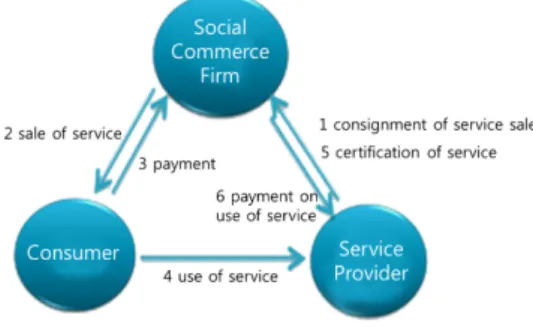
Group purchase of social commerce flows as follows.

First, service providers consign their products or service to a social commerce company, which provides information on the items and sells them to consumers on their sites. Then, consumers purchase products, pay to the social commerce company and use the purchased coupons within the given period of time. Service providers, in turn, certifies those particular coupons used by consumers to the social commerce company, which finally balance accounts with their commission, usually 20 to 50 % of a transaction, off. At present, a great portion of social commerce companies in Korea and China follow this pattern.

As mentioned above, social commerce refers to electronic commerce in which a certain minimum number of consumers can get a considerable amount of discount, often greater than a half-price. And the information on such a big discount is spread through a variety of paths of social network service. It goes without saying that the greatest strength of this type of commerce is a great bargain on particular products and service. Another aspect to note is that such a big bargain promotes sale and purchase since it is offered to a limited number of consumers and within a limited period of time[16][17].

Social commerce also differs from traditional electronic commerce in that it utilizes SNS in order to provide and spread information on such big bargains.

The explosively developing SNS connects individual consumers into a group so that marketing personnel can more easily target their prospective consumers and consumers' voluntary word-of-mouth activities within SNS networks can maximize promotion effects[15].

The main goal of the current paper is to present a set of problems that arise from the development of social commerce and to propose policies that protect consumers from those problems. To that purpose, we start with the discussion of the concept of social commerce and various types of social commerce and, then, look into the problems of this new trend of transactions. We also intend to suggest solutions to the problems in order to present policies to protect consumers. The eventual aim is to figure out an optimal way to protect consumers from the possible danger of social commerce.

1.2 Various Types of Social Commerce Social commerce essentially focuses on group purchase by maximizing the effect of word-of-mouth on the internet. However, it is often considered as a synonym to half-priced discount in Korea. We should note that social commerce in other countries has utilized various types of business transactions. In Korea, Group-Buy type social commerce as in Groupon is a prevailing form, whereas many other types reflecting a real meaning of social commerce are in business across the globe. We follow Gyeongchun Lee[3] and categorize social commerce into six different types.

1.2.1 Group-Buy

Group-buy can be characterized by the process of

attracting a certain number of buyers within a given

period of time. Then, consumers can buy the product

by buying and using a discount coupon. What is unique

about this type of social commerce is that most

products are local ones. Groupon is the representative

example of this category. It succeeded in attracting

local off-line businesses to the on-line commerce.

(3)

The leading brand Groupon sells products of local businesses on commission. It succeeded in letting sellers recognize the commission and the discount rate as a kind of marketing cost. Consumers, on the other hand, can purchase products at a considerably big discount rate. Thus, it might be understood as a win-win situation for both sellers and consumers.

Groupon maximized the effect of social commerce by providing a 10-dollar coupon to their users who refer their service to other customers and friends. This company has kept growing and ranked as one of the top 50 web sites selected by Times in less than 2 years since it started service.

However, a big rival named Livingsocial has recently launched their business and is now recording a faster growth than Groupon. This company is more aggressive in providing rewards: when one refers 3 friends and they purchase a certain item, the original customer gets a free deal. Some predict that Livingsocial with investment from Amazon will pass Groupon in 2012. A bunch of businesses in Korea follow this Group-Buy pattern of social commerce.

1.2.2 Flash Sale

Flash Sale sells a certain product or service within a very limited time on the internet. Vente-Privěe is a leading brand in this type. This site is a kind of private shopping in the sense that their service is exclusive to their members only. They carry a variety of products including sport equipment, automobiles and tour packages as well as more than 1,200 fashion brands.

The discount rate is as high as 70 %. Most products are on sale for 2 to 4 days. At the core of this system is to drive members in order to get members' referrals.

1.2.3 Social Shopping

Social Shopping does not merely sell products at a discounted rate but also encourages consumers to share useful information such as valuable sites and products with one another. For example, Polyvore, a site visited by 6.5 million people a month, functions as a portal site

that gathers all the possible information on fashion items. This site provides users with information on valuable sites, products, fashion styles of famous celebrities, magazines along with feedbacks from consumers. Users can also contribute their own materials.

For example, one can upload a picture of a shirt and ask for a well-matched item. Then, he or she can get a response from the site, often with a picture and a link to another site. A great portion of the activities like this comes from the community of voluntary users, not from the site manager. As a consequence, all the shared information from this site are rapidly spread through Web logs, Twitter and Facebook. This is what Polyvore calls 'Word-of-mouth buzz'. Other sites than Polyvore that belong to this category include Kaboodle and Lockerz, which encourages Social Discovery.

1.2.4 Purchase-Sharing

This type of social commerce lets consumers allow the information on their purchases to be shared with the manufacturers and brings some monetary rewards back to them. Swipely is a leading brand in this category. They let users provide the information on their credit cards in the site. When consumers purchase using the registered credit cards, that information is sent to the sellers for future use for their marketing.

At the heart of this type of marketing is reward points that help attract regular customers and let them voluntarily use word-of-mouth activities to their family and friends.

1.2.5 Social Shopping Apps

Shopkick established in 2009 might be a leading

brand in this category. Consumers with the Shopkick

app on their smart phones can receive reward points

called kicks when they visit one of the local stores

registered in the app. They can accumulate additional

points by checking in or scanning bar codes of

products. These saved kicks can be used to get gift

(4)

cards of iTunes, restaurants and major retail stores including iTunes, BestBuy, Target, Macy's, Crae &

Barrel, American Eagle, Simon Malls and Sports Authority. They can also be exchanged for Facebook credits or donated to others.

Collected information on customers' frequently visited stores, consumption patterns and styles, then, make up a system and mechanism that businesses can utilize for their marketing. The data base is systemized statistically by tracking records of customers' walk-ins, check-ins and scans. Customers also enjoy the merits of this system since they can obtain valuable information such as special offers and discounts of the products of their interest at a right time.

1.2.6 Personal Shopper

Another type of social commerce might be called 'Personal Shopper'. GoTryItOn, for example, enables customers to get second opinions from other users via SNS networks when they are not sure of what to wear and buy. This web site also employs a system of offering reward points to frequent users and opinion providers. As the number of users increases, we expect that businesses may enjoy word-of-mouth effect and the site can gain profit from attracting commercials and advertisements. At present, this type remains as a small community on the internet.

2. The current situation of social commerce in Korea

Social commerce market in Korea has rapidly expanded ever since 2010 and approximately 700 different firms are in business as of May 2011. The number is expected to grow up to 1500 at the end of this year. The merchandise sale is increasing by 250 % every month and the total sale is growing by 200 % [2].

According to an article in Segye Daily [11], 6 out of 10 consumers in the 20's use social commerce. The leading brands in terms of the number of visitors and brand awareness--Coupon, Ticket Monster, We

MakePrice and Groupon Korea--account for 90 percent of the market, but new brands are constantly coming to the market.

The size of the market keeps growing: 50 billion Won in 2010, 300 to 500 billion Won in 2011 and 700 to 800 billion Won in 2012(Electronic Newspaper, Feb. 7, 2012). The top brand Ticket Monster recorded 10 billion Won in sale for 6 months in 2010 but it marked the same amount of sale for one single month in 2011[4]. It took only 2.56 months for the number 2 brand WeMakePrice to record 10 billion Won in sale, 300,000 members and 1.5 million visitors per day.

Ticket Monster carries 1,570 items of products and services and each item averages 1.630 million Won in sale. They explain that this high figure can be attributed to a great selection of attractive products &

services and their effective exposure to customers.

Ticket Monster used to sell one item per day at their earlier business but they have changed the policy and put many items on sale at the same time. A unique characteristic of this business is TiMon Talk, in which customers can leave and share their questions, opinions and comments on their purchase and experience. It functions as a bulletin board where coupon buyers can ask questions and receive answers before they visit local stores. It also lets customers share opinions and information with others. Anybody can leave feedbacks and comments, which are also open to the public.

Ticket Monster also makes use of reward system to

encourage their members to spread the word on their

products and services. If one invites a friend, who

makes his or her first purchase in 72 hours, the

company rewards both the inviter and the friends with

2,000 Won in TiMon cash[5]. Thus, the rewards

encourage customers to make referrals to their friends

and invite them to join the membership through SNS

networks. As the size of the market is expected to keep

growing, collaboration and M&A among leading brands

are very actively discussed. Even Korea's major large

companies are getting prepared to enter into this new

type of commerce. We can easily predict that the

(5)

competition among social commerce businesses will become very fierce and intense.

3. Problems of Social Commerce Industry in Korea

3.1 Exaggerated advertisements and false advertisements

National Committee for Fair Transaction has asked Korean Consumers Association to examine 53 social commerce products and services and reported the results: the base price of 29(54.7%) items is higher than that of the most expensive store in the internet. What it means is that the standard price before discount is inflated. Thus, their advertised half-price is in fact not true and the actual discount rate is less than 50 percent.

To take an example, Groupon Korea sold 'LS Electric LED' with its base price being 176,000 Won and the discounted price at 104,000 Won. They advertised the item to be sold at 40 percent off.

However, the same product was on sale as high as 136,820, which is much lower than their base price. In some cases, the discounted price of a social commerce firm is found to be more expensive than in other traditional online stores(4 out of 53 under analysis, October 12, 2011 in Newsis)

3.2 Unstable system of sale

According to major media like New York Times, Groupon is expected to be financially in danger unless they succeed to draw new investment via IPO until the end of the year. As the global leader Groupon's attempt to go public and be listed in the stock market has not succeeded, many Korean social commerce companies are also in difficult situations in terms of cash flow. As of the last quarter, Groupon had 225 million dollars in their account, but recently reported 878 million dollars of sael and 127 million dollars of deficit. If this trend continues until the end of the year, their account will be drained and empty. More importantly, the cash in

the account does not belong to Groupon. Out of 681 million dollars of assets, only 392 million dollars is Groupon's capital. In reality, the company has 392 million dollars of account payable-other, which is total transaction minus commission. In other words, this company is actually using cash advances[10].

Big issue makers such as half-priced products of Lotteria and Burger King contributed to raise brand awareness, but they turned out to be 'costs', not 'real sales'. In essence, they bought a product at 10,000 won and sold it at 5,000 won. It was a promotional event for marketing. But, such a statistical data might be misleading, since the sales of 100 million Won, for example, does not actually mean that they really sold products worth 100 million Won. The number might really mean the amount of 'cost', not 'sales', as this type of business heavily relies on commission. Such aspect of business does not do any harm to users, but it may distort the order of the overall market. The understanding has been that service providers have so far provided social commerce companies with a considerable discount in order to obtain the benefits of volume sales at a low margin and advertising effect.

However, this policy of negative margin of social commerce firms is contrary to our expectation.

3.3 Counterfeit goods

The second biggest problem is counterfeit goods.

Some doubt that a few products of some big-name brands are counterfeit goods. Unlike other traditional shopping web sites that carry a particular product for a long time, social commerce ones usually receive orders for a limited time. Thus, the danger of carrying fake goods always exists. In fact, some companies have been prosecuted for such a crime. It was reported that a big-name WeMakePrice sold counterfeit goods twice:

New Balance sneakers on July 11 and Kiehl's

Cosmetics on August 29. The sneakers were sold at 28

percent discount to 875 users, but they turned out to be

counterfeits. The company was sued by E-Land that

has the domestic right to the brand of New Balance.

(6)

Another big case came out when they sold fake Kiehel's moisturizing cream to 3172 users, according to Yonhap News[12].

3.4 Electronic gift cards and other probl ems of sales

Sale of alternative currency such as online cash and electronic gift cards has been growing and consumer injuries have accordingly increased. According to Fair Trade Commission, consumer injuries from MSPoints amount to 3.5 billion Won. This company has sold online cash through 70 social commerce web sites. This online cash is supposed to be exchangeable with gift cards, but the reality is that 10,000 users have failed to exchange them with gift cards or get refunds[13].

Especially more and more cases have been reported in which users pay in cash but get the gift cards in installments. Thus, if one pays without Safe Purchase Service, he or she is more likely to be swindled.

3.5 Fraud sites and Financial difficulties One can easily start a social commerce firm with a small capital. As a consequence, a fraud site can easily open to lure and swindle users. Another common problem is that some companies out of financial difficulties may unpurposely do harm to consumers. To take an example, Sadaku, which started selling gift cards for gasoline and Japanese diapers, closed the web site only 7 days after it opened. The reported consumer injury is 80 million Won from 1,400 users. Seven Daily, stopped their business owing to their failure to make ends meet. Both consumers and service providers suffer financially from these cases.

These fraud web sites appeal to the trend of social commerce to easily attract customers. K-mart even used the advertisement copy 'Number 1 brand in Social Commerce' and stole 100 million Won from 200 customers.

3.6 Problems from Service providers It is also true that some service provides also raise

problems. A typical example would be for them to provide products that are different from the advertised ones. Also, some stores do not treat coupon holders as fairly as cash payers and often do not take reservations[8].

4. Customer protection policies

4.1 Regulations for protection of personal information

An individual's rights for personal data include (i) defensive right to control personal information and not to allow it to be collected by others, (ii) active rights to request for his own personal information, to revise personal information and to request for safety[7].

Invasion of personal information may differ in public and private sectors. In public sector, collection of personal information is usually carried out enforcedly.

In private sector, on the other hand, it often involves individuals' agreement, either implicit or explicit.

Common damage of privacy include improper outflow and sale of personal data, collection of information without agreement, illegal use of personal information, and collection of information on children without legal guardians' agreement.

Protection measures from invasion of personal information include administrative, civil and criminal means. Laws regarding this issue often contain penalty clauses for violations. If there is any dispute or conflict, individuals can appeal to Conciliation Committee for adjustment(Law of Information Communication Article 33). To emphasize the importance of preventive protection of rights, the Law of Protection of Personal Information include a system of group conflict adjustment(Article 49) and a system of group lawsuit.

When an individual refuses or disagrees with the

Committee's adjustment, some organizations defined in

this particular law can file a group lawsuit to ask them

to stop the activity. However, even in a group lawsuit,

only certain organizations are allowed to file a suit,

Thus, individuals should take an individual or class

(7)

action. Each individual has right to file a civil suit to stop the action of invasion or make a claim for damages.

4.2 Consumer protection through regulations on contract/membership terms

When one signs up for a membership, a social commerce website usually asks him to agree with a set of terms. At present, most of the group-buy social commerce firms provide certain products often at a half-price and the deals are valid for a limited period of time. Therefore, the terms of membership might be unfavorable to customers. The list of problematic terms of agreement include limited right to cancel the deals, prohibition on refund and escape clauses. To resolve the problems, Law of Regulations on Contract Terms listed a set of ways to control transfer, interpretation and unfairness. Standardized guidelines for the terms should be considered for the social commerce industry.

4.3 Measure to rescue from consumers' damages

The legal status of social commerce business operators is defined as a mail-order sales businessmen by Committee for Fair Transactions. Then, they have to follow the guidelines to protect customers as stated in Law of Online Business Transactions. Thus, damaged customers can be protected by this Law in regard to cancellation of contracts and refunds. Legal protection of consumers can provide them with safe use of social commerce service and eventually contribute to the development of the industry. The Committee's decision will also help protect small businesses by revising the unfair terms of contract that have been imposed by force to them.

However, we should not fail to notice that a new type of social commerce brings a new type of problem that current system may find it hard to deal with. Some business operators, who apparently follow the current regulations, make bad use of them. For example, some mail-order businesses carry only the products that are

not protected by consumers' rights to cancel contracts.

Others try to change their category of business from mail-order business to mail-order brokers in order to escape from the responsibilities for consumer protection.

We can expect that a new type of social commerce will emerge that can not be easily categorized as mail-order business. The current Law of Online Transactions has a limited range of consumer protection. Thus, we propose that a careful investigation of the role of mail-order sale brokers.

Then, we should start discussing plausible policies for consumer protection in order for the process of legislation

4.4 Enlarged responsibility for mail-order sale brokers

We believe that range of consumer protection should be expanded regardless of the legal status of social commerce, since we can easily expect social commerce to keep changing and expanding and, thus, it would be extremely difficult to define each type of social commerce. Therefore, even though the legal status of social commerce operators is defined as a mail-order sale broker, we should strengthen their responsibilities for consumer protection.

We might need to refer to precedent cases in order to figure out who is responsible for mail-order sales.

Cases show that the two agents, mail-order sellers and mail-order brokers, are not differently treated in terms of the contents of transaction agreements, roles played, level of involvement and presence/absence of recognition. But, from the angles of consumers and the third party, notice of immunity on the part of mail-order seller is a crucial difference in terms of possibility of misunderstanding the agent of action. We must mention, however, that it is wrong that the absence of notice of immunity alone should not exempt mail-order brokers from customers' damages.

Some of the advertisements in the open market are

independently designed. Commercials on TV,

(8)

newspapers and subway spaces also show the open market as their main agent. In this case, customers might use this market, without being aware of immunity notice, with trust in the brand of the products and believe that this open market has actually been involved in advertising the particular product. It is time, I believe, to start legislative discussion to figure out who is responsible for the prospective damages of customers.

First, let us consider one of the mail-order sale brokers' duties, that is to provide information on their clients, mail-order sellers'. Sufficient and reliable information on the clients should be identified in order to fulfill this particular duty. Unless the authentic and true information on the sellers is provided by the brokers' utmost efforts to identify the validity of the information, they have violated this duty. If this violation results in damages on customers, both the broker and the seller must be responsible for the damage and compensate for it. The utmost efforts may include securing and confirming the sellers' accredited certificates, cell phone numbers, and bank account numbers.

Next, the current notice of immunity, which states that the brokers are not responsible, should be revised.

It would be more desirable and necessary to make the brokers responsible for a part they are responsible.

Consumers should be allowed to make a direct claim to the brokers for compensation for their damages. If the online sale brokers are responsible for damages, then, customers should have the right to ask for compensation. If the brokers make a notice of immunity in spite of the fact that the brokers are partially or wholly involved in transactions, then, it should be considered as an attempt to deceive customers by false information.

5. Concluding Remarks

As mentioned above, the legal status of social

commerce operators has been controversial. The reason why the answer to this issue is important is that the laws of application and range of protection might depend on the answer. Judging from the decision by Committee for Fair Transactions, social commerce operators belong to the category of mail-order sellers, and, hence, should take the responsibility for consumer protection as stated in Law of Online Transactions.

However, social commerce is not well defined legally. Moreover, a variety of business types of social commerce have emerged and other new types of E-commerce will continue to grow. Though current group-buy social commerce business is now categorized as mail-order seller, we can not categorize all the new types into the same group. Some argue that the distinction between mail-order seller and broker is also controversial. Many will agree that it is hard to find real differences between the two types if we look carefully into the ways they run their businesses. The real problem lies in the fact that the two agents, sellers and brokers, carry extremely different amount of responsibility, though.

If a social commerce business is a mail-order seller, customers should be protected by the regulations stated in the Law of Online Transactions. Thus, social commerce businessmen should list their business as a seller in the Committee for Fair Transactions and local governments. Customers can exercise their rights to cancel purchases. If the business operator limits the right for cancellation and puts immunity clause in their terms of agreement, it can be considered as invalid if it is not fair to customers.

However, a new type of social commerce can not be categorized as a mail-order seller, customer protection might be in danger. As a hedge against this case, the range of responsibility on the part of the brokers should be expanded. We propose the following four guidelines.

First, as far as the mail-order seller's duty of

providing the information on their clients is concerned,

we propose that the level of reliability of information

should be carefully checked and identified by

(9)

understandable and reliable methods before saying that the duty has been fulfilled.

Second, one thing to note is that customers might not be sure whether they purchase products from a mail-order seller or a broker. Thus, as regulated by the Law of Online Transactions, the mail-order broker should notify immunity only when they are not involved in any deal or transaction and the notice should be made easily recognizable to customers.

Third, when the mail-order sale broker is involved in any transaction, it should also take responsibility for compensation for any damage. And, as mentioned above, if mail-order sale brokers notify immunity despite they are partially or wholly involved in transactions, then, it should be considered as an attempt to deceive customers by false information.

Fourth, as announced by the Committee for Fair Transactions, Article 20 of Law of Online Transactions should be revised in a way that the responsibility of the mail-order sale broker should be strengthened. The danger of misusing or abusing personal information exist at every corner of social commerce, since it heavily appeals to the information spreading through SNS. Uncontrolled collection and spreading of personal information should be avoided. Social commerce businesses are the main parties to Law of Protection of Personal Information and Law of Information and Communication and should not do invade privacy.

Consistent and careful consideration of customer protection are expected from the personnel in the field.

Customers have recently been exposed to damages from unfair business transactions of social commerce businesses. Fierce competition and pressure to expand their business size might bring a more dangerous situation in the future. Then, it will result in more burden on customers, who will lose trust in the social commerce businesses. Such a series of negative effects may endanger the industry itself.

Thus, it would be necessary to raise the barriers to entry to the industry. A social commerce firm based on a local area can easily start its business with a small

amount of capital and, thus, the industry is flooded with too many businesses. Without a stable business model, many companies are always exposed to danger of falling.

Finally, we should secure financial transparency of management in the social commerce industry. To that purpose, one thing we should do is that the basis of accounting in this industry should be the amount of commission, not total sales. Then, we can prick the bubble of social commerce companies, restore accountability from customers and, as a consequence, increase the size of the social commerce market. A financially stable company with transparent accounting should keep growing in the market and can also protect consumers' rights as well. In the future, it is necessary to conduct research through surveys.

References

(publications written in Korean)

[1] Kong, Young Il (2010). Daily Deal Service Market:

its Trend and Outlook in IT Policies Vol. 22.18: pp 65-74

[2] Kim, Cheolhwan (2011) Social Commerce: Con sumer-oriented Online Business Evolution Bloter

& Media

[3] Lee, Kyongjun (2011) Taxonomy of Commerce, presented at the Conference for Success in Social Commerce and Online Shopping Malls

[4] Lee, Eunmin (2011) Current Trends of Global Social Commerce Businesses in IT Policies Vol. 23.3: pp.

36-44.

[5] Yoo, Yoonsoo and Sangjin Yoon (2011) Social Commerce: What is it and How can we Use it published by Desoop

[6] Korean Consumers Society (2005) Mail-order Sale Brokers and Consumer Protection

[7] Han, Gwihyun(2005) Current Trends of Laws for Personal Information in Research in Public Laws Vol. 6.2: p. 85.

(Newspaper Articles)

[8] No-Cut News Be Careful about Social Commerce

(10)

Discount (Oct. 18, 2011)

[9] Newsis A Half Price? Social Commerce Trying to Cheat on Customers (Oct. 12, 2011)

[10] Money Today Social Commerce Industry with No Exit: Surviving with Cash Advances (Oct. 20, 2010) [11] Segye Ilbo Daily Social Commerce 3.0 : A

Never-ending Evolution

[12] Yeonhap News Exaggerated Discount, Counterfeit and Frauds (Oct. 12, 2011)

[13] Yeonhap News Be Careful when Purchasing through Social Commerce (Oct. 12, 2011) [14] Korean Economy Alarm for Social Commerce:

Counterfeits and Fake Sites (Oct. 12, 2011) (publications written in English)

[15] Leitner, P., and Grechenig, T. (2008). Collaborative Shopping Networks: Sharing the Wisdom of Crowds in E-commerce Environments. Pro ceedings of 21st Bled E-conference 2008, pp.

321-335.

[16] Marsden, P. (2010). Social Commerce: Monetizing Social Media. SYZYGY Group.

[17] Shen, J., and Eder, L. (2009). Determining Factors in the Acceptance of Social Shopping Websites.

AMCIS 2009 Proceedings, pp. 1-9.

유 승 엽

․1987년 : 중앙대학교 심리학과(문학 사)

․1991년 : 중앙대학교(문학석사)

․1995년 : 중앙대학교(광고심리박사)

․1997년 ~ 현재 : 남서울대학교 광고 홍보학과 교수

․2003년 ~ 현재 : 사) 한국광고학회 이사 및 편집위원

․2006년 ~ 2010년 : 한국소비자광고심리학회 편집위원장

․2009년 ~ 2010년 : 북경대학교 신문방송학부 교환교수

․2011년 ~ 현재 : 스마트융합학술전국연합 학술이사

․2011년 : ~ 현재 : 한국소비자광고심리학회 회장

․관심분야 : 광고심리, 미디어융합

․E-Mail : [email protected]

수치

Figure  1.  Main  actors  in  the  flow  are  service  providers,  social  commerce  firms  and  consumers.

참조

관련 문서

• 이명의 치료에 대한 매커니즘과 디지털 음향 기술에 대한 상업적으로의 급속한 발전으로 인해 치료 옵션은 증가했 지만, 선택 가이드 라인은 거의 없음.. •

The Purpose of this study was to investigate the epistemological and ontological background of narrative inquiry and to examine its problems. To achieve

This course lays conceptual foundation for key ideas and issues of social welfare policies It also examines relationship between social welfare policy

This course lays conceptual foundation for key ideas and issues of social welfare policies It also examines relationship between social welfare policy and

This study introduces in ternational discu ssions on the issues of consumer protection, privacy, intellectual property, taxation, tariff and trade facilitation

As stated in its contribution to the preparation of Europe 2020 2 , reinforcing the Open Method of Coordination in the field of social protection and social inclusion and

57 Center for Consumer Protection in Direct Selling and Direct Marketing

This study aimed to speculate on the relations between self-resilience, euphoria and social support of early childhood teachers and mediating effects of