Peanut (Arachis hypogaea L.) is widely cultivated from tropical to temperate regions such as Africa, America and Asia with an annual production of about 42.4 million tons (FAO, 2020). It is also one of the main sources of cooking oil in the world, which contains 25% protein and 50% of oil. Peanut has a significant role in sustainable agriculture in terms of global food security and nutrition, fuel and energy, sustainable fertilization, and enhanced agricultural productivity as a rotation crop (Feng et al., 2012).
Cultivated peanut is allotetraploid (2n = 4× = 40, AABB) with a genome size of 2800 Mb/1C and the genome composition of cultivated peanut was known to have derived from a recent hybridization of A. duranensis (A subgenome) and A. ipaensis (B subgenome) (Smartt et al., 1978; Seijo et al., 2007; Robledo et al., 2009; Bertioli et al., 2016). The genetic diversity of
cultivated peanut is extremely low because of the single recent polyploidization during domestication (Kim et al., 2017). Peanut subgenomes show a high similarity (Kottapalli et al., 2007;
Khera et al., 2013) with an estimated repetition rate of 64%, which makes the assembly of peanut genome sequences extremely difficult (Dhillon et al., 1980; Temsch & Greilhuber, 2000; Bertioli et al., 2016). The genome sequences of the diploid ancestors (A. duranensis and A. ipaensis) of cultivated peanut were reported in 2016, which became the basis for understanding the genome of cultivated peanut (Ren et al., 2011). Recently, the reference sequence of cultivated peanut allotetraploid A.
hypogaea genome was reported in 2019 and compared with the related diploid A. duranensis and A. ipaensis genomes. A total of 39,888 A subgenome genes and 41,526 B subgenome genes were annotated in the allotetraploid subgenomes (Chen et al.,
Genetic Diversity and Population Structure of Peanut (Arachis hypogaea L.) Accessions from Five Different Origins
Kunyan Zou1, Ki-Seung Kim2, Daewoong Lee3, and Tae-Hwan Jun4,5,†
ABSTRACT Peanut is an allotetraploid derived from a single recent polyploidization. Polyploidization has been reported to have caused significant loss in genetic diversity during the domestication of cultivated peanuts. Single nucleotide polymorphism (SNP)-based markers such as cleaved amplified polymorphic sequences (CAPS) derived from next-generation sequencing (NGS) have been developed and widely applied for breeding and genetic research in peanuts. This study aimed to identify the genetic diversity and population structure using 30 CAPS markers and 96 peanut accessions from five different origins. High genetic dissimilarities were detected between the accessions from Korea and those from the other three South American origins generally regarded as the origin of peanuts, while the accessions from Brazil and Argentina presented the lowest genetic dissimilarity. Based on the results of the present study, accessions from Korea have unique genetic variation compared to those from other countries, while accessions from the other four origins are closely related. Our study identified the genetic differentiation in 96 peanut accessions from five different origins, and this study also showed the successful application of SNP information derived from re-sequencing based on NGS technology.
Keywords : CAPS marker, genetic differentiation, genetic diversity, peanut, population structure Original Research Article
ⓒ 본 학회지의 저작권은 한국작물학회지에 있으며, 이의 무단전재나 복제를 금합니다.
This is an Open-Access article distributed under the terms of the Creative Commons Attribution Non-Commercial License (http://creativecommons.org/licenses/by-nc/3.0) which permits unrestricted non-commercial use, distribution, and reproduction in any medium, provided the original work is properly cited.
1)PhD Student, Department of Plant Bioscience, Pusan National University, Miryang 50463, Korea
2)Senior Researcher, FarmHannong, Ltd., Daejeon 34115, Korea
3)MSc Student, Department of Plant Bioscience, Pusan National University, Miryang 50463, Korea
4)Professor, Department of Plant Bioscience, Pusan National University, Miryang 50463, Korea
5)Professor, Life and Industry Convergence Research Institute, Pusan National University, Miryang 50463, Korea
†Corresponding author: Tae-Hwan Jun; (Phone) +82-55-350-5507; (E-mail) [email protected]
<Received 2 September, 2020; Accepted 12 September, 2020>
2019).
Recently, next generation sequencing (NGS) technology has made significant progress and the sequencing cost has dropped sharply (Kim et al., 2017). In addition, the accuracy and pro- ductivity of sequencing data have indeed improved innovatively.
In particular, NGS technologies such as De nove assembly and resequencing based on a variety of bioinformatics methods have enabled the production of large numbers of single nucleotide polymorphism (SNP) and simple sequence repeats (SSR) in complex genomes (Yang et al., 2012; Lee et al., 2015; Bertioli et al., 2016; Kang et al., 2016). Using NGS technology, high throughput genotyping was conducted by using double-digest restriction-site associated DNA sequencing (ddRADseq), a total of 14,663 SNPs were developed and used for the construction of a genetic linkage map in peanut cultivars (Zhou et al., 2014).
Numerous SNP and CAPS markers have been developed from the re-sequencing of the two Korean peanut cultivars “K-OL”
and “Pungan”, which means that the molecular marker information can provide valuable guidance and information for peanut breeding program (Kim et al., 2017).
Cleaved amplified polymorphic sequence (CAPS) is the combination of PCR amplification and restriction enzyme analysis, SNP occurs within the recognition site of a restriction enzyme. The digestion of PCR products can be carried out in laboratory with separation of the fragments in agarose gel.
Because of the convenience of analysis, development of SNP-based markers such as CAPS has been widely carried out followed by NGS analysis, and the developed markers have been used to figure out genetic diversity or population structure in crops (Rasheed et al., 2017; Wang et al., 2017).
In this study, we aimed to evaluate genetic diversity and population structure in 96 peanut accessions derived from five different origins using the CAPS markers developed from re-sequencing of two Korean peanut cultivars
MATERIALS AND METHODS Plant material and DNA extraction
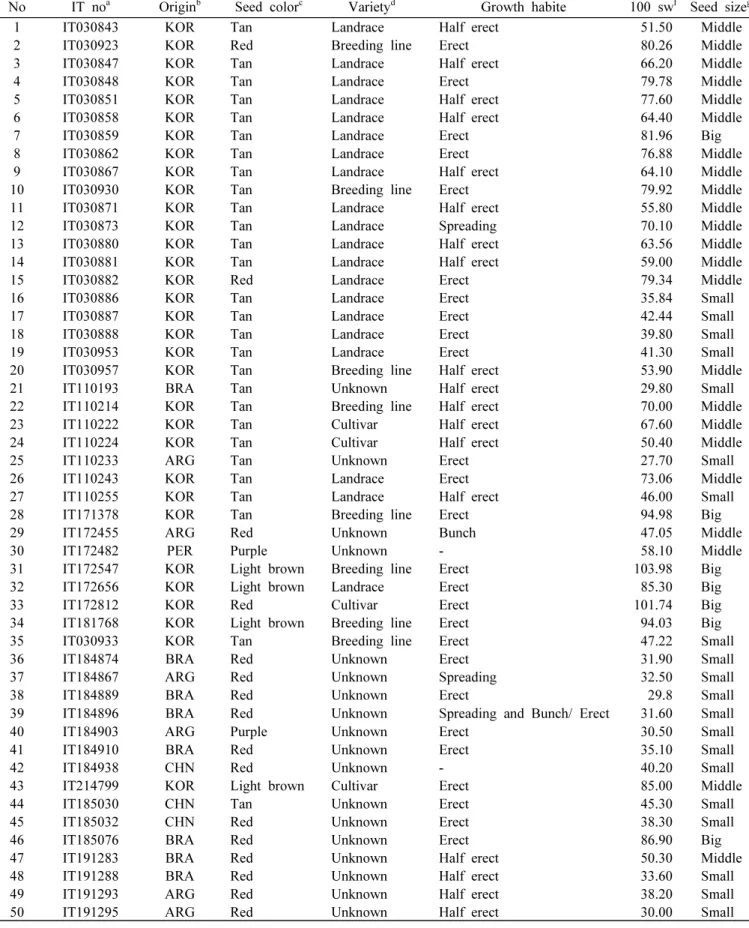
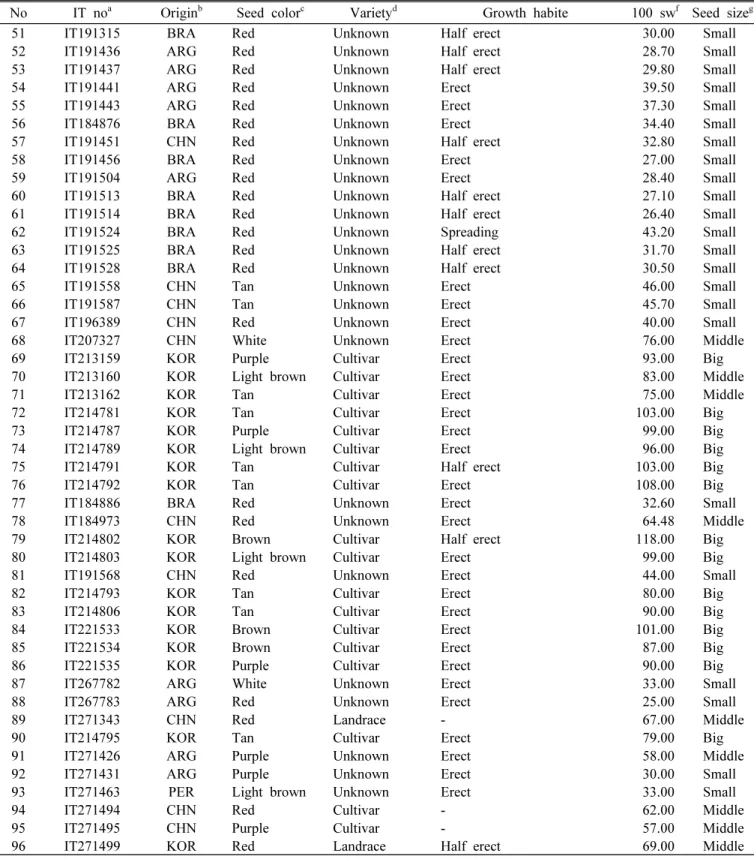
A total of 96 peanut accessions obtained from the National Agrobiodiversity Center, Jeonju, Republic of Korea were used for the present study (Table 1). Ninety-six accessions were originally donated from five countries; two accessions from Peru (PRE), thirteen accessions from China (CHN), fifteen accessions
from Argentina (ARG), 17 accessions from Brazil (BRA), and 49 accessions from Korea (KOR). In 2017, the accessions were planted in a greenhouse at Pusan National University, Miryang, Republic of Korea. A young leaf from each individual accession was collected to extract genomic DNA. Genomic DNA was extracted for each accession with the CetyltrimethylAmmonium Bromide (CTAB) protocol (Saghai-Maroof et al., 1984) with minor modifications. The quality and quantity of the extracted DNA were measured with a NanoDrop ND-1000 (Thermos Fisher Scientific Inc., USA) and electrophoresis on a 1% agarose gel. Final concentration of each DNA sample was adjusted to 30 ng/µl.
Analysis of the CAPS markers
A total 30 CAPS markers were used to evaluate genetic diversity and population structure of the peanut accessions in the present study (Supplementary Table S1). The CAPS markers were derived from thirteen different chromosomes (A01, A03, A05, A06, A07, A06, A08; B01, B03, B04, B06, B07, B08). It has been confirmed that 28 of the CAPSs were in intergenic regions and two CAPSs were in coding regions in peanut genome (Kim et al., 2017).
Polymerase chain reaction (PCR) amplifications were conducted in 20 µL reactions containing 60 ng of template DNA, 5nM mixed Primer, 1X reaction buffer, 10mM dNTP, and 1.0 unit of Taq DNA polymerase (Gen-Script USA Inc., Piscataway, N.J., USA). PCR product was digested with enzyme (AseI, DraI, HpaII, MseI, MspI, PstI, Taq. I) (New England Biolabs, USA;
Enzynomics, Republic of Korea) and incubated at T-100 thermal cycler (BIO-RAD, USA) using optimum enzyme cutting tem- perature for 1 h. PCR products and the restriction enzyme- digested PCR products were resolved on 1.5% agarose gels (Promega, USA) to detect the polymorphism.
Data analysis
UPGMA (Unweighted Pair Group Method with Arithmetic Mean) dendrogram was constructed using the MEGA 4 (Tamura et al., 2007). The bootstrap consensus tree inferred from 1000 replicates is taken to represent the evolutionary history of the accessions analyzed, and branches corresponding to partitions reproduced in less than 42 % bootstrap replicates collapsed (Felsenstein, 1985). The evolutionary distances were computed among the 96 accessions by using the Maximum Composite
Table 1. Information on the 96 peanut accessions used in the study.
No IT noa Originb Seed colorc Varietyd Growth habite 100 swf Seed sizeg
1 IT030843 KOR Tan Landrace Half erect 51.50 Middle
2 IT030923 KOR Red Breeding line Erect 80.26 Middle
3 IT030847 KOR Tan Landrace Half erect 66.20 Middle
4 IT030848 KOR Tan Landrace Erect 79.78 Middle
5 IT030851 KOR Tan Landrace Half erect 77.60 Middle
6 IT030858 KOR Tan Landrace Half erect 64.40 Middle
7 IT030859 KOR Tan Landrace Erect 81.96 Big
8 IT030862 KOR Tan Landrace Erect 76.88 Middle
9 IT030867 KOR Tan Landrace Half erect 64.10 Middle
10IT030930 KOR Tan Breeding line Erect 79.92 Middle
11 IT030871 KOR Tan Landrace Half erect 55.80 Middle
12 IT030873 KOR Tan Landrace Spreading 70.10 Middle
13 IT030880 KOR Tan Landrace Half erect 63.56 Middle
14 IT030881 KOR Tan Landrace Half erect 59.00 Middle
15 IT030882 KOR Red Landrace Erect 79.34 Middle
16 IT030886 KOR Tan Landrace Erect 35.84 Small
17 IT030887 KOR Tan Landrace Erect 42.44 Small
18 IT030888 KOR Tan Landrace Erect 39.80 Small
19 IT030953 KOR Tan Landrace Erect 41.30 Small
20 IT030957 KOR Tan Breeding line Half erect 53.90 Middle
21 IT110193 BRA Tan Unknown Half erect 29.80 Small
22 IT110214 KOR Tan Breeding line Half erect 70.00 Middle
23 IT110222 KOR Tan Cultivar Half erect 67.60 Middle
24 IT110224 KOR Tan Cultivar Half erect 50.40 Middle
25 IT110233 ARG Tan Unknown Erect 27.70 Small
26 IT110243 KOR Tan Landrace Erect 73.06 Middle
27 IT110255 KOR Tan Landrace Half erect 46.00 Small
28 IT171378 KOR Tan Breeding line Erect 94.98 Big
29 IT172455 ARG Red Unknown Bunch 47.05 Middle
30IT172482 PER Purple Unknown - 58.10Middle
31 IT172547 KOR Light brown Breeding line Erect 103.98 Big
32 IT172656 KOR Light brown Landrace Erect 85.30 Big
33 IT172812 KOR Red Cultivar Erect 101.74 Big
34 IT181768 KOR Light brown Breeding line Erect 94.03 Big
35 IT030933 KOR Tan Breeding line Erect 47.22 Small
36 IT184874 BRA Red Unknown Erect 31.90 Small
37 IT184867 ARG Red Unknown Spreading 32.50 Small
38 IT184889 BRA Red Unknown Erect 29.8 Small
39 IT184896 BRA Red Unknown Spreading and Bunch/ Erect 31.60 Small
40 IT184903 ARG Purple Unknown Erect 30.50 Small
41 IT184910BRA Red Unknown Erect 35.10Small
42 IT184938 CHN Red Unknown - 40.20 Small
43 IT214799 KOR Light brown Cultivar Erect 85.00 Middle
44 IT185030 CHN Tan Unknown Erect 45.30 Small
45 IT185032 CHN Red Unknown Erect 38.30 Small
46 IT185076 BRA Red Unknown Erect 86.90 Big
47 IT191283 BRA Red Unknown Half erect 50.30 Middle
48 IT191288 BRA Red Unknown Half erect 33.60 Small
49 IT191293 ARG Red Unknown Half erect 38.20 Small
50 IT191295 ARG Red Unknown Half erect 30.00 Small
Table 1. Information on the 96 peanut accessions used in the study (Continued).
No IT noa Originb Seed colorc Varietyd Growth habite 100 swf Seed sizeg
51 IT191315 BRA Red Unknown Half erect 30.00 Small
52 IT191436 ARG Red Unknown Half erect 28.70 Small
53 IT191437 ARG Red Unknown Half erect 29.80 Small
54 IT191441 ARG Red Unknown Erect 39.50 Small
55 IT191443 ARG Red Unknown Erect 37.30 Small
56 IT184876 BRA Red Unknown Erect 34.40 Small
57 IT191451 CHN Red Unknown Half erect 32.80 Small
58 IT191456 BRA Red Unknown Erect 27.00 Small
59 IT191504 ARG Red Unknown Erect 28.40 Small
60IT191513 BRA Red Unknown Half erect 27.10Small
61 IT191514 BRA Red Unknown Half erect 26.40 Small
62 IT191524 BRA Red Unknown Spreading 43.20 Small
63 IT191525 BRA Red Unknown Half erect 31.70 Small
64 IT191528 BRA Red Unknown Half erect 30.50 Small
65 IT191558 CHN Tan Unknown Erect 46.00 Small
66 IT191587 CHN Tan Unknown Erect 45.70 Small
67 IT196389 CHN Red Unknown Erect 40.00 Small
68 IT207327 CHN White Unknown Erect 76.00 Middle
69 IT213159 KOR Purple Cultivar Erect 93.00 Big
70IT213160 KOR Light brown Cultivar Erect 83.00Middle
71 IT213162 KOR Tan Cultivar Erect 75.00 Middle
72 IT214781 KOR Tan Cultivar Erect 103.00 Big
73 IT214787 KOR Purple Cultivar Erect 99.00 Big
74 IT214789 KOR Light brown Cultivar Erect 96.00 Big
75 IT214791 KOR Tan Cultivar Half erect 103.00 Big
76 IT214792 KOR Tan Cultivar Erect 108.00 Big
77 IT184886 BRA Red Unknown Erect 32.60 Small
78 IT184973 CHN Red Unknown Erect 64.48 Middle
79 IT214802 KOR Brown Cultivar Half erect 118.00 Big
80 IT214803 KOR Light brown Cultivar Erect 99.00 Big
81 IT191568 CHN Red Unknown Erect 44.00 Small
82 IT214793 KOR Tan Cultivar Erect 80.00 Big
83 IT214806 KOR Tan Cultivar Erect 90.00 Big
84 IT221533 KOR Brown Cultivar Erect 101.00 Big
85 IT221534 KOR Brown Cultivar Erect 87.00 Big
86 IT221535 KOR Purple Cultivar Erect 90.00 Big
87 IT267782 ARG White Unknown Erect 33.00 Small
88 IT267783 ARG Red Unknown Erect 25.00 Small
89 IT271343 CHN Red Landrace - 67.00 Middle
90IT214795 KOR Tan Cultivar Erect 79.00Big
91 IT271426 ARG Purple Unknown Erect 58.00 Middle
92 IT271431 ARG Purple Unknown Erect 30.00 Small
93 IT271463 PER Light brown Unknown Erect 33.00 Small
94 IT271494 CHN Red Cultivar - 62.00 Middle
95 IT271495 CHN Purple Cultivar - 57.00 Middle
96 IT271499 KOR Red Landrace Half erect 69.00 Middle
a-gInformation were obtained from Korean National Agrobiodiversity Center
bARG, Argentina; BRA, Brazil; CHN, China; KOR, Korea; PER, Peru
cSeed color of each accession was double-checked, and off-types were discarded. Tan indicates the Tannin color.
gMiddle (51-70 seeds per oz), Small (71-90 seeds per oz), Big (36-50 seeds per oz).
Likelihood method (Tamura et al., 2004).
The population structure of 96 peanut accessions was evaluated by Structure v2.3.4 software (https://web.stanford.edu/group/
pritchardlab/structure_software/release_versions/v2.3.4/html/st ructure.html) under the admixture model. Models were tested for K-values ranging from 1 to 15, with 3 independent runs per K value. To make a decision for the optimum number of K, delta K (ΔK) method was used the software online “harvester structure”
(Evanno et al., 2005). Population structure and relationships were analyzed by principle coordinate analysis (PCoA) using software GenAlEx V6.503 (Peakall & Smouse, 2006).
For the estimation of genetic differentiation between sub- populations, the values of FST > 0.25 are taken to mean great differentiation between subpopulations; the range 0.15 to 0.25 indicates high differentiation; and the range 0.05 to 0.15 indicates moderate differentiation, while differentiation can negligible if FST < 0.05. Estimates of Genetic diversity indices
were calculated for each locus using GeneAlEx 6.503. The genetic differentiation between individual accessions was calculated using the FST to evaluate the reduction in genotypic heterozygosity (Grasso et al., 2014).
RESULTS Genetic diversity
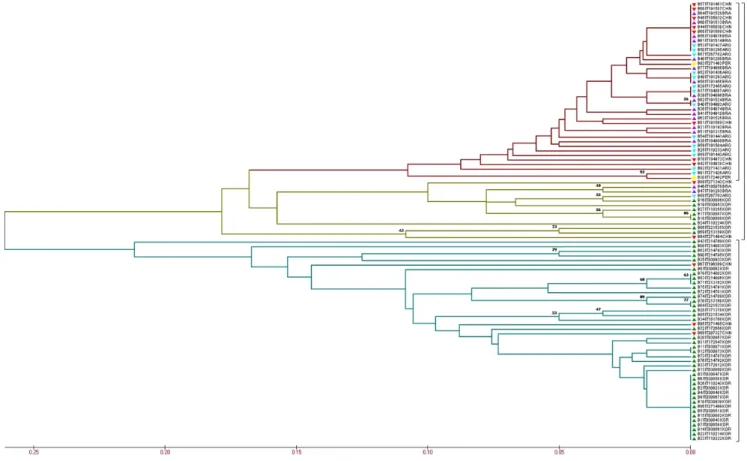
The UPGMA tree placed the peanut accessions into two major clusters (Fig. 1), indicating that most accessions from Korea grouped in a cluster. The other cluster contained with accessions from other four origins and eight accessions collected from Korea show a small group in this cluster.
Accessions from BRA and ARG presented the FST values more than 0.25 compared to the KOR accessions (0.311 and 0.264, respectively) indicating the most significant differences between the accessions (Table 2). Accessions from KOR and
Fig. 1. Evaluation of evolutionary relationships among the 96 peanut accessions based on the 30 CAPS markers. The green mark indicates the genotypes from Korea; the blue mark indicates the genotypes from Argentina; the purple mark indicates the genotypes from Brazil; the red mark indicates the genotypes from China; and the yellow mark indicates the genotypes from Peru. The different colors of the branch represent different groups.
CHN, KOR and PER, PER and BRA had FST values ranged from 0.15 to 0.25 showed a high differentiation. Accessions from BRA and CHN, ARG and CHN, ARG and PER, PER and CHN had FST values ranged from 0.15 to 0.25 presented moderate differentiation. Accessions from BRA and ARG had FST values less than 0.05 indicating that the differentiation could be negligible.
The value of the Nei’s genetic distance ranged from 0.012 to 0.437 (Table 3). The accessions from BRA and ARG presented the lowest genetic dissimilarity (0.012). The accessions from
KOR and BRA presented the highest genetic dissimilarities (0.437). The highest genetic dissimilarities were observed accessions from KOR between other four origins while genetic dissimilarities of accessions from other four origins had less than 0.1.
The pattern of PCoA (Fig. 2) was similar with the results of the UPGMA tree. The first two axes accounted for 65.03% of the total variation, and the 96 accessions were divided into three broad groups across the first two axes. The first axes separate the KOR accessions into two parts. However, Korea accessions Table 2. Pairwise population FST values among five different origins.
Origins† KOR BRA ARG CHN
BRA 0.311 -
ARG 0.264 0.034 -
CHN 0.159 0.083 0.056 -
PER 0.246 0.156 0.094 0.115
†ARG, Argentina; BRA, Brazil; CHN, China; KOR, Korea; PER, Peru
Table 3. Pairwise population matrix of Nei’s genetic distance among five different origins.
Origins† KOR BRA ARG CHN
BRA 0.437 -
ARG 0.390 0.012 -
CHN 0.224 0.047 0.036 -
PER 0.284 0.083 0.051 0.071
†ARG, Argentina; BRA, Brazil; CHN, China; KOR, Korea; PER, Peru
Fig. 2. Principal component analysis (PCoA) for the 96 peanut accessions based on the 30 CAPS markers; each point represents one accession and individuals are colored according to their origins. Coord.1 (49.86%) and Coord.2 (12.95%) refer to the first and second principal component, respectively. ARG is Argentina; BRA is Brazil; CHN is China; KOR is Korea;
PER is Peru.
formed a less sticky block with the others. The intermixing of color across the coordinates, further support the UPGMA tree with SNP marker that there is no location-specific grouping (Singh et al., 2013) between accessions from BRA and ARG.
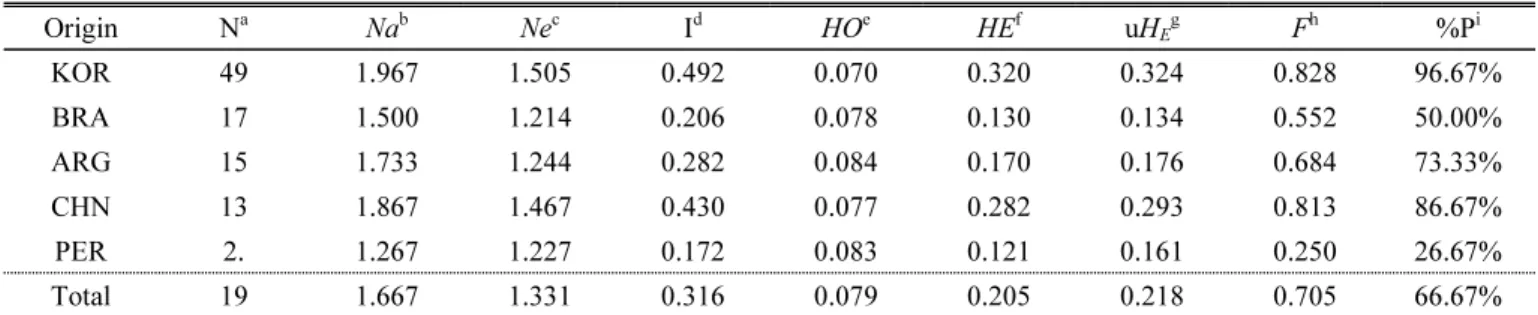
Genetic diversity indices including HO (observed heterozygosity), HE (expected heterozygosity), and the Fixation Index (F) were calculated (Table 4). For each group, the HO and HE calculated using all SNPs by observed genotype frequencies. The F values ranged from -1 to +1. Negative values indicate excess of heterozygosity. Values close to zero expected under random mating while a mass of positive values indicate inbreeding or undetected null alleles. For the 96 peanut individuals, mean HO
ranged from 0.070 (KOR) to 0.084 (ARG). The lowest mean HE
was found in the population from PER (0.121), whereas the highest was in the population from KOR (0.320). Across the origins, HO (0.079) was significantly less than HE (0.205).
Population structure
At K = 2, we found maximum Δk (Fig. 3A) values that were plotted against the K to confirm the number of populations.
Another lower peak was shown at K = 6 (Fig. 3A). When most accessions divided into the two subpopulations (K = 2, Fig. 3B), a large portion of accessions from Korea belonged to one subgroup (red) while another subgroup (green) revealed features of accessions from other four origins. As we continue to divide subgroups carefully, there is a new division into the subgroups.
The most divergent subgroups by origin were formed at K = 6, but all subgroups are mixed in origin. In the red, green, and yellow subpopulations, most accessions derived from KOR with only four accessions from CHN. However, the subpopulation labeled with dark blue were mainly from ARG and BRA, pink and light blue subpopulations mixed with different areas, which coincided with results of the UPGMA tree and PCoA.
Table 4. Genetic diversity indices in five subpopulations.
Origin Na Nab Nec Id HOe HEf uHEg Fh %Pi
KOR 49 1.967 1.505 0.492 0.070 0.320 0.324 0.828 96.67%
BRA 17 1.500 1.214 0.206 0.078 0.130 0.134 0.552 50.00%
ARG 15 1.733 1.244 0.282 0.084 0.170 0.176 0.684 73.33%
CHN 13 1.867 1.467 0.430 0.077 0.282 0.293 0.813 86.67%
PER 2. 1.267 1.227 0.172 0.083 0.121 0.161 0.250 26.67%
Total 19 1.667 1.331 0.316 0.079 0.205 0.218 0.705 66.67%
aNo. of Alleles; bNo. of Different Alleles; cNo. of Effective Alleles = 1 / (Sum pi^2);
dShannon’s Information Index = -1* Sum (pi * Ln (pi)); e Observed Heterozygosity = No. of Hets / N; f Expected Heterozygosity = 1 - Sum pi^2; g Unbiased Expected Heterozygosity = (2N / (2N-1)) * He; h Fixation Index = (He - Ho) / He = 1 - (Ho / He);
iPercentage of Polymorphic Loci
Fig. 3. (A) Estimation of the number of populations for K ranging from 2 to 15 by ΔK values, (B) Estimated genetic structure for K=2 to K=6.
DISCUSSION
Most crops including peanut have undergone a significant loss of genetic diversity during both the evolution and cultivation (Smýkal et al., 2018). The rich genetic diversity of genetic resources is a precondition for improvement in productivity and other goals in crop breeding programs. Genetic heterozygosity (H) known as genetic diversity could reflect the degree of genetic consistency of in the population (Tambasco-Talhari et al., 2005). The lower H values represent that the higher genetic consistency and the lower genetic variation in the population. In the present study, the HO was significantly lower than the HE
regardless the origins. This result might be directly affected by low heterozygosity of the tested peanut accessions or a general characteristic of peanut species with low genetic diversity.
Besides, the low genetic diversity in the peanut accessions might be results of long-term peanut germplasm collection conducting with a lack of understanding of the genetic background or too much emphasis on the phenotypic variations.
The genetic diversity of the 96 peanut accessions was analyzed by cluster analysis. According to the SNP marker data, the 96 accessions were divided into two subpopulations. Most of the analyzed germplasms come from KOR divided with other germplasms. Genotypes from other origins were mixed in the same group, in this group, some peanut accessions from Korea formed a small separate group. Although low genetic diversity in peanut germplasm has been reported, analyses for population structure and clustering indicated that clear genetic differentiation between germplasm from KOR and other four countries. The STRUCTURE analysis reveals the existence of two subpop- ulations consistent with the clustering results based on genetic diversity. Our study identified the genetic differentiation in the peanut accessions from the five origins and this result could provide fundamental and visible information for enhancing genetic diversity studies and for finding novel traits in peanut breeding programs.
According to the geographical origin of different peanut accessions, the origins of peanut accessions are divided into East Asia and South America. The East Asia section includes peanut accessions from China and South Korea, while the South America section includes peanut accessions from Argentina, Brazil and Peru. In terms of geographical distribution, the peanut accessions from China and South Korea are the closest, while the
other accessions from Argentina, Brazil and Peru are the closest.
The Fst values between ARG, BRA, CHN and PER were small, indicating that there was a small genetic differentiation between the four populations. However, the Fst value between KOR and ARG, BRA, CHN and PER is large, which indicates that the genetic distance between peanut varieties from Korea and those from ARG, BRA, CHN and PER is large, and there is a high genetic differentiation between populations, indicating that there is a significant difference between groups from Korea and other groups. Moreover, the Fst value between KOR and CHN was relatively small compared with that between KOR and ARG, BRA and PER, indicating that the genetic differentiation of peanut accessions in KOR and CHN was small. Geographically, it corresponds to the distribution characteristics of East Asia and South America. The long distance geographical separation of East Asia and South America is the reason for the high genetic diversity between KOR and South American peanut populations generally regarded as the origin of peanuts. According to the results of population structure, there are abundant genetic differences between peanut accessions from Korea and those from other sources, which may be the result of human selection, or the peanut accessions from Korea are excellent adapted to the local ecological environment. Also, it is necessary to introduce more peanut germplasm resources into Korean peanut accessions to expand the genetic diversity of Korean peanut accessions in future breeding programs.
In the latest research, peanuts made significant progress in the whole genome sequencing, providing a huge amount of molecular marker information and gene annotations, despite the complexity of genome of cultivated peanut (Bertioli et al., 2016). Especially, SNP markers have good genetic affinity and can directly reflect a genetic diversity in the accessions at the DNA sequence level (Ren et al., 2013). In this study, CAPS markers developed from SNPs clearly separated all accessions into the distinct subpop- ulations. Therefore, the use of molecular markers including CAPS might be a useful tool to determine genetic diversity and population structure in peanut.
In summary, this investigation about information on genetic diversity is helpful for developing appropriate scientific strategy for peanut breeding (Landjeva et al., 2006) and it can be a great tool for genotype selection in a breeding program. Because of the large size of genome in the peanut species, it is necessary to use molecular markers, and breeders can use the molecular
marker data to select the required information in the absence of any pedigree information. The results obtained from this study showed that the successful application of SNP information derived from re-sequencing based on NGS technology, and this study also proved availability of the CAPS marker to figure out genetic diversity and population structure using 96 peanut accessions.
ACKNOWLEDGEMENTS
This work was supported by a 2-year Research Grant of Pusan National University.
REFERENCES
Bertioli, D. J., S. B. Cannon, L. Froenicke, G. Huang, A. D.
Farmer, E. K. Cannon, X. Liu, D. Gao, J. Clevenger, and S.
Dash. 2016. The genome sequences of Arachis duranensis and Arachis ipaensis, the diploid ancestors of cultivated peanut.
Nature Genetics 48(4) : 438-446.
Bertioli, D. J., S. C. Leal-Bertioli, and H. T. Stalker. 2016. The peanut genome: The history of the consortium and the structure of the genome of cultivated peanut and its diploid ancestors. Peanuts, Elsevier: 147-161.
Chen, X., Q. Lu, H. Liu, J. Zhang, Y. Hong, H. Lan, H. Li, J.
Wang, H. Liu, and S. Li. 2019. Sequencing of cultivated peanut, Arachis hypogaea, yields insights into genome evolution and oil improvement. Molecular Plant 12(7) : 920-934.
Dhillon, S. S., A. V. Rake, and J. P. Miksche. 1980. Reassociation kinetics and cytophotometric characterization of peanut (Arachis hypogaea L.) DNA. Plant Physiology 65(6) : 1121- 1127.
Evanno, G., S. Regnaut, and J. Goudet. 2005. Detecting the number of clusters of individuals using the software Structure:
a simulation study. Molecular Ecology 14(8) : 2611-2620.
FAO. 2020. Food Outlook - Biannual Report on Global Food Markets. Rome, Italy.
Felsenstein, J. 1985. Confidence limits on phylogenies: an approach using the bootstrap. Evolution 39(4): 783-791.
Feng, S., X. Wang, X. Zhang, P. M. Dang, C. C. Holbrook, A. K.
Culbreath, Y. Wu, and B. Guo. 2012. Peanut (Arachis hypogaea) expressed sequence tag project: progress and application.
Comparative and Functional Genomics 2012.
Grasso, A. N., V. Goldberg, E. A. Navajas, W. Iriarte, D. Gimeno, I. Aguilar, J. F. Medrano, G. Rincón, and G. Ciappesoni. 2014.
Genomic variation and population structure detected by single nucleotide polymorphism arrays in Corriedale, Merino and Creole sheep. Genetics and Molecular Biology 37(2) : 389-395.
Kang, Y. J., Y.-K. Ahn, K.-T. Kim, and T.-H. Jun. 2016.
Resequencing of Capsicum annuum parental lines (YCM334 and Taean) for the genetic analysis of bacterial wilt resistance.
BMC Plant Biology 16(1) : 235.
Khera, P., H. Upadhyaya, M. Pandey, M. Roorkiwal, M. Sriswathi, P. Janila, Y. Guo, M. McKain, E. Nagy, and S. Knapp. 2013.
SNP-based genetic diversity in the reference set of peanut (Arachis spp.) by developing and applying cost-effective KASPar genotyping assays. Plant Genome 6 : 1-11.
Kim, K.-S., D. Lee, S. B. Bae, Y.-C. Kim, I.-S. Choi, S. T. Kim, T.-H. Lee, and T.-H. Jun. 2017. Development of SNP-Based Molecular Markers by Re-Sequencing Strategy in Peanut.
Plant Breeding and Biotechnology 5(4) : 325-333.
Kottapalli, K. R., M. D. Burow, G. Burow, J. Burke, and N.
Puppala. 2007. Molecular characterization of the US peanut mini core collection using microsatellite markers. Crop Science 47(4) : 1718-1727.
Landjeva, S., V. Korzun, and G. Ganeva. 2006. Evaluation of genetic diversity among Bulgarian winter wheat (Triticum aestivum L.) varieties during the period 1925–2003 using microsatellites. Genetic Resources and Crop Evolution 53(8) : 1605-1614.
Lee, J., N. K. Izzah, M. Jayakodi, S. Perumal, H. J. Joh, H. J. Lee, S.-C. Lee, J. Y. Park, K.-W. Yang, and I.-S. Nou. 2015. Genome- wide SNP identification and QTL mapping for black rot resistance in cabbage. BMC Plant Biology 15(1) : 1-11.
Peakall, R. and P. E. Smouse. 2006. GENALEX 6: genetic analysis in Excel. Population genetic software for teaching and research. Molecular Ecology Notes 6(1) : 288-295.
Rasheed, A., Y. Hao, X. Xia, A. Khan, Y. Xu, R. K. Varshney, and Z. He. 2017. Crop breeding chips and genotyping platforms: progress, challenges, and perspectives. Molecular Plant 10(8) : 1047-1064.
Ren, J., D. Sun, L. Chen, F. M. You, J. Wang, Y. Peng, E. Nevo, D. Sun, M.-C. Luo, and J. Peng. 2013. Genetic diversity revealed by single nucleotide polymorphism markers in a worldwide germplasm collection of durum wheat. International Journal of Molecular Sciences 14(4) : 7061-7088.
Ren, X.-P., H.-F. Jiang, B.-S. Liao, X.-J. Zhang, Y. Lei, G.-Q.
Huang, L.-Y. Yan, and Y.-N. Chen. 2011. Distributing and genetic diversity of high oleic acid germplasm in Peanut (Arachia Hypogaea L.) core collection of China. Journal of Plant Genetic Resources 12(4) : 513-518.
Robledo, G., G. Lavia, and G. Seijo. 2009. Species relations among wild Arachis species with the A genome as revealed by FISH mapping of rDNA loci and heterochromatin detection.
Theoretical and Applied Genetics 118(7) : 1295-1307.
Saghai-Maroof, M. A., K. M. Soliman, R. A. Jorgensen and R.
Allard. 1984. Ribosomal DNA spacer-length polymorphisms in barley: Mendelian inheritance, chromosomal location, and population dynamics. Proceedings of the National Academy of Sciences 81(24) : 8014-8018.
Seijo, G., G. I. Lavia, A. Fernández, A. Krapovickas, D. A.
Ducasse, D. J. Bertioli, and E. A. Moscone. 2007. Genomic relationships between the cultivated peanut (Arachis hypogaea, Leguminosae) and its close relatives revealed by double GISH. American Journal of Botany 94(12) : 1963-1971.
Singh, N., D. R. Choudhury, A. K. Singh, S. Kumar, K. Srinivasan, R. Tyagi, N. Singh, and R. Singh. 2013. Comparison of SSR and SNP markers in estimation of genetic diversity and population structure of Indian rice varieties. PloS One 8(12) : e84136.
Smartt, J., W. Gregory, and M. P. Gregory. 1978. The genomes of Arachis hypogaea. L. Cytogenetic studies of putative genome donors. Euphytica 27(3) : 665-675.
Smýkal, P., M. Nelson, J. Berger, and E. Von Wettberg. 2018.
The Impact of Genetic Changes during Crop Domestication.
Agronomy 8(7) : 119.
Tambasco-Talhari, D., M. M. d. Alencar, C. C. P. d. Paz, G. M. d.
Cruz, A. d. A. Rodrigues, I. U. Packer, L. L. Coutinho, and L.
C. d. A. Regitano. 2005. Molecular marker heterozygosities and genetic distances as correlates of production traits in F1 bovine crosses. Genetics and Molecular Biology 28(2) : 218- 224.
Tamura, K., J. Dudley, M. Nei, and S. Kumar. 2007. MEGA4:
molecular evolutionary genetics analysis (MEGA) software version 4.0. Molecular Biology and Evolution 24(8) : 1596-
1599.
Tamura, K., M. Nei, and S. Kumar. 2004. Prospects for inferring very large phylogenies by using the neighbor-joining method.
Proceedings of the National Academy of Sciences 101(30) : 11030-11035.
Temsch, E. M. and J. Greilhuber. 2000. Genome size variation in Arachis hypogaea and A. monticola re-evaluated. Genome 43(3) : 449-451.
Wang, Y., W. Liu, L. Xu, Y. Wang, Y. Chen, X. Luo, M. Tang, and L. Liu. 2017. Development of SNP markers based on transcriptome sequences and their application in germplasm identification in radish (Raphanus sativus L.). Molecular Breeding 37(3) : 26.
Yang, H., Y. Tao, Z. Zheng, C. Li, M. W. Sweetingham, and J. G.
Howieson. 2012. Application of next-generation sequencing for rapid marker development in molecular plant breeding: a case study on anthracnose disease resistance in Lupinus angustifolius L. BMC Genomics 13(1) : 318.
Zhou, X., Y. Xia, X. Ren, Y. Chen, L. Huang, S. Huang, B. Liao, Y. Lei, L. Yan, and H. Jiang. 2014. Construction of a SNP- based genetic linkage map in cultivated peanut based on large scale marker development using next-generation double- digest restriction-site-associated DNA sequencing (ddRAD seq). BMC Genomics 15(1) : 351.