• 검색 결과가 없습니다.

Listed Local State-Owned Enterprises and Environmental Performance: Evidence from China

N/A
N/A
Protected

Academic year: 2021

Share "Listed Local State-Owned Enterprises and Environmental Performance: Evidence from China"

Copied!
8
0
0

로드 중.... (전체 텍스트 보기)

전체 글

(1)

Print ISSN: 2288-4637 / Online ISSN 2288-4645 doi:10.13106/jafeb.2021.vol8.no2.0255

Listed Local State-Owned Enterprises and Environmental Performance:

Evidence from China

Kai TANG

1

, Khee Su BAE

2

Received: November 05, 2020 Revised: December 30, 2020 Accepted: January 08, 2021

Abstract

The paper examines the influence of ownership type on environmental performance of Chinese listed enterprises. China’s environmental problems are attributed to the collusion between enterprises and economy-oriented local governments, which has allowed many companies to skirt environmental regulations. Especially, local state-owned enterprises (SOEs) tend to have worse environmental performance than private firms, under the wing of local governments, with whom they have a closer political connection. According to the report of the Environmental Protection Agency, currently the unacceptably poor environmental performance of local SOEs has severely hampered the realization of green economy in China. After examining the dataset of 15,996 firm-year observations from 2,688 listed firms, this paper found that, in the presence of central government supervision and personnel intervention, listed local SOEs will be forced to improve their environmental performance in accordance with standards set by the central government, which leads to better environmental performance than that of listed private firms (private firms). The result of two-stage regression also supports the conclusion. This shows increased supervision and personnel intervention from the central government can significantly improve the environmental performance of local SOEs. The research in this paper expects to make a contribution to attaining the goal of green economy in China.

Keywords: Listed Local State-Owned Enterprises, Local State-Owned Enterprises, Environmental Performance JEL Classification Code: H32, L32, M14, O13, Q56

longer be used for drinking, and 55.3 percent of the country’s area is no longer hospitable for human beings (2019 Report on the State of the Environment in China). Environmental pollution has posed a serious threat to the life and health of people–for example, in 2019, there were over 530 thousand complaint cases resulting from environmental pollution (Ministry of Ecology and Environment of the People’s Republic of China).

With regard to the cause of the serious environmental pollution in China, it can be attributed to the collusion between enterprises and local governments, which allows many polluters to skirt environmental laws and regulations (Zhang, 2017). Under the current GDP-centered evaluation system for government official performance, officials at local governments are inclined to sacrifice environmental protection for economic growth (Deng & Xu, 2013; Yang, Chen, & Zhou, 2008; Zhang, 2018; Zhang & Zhong, 2014).

Meanwhile, for their own profit, enterprises have the incentive to seek political assistance to reduce their cost on environmental protection (Yao & Cheng, 2014; Zhang

& Zhong, 2014). That way, the government-enterprise collusion on environmental protection satisfies both the need

1

First Author. Ph.D. Candidate, Department of Accounting, College of Business, Chungbuk National University, Republic of Korea.

Email: [email protected]

2

Corresponding Author. Professor, Department of Accounting, College of Business, Chungbuk National University, Republic of Korea [Postal Address: Chungdae-ro 1, Seowon-Gu, Cheongju, Chungbuk 28644, Republic of Korea]

Email: [email protected]

© Copyright: The Author(s)

This is an Open Access article distributed under the terms of the Creative Commons Attribution Non-Commercial License (https://creativecommons.org/licenses/by-nc/4.0/) which permits unrestricted non-commercial use, distribution, and reproduction in any medium, provided the original work is properly cited.

1. Introduction

Over the past three decades, while the Chinese economy

has been growing rapidly, the living environment is being

seriously damaged. Due to emissions from polluting

industries, currently the air quality of 57.3 percent of

Chinese cities exceeds the acceptable standard and 33.3

percent are facing the threat of acid rain. As a result of

ongoing pollution, 85 percent of the groundwater can no

(2)

of government officials for glaring political achievements and that of enterprises for profit maximization (Long & Hu, 2014; Zhang & Zhong, 2014).

Previous research suggests that enterprises politically associated with local governments can easily form a collusive relationship with the governments to obtain preferential policies and thus ease their environmental responsibilities (Nie, 2018). In particular, compared to private businesses, local state-owned enterprises (SOEs), in a natural and closer political connection with their local government (Cheng, Wang, Keung, & Bai, 2017), can not only realize the collusive relationship more easily, but also secure lower environmental spending and lesser penalties in negotiation. Consequently, local SOEs often perform worse environmentally than private ones (Li & Chan, 2016). Under the protection of local government officials, some SOEs show startling environmental performance and have virtually become incorrigible chief polluters (Ministry of Ecological Environment of the People’s Republic of China). According to the report of the Environmental Protection Agency, green economy can be basically realized in China by improving the level of environmental performance of local SOEs (Li &

Chan, 2016).

Nonetheless, in China, listed firms receive extra supervision and personnel intervention from the central government. Unlike local governments, the central government not only places more emphasis on the balance between economic growth and environmental protection (Nie, 2018), but also demands better environmental performance from local SOEs than private firms–both listed and non-listed ones (the Central Committee of the Communist Party of China). Based on the dataset of 15,996 firm-year observations from 2,688 listed firms, this paper explores the differences between listed local SOEs and listed private firms in terms of environmental performance. The findings indicate that in the presence of central government supervision and personnel intervention, listed local SOEs are forced to improve their environmental performance, therefore surpassing that of listed private firms (private firms). The result of two stage regression also supports the conclusion. Environmental pollution caused by local SOEs has become the biggest obstacle to realizing green development in China. The research in this paper shows that increased central government supervision and personnel intervention for local SOEs can significantly improve their environmental performance. The research aims to contribute to attaining the goal of green development and improving environmental conditions in China.

The remainder of this paper is organized as follows: the second section provides information on previous research and established hypotheses, the third section explains the model and data involved, the fourth offers empirical results, and the fifth section states the conclusion.

2. Literature Review and Hypothesis Development

2.1. Fiscal Decentralization, Official Promotion and Environmental Pollution

It is believed that the problem of environmental pollution in China is mainly caused by the behaviors of local governments under the influence of fiscal decentralization and the evaluation system for government official performance (Cai, Du, & Wang, 2008; Que, Zhang, Liu, &

Yang, 2018). Since 1994, owing to the tax incentive brought by fiscal decentralization and official promotion based on chief indicator of economic growth, local governments in China have been obsessed with promoting economic growth, which directly leads to the rapid economic growth in China (Cai et al., 2008; Zhou, 2007). Nonetheless, while local governments seek economic growth and tax revenues, other social goals such as environmental protection are put on the backburner (Cai, Chen, & Gong, 2016). Under the current fiscal and evaluation system, environmental protection and governance have been sacrificed for local economic achievements (Song, Du, & Tan, 2018).

Certainly, the behavior of local governments is influenced by central government policies. For a developing country like China, despite the importance of environmental protection, economic growth remains the primary goal (Kuo, Yeh, &

Yu, 2012). At present, in order to ensure a rising standard of living, China needs to maintain a comparatively high rate of economic growth over a long period (Zhang & Wen, 2008).

Thus, it becomes unavoidable that the central government has to set GDP growth as a main indicator for evaluating official performance.

2.2. Local SOEs and Environmental Performance

Previous research suggests that it is the pressure

form stakeholders that determines the level of corporate

environmental performance (Sade-Abreu, 2009), while the

government is believed as the most important stakeholder,

who put huge pressure on enterprises through policymaking

(Delmas, 2002; Delmas & Toffel, 2004; Steurer, 2010). What

is more distinctive in China’s case is that due to its special

institutional background, other factors such as external public

pressure and media attention have little influence on the

environmental behaviors of enterprises, and environmental

polices play an overwhelming role in regulating corporate

environmental behaviors, forcing enterprises to act upon

the policies (Yao & Yang, 2017). Therefore, for their own

benefit, enterprises are motivated to seek political assistance

so as to escape the circumvent legal constraints and evade

environmental responsibilities (Yao & Cheng, 2014; Zhang

(3)

& Zhong, 2014). Besides, in view of the existing evaluation system, officials at local governments have the incentive to sacrifice the environment for economic development (Deng & Xu, 2013; Yang et al., 2008; Zhang, 2018; Zhang

& Zhong, 2014). In this situation, the government-enterprise collusion on environmental protection satisfies both the need of government officials for glaring political achievements and that of enterprises for profit maximization (Long & Hu, 2014; Zhang & Zhong, 2014).

As discovered by previous studies, enterprises that have a political connection with their local government can easily build a collusion relationship with them, which allows them to obtain preferential environmental policies under the wing of local governments and diminish their environmental responsibilities (Nie, 2018). In particular, compared with private enterprises, the managers of local SOEs have a political role because they are appointed by local governments, which predetermines the natural political connection between local SOEs and their governments (Cheng et al., 2017). Based on the survey data from the China Center for Economic Research (CCER) and the National Bureau of Statistics (NBS), the research conducted by Li and Chan (2016) shows that by virtue of their natural and closer political connection with local governments, local SOEs are not only able to build business-government collusion more easily, but also can secure lower environmental expenses and penalties in negotiation. Therefore, in general, local SOEs perform worse than private businesses environmentally.

However, meanwhile, publicly listed firms in China receive extra supervision and personnel intervention from the central government. Hence the next section will explore the differences between listed local SOEs and listed private firms in terms of environmental performance.

2.3. The Differences between Listed Local SOEs and Listed Private Firms in Terms of Environmental Performance

In general, local SOEs are supervised by local governments, their directors and senior executives are also appointed by local governments. Therefore, they only need to meet the requirements on environmental performance set by the local government. However, listed companies in China receive extra supervision from China Securities Regulatory Commission (a public institution directly under the State Council), who can also intervene in the appointment and removal of directors and senior executives at listed firms (CSRC may criticize and punish directors and senior executives of listed firms, or decide that they are not suitable for their position. According to the Stock Listing Rules, those who have received the aforementioned punishment shall not be candidates for directors and senior executives

within a certain period of time). Therefore, local SOEs need to reach the level of environmental performance set by the central government as well.

Unlike economy-oriented local governments, the central government (the Central Committee of the Communist Party of China) not only places more emphasis on the balance between economic growth and environmental protection, but also demands better environmental performance from local SOEs than private firms. Under the supervision and personnel intervention of the central government, listed local SOEs will have to improve their environmental performance according to the requirements of the central government and thus perform better than private firms (both listed and non- listed ones).

Hence, we can formulate the following hypothesis:

Hypothesis: Listed local SOEs have better environmental performance than listed private enterprises.

3. Research Methods and Materials

3.1. Measuring Environmental Performance and Ownership type

Based on the methods of previous research (Jiang & Fu, 2019; Khan, Gang, Fareed, & Yasmeen, 2020; Zhang, Liu, Ge, Hao, & Hao, 2020), corporate environmental performance is measured in this paper with CEP_score from Hexun.com, on a scale of 0-30. The data of ownership type is from the CSMAR database, which determines the ownership structure according to the nature of the actual controller of an enterprise.

3.2. Regression models

The following regression model is constructed to test the hypothesis:

CEP GROWTH

LEV LNAG

LLSOE

score i t

i t

Dummy

i t, i t, ,

,

= + +

+ +

a a a

a a

0 1 2

3 4

EE LNSIZE

OWNER ROA Industry Dummies Yea

i t i t

i t i t

, ,

, ,

+

+ + +

+

a

a a

5

6 7
rr Dummies + e

i t,

The table 1 illustrates definitions for variables of the model.

According to previous research, GROWTH (Zhang et al., 2020), LEV (Nguyen, 2020), LNAGE (Khan et al., 2020;), LNSIZE (Li & Chan, 2016; Nguyen, Nguyen, & Nguyen, 2020), OWNER (Khan et al., 2020; Zhang et al., 2020), ROA (Nguyen, Nguyen, Nguyen, Le, & Nguyen, 2020; Russo &

Fouts, 1997) will influence the environmental behavior of

enterprises.

(4)

3.3. Samples

All data is sourced from the annual reports of A-share listed companies released every December, with CEP_

score data from Hexun.com and the rest from the CSMAR database.

The data is filtered by following conditions:

(1) Delete missing values;

(2) Delete the data of financial enterprises.

Through data filtering, finally the dataset of 15,996 firm- year observations from 2,688 listed firms between 2020 and 2017 were obtained (The data range was chosen because so far Hexun.com only provided detailed evaluation on the environmental performance of listed firms between 2010 and 2017).

To mitigate the influence of outliers, we winsorize all of the continuous variables at the 1% and 99% levels.

4. Results

4.1. Descriptive statistics

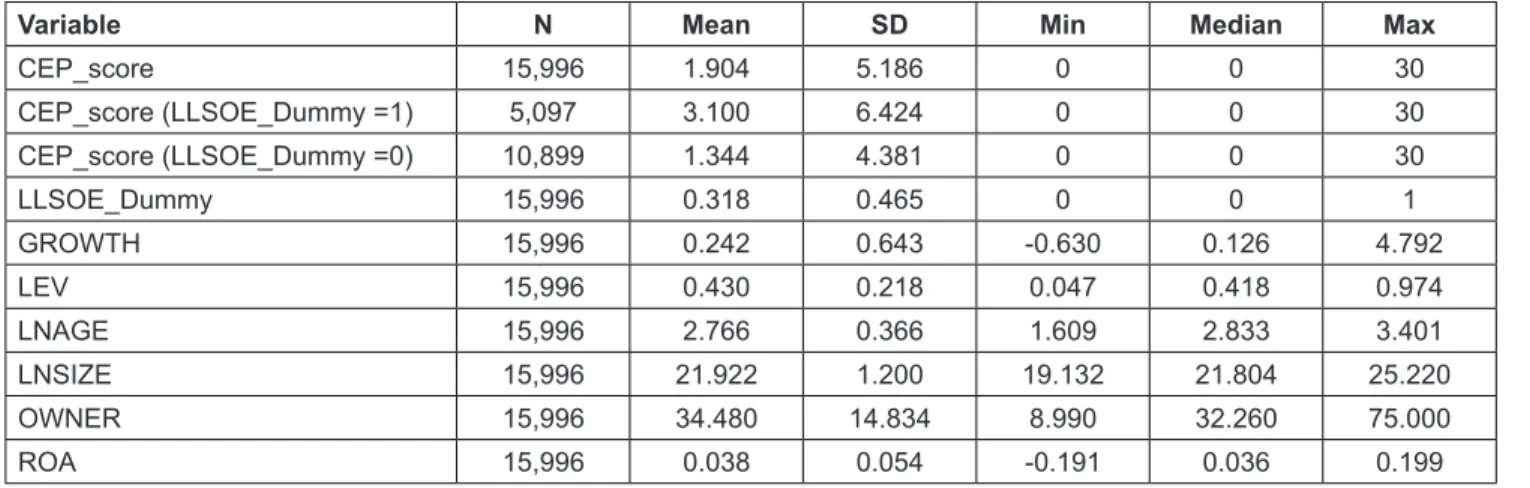
Table 2 presents the descriptive statistics of variables. The 15,996 samples studied in this paper include 5,097 samples of listed local SOEs, whose average score of environmental performance is 3.100, and 10,899 listed private enterprises, whose average score of environmental performance is 1.344.

In general, listed local SOEs score higher in environmental performance than listed private firms do (The results of t-test are: CEP-score (LLSOE-Dummy=1)- CEP-score (LLSOE- Dummy=0) =1.755, t=17.678).

4.2. Univariate Analysis

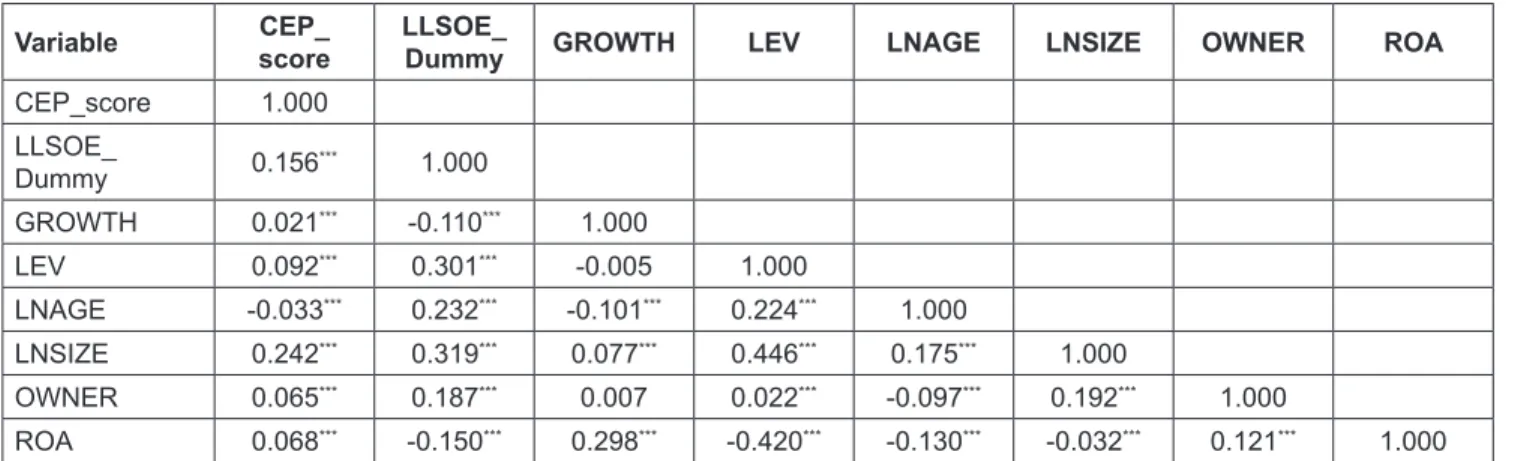
Table 3 displays the results of the univariate correlation analysis of main variables in the model. In this paper there is a significant positive relationship between the CEP_

Table1: Variable Definitions

Variable Definition

CEP_score Corporate environmental performance, measured as the scores of environmental responsibilities.

LLSOE_Dummy Ownership style. listed local state-owned firm = 1, listed private firm = 0.

GROWTH Growth ability, measured as the growth rate of sales.

LEV Leverage ratio, which is obtained by dividing total liabilities by total assets.

LNAGE The natural logarithm of firm age.

LNSIZE The natural logarithm of total assets.

OWNER Percentage of shares owned by the largest shareholder.

ROA Return of assets.

Industry Dummies Industry dummy variables.

Year Dummies Year dummy variables.

ε Error term.

Table 2: Descriptive statistics

Variable N Mean SD Min Median Max

CEP_score 15,996 1.904 5.186 0 0 30

CEP_score (LLSOE_Dummy =1) 5,097 3.100 6.424 0 0 30

CEP_score (LLSOE_Dummy =0) 10,899 1.344 4.381 0 0 30

LLSOE_Dummy 15,996 0.318 0.465 0 0 1

GROWTH 15,996 0.242 0.643 -0.630 0.126 4.792

LEV 15,996 0.430 0.218 0.047 0.418 0.974

LNAGE 15,996 2.766 0.366 1.609 2.833 3.401

LNSIZE 15,996 21.922 1.200 19.132 21.804 25.220

OWNER 15,996 34.480 14.834 8.990 32.260 75.000

ROA 15,996 0.038 0.054 -0.191 0.036 0.199

(5)

score and LLSOE_Dummy. However, the results based on univariates are not sufficiently meaningful. Therefore, multivariate regression analysis is employed to further test the relationship between CEP_score and LLSOE_Dummy.

4.3. Multivariate Regression Analysis

Multivariate OLS regression results on this model are listed in Table 4. As shown in the Column 1 of Table 4, the coefficient of LLSOE_Dummy is 0.634 and it is statistically

significant at the 1% level (t=6.594). In order to control the influence of problems such as heteroscedasticity on the results, the cluster robust standard error (firm-level) is used for OLS regression. The Column 2 of Table 4 shows that the coefficient of LLSOE_Dummy remains statistically significant at the 1% level (t=3.347). The result suggests that under the pressure of extra supervision and personnel intervention from the central government, listed local SOEs can have better environmental performance than listed private firms (private firms).

Table 3: Univariate correlations among key variables

Variable CEP_

score LLSOE_

Dummy GROWTH LEV LNAGE LNSIZE OWNER ROA

CEP_score 1.000

LLSOE_

Dummy 0.156

***

1.000

GROWTH 0.021

***

-0.110

***

1.000

LEV 0.092

***

0.301

***

-0.005 1.000

LNAGE -0.033

***

0.232

***

-0.101

***

0.224

***

1.000

LNSIZE 0.242

***

0.319

***

0.077

***

0.446

***

0.175

***

1.000

OWNER 0.065

***

0.187

***

0.007 0.022

***

-0.097

***

0.192

***

1.000

ROA 0.068

***

-0.150

***

0.298

***

-0.420

***

-0.130

***

-0.032

***

0.121

***

1.000 Note: ***, **, * indicate respectively significance at the 1%, 5%, and 10% levels or better.

Table 4: Regression Results

Variable CEP_score

Coeff. t-statistics Coeff. t-statistics

LLSOE_Dummy 0.634

***

6.594 0.634

***

3.347

GROWTH -0.224

***

-3.709 -0.224

***

-4.419

LEV -0.852

***

-3.734 -0.852

***

-2.670

LNAGE 0.242

**

2.043 0.242 1.081

LNSIZE 1.338

***

34.032 1.338

***

18.250

OWNER -0.009

***

-3.629 -0.009

*

-1.943

ROA 3.752

***

4.703 3.752

***

3.615

Constant -25.908

***

-28.756 -25.908

***

-15.302

Year dummy YES

Industry dummy YES

Cluster by firm NO YES

R-squared 0.1586

F-test 100.35

***

23.59

***

N 15,996

Note: ***, **, * indicate respectively significance at the 1%, 5%, and 10% levels or better.

(6)

4.4. Endogeneity

Two-stage regression is used in this paper to exclude the interference of the endogeneity problem.

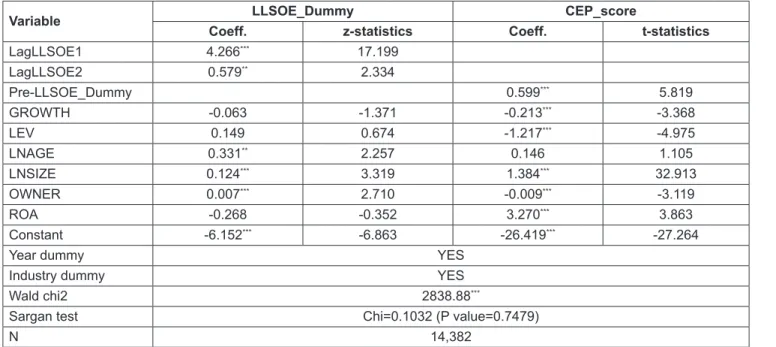
LagLLSOE1 and LagLLSOE2 serve as the instrumental variables for LLSOE_Dummy. If Enterprise i is a listed local SOE in year(t-1), LagLLSOE1 equals 1; if Enterprise i is a listed private firm year(t-1), LagLLSOE1 equals 0; if Enterprise i is a listed local SOE in year(t-2), then LagLLSOE2 equals 1; if Enterprise i is a listed private firm in year(t-2), LagLLSOE2 equals 0. The approach of lagged variables is widely applied in fields such as accounting and political economy (Gerber, 1998; Kang & Sivaramakrishnan,1995).

In the two-stage regression, the MLE approach shows higher efficiency than OLS (Larcker & Rusticus, 2010;

Staiger & Stock, 1997) . Thus, in the two-stage regression model, the first stage involves a Probit regression model, and the second, an MLE-based linear regression model. Readers may use the new command “eregress” developed by STATA in 2017 to compute the model directly.

As the ownership style of the vast majority of listed companies in China remains unchanged every year, there should be a positive correlation between LagLLSOE1 &

LagLLSOE2 and LLSOE_Dummy. However, obviously there will be no direct correlation between corporate ownership style in year(t-1) & year(t-2) and corporate environmental performance in the year(t).

As revealed in the Column 1 in Table 5, there is a positive correlation between the instrumental variables LagLLSOE1

& LagLLSOE2 and the variable LLSOE_Dummy. The Column 2 of Table 5 shows that the fitting value of the variable LLSOE_Dummy(Pre-LLSOE_Dummy) has a positive correlation with CEP_score. Moreover, the result of Sargan-test supports the validity of the selected instrumental variables (P-value> 0.1).

To sum up, after eliminating the interference of the endogeneity problem, the conclusion can still be obtained that there is a significant positive correlation between LLSOE_Dummy and CEP_score.

5. Conclusions

China’s environmental problems are attributed to the collusion between enterprises and economy-oriented local governments, which has allowed many companies to skirt environmental regulations. In a natural and closer political connection with their local government, local SOEs can not only realize the collusive relationship more easily, but also secure lower environmental spending and lesser penalties in negotiation. While the central government demands better environmental performance from local SOEs than private firms, as local SOEs are not supervised and intervened by the central government, the environmental performance of local SOEs is often worse than that of private firms. At present, the unacceptably poor environmental performance of local SOEs has severely hampered the realization of green economy in China.

Table 5: Endogeneity: Two-stage regression.

Variable LLSOE_Dummy CEP_score

Coeff. z-statistics Coeff. t-statistics

LagLLSOE1 4.266

***

17.199

LagLLSOE2 0.579

**

2.334

Pre-LLSOE_Dummy 0.599

***

5.819

GROWTH -0.063 -1.371 -0.213

***

-3.368

LEV 0.149 0.674 -1.217

***

-4.975

LNAGE 0.331

**

2.257 0.146 1.105

LNSIZE 0.124

***

3.319 1.384

***

32.913

OWNER 0.007

***

2.710 -0.009

***

-3.119

ROA -0.268 -0.352 3.270

***

3.863

Constant -6.152

***

-6.863 -26.419

***

-27.264

Year dummy YES

Industry dummy YES

Wald chi2 2838.88

***

Sargan test Chi=0.1032 (P value=0.7479)

N 14,382

Note: ***, **, * indicate respectively significance at the 1%, 5%, and 10% levels or better.

(7)

As in China, listed firms are supervised and intervened by the central government, this paper explores the differences between listed local SOEs and listed private firms in terms of environmental performance. In light of the empirical study based on the dataset of 15,996 firm- year observations from 2,688 listed firms, this paper found that in the presence of central government supervision and personnel intervention, listed local SOEs will be forced to improve their environmental performance in accordance with standards set by the central government, which leads to better environmental performance than that of listed private firms (private firms). The conclusion remains valid after excluding the interference of the problems of heteroscedasticity and endogeneity, indicating that increased supervision and personnel intervention from the central government can be an effective way to improve the environmental performance of local SOEs.

Meanwhile, this paper certainly has its limitations. Since only the evaluation on the environmental performance of listed firms is available from Hexun.com, this paper merely touches upon the differences between the environmental performance of listed local SOEs and listed private firms, rather than include the comparison between listed SOEs and private firms (both listed and non-listed ones), which is indeed regretful. Nonetheless, as stated in previous research (Yao & Yang, 2017), the special institutional environment in China has predetermined that the environmental performance of Chinese enterprises mainly depends on the pressure from the government. Compared to non-listed private enterprises, listed ones are not only supervised by economy-oriented local governments, but also receive supervision and personnel intervention from the central government focusing more on the balance between economic development and environmental protection. For this reason, there is no reason to believe that the environmental performance of listed private firms could be worse than non-listed ones. Therefore, our research is still reliable. The research in this paper expects to provide some guidance for the decision-making of the central government and make a contribution to attaining the goal of green economy.

References

Cai, F., Du, Y., & Wang, M. (2008). The Political Economy of Emission in China: Will a Low Carbon Growth Be Incentive Compatible in Next Decade and Beyond? Economic Research Journal, 6, 4–11, 36.

Cai, H., Chen, Y., & Gong, Q. (2016). Polluting thy neighbor:

Unintended consequences of China’s pollution reduction mandates. Journal of Environmental Economics and Management, 76, 86–104. https://doi.org/10.1016/j.

jeem.2015.01.002

Cheng, Z., Wang, F., Keung, C., & Bai, Y. (2017). Will Corporate Political Connection Influence the Environmental Information Disclosure Level? Based on the Panel Data of A-Shares from Listed Companies in Shanghai Stock Market. Journal of Business Ethics, 143, 209–221. https://doi.org/10.1007/

s10551-015-2776-0

Delmas, M. A. (2002). The diffusion of environmental management standards in Europe and the United States: an institutional perspective. Policy Sciences, 35, 91–119. https://doi.

org/10.1023/A:1016108804453

Delmas, M., & Toffel, M. W. (2004). Stakeholders and Environmental Management Practices: An Institutional Framework. Business Strategy and the Environmental, 13(4), 209–222. https://doi.org/10.1002/bse.409

Deng, Y., & Xu, H. (2013). Foreign Direct Investment, Local Government Competition and Environmental Pollution:

Empirical Analysis on Fiscal Decentralization. China Population, Resources and Environment, 23, 155–163.

Gerber, A. (1998). Estimating the Effect of Campaign Spending on Senate Election Outcomes Using Instrumental Variables.

American Political Science Review, 92(2), 401–411. https://doi.

org/10.2307/2585672

Jiang, C., & Fu, Q. (2019). A Win-Win Outcome between Corporate Environmental Performance and Corporate Value: From the Perspective of Stakeholders. Sustainability, 11(3), 921. https://

doi.org/10.3390/su11030921

Kang, S.-H., & Sivaramakrishnan, K. (1995). Issues in Testing Earnings Management and an Instrumental Variable Approach.

Journal of Accounting Research, 33(2), 353–367. https://doi.

org/10.2307/2491492

Khan, T. M., Gang, B., Fareed, Z., & Yasmeen, R. (2020). The impact of CEO tenure on corporate social and environmental performance: an emerging country’s analysis. Environmental Science and Pollution Research, 27, 19314–19326. https://doi.

org/10.1007/s11356-020-08468-y

Kuo, L., Yeh, C.-C., & Yu, H.-C. (2012). Disclosure of Corporate Social Responsibility and Environmental Management:

Evidence from China. Corporate Social Responsibility and Environmental Management, 19(5), 273–287. https://doi.

org/10.1002/csr.274

Larcker, D. F., & Rusticus, T. O. (2010). On the use of instrumental variables in accounting research. Journal of Accounting and Economics, 49(3), 186–205. https://doi.org/10.1016/j.

jacceco.2009.11.004

Li, X., & Chan, C. G.-W. (2016). Who Pollutes? Ownership type and environmental performance of Chinese firms. Journal of Contemporary China, 25(98), 248-263. https://doi.org/10.1080 /10670564.2015.1075718

Long, S., & Hu, J. (2014). On Environmental Pollution from the

Perspective of Government-enterprise Collusion: Theoretical

and Empirical Analysis. Journal of Finance and Economics,

40, 131–144.

(8)

Nguyen, T. D. (2020). Factors Influencing Environmental Accounting Information Disclosure of Listed Enterprises on Vietnamese Stock Markets. Journal of Asian Finance, Economics and Business, 7(11), 877–883. https://doi.

org/10.13106/jafeb.2020.vol7.no11.877

Nguyen, T. L. H., Nguyen, T. T. H., Nguyen, T. T. H., Le, T. H. A.,

& Nguyen, V. C. (2020). The Determinants of Environmental Information Disclosure in Vietnam Listed Companies. Journal of Asian Finance, Economics and Business, 7(2), 21–31. https://

doi.org/10.13106/jafeb.2020.vol7.no2.21

Nguyen, T. M. H., Nguyen, T. K. T., & Nguyen, T. T. V. (2020).

Factors Affecting the Implementation of Environmental Accounting by Construction Companies Listed on the Ho Chi Minh Stock Exchange. Journal of Asian Finance, Economics and Business, 7(8), 269–280. https://doi.org/10.13106/

jafeb.2020.vol7.no8.269

Nie, J. Q. (2018). Political Connections and Corporate Environmental Responsibility: Empirical Evidence Based on China’s Heavily Polluting Industries. Journal of Finance and Economics, 3, 65–72.

Que, W., Zhang, Y., Liu, S., & Yang, C. (2018). The spatial effect of fiscal decentralization and factor market segmentation on environmental pollution. Journal of Cleaner Production, 184, 402–413. https://doi.org/10.1016/j.jclepro.2018.02.285 Russo, M. V., & Fouts, P. A. (1997). A resource-based perspective

on corporate environmental performance and profitability.

Academy of Management Journal, 40(3), 534–559. https://doi.

org/10.2307/257052

Sade-Abreu, M. C. (2009). How to Define an Environmental Policy to Improve Corporate Sustainability in Developing Countries.

Business Strategy and the Environmental, 18(8), 542–556.

https://doi.org/10.1002/bse.625

Song, M., Du, J., & Tan, K. H. (2018). Impact of fiscal decentralization on green total factor productivity. International Journal of Production Economics, 205, 359–367. https://doi.

org/10.1016/j.ijpe.2018.09.019

Staiger, D., & Stock, J. H. (1997). Instrumental Variables Regression with Weak Instruments. Econometrica, 65(3), 557–586. https://

doi.org/10.2307/2171753

Steurer, R. (2010). The role of governments in corporate social responsibility: characterising public policies on CSR in Europe.

Policy Sciences, 43, 49–72. https://doi.org/10.1007/s11077- 009-9084-4

Yang, H., Chen, S., & Zhou, Y. (2008). Local Government Competition and Environmental Policy---Empirical Evidence from Province’s Governments in China. South China Journal of Economics, 6, 15–30.

Yao, S., & Cheng, N. (2014). What the Discharge Fees Paid by the Enterprise is Affected by the Political Connections–Based on the Key Environmental Monitoring Enterprises’ Empirical Evidence. Economy and Management, 28, 56-61.

Yao, S., & Yang, J. (2017). Geographical Distance and Environmental Information Disclosure: The Perspective of Public Pressure Transmission Efficiency. Asia-Pacific Journal of Financial Studies, 46(3), 445–462. https://doi.org/10.1111/

ajfs.12176

Zhang, C. (2017). Political connections and corporate environmental responsibility: Adopting or escaping?. Energy Economics, 68, 539–547. https://doi.org/10.1016/j.eneco.2017.10.036

Zhang, C., Liu, Q., Ge, G., Hao, Y., & Hao, H. (2020). The impact of government intervention on corporate environmental performance: Evidence from China’s national civilized city award. Finance Research Letters, [Online First], https://doi.

org/10.1016/j.frl.2020.101624

Zhang, J., & Zhong, C. (2014). Pollution and Collusion between Local Governments and Firms: Evidence from Provincial Level Panel Data in China. Journal of Huazhong University of Science and Technology, 28, 89–97.

Zhang, K., & Wen, Z. (2008). Review and challenges of policies of environmental protection and sustainable development in China. Journal of Environmental Management, 88(4), 1249–

1261. https://doi.org/10.1016/j.jenvman.2007.06.019

Zhang, P. (2018). Do Local Governments’ Environmental Protection Really Work? An Empirical Study Based on Fiscal Decentralization. Business Management Journal, 8, 23–37.

https://doi.org/10.19616/j.cnki.bmj.2018.08.002

Zhou, L. (2007). Governing China’s Local Officials: An Analysis

of Promotion Tournament Model. Economic Research Journal,

7, 36–50.

수치

Table 3 displays the results of the univariate correlation  analysis of main variables in the model
Table 3: Univariate correlations among key variables
Table 5: Endogeneity: Two-stage regression.

참조

관련 문서

State-owned Islamic Republic News Agency (IRNA) reports that Takfiri terrorists seem to be extending the scope of their operations into the central parts of Iran.. In

S국은 국내법에 따라 과세할 권리를 기지고 있 지 않기 때문에 , 그리고 조세조약에 따라 소득이 귀속될 S국에 있는 Tco가 S국에 고정사업장을 가지고 있지

1 John Owen, Justification by Faith Alone, in The Works of John Owen, ed. John Bolt, trans. Scott Clark, "Do This and Live: Christ's Active Obedience as the

This research further enriches the previous research on the influencing factors of employee organizational commitment and OCB, which help Chinese companies

The First Senior Officials Meeting on Energy (SOME) + the Ministry of Economy, Trade, and Industry (METI) of Japan, the State Planning and Development Commission (SPDC) of

The purpose of this study is to analyze the relationship between dance performances, which is a part of social contribution activities of local governments,

Especially, the Principle of Legal grounds to local legislation by the interpretation of Constitutional law(especially §37 ②) and the provisory clause of Local government

▶ Key Words : Australia, Federal Government, State or Territory Government, Local Government, Local Government Act, Referendums, Constitutional Recognition of