Print ISSN: 2288-4637 / Online ISSN 2288-4645 doi:10.13106/jafeb.2021.vol8.no2.0963
The Effect of Financial and Taxation Literation on Competitive Advantages and Business Performance: A Case Study in Indonesia
Siti RESMI
1, Reza Widhar PAHLEVI
2, Frans SAYEKTI
3Received: November 05, 2020 Revised: December 30, 2020 Accepted: January 15, 2021
Abstract
This study aims to determine the effect of financial literacy and taxation on competitive advantage, in order to determine the effect of financial literacy and taxation on the performance of MSMEs, and to determine the effect of competitive advantage on the performance of MSMEs.
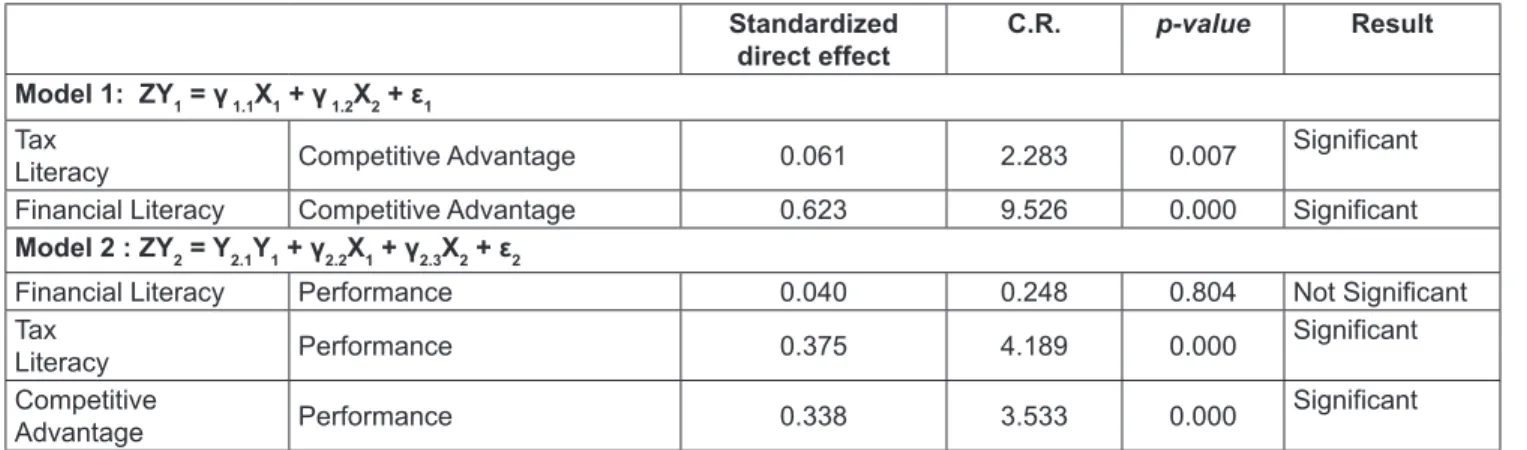
This study uses primary data through a questionnaire. The population is Creative MSME actors in DIY. Creative MSMEs in Yogyakarta were chosen because Yogyakarta is an area that is rich in traditional culture and various characters of its inhabitants, thus encouraging the development of the potential of Creative MSMEs. This research uses primary data sources on Creative MSMEs in Yogyakarta. The samples were determined by the proportional simple random sampling technique; taking a sample of 20% of the total Creative MSMEs in each district/city. The samples that deserve to be respondents in this study were 210 samples of Creative MSMEs actors in DIY. The statistical technique for analyzing data is the AMOS Structural Equation Modeling (SEM). The results showed that financial literacy had an effect on the competitive advantage and performance of MSMEs, tax literacy had an effect on competitive advantage, competitive advantage had an effect on the performance of MSMEs. However, tax literacy has no effect on the performance of MSMEs.
Keywords: Tax Literacy, Financial Literacy, Competitive Advantage, MSMEs Performance JEL Classification Code: D9, E3, E6
conventional problems that are not completely resolved.
Strategic efforts are needed to improve the performance and sustainability of Creative MSMEs, including increasing financial and tax knowledge (literacy) to improve performance and competitive advantage.
Creative industry MSMEs tend to have a short-term orientation (when businesses are focused on the present or past and consider them more important than the future) in making business decisions. Therefore, strategic efforts are needed to increase the competitive advantage of MSMEs. One of the ways that can be done is by enriching the knowledge of MSMEs actors with financial and tax knowledge so that management and accountability can be better accounted for like a large company (Resmi et al., 2019). Micro, Small, and Medium-sized Enterprises (MSMEs), which play a vital role in every country’s economy, are an increasingly pervasive and influential force in the business environment. Despite the compelling role of MSMEs in the country’s socio-economic advancement, it has become ambitious for them to get access to a short-long term and flexible credit sources. Several justifications have been considered to explain the absence of access to credit and finance by MSMEs such as high-risk associated with MSMEs lending, information asymmetry
1
First Author. Sekolah Tinggi Ilmu Manajemen YKPN Yogyakarta, Indonesia. Email: [email protected]
2
Corresponding Author. Department of Management, Faculty of Business and Economics, Universitas Islam Indonesia, Indonesia [Postal Address: Kaliurang St No. Km. 14,5, Krawitan, Umbulmartani, Ngemplak, Sleman Regency, Yogyakarta 55584, Indonesia]
Email: [email protected]
3
Department of Accounting Faculty of Economics, Universitas Teknologi Yogyakarta, Indonesia. Email: [email protected]
© Copyright: The Author(s)
This is an Open Access article distributed under the terms of the Creative Commons Attribution Non-Commercial License (https://creativecommons.org/licenses/by-nc/4.0/) which permits unrestricted non-commercial use, distribution, and reproduction in any medium, provided the original work is properly cited.