Strobilurin계 살균제의 시설재배 참외 중 잔류 양상
박은정 ․ 이주희 ․ 김태화 ․ 김장억
*경북대학교 농업생명과학대학 응용생명과학부 (2009년 9월 9일 접수, 2009년 9월 26일 수리)
Residual Patterns of Strobilurin Fungicides in Korean Melon under Plastic Film House Condition
Eun-jeong Park, Ju-Hee Lee, Tae-Hwa Kim, and Jang-Eok Kim*(School of Applied Biosciences, College of Agricultural Life Science, Kyungpook National University, Daegu 702-701, Korea.)
ABSTRACT: The strobilurin fungicides, azoxystrobin and kresoxim-methyl, were investigated to know the biological half-lives and dissipation patterns in Korean melon under plastic film house condition. Used pesticides for field application were 20% azoxystrobin of suspension concentrate and 47% kresoxim-methyl of water dispersible granule. Two pesticides were sprayed at recommended and double dose rate. Pesticide residues in Korean melon were analyzed until 14 days after application. The azoxystrobin was analyzed by HPLC equipped with UV detector after cleanup with florisil glass column. Initial residue concentrations of azoxystrobin in Korean melon at recommended and double dose rate were 0.09 mg/kg and 0.14 mg/kg, respectively. Those were less than 0.2 mg/kg maximum residue limit of Korean melon established by KFDA. The biological half-lives of azoxystrobin in Korean melon were 4.7 days at recommended dose rate and 7.8 days at double dose rate. Initial concentrations of kresoxim-methyl which was analyzed by GLC-ECD in Korean melon at recommended and double dose rate were 0.10 mg/kg and 0.23 mg/kg, respectively. Those were less than 1.0 mg/kg, MRL. The biological half-lives of kresoxim-methyl in Korean melon were 4.1 days at recommended dose rate and 4.8 days at double dose rate. The residue amounts of both pesticide was lower than MRL and biological half-lives were not so long. Because the weight of Korean melon under plastic film house condition was fast increased during cultivation.
Key Words: Biological half-life, Strobilurin Fungicides, Azoxystrobin, Kresoxim-methyl, Korean melon
281
*
연락저자:
Tel: +82-53-950-5720 Fax: +82-53-953-7233 E-mail: [email protected]
서 론
현재 국내 농식품의 잔류농약에 대한 안전관리는 생산단 계와 유통단계로 구분하여 국립농산물품질관리원과 식품의약 품안전청이 담당하고 있다. 국내에서 유통 전까지 농산물에 대한 농약의 잔류검사는 국립농산물품질관리원을 중심으로 이루어지고 있으며 농림수산식품부에서는 1999년부터 농산 물품질관리법에 근거하여 생산단계 농작물에 대하여 잔류허 용기준을 설정하고 계속적인 잔류검사 및 모니터링 연구를 통하여 부적합한 농산물의 출하를 사전에 차단하고 있다1-5). 이 기준에 따라 농산물이 유통 및 소비되기 전에 수확물의 농약 잔류량을 조사 평가하여 부적합한 농산물에 대한 출하
연기 및 폐기 등의 과정을 거쳐 생산자의 손실을 최소화하고 소비자의 안전성을 확보하고 있다. 따라서 잔류허용기준이 설정되어 있는 농약에 대해서 작물의 재배기간 중 분해양상 을 조사하고 반감기를 산출하여 적절한 농산물의 출하시기를 조절하는 연구는 소비자의 안전과 생산자의 권익을 위해 꼭 필요한 연구이다.
참외는 박과에 속하는 1년생 식물로서 우리나라 여름철의 대표적인 과채류의 하나이다. 그 중에서 경상북도 성주시의 참외 재배면적은 2008년을 기준으로 3,820 ha를 차지하여 전국 대비 71%에 이르고 있다6). 시설재배의 특성상 참외 재 배시 농약의 사용은 불가피하며 사용되는 농약들은 참외에 주로 발생하는 노균병, 흰가루병, 총채벌레 및 응애류 등의 방제를 위해서 strobilurin계, anilide계, triazole계, pyri- midine계와 유기인 계통의 농약들이 사용되고 있다7-15).
이렇게 사용된 여러가지 농약들은 참외의 재배기간 중 분
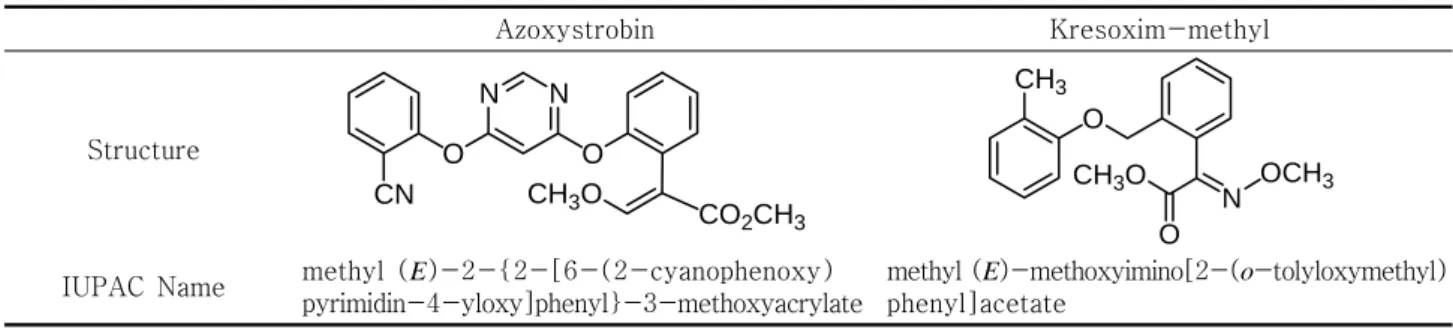
Table 1. Chemical Structure of azoxystrobin and kresoxim-methyl
Azoxystrobin Kresoxim-methyl
Structure
CN O
N N
O CH3O
CO2CH3
O
N OCH3 CH3O
O CH3
IUPAC Name methyl (E)-2-{2-[6-(2-cyanophenoxy) pyrimidin-4-yloxy]phenyl}-3-methoxyacrylate
methyl (E)-methoxyimino[2-(o-tolyloxymethyl) phenyl]acetate
해, 휘산, 용탈 및 세척 등에 의해서 참외 중 잔류농도는 상 당히 감소하지만 출하되는 시점까지도 일정수준은 참외에 그 대로 잔류하고 있다16). 또한 참외에 잔류된 농약은 국내 과채 류에 등록된 농약의 독성과 토양잔류시험 결과를 이용한 농 약에 대한 환경영향 평가에서도 다른 과채류에 비하여 농작 업자, 소비자 및 환경에 대한 영향 지수가 약간 더 높게 나타 났다17). 따라서 참외에 사용되는 농약에 대하여 생산단계에 서 출하단계까지 잔류농약의 변화정도를 정확히 파악하여 출 하시점에서의 안전성 유무를 평가하는 연구는 생산자에게는 작물의 재배단계에서 합리적인 농약의 사용을 유도하고 소비 자에게는 안전한 농산물을 공급하는데 중요한 연구이다. 따 라서 본 연구는 strobilurin계 살균제 azoxystrobin과 kresoxim- methyl를 참외재배포장에 직접 살포하여 일정기간별로 참외 중의 농약잔류 특성을 조사하고, kinetic 해석에 따른 합리적 인 회귀식과 생물학적인 반감기를 산출하여 잔류허용기준치 와 비교평가 함으로서 생산단계에서의 농약잔류허용기준을 설정하기 위한 기초자료로 활용하고자 하였다.
재료 및 방법
약제 및 시약
살균제인 azoxystrobin(99.7%)과 kresoxim-methyl(99.8%) 의 표준품은 Dr. Ehrenstorfer(독일)로부터 구입하여 사용하 였으며 시험 농약의 구조는 Table 1과 같다. 포장시험에 사 용된 azoxystrobin은 20% 액상수화제(상표명:오티바), kresoxim- methyl은 47% 입상수화제(상표명:해비치)를 살포하였다. 잔 류농약의 분석을 위한 acetone, acetonitrile, dichloromethane, ethyl acetate 및 n-hexane은 Burdick & Jackson(U.S.A.) 사로부터 농약잔류분석용 시약을 구입하여 사용하였다. 시료 의 정제를 위한 glass column(지름 16 mm)의 충진제는 florisil이었으며 Sigma-aldrich Chemical Co.(U.S.A.)사의 F9127(60-100 mesh, 농약잔류분석용)을 구입하여 사용하였 다. Sodium sulfate(GR급) 및 sodium chloride (EP급)은 Junsei Chemical(Japan)에서 구입하여 사용하였다.
시험구 배치 및 약제 살포
시험포장은 경상북도 성주군 대가면 옥성리에 위치한 시
설재배 단지의 참외경작 농가의 포장을 사용하였다. 시험에 사용된 참외(
Cucumis melo L.
)의 품종은 명문으로 2007년 12월에 정식하여 이듬해인 2008년 4월부터 수확을 시작하였 으며 참외의 주산지인 성주지역의 관행적인 참외재배방법에 따라서 폭 5 m × 길이 75 m의 단동식 비닐하우스 내에서 시험구는 폭 2 m × 길이 10 m크기로 구획을 정리하고, 시 험구 배치는 완전임의배치법 3반복으로 하였으며, 처리구간 의 오염을 방지하기 위하여 폭 2 m × 길이 1 m의 완충지대 를 설치하였다. 참외에 대한 농약의 살포는 농약사용지침서 의 안전사용기준에 준하여 2008년 6월 13일에 azoxystrobin 20% 액상수화제는 8 mL/20 L(2,500배 희석, 기준량) 및 16 m/20 L(1,250배 희석, 배량)희석하고, kresoxim-methyl 47% 입상수화제는 6.7 g/20 L(3,000배 희석, 기준량) 및 13.4 g/20 L(1,500배 희석, 배량)수준으로 희석하여 배부식 분무기를 사용하여 시험구 전체에 골고루 살포하였다. 약제 살포 후 2 시간부터 0, 1, 3, 5, 7, 10 및 14일까지 생육상태 가 균일한 시료를 15개 이상씩 무작위로 채취하였다. 이 시 료는 처리구별로 포장상자에 개별 포장하여 실험실로 운반 하였으며 즉시 균질화한 후 플라스틱 용기에 넣고 밀봉한 후 분석할 때까지 -20℃의 냉동고에 보관하였다.농약 분석
균질화된 참외시료 25 g을 칭량하여 취하고 acetone 100 mL를 가한 후 homogenizer를 이용하여 12,000 rpm으로 3분 동안 마쇄 추출하였다. 이 추출액을 Celite 545가 깔린 Büchner funnel에서 감압여과 한 후 1,000 mL의 분액여두 로 옮기고 증류수 500 mL, 소금으로 포화된 증류수 50 mL 와 dichloromethane 50 mL를 가하고 3분 동안 격렬하게 흔들어 정치시켰다. dichloromethane층을 sodium sulfate anhydrous층을 통과시켜 탈수시키고 감압농축기를 이용하 여 농축건고한 후 florisil 10 g이 충진 된 glass column에 서 정제하였다.
Azoxystrobin과 kresozim-methyl의 추출 및 분배과정 은 동일하였으며 정제과정은 서로 다른 혼합 용출용매를 이 용하여 농약을 용출시켰다. Azoxystrobin의 정제는 florisil 이 충진된 column을 n-hexane 100 mL로 활성화 시킨 후 농축 건고된 시료를 n-hexane 10 mL에 재용해하여 옮기고 ethyl
Table 2. Recoveries and limit of detection for azoxystrobin and kresoxim-methyl analysis
Pesticide
Fortification level (mg/kg)
Recovery(%) MDA
b)(ng)
LOD
c)1 2 3 Mean±SD
a)(ng)
Azoxystrobin 0.1 104.3 99.0 99.5 100.9±2.9
4 0.02
1.0 96.6 93.5 98.7 96.3±2.6
Kresoxim- methyl
0.1 105.9 112.4 106.0 108.1±3.7
0.1 0.01
0.4 97.4 101.2 104.1 100.9±3.4
a)
SD, Standard Deviation ;
b)MDA, Minimum detectable amount;
c)LOD, Limit of detection
A B C
Azoxystrobin 200 ng Control Recovery 1.0 mg/kg Fig. 1. HPLC chromatograms of azoxystrobin in Korean melon.
acetate : n-hexane(5/95, v/v) 혼합용액 100 mL와 acetone : n-hexane(20/80, v/v) 혼합용액 30 mL를 차례대로 용출 시켜서 버렸다. 계속해서 acetone : n-hexane(20/80, v/v) 혼합용액 60 mL로 다시 용출시켜서 모은 후 40℃ 이하의 수욕상에서 감압 농축하였다. 농축된 잔사를 acetonitrile 2.5 mL 에 다시 용해시켜 0.45 μm membrane filter로 여과하 여 그 여과액을 HPLC-UVD(YoungLin ACME-9000, 235 nm)로 분석하였다. Column은 Waters X-Bridge[15 cm(L.) x 4.6 mm(i.d.), particle size: 5 μm]를 사용하였으며 mobile phase로는 acetonitrile : H2O(50/50, v/v)를 사 용하여 유속 1.0 mL/min 조건으로 분석하였다.
Kresoxim-methyl의 정제는 florisil이 충진된 column 을 n-hexane 100 mL로 활성화 시킨 후 농축 건고된 시료를 n-hexane 10 mL에 재용해하여 가하고 ethyl acetate : n-hexane(5/95, v/v) 혼합용액으로 30 mL를 용출시켜서 버렸다. 계속해서 ethyl acetate : n-hexane(5/95, v/v) 혼 합용액 70 mL로 다시 용출시켜서 모은 시료를 40℃ 이하의 수욕상에서 감압 농축하였다. 이 농축된 잔사를 잔류분석용 acetone 2.5 mL 에 재용해한 후 GLC-ECD(Varian CP-3800) 로 분석하였다. Column은 DB-1[30 m(L.) × 0.53 mm(i.d.), film thickness 0.5 μm]을 사용하였으며 기기의 분석온도는 injector 260℃, oven 220℃, detector 300℃에서 gas flow(N2) 4.0 mL/min의 조건으로 분석하였다.
회수율시험
무처리 참외시료 25 g에 azoxystrobin의 경우에는 0.1 mg/kg 및 1.0 mg/kg 수준으로 농약 표준품을 처리하였고, kresoxim-methyl의 경우에는 0.1 mg/kg 및 0.4 mg/kg 수준으로 농약 표준품을 처리한 후 1시간 정도 방치하여 유 기용매를 휘발시켰다. 이 시료를 확립된 분석방법에 따라서 acetone을 가하고 추출, 분배 및 정제과정을 거쳐 분석을 실 시하였다. 분석은 각 처리농도별로 3반복으로 실시하였으며 처리구의 평균과 표준편차를 구하였다.
결과 및 고찰
회수율 및 검출한계
참외 중 회수율시험 결과는 Table 2와 같았으며 azoxystrobin 및 kresoxim-methyl 표준검량선의 상관계수(r2)는 각각 0.9998 및 0.9995로서 정량분석을 위한 양호한 직선성을 나타내었다.
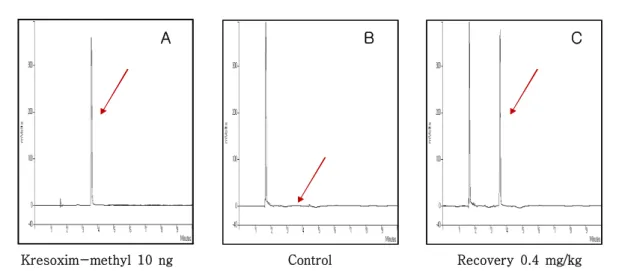
Azoxystrobin의 회수율 시험 결과는 93.5~104.3% 수준 이 었으며 HPLC/UVD 상에서의 최소검출량은 4.0 ng 이었고 검출한계는 0.02 mg/kg 이었다. Kresoxim-methyl의 회수 율 시험의 결과는 97.2 ~ 112.4%이었고 최소검출량은 0.1 ng, 검출한계는 각각 0.01 mg/kg 이었다. 표준품 및 회수율 시험 중의 분석 chromatogram은 각각 Fig. 1 및 2와 같이 나타났으며 농약의 retention time과 중첩되는 방해 peak는 발생되지 않았다.
C B
A
Kresoxim-methyl 10 ng Control Recovery 0.4 mg/kg Fig. 2. GLC chromatograms of kresoxim-methyl in Korean melon.
Days after application (days)
0 2 4 6 8 10 12 14 16
Weight (g)
200 250 300 350 400
Days after application (days)
0 2 4 6 8 10 12 14
Temperature ()℃
0 20 40 60 80 100
Humidity (%)
0 20 40 60 80 100 Temperature Humidity
Fig. 3. Variation of Korean melon weight during the experimental period.
Fig. 4. The climatic conditions of the plastic film house during the experimental period.
참외의 증체율 및 기상조건
포장실험 기간 중 참외의 무게변화는 Fig. 3에 나타내었 다. 경과일수별로 채취된 참외시료는 실험실로 이송직후 개 별로 무게를 측정하여 시험기간 중 참외의 무게변화 및 증체 율을 기록하였다. 참외는 다른 박과류18)나 엽채류19-20)에 비하 여 무게의 증체율은 상대적으로 낮았으며 시험기간(2008년 6 월 13일~6월 27일)중 평균 50% 정도의 무게가 증가하였다.
시험기간 중 시설내의 온도 및 습도의 변화를 연속적으로 측 정한 결과는 Fig. 4와 같았으며 온도의 측정 및 기록은 자동 온습도기록계(SATO, SK-L200TH, Japan)를 이용하였다.
시험기간 중 비닐하우스내의 평균 온도는 26.6 ± 3.7℃, 평 균 습도는 68.5 ± 9.8%이었다.
참외 중 잔류농약
시설재배 참외에 살포한 농약 잔류량은 Fig. 5와 같이 살 포 후 시간의 경과에 따라서 지속적으로 감소하는 경향을 보 였다. Azoxystrobin 살포직후의 참외 중 잔류량은 기준량
및 배량 처리구에서 각각 0.09과 0.14 mg/kg으로 참외에 식품의약품안전청에서 설정한 azoxystrobin의 잔류허용기준 인 0.2 mg/kg보다 낮게 나타났으며, kresoxim-methyl의 최대잔류량도 처리직후 기준량 및 배량 처리구에서 각각 0.10 mg/kg 및 0.23 mg/kg으로서 참외에 설정된 잔류허 용기준인 1.0 mg/kg보다 낮은 수준이었다. Azoxystrobin 과 kresoxim-methyl의 반감기 소실곡선식은 Table 3에 나 타낸 바와 같았다. Azoxystrobin의 반감기 소실곡선은 기준 량 처리구에서 y=0.0766e-0.138x, 배량 처리구에서 y=0.1143e-0.089x 이었으며 잔류반감기는 각각 5.0일 및 7.8일 이었다. Kresoxim- methyl의 반감기 소실곡선은 기준량 처리구에서 y=0.0896e-0.1672x, 배량 처리구에서 y=0.1504e-0.1446x이었으며 잔류반감기는 기 준량 처리구에서 4.1일, 배량 처리구에서 4.8일 이었다. Azoxy- strobin과 kresoxim-methyl은 동일한 strobilurin 계통의 약제이며 주성분의 함량이 각각 20%와 47%로서 함량이 높 은 kresoxim-methyl이 azoxystrobin에 비하여 다소 높게 나타났다.
Days after application(days)
0 2 4 6 8 10 12 14
Residue Conc. of Azoxystrobin (ln)
e-5 e-4 e-3 e-2 e-1
Recommended Double
A
Days after application(days)
0 2 4 6 8 10 12 14
Residue Conc. of Kresoxim-methyl (ln)
e-5 e-4 e-3 e-2 e-1
Recommended Double
B
Fig. 5. Dissipation patterns of azoxystrobin and kresoxim-methyl in Korean melon under plastic film house condition.
A: Azoxystrobin, B: Kresoxim-methyl.
Table 3. Biological half-lives of pesticides in Korean melon under plastic film house condition
Pesticides Application Regression curve
a)Half-lives(days)
Equation r
2Azoxystrobin Recommended Y=0.0766e
-0.138x0.9424 5.0
Double Y=0.1143e
-0.089x0.9310 7.8
Kresoxim-methyl Recommended Y=0.0896e
-0.1672x0.9428 4.1
Double Y=0.1504e
-0.1446x0.9040 4.8
a)
Regression curve, Based on the first-order kinetics
그러나 잔류량의 차이는 두 약제의 함량차이가 2.35배인 것을 감안한다면 비교적 크게 차이가 나지 않았으며, 이렇게 차이가 적은 이유는 kresoxim-methyl의 제형이 입상수화제 로서 액상수화제인 azoxystrobin에 비하여 부착성이 다소 떨어지기 때문인 것으로 사료된다. 또한 두 농약 모두 살포직 후의 잔류량이 이렇게 낮은 이유는 참외의 생육특성에 기인 할 것으로 사료된다. 사과나 복숭아 등과 같은 과수의 경우에 는 움푹 파인 과일꼭지 부분에 농약살포액이 상당량 집적되 어 고농도로 존재하면서 일부만이 휘산, 광분해 및 강우에 의 한 유실 등으로 제거된다21). 그러나 참외는 사과나 복숭아처 럼 움푹 파인 꼭지부분이 없고 포도나 방울 토마토 등과 비 교해서 표면적이 적으며 표면도 털이 없이 매끄럽기 때문에 농약의 부착이 적게 이루어지는 것으로 사료된다22). 또한 수 정이 이루어진 꽃은 착과가 이루어지는데 시험이 이루어진 시기는 잎의 생육이 왕성하게 이루어져서 참외과일을 가리기 때문에 농약살포시 부착성이 떨어지는 것도 살포직후 농약의 잔류량이 낮은 원인 중 한 가지일 것으로 사료된다.
참외 중 농약의 절대잔류량
참외포장에 살포된 농약은 시설내의 높은 온도와 습도에 의해 분해 및 휘발이 이루어지고 작물의 생육을 위한 관수처 리 등에 의해서 세척되어 농약의 잔류량은 점차 감소하게 된 다. 또한 이런 순수한 분해, 휘발 및 세척 외에도 참외의 재배
기간 중 무게가 증가함에 따라서 희석효과도 azoxystrobin과 kresoxim-methyl의 잔류농도 감소에 큰 영향을 끼치게 된 다. 따라서 참외의 무게 증가에 의한 희석효과를 배제한 참외 중 농약의 순수한 잔류량을 다음 식 1과 같이 계산하여 참외 중 농약의 절대잔류농도라고 정의한다면 이 절대잔류농도의 감소추이는 다음 Fig. 6과 같이 나타낼 수 있으며, 반감기 소 실곡선식은 Table 4와 같이 나타내었다.
Absolute Residue Concentrate
in Korean melon(mg/kg) - Equation 1
= Residue Concentrate in Korean melon(mg/kg)
× Increase Rate of Korean melon weight(mg/kg)
또한 이 절대잔류농도의 감소는 참외 중 azoxystrobin과 kresoxim-methyl의 잔류량이 실제로 분해되는 것으로 추정 할 수 있다. Azoxystrobin 살포직후의 0일차 절대잔류농도 는 기준량 및 배량 처리구에서 각각 0.09 및 0.14 mg/kg으 로 나타났으며 14일 경과한 때의 절대잔류농도는 각각 0.01 및 0.05 mg/kg 이었다. 시험기간 중의 무게의 증가율이 약 50% 정도 일어났으므로 14일 동안의 시험기간 중 분해나 휘 발 및 관수처리 중 세척 등에 의한 순수한 농약의 감소는 기 준량의 경우 83.6%, 배량의 경우에는 67.0% 정도 이루어진
Days after application(days)
0 2 4 6 8 10 12 14
Absolute Residue Conc. of Azoxystrobin (ln)
e-5 e-4 e-3 e-2 e-1
Recommended Double
A
Days after application(days)
0 2 4 6 8 10 12 14
Absolute Residue Conc. of Kresoxim-methyl (ln)
e-5 e-4 e-3 e-2 e-1
Recommended Double
B
Fig. 6. Dissipation patterns of absolute residue amount of azoxystrobin and kresoxim-methyl. A: Azoxystrobin, B:
Kresoxim-methyl.
Table 4. Biological half-lives of absolute residue amount pesticides in Korean melon under plastic film house condition
Pesticides Application Regression curve
a)Half-lives(days)
Equation r
2Azoxystrobin Recommended Y=0.075e
-0.114x0.9687 6.1
Double Y=0.112e
-0.0633x0.8545 11.0
Kresoxim- methyl
Recommended Y=0.087e
-0.1251x0.8797 5.5
Double Y=0.152e
-0.1248x0.8808 5.6
a)
Regression curve, Based on the first-order kinetics
것을 알 수 있다. Kresoxim-methyl의 살포직후의 절대잔류 농도는 기준량 및 배량 처리구에서 각각 0.10 및 0.23 mg/kg으로 나타났으며 14일 경과한 때의 절대잔류농도는 각각 0.01 및 0.03 mg/kg 이었다. 시험기간 중의 무게의 증 가율은 약 50% 이었으며 14일 동안의 시험기간 중 분해나 휘발 및 관수처리 중 세척 등에 의한 순수한 농약감소율은 기준량의 경우 86.2%, 배량의 경우에는 87.8%이었다.
본 연구의 결과에서 알 수 있듯이 azoxystrobin과 kresoxim- methyl의 경우에는 참외에 대한 잔류허용기준이 각각 0.2 및 1.0 mg/kg으로 설정되어 있어서 농약의 살포직후 잔류 량이 허용기준을 초과하지 않았으며 정상적인 시설재배 환경 에서 농약이 살포된 경우에는 농약살포 직후에도 참외의 출 하가 가능할 것으로 사료된다.
요 약
Azoxystrobin과 kresoxim-methyl의 참외 중 반감기와 잔류양상을 조사하였다. Azoxystrobin의 참외 중 0일차 잔 류량은 기준량 및 배량 처리구에서 각각 0.09 및 0.14 mg/kg 으로 나타났으며 농약의 반감기 소실곡선식은 y=0.0766e-0.138x (r2=0.9424) 및 y=0.1143e-0.0890x(r2=0.9310) 이었으며 생물 학적 반감기는 각각 5.0일 및 7.8일 이었다. Kresoxim-methyl 의 참외 중 0일차 잔류량은 기준량 및 배량 처리구에서 각각
0.10 및 0.23 mg/kg으로 나타났으며 농약의 소실곡선식은 y=0.0896e-0.1672x(r2=0.9428) 및 y=0.1504e-0.1446x(r2=0.9040) 이었고 생물학적인 반감기는 각각 4.1일 및 4.8일 이었다. 재 배기간 중 참외의 무게증가에 농약희석효과를 배제한 절대잔 류농도는 약제 살포 후 14일 경과시 azoxystrobin은 기준량 및 배량에서 0.01 및 0.05 mg/kg으로서 각각 83.6 및 67%
의 농약이 분해되었다. Kresoxim-methyl은 각각 0.01 및 0.03 mg/kg 으로서 86.2 및 87.8% 정도의 농약 분해율을 보였다.
감사의 글
이 연구는 2008년 국립농산물품질관리원의 ‘생산단계 농 산물의 잔류농약 허용기준 설정연구’의 연구비 지원으로 수 행한 결과의 일부이며, 연구비 지원에 감사드립니다.
참고문헌
1. Park, D. S., Seong, K. Y., Choi, K. I. and Hur, J.
H. (2005) Field tolerance of pesticides in the strawberry and comparison of biological half-lives estimated from kinetic models.
The Korean Journal
of Pesticide Science
, 9(3), 231-236.2. Kim, Y. S., Park J. H., Park, J. W., Lee, Y. D., Lee, K. S. and Kim, J. E. (2002) Persistence and dis- lodgeable residues of chlorpyrifos and procymidone in lettuce leaves under greenhouse condition,
Korean Journal of Environmental Agriculture
, 21(2), 149-155.3. Ko, K. Y., Kim K. H. and Lee K. S. (2004) Residual pattern of procymidone and Chloro- thalonil in Grape During the Period of Cultivation and Storage,
Korean Journal of Environmental Agriculture
, 23(1) 47-51.4. Lee, E. Y., Kim D. K., Park I. Y., Noh H. H., Park, Y. S., Kim, T. H., Jin, C. W., Kim, K. I., Yun, S. S., Oh, S. K. and Kyung, K. S. (2008) Residue patterns of indoxacarb and thiamethoxam in chinese cabbage (
Brassica campestris L.
) Grown under Greenhouse Conditions and Their Estimated Daily Intake,Korean Journal of Environmental Agriculture
, 27(1), 92-98.5. Yun, S. S., Shim, S. W., Kim, K. I., Ahn, M. S., Youn, T. H., Kim, Y. J., Hwang, H. S., Jin, C. W., Han, S. K., Oh, S. K., Shin, J. H., Jin, Y. D., Lee, E. Y. and Kyung, K. S. (2008) Residual characteri- stics of lambda-cyhalothrin and deltamethrin in lettuce,
The Korean Journal of Pesticide Science
, 12(2), 148-154.6. Seong-ju Agriculture Technology Center (2009) The present status of Korean melon cultivation in 2008.
7. Chang, T. H., Ryu, Y. J., Lim, S. J., Choi, M. Y., Jeong, B. R., Kim, C. W. and Lee, Y. S. (2006) Evaluation of fungicides for preventive and curative effects against powdery mildew on Oriental melon.
Korean Journal of Environmental Agriculture
, 25(1) 85-92.8. Uesugi. Y. (1998) Fungicidal classes; chemistry, uses and mode of action. In fungicidial activity;
chemical and biological approaches to plant pro- tection (ed. Hutson D. and J. Miyamoto), John Wiley & Sons Ltd, New York. U.S.A. pp. 23-26.
9. Chang, S. W., Kim, S. K. and Kim, H. D. (2001) Chemical control of powdery mildew of sweet pumpkin in Korea,
Research in Plant Disease
, 7, 31-36.10. Keinath, A. P. and DuBose, V. B. (2004) Evalu- ation of fungicides for prevention and manage- ment of powdery mildew on watermelon.
Crop
Protection,
23(35), p. 4210.11. Yeon I. K., Shin, Y. S., Do, H. W., Bae, S. G. and Park S. D. (2002) Occurrence and chemical control of downy mildew (
Pseudoperonospora cubensis rostowzew
) infecting oriental melon(Cucumis melo L. var.
makuwa Makino
) in plastic greenhouse,Korean Journal of Horticultural Science & Technology
, 20(1), 25-28.12. Choi, B. Y., Lee, S. W., Park, H. M., Yoo, J. K., Kim, S. K. and Baik, C. H. (2005) Monitoring on insecticide resistance of major insect pests in plastic house,
The Korean Journal of Pesticide Science
, 9(4), 380-390.13. Lee, S. C. (2004) Control of major disease in green- house crops,
The Korea Research Society Protected Horticulture
, 17(2), 2-9.14. Kim, J. Y., Lee Y. G. and Song, Y. H. (1998) Plant diseases on green-house crops in kyeongbuk areas,
The Plant Pathology Journal
, 14(1), 41-45.15. Nam, K. U. (2001) Development of control measures and ecology against main plants disease in greenhouse,
Korea Research Society Protected Horti- culture
, 14(1), 23-29.16. Kim, M. R., Na, M. A., Jung, W. Y., Kim, C. S., Sun, N. K., Seo, E. C., Lee, E. M., Park, Y. G., Byun, J. A., Eom, J. H., Jung, R. S. and Lee, J. H.
(2008) Monitoring of pesticide residues in special products,
The Korean Journal of Pesticide Science
, 12(4), 323-334.17. Oh, K. S., Lee, B. M., Seong, H. J., Oh, H. K., Lim, Y. B. and Kyung, K. S. (2003) The environmental impact quotient on fruit and vegetables pesticides in korea,
The Korean Journal of Pesticide Science
, 7(2), 123-130.18. Lee, H. D., Ihm, Y. B., Kwon, H. Y., Kim, J. B., Kyung, K. S., Park, S. S., Oh, B. Y., Im, G. J. and Kim, J. E. (2005) Characteristics of Pesticide residue in/on cucurbitaceous fruit vegetables applied with foliar spraying under greenhouse,
The Korean Journal of Pesticide Science
, 9(4), 359-364.19. Kim, T. H., Kim, Y. H. and Kim J. E. (2008) Residual characteristics of tetraconazole, trifloxy- strobin and fuquinconazole in cucumber under greenhouse condition,
The Korean Society of Pesti- cide Science Spring Symposium,
p.7620. Lee, E. Y., Noh, H. H., Park, Y. S., Kang, K. W., Kim, J. K., Jin, Y. D., Yun, S. S., Jin, C. W., Han,
S. K. and Kyung, K. S. (2009) Residual characteri- stics of etofenprox and methoxyfenozide in chinese cabbage,
The Korean Journal of Pesticide Science
, 13(1), 13-20.21. Kim, Y. S., Park, J. H., Park, J. W., Lee, Y. D., Lee, K. S. and Kim, J. E. (2003) Residue levels of chlorpy- rifos and chlorothalonil in apples at harvest,
Korean
Journal of Environmental Agriculture
, 22(2), 130-136.22. Lee, H. D., Kyung, K. S., Kwon, H. Y., Ihm, Y. B., Kim, J. B., Park, S. S. and Kim, J. E. (2004) Residue characteristics of hexaconazole and chloro- thalonil in several fruits,