41(3) : 227∼ 231 (2010)
227
생약의 Protein Tyrosine Phosphatase 1B 저해활성 검색
이우정·김수남·윤 구* 한국과학기술연구원 강릉분원
Screening of Medicinal Herbs for Inhibitory Activity against Protein Tyrosine Phosphatase 1B
Woojung Lee,Su-Nam Kim and Goo Yoon* KIST Gangneung Institute, Gangneung 210-340, Korea
Abstract − Protein tyrosine phosphatase 1B (PTP1B) is predicted to be therapeutic target in treatment of type 2 diabetes and obesity. Thus, in order to search for PTP1B inhibitors, we screened the inhibitory activity of PTP1B in the water extracts of 84 medicinal herbs. Among them, the extracts of Pini Folium, Magnoliae Cortex, Artemisiae asiaticae Herba, Schizonepetae Herba, Menthae Herba, Mume Fructus, Cimicifugae Rhizoma, and Amomi Cardamomi Fructus showed relatively significant (58-68%) inhibitory activity against PTP1B. Especially, the methylene chloride fraction of the methanol extract of Menthae Herba (81% inhibition at 30µg/ml) showed more potent inhibitory activity against PTP1B than others.
Key words − type 2 diabetes, obesity, protein tyrosine phosphatase 1B, medicinal herb, menthae Herba
전세계적으로 사람의 수명이 늘어나고 생활수준이 향상 되면서 열량의 과잉섭취와 운동부족, 스트레스 등에 의해 당뇨병, 고혈압, 고지혈증, 비만, 중풍, 심혈관질환, 지방간 및 전신 동맥경화증 등과 같은 만성 대사성 증후군의 발생 이 폭발적으로 증가하는 추세이다. 이러한 대사성 증후군 발생원인의 중심에는 인슐린 저항성과 비만이 있다고 알려 져 있으며, 인슐린에 대한 저항성으로 야기되는 대표적인 질환이 제2형 당뇨이다. 그러므로 제2형 당뇨와 비만에 대 한 치료약물 개발에 관심이 모아지고 있다.1,2)
제2형 당뇨와 당뇨의 원인 중 하나인 비만은 인슐린 저항 성과 상호 밀접한 상관관계가 있다. 인슐린 저항성은 주어 진 인슐린 농도하에서 인슐린에 대한 반응이 정상보다 감 소되어있는 상태를 의미하며, 인슐린의 신호전달 체계의 결 함으로 인해서 발생된다고 보고 되어 있다.3) 인슐린의 신호 전달은 인슐린이 인슐린 수용체 (insulin receptor, IR)에 결 합되어 인슐린 수용체의 tyrosine 잔기들이 자동인산화 (autophosphorylation) 되면서 시작되며 인슐린 수용체의 tyrosine kinase의 활성화는 인슐린 수용체 기질 (insulin receptor substrate, IRS)을 인산화시켜 인슐린의 생리적 기
능을 수행하게 한다고 알려져 있다.4)
Protein tyrosine phosphatase (PTPase)는 인슐린 신호전달 에 중요한 효소로 알려져 있으며5,6) 이러한PTPase에는 PTP- α, leukocyte antigen-related tyrosine phosphatase (LAR), SH2-domain-containing phosphotyrosine phosphatase (SHP2), PTP1B 등이 있다. 그 중 PTP1B는 인산화된 인슐린 수용 체의 tyrosine 잔기와 인슐린의 신호전달에 관여된 단백질 들을 탈인산화시켜 인슐린의 세포내 기능을 차단하는 기 능을 담당하며, 또한 인슐린에 대한 감수성과 energy balance를 조절하는 가장 중요한 negative regulator로 알 려져 있다.6-8)
이러한 PTP1B에 대한 기존의 연구결과들을 살펴보면, PTP1B를 knock-out시킨 쥐에서 인슐린에 대한 감수성의 증 가와 고지방식에 대한 저항성이 관찰되었고,9) 체중의 증가 를 억제하여 렙틴에 대한 감수성을 증가시키는 것 또한 확 인 되었다.10,11)한편, Antisense oligonucleotides를 이용해 PTP1B의 발현을 감소시킨 쥐의 연구 결과에서도 인슐린 감 수성이 증가되는 것으로 보고 되었다.12,13) 이러한 일련의 연 구결과들을 종합해 보면 PTP1B가 실제로 인슐린의 기능을 조절하는 핵심적인 역할을 하고 있는 것으로 여겨진다. 따 라서, PTP1B 저해제는 제2형 당뇨와 비만 개선에 효과적인 약물로써 그 가능성이 있을 것으로 사료 된다.4)
*교신저자(E-mail):[email protected] (Tel): +82-33-650-3505
그러나, 기존에 보고된 PTP1B 저해제들은 낮은 약효와 선택성 때문에 많은 제한이 있어 보다 강력한 약효와 높은 선택성을 지닌 PTP1B의 저해제의 필요성이 요구되어지고 있는 실정이며, 또한 최근의 연구 동향은 다양한 성분을 지니고 있는 천연물로부터 유래된 PTP1B 저해제에 관심 이 집중 되고 있다.14) 따라서 우리는 새로운 천연물 유래 PTP1B 저해제를 개발하고자 84종의 생약추출물과 활성 성 분을 포함한 유기용매 분획에서 PTP1B의 저해활성을 측 정하였다.
재료 및 방법
시약 − Recombinant human protein tyrosine phosphatase 1B (PTP1B)는 BIOMOL Research Laboratories, Inc.
(Plymouth Meeting, U.S.A.)에서 구입하였고, 기질인 para- nitrophenyl phosphate (p-NPP)는 New England Biolabs, Inc. (Beverly, MA, U.S.A.)에서 구입하여 사용하였다.
생약 − 실험에 사용한 생약은 전라남도 화순에 소재한 전 남생약조합에서 구입하여 사용하였다.
생약 및 생약 시료의 조제 − 각각의 한약 10 g에 50 mL 의 증류수를 가하여 약탕기를 이용하여 2시간에 걸쳐 추출 한 후 감압 농축을 실시한 후, 동결건조기에서 건조하여 사 용하였다. Pini Folium (송엽), Magnoliae Cortex (후박), Artemisiae asiaticae Herba (약쑥), Schizonepetae Herba (형개), Menthae Herba (박하), Mume Fructus (오매), Cimi- cifugae Rhizoma (승마), Amomi Cardamomi Fructus (백두 구)의 물추출물은 EtOAc과 H2O로 용매 분획하여 활성 검 색하였다. Pini Folium (송엽), Magnoliae Cortex (후박), Artemisiae asiaticae Herba (약쑥), Schizonepetae Herba (형개), Menthae Herba (박하), Mume Fructus (오매), Amomi Cardamomi Fructus (백두구)의 MeOH 추출물은 생 약 10 g에 MeOH 100 mL을 가하여 3시간 동안 ultrasoni- fication하여 추출, 감압 농축하여 제조하였으며, MeOH 추 출물에 물을 가하여 n-hexane, CH2Cl2, EtOAc으로 순차적 으로 용매 분획하여 활성 검색에 사용하였다.
Protein tyrosine phosphatase 1B 억제활성측정 − PTP1B 효소 활성은 기질인 para-nitrophenyl phosphate (p- NPP)을 사용하여 측정 하였다.15) 50 mM citrate buffer (pH 6.0), 0.1 M NaCl, 1 mM EDTA 그리고 1 mM DTT이 포 함되어진 완충용액에 20 mM p-NPP, PTP1B (0.05 µg) 그 리고 생약추출물을 넣고 37oC에서 30분간 반응시킨 후, 10 N NaOH 10µl를 첨가하여 반응을 종결하였다. p-nitrophenol 은 405 nm에서 흡광도를 측정하였다. 효소 저해율(%)은 완 충용액에 효소와 기질만 넣고 반응시켜 측정한 값을 100%
로 하고 효소만 넣어 측정한 값을 0%로 하여 계산한 후 이 에 대한 비율로 나타내었다.
결과 및 고찰
제2형 당뇨와 비만은 전세계적으로 많은 연구가 진행되 고 있음에도 불구하고 지속적으로 증가하는 추세이기 때문 에 새로운 약물의 개발에 관심이 집중되고 있다. 제2형 당 뇨와 비만에 관련된 중요한 호르몬이 인슐린과 렙틴이며 이 호르몬들의 저항성에 의해 인슐린 신호체계에 결함이 생기 게 된다.8) PTP1B는 이러한 호르몬들의 핵심적인 negative regulator로 알려져 있기 때문에 이 효소에 저해활성을 갖는 물질을 찾는 것은 제2형 당뇨와 비만의 치료에 대한 가능 성을 갖는다고 할 수 있다.16)
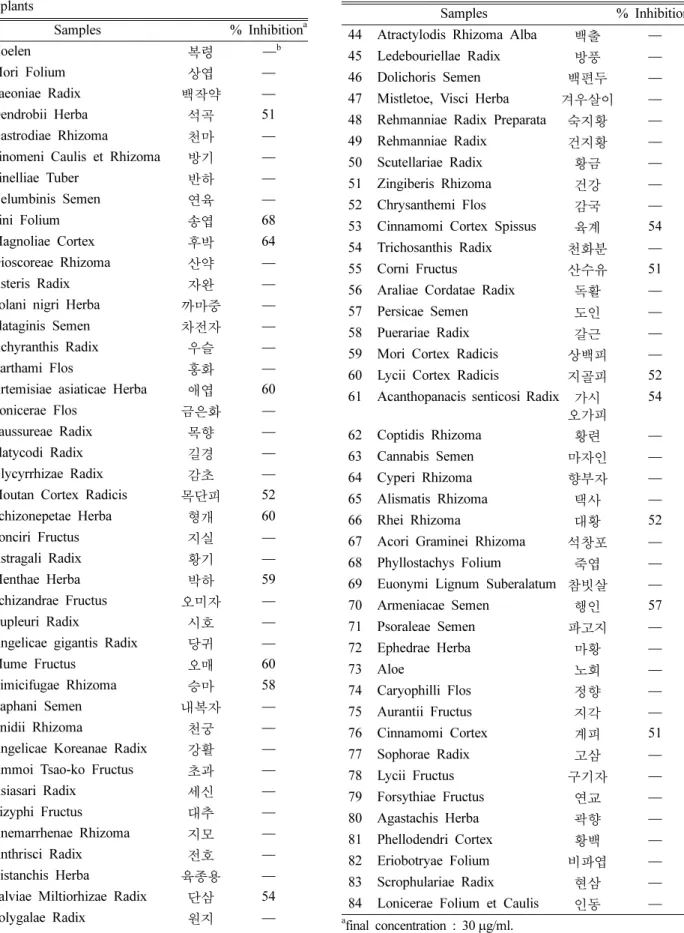
따라서, 우리는 새로운 당뇨 및 비만 치료제의 후보물질 탐색을 위해 일차적으로 84종 생약의 물추출물에 대해서 PTP1B 저해활성을 조사하였다. 기존의 연구결과에 의하면, PTP1B의 저해활성은 생약 추출물 30 µg/ml에서 50%이상 의 활성이 있으면 효과가 있다고 판단 한다.15,17-20) 본 연구 에서 탐색한 84종의 추출물 중 18종의 생약추출물이 50%
이상의 저해활성이 있는 것을 관찰할 수 있었으며, 특히 18 종의 생약 추출물 중 Pini Folium (송엽), Magnoliae Cortex (후박), Artemisiae asiaticae Herba (약쑥), Schizonepetae Herba (형개), Menthae Herba (박하), Mume Fructus (오매), Cimicifugae Rhizoma (승마), 그리고 Amomi Cardamomi Fructus (백두구)는 PTP1B에 대해 58%-68%의 강한 저해 활성을 나타내었다 (Table I). 본 연구결과는 기존에 보고된 연구결과와 차이점이 있는 것으로 보이지만 이는 생약의 채 집시기와 그 기원에 따라 그 생약의 생리활성 물질의 변화 로 인해 PTP1B의 활성 저해 특성이 차이가 있을 수 있을 것으로 사료 된다.21)
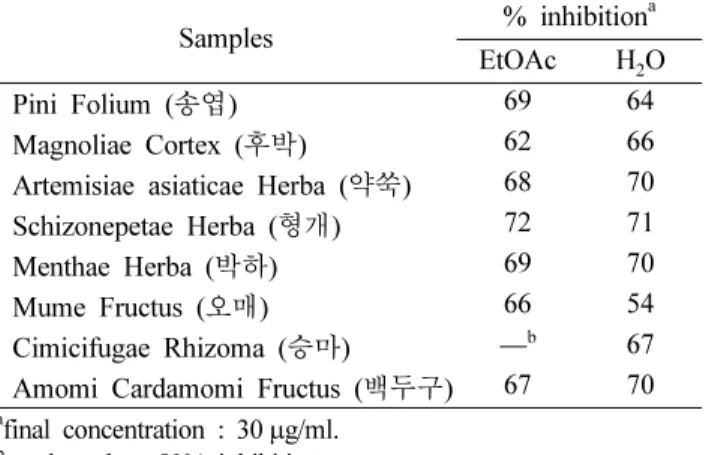
활성 분획을 찾기 위해서 8종의 생약의 물추출물을 각각 EtOAc와 H2O로 분획한 후 PTP1B의 저해활성을 측정하였 다. 8종의 생약 추출물 중 Cimicifugae Rhizoma (승마)의 EtOAc 분획을 제외한 모든 분획에서 PTP1B에 대한 강한 저해활성 (66~72%)을 나타내었고, Cimicifugae Rhizoma (승마)의 경우, H2O 분획층에서만 좋은 저해활성 효과 (67%) 를 나타내었다 (Table II). 이것은 Cimicifugae Rhizoma (승 마) 추출물 중 PTP1B에 저해활성을 나타내는 성분이 상대 적으로 극성을 나타내고 있음을 알 수 있다.
유기용매층에서 활성성분을 포함한 분획을 찾기 위해서 7종의 생약을 MeOH로 추출하고 n-hexane, CH2Cl2 그리고 EtOAc으로 분획한 후, 각 분획에 대한 저해활성을 측정하 였다. 대부분의 분획에서 PTP1B에 대한 높은 저해활성을 나타내었다. Schizonepetae Herba (형개)의 n-hexane 분획층, Pini Folium (송엽), Artemisiae asiaticae Herba (약쑥), Menthae Herba (박하) 그리고 Mume Fructus (오매)의 CH2Cl2분획층, 그리고 Magnoliae Cortex (후박)과 Amomi Cardamomi Fructus (백두구)의 EtOAc 분획층이 다른 분획
Table I. Inhibition of PTP1B by the water extracts of natural plants
Samples % Inhibitiona
1 Hoelen 복령 ―b
2 Mori Folium 상엽 ―
3 Paeoniae Radix 백작약 ―
4 Dendrobii Herba 석곡 51
5 Gastrodiae Rhizoma 천마 ―
6 Sinomeni Caulis et Rhizoma 방기 ―
7 Pinelliae Tuber 반하 ―
8 Nelumbinis Semen 연육 ―
9 Pini Folium 송엽 68
10 Magnoliae Cortex 후박 64
11 Dioscoreae Rhizoma 산약 ―
12 Asteris Radix 자완 ―
13 Solani nigri Herba 까마중 ―
14 Plataginis Semen 차전자 ―
15 Achyranthis Radix 우슬 ―
16 Carthami Flos 홍화 ―
17 Artemisiae asiaticae Herba 애엽 60
18 Lonicerae Flos 금은화 ―
19 Saussureae Radix 목향 ―
20 Platycodi Radix 길경 ―
21 Glycyrrhizae Radix 감초 ―
22 Moutan Cortex Radicis 목단피 52 23 Schizonepetae Herba 형개 60
24 Ponciri Fructus 지실 ―
25 Astragali Radix 황기 ―
26 Menthae Herba 박하 59
27 Schizandrae Fructus 오미자 ―
28 Bupleuri Radix 시호 ―
29 Angelicae gigantis Radix 당귀 ―
30 Mume Fructus 오매 60
31 Cimicifugae Rhizoma 승마 58
32 Raphani Semen 내복자 ―
33 Cnidii Rhizoma 천궁 ―
34 Angelicae Koreanae Radix 강활 ― 35 Ammoi Tsao-ko Fructus 초과 ―
36 Asiasari Radix 세신 ―
37 Zizyphi Fructus 대추 ―
38 Anemarrhenae Rhizoma 지모 ―
39 Anthrisci Radix 전호 ―
40 Cistanchis Herba 육종용 ―
41 Salviae Miltiorhizae Radix 단삼 54
42 Polygalae Radix 원지 ―
43 Amomi Cardamomi Fructus 백두구 58
Table I. Continued
Samples % Inhibitiona
44 Atractylodis Rhizoma Alba 백출 ― 45 Ledebouriellae Radix 방풍 ―
46 Dolichoris Semen 백편두 ―
47 Mistletoe, Visci Herba 겨우살이 ― 48 Rehmanniae Radix Preparata 숙지황 ―
49 Rehmanniae Radix 건지황 ―
50 Scutellariae Radix 황금 ―
51 Zingiberis Rhizoma 건강 ―
52 Chrysanthemi Flos 감국 ―
53 Cinnamomi Cortex Spissus 육계 54 54 Trichosanthis Radix 천화분 ―
55 Corni Fructus 산수유 51
56 Araliae Cordatae Radix 독활 ―
57 Persicae Semen 도인 ―
58 Puerariae Radix 갈근 ―
59 Mori Cortex Radicis 상백피 ― 60 Lycii Cortex Radicis 지골피 52 61 Acanthopanacis senticosi Radix 가시
오가피
54
62 Coptidis Rhizoma 황련 ―
63 Cannabis Semen 마자인 ―
64 Cyperi Rhizoma 향부자 ―
65 Alismatis Rhizoma 택사 ―
66 Rhei Rhizoma 대황 52
67 Acori Graminei Rhizoma 석창포 ― 68 Phyllostachys Folium 죽엽 ― 69 Euonymi Lignum Suberalatum 참빗살 ―
70 Armeniacae Semen 행인 57
71 Psoraleae Semen 파고지 ―
72 Ephedrae Herba 마황 ―
73 Aloe 노회 ―
74 Caryophilli Flos 정향 ―
75 Aurantii Fructus 지각 ―
76 Cinnamomi Cortex 계피 51
77 Sophorae Radix 고삼 ―
78 Lycii Fructus 구기자 ―
79 Forsythiae Fructus 연교 ―
80 Agastachis Herba 곽향 ―
81 Phellodendri Cortex 황백 ―
82 Eriobotryae Folium 비파엽 ―
83 Scrophulariae Radix 현삼 ―
84 Lonicerae Folium et Caulis 인동 ―
afinal concentration : 30 µg/ml.
b―: less than 50% inhibition.
층보다 PTP1B에 대해 더 좋은 저해활성을 나타내었다. 특 히 Menthae Herba (박하)의 CH2Cl2 분획층 (81% inhibition at 30µg/ml)은 분획층 중 가장 강한 저해활성을 나타내었다 (Table III).
본 연구에서 PTP1B의 활성저해가 탐색된 8종의 생약 중 Magnoliae Cortex (후박), Schizonepetae Herba (형개), Menthae Herba (박하) 그리고 Cimicifugae Rhizoma (승마) 에 대해서는 기존의 연구결과들에서도 항당뇨, 혈당 저하, 당뇨합병증 억제, 그리고 항비만에 대한 효능이 알려져 있 다. Magnoliae Cortex (후박)은 당뇨 합병증을 유발하는 중 요한 인자인 최종당화산물 (AGEs) 형성을 저해하며22), 또 한 Magnoliae Cortex (후박)에서 분리된 주성분인 magnolol 은 streptozotocine-induced diabetic rats에서는 AGEs 형성 과 sorbitol 축적을 억제한다고 보고되었고23), non-obese type 2 diabetes animal model 에서는 인슐린 저항성을 감소시킨 다고 보고 되었다.24) 또한, 중국과 일본에서 항비만 약물로
쓰여지는 Bofu-tsusho-san의 성분 중 일부가 Schizonepetae Herba (형개)와 Menthae Herba (박하)의 추출물이다.25)
Cimicifugae Rhizoma (승마)는 중국전통약제 중 당뇨에 사 용되는 Bu-Zhong-I-Chi-Tang에 포함되는 성분 중 하나이다.
Cimicifugae Rhizoma (승마)의 활성성분 중 하나인 isoferulic acid는 insulin dependent diabetes rat model 에서 혈당저하 효과를 나타내며, insulin-deficient diabetes rat model 에서 간성 당생산 (hepatic gluconeogenesis) 억제효과를 나타낸다 고 보고되어 있다.26) 그리고 streptozotocin-induced diabetic rat에서는 혈당강하 효과를 나타낸다고 보고되어 있다.27)
결 론
본 연구에서는 84종의 생약에서 PTP1B 저해활성이 있는 생약 18종을 확인 하였으며 그 중 강한 활성을 나타낸 8종 의 생약에서 저해활성이 있는 분획층을 확인하였다. Pini Folium (송엽), Magnoliae Cortex (후박), Artemisiae asiaticae Herba (약쑥), Schizonepetae Herba (형개), Menthae Herba (박하), Mume Fructus (오매), 그리고 Amomi Cardamomi Fructus (백두구)의 유기용매분획과 Cimicifugae Rhizoma (승마)의 H2O 분획이 PTP1B에 대한 저해활성이 있는 것을 확인 하였으며 현재 유효 성분 연구를 진행 중에 있다. 또 한 8종의 생약에 대한 PTP1B에 대한 저해 물질 탐색뿐만 아니라 저해활성 메커니즘에 대한 연구를 지속적으로 진행 할 예정이다. PTP1B 저해활성을 갖는 물질에 대한 연구는 당뇨, 비만뿐 아니라 암, 면역질환 등의 치료제 개발에도 이 용될 수 있을 것으로 사료 된다.
사 사
본 연구는 한국과학기술연구원 기관고유사업(2V01840)의 지원에 의해 수행되었으며 이에 감사드립니다.
인용문헌
1. Zimmet, P., Alberti, K. G. and Shaw, J. (2001) Global and societal implications of the diabetes epidemic. Nature 414:
782-787.
2. King, H., Aubert, R. E. and Herman, W. H. (1998) Global burden of diabetes, 1995-2025: prevalence, numerical esti- mates, and projections. Diabetes Care 21: 1414-1431.
3. Moller, D. E. (2001) New drug targets for type 2 diabetes and the metabolic syndrome. Nature 414: 821-827.
4. Koren, S. and Fantus, I. G. (2007) Inhibition of the protein tyrosine phosphatase PTP1B: potential therapy for obesity, insulin resistance and type-2 diabetes mellitus. Best Pract.
Res. Clin. Endocrinol. Metab. 21: 621-640.
5. Bleyle, L. A., Peng, Y., Ellis, C. and Mooney, R. A. (1999) Table II. Inhibition of PTP1B activity against ethyl acetate
and water fraction of the water extracts of 8 natural plants Samples % inhibitiona
EtOAc H2O
Pini Folium (송엽) 69 64
Magnoliae Cortex (후박) 62 66
Artemisiae asiaticae Herba (약쑥) 68 70 Schizonepetae Herba (형개) 72 71
Menthae Herba (박하) 69 70
Mume Fructus (오매) 66 54
Cimicifugae Rhizoma (승마) ―b 67 Amomi Cardamomi Fructus (백두구) 67 70
afinal concentration : 30 µg/ml.
b―: less than 50% inhibition.
Table III. Inhibition of PTP1B activity against n-hexane, methylene chloride and ethyl acetate fraction of the methanol extracts of 7 natural plants
Sample % inhibitiona n-Hexane CH2Cl2 EtOAc
Pini Folium (송엽) 70 74 69
Magnoliae Cortex (후박) 68 71 73 Artemisiae asiaticae Herba
(약쑥)
73 75 73
Schizonepetae Herba (형개) 76 74 63
Menthae Herba (박하) 76 81 75
Mume Fructus (오매) 71 73 69
Amomi Cardamomi Fructus (백두구)
69 72 74
afinal concentration : 30 µg/ml.
Dissociation of PTPase levels from their modulation of insu- lin receptor signal transduction. Cell Signal. 11: 719-725.
6. Cheng, A., Dubé, N., Gu, F. and Tremblay, M. L. (2002) Coordinated action of protein tyrosine phosphatases in insulin signal transduction. Eur. J. Biochem. 269: 1050-1059.
7. Goldstein, B. J., Ahmad, F., Ding, W., Li, P. M. and Zhang, W. R. (1998) Regulation of the insulin signalling pathway by cellular protein-tyrosine phosphatases. Mol. Cell. Biochem.
182: 91-99.
8 Johnson, T. O., Ermolieff, J. and Jirousek, M. R. (2002) Pro- tein tyrosine phosphatase 1B inhibitors for diabetes. Nat. Rev.
Drug Discov. 1: 696-709.
9. Elchebly, M., Payette, P., Michaliszyn, E., Cromlish, W., Col- lins, S., Loy, A. L., Normandin, D., Cheng, A., Himms- Hagen, J., Chan, C. C., Ramachandran, C., Gresser, M. J., Tremblay, M. L. and Kennedy, B. P. (1999) Increased insulin sensitivity and obesity resistance in mice lacking the protein tyrosine phosphatase 1B gene. Science 283: 1544-1548.
10. Klaman, L. D., Boss, O., Peroni, O. D., Kim, J. K., Martino, J. L., Zabolotny, J. M., Moghal, N., Lubkin, M., Kim, Y. B., Sharpe, A. H., Stricker-Krongrad, A., Shulman, G. I., Neel, B.
G. and Kahn, B. B. (2000) Increased Energy Expenditure, Decreased Adiposity, and Tissue-Specific Insulin Sensitivity in Protein-Tyrosine Phosphatase 1B-Deficient Mice. Mol.
Cell Biol. 20: 5479-5489.
11. Zabolotny, J. M., Bence-Hanulec, K. K., Stricker-Krongrad, A., Haj, F., Wang, Y., Minokoshi, Y., Kim, Y. B., Elmquist, J.
K., Tartaglia, L. A., Kahn, B. B. and Neel, B. G. (2002) PTP1B regulates leptin signal transduction in vivo. Dev. Cell 2: 489-495.
12. Zinker, B. A., Rondinone, C. M., Trevillyan, J. M., Gum, R.
J., Clampit, J. E., Waring, J. F., Xie, N., Wilcox, D., Jacobson, P., Frost, L., Kroeger, P. E., Reilly, R. M., Koterski, S., Opgenorth, T. J., Ulrich, R. G., Crosby, S., Butler, M., Mur- ray, S. F., McKay, R. A., Bhanot, S., Monia, B. P. and Jir- ousek, M. R. (2002) PTP1B antisense oligonucleotide lowers PTP1B protein, normalizes blood glucose, and improves insulin sensitivity in diabetic mice. Proc. Natl. Acad. Sci.
USA 99: 11357-11362.
13. Gum, R. J., Gaede, L. L., Koterski, S. L., Heindel, M., Clampit, J. E., Zinker, B. A., Trevillyan, J. M., Ulrich, R. G., Jirousek, M. R. and Rondinone, C. M. (2003) Reduction of protein tyrosine phosphatase 1B increases insulin-dependent signaling in ob/ob mice. Diabetes 52: 21-28.
14. Zhang, Y. N., Zhang, W., Hong, D., Shi, L., Shen, Q., Li, J.
Y., Li, J. and Hu, L. H. (2008) Oleanolic acid and its deriv- atives: new inhibitor of protein tyrosine phosphatase 1B with cellular activities. Bioorg. Med. Chem. 16: 8697-8705.
15. Cui, L., Na, M., Oh, H., Bae, E. Y., Jeong, D. G., Ryu, S. E., Kim, S., Kim, B. Y., Oh, W. K. and Ahn, J. S. (2006) Protein tyrosine phosphatase 1B inhibitors from Morus root bark.
Bioorg. Med. Chem. Lett. 16: 1426-1429.
16. Erbe, D. V., Klaman, L. D., Wilson, D. P., Wan, Z. K., Kir- incich, S. J., Will, S., Xu, X., Kung, L., Wang, S., Tam, S., Lee, J. and Tobin, J. F. (2009) Prodrug delivery of novel PTP1B inhibitors to enhance insulin signalling. Diabetes Obes. Metab. 11: 579-588.
17. Hung, T. M., Hoang, D. M., Minh, P. T. H., Youn, U. J., Na, M. K., Oh, W. K., Min, B. S. and Bae, K. (2007) α-Amylase and protein tyrosine phosphatase 1B inhibitory of some Viet- namese medicinal plants used to treat diabetes. Natural Prod- uct Sciences 13: 311-316.
18. Hung, T. M., Hoang, D. M., Kim, J. C., Jang, H. S., Ahn, J.
S. and Min, B. S. (2009) Protein tyrosine phosphatase 1B inhibitory by dammaranes from Vietnamese Giao-Co-Lam tea. J. Ethnopharmacol. 124: 240-245
19. Lee, H. J., Kim, Y. A., Lee, J. I., Lee, B. J. and Seo, Y. (2007) Screening of Korean marine plants extracts for inhibitory activity on protein tyrosine phosphatase 1B. J. Appl. Biol.
Chem. 50: 74-77.
20. Seo, C., Sohn, J. H., Ahn, J. S., Yim, J. H., Lee, H. K. and Oh, H. (2009) Protein tyrosine phosphatase 1B inhibitory effects of depsidone and pseudodepsidone metabolites from the Ant- arctic lichen Stereocaulon alpinum. Bioorg. Med. Chem. Lett.
19: 2801-2803.
21. Hong, J. H., Lee, M. S., Bae, E. Y., Kim, Y. H., Oh, H. C., Oh, W. K., Kim, B. Y. and Ahn, J. S. (2004) Screening of the inhibitory activity of medicinal plants against protein tyrosine phosphatase 1B. Kor. J. Pharmacogn. 35: 16-21.
22. Kim, J. S., Kim, H. and Ko, J. H. (2002) Studies on the pro- cessing of herbal medicines (III)-HPLC analysis of magnolol and inhibitory effects on the Formation of advanced glycation endproducts (AGEs) in vitro of unprocessed and processed Magnolia Bark. Kor. J. Pharmacogn. 33: 308-311.
23. Lee,Y. M., Kim, C. S., Kim, Y. S., Sohn, E. J. and Kim, J. S.
(2006) Effects of magnolol on the AGEs formation and sor- bitol accumulation in STZ-induced diabetic rats. American Diabetes Association's 66th Scientific Sessions, p. A120.
24. Sohn, E. J., Kim, C. S., Kim, Y. S., Jung, D. H., Jang, D. S., Lee, Y. M. and Kim, J. S. (2007) Effects of magnolol (5,5'- diallyl-2,2'-dihydroxybiphenyl) on diabetic nephropathy in type 2 diabetic Goto-Kakizaki rats. Life Sci. 80: 468-475.
25. Yoshida, T., Sakane, N., Wakabayashi, Y., Umekawa, T. and Kondo, M. (1995) Thermogenic, anti-obesity effects of bofu- tsusho-san in MSG-obese mice. Int. J. Obes. Relat. Metab.
Disord. 19: 717-722.
26. Liu, I. M., Hsu, F. L., Chen, C. F. and Cheng, J. T. (2000) Antihyperglycemic action of isoferulic acid in streptozotocin- induced diabetic rats. Br. J. Pharmacol. 129: 631-636.
27. Liu, I. M., Chi, T. C., Hsu, F. L., Chen, C. F. and Cheng, J.
T. (1999) Isoferulic acid as active principle from the rhizoma of Cimicifuga dahurica to lower plasma glucose in diabetic rats. Planta Med. 65: 712-714.
(2010. 8. 6 접수; 2010. 8. 18 심사; 2010. 8. 26 게재확정)