J. Appl. Biol. Chem. 50(2), 74-77 (2007) Article
Screening of Korean Marine Plants Extracts for Inhibitory Activity on Protein Tyrosine Phosphatase 1B
Hee Jung Lee
2, You Ah Kim
1, Jung Im Lee
1, Burm-Jong Lee
3and Youngwan Seo
1,*
1Division of Marine Environment and Bioscience, Korea Maritime University, Youngdo-Gu, Busan 606-791, Korea
2Busan Regional Food & Drug Administration, Test & Analysis Center, Busan 608-829, Korea
3Department of Chemistry, Inje University, Gimhae 621-749, Korea
Received April 10, 2007; Accepted June 11, 2007
Crude extracts of 69 marine organisms (27 salt marsh plants and 42 seaweeds) were screened for the inhibitory activity against the protein tyrosine phosphatase 1B (PTP1) in vitro. The most active extracts were methanol extracts from Derbesia marina (80.6% in inhibitory activity) and Symphycladia latiscula (85.6%) at the concentration of 15 µg/mL. Methanol extracts of Codium adhaerens and Hisikia fuziformis were moderately inhibitory with 71.2 and 69.1% inhibition, respectively. It was peculiar that only the extracts from seaweeds show inhibitory activity where those from salt marsh plants do not show any significant effect.
Key words: diabetes mellitus, protein tyrosine phosphatase 1B, salt marsh plant, seaweed
Diabetes mellitus is classified into type 1 and type 2.
Type 1 is caused by absolute deficiency of insulin by the destruction of insulin-producing β-cells, while type 2 is caused by insulin resistance of target tissues and decrease of insulin production. Since the receptor of insulin is a tyrosine kinase, it has been considered that protein tyrosine phosphatase (PTPase) negatively regulates insulin signaling via receptor dephosphorylation. The phosphorylation of protein on tyrosine is controlled both by the concerted action of protein tyrosine kinases (PTKases) that transfer the terminal phosphate from nucleoside triphosphate to tyrosine on the protein and protein tyrosine phosphatases (PTPases) that remove phosphate from phosphotyrosine-containing proteins.
Tyrosine phosphorylation levels are regulated by the balance of the activities of the PTKase and PTPase acting on the individual protein. Therefore, PTPase is a possible target for type 2 diabetes with insulin resistance [Hong et al., 2004; Kenndy, 1999; Montalibet and Kennedy, 2005;
Kennedy and Ramachandran, 2000; Umezawa et al., 2003;
Cheon et al., 2004]. Several PTPases have been identified in major insulin-sensitive tissues, such as skeletal muscle, liver and adipose tissues. In fact, PTP1B is known to be a negative regulator of insulin receptor associated with
signal transduction [Kenner et al., 1996]. PTP1B deficient mice showed increased insulin sensitivity in muscle and liver and resistance to obesity [Elchebly et al., 1999].
Overexpression of PTP1B inhibits proximal and distal insulin signaling events. Therefore, PTPases are considered to be involved in the etiology of diabetes mellitus.
In our continuous search for biologically active metabolite from marine resources [Lee et al., 2004a,b; Seo et al., 2004; Lee and Seo, 2006; Jung et al., 2004; Seo et al., 2005; Lee et al., 2006], we have attempted to screen inhibitory metabolites from Korean salt marsh plants (27 species) and seaweeds (42 species) against the protein tyrosine phosphatase 1B.
Materials and Methods
Sample collection, extraction, and fractionation. The species of seaweeds were collected by hand in March 2004, along with the shores of Cheju Island and Busan, Korea and identified by Dr. J. S. Yoo, at the Research Institute of Marine Science and Technology, Korea Maritime University, Korea. The salt marsh plants were collected at Daebudo, Yangpori, Pohang and Geojedo, Korea. The specimen was identified by Prof. S. G. Moon, Department of Biology, Kyungsung University, Korea.
Shade-dried seaweeds were extracted with a volumetrically equal mixture of acetone and dichloromethane for 24 hours at room temperature and then with methanol. Each
*Corresponding author
Phone: +82-51-410-4328; Fax: +82-51-404-3988 E-mail: [email protected]
Inhibitory Activity of Korean Marine Plants against PTP1B 75 step was repeated twice. The shade-dried salt marsh
plants were chopped into small pieces and repeatedly extracted for 2 days with CH2Cl2 and then methanol according to the same procedure. The extracted solutions with the same solvent for each sample were combined and then evaporated under vacuum, yielding a dark and sticky material. Each of the crude extracts was used as experimental material. The prepared samples were then stored in a refrigerator at −20oC, for later study. Each of the combined solvent extracts of Derbesia marina, Symphyocladia latiscula, Codium adhaerens and Hisikia fuziformis was partitioned between CH2Cl2 and H2O. The CH2Cl2 fraction was further partitioned with n-hexane and 85% aq. MeOH and the H2O fraction was successively fractionated with n-BuOH and H2O.
Chemicals. PTP1B (human, recombinant) and p- nitrophenylphosphate were purchased from BIOMOL International LP (USA) and Sigma-Aldrich Chemical Company (St. Louis, MO, USA), respectively.
Assay method of PTP1B inhibitory activity. For inhibition assay, test sample (3µL in DMSO) was added to a reaction mixture containing enzyme (2µL), reaction
Table 1. Inhibition of PTP1B by the crude extracts of salt marsh plants
% inhibition Species (15 µg/mL) CH2Cl2 ext. MeOH ext.
Rosa rugosa Thunberg 3.2 37.5
Messerschmidia sibirica 11.2 -
Lathyrus japonicus willdenow - -
Carex scabrifolia - -
Sonchus brachyotus - -
Limonjm tetragonum - -
Salsola komarvii lljin - -
Suaeda asparagoides - -
Suaeda japonica - -
Erigron annuus - -
Ixeris tamagawaensis kitamura - -
Imperata cylindrica - -
Aster tripolium - -
Calystegia soldanella - -
Glehnia littoralis - -
Artemisia capillaris Thungerg - -
Tetragonia tetragonoides - -
03H-4 - -
Vitex rotundifolia - -
Corydalis heterocarpa - -
Carex kobomugi - -
Polygonum bellardi - -
Hypochoeris radicata - -
Suaeda asparagoides - -
Limonjm tetragonum - -
03U-3 - -
Erigron annuus 3.9 -
Table 2. Inhibition of PTP1B by the crude extracts of seaweeds
% inhibition Species (15 µg/mL) Acetone/
CH2Cl2 ext. MeOH ext.
Sargassum yezoense 54.4 -
Sargassum fluvellum 36.1 -
Sargassum hornerii 46.2 -
Sargassum sagamianum 21.4 -
Sargassum coreanum 27.5 -
Sargassum hemiphyllum 44.1 -
Sargassum siliquastrum 14.8 -
Sargassum confusum - -
Chondrus ocellathus 41.5 -
Chondrus crispus 27.6 -
Corallina spp - -
Corallina pilulifera 58.3 -
Padina crassa 26 -
Padina arborescens 54.1 54.1
Carpopeltis cornea - -
Gymnogongrus flabelliformis 38.6 -
Gracillaria textori 24.9 15.6
Pachydictyon coriaceum - -
Spatoglossum pacificum - -
Dictyota dichotoma 22.8 53.2
Ulva pertusa 25.8 48.1
Enteromorpha linza 42.1 35.4
Lomentaria hakodatensis - -
Carpopeltis affinis 1.1 -
Prionitis cornea 21 -
Laruencia okamurae 12.8 33.3
Chondria crassicaulis - -
Laurencia intermedia 43.4 -
Halymenia acuminata 30.4 -
Gratelopia turutura 33.1 61.7
Pachymeniopsis lanceolata 13.2 9.5 Grateloupia lanceolata 45.6 - Porphyra suborbiculata 44.9 -
Colpomenia sinuosa 51.2 6.9
Colpomenia bullosa 53.9 59.5
Gelidium amansii 45.3 23.7
Hisikia fuziformis 26.5 69.1
Codium adhaerens 51.5 71.2
Polysiphonia sp. 14.6 -
Scytosiphon lomentaria 18.7 -
Derbesia marina 61.7 80.6
Symphyocladia latiscula 85.6 (Crude ext.)
76 Hee Jung Lee et al.
buffer [10µL, 50 mM citrate, pH 6.0, 0.1 M NaCl, 1 mM EDTA, 1 mM dithiothreitol (DTT)], water (35µL), and 50µL of p-nitrophenylphosphate (p-NPP, 20 mM). The reaction mixture was placed in a 37oC incubator for 30 min and the reaction was terminated with 1 N NaOH. The amount of produced p-nitrophenol was estimated by measuring the increase in absorbance at 405 nm.
Nonenzymatic hydrolysis of 20 mM p-NPP was corrected by measuring the increase in absorbance at 405 nm in the absence of PTP1B [Oh et al., 2005].
Results and Discussion
Even though physiological function and role of PTP1B are not completely elucidated, a number of evidences accumulated from the various biochemical studies are now suggesting that PTP1B is a major negative regulator of insulin receptor signaling [Cheng et al., 1999; Zhang et al., 1999; Klaman et al., 2000]. Accordingly, PTP1B is considered as an attractive target for the treatment of type 2 diabetes and related metabolic syndromes [Johnson et al., 2002; Dadke and Chernoff, 2003; Tonks, 2003].
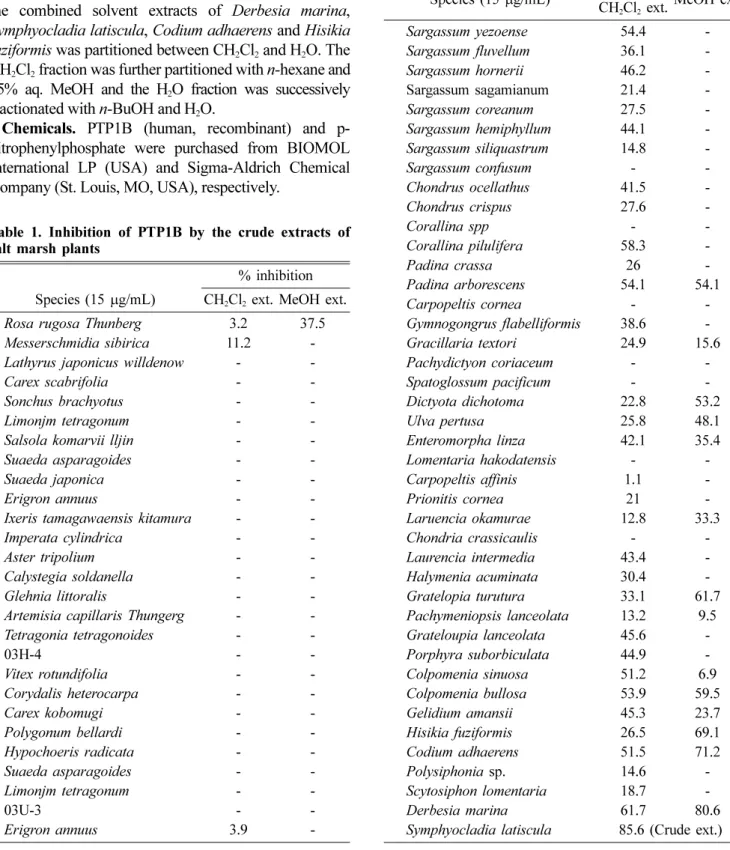
As shown in Table 1 and 2, the in vitro PTP1B inhibitory activities of 71 marine plant species from Korea showed that the extracts from D. marina, S.
latiscula, C. adhaerens, and H. fuziformis were significant PTP1B inhibitors and those from C. pilulifera, S.
yezoense, P. arborescen, C. cornea, D. dichotoma, G.
turutura, C. sinuosa, C. bullosa were moderately active with inhibition rate ranging 50-62% against PTP1B in comparison to the known phosphatase inhibitor, RK-682 (68.3% inhibition) as a positive control in the assay [Hamaguchi et al., 1995]. However, the crude extracts of 27 salt marsh plants didn’t show any effect on PTP1B enzyme activity in vitro.
Interestingly, high PTP1B inhibitory activities were observed from the methanol extracts of D. marinaand and S. latiscula with 80.6 and 85.6% inhibition at the concentration of 15µg/mL, respectively. The methanol extracts of H. fuziformi and C. adhaerens also exhibited comparatively high PTP1B inhibitory activities (69.1%
and 71.2%).
Each crude extract of these four seaweeds was fractionated
with n-hexane, 85% aq. MeOH, n-BuOH and H2O successively and then each of the solvent fractions was evaluated for PTP1B inhibitory activity. Other fractions of S. latiscula, H. fuziformi, D. marinaand,except for the H2O fraction showed good PTP1B inhibitory activities.
Activity of four fractions from H. fuziformi and D.
marina increased in the order of n-hexane > 85%
aq.MeOH >n-BuOH > H2O while that of S. latiscula increased in the order of 85% aq.MeOH >n-hexane >n- BuOH > H2O, suggesting inhibitory activity is presumably attributed to relatively nonpolar constituents of seaweeds.
In the case of C. adhaerens, the highest PTP1B inhibitory activity was observed from the n-BuOH fraction (69.4%), which is expected to include relatively polar constituents.
To our knowledge, this is the first report on PTP1B inhibitory effect of Korean seaweeds and salt marsh plants. From the above results, it is obvious that some seaweeds have PTP1B inhibitory effect, at least in vitro. This study suggests that several seaweed extracts have a potential as anti-diabetic agent.
Acknowledgments. This work was supported by Korea Research Foundation (KRF) grant KRF-2006-005- J00502.
References
Cheng A, Kusari J Jansen D, Bangyopadhyay D Kusari A, and Bryerash M (1999) Marked impairment of protein tyrosine phosphatase 1B activity in adipose tissue of ocese subjects with and without type 2 diabetes melli- tus. J Lab Clinic Med134, 115-123.
Cheon HG, Kim SM, Yang SD, Ha JD, and Choi JK (2004) Discovery of novel protein tyrosine phosphatase-1B inhibitor, KR61639: potential development as an antihy- perglycemic agent. Eur J Pharmacol485, 333-339.
Dadke S and Chernoff J (2003) Protein tyrosine phosphates 1b as a potential drug target for obesity. Current drug targets. Immune, endocrine and metabolic disorders 3, 299-304.
Elchebly M, Peyette P, Michaliszyn E, Cromlish W, Collins S, Loy AL, Normandin D, Cheng A, Himms-Hagen J, Chan CC, Ramachandran C, Gresser MJ, Tremblay ML, and Kennedy BP (1999) Increased insulin sensitivity and obesity resistance in mice lacking the protein tyrosine
Table 3. Inhibition of PTP1B activity against n-hexane, 85% aq. MeOH, n-BuOH and H2O fraction of 4 seaweeds
% Inhibition
Seaweeds n-hexane 85% aq. MeOH n-BuOH H2O
Symphyocladia latiscula 87.6 90.6 73 1.3
Hisikia fuziformis 99 91.3 77.8 16.6
Codium adhaerens 20.8 52.4 69.4 -
Derbesia marina 91.5 73 80.1 56.2
Inhibitory Activity of Korean Marine Plants against PTP1B 77 phosphtase-1B gene. Science283, 1544-1548.
Hamaguchi T, Sudo T, and Osada H (1995) RK-682, a potent inhibitor of tyrosine phosphatase arrested the mammalian cell cycle progression at G1 Phase. FEBS Lett372, 54-58.
Hong JH, Lee MS, Bae EY, Kim YH, Oh HC, Oh WK, Kim BY, and Ahn JS (2004) Screening of the inhibitory activity of medicinal plants against protein tyrosine phos- phatase 1B. Korean J Pharmacogn35, 16-21.
Johnson TO, Emolieff J, and Jirous ek MR (2002) Protein tyrosine phosphatase 1b inhibitors for diabetes. Nature Review Drug Discovery 1, 696-709.
Jung HA, Lee HJ, Kim YA, Park KE, Ahn JW, Lee BJ, Moon SG and Seo Y (2004) Antioxidant activity of Artemisia capillaries Thunberg. Food Sci Biotechnol 13, 328-331.
Kennedy BP (1999) Role of protein tyrosine phosphatase-1B in diabetes and obesity. Biomed and Pharmacother 53, 466-470.
Kennedy BP and Ramachandran C (2000) Protein tyrosine phosphatase-1B in Diabtes. Bioche Pharmacol 60, 877- 883.
Kenner KA, Anyanwu E, Olefsky JM, and Kusari J (1996) Protein-tyrosine phosphotase 1B is a negative regulator of insulin and insulin-like growth factor-I stimulated sig- naling. J Biol Chem 271, 19810-19816.
Klaman LD, Boss O, Peroni OD, Kim JK, Martino JL, Zab- olotny JM, Moghal N, Lubkin M, Kim YB, Sharpe AH, Stricker-Krongrad A, Shulman GI, Neel BG, and Kahn BB (2000) Increased energy expenditure, decreased adi- posity and tissue specific insulin sensitivity in protein- tyrosine phosphtase 1B-deficint mice. Mol Cell Biol 20, 5479-5489.
Lee HJ, Park KE, Yoo JS, Ahn JW, Lee BJ and Seo Y (2004a) Studies on screening of seaweed extracts for peroxynitrite and DPPH radical scavenging activities.
Ocean and Polar Research26, 59-64.
Lee HJ, Kim YA, Ahn JW, Lee BJ, Moon SG, and Seo Y (2004b) Screening of peroxynitrite and DPPH radical scavenging activities from salt marsh plants. Korean J Biotechnol Bioeng19, 57-61.
Lee HJ, Kim YA, Ahn JW, Na HJ, Kim HM, and Seo Y (2006) Screening of Korean marine plants for their inhibitory effect on histamine release from RPMC in vitro. Biotechnol Bioeng11, 80-83.
Lee HJ and Seo Y (2006) Antioxidant properties of Eri- geron annuus extract and its three phenolic constituents Biotechnol Bioeng11, 13-18.
Montalibet J and Kennedy BP (2005) Therapeutic strategies for targeting PTP1B in Diabetes. Drug Discovery Today:
Therapeutic Strategies2, 129-135.
Oh WK, Lee CH, Lee MS, Bae EY, Sohn CB, Oh H, Kim BY, and Ahn JS (2005) Antidiabetic effects of extracts from Psidium guajava. J Ethanopharmacol96, 411-415.
Seo Y, Lee HJ, Park KE, Kim YA, Ahn JW, Yoo JS and Lee BJ (2004) Peroxynitrite scavenging constituents from the brown Alga Sargassum thunbergii. Biotechnol Bioeng9, 212-216.
Seo Y, Lee HJ, Kim YA, Youn HJ and Lee BJ (2005) Effects of several salt marsh plants on mouse spleen and thymus cell proliferation using MTT assay. Ocean Sci- ence J40, 209-212.
Tonks NK (2003) PTP1B: From the sidelines to the front lines. FEBS Letters546, 140-148.
Umezawa K, Kawakami M, and Watanabe T (2003) Molec- ular design and biological activities of protein-tyrosine phosphatase inhibitors. Pharmacol Therapeut99, 15-24.
Zhang B, Salituro G, Szalkowski D, Li Z, Zhang Y, Royo I, Vilella D, Diez MT, Pelaez F, Ruby C, Kendall RL, Mao X, Griffin P, Calaycay J, and Zierat JR (1999) Dis- covery of a small molecule insulin mimetic with antidia- betic activity in mice. Science284, 974-977.