• 검색 결과가 없습니다.

Does family support mediate the effect of anxiety and depression on maternal-fetal attachment in high-risk pregnant women admitted to the maternal-fetal intensive care unit?

N/A
N/A
Protected

Academic year: 2021

Share "Does family support mediate the effect of anxiety and depression on maternal-fetal attachment in high-risk pregnant women admitted to the maternal-fetal intensive care unit?"

Copied!
9
0
0

로드 중.... (전체 텍스트 보기)

전체 글

(1)

This is an Open Access article distributed under the terms of the Creative Commons Attribution License (http://creativecommons.org/licenses/by/4.0) which permits unrestricted use, distribution, and reproduction in any medium, provided the original work is properly cited.

Copyright © 2021 Korean Society of Women Health Nursing

Does family support mediate the effect of anxiety and depression on maternal-fetal attachment in high-risk pregnant women

admitted to the maternal-fetal intensive care unit?

Se-Hee Yoon 1 , Mi-Hae Sung 2

1

Busan Paik Hospital, Busan, Korea

2

College of Nursing and Institute of Health Science, Inje University, Busan, Korea

Purpose: This study investigated the mediating effect of family support in the relationships of anxi- ety and depression with maternal-fetal attachment among pregnant women admitted to the mater- nal-fetal intensive care unit (MFICU) in Korea.

Methods: The participants were high-risk pregnant women with a gestational age of at least 20 weeks who were admitted to MFICUs in Busan and Yangsan. The Korean versions of four measure- ment tools were used for the self-report questionnaire: Spielberger’s State-Trait Anxiety Inventory, the Edinburgh Postnatal Depression Scale, Cobb’s family support measurement, and Cranley’s ma- ternal-fetal attachment scale. Data were collected from June 22 to September 20, 2020. Out of 124 participants, data from 123 respondents were analyzed. Descriptive statistics and regression analysis were done.

Results: The average age of participants was 34.1 years. Their anxiety level was moderate (43.57±11.65 points out of 80) and 53.6% were identified as having moderate depression (average 10.13±5.48 points out of 30). Family support was somewhat high (average 43.30±5.03 points out of 55). The average score of maternal-fetal attachment was also somewhat high (73.37±12.14 points out of 96). Family support had a partial mediating effect in the relationships of anxiety and depres- sion with maternal-fetal attachment among high-risk pregnant women admitted to the MFICU.

Conclusion: Maintaining family support is challenging due to the nature of the MFICU. Consider- ing the mediating effect of family support, establishing an intervention plan to strengthen family support can be helpful as a way to improve maternal-fetal attachment for high-risk pregnant women admitted to the MFICU.

Keywords: Anxiety; Depression; Hospitals; Pregnancy; Self-report pISSN 2287-1640 · eISSN 2093-7695

Korean J Women Health Nurs 2021;27(2):104-112 https://doi.org/10.4069/kjwhn.2021.05.14

Received: January 19, 2021 Revised: May 14, 2021 Accepted: May 14, 2021 Corresponding author:

Mi-Hae Sung

College of Nursing and Institute of Health Science, Inje University, 75 Bokji-ro, Busanjin-gu, Busan 47392, Korea

Tel: +82-51-890-6825 E-mail: [email protected] This article is based on the master’s thesis of the first author (Se-Hee Yoon) from Inje University.

Introduction

Due to the recent increase in women’s social status and activity in the workforce, the proportion of older and high-risk pregnant women over 35 is also increasing. The number of pregnant wom- en who received hospitalization or outpatient care for high-risk pregnancies in Korea increased from 27,223 in 2009 to 142,565

in 2019, corresponding to approximately six-fold growth over 10

years [1]. High-risk pregnancies cause high-risk deliveries of

high-risk newborn babies [2], and constitute a social problem

that increases medical costs, reduces population health [3], and

increases individual and national economic losses [4]. Against

this background, the Korean government established a policy to

support the establishment of maternal neonatal intensive care

(2)

centers as a public health policy project. This policy provides sys- tematic therapeutic management and nursing for high-risk preg- nant women in the maternal-fetal intensive care unit (MFICU), and as of 2021, 19 hospitals are operating MFICUs. MFICUs provide intensive management, including fetal monitoring for pregnant women with gestational hypertension, gestational dia- betes, heart disease, and complications such as postpartum bleeding and sepsis [5]. Fetal attachment refers to the develop- ment of emotional bonds with the fetus, prompting women to participate in interactive behaviors with and show affection for the fetus [6]. It is an important factor in helping pregnant women develop and adapt during pregnancy and influences healthy fetal development [7].

Pregnant women can experience depression due to changes in hormone levels and emotions related to pregnancy [8]. Depres- sion has negative consequences for childbirth, such as preterm delivery, low birth weight, and difficulty forming bonds with the baby after childbirth [9]. Pregnant women admitted to the MFI- CU often experience panic and frustration due to the sudden di- agnosis of a high-risk pregnancy, uncertain prognosis, and hospi- talization [4]; thus, they often experience higher anxiety than women with normal pregnancies [10]. Depressed pregnant women have less interest in the fetus and interact less with the fe- tus, making it challenging to form maternal-fetal attachment [9].

Previous studies of maternal-fetal attachment have shown that the higher anxiety and depression of hospitalized high-risk preg- nant women negatively affect fetal attachment, whereas family support reduces these adverse effects [2,9,11].

With the recent increase in MFICUs across Korea and the re- strictive nature of the MFICU setting, multiple issues are foresee- able for high-risk pregnant women. However, insufficient re- search has explored factors associated with fetal attachment and

the mediating effects of family support, both in domestic and in- ternational contexts. No studies have been conducted on the ef- fects of anxiety and depression on fetal attachment and the medi- ating effects of family support in that relationship among high- risk pregnant women admitted to the MFICU.

This study aimed to identify factors affecting maternal-fetal at- tachment and the mediating effect of family support among high- risk pregnant women admitted to MFICU in Korea. The specific aims were (1) to identify the factors affecting the participants’

maternal-fetal attachment, and (2) to identify the mediating ef- fect of family support on mater nal-fetal attachment.

Methods

Ethics statement: This study was approved by the Institutional Review Board of Inje University (2020-04-022-003). Informed consent was obtained from the participants.

This is a self-report-based study using a correlational survey design.

This manuscript was written in accordance with the Strengthening the Reporting of Observational Studies in Epidemiology (STROBE) guidelines (https://www.strobe-statement.org/index.

php?id=strobe-home).

Sample and sampling

The participants of this study were women who were diagnosed with high-risk pregnancy and admitted to the MFICU of Inje University Busan Paik Hospital in Busan and Pusan National University Yangsan Hospital in Yangsan. Pregnant women who fulfilled the following four criteria were included via convenience sampling: (1) admission after being diagnosed with premature

Summary statement

What is already known about this topic?

Several studies have compared the relationships of anxiety and depression with fetal attachment among high-risk and normal pregnant women. However, the mediating effects of family support in this relationship have not been examined among high- risk pregnant women in the maternal-fetal intensive care unit (MFICU).

What this paper adds

Family support was found to have a partial mediating effect in the relationships of anxiety and depression with maternal-fetal attach- ment among high-risk pregnant women admitted to the MFICU.

Implications for practice, education, and/or policy

The development and application of nursing mediation programs and counseling that can increase family support, reduce anxiety

and depression, and promote maternal-fetal attachment would benefit high-risk pregnant women in the MFICU.

(3)

labor, early amniotic membrane rupture, cervical incompetence, placenta previa, premature rupture of amniotic membrane, pre- eclampsia, oligohydramnios, abruptio placentae, uterine malfor- mation, multiple pregnancies, polyhydramnios, fetal abnormali- ties (fetal growth delay, fetal malformation, or fetal lyrics), and relevant medical conditions (high blood pressure, diabetes, auto- immune diseases, blood clotting disorders, etc.); (2) at least 20 weeks of pregnancy; (3) a hospital stay of more than 3 days; and (4) comprehension of the purpose of the study and voluntary agreement to participate. The following two exclusion criteria were applied: (1) diagnosis of psychiatric diseases such as de- pression and cognitive dysfunction; and (2) unstable conditions that could affect the mother or fetus, such as delivery in progress or active bleeding. There was no identifiable bias in the selection or exclusion process.

The sample size required for this study was calculated using G*Power version 3.1.9.4. Based on previous studies [12], the fol- lowing conditions were entered: effect size, .15 (medium size);

significance level, .05; power, .80; and seven predictor variables (age, religion, high-risk pregnancy experience, planned pregnan- cy, anxiety, depression, and family support). The minimum num- ber of samples required for multiple regression analysis was cal- culated as 103 participants, and a dropout rate of 20% was antici- pated based on a previous study [12]. All eligible women were invited to take part in the study; out of a total of 124 participants, all responded to the questionnaire. Excluding one inadequate re- sponse, 123 participants were included in the analysis (Figure 1).

Instruments

The original developers and Korean translators gave permission to use all the measurement tools used in this study. Measurement

tools for anxiety, depression, family support, and maternal-fetal attachment were used. The time to complete the paper question- naire was about 10 minutes.

Maternal-fetal attachment

Cranley’s maternal-fetal attachment scale (MFAS) was devel- oped for pregnant women [6], and the Korean version was de- veloped by Kim [13]. This tool consists of a total of 24 items;

three items that distinguish oneself from the fetus, six items that speculate on the characteristics and intentions of the fetus, four items related to role acceptance, five items that ask about interac- tion with the fetus and the woman herself, and six items related to commitment. The responses are given on a 4-point Likert scale (1, definitely no; 4, definitely yes). The scores range from 24 to 96 points, and higher scores indicate a greater degree of maternal-fetal attachment. At the time of development, Cron- bach’s α of the original tool was .85 [6]. Internal reliability was good for the translated tool (Cronbach’s α= 92) [13] and in the present study (Cronbach’s α= .92).

Family support

Cobb’s family support measurement tool was developed for pa- tients with various pathologies [14] and translated into Korean by Kang [15]. This 11-item tool measures the degree of family support perceived by the patient with a 5-point Likert scale (1, not at all; 5, very much). The total score ranges from 11 to 55 points, and higher scores indicate a higher degree of family sup- port. The Cronbach’s α value of the tool at the time of develop- ment was .89 [14], and it was .86 for the translated tool [15]. In- ternal reliability was good in the present study (Cronbach’s α= .87).

Anxiety

The Korean version of Spielberger’s State-Trait Anxiety Invento- ry [16], translated by Kim and Shin [17], was developed for measuring anxiety in normal adults without mental disorders. In this study, the 20 items on present state anxiety were included to measure anxiety levels in hospitalization. The summed scores us- ing the 4-point Likert scale (1, not at all; 4, always) yielded a pos- sible range from 20 to 80 points, with higher scores correspond- ing to a higher degree of anxiety. Cronbach’s α was .84 at the time of development [16], .87 for the Korean translation [17], and .94 in the present study.

Depression

The Edinburgh Postnatal Depression Scale (EPDS) was initially developed to screen for postpartum depression [18] and has also Eligible participants

(n=124)

Refusal - None

Excluded

- Incomplete response (n=1) Agreed to participate

(n=124)

123 Included in the analysis

Figure 1. Flow diagram of recruitment.

(4)

been used in pregnancy [19]. The Korean translation by Han et al. [20] was used. It measures respondents’ mood for the last week with 10 items on a 4-point Likert scale (0, no, never; 3, yes, most of the time; or variable descriptions), and positive items are handled by inverse conversion. The total score ranged from 0 to 30, and a higher score indicates more severe depression. Those with a score of 10 or higher are classified as requiring psychiatric evaluation in Korea [20], with scores of 10 to 12 points classified as mild depression and a score of more than 12 requiring careful attention for major depressive disorder. Cronbach’s α was .87 for the original tool [18], .85 for the translated tool [20], and .84 in the present study.

General characteristics and obstetric characteristics

The general characteristics consisted of eight items, including current age, marital status, marital period, education, occupation, monthly income, religion, and the number of family members.

The obstetric characteristics consisted of 15 items, including the number of days of hospitalization, diagnosis, and whether the pregnancy was planned. These items were designed by the au- thors according to the literature.

Procedures

The survey data were collected from June 22 to September 20, 2020. Questionnaires were distributed by the research team and collected after completion on the same day. A gift for the new- born (worth 2 US dollars [USD]) was provided as a token of ap- preciation.

Statistical methods

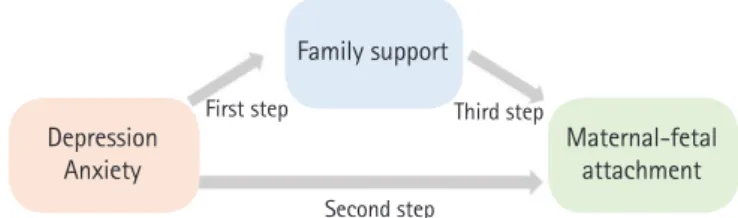
Skewness and kurtosis were tested to confirm whether the data had a normal distribution. The general characteristics, obstetric characteristics, anxiety, depression, and degree of maternal-fetal attachment were analyzed using descriptive statistics, and factors affecting maternal-fetal attachment were analyzed using hierar- chical multiple regression. The procedure proposed by Baron and Kenny [21] was used to confirm the mediating effect of fam- ily support, and the Sobel test was performed to verify the effec- tiveness of the mediating effect path. The independent variables were anxiety and depression, which showed significant correla- tions with fetal attachment. Family support was introduced as a mediator. In the first step, it was checked whether the indepen- dent variables (anxiety and depression) affected the mediator (family support). In the second step, it was checked whether the independent variables (anxiety and depression) had a significant effect on the dependent variable (fetal attachment). In the final step, it was checked whether the independent variables (anxiety

and depression) and the mediator (family support) had a signifi- cant effect on the dependent variable (fetal attachment). The mediating effect was confirmed by comparing the regression co- efficient in step 2 with the regression coefficient in step 3. The analytical process is presented in Figure 2. The collected data were analyzed using IBM SPSS ver. 25.0 (IBM Corp., Armonk, NY, USA).

Results

General and obstetric characteristics of the participants The average age of the participants was 34.1 years old, and 53.7%

were under 35 years old. The average length of marriage was 46.63 months, and 39.1% of participants had been married for less than 24 months. The proportion of participants with a spouse was 96.7%, and 78.9% of the participants had a terminal education level of college graduation. Furthermore, 51.2% of participants were employed. The average monthly household in- come was 5.22 million Korean won (USD 4,626), and 49.6% of the group had monthly household incomes between 3 million Korean won (USD 2,659) and 6 million Korean won (USD 5,318). The majority of the participants (69.1%) were not reli- gious, and 61.8% lived with their husbands (Table 1).

The average gestational age was 32.08 weeks, and 39.8% of the participants’ gestational age was between 28 weeks and 37 weeks.

Fewer than half of the women (38.2%) were pregnant for the first time, while 31.7% previously had a natural abortion, and 7.3%

previously had an artificial abortion. In addition, 13.8% of the par- ticipants had a history of preterm birth, and 28.5% of the partici- pants had a previous full-term delivery. The proportion of the par- ticipants who had previously experienced a high-risk pregnancy was 30.1%. Most of the participants (61.0%) had spontaneous natural pregnancies and planned pregnancies (65.0%). The aver- age length of hospitalization was 5.02 days, and 72.4% were hos- pitalized for 3 days. Multiple diseases were diagnosed in 56.3% of

Family support First step

Second step

Third step

Maternal-fetal attachment Depression

Anxiety

Figure 2. Relationships among the two independent variables

(depression and anxiety), the mediator (family support), and

dependent variable (maternal-fetal attachment) and the analysis

steps.

(5)

the participants. The proportion of participants with medical ill- nesses was 40.7%, while 35.8% of participants had preterm labor and 26.8% had fetal abnormalities. The other obstetric conditions were as follows; cervical incompetence (21.1%), multiple preg- nancies (19.5%), placenta previa (13.8%), premature rupture of amniotic membrane (11.4%), preeclampsia (9.8%), uterine mal- formation (8.9%), oligohydramnios (4.9%), abruptio placentae (1.6%), and polyhydramnios (0.8%) (Table 2).

Participants’ anxiety, depression, family support, and fetal attachment

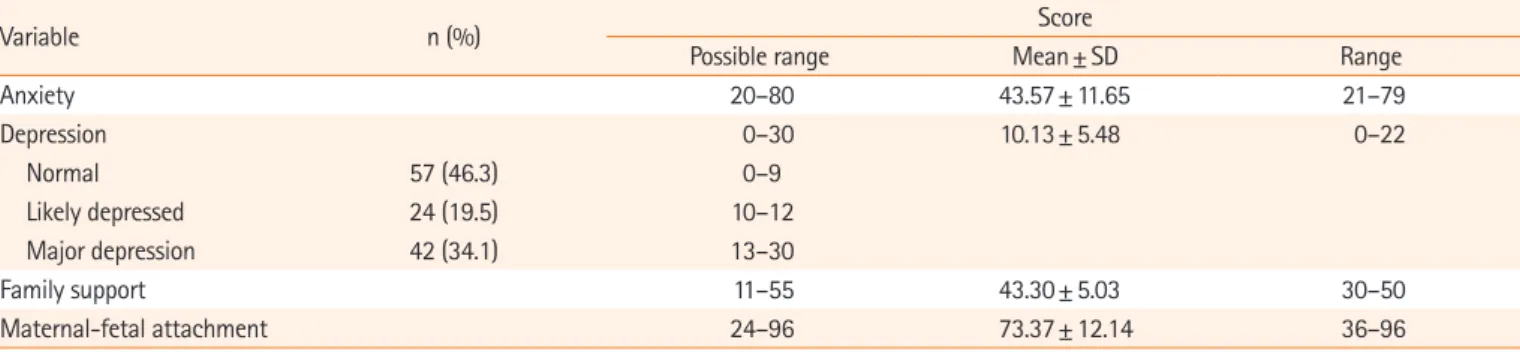
The participants’ anxiety score was medium (43.57 ± 11.65 points out of a maximum of 80). For depression, the average was 10.13± 5.48 points out of a maximum of 30, with 66 (53.6%) identified as likely depressed (score of 10 or more) and 42 wom- en (34.1%) having levels highly suspicious for depression (score of 13 or greater). The average score of family support was some- what high (43.30± 5.03 points out of a maximum of 55). The av- erage score of maternal-fetal attachment was also somewhat high (73.37± 12.14 points out of a maximum of 96) (Table 3).

Mediating effects of family support in the relationships of anxiety and depression with maternal-fetal attachment We examined the autocorrelation of the dependent variable and

the multicollinearity between the independent variables before verifying the mediating effect. The Durbin-Watson statistic yielded results of 2.10 to 2.45, which were close to 2. Therefore, the assumption of the independence of the residuals could be ac- cepted. Tolerance ranged from .74 to .95, all above .10, and the variance inflation factor (VIF) ranged from 1.04 to 1.33, all be- low 10, indicating no multicollinearity.

Controlling for age, which was a significant factor, in the first step, it was found that anxiety, an independent variable, had a sig- nificant effect on the mediator (family support) (β =–.50, p<.001). In the second step, anxiety was found to have a signifi- cant effect on maternal-fetal attachment (dependent variable) (β=–.55, p<.001). In the third step, anxiety (independent vari- able) and family support (mediator) had significant effects on ma- ternal-fetal attachment (dependent variable) (anxiety: β=–.42, p<.001; family support: β=.25, p= .002). In the third step, the explanatory power of anxiety and family support was 41.9%. The β value of anxiety in the third step was –.42, the absolute value of which was less than that in the second stage, –.55, indicating a mediating effect of family support. Since both the independent variable and the mediator significantly affected the dependent variable, it was found that family support partially mediated the effect of anxiety on maternal-fetal attachment. Furthermore, the Sobel test showed the significance of the mediating effect (z=–2.87, Table 1. General characteristics of participants (N=123)

Characteristic Categories n (%) Mean± SD t/F p

Age (year) < 35 66 (53.7) 76.46± 10.94 3.15 .002

≥ 35 57 (46.3) 69.78± 12.56

Spouse Yes 119 (96.7) 73.61± 11.62 0.59 .595

No 4 (3.3) 66.20± 24.77

Length of marriage (month) ≤ 24 48 (39.0) 75.81± 13.07 2.84 .062

25–72 59 (48.0) 70.69± 10.78

≥ 73 16 (13.0) 75.93± 12.66

Education ≤ High school 15 (12.2) 71.73± 9.17 2.66 .073

University (college) 97 (78.9) 72.73± 12.15

≥ Graduate school 11 (8.9) 81.27± 13.68

Job Yes 63 (51.2) 72.82± 13.34 –0.51 .610

No 60 (48.8) 73.95± 10.83

Monthly household income (KRW) ≤ 3 million 30 (24.4) 71.13± 12.85 0.81 .444

3.01–6 million 61 (49.6) 73.60± 11.60

≥ 6.01 million 32 (26.0) 75.01± 12.55

Religion Yes 38 (30.9) 72.94± 11.25 –0.25 .796

No 85 (69.1) 73.56± 12.58

Cohabiting family Living without spouse 6 (4.9) 68.00± 20.48 0.77 .462

Living with spouse only 76 (61.8) 74.11± 11.91

Living with spouse & others 41 (33.3) 72.78± 11.20

KRW: Korean won (1 million KRW is approximately 900 US dollars).

(6)

p=.003).

Controlling for age, which was a significant factor, depression, an independent variable, had a significant effect on the mediator (family support) in the first step (β= –.45, p<.001). In the sec- ond step, depression was found to have a significant effect on ma- ternal-fetal attachment (dependent variable) (β= –.56, p<.001).

In the third step, depression (β= –.44, p<.001) and family sup- port (β=.26, p=.001) were found to have statistically significant ef-

fects, and the explanatory power of depression and family support was 43.5%. The β value of depression in the third step was –.44, the absolute value of which was lower than the β-value in the second step, –.56. Therefore, it can be concluded that family support mediated the effect of depression on maternal-fetal attachment.

Since both the independent variable and the mediator signifi- cantly affected the dependent variable, it can be concluded that family support partially mediated the effect of depression on fetal Table 2. Obstetric characteristics of participants (N=123)

Characteristic Categories n (%) Mean± SD t/F p

Gestational period (week) ≤ 27 35 (28.5) 71.94± 10.22 1.37 .256

28–36 49 (39.8) 72.28± 13.19

≥ 37 39 (31.7) 76.02± 12.23

Experience of spontaneous abortion Yes 39 (31.7) 71.41± 10.88 –1.22 .223

No 84 (68.3) 74.28± 12.64

Number of pregnancies 1 47 (38.2) 74.89± 13.62 0.60 .550

2 42 (34.1) 72.26± 10.61

≥ 3 34 (27.6) 72.64± 11.89

Experience of induced abortion Yes 9 (7.3) 75.66± 8.58 0.58 .559

No 114 (92.7) 73.19± 12.39

Experience of preterm delivery Yes 17 (13.8) 68.52± 12.28 –1.78 .076

No 106 (86.2) 74.15± 11.99

Experience of full-term delivery Yes 35 (28.5) 74.17± 11.04 0.45 .648

No 88 (71.5) 73.05± 12.60

Experience of high-risk pregnancy Yes 37 (30.1) 70.89± 12.36 –1.49 .138

No 86 (69.9) 74.44± 11.96

Pregnancy method Natural pregnancy 75 (61.0) 73.52± 12.16 0.02 .995

Ovulation induction 5 (4.1) 74.20± 16.78

Intrauterine insemination 6 (4.9) 72.66± 11.44

In vitro fertilization 37 (30.1) 73.08± 12.07

Planned pregnancy Yes 80 (65.0) 73.70± 11.88 0.40 .686

No 43 (35.0) 72.76± 12.74

Hospitalization days 3 89 (72.4) 73.97± 12.54 1.01 .365

4–5 15 (12.2) 74.40± 10.86

≥ 6 19 (15.4) 69.73± 11.02

Number of diagnosed diseases 1 54 (43.9) 72.70± 11.78 0.79 .454

2 39 (31.7) 72.43± 11.88

≥ 3 30 (24.4) 75.80± 13.17

Disease Preterm labor 44 (35.8)

Premature rupture of membrane 14 (11.4) Incompetent internal os of cervix 26 (21.1)

Placenta previa 17 (13.8)

Placenta abruptio 2 (1.6)

Preeclampsia 12 (9.8)

Polyhydramnios 1 (0.8)

Oligohydramnios 6 (4.9)

Uterus anomaly 11 (8.9)

Multifetal gestation 24 (19.5)

Fetal abnormality 33 (26.8)

Maternal disease 50 (40.7)

(7)

attachment. Furthermore, according to the Sobel test, the medi- ating effect (z= –3.03, p=.002) was significant (Table 4).

Discussion

The factors influencing maternal-fetal attachment in high-risk pregnant women admitted to MFICU were depression, anxiety, and family support, of which depression was the most influential factor. Conducting screening for prenatal depression using an available tool would make it possible to effectively screen and manage patients with significant depression within a short time at a low cost. Systematic and ongoing management of prenatal depression may help not only reduce patients’ depression but also improve maternal-fetal attachment. According to a prior study [22], support through collective counseling helps reduce depression and enhances hope and optimism. Thus, it may be helpful to provide supportive counseling for high-risk women admitted to MFICU. Other influencing factors were anxiety and family support. This result is similar to the findings of a previous study in high-risk pregnant women [2] that reported that anxiety and marital adaptation influenced maternal-fetal attachment. An- other study of women who experienced miscarriage noted that

spousal support was a factor associated with maternal-fetal at- tachment [12].

The partial mediating effect of family support was confirmed in the relationships of anxiety and depression with maternal-fetal attachment in high-risk pregnant women admitted to MFICU.

High anxiety and depression levels may reduce family support, which can negatively affect maternal-fetal attachment. Family support acts as a mediator to reduce the decline in maternal-fetal attachment caused by anxiety and depression. Although family members should be encouraged to visit the hospital during per- mitted hours to support high-risk pregnant women, their ability to do is very limited in the MFICU due to the nature of this set- ting and the constant surveillance required. Although the data collection period was during the COVID-19 pandemic, the lim- ited opportunity for in-person support from family is inherent to the MFICU. Family support via smartphones is an alternative, but more structured “visiting” modes that encourage engage- ment and supportive interactions are needed.

The participants in this study reported relatively high mater- nal-fetal attachment scores, with an average of 73.37 out of 96 points, which is similar to the result of 74.25 points in a study of high-risk pregnant women [10] using the same tool. However, it Table 3. Degree of anxiety, depression, family support, and maternal-fetal attachment (N=123)

Variable n (%) Score

Possible range Mean± SD Range

Anxiety 20–80 43.57± 11.65 21–79

Depression 0–30 10.13± 5.48 0–22

Normal 57 (46.3) 0–9

Likely depressed 24 (19.5) 10–12

Major depression 42 (34.1) 13–30

Family support 11–55 43.30± 5.03 30–50

Maternal-fetal attachment 24–96 73.37± 12.14 36–96

Table 4. The mediating effect of family support on the relationships of anxiety and depression with maternal-fetal attachment (N=123)

Variable B SE β t p Adjusted R

2

F

1 Anxiety → Family support –0.21 .03 –.50 –6.39 < .001 .246 40.82

2 Anxiety → Maternal-fetal attachment –0.57 .07 –.55 –7.68 < .001 .376 37.79

3 Anxiety → Maternal-fetal attachment –0.44 .08 –.42 –5.35 < .001 .419 30.38

Family support → Maternal-fetal attachment 0.60 .19 .25 3.15 .002

Sobel test: Z= –2.95, p= .003

1 Depression → Family support –0.41 .07 –.45 –5.58 < .001 .198 31.17

2 Depression → Maternal-fetal attachment –1.25 .16 –.56 –7.77 < .001 .381 38.70

3 Depression → Maternal-fetal attachment –0.09 .17 –.44 –5.72 < .001 .435 32.34

Family support → Maternal-fetal attachment 0.64 .18 .26 3.52 .001

Sobel test: Z= –3.07, p= .002

Age is adjusted.

(8)

is lower than the average of 81.36 points in a study of women with normal pregnancies women [7]. These results imply that high- risk pregnant women admitted to the MFICU have a lower degree of maternal-fetal attachment than women with normal pregnan- cies (i.e., without pregnancy complications or other diseases).

In this study, the average anxiety score was 43.57 out of a total of 80. This is higher than previously reported scores of 39.02 points in high-risk pregnancies [2] and 39.3 points in normal pregnancies [9] using the same tool. As state anxiety ranged from 21 to 79 points, reflecting significant variation among individu- als, nursing interventions for pregnant women in the MFICU should carefully note differences in individual characteristics and the degree of anxiety.

The average depression score (10.13 out of a total of 30) was also higher than previously reported among pregnant women (7.8 points) [23]. In this study, 53.6% of participants required a psychiatric evaluation (score ≥ 10). Furthermore, 34.1% were found to be at risk for severe depression (score≥ 13), which is higher than the proportion of 20.6% reported for generally healthy pregnant women [23]. Underlying diseases, early labor pains, and fetal abnormalities were present in a large proportion of participants in this study, which is believed to have affected de- pression among pregnant women.

Although it is difficult to compare the findings directly due to insufficient research using the same tool among high-risk preg- nant women, the degree of family support in this study (43.3 out of 55) appears to be similar to that reported for women with nor- mal pregnancies (17.84 out of 20) using the multidimensional scale of perceived social support tool [24]. There is a need for further research on family support among high-risk pregnant women admitted to the MFICU.

Since the participants of the study were selected through con- venience sampling from two hospitals in one region, caution is needed when generalizing the results to other institutions in oth- er regions or countries. Nonetheless, this study is meaningful in that it examined high-risk women in the MFICU; as such, future studies would be beneficial to expand the target participants through nationwide sampling. It is also necessary to conduct fur- ther studies to develop nursing intervention programs that can strengthen family support and engagement with high-risk preg- nant women during their stay in the MFICU to improve mater- nal-fetal attachment.

In conclusion, this study found that lower levels of anxiety and depression, as well as higher levels of family support, were associ- ated with higher maternal-fetal attachment. Depression was iden- tified as the most influential factor, and the mediating effect of family support in the relationships of depression and anxiety

with maternal-fetal attachment was verified. Therefore, it is nec- essary to reduce negative emotions such as anxiety and depres- sion, and active family support is necessary to overcome those negative emotions. Developing a nursing intervention program to reduce anxiety would also support pregnant women and their family members. It is necessary to diagnose depression early through a prenatal depression screening system to enable early interventions. It would also be worth considering preparing an educational program to cultivate professional counselors for high-risk pregnant women with formal certificates for those who complete the course.

ORCID

Se-Hee Yoon, https://orcid.org/0000-0002-6623-9634 Mi-Hae Sung, https://orcid.org/0000-0002-5769-5857

Authors’ contributions

Conceptualization, Methodology: Yoon SH, Sung MH; Data cu- ration, Formal analysis, Investigation: Yoon SH; Supervision:

Sung MH; Writing-original draft: Yoon SH; Writing-review &

editing: Sung MH.

Conflict of interest

The authors declared no conflict of interest.

Funding

None.

Data availability

Please contact the corresponding author for data availability.

Acknowledgments

None.

References

1. Health Insurance Review & Assessment Service. Statistics of national diseases of interest [Internet]. Seoul: Author; 2020 [cited 2020 Sep 1]. Available from: http://opendata.hira.or.kr/

op/opc/olapMfrnIntrsIlnsInfo.do

2. Lee EY. Influence of anxiety and dyadic adjustment on ma-

(9)

ternal-fetal attachment in high-risk pregnant women [mas- ter’s thesis]. Daegu: Kyungpook National University; 2015. 42 p.

3. Lee SY, Im JY. Measures for improving population qualifica- tions in response to low birth and aging: birth status and pol- icy tasks of elderly pregnant women. Seoul: Korea Institute for Health and Social Affairs; 2013. p. 208.

4. Kim S, Cha C. Bed rest experience among high-risk primi- gravida. J Qual Res. 2018;19(1):1-12. https://doi.org/10.

22284/qr.2018.19.1.1

5. Kim HY, Moon CS. Integrated care center for high risk preg- nancy and neonate: an analysis of process and problems in obstetrics. Korean J Perinatol. 2014;25(3):140-152. https://

doi.org/10.14734/kjp.2014.25.3.140

6. Cranley MS. Development of a tool for the measurement of maternal attachment during pregnancy. Nurs Res. 1981;30 (5):281-284. https://doi.org/10.1097/00006199-198109000- 00008

7. Kang SK, Chung MR. The relationship between pregnant woman’s stress, temperament and maternal-fetal attachment.

Korean J Human Ecol. 2012;21(2):213-223. https://doi.

org/10.5934/kjhe.2012.21.2.213

8. American Pregnancy Association. Depression in pregnancy [Internet]. Irving (TX): Author; c2021 [cited 2021 May 20].

Available from: http://americanpregnancy.org/pregnancy- health/depressionduringpregnancy.html

9. Wi H, Park SY. The relationships between anxiety, depres- sion, prenatal stress, maternal-fetal attachment and gratitude.

J Korean Soc Matern Child Health. 2012;16(2):274-286.

https://doi.org/10.21896/jksmch.2012.16.2.274

10. Ko SY, Bae JG, Jung SW. A comparative study on the anxiety, depression, and maternal-fetal attachment of high-risk preg- nant women and normal pregnant women. J Korean Soc Biol Ther Psychiatry. 2019;25(2):117-126. https://doi.org/10.

22802/jksbtp.2019.25.2.117

11. Yu M, Kim MO. The contribution of maternal-fetal attach- ment: taegyo, maternal fatigue and social support during pregnancy. Child Health Nurs Res. 2014;20(4):247-254.

https://doi.org/10.4094/chnr.2014.20.4.247

12. Kim BK, Sung MH. Impact of anxiety, social support, and ta- egyo practice on maternal-fetal attachment in pregnant women having an abortion. Korean J Women Health Nurs.

2019;25(2):182-193. https://doi.org/10.4069/kjwhn.2019.

25.2.182

13. Kim KY. Effects on maternal-infant attachment by the taegyo perspective prenatal class [master’s thesis]. Seoul: Yonsei Uni- versity; 2000. 63 p.

14. Cobb S. Presidential Address-1976. Social support as a mod- erator of life stress. Psychosom Med. 1976;38(5):300-314.

https://doi.org/10.1097/00006842-197609000-00003

15. Kang HS. Experimental study of the effects of reinforcement education for rehabilitation on hemiplegia patients’ self-care activities [dissertation]. Seoul: Yonsei University; 1984. 125 p.

16. Spielberger CD, Gorsuch R, Lushene RE. Manual for the state-trait anxiety inventory. Palo Alto: Consulting Psycholo- gist Press; 1970. p. 24.

17. Kim JT, Shin DK. A study based on the standardization of the STAI for Korea. New Med J. 1978;21(11):69-75.

18. Cox JL, Holden JM, Sagovsky R. Detection of postnatal de- pression. Development of the 10-item Edinburgh postnatal depression scale. Br J Psychiatry. 1987;150:782-786. https://

doi.org/10.1192/bjp.150.6.782

19. Cox JL, Chapman G, Murray D, Jones P. Validation of the Ed- inburgh Postnatal Depression Scale (EPDS) in non-postnatal women. J Affect Disord. 1996;39(3):185-189. https://doi.

org/10.1016/0165-0327(96)00008-0

20. Han KW, Kim MJ, Park JM. The Edinburgh postnatal depres- sion scale, Korean version: reliability and validity. J Korean Soc Biol Ther Psychiatry. 2004;10(2):201-207.

21. Baron RM, Kenny DA. The moderator-mediator variable dis- tinction in social psychological research: conceptual, strate- gic, and statistical considerations. J Pers Soc Psychol.

1986;51(6):1173-1182. https://doi.org/10.1037//0022-3514.

51.6.1173

22. Hong HJ, Kim SJ. The effects of positive psychology group counseling program on depression, hope and optimism of adolescent. J Korean Data Anal Soc. 2014;16(2):1045-1059.

23. Lee EJ, Park JS. Status of antepartum depression and its influ- encing factors in pregnant women. J Korea Acad-Industr Coop Soc. 2013;14(8):3897-3906. https://doi.org/10.5762/

KAIS.2013.14.8.3897

24. Lee SH, Kim JA, Kim MK. The effect of family support on health-related quality of life in pregnant women: the moder- ating effect of depression. AJMAHS. 2018;8(1):637-647.

https://doi.org/10.35873/ajmahs.2018.8.1.063

수치

Figure 1. Flow diagram of recruitment.
Figure 2. Relationships among the two independent variables  (depression and anxiety), the mediator (family support), and  dependent variable (maternal-fetal attachment) and the analysis  steps.
Table 4. The mediating effect of family support on the relationships of anxiety and depression with maternal-fetal attachment (N=123)

참조

관련 문서

Purpose: This study was performed to identify the association between family support, ADL and depression among hospitalized older patients with chronic

The purpose of this research was to identify the mediating effect of unconditional self-acceptance and the moderated mediating effect of emotional

This study derived the financial risk elements of the sports circle and suggested the methods to decrease subsidy support and increase financial independence

The investigator examined the mediating effects of depression and family conflict on relations between problem drinking and life satisfaction according to the life cycle and

An Effect of Group Art Therapy on the Anxiety, Depression and Self-Esteem of single-parented children.. 2009년

This study was conducted to analyze the effects of obesity on the core stability and metabolic syndrome risk factors of middle - aged women.. The effect

In order to criminalize the failure to fulfill family obligations, provisions concerning obligations to support family in Korean Civil Law should be

Effect of electric current on the microstructure and mechanical properties of hard-to-sinter materials with high melting point.. Effect of electric current on the