Comparison of Bypass Surgery with Drug-Eluting Stents in Diabetic Patients with Left Main Coronary Stenosis
Xiaoxiao Zhao,
1Yujie Zhou,
2Hui Song,
1Like Guan,
1Guanbin Zheng,
1Zhehu Jin,
1Dongmei Shi,
2Yuzi Li,
1Yonghe Guo,
2Guo-Ping Shi,
3and Xian Wu Cheng
1,4,51Department of Cardiology, Yanbian University Hospital, Yanji, China;
2Department of Cardiology, Anzhen Hospital, Capital University of Medical Sciences, Beijing, China;
3Department of Medicine, Brigham and Women's Hospital, Harvard Medical School, Boston, Massachusetts, USA;
4Department of Cardiology, Nagoya University Graduate School of Medicine, Nagoya, Japan;
5Department of Internal Medicine, Kyung Hee University Hospital, Seoul, Korea.
Received: October 7, 2010 Revised: January 1, 2011 Accepted: January 24, 2011
Co-corresponding authors: Dr. Yujie Zhou, Department of Cardiology, Anzhen Hospital, Capital University of Medical Sciences, Anzhen Avenue-2, Chaoyang-district, Beijing 10029, China.
Tel: 86-10-64456489, Fax: 86-10-64452234 E-mail: [email protected] and Dr. Xian Wu Cheng,
Department of Cardiology, Nagoya University, Graduate School of Medicine,
65 Tsuruma-cho, Showa-ku, Nagoya 466-8550, Japan.
Tel: 81-52-744-2147, Fax: 81-52-744-2210 E-mail: [email protected]
∙ The authors have no financial conflicts of interest.
© Copyright:
Yonsei University College of Medicine 2011 This is an Open Access article distributed under the terms of the Creative Commons Attribution Non- Commercial License (http://creativecommons.org/
licenses/by-nc/3.0) which permits unrestricted non- commercial use, distribution, and reproduction in any medium, provided the original work is properly cited.
Purpose: Several studies have compared the effects of coronary stenting and coro- nary-artery bypass grafting (CABG) on left main coronary artery (LMCA) disease.
However, there are limited data on the long-term outcomes of these two interven- tions in diabetic patients. Materials and Methods: We evaluated 56 patients with LMCA stenosis who underwent drug-eluting stent (DES) implantation and 116 pa- tients who underwent CABG in a single hospital in China between January 2004 and December 2006. We compared long-term major adverse cardiac events (death; a
“serious outcome” composite of death, myocardial infarction, or stroke; and target- vessel revascularization). Results: In-hospital (30-day) mortality was 0% for the DES group and 3.4% for the CABG group (p=0.31). There was no difference be- tween the two groups in terms of risk of death [hazard ratio for stenting group, 0.49;
95% confidence interval (CI), 0.13-1.63; p=0.55] or risk of serious outcome (hazard ratio for DES group, 1.11; 95% CI, 0.39-1.45; p=0.47). The target-vessel revascular- ization rate was higher in the DES group than in the CABG group (hazard ratio, 3.67; 95% CI, 1.24-11.06; p=0.018). Conclusion: In this cohort of diabetic patients with LMCA stenosis, there was no difference in composite endpoints between pa- tients receiving DESs and those undergoing CABG. However, stenting was associat- ed with higher rates of target-vessel revascularization than CABG. DES implantation in diabetic patients with LMCA disease was found to be at least as safe as CABG.
Key Words: Left main coronary artery disease, coronary intervention, drug-elut- ing stent, coronary-artery bypass grafting, diabetes mellitus
INTRODUCTION
As known, coronary-artery bypass grafting (CABG) has been considered standard therapy for patients with left main coronary artery disease and is recommended by current practice guidelines.1,2 However, these guidelines have been challenged by the widespread use of coronary stents in combination with improved antiplatelet
Revascularization procedure
Patients underwent PCI instead of CABG due to their own or their physician’s preference or the high risk associated with CABG. Previous studies described about the methods of stent implantation for patients with LMCA disease.12,13 Standard interventional techniques were processed for all procedures. According to the operators’ discretion, the use of pre-dilation, an intra-aortic balloon pump, or intravascu- lar ultrasound and the choice of the specific type of DES were applied for each patient treatment. Periprocedurla an- ticoagulation and antiplatelet therapy followed standard regimens. All patients undergoing stenting were prescribed clopidogrel for at least 12 months. Treatment beyond this duration was administered at the discretion of the physician (clopidogrel 79.2% at the end of follow-up in the PCI group).
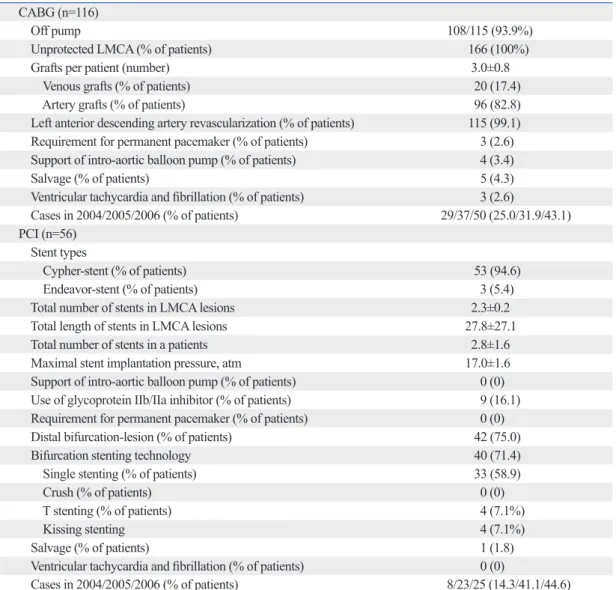
Aspirin was prescribed indefinitely for all patients who un- derwent either PCI with DES or CABG treatment. Surgical revascularization was performed with the use of standard bypass techniques.14 Whenever possible, the internal tho- racic artery was used preferentially for revascularization of the left anterior descending artery. Complete revasculariza- tion was performed when possible with arterial conduits or saphenous vein grafts. A recognized standard of post-inter- ventional care was recommended to the patients.15 Other procedural details are given in Table 1.
Follow-up, end points, and definitions
Clinical follow-up after PCI with DES and after CABG was stopped in March 2008, and major adverse cardiac events (MACE) that occurred during the follow-up period were studied. During the 30 days of in-hospital follow-up, renal events were also evaluated by biological analysis and calcu- lated for major adverse cardiac cerebrovascular and renal events (MACCRE). Routine angiographic follow-up was recommended by the operators in PCI-group patients (22/56, 39.3%) 6 to 12 months after the procedure. However, pa- tients who were at high risk of procedural complications of angiography and had no symptoms or signs of ischemia, as well as patients who declined to comply with this recom- mendation, did not undergo routine follow-up angiography.
For CABG-group patients, angiographic follow-up was rec- ommended only if there were ischemic symptoms or signs during follow-up (29/116, 25.0%). This is consistent with previous studies in which a low threshold for control coro- nary angiography was maintained.16
The endpoints of the study were death, the “serious out- comes” composite (death, Q-wave myocardial infarction, or treatment and by the recent introduction of drug-eluting stents
(DESs), which virtually eliminate the recurrence of acute coronary occlusion and also limit the occurrence of resteno- sis.3,4 Percutaneous coronary intervention (PCI) is therefore being used increasingly in patients with left main coronary artery (LMCA) stenosis.5
In patients with coronary artery diseases, diabetes melli- tus (DM) increases the risk of cardiac mortality approxi- mately two- to four-fold.6,7 Although the acute outcomes af- ter PCI are similar in patients with and without diabetes, because of excessive neointimal proliferation, diabetic pa- tients have higher rates of restenosis and repeat revascular- ization after PCI with or without stenting.8,9 Preliminary re- sults from registries show that the implantation of DESs for unprotected LMCA disease in patients without diabetes is a feasible and safe approach.10 However, until now, no study has analyzed the treatment of LMCA lesions with PCI ver- sus CABG in diabetic patients. The purpose of this study was to compare treatment of LMCA lesions with PCI and DES implantation versus surgical revascularization in pa- tients with DM during their hospital stay (30 days) and long-term follow-up.
MATERIALS AND METHODS
Study population
All diabetic patients with LMCA disease treated with PCI with DES implantation or CABG between January 2004 and December 2006 at Beijing’s Anzhen Hospital (Capital University of Medical Sciences, Beijing, China) were con- sidered for inclusion in this study. In all cases, the selected revascularization approach appeared to be suitable for guar- anteeing complete revascularization. We excluded patients who had undergone previous CABG or who underwent concomitant valvular or aortic surgery. We also excluded those who had primary cardiomyopathy or myocardial in- farction (MI) with ST-segment elevation, or who presented with cardiogenic shock. During the same period, one of the patients who underwent PCI received a bare-metal stent and was therefore excluded from the study. DM was diag- nosed on the basis of a history of using glucose-lowering medications or insulin, or a fasting plasma glucose concen- tration of ≥126 mg/mL.11 All patients were considered to have type 2 DM. The study protocol was approved by the appropriate local institutional ethics committee, and written informed consent was obtained from all patients.
ative-risk evaluation (Ontario score, available at http//www.
sfar.org/scores2/ontario2.htm) was used to stratify the risk of death during hospitalization in patients undergoing cardi- ac surgery.17 Relevant factors that contributed to the Ontario score calculation include age, sex, ejection fraction, urgen- cy of surgery, type of surgery, and repeat operation.
Statistical analysis
Data are presented as mean±standard deviation (SD). We compared the baseline covariates between the DES and CABG groups. Comparisons of the continuous baseline char- acteristics were made using an unpaired t-test. Comparisons of categorical baseline characteristics were made using χ2 tests. Statistical significance and the effects of both thera- pies on the outcomes of in-hospital (up to 30 days) or long- term follow-up were estimated. The Kaplan-Meier method stroke), and target-vessel revascularization (TVR). Clinical
events were assessed annually by mail and/or telephone contact with the patients. The medical records of those pa- tients who reported events were collected and the events adjudicated by the patient’s physician. Death was defined as death from any cause. Q-wave MI was defined as docu- mentation of a new abnormal Q wave after the index treat- ment. Stroke, as indicated by neurologic deficits, was con- firmed by a neurologist on the basis of imaging studies. TVR was defined as repeat revascularization of the treated ves- sel, including any segments of the left anterior descending artery and the left circumflex artery. Both PCI with DES and repeat CABG were judged as revascularization.
Ontario score calculation
The Ontario Province Risk system for cardiac surgery oper-
Table 1. Procedural Characteristics of Patients Treated with CABG and PCI CABG (n=116)
Off pump 108/115 (93.9%)
Unprotected LMCA (% of patients) 166 (100%)
Grafts per patient (number) 3.0±0.8
Venous grafts (% of patients) 20 (17.4)
Artery grafts (% of patients) 96 (82.8)
Left anterior descending artery revascularization (% of patients) 115 (99.1) Requirement for permanent pacemaker (% of patients) 3 (2.6) Support of intro-aortic balloon pump (% of patients) 4 (3.4)
Salvage (% of patients) 5 (4.3)
Ventricular tachycardia and fibrillation (% of patients) 3 (2.6)
Cases in 2004/2005/2006 (% of patients) 29/37/50 (25.0/31.9/43.1)
PCI (n=56) Stent types
Cypher-stent (% of patients) 53 (94.6)
Endeavor-stent (% of patients) 3 (5.4)
Total number of stents in LMCA lesions 2.3±0.2
Total length of stents in LMCA lesions 27.8±27.1
Total number of stents in a patients 2.8±1.6
Maximal stent implantation pressure, atm 17.0±1.6
Support of intro-aortic balloon pump (% of patients) 0 (0) Use of glycoprotein IIb/IIa inhibitor (% of patients) 9 (16.1) Requirement for permanent pacemaker (% of patients) 0 (0) Distal bifurcation-lesion (% of patients) 42 (75.0)
Bifurcation stenting technology 40 (71.4)
Single stenting (% of patients) 33 (58.9)
Crush (% of patients) 0 (0)
T stenting (% of patients) 4 (7.1%)
Kissing stenting 4 (7.1%)
Salvage (% of patients) 1 (1.8)
Ventricular tachycardia and fibrillation (% of patients) 0 (0)
Cases in 2004/2005/2006 (% of patients) 8/23/25 (14.3/41.1/44.6)
PCI, percutaneous cardiac intervention; CABG, coronary-artery bypass grafting; LMCA, left main coronary artery disease.
Percentages may not total 100 because of rounding.
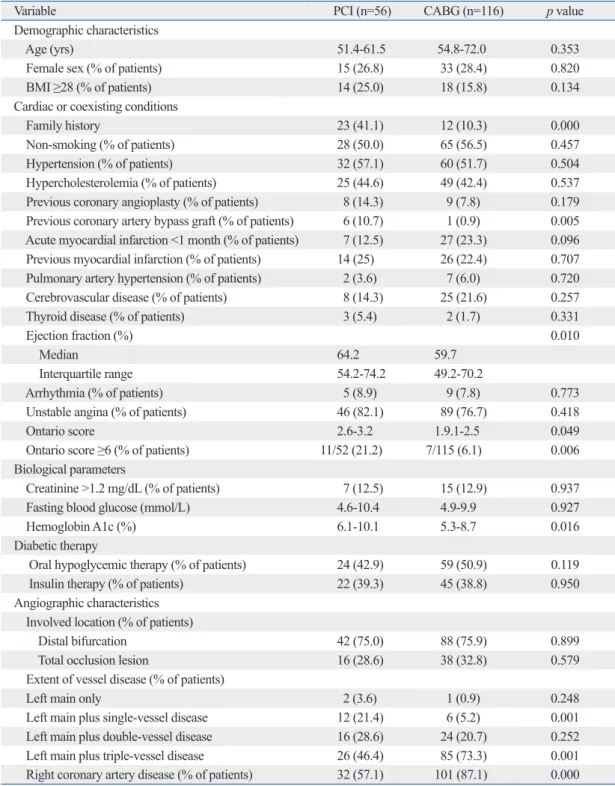
cantly more likely to have had previous coronary bypass grafting than those receiving CABG (p=0.005). The PCI group included a significantly larger number of poorly con- trolled diabetic patients (hemoglobin A1c, 8.1%±2.0% vs.
7.0%±1.7%, p=0.016) (Table 2). Patients undergoing CABG had significantly lower ejection fractions (p=0.010) and On- tario scores (p=0.04), and had significantly more instances of double- or quadruple-vessel disease and involvement of the right coronary artery (p<0.05). There was no significant difference in the proportion of patients in the two groups re- ceiving insulin treatment (39.3% for the PCI group and 38.8% for the CABG group, p=0.950). There were no sig- nificant differences in any other preoperative characteristics between the PCI and CABG groups (p>0.05) (Table 2).
In-hospital events
The rates of MACCRE and acute MI (AMI) were signifi- cantly higher in the CABG group (31.0% and 29.3%, re- spectively) than in the PCI group (both 8.9%, p<0.001) (Table 3), during the in-hospital (up to 30-day) follow-up period. In the CABG group, in-hospital cardiac and stroke death occurred in four patients with acute coronary syn- drome. One patient, who underwent concomitant pericardi- al cystectomy, died from low cardiac output syndrome; two patients died from fatal AMI involving postoperative stroke;
and one died from cardiac tamponade. The rates of cardiac tamponade, acute heart failure, permanent pacemaker im- plantation, ventricular tachycardia and fibrillation, postop- erative pneumothorax, shock, dialysis requirement, repeat thoracotomy for bleeding or suppuration, and vascular he- matoma requiring repair were higher in the CABG group, but the differences between the two groups were not signif- icant (Table 3). The duration of the post-procedural hospital stay was significantly longer in the CABG group than in the PCI group (p<0.001) (Table 3).
Long-term outcomes
The median follow-up was 28.5 months (interquartile range, 18.5-29.5) in the PCI group and 28.4 months (17.9-38.9) in the CABG group (Table 4). Complete follow-up data for ma- jor clinical events were obtained in 97.4% of the subjects overall (98.2% for the PCI group and 96.6% for the CABG group). During follow-up, 10 patients (6.1%) died; seven of these (one from the PCI group and six from the CABG group) died of cardiovascular causes. Twelve (7.0%) patients (14.5% in the PCI group and 3.7% in the CABG group, p=0.022) underwent TVR. The incidence rates of MACE was used to estimate the incidence of the clinical endpoints,
death (overall survival), the “serious outcomes” composite (death, MI or stroke), and TVR, during the follow-up period.
The Log-rank test was used to compare the Kaplan-Meier results.
Multivariable analysis was performed using Cox propor- tional hazards models adjusted for age, sex, body mass index (BMI), left ventricular ejection fraction, and Ontario scores.18 Cox proportional hazard regression analysis was performed to calculate the hazard ratios and 95% confidence intervals (CIs) for the clinical outcomes.
A p-value of <0.05 was considered to indicate statistical significance. Data processing and statistical analysis was performed using the SPSS 13.0 statistical program (SPSS Inc., Chicago, IL, USA).
RESULTS
Baseline characteristics
Between January 2004 and December 2006, 172 patients with LMCA disease met the criteria for inclusion. Fifty-six of these patients received PCI with DES and 116 received CABG. A total of 168 patients (97.7%: 52 DES, 116 CABG) had unprotected LMCA disease.
In the DES group, 53 patients received rapamycin-eluting stents (94.6%) and three received zotarolimus-eluting stents (5.4%). The mean (±SD) total length of stents was 27.8±27.1 mm, the total stent diameter was 3.4±0.6 mm, and the maxi- mum stent implantation pressure was 17.0±1.6 atm. The mean total number of stents implanted in a patient (includ- ing left and other vessels) was 2.8±1.6.
In the CABG group, 108 patients (93.1%) underwent off- pump surgery. All of them received at least one arterial con- duit, which was used in 115 of the patients (99.1%) towards the revascularization of the left anterior descending artery.
One patient underwent concomitant left ventricular aneu- rysmectomy and one underwent pericardial cystectomy.
The mean number of grafts used was 3.0±0.8 (17.2% ve- nous and 82.8% arterial).
The baseline characteristics of the study patients in each group are shown in Table 1. The numbers of patients in the two groups were well balanced with regard to most of the baseline demographic and clinical characteristics. Patients undergoing PCI had a significantly higher prevalence of family history of hypertension and of diabetic, coronary ar- tery, and cerebral disease (p<0.001); they were also signifi-
difference between the PCI and CABG groups in terms of risk of death (hazard ratio for PCI group, 1.33; 95% CI, 0.68-2.59; p=0.27) or risk of serious outcome (hazard ratio for PCI group, 1.37; 95% CI, 0.75-2.67; p=0.59). The rate of TVR was significantly higher in the PCI group than in and AMI tended to be greater in the PCI group (23.6% and
10.9%, respectively) than in the CABG group (13.0% and 8.3%, p>0.05), and the rate of cerebrovascular events tend- ed to be greater in the CABG group (5.6%) than in the PCI group (0%, p=0.098) (Table 4). There was no significant
Table 2. Baseline Patient Characteristics
Variable PCI (n=56) CABG (n=116) p value
Demographic characteristics
Age (yrs) 51.4-61.5 54.8-72.0 0.353
Female sex (% of patients) 15 (26.8) 33 (28.4) 0.820
BMI ≥28 (% of patients) 14 (25.0) 18 (15.8) 0.134
Cardiac or coexisting conditions
Family history 23 (41.1) 12 (10.3) 0.000
Non-smoking (% of patients) 28 (50.0) 65 (56.5) 0.457
Hypertension (% of patients) 32 (57.1) 60 (51.7) 0.504
Hypercholesterolemia (% of patients) 25 (44.6) 49 (42.4) 0.537
Previous coronary angioplasty (% of patients) 8 (14.3) 9 (7.8) 0.179 Previous coronary artery bypass graft (% of patients) 6 (10.7) 1 (0.9) 0.005 Acute myocardial infarction <1 month (% of patients) 7 (12.5) 27 (23.3) 0.096 Previous myocardial infarction (% of patients) 14 (25) 26 (22.4) 0.707 Pulmonary artery hypertension (% of patients) 2 (3.6) 7 (6.0) 0.720
Cerebrovascular disease (% of patients) 8 (14.3) 25 (21.6) 0.257
Thyroid disease (% of patients) 3 (5.4) 2 (1.7) 0.331
Ejection fraction (%) 0.010
Median 64.2 59.7
Interquartile range 54.2-74.2 49.2-70.2
Arrhythmia (% of patients) 5 (8.9) 9 (7.8) 0.773
Unstable angina (% of patients) 46 (82.1) 89 (76.7) 0.418
Ontario score 2.6-3.2 1.9.1-2.5 0.049
Ontario score ≥6 (% of patients) 11/52 (21.2) 7/115 (6.1) 0.006
Biological parameters
Creatinine >1.2 mg/dL (% of patients) 7 (12.5) 15 (12.9) 0.937
Fasting blood glucose (mmol/L) 4.6-10.4 4.9-9.9 0.927
Hemoglobin A1c (%) 6.1-10.1 5.3-8.7 0.016
Diabetic therapy
Oral hypoglycemic therapy (% of patients) 24 (42.9) 59 (50.9) 0.119
Insulin therapy (% of patients) 22 (39.3) 45 (38.8) 0.950
Angiographic characteristics Involved location (% of patients)
Distal bifurcation 42 (75.0) 88 (75.9) 0.899
Total occlusion lesion 16 (28.6) 38 (32.8) 0.579
Extent of vessel disease (% of patients)
Left main only 2 (3.6) 1 (0.9) 0.248
Left main plus single-vessel disease 12 (21.4) 6 (5.2) 0.001
Left main plus double-vessel disease 16 (28.6) 24 (20.7) 0.252
Left main plus triple-vessel disease 26 (46.4) 85 (73.3) 0.001
Right coronary artery disease (% of patients) 32 (57.1) 101 (87.1) 0.000 PCI, percutaneous cardiac intervention; CABG, coronary-artery bypass grafting.
Percentages may not total 100 because of rounding. Data are shown as mean±SD for continuous variables and absolute numbers (per- centages) for dichotomous variables.
P values are based on the unpaired t-test for continuous variables and on the χ2 tests for categorical variables.
Table 3. In-Hospital Events
Event or variable PCI (n=56) CABG (n=116) p value
Major adverse cardiac cerebrovascular and renal events
(% of patients) 5 (8.9) 36 (31.0) 0.001
Death (% of patients) 0 (0) 4 (3.4) 0.305
Cardiac tamponade (% of patients) 0 (0) 1 (0.9) 1.00
Acute myocardial infarction (% of patients) 5 (8.9) 34 (29.3) 0.003
Non-ST-segment elevation myocardial infarction
(% of infarction patients) 1 (20) 5 (14.7) 0.408
Acute left heart failure (% of patients) 0 (0) 2 (1.7) 0.819
Requirement for permanent pacemaker (% of patients) 0 (0) 2 (1.7) 0.819
Ventricular tachycardia and fibrillation (% of patients) 0 (0) 1 (0.9) 1.00 Pleural effusion (medium or more volume) (% of patients) 0 (0) 10 (8.6) 0.032
Postoperative pneumothorax (% of patients) 0 (0) 3 (2.6) 0.552
Shock (% of patients) 1 (1.8) 4 (3.4) 0.901
Requiring dialysis (% of patients) 0 (0) 3 (2.6) 0.552
Repeat thoracotomy for bleeding or suppuration 0 (0) 5 (4.3) 0.175
Repeat surgery for bleeding (% of patients) 0 (0) 1 (0.9) 1.00
Vascular hematoma requiring vascular repair (% of patients) 0 (0) 1 (0.9) 1.00
Postoperative creatinine (Cr >1.5 mg/dL) 0 (0) 14 (12.1) 0.005
In-hospital length of stay (days) 9.0-13.8 20-27 0.000
PCI, percutaneous coronary intervention; CABG, coronary-artery bypass grafting.
Percentages may not total 100 because of rounding. P values are based on the unpaired t-test for continuous variables and on the χ2 tests for categorical variables.
Table 4. Follow-Up Outcomes
Event or variable PCI (n=55) CABG (n=108) p value
Followed-up cases (% of patients) 55 (98.2) 108 (96.4) 0.666
Follow-up period (months, mean±SD) 28.5±10.0 28.4±10.5 0.328
Major adverse cardiac events (% of patients) 13 (23.6) 14 (13.0) 0.083
Death (% of patients) 3 (5.5) 7 (6.5) 0.995
Acute myocardial infarction (% of patients) 6 (10.9) 9 (8.3) 0.591
Target-vessel revascularization (% of patients) 8 (14.5) 4 (3.7) 0.022
Cerebrovascular events 0 (0) 6 (5.6) 0.098
PCI, percutaneous coronary intervention; CABG, coronary-artery bypass grafting.
Percentages may not total 100 because of rounding. Data are shown as mean±SD for continuous variables and absolute numbers (percentages) for dichotomous variables. P values are based on unpaired t-tests for continuous variables and on χ2 tests for categorical variables. Data are shown as mean±SD for continuous variables and absolute numbers (percentages) for dichotomous variables.
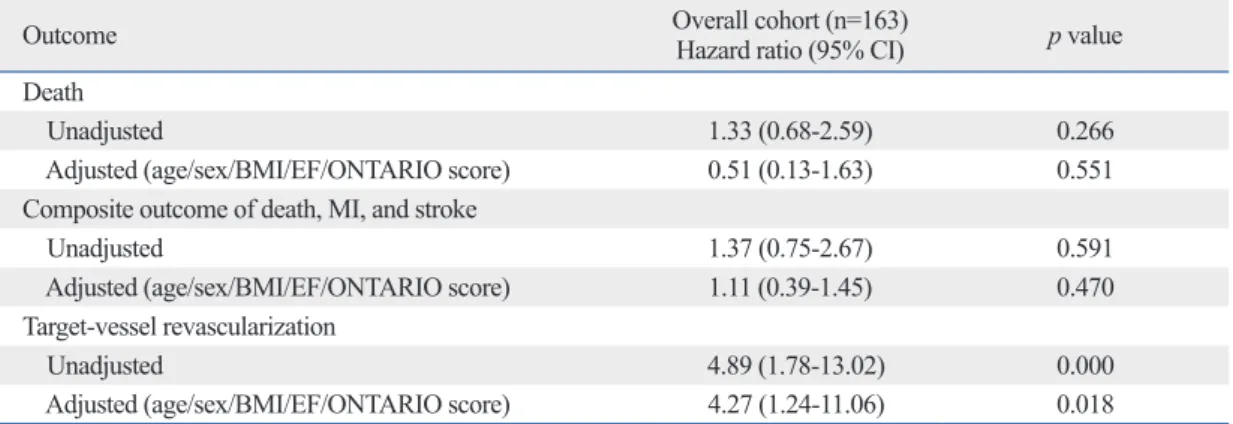
Table 5. Hazard Ratios for Clinical Outcomes after Stenting as Compared to after CABG
Outcome Overall cohort (n=163)
Hazard ratio (95% CI) p value
Death
Unadjusted 1.33 (0.68-2.59) 0.266
Adjusted (age/sex/BMI/EF/ONTARIO score) 0.51 (0.13-1.63) 0.551
Composite outcome of death, MI, and stroke
Unadjusted 1.37 (0.75-2.67) 0.591
Adjusted (age/sex/BMI/EF/ONTARIO score) 1.11 (0.39-1.45) 0.470
Target-vessel revascularization
Unadjusted 4.89 (1.78-13.02) 0.000
Adjusted (age/sex/BMI/EF/ONTARIO score) 4.27 (1.24-11.06) 0.018
CABG, coronary-artery bypass grafting; MI, myocardial infarction; BMI, body mass index; CI, confidence interval.
Values in parentheses are 95% CIs. CIs were estimated from Cox proportional-hazard regression with or without covariate adjustment.
hand, the rate of statins-treatment tended to be higher for the PCI group (51.2%) than for the CABG group (39.8%, p=0.39), and the rate of clopitogrel treatment was signifi- cantly higher for the PCI group (79.2%) than for the CABG group (17.8%, p<0.001).
DISCUSSION
During the in-hospital (up to 30-day) follow-up, DES im- plantation for diabetic patients with LMCA lesions was shown to be safe and was associated with a low rate of in- hospital events (including MACCER and AMI). Our long- term observations showed that the risks of death and serious outcomes (death, Q-wave MI, or stroke) were similar be- tween the PCI and CABG groups. In contrast, the rate of TVR was significantly higher in the PCI group than in the CABG group.
Recent observational studies have reported that patients undergoing CABG have a significantly higher 30-day mor- tality rate than those receiving PCI.19,20 Our observations here showed that the patients in the CABG group tended to have higher rates of MACCRE and AMI than CABG pa- tients. Ninety-four percent of the patients in our CABG group were found to have coronary stenosis involving more than one vessel in addition to the LMCA segment (p<0.05 v. PCI group), and the CABG group was found to have sig- nificantly lower Ontario scores and ejection fractions; these results were similar to those of previous studies.19-21 It is like- ly that the patients who underwent PCI were those for whom the surgical risk was considered prohibitive, or those who were candidates for CABG but in whom PCI was consid- ered feasible and relatively low-risk. Differences in the clini- cal baseline demographics as well as the extent of coronary stenosis might have caused the greater proportion of in-hos- pital events in the CABG group.
The assumption that CABG surgery is the best therapy for unprotected LMCA stenosis is based on the results of many historical studies performed two decades ago22 and on the disappointing results registered in early experience with PCI.23,24 Another large observational study, published before the development of the DES, suggested that patients with LMCA disease did significantly better with CABG than with PCI.25 Although this was a risk-adjusted analysis, patient-selection factors probably influenced the results. In contrast, favorable initial outcomes after LMCA interven- tion using DESs have been reported in select low-risk pa- the CABG group (hazard ratio, 4.89; 95% CI, 1.78-13.02;
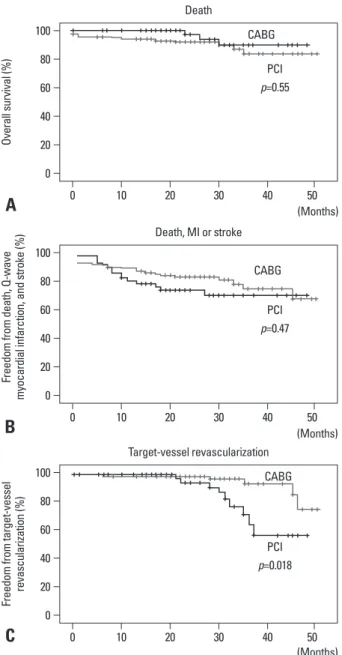
p<0.001). Following adjustment for age, sex, BMI, EF, and Ontario score, there was still no significant difference be- tween the PCI and CABG groups in terms of risk of death (hazard ratio for PCI group, 0.49; 95% CI, 0.13-1.63;
p=0.55) (Fig. 1A, Table 5) or risk of serious outcome (hazard ratio for PCI group, 1.11; 95% CI, 0.39-1.45; p=0.47) (Fig.
1B, Table 5). The rate of TVR was still significantly higher in the PCI group than in the CABG group (hazard ratio, 3.67;
95% CI, 1.24-11.06; p=0.018) (Fig. 1C, Table 5). On other
Fig. 1. Kaplan-Meier curves of the PCI (n=56) and the CABG (n=116) groups for death, composite risk of serious outcomes, and the rate of target-vessel revascularization (TVR). There were no differences in death and composite risk between the two groups (A and B), whereas the rate of TVR was high- er in the PCI group than in the CABG group (C). PCI, percutaneous coro- nary intervention; CABG, coronary-artery bypass grafting; MI, myocardial infarction.
A
0 20 40 60 80 100
Overall survival (%)
0 10 20 30 40 50
(Months) Death
CABG
PCI p=0.55
B
0 20 40 60 80 100
Freedom from death, Q-wave myocardial infarction, and stroke (%)
0 10 20 30 40 50
(Months) Death, MI or stroke
CABG
PCI p=0.47
C
0 20 40 60 80 100
Freedom from target-vessel revascularization (%)
0 10 20 30 40 50
(Months) Target-vessel revascularization
CABG
PCI p=0.018
cardiac and cerebrovascular event rate is higher among dia- betic patients with left main and/or 3-vessel disease treated with paclitaxel-eluting stents compared with CABG, due to the increase in repeat revascularization.39 We observed no increases in the risk of death or of composite serious out- comes. These findings suggest the early and long-term safe- ty and efficacy of stenting versus CABG for unprotected LMCA disease in patients with or without DM. This notion is further supported by a recent study showing that the ad- justed risks of death and of the composite (death, Q-wave MI, or stroke) were similar in diabetic patients who received DES and those who underwent CABG, and that diabetes had a minimal prognostic impact on the long-term treatment effects in patients who underwent DES or CABG.40 It should be noted that not only non-diabetic but also diabetic patients treated with DES show higher rates of TVR as compared to those treated with CABG. Effectiveness and durability are concerns related to stenting in coronary atherosclerotic ste- nosis, as is safety with regards to potential in-stent thrombo- sis in DES implantation. Although one angiographic study that lasted for up to four years suggested that DES implanta- tion has a low in-stent restenosis rate,41 most other studies have suggested that it has a high TVR rate,3,21 and it is not known whether PCI with DESs further increases the TVR rate. In CABG, the grafts usually bypass the proximal epi- cardial coronary segment, in which more obstructive lesions occur and progress;42 the alternative route provided by the surgery can perfuse the distal myocardial territory,8 thus pro- tecting, to some degree, against progressive atherosclerosis.
There are inherent limitations to our study. First, this was a single-center retrospective study; therefore, the results are not adequate to draw definite wide-ranging conclusions. Sec- ond, there were baseline clinical differences between the study groups, highlighting the inevitable bias related to pa- tient selection. This was similar to previous studies of clini- cal outcomes following CABG and PCI for LMCA steno-
sis.43,44 Patients who underwent CABG had more multi-
vessel lesions and a lower Ontario score and cardiac output, while patients who underwent PCI had a higher incidence of poorly controlled diabetes and a higher prevalence and family history of cardiovascular disease with previous cor- onary bypass grafting. Third, the number of study patients was too small to generalize our results to all diabetic pa- tients with LMCA lesions.
In conclusion, these results provide new information re- garding the safety and effectiveness of DES implantation in diabetic patients with LMCA lesions. These data highlight tients.26 DES implantation has recently been shown to be safe
with regard to acute and midterm complications and the pre- vention of restenosis in patients with unprotected LMCA ste- nosis.10 More recent observational studies have shown simi- lar mortality rates and similar risks of major cardiac and cerebrovascular events in both patients receiving DESs and those undergoing CABG.27,28 These studies have all been limited by a lack of consideration of coronary disease risk factors (including diabetes and hypertension), a limited du- ration of follow-up, and selective use of PCI in patients con- sidered to be poor candidates for CABG.
Despite endeavors to decrease in-stent restenosis after LMCA intervention with BMSs, such as by the use of ag- gressive debulking atherectomy, the restenosis rate remains high at 20% to 30%.26,29,30 Generally, before the development of the DES, BMS-related in-stent restenosis was widely rec- ognized as the most important reason for which bypass sur- gery was the first choice for treating LMCA stenosis. On the other hand, DES implantation for LMCA lesions has re- cently been shown to reduce rates of in-stent restenosis and the rates of target-vessel revascularization in LMCA lesions, or both.10,11 However, recent observational studies have re- ported that the restenosis rate with DESs was still higher in patients with DM than in those without DM.31 The FRE- DOM trial was designed to define the optimal revascular- ization strategy for diabetic patients with multi-vessel coro- nary disease.32 Here, we observed that the rate of TVR was higher in diabetic patients who underwent PCI than in pa- tients undergoing CABG, although we did not evaluate the impact of diabetic coronary risk factors on in-stent resteno- sis. Given the limitations in the trials to date and the inher- ent risk of DES restenosis, results from randomized trials are still needed to definitively establish the role of DES im- plantation in place of the reference treatment surgery for di- abetic patients with LMCA disease.
A number of single- and multi-center cohort studies have shown that DES stenting is similar to CABG for patients with unprotected LMCA disease in terms of short- and long- term mortality and rates of death, Q-wave MI, or stroke.33-36 Notably, Sheiban and other groups reported that EDS stents showed favorable early and long-term results in selected di- abetic and nondiabetic individuals undergoing PCI for un- protected LMCA disease.37,38 Furthermore, recent subgroup analyses by Banning and colleagues suggest that the com- posite safety end point (death/stroke/MI) is comparable be- tween the two treatment options for both diabetic and nondi- abetic patients, even though the one-year major adverse
11. Genuth S, Alberti KG, Bennett P, Buse J, Defronzo R, Kahn R, et al. Follow-up report on the diagnosis of diabetes mellitus. Diabe- tes Care 2003;26:3160-7.
12. Park SJ, Hong MK, Lee CW, Kim JJ, Song JK, Kang DH, et al.
Elective stenting of unprotected left main coronary artery stenosis:
effect of debulking before stenting and intravascular ultrasound guidance. J Am Coll Cardiol 2001;38:1054-60.
13. Park SJ, Lee CW, Kim YH, Lee JH, Hong MK, Kim JJ, et al.
Technical feasibility, safety, and clinical outcome of stenting of unprotected left main coronary artery bifurcation narrowing. Am J Cardiol 2002;90:374-8.
14. Eagle KA, Guyton RA, Davidoff R, Edwards FH, Ewy GA, Gard- ner TJ, et al. ACC/AHA 2004 guideline update for coronary artery bypass graft surgery: summary article. A report of the American College of Cardiology/American Heart Association Task Force on Practice Guidelines (Committee to Update the 1999 Guidelines for Coronary Artery Bypass Graft Surgery). J Am Coll Cardiol 2004;44:e213-310.
15. Wang ZJ, Zhou YJ, Liu YY, Yu M, Shi DM, Zhao YX, et al. Obe- sity and cardiovascular thrombotic events in patients undergoing percutaneous coronary intervention with drug-eluting stents. Heart 2009;95:1587-92.
16. Biondi-Zoccai GG, Giraudi E, Moretti C, Sciuto F, Omedè P, Sil- lano D, et al. Impact of routine angiographic follow-up after per- cutaneous coronary drug-eluting stenting for unprotected left main disease: the Turin Registry. Clin Res Cardiol 2010;99:235-42.
17. Tu JV, Jaglal SB, Naylor CD. Multicenter validation of a risk in- dex for mortality, intensive care unit stay, and overall hospital length of stay after cardiac surgery. Steering Committee of the Provincial Adult Cardiac Care Network of Ontario. Circulation 1995;91:677-84.
18. Hirashiki A, Izawa H, Cheng XW, Unno K, Ohshima S, Murohara T. Dobutamine-induced mechanical alternans is a marker of poor prognosis in idiopathic dilated cardiomyopathy. Clin Exp Pharma- col Physiol 2010;37:1004-9.
19. Cheng CI, Lee FY, Chang JP, Hsueh SK, Hsieh YK, Fang CY, et al. Long-term outcomes of intervention for unprotected left main coronary artery stenosis: coronary stenting vs coronary artery by- pass grafting. Circ J 2009;73:705-12.
20. Dubois C, Dens J, Sinnaeve P, Belmans A, Van Cleemput J, Men- dez M, et al. Results of percutaneous coronary intervention of the unprotected left main coronary artery in 143 patients and compari- son of 30-day mortality to results of coronary artery bypass graft- ing. Am J Cardiol 2008;101:75-81.
21. Seung KB, Park DW, Kim YH, Lee SW, Lee CW, Hong MK, et al. Stents versus coronary-artery bypass grafting for left main cor- onary artery disease. N Engl J Med 2008;358:1781-92.
22. Chaitman BR, Fisher LD, Bourassa MG, Davis K, Rogers WJ, Maynard C, et al. Effect of coronary bypass surgery on survival patterns in subsets of patients with left main coronary artery dis- ease. Report of the Collaborative Study in Coronary Artery Sur- gery (CASS). Am J Cardiol 1981;48:765-77.
23. Eldar M, Schulhoff N, Herz I, Frankel R, Feld H, Shani J. Results of percutaneous transluminal angioplasty of the left main coronary artery. Am J Cardiol 1991;68:255-6.
24. O’Keefe JH Jr, Hartzler GO, Rutherford BD, McConahay DR, Johnson WL, Giorgi LV, et al. Left main coronary angioplasty:
early and late results of 127 acute and elective procedures. Am J Cardiol 1989;64:144-7.
25. Dzavik V, Ghali WA, Norris C, Mitchell LB, Koshal A, Saunders
the need for a large, long-term, multi-center randomized study comparing DES implantation and bypass surgery in diabetic patients with LMCA disease.
ACKNOWLEDGEMENTS
This work was supported in part by grants from the Nation- al Natural Science Foundation of China (no. 30960128).
REFERENCES
1. Caracciolo EA, Davis KB, Sopko G, Kaiser GC, Corley SD, Schaff H, et al. Comparison of surgical and medical group surviv- al in patients with left main equivalent coronary artery disease.
Long-term CASS experience. Circulation 1995;91:2335-44.
2. Eagle KA, Guyton RA, Davidoff R, Edwards FH, Ewy GA, Gard- ner TJ, et al. ACC/AHA 2004 guideline update for coronary artery bypass graft surgery: a report of the American College of Cardiol- ogy/American Heart Association Task Force on Practice Guide- lines (Committee to Update the 1999 Guidelines for Coronary Ar- tery Bypass Graft Surgery). Circulation 2004;110:e340-437.
3. Colombo A, Chieffo A. Drug-eluting stent update 2007: part III:
technique and unapproved/unsettled indications (left main, bifur- cations, chronic total occlusions, small vessels and long lesions, saphenous vein grafts, acute myocardial infarctions, and multives- sel disease). Circulation 2007;116:1424-32.
4. Serruys PW, Morice MC, Kappetein AP, Colombo A, Holmes DR, Mack MJ, et al. Percutaneous coronary intervention versus coronary-artery bypass grafting for severe coronary artery disease.
N Engl J Med 2009;360:961-72.
5. Bottner RK, Klein LW; Inverventional Committee of The Society for Cardiovascular Angiography and Interventions. Do the current ACC/AHA guidelines correctly reflect the attitudes and utilization of PCI in patients with unprotected left main coronary artery ste- nosis? Catheter Cardiovasc Interv 2005;64:402-5.
6. Kannel WB, McGee DL. Diabetes and glucose tolerance as risk factors for cardiovascular disease: the Framingham study. Diabe- tes Care 1979;2:120-6.
7. Stamler J, Vaccaro O, Neaton JD, Wentworth D. Diabetes, other risk factors, and 12-yr cardiovascular mortality for men screened in the Multiple Risk Factor Intervention Trial. Diabetes Care 1993;16:434-44.
8. Stein B, Weintraub WS, Gebhart SP, Cohen-Bernstein CL, Gross- wald R, Liberman HA, et al. Influence of diabetes mellitus on ear- ly and late outcome after percutaneous transluminal coronary an- gioplasty. Circulation 1995;91:979-89.
9. Van Belle E, Ketelers R, Bauters C, Périé M, Abolmaali K, Rich- ard F, et al. Patency of percutaneous transluminal coronary angio- plasty sites at 6-month angiographic follow-up: a key determinant of survival in diabetics after coronary balloon angioplasty. Circu- lation 2001;103:1218-24.
10. Park SJ, Kim YH, Lee BK, Lee SW, Lee CW, Hong MK, et al. Si- rolimus-eluting stent implantation for unprotected left main coro- nary artery stenosis: comparison with bare metal stent implanta- tion. J Am Coll Cardiol 2005;45:351-6.
35. Morice MC, Serruys PW, Kappetein AP, Feldman TE, Ståhle E, Colombo A, et al. Outcomes in patients with de novo left main disease treated with either percutaneous coronary intervention us- ing paclitaxel-eluting stents or coronary artery bypass graft treat- ment in the Synergy Between Percutaneous Coronary Intervention with TAXUS and Cardiac Surgery (SYNTAX) trial. Circulation 2010;121:2645-53.
36. Kim YH, Park DW, Kim WJ, Lee JY, Yun SC, Kang SJ, et al. Im- pact of the extent of coronary artery disease on outcomes after re- vascularization for unprotected left main coronary artery stenosis.
J Am Coll Cardiol 2010;55:2544-52.
37. Sheiban I, Garrone P, Sillano D, Biondi-Zoccai G, Sciuto F, Omedè P, et al. Impact of diabetes mellitus on early and long-term results of percutaneous drug-eluting stent implantation for unpro- tected left main coronary disease. J Cardiovasc Med (Hagerstown) 2008;9:1246-53.
38. Meliga E, Garcia-Garcia HM, Valgimigli M, Chieffo A, Biondi- Zoccai G, Maree AO, et al. Diabetic patients treated for unprotected left main coronary artery disease with drug eluting stents: a 3-year clinical outcome study. The diabetes and drug eluting stent for LeFT main registry (D-DELFT). EuroIntervention 2008;4:77-83.
39. Banning AP, Westaby S, Morice MC, Kappetein AP, Mohr FW, Berti S, et al. Diabetic and nondiabetic patients with left main and/
or 3-vessel coronary artery disease: comparison of outcomes with cardiac surgery and paclitaxel-eluting stents. J Am Coll Cardiol 2010;55:1067-75.
40. Kim WJ, Park DW, Yun SC, Lee JY, Lee SW, Kim YH, et al. Im- pact of diabetes mellitus on the treatment effect of percutaneous or surgical revascularization for patients with unprotected left main coronary artery disease: a subgroup analysis of the MAIN-COM- PARE study. JACC Cardiovasc Interv 2009;2:956-63.
41. Sousa JE, Costa MA, Abizaid A, Feres F, Seixas AC, Tanajura LF, et al. Four-year angiographic and intravascular ultrasound follow- up of patients treated with sirolimus-eluting stents. Circulation 2005;111:2326-9.
42. Kuntz RE. Importance of considering atherosclerosis progression when choosing a coronary revascularization strategy: the diabetes- percutaneous transluminal coronary angioplasty dilemma. Circu- lation 1999;99:847-51.
43. Lee MS, Kapoor N, Jamal F, Czer L, Aragon J, Forrester J, et al.
Comparison of coronary artery bypass surgery with percutaneous coronary intervention with drug-eluting stents for unprotected left main coronary artery disease. J Am Coll Cardiol 2006;47:864-70.
44. Chieffo A, Morici N, Maisano F, Bonizzoni E, Cosgrave J, Mon- torfano M, et al. Percutaneous treatment with drug-eluting stent implantation versus bypass surgery for unprotected left main ste- nosis: a single-center experience. Circulation 2006;113:2542-7.
LD, et al. Long-term survival in 11,661 patients with multivessel coronary artery disease in the era of stenting: a report from the Al- berta Provincial Project for Outcome Assessment in Coronary Heart Disease (APPROACH) Investigators. Am Heart J 2001;142:
119-26.
26. Takagi T, Stankovic G, Finci L, Toutouzas K, Chieffo A, Spanos V, et al. Results and long-term predictors of adverse clinical events after elective percutaneous interventions on unprotected left main coronary artery. Circulation 2002;106:698-702.
27. Sanmartin M, Baz JA, Claro R, Asorey V, Durán D, Pradas G, et al. Comparison of drug-eluting stents versus surgery for unpro- tected left main coronary artery disease. Am J Cardiol 2007;100:
970-3.
28. Brener SJ, Galla JM, Bryant R 3rd, Sabik JF 3rd, Ellis SG. Com- parison of percutaneous versus surgical revascularization of severe unprotected left main coronary stenosis in matched patients. Am J Cardiol 2008;101:169-72.
29. Silvestri M, Barragan P, Sainsous J, Bayet G, Simeoni JB, Roque- bert PO, et al. Unprotected left main coronary artery stenting: im- mediate and medium-term outcomes of 140 elective procedures. J Am Coll Cardiol 2000;35:1543-50.
30. Hu FB, Tamai H, Kosuga K, Kyo E, Hata T, Okada M, et al. Intra- vascular ultrasound-guided directional coronary atherectomy for unprotected left main coronary stenoses with distal bifurcation in- volvement. Am J Cardiol 2003;92:936-40.
31. Fröbert O, Lagerqvist B, Carlsson J, Lindbäck J, Stenestrand U, James SK. Differences in restenosis rate with different drug-elut- ing stents in patients with and without diabetes mellitus: a report from the SCAAR (Swedish Angiography and Angioplasty Regis- try). J Am Coll Cardiol 2009;53:1660-7.
32. Farkouh ME, Dangas G, Leon MB, Smith C, Nesto R, Buse JB, et al. Design of the Future REvascularization Evaluation in patients with Diabetes mellitus: optimal management of Multivessel dis- ease (FREEDOM) Trial. Am Heart J 2008;155:215-23.
33. Park DW, Seung KB, Kim YH, Lee JY, Kim WJ, Kang SJ, et al.
Long-term safety and efficacy of stenting versus coronary artery bypass grafting for unprotected left main coronary artery disease:
5-year results from the MAIN-COMPARE (Revascularization for Unprotected Left Main Coronary Artery Stenosis: Comparison of Percutaneous Coronary Angioplasty Versus Surgical Revascular- ization) registry. J Am Coll Cardiol 2010;56:117-24.
34. Park DW, Kim YH, Yun SC, Lee JY, Kim WJ, Kang SJ, et al.
Long-term outcomes after stenting versus coronary artery bypass grafting for unprotected left main coronary artery disease: 10-year results of bare-metal stents and 5-year results of drug-eluting stents from the ASAN-MAIN (ASAN Medical Center-Left MAIN Revascularization) Registry. J Am Coll Cardiol 2010;56:1366-75.