Yonsei Medical Journal
Vol. 47, No. 6, pp. 870 - 872, 2006
Yonsei Med J Vol. 47, No. 6, 2006
Clear cell basal cell carcinoma (BCC) is a variant of BCC with a characteristic clear cell component that may occupy all or part of the tumor islands. Periodic acid-Schiff (PAS) staining for glycogen is variably positive, and mild deposition of sulfated mucin has been noted. However, to our knowledge, clear cell BCC with sialomucin deposition has not been re- ported. Here we report a case of clear cell BCC showing sialo- mucin deposition. The clear tumor cells stained with PAS and showed incomplete diastase-resistance. In addition, mucin stain- ing with alcian blue was positive at pH 2.5 but not at pH 0.5.
Key Words: Basal cell carcinoma, sialomucins
INTRODUCTION
Basal cell carcinomas (BCCs) have several his- tological variants which may be due, in part, to the pluripotential capacity of the primary epi- thelial germ to differentiate in different directions, and to the different responses of the stroma to these tumors.
1Clear cell BCC is a variant of BCC with a characteristic clear cell component that may occupy all or part of the tumor islands;
however, the basis for this unusual histological variant has not been elucidated.
2The affected cells are round to polyhedral in shape, with pale, eosinophilic, vacuolated, or finely granular cyto- plasm.
3Periodic acid-Schiff (PAS) staining for gly- cogen is variably positive, and mild deposition of sulfated mucin has been noted.
2,3However, to our knowledge, clear cell BCC with sialomucin depo- sition has not been reported. Here, we report a
case of clear cell BCC showing sialomucin deposi- tion.
CASE REPORT
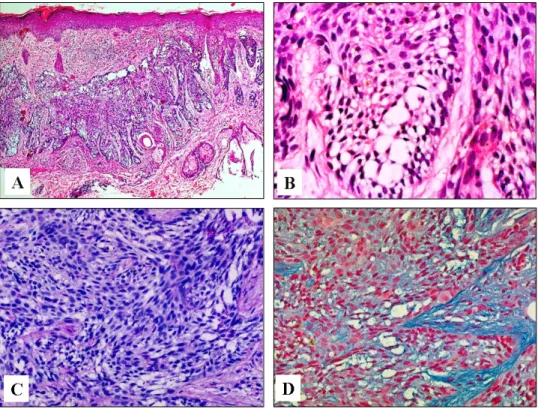
An 83-year-old Korean woman presented to our clinic with a slowly enlarging cutaneous lesion in the right infraorbital area that was first noticed three years earlier. The lesion was depressed with crusts and marginal infiltration and was about 2.0 cm in diameter (Fig. 1). A punch biopsy of the tumor was performed, and the pathologic examination showed that the tumor lobules were composed of irregularly arranged, atypical-appearing basaloid cells with portions of peripheral palisading. Vacuolated cells were distributed across a fairly large area within the lobules (Fig. 2A). The vacuoles varied in size and number, and often occupied the entire cytoplasm (Fig. 2B). The nuclei of the vacuolated cells were deformed and displaced to one side of the cells. Neither mitotic activity nor necrosis was observed. The clear tumor cells were stained with PAS, and showed incomplete diastase-resistance (Fig. 2C). Mucin staining with alcian blue of the tumor cells was positive at pH 2.5 but not at pH 0.5 (Fig. 2D). The stroma surrounding the tumor lobules stained with alcian blue at pH 0.5 and it stained more deeply than the tumor cells at pH 2.5. Immunohistochemically, the tumor cells were negative for both epithelial membrane antigen (EMA) and carcinoembryonic antigen (CEA). A pathologic diagnosis of clear cell BCC with sialomucin deposition was established, and the tumor was removed by Mohs micrographic surgery.
Clear Cell Basal Cell Carcinoma with Sialomucin Deposition
Do Young Kim,
1Sung Bin Cho,
1Kee Yang Chung,
1and You Chan Kim
21
Department of Dermatology and Cutaneous Biology Research Institute, Yonsei University College of Medicine, Seoul, Korea;
2