http://dx.doi.org/10.20307/nps.2016.22.1.13
13
Anti-osteoporotic and Antioxidant Activities by Rhizomes of Kaempferia parviflora Wall. ex Baker
Nguyen Phuong Thao
1, 2, Bui Thi Thuy Luyen
1, Sang Hyun Lee
3, Hae Dong Jang
3,*, and Young Ho Kim
1,*
1
College of Pharmacy, Chungnam National University, Daejeon 305-764, Republic of Korea
2
Institute of Marine Biochemistry (IMBC), Vietnam Academy of Science and Technology (VAST), 18 Hoang Quoc Viet, Cau Giay, Hanoi, Vietnam
3
Department of Food and Nutrition, Hannam University, Daejeon 305-811, Republic of Korea
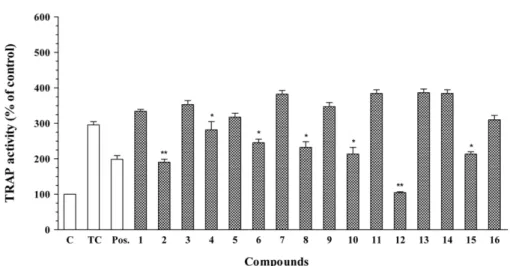
Abstract − In this report, we investigated the antioxidant (peroxyl radical-scavenging and reducing capacities) and anti-osteoporotic activities of extracts and isolated constituents (1 - 16) from the rhizomes of Kaempferia parviflora Wall. ex Baker on pre-osteoclastic RAW 264.7 cells. Compound 5 exhibited significant peroxyl radical- scavenging capacity, with TE value of 8.47 ± 0.52 µM, while compound 13 showed significant reducing capacity, with CUPRAC value of 5.66 ± 0.26 µM, at 10.0 µM. In addition, flavonoid compounds 2, 4, 6, 8, 10, 12, and terpene compound 15 showed significant inhibition of tartrate-resistant acid phosphatase (TRAP) in NF-κB ligand-induced osteoclastic RAW 264.7 cells, with values ranging from 16.97 ± 1.02 to 64.67 ± 2.76%. These results indicated that K. parviflora could be excellent sources for the antioxidant and anti-osteoporotic traditional medicinal plants.
Keywords − Kaempferia parviflora, Zingiberaceae, Antioxidant, Anti-osteoporosis, TRAP
Introduction
Natural antioxidant compounds have numerous beneficial health effects. Previous studies suggested that antioxidants reduce the risk of chronic diseases, including cancer and heart diseases, as well as cardiovascular and cerebrovas- cular events. Several antioxidants have been reported including anthocyanins, flavonoids, phenolic acids, and tanins.
1These compounds act as radical scavengers, hydrogen donors, electron donors, and metal-chelating agents that can detoxify reactive oxygen species (ROS) and reduce ROS induced damage. Antioxidant activity is generally due to the trapping of free radicals.
2In addition, antioxidant systems play important roles in the develop- ment of osteoporosis. Evolving evidence suggests that ROS are involved in osteogenesis, including bone formation and resorption, which are associated with the aging process and may lead to osteoporosis. Osteoporosis is a family of disorders in which systemic bone mass is reduced and the
patient is at risk of spontaneous fracture. Bone develop- ment is a normal process that involves the resorption of bone by osteoclasts and the synthesis of bone matrix by osteoblasts.
3Kaempferia parviflora Wall ex. Baker (Black galingale), known locally in Thai as Kra-Chai-Dam, is an herbaceous plant in the Zingiberaceae. Traditionally, its black to purple rhizomes are used in local food as a flavoring agent and as a traditional medicinal plant for the treatment of a wide spectrum of illnesses. Since ancient times, it has traditionally been used as a health-promoting and vitalizing agent, and a folk medicine to lower blood glucose levels, improve blood flow, and increase vitality.
4The effects of K. parviflora rhizomes on male sexual function have also been promoted. Several studies have examined the chemical constituents of K. parviflora and their biological activities.
Flavonoids, attached with many methoxyl groups, are demonstrated as the major constituents,
5along with chalcone derivatives, related phenolic compounds, and kaempferiaosides.
6Recently, extracts of this plant and compounds isolated from them, including flavonoids have been reported to exert various pharmacological activities, such as inhibition of α-glucosidase,
7cholinesterase,
8P- glycoprotein,
9and NO production,
10as well as the ability to reduce obesity,
11inflammatory,
12allergic,
13and convul-
*Author for correspondence
Prof. Young Ho Kim, College of Pharmacy, Chungnam National University, Daejeon 305-764, Korea
Tel: +82-42-821-5933; E-mail: [email protected]
Prof. Hae Dong Jang, Department of Food and Nutrition, Hannam University, Daejeon 305-811, Korea
Tel: +82-42-629-8805; E-mail: [email protected]
sions,
14and treatment of plasmodial, fungal, and myco- bacterial infections.
4K. parviflora extracts have also been shown to modulate the function of multidrug resistance associated-proteins,
15and induce cytotoxicity in various cancer cell lines.
16In our screening study of medicinal plants on antioxi- dant and anti-osteoporotis activities, the methanolic extract of K. parviflora exhibited significant antioxidant and anti- osteoporosis properties. This study details anti-oxidative evaluation of extracts and constituents isolated from K.
parviflora (1 - 16, see Fig. 1) determined using the oxygen radical absorbance capacity (ORAC) and cupric ion reducing antioxidant capacity (CUPRAC) assays. In addition, the anti-osteoporosis activity of these compounds were evaluated through their inhibitory effects on the osteoclast differen- tiation from RAW 264.7 pre-osteoclast cells.
Experimental
Plant material − The rhizomes of Kaempferia parviflora Wall. Ex Baker were kindly provided from Ok Nam Kim, which was purchased from a local shop, Laos, in 2014, and identified by Prof. Young Ho Kim, College of Pharmacy, Chungnam National University. A voucher specimen (CNU-14110) was deposited at the Herbarium
of the College of Pharmacy, Chungnam National University, Republic of Korea.
Compounds − From the methanolic extracts of the rhizomes of K. parviflora sixteen compounds (1 - 16) were isolated and structurally elucidated. Stock solutions of tested compounds in DMSO were prepared, kept at −20
o