추출용매별 귀리의 항산화 및 암세포 증식 억제 활성
⁃연구노트⁃
함현미1․우관식1․박지영1․이병원1․최용환1․이춘우1․김욱한1․이준수2․이유영1
1농촌진흥청 국립식량과학원 중부작물부
2충북대학교 식품생명공학과
Antioxidant and Anti-Proliferative Activities of Oats under Different Solvent Extraction Conditions
Hyeonmi Ham1, Koan Sik Woo1, Ji-Young Park1, Byongwon Lee1, Yong-Hwan Choi1, Choonwoo Lee1, Wook Han Kim1, Junsoo Lee2, and Yu-Young Lee1
1Department of Central Area, National Institute of Crop Science, Rural Development Administration
2Department of Food Science and Biotechnology, Chungbuk National University
ABSTRACT The objective of this study was to determine the antioxidant and anti-proliferative activities of methanol, ethanol, acetone, and ethyl acetate extracts from oats (Avena sativa L.). Total polyphenol contents of extracts were analyzed by Folin-Ciocalteu assay. The antioxidant activities of extracts were determined by 2,2-azino-bis-(3-ethylbenzo- thiazoline-6-sulphonic acid) (ABTS) and 1,1-diphenyl-2-picrylhydrazyl (DPPH) radical scavenging activities and re- ducing power. The anti-proliferative activities of colon (HCT116), lung (NCI-H460), and breast (MCF7) cancer cells were investigated. Among solvents, methanol extract showed the highest amount of total polyphenols, which was 8.2 mg gallic acid equivalents/g residue. High levels of ABTS radical [12.1 mg Trolox equivalent antioxidant capacity (TEAC)/g residue] and DPPH radical (4.4 mg TEAC/g residue) scavenging activity and reducing power (A700=0.39) were found in methanol extracts. Moreover, methanol extracts indicated higher anti-proliferative activities against HCT116 (69.5%), NCI-H460 (75.2%), and MCF7 (84.8%) cells compared with other extracts. The results show that methanol was the best solvent for extraction of antioxidant and anti-proliferative compounds from oats. Moreover, notable antioxidant and anti-proliferative activities of oats could have significant health benefits.
Key words: oat, polyphenolics, antioxidant, antiproliferation
Received 22 February 2016; Accepted 20 April 2016
Corresponding author: Yu-Young Lee, Department of Central Area, National Institute of Crop Science, Rural Development Administra- tion, Suwon, Gyeonggi 16613, Korea
E-mail: [email protected], Phone: +82-31-695-0621
서 론
최근 경제성장에 따른 소득 수준의 증가와 가공식품, 외 식의 증가에 따른 식생활의 변화 및 생활양식의 변화 등으로 비만, 당뇨병, 고혈압, 동맥경화, 암 등과 같은 성인병 발생 이 증가하고 생활 수준의 향상으로 건강에 대한 관심이 높아 지고 있다(1). 특히 암은 전 세계적으로 인간의 건강과 생명 을 위협하는 주요 원인 중 하나로 지목되고 있으며 암으로 인한 사망 빈도는 통계학적으로 매년 증가하는 추세를 보인 다(2). 최근 미국 암 협회(American Cancer Society)에서 발간한 세계 암 현황 및 전망(Global cancer facts & fig- ures, 3rd edition) 보고서에 따르면 2012년 한 해 동안 전 세계에서는 1,410만 명이 새로 암에 걸렸으며 암으로 인한 사망자 수가 820만 명에 이를 것으로 추정하였다(3). 국내
에서도 암으로 인한 사망률이 매년 높아지고 있으며, 질병으 로 인한 사망 원인 중 1위를 차지하는 주요 질환이다(2,4).
이러한 암을 비롯한 대부분 현대인의 질병은 과잉으로 생성 된 활성산소종(reactive oxygen species)에 의한 산화적 스트레스에 기인하는 것으로 보고되어 있다(5,6). 따라서 과 잉 생성된 활성산소종의 제거 및 생체 내 산화적 스트레스에 대한 방어 시스템의 증진에 대한 관심이 높아지고 있으며 부작용이 적으면서 항암 효능이 높은 천연소재에 대한 연구 가 활발하게 진행되고 있다(7).
귀리(Avena sativa L.)는 벼과(Gramineae)에 속하는 곡 류로 오래전부터 오트밀 형태의 식품으로 섭취됐다. 귀리는 쌀과 밀에 비해 소비가 적지만 단백질과 지질이 풍부하고 필수 아미노산이 균형 있게 함유되어 있으며 2~6%의 β- glucan이 함유되어 식품학적으로 가치가 높은 작물로 인식 되고 있다(8,9). 귀리에는 곡류 중 특이적으로 귀리에만 존 재하는 phenolic amide인 avenanthramides가 존재하는 것으로 알려져 있으며 이는 항산화, 항염증 및 항증식 활성 을 가진다고 보고되어 있다(10). 최근 귀리의 기능성과 관련 하여 많은 연구가 이루어지고 있으며, 특히 체내 콜레스테롤
함량을 저하시켜 성인병 예방에 효과가 있는 것으로 보고되 어 있다(11,12). 또한, 항산화 활성과 당뇨병 및 비만 예방 등 다양한 생리활성을 가지는 것으로 알려져 있다(13-16).
이처럼 귀리는 높은 영양학적 가치와 식품 소재로서의 가치 를 지니고 있으며 건강에 대한 소비자의 관심 증가로 인해 수요가 증가하고 있다. 하지만 국내 육성 귀리의 암세포 증 식 억제 활성 등 생리활성을 비교한 연구는 미비한 실정이 다. 따라서 본 연구에서는 귀리 용매 추출물의 항산화 성분 과 활성 및 암세포 증식 억제 활성을 비교 분석함으로써 귀 리의 이용성 증진을 위한 기초자료를 제공하고자 하였다.
재료 및 방법
재료 및 시약
본 연구에 사용된 귀리는 2014년 경기 수원 소재의 국립 식량과학원에서 생산된 조양 품종을 사용하였다. 항산화 성 분 분석에 사용된 gallic acid, Folin-Ciocalteu reagent, sodium carbonate와 항산화 활성 측정에 사용된 Trolox, 2,2-azino-bis(3-ethylbenzothiazoline-6-sulphonic acid)(ABTS), 1,1-diphenyl-2-picrylhydrazyl(DPPH), po- tassium persulfate, potassium ferricyanide, trichloro- acetic acid, ferric chloride, dimethyl sulfoxide(DMSO) 등은 Sigma-Aldrich Co.(St. Louis, MO, USA)에서 구입하 여 사용하였다. 암세포 증식 억제 활성 측정에 사용된 fetal bovine serum(FBS), trypsin 및 RPMI 1640 배지는 Cais- son Laboratories(North Logan, UT, USA) 제품을 사용하 였다. 그 밖에 사용된 추출용매 및 시약은 analytical 및 HPLC 등급을 사용하였다.
추출물의 제조
시료는 Vibrating sample mill(CMT Co. Ltd., Tokyo, Japan)을 이용하여 분쇄하였으며, 분쇄된 시료 25 g에 me- thanol, ethanol, acetone 및 ethyl acetate 300 mL를 각각 가한 후 상온에서 24시간 교반하면서 추출하였다. 추출 후 고형분은 Whatman No. 2 filter paper(Whatman Interna- tional Limited, Kent, UK)를 이용하여 분리하였고 용매는 감압 농축기(N-1000, EYELA, Tokyo, Japan)를 이용하여 완전히 제거하였다. 추출 수율을 측정한 후 잔사는 DMSO로 재용해하였다. 각 추출물은 질소 충진 후 -20°C에서 보관하 면서 실험에 사용하였다.
총폴리페놀 함량 측정
총폴리페놀 함량은 Folin-Ciocalteu phenol reagent가 추출물의 폴리페놀 화합물에 의해 환원된 결과 몰리브덴 청 색으로 발색하는 것을 원리로 하여 측정하였다(17). 각 추출 물 100 μL에 2% Na2CO3 용액 2 mL를 가하고 3분 방치한 후 50% Folin-Ciocalteu's reagent 100 μL를 가하였다.
3분 반응 후 반응액의 흡광도를 750 nm에서 측정하였고
표준물질로 0.1% gallic acid를 사용하였으며, mg gallic acid equivalent(GAE)/g residue로 나타내었다.
ABTS 라디칼 제거능
ABTS 라디칼 제거능은 Re 등(18)의 방법을 변형하여 측 정하였다. ABTS 7.4 mM과 potassium persulfate 2.6 mM 을 하루 동안 암소에 방치하여 ABTS 라디칼을 형성시킨 후 이 용액을 734 nm에서 흡광도 값이 1.0이 되도록 몰 흡광 계수(ε=3.6×10⁴ M-1cm-1)를 이용하여 증류수로 희석하였 다. 희석된 ABTS 라디칼 용액 1 mL에 추출물 50 μL를 가하 여 60분 후에 734 nm에서 흡광도를 측정하였다. Trolox를 이용하여 표준곡선을 작성한 후 시료의 항산화력(Trolox equivalent antioxidant capacity, TEAC)을 계산하였으며, mg TEAC/g residue로 나타내었다.
DPPH 라디칼 제거능
DPPH 라디칼 제거능은 0.2 mM DPPH 용액 1 mL에 추 출물 50 μL를 가하고 30분 후에 흡광도의 변화를 520 nm에 서 측정하였다(19). DPPH 라디칼 제거능은 Trolox를 이용 하여 표준곡선을 작성한 후 시료의 항산화력(TEAC)을 계산 하였으며, mg TEAC/g residue로 나타내었다.
환원력
환원력은 Oyaizu(20)의 방법을 응용하여 측정하였다. 추 출물 250 μL에 200 mM sodium phosphate buffer(pH 6.6) 250 μL, 1%(w/v) potassium ferricyanide 250 μL를 혼합하여 50°C에서 20분 동안 반응시킨 후 10%(w/v) tri- chloroacetic acid 250 μL를 가하였다. 위 반응액을 10,000 rpm에서 10분 동안 원심분리 하여 상등액 500 μL에 증류수 500 μL를 혼합하고, 0.1%(w/v) ferric chloride 100 μL를 가하여 700 nm에서 반응액의 흡광도를 측정하였다. 반응액 은 Fe3+과 Fe2+ 간의 상호 전환으로 청록색을 나타내며 흡 광도 값이 클수록 높은 환원력을 의미한다.
암세포 증식 억제 활성 측정
암세포주(HCT116, 대장암; NCI-H460, 폐암; MCF7, 유 방암)에 대한 추출물의 증식 억제 효과는 colorimetric as- say인 3-(4,5-dimethylthiazol-2-yl)-2,5-diphenyltetra- zolium bromide(MTT) 방법을 이용하여 측정하였다(21).
각각의 암세포는 10% FBS, 100 unit/mL penicillin, 100 μg/mL streptomycin을 함유한 RPMI 1640 배지에서 37
°C, 5% CO2 조건으로 배양하였다. 배양된 암세포는 5.0×
103 cells/well의 농도로 96-well plate에 분주하고 24시간 배양하였다. 배지를 제거하고 추출물을 24시간 처리한 후 0.5 mg/mL MTT 용액을 각 well에 첨가하였다. 4시간 후 생성된 formazan product를 DMSO에 재용해한 다음 mi- croplate reader를 사용하여 550 nm에서 흡광도를 측정하 였다.
Table 1. Total polyphenol contents of the extracts from the oat and extraction yields
Extract Polyphenol1)
(mg GAE/g residue) Yield (%) Methanol
Ethanol Acetone Ethyl acetate
8.2±0.5a2) 2.8±0.6b 0.6±0.4c 1.3±0.6c
5.9 5.6 6.6 5.8
1)Mean of triplicate determinations±standard deviation (SD) ex- pressed as mg gallic acid equivalents per g of residue.
2)Different letters within a column indicate significant differ- ences at P<0.05 by Duncan's multiple range test.
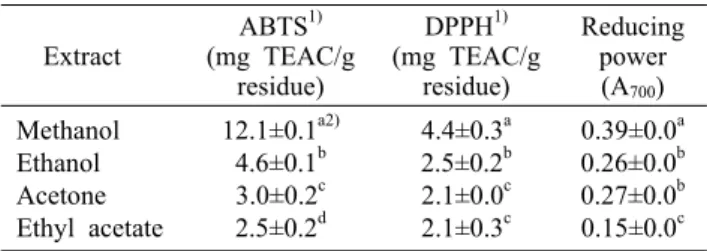
Table 2. Antioxidant activities of the extracts from the oat Extract ABTS1)
(mg TEAC/g residue)
DPPH1) (mg TEAC/g
residue)
Reducing power (A700) Methanol
Ethanol Acetone Ethyl acetate
12.1±0.1a2) 4.6±0.1b 3.0±0.2c 2.5±0.2d
4.4±0.3a 2.5±0.2b 2.1±0.0c 2.1±0.3c
0.39±0.0a 0.26±0.0b 0.27±0.0b 0.15±0.0c
1)Mean of triplicate determinations±standard deviation (SD) ex- pressed as mg Trolox equivalents per g of residue.
2)Different letters within a column indicate significant differ- ences at P<0.05 by Duncan's multiple range test.
통계분석
모든 실험 결과는 평균±표준편차로 나타내었으며, 결과 에 대한 유의성 검정은 SAS version 9.2(Statistical Anal- ysis System, SAS Institute Inc., Cary, NC, USA)를 이용 하여 ANOVA 분석 후 Duncan's multiple range test를 이 용하여 P<0.05 수준에서 유의성을 검정하였다.
결과 및 고찰
귀리 추출물의 총폴리페놀 함량
추출용매에 따라 수율 차이가 나타나며 항산화 활성 등 기타 생리활성에서도 차이가 발생함이 보고되어 있다(22).
따라서 본 연구에서는 추출용매로 널리 사용되고 있는 meth- anol, ethanol, acetone 및 ethyl acetate를 이용하여 각 추출용매에 따른 수율 및 생리활성의 차이를 비교 분석하고 자 하였다. 용매별 귀리 추출물의 수율은 Table 1에 나타내 었으며 acetone 추출물이 6.6%로 가장 높게 나타났고 eth- anol 추출물이 5.6%로 가장 낮게 나타났다. 추출용매별 귀 리의 총폴리페놀(mg GAE/g residue) 함량은 Table 1에 나타내었다. Methanol 추출물이 8.2 mg GAE/g residue로 가장 높은 총폴리페놀 함량을 보였으며, ethanol 추출물 2.8 mg GAE/g residue, ethyl acetate 추출물 1.3 mg GAE/g residue, acetone 추출물 0.6 mg GAE/g residue의 순서로 나타났다. 폴리페놀 화합물은 곡류에 함유된 주요 항산화 성분 중 하나로 항산화, 심혈관계 질환, 암 등에 효과가 있는 것으로 보고되어 있다(23,24). Choupani 등(25)은 추출용 매에 따른 레몬 버베나 잎의 총폴리페놀 함량을 분석한 결과 methanol 추출물의 총폴리페놀 함량이 ethanol 및 acetone 추출물보다 더 높음을 보고하였으며 본 연구 결과와 유사한 결과를 나타내었다.
귀리 추출물의 항산화 활성
추출용매별 귀리의 항산화 활성을 측정한 결과는 Table 2에 나타내었으며, ABTS 및 DPPH 라디칼 제거능과 환원 력을 이용하여 추출물의 항산화 활성을 비교하였다. ABTS 라디칼 제거능은 methanol 추출물이 12.1 mg TEAC/g residue로 가장 높았고 ethanol 추출물 4.6 mg TEAC/g
residue, acetone 추출물 3.0 mg TEAC/g residue, ethyl acetate 추출물 2.5 mg TEAC/g residue의 순서로 나타났 다. DPPH 라디칼 제거능은 2.1~4.4 mg TEAC/g residue 의 범위로 나타났으며, methanol 추출물이 4.4 mg TEAC/g residue로 높은 활성을 보였고 acetone 및 ethyl acetate 추출물이 2.1 mg TEAC/g residue로 낮은 활성을 보였다.
추출용매별 귀리 추출물의 환원력은 항산화 물질의 수소 공 여능에 의한 것으로 각 추출물 30 mg/mL의 농도에서 측정 하였으며 700 nm에서의 흡광도 값으로 나타내었다. Me- thanol 추출물이 A700=0.39로 가장 높았으며 ethyl acetate 추출물이 A700=0.15로 가장 낮은 활성을 나타내었다. Me- thanol 추출물의 항산화 활성이 가장 높고 ethyl acetate 추출물의 항산화 활성이 가장 낮았으며, 이는 총폴리페놀 함량과 유사한 경향을 보였다. Oki 등(26)은 추출용매에 따 른 쌀의 항산화 활성 측정 결과 극성이 높은 메탄올 추출물 이 n-hexane, diethyl ether, ethyl acetate, acetone 및 water 추출물보다 높은 항산화 활성이 나타남을 보고하였 다. Sultana 등(27)은 약용 식물 methanol 및 ethanol 추출 물의 항산화 활성 측정 결과 methanol 추출물의 DPPH 라디 칼 제거능과 환원력 등 항산화 활성이 ethanol 추출물보다 우수함을 보고하였다. 또한 Ham 등(28)은 품종별 귀리 methanol 추출물의 ABTS 및 DPPH 라디칼 제거능이 각각 77.88~116.14 및 25.85~38.58 mg TEAC/100 g sample 로 나타났음을 보고하였다. 본 연구에서 methanol 추출물의 활성 측정 결과 각각 12.1 및 4.4 mg TEAC/g residue로 나타났으며, 이를 100 g sample로 환산하면 81.1 및 26.1 mg TEAC/100 g sample로 나타나 본 연구와 유사한 수준 을 보였다.
귀리 추출물의 암세포 증식 억제 활성
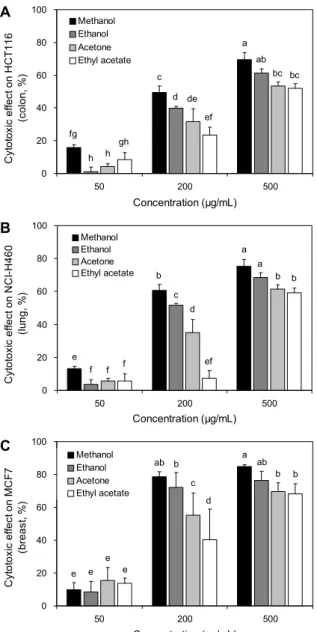
용매별 귀리 추출물의 대장암(HCT116), 폐암(NCI-H460) 및 유방암(MCF7) 세포에 대한 독성은 Fig. 1에 나타내었다.
실험에 사용된 시료는 50, 200 및 500 μg/mL로 조정하여 각 암세포에 대한 증식 억제 활성을 측정하였다. Fig. 1A는 대장암(HCT116) 세포에 대한 증식 억제 활성(cytotoxic effect, %)을 나타낸 것으로 모든 추출물에서 농도 의존적인 경향을 보여주었다. Methanol 추출물이 500 μg/mL에서
0 20 40 60 80 100
50 200 500
Concentration (µg/mL) Cytotoxic effect on HCT116 . (colon, %) .
Methanol Ethanol Acetone Ethyl acetate
fg
bc bc ab a
ef d de c
gh h h
A
0 20 40 60 80 100
50 200 500
Concentration (µg/mL) Cytotoxic effect on NCI-H460 . (lung, %) .
Methanol Ethanol Acetone Ethyl acetate
e
b b a a
ef d c b
f f f
B
0 20 40 60 80 100
50 200 500
Concentration (µg/mL) Cytotoxic effect on MCF7 . (breast, %) .
Methanol Ethanol Acetone Ethyl acetate
e
b b a ab
d c ab b
e e e
C
Fig. 1. Cytotoxic effect of the extracts from the oat on human cancer cells. Different letters (a-h) above bars indicate significant differences at P<0.05 by Duncan's multiple range test. A, colon cancer HCT116; B, lung cancer NCI-H460; C, breast cancer MCF7.
69.5%로 가장 높은 활성을 보였으며, 다음으로 ethanol 추 출물이 61.3%의 활성을 보였다. Acetone 및 ethyl acetate 추출물은 53.4 및 52.0%로 나타났다. 폐암(NCI-H460) 세 포에 대한 증식 억제 활성은 Fig. 1B에 나타내었으며 이 역 시 농도 의존적인 활성을 보였다. 500 μg/mL에서 meth- anol 추출물과 ethanol 추출물이 각각 75.2 및 68.6%로 높 은 활성을 보였으며, acetone 추출물과 ethyl acetate 추출 물은 61.4 및 59.2%로 나타났다. Fig. 1C는 유방암(MCF7) 세포에 대한 증식 억제 활성을 나타낸 것으로 methanol 추출 물이 500 μg/mL에서 84.8%의 높은 활성을 나타내었으며, 200 μg/mL에서도 78.5%의 높은 활성을 보였다. Acetone 및 ethyl acetate 추출물은 500 μg/mL에서 각각 69.6 및
68.2%로 낮은 활성을 나타내었다. Guo 등(29)은 귀리의 섭 취가 대장암(HCT116) 세포의 증식을 감소시키는 효과를 가지며, 이는 귀리에 특이적으로 존재하는 폴리페놀류인 avenanthramide가 함유되어 있기 때문이라 보고하였다.
Meydani(30) 역시 귀리의 폴리페놀 성분이 대장암 예방에 효과를 나타냄을 보고하였다. 따라서 귀리의 폴리페놀 성분 이 암세포 증식 억제 활성에 영향을 주며, 특히 폴리페놀 함량이 가장 높은 methanol 추출물의 암세포 증식 억제 활 성이 가장 높은 것으로 생각한다.
요 약
본 연구에서는 귀리 추출물에 대한 항산화 활성과 암세포 증식 억제 활성을 측정하고 각 추출용매에 따른 차이를 비교 분석하고자 하였다. 추출물의 항산화 활성은 2,2-azino- bis(3-ethylbenzothiazoline-6-sulphonic acid)(ABTS)와 1,1-diphenyl-2-picrylhydrazyl(DPPH) 라디칼 제거능 및 환원력을 이용하여 측정하였으며, 암세포 증식 억제 활성은 대장암, 폐암 및 유방암 세포주를 이용하여 평가하였다. 총 폴리페놀 함량, ABTS 및 DPPH 라디칼 제거능, 환원력 모 두 methanol 추출물이 각각 8.2 mg gallic acid equiva- lent/g residue, 12.1 mg Trolox equivalent antioxidant capacity(TEAC)/g residue, 4.4 mg TEAC/g residue 및 A700=0.39로 가장 높은 활성을 나타내었다. 또한 암세포 증 식 억제 활성은 methanol 추출물이 대장암(HCT116), 폐암 (NCI-H460) 및 유방암(MCF7) 세포에서 각각 69.5, 75.2 및 84.8%로 높은 증식 억제 활성을 나타내었다. 따라서 추 출용매에 따라 귀리의 항산화 및 암세포 증식 억제 활성에 차이가 나타나며, 이는 추출용매의 극성에 따라 추출된 생리 활성 물질, 특히 폴리페놀 화합물의 용해도 차이로 생각된 다. 본 연구 결과는 점차 관심이 높아지고 있는 천연 항산화 제 및 항암제로서 귀리에 관한 생리활성 연구에 있어 기초자 료로 활용될 수 있을 것으로 생각되며, 귀리의 소비 촉진에 영향을 끼칠 것으로 생각된다.
감사의 글
본 연구는 농촌진흥청 AGENDA 연구사업(ATIS 과제번호:
PJ01050802)의 지원에 의해 이루어진 것임.
REFERENCES
1. Ha TY. 2006. Development of functional food materials for healthy life. Korean J Crop Sci 51: 26-39.
2. Kim JH, Kim MY. 2015. Anticancer effect of citrus fruit prepared by gamma irradiation of budsticks. J Life Sci 25:
1051-1058.
3. Torre L, Siegel R, Jemal A. 2015. Global cancer facts &
figures. 3rd ed. American Cancer Society Inc., Atlanta, GA, USA.
4. Choi JH, Kim HI, Lee IS. 2009. Effect of Rosmarinus offici- nalis L. on growth inhibition and apoptosis induction in can- cer cells. J Korean Soc Food Sci Nutr 38: 1008-1015.
5. Biesalski HK. 2002. Free radical theory of aging. Curr Opin Clin Nutr Metab Care 5: 5-10.
6. Stadtman ER, Berlett BS. 1998. Reactive oxygen-mediated protein oxidation in aging and disease. Drug Metab Rev 30:
225-243.
7. Neergheen VS, Bahorun T, Taylor EW, Jen LS, Aruoma OI.
2010. Targeting specific cell signaling transduction path- ways by dietary and medicinal phytochemicals in cancer chemoprevention. Toxicology 278: 229-241.
8. Jeong YS, Kim JW, Lee ES, Gil NY, Kim SS, Hong ST.
2014. Optimization of alkali extraction for preparing oat protein concentrates from oat groat by response surface methodology. J Korean Soc Food Sci Nutr 43: 1462-1466.
9. Aman P, Graham H. 1987. Analysis of total and insoluble mixed-linked (1→3),(1→4)-β-D-glucans in barley and oats.
J Agric Food Chem 35: 704-709.
10. Boz H. 2015. Phenolic amides (avenanthramides) in oats-a review. Czech J Food Sci 33: 399-404.
11. Davidson MH, Dugan LD, Burns JH, Bova J, Story K, Drennan KB. 1991. The hypocholesterolemic effects of β- glucan in oatmeal and oat bran. A dose-controlled study.
JAMA 265: 1833-1839.
12. Berg A, König D, Deibert P, Grathwohl D, Berg A, Baum- stark MW, Franz IW. 2003. Effect of an oat bran enriched diet on the atherogenic lipid profile in patients with an in- creased coronary heart disease risk. A controlled random- ized lifestyle intervention study. Ann Nutr Metab 47: 306- 311.
13. Tong L, Liu L, Zhong K, Wang Y, Guo L, Zhou S. 2014.
Effects of cultivar on phenolic content and antioxidant activ- ity of naked oat in China. J Integr Agric 13: 1809-1816.
14. Tapola N, Karvonen H, Niskanen L, Mikola M, Sarkkinen E. 2005. Glycemic responses of oat bran products in type 2 diabetic patients. Nutr Metab Cardiovasc Dis 15: 255-261.
15. Chang HC, Huang CN, Yeh DM, Wang SJ, Peng CH, Wang CJ. 2013. Oat prevents obesity and abdominal fat distribu- tion, and improves liver function in humans. Plant Foods Hum Nutr 68: 18-23.
16. Peng CH, Chang HC, Yang MY, Huang CN, Wang SJ, Wang CJ. 2013. Oat attenuate non-alcoholic fatty liver and obesity via inhibiting lipogenesis in high fat-fed rat. J Funct Foods 5: 53-61.
17. Velioglu YS, Mazza G, Gao L, Oomah BD. 1998. Antiox- idant activity and total phenolics in selected fruits, vegeta- bles, and grain products. J Agric Food Chem 46: 4113-4117.
18. Re R, Pellegrini N, Proteggente A, Pannala A, Yang M, Rice-Evans C. 1999. Antioxidant activity applying an im- proved ABTS radical cation decolorization assay. Free Radic Biol Med 26: 1231-1237.
19. Sharma OP, Bhat TK. 2009. DPPH antioxidant assay revis- ited. Food Chem 113: 1202-1205.
20. Oyaizu M. 1986. Studies on products of browning reaction:
antioxidative activities of products of browning reaction prepared form glucosamine. Jpn J Nutr 44: 307-315.
21. Mosmann T. 1983. Rapid colorimetric assay for cellular growth and survival: Application to proliferation and cyto- toxicity assays. J Immunol Methods 65: 55-63.
22. Tatiya AU, Tapadiya GG, Kotecha S, Surana SJ. 2011.
Effect of solvents on total phenolics, antioxidant and anti- microbial properties of Bridelia retusa Spreng. stem bark.
Indian J Nat Prod Resour 2: 442-447.
23. Stoner GD, Mukhtar H. 1995. Polyphenols as cancer chemo- preventive agents. J Cell Biochem Suppl 22: 169-180.
24. Duthie GG, Duthie SJ, Kyle JAM. 2000. Plant polyphenols in cancer and heart disease: implications as nutritional anti- oxidants. Nutr Res Rev 13: 79-106.
25. Choupani M, Delouee SA, Alami M. 2014. Antioxidant prop- erties of various solvent extracts of lemon verbena (Lippia citriodora) leaves. Int J Adv Biol Biomed Res 2: 1340-1346.
26. Oki T, Masuda M, Kobayashi M, Nishiba Y, Furuta S, Suda I, Sato T. 2002. Polymeric procyanidins as radical-scaveng- ing components in red-hulled rice. J Agric Food Chem 50:
7524-7529.
27. Sultana B, Anwar F, Ashraf M. 2009. Effect of extraction solvent/technique on the antioxidant activity of selected me- dicinal plant extracts. Molecules 14: 2167-2180.
28. Ham H, Woo KS, Lee B, Park JY, Sim EY, Kim BJ, Lee C, Kim SJ, Kim WH, Lee J, Lee YY. 2015. Antioxidant compounds and activities of methanolic extracts from oat cultivars. J Korean Soc Food Sci Nutr 44: 1660-1665.
29. Guo W, Nie L, Wu D, Wise ML, Collins FW, Meydani SN, Meydani M. 2010. Avenanthramides inhibit proliferation of human colon cancer cell lines in vitro. Nutr Cancer 62:
1007-1016.
30. Meydani M. 2009. Potential health benefits of avenanthra- mides of oats. Nutr Rev 67: 731-735.