https://doi.org/10.5763/kjsm.2019.37.2.54 pISSN 1226-3729 eISSN 2288-6028
동계 종목 엘리트 선수들의 상기도 감염 경험과 상기도 감염이 훈련, 경기 참가에 미치는 영향
대한체육회 국가대표선수촌 의과학부
배문정
∙
김세준∙
윤정중The Experience of the Upper Respiratory Infection of the Elite Winter Sports Athletes and Its Effect on Training and Competition
Moonjung Bae, Sejun Kim, Jungjoong Yun
Department of Medicine and Science, National Training Center, Korean Sport and Olympic Committee, Jincheon, Korea
Purpose: This study aimed to investigate the experience of the upper respiratory infection of the elite winter sports athletes and its effect on training and competition.
Methods: We conducted survey on elite athletes preparing for the 2018 PyeongChang Winter Olympic Games. The general characteristics, training and competition loss due to upper respiratory infection were analyzed by descriptive statistics. Multiple regression analysis was performed to find out the factors that influence on training loss due to upper respiratory infection. A p-value less than 0.05 was considered statistically significant and data were analyzed using SPSS ver. 24.0.
Results: A total 65 players answered the questionnaire. Sixteen players (24.7%) reported that they got an upper respiratory infection more than three times a year. The month mainly affected by upper respiratory infection was September to November. Main symptom of upper respiratory infection was rhinorrhea mostly, followed by sore throat, cough, sputum. Six players (9.2%) answered that they were excluded from training more than three times due to upper respiratory infection for 1 year. Seven players (10.7%) answered that they were excluded from competition one time due to upper respiratory infection for 1 year. The factors that influence on training loss due to upper respiratory syndrome were the numbers of getting upper respiratory infection for 1 year and age.
Conclusion: Elite winter athletes are vulnerable to upper respiratory and it has a bad effect on training and competition. So we need to take care of elite athletes’ illness like upper respiratory infection.
Keywords: Athletes, Common cold, Disease, Sports medicine
Received: February 1, 2019 Revised: April 24, 2019 Accepted: May 7, 2019 Correspondence: Moonjung Bae
Department of Medicine and Science, National Training Center, Korean Sport and Olympic Committee, 105 Seonsuchon-ro, Gwanghyewon-myeon, Jincheon 27809, Korea
Tel: +82-43-531-0093, Fax: +82-43-531-0070, E-mail: [email protected]
Copyright ©2019 The Korean Society of Sports Medicine
CC
This is an Open Access article distributed under the terms of the Creative Commons Attribution Non-Commercial License (http://creativecommons.org/
licenses/by-nc/4.0) which permits unrestricted non-commercial use, distribution, and reproduction in any medium, provided the original work is properly cited.
Table 1. General characteristics of elite winter sports athletes
Variable Bobsleigh Skeleton Ski Snowboard Cross
country Biathlon Total Number (male:female) 16 (11:5) 8 (4:4) 15 (11:4) 5 (4:1) 9 (5:4) 12 (6:6) 65 (41:24)
Age (yr) 26.8±3.6 24.9±2.8 25.9±5.0 18.2±1.9 25.7±4.9 26.6±4.3 25.5±4.5
Career (yr) 4.4±3.5 4.0±2.1 15.9±5.8 9.0±3.1 14.3±3.6 13.7±4.8 10.5±6.5
Use of supplement 13 (81.3) 6 (75.0) 12 (80.0) 2 (40.0) 6 (66.7) 10 (83.3) 49 (75.4) Values are presented as mean±standard deviation or number (%).
서 론
엘리트 선수들은 시합과 훈련 상황에서 많은 부상과 질병을 경험한다. 국제올림픽위원회(International Olympic Committee [IOC])에서는 선수들의 부상과 질병을 예방하기 위하여 국제 대회의 부상과 질병에 대한 역학조사를 시행하고 있다 1,2 .
이러한 역학조사에 따르면 선수들은 훈련과 시합 상황에서 상기도 감염과 같은 질병에 많이 걸린다. 2010년 밴쿠버 동계 올림픽에 참여한 2,567명의 선수들 중 185명이 대회 기간 중 질병으로 의무실을 방문하였다 3 . 2014년 소치 동계 올림픽 기간 동안에는 2,780명의 선수들 중 249명이 질병으로 의무실 을 방문하였고, 그 중 64.0%가 호흡기계 질병이었다 4 . 2016년 리우 하계 올림픽 대회 기간 동안에는 대한민국 국가대표 선수 204명 중 73명이 질병으로 한국 대표팀 의무실을 방문하 였고, 그 중 75.9%가 호흡기계 질병이었다 5 .
이와 같이 국제 대회나 훈련 기간 중 질병에 걸리는 선수들 이 많음에도 불구하고 엘리트 선수들의 질병에 대한 연구가 부족한 것으로 생각된다 . 따라서 본 연구는 2018년 평창 동계 올림픽을 준비하고 있는 동계 종목 선수들을 대상으로 질병 발생 경향 , 특히 많은 빈도를 보이는 상기도 감염의 발생 경향 과 상기도 감염이 훈련과 시합에 미치는 영향에 대하여 알아보 고자 하였다.
연구 방법
1. 대상
본 연구는 2018년 평창 동계 올림픽을 준비하는 대한민국 국가대표 선수 65명(남자 41명, 여자 24명)을 대상으로 설문 조사를 시행하였다. 종목별 참가자는 봅슬레이 16명, 스켈레 톤 8명, 스키 15명, 스노보드 5명, 크로스컨트리 9명, 바이애슬 론 12명이었다.
2. 자료 수집
모든 선수들은 가정의학과 전문의에게 연구의 목적에 대하 여 충분한 설명을 들었으며 연구에 참여하기로 동의한 경우에 만 설문을 작성하였다. 설문 내용은 IOC의 Daily Report on Injuries and Illnesses의 내용을 참고하여 본 연구의 취지에 부합하도록 제작하였다 6 . 설문 내용은 참가자의 일반적인 특 성으로 운동경력 , 영양제 복용 여부, 질병의 과거력, 지난 1년 간 상기도 감염에 걸린 횟수, 상기도 감염이 자주 걸리는 달, 주요 증상 등으로 구성하였다. 상기도 감염이 경기력에 주는 영향을 알아보기 위하여 상기도 감염으로 인하여 훈련과 시합 에 참여하지 못했던 경험에 대한 질문을 포함하였다. 상기도 감염은 증상으로 인해 병원이나 약국을 방문한 경우만 포함하 였고 증상이 경한 경우는 제외하였다.
3. 자료 처리 방법
상기도 감염으로 인해 훈련 및 시합에 제외된 경험에 대하여 종목별로 빈도분석을 시행하였다. 그리고 상기도 감염으로 인한 훈련 제외에 영향을 주는 요인을 알아보기 위하여 종목, 나이, 성별, 운동경력, 영양제 복용여부, 1년간 감기에 걸린 횟수를 변수로 하여 다중회귀분석(multiple regression analysis) 을 시행하였다. 상기도 감염으로 인해 시합에 제외된 경험은 빈도가 많지 않아 분석하지 못하였다 . 지난 1년간 상기도 감염 에 걸린 횟수, 자주 걸리는 시기, 주요 증상, 영양제 복용여부 등에 대해서는 기술적 통계분석인 빈도분석을 시행하였다.
통계적 유의수준은 p<0.05로 설정하였으며 IBM SPSS ver.
24.0 (IBM Corp., Armonk, NY, USA)을 이용하여 자료를 분석하 였다.
결 과
총 65명의 선수가 설문에 응답하였다. 바이애슬론, 봅슬레
이, 스켈레톤, 스키, 스노보드, 크로스컨트리 6종목의 선수들
Table 2. General characteristics of URI* for 1 year
Variable Biathlon Bobsleigh Snowboard Skeleton Ski Cross
country Total No. of getting URI
0 2 (16.7) 0 2 (40.0) 0 0 0 4 (6.2)
1 6 (50.0) 6 (37.5) 0 2 (25.0) 3 (20.0) 4 (44.4) 21 (32.3)
2 2 (16.7) 7 (43.8) 2 (40.0) 2 (25.0) 9 (60.0) 2 (22.2) 24 (36.9)
3 1 (8.3) 3 (18.8) 0 1 (12.5) 3 (20.0) 2 (22.2) 10 (15.4)
4 1 (8.3) 0 1 (20.0) 2 (25.0) 0 1 (11.1) 5 (7.7)
5 0 0 0 1 (12.5) 0 0 1 (1.5)
Total 12 (100) 16 (100) 5 (100) 8 (100) 15 (100) 9 (100) 65 (100)
Month mainly affected by URI
12−2 0 7 (38.8) 1 (20.0) 3 (25.0) 7 (50.0) 4 (40.0) 22 (31.4)
3−5 5 (45.4) 1 (5.5) 2 (40.0) 3 (25.0) 3 (21.4) 3 (30.0) 17 (24.2)
6−8 1 (9.0) 1 (5.5) 0 2 (16.6) 3 (21.4) 1 (10.0) 8 (11.4)
9−11 5 (45.4) 9 (50.0) 2 (40.0) 4 (33.3) 1 (7.1) 2 (20.0) 23 (32.8)
Total 11 (100) 18 (100) 5 (100) 12 (100) 14 (100) 10 (100) 70 (100)
Main symptom
Rhinorrhea 6 (21.4) 12 (26.0) 4 (33.3) 7 (29.1) 9 (19.5) 6 (22.2) 44 (24.0) Sore throat 8 (28.5) 13 (28.2) 2 (16.6) 3 (12.5) 7 (15.2) 7 (25.9) 40 (21.8) Cough 4 (14.2) 9 (19.5) 3 (25.0) 6 (25.0) 10 (21.7) 7 (25.9) 39 (21.3)
Sputum 4 (14.2) 2 (4.3) 1 (8.3) 4 (16.6) 8 (17.3) 4 (14.8) 23 (12.8)
Myalgia 2 (7.1) 6 (13.0) 2 (16.6) 2 (8.3) 8 (17.3) 2 (7.4) 22 (12.0)
Fever 4 (14.2) 4 (8.6) 0 2 (8.3) 4 (8.6) 1 (3.7) 15 (8.1)
Total 28 (100) 46 (100) 12 (100) 24 (100) 46 (100) 27 (100) 183 (100) Values are presented as number (%).
URI: upper respiratory infection.
*Only the case when athletes visited medical clinic due to URI.
Table 3. Training and event loss due to URI*
Variable Biathlon Bobsleigh Snowboard Skeleton Ski Cross
country Total No. of training losses
0 5 (41.7) 8 (50.0) 4 (80.0) 5 (62.5) 9 (60.0) 6 (66.7) 37 (56.9)
1 1 (8.3) 5 (31.2) 1 (20.0) 2 (25.0) 3 (20.0) 0 12 (18.4)
2 4 (33.3) 1 (6.3) 0 1 (12.5) 3 (20.0) 1 (11.1) 10 (15.3)
≥3 2 (16.7) 2 (12.5) 0 0 0 2 (22.2) 6 (9.2)
Total 12 (100) 16 (100) 5 (100) 8 (100) 15 (100) 9 (100) 65 (100)
No. of event losses
0 10 (83.3) 16 (100.0) 5 (100.0) 8 (100.0) 13 (86.7) 6 (66.7) 58 (89.2)
1 2 (16.7) 0 0 0 2 (13.3) 3 (33.3) 7 (10.7)
Total 12 (100) 16 (100) 5 (100) 8 (100) 15 (100) 9 (100) 65 (100)
Values are presented as number (%).
URI: upper respiratory infection.
*Only the case when athletes visited medical clinic due to URI.
이 설문에 응답하였으며 평균 연령은 25.5±4.5세, 평균 경력은 10.5±6.5년이었다. 영양제를 복용하고 있냐는 질문에 49명 (75.4%)의 선수가 복용하고 있다고 대답하였다(Table 1).
근골격계 부상 이외에 자주 걸리는 질병이 있냐는 질문에
15명이 그렇다고 대답하였다. 자주 걸리는 질병으로는 상기도
감염이 가장 많았으며 위장염, 알러지 비염, 아토피 피부염
등이 있다고 대답하였다. 가장 발생 빈도가 높았던 상기도
감염에 대한 설문 결과 총 16명(24.7%)의 선수가 1년에 3회
Table 4. Factors that associated with training loss due to URI*
Variable
Unstandardized coefficient
Standardized
coefficient t p-value
Collinearity statistic
B SE Beta Tolerance VIF
No. of getting URI 0.360 0.107 0.381 3.361 0.001 0.994 1.006
Age 0.065 0.026 0.286 2.523 0.014 0.994 1.006
URI: upper respiratory infection, B: unstandardized regression coefficients, SE: standard error, Beta: standardized regression coefficients, VIF: variance inflation factor.
*Only the case when athletes visited medical clinic due to URI.
이상 상기도 감염에 걸린다고 대답하였으며 24명(36.9%)이 2회, 21명(32.3%)이 1회 정도의 빈도로 상기도 감염에 걸린다 고 대답하였다. 상기도 감염이 자주 걸리는 달이 언제냐는 질문에 23명(32.8%)이 9–11월에 가장 많이 걸린다고 대답하였 고 12–2월에 22명(31.4%), 3–5월에 17명(24.2%), 6–8월에 8명 (11.4%)이 자주 걸린다고 대답하여 주로 겨울철에 상기도 감염에 자주 걸린다는 것을 알 수 있었다 . 상기도 감염의 주요 증상으로는 콧물이 44명(24.0%)으로 가장 많았고 인후통(40 명), 기침(39명), 가래(23명), 몸살(22명), 열(15명) 순이었다 (Table 2).
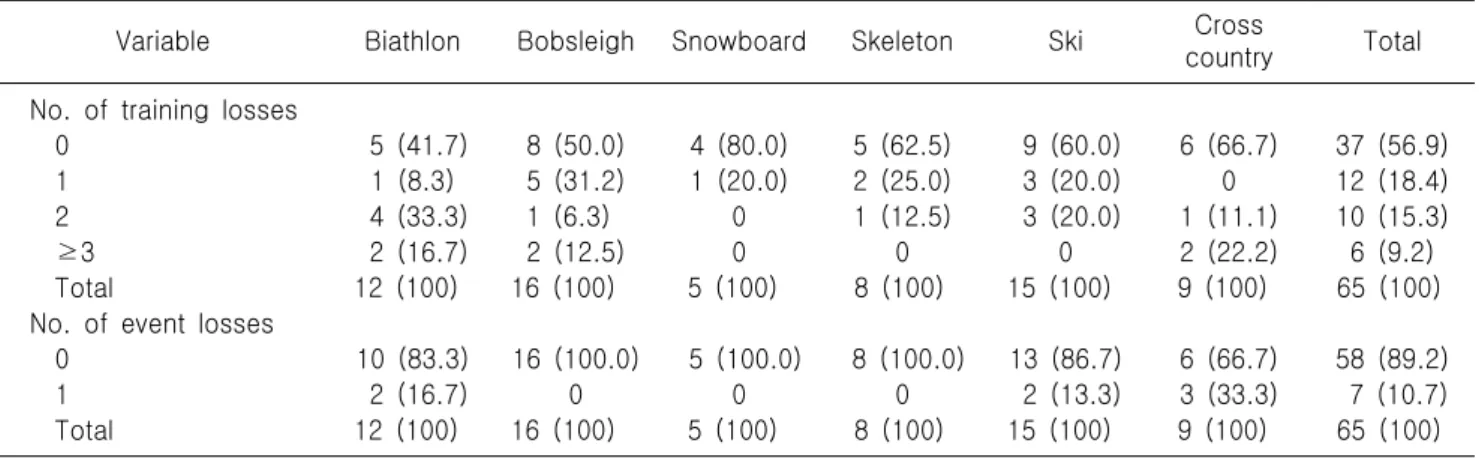
지난 1년 동안 상기도 감염으로 인해 훈련에 빠진 적이 있냐는 질문에 6명(9.2%)의 선수가 3회 이상 빠진 적이 있다고 대답하였고 10명(15.3%)의 선수가 2회, 12명(18.4%)이 1회 훈련에 빠진 적이 있다고 대답하였다 . 37명(56.9%)의 선수는 상기도 감염으로 인해 훈련에 빠진 적이 없다고 대답하였다.
지난 1년 동안 상기도 감염으로 인해 시합을 빠진 적이 있냐는 질문에 7명(10.7%)의 선수가 1번 시합에 빠진 적이 있다고 대답하였다(Table 3).
상기도 감염으로 인한 훈련 제외에 영향을 주는 요인을 분석한 결과 나이 , 1년 동안 감기에 걸린 횟수가 유의한 영향을 미치는 것으로 분석되었다(Table 4). 나이가 많을 수록, 감기에 걸린 횟수가 많을수록 상기도 감염으로 인한 훈련 제외에 유의한 영향을 미치는 것으로 나타났다. 종목, 성별, 영양제 복용 여부 , 운동 경력의 변수는 통계학적으로 유의하지 못하여 제외하였다.
고 찰