https://doi.org/10.5468/ogs.2020.63.2.173 pISSN 2287-8572 · eISSN 2287-8580
Introduction
Cesarean section is one of the most common surgical proce- dures conducted on women. Cesarean delivery is the deliv- ery of a fetus through an incision into the abdominal cavity (laparotomy) and uterine wall (hysterotomy) [1].
Currently, a large number of cesarean sections are per-
The effect of ginger and metoclopramide in the
prevention of nausea and vomiting during and after surgery in cesarean section under spinal anesthesia
Hamideh Pakniat, MD
1, Fatemeh Lalooha, MD
1, Farideh Movahed, MD
1, Aynaz Boostan, MD
1, Marzieh Beigom Khezri, MD
2, Caleb Hedberg, DO
3, Mohammad Ali Hosseini, MD
4,5Departments of 1Obstetrics and Gynecology, 2Anesthesiology, Faculty of Medicine, Qazvin University of Medical Sciences, Qazvin, Iran; 3Rocky Vista University College of Osteopathic Medicine, Parker, CO, USA; 4Infertility and Reproductive Health Research Center, Shahid Beheshti Medical University, Tehran; 5Student Research Committee, Qazvin University of Medical Sciences, Qazvin, Iran
Objective
Postoperative nausea and vomiting is one of the most common side effects after anesthesia in surgeries, such as cesarean section. This study aimed to investigate the effect of ginger and metoclopramide in the prevention of nausea and vomiting during and after cesarean section.
Methods
This clinical trial was conducted on 180 patients aged 18–40 years who underwent cesarean section under spinal anesthesia. The first group received 10 mg of metoclopramide via intravenous injection (metoclopramide group), and the second group received 1 g of oral ginger (ginger group) half an hour before spinal anesthesia. The frequency and severity of nausea and vomiting during surgery and at 2, 6, 12, and 24 hours postoperatively were compared in both groups. To analyze the results, the t-test, chi-square test, and Mann-Whitney test were used.
Results
There was no significant difference in the frequency of nausea and vomiting between the 2 groups during operation, 2 hours and 6 hours after surgery (P=0.182, 0.444 and 0.563 respectively). The severity of nausea and vomiting was also similar in the 2 groups (P=0.487 and 0.652 respectively); however, the metoclopramide group had a lower systolic blood pressure (P<0.001; df=2.176; f=18.66) and mean arterial pressure (P<0.001; df=2.176; f=6.36) than the ginger group.
Conclusion
The results revealed that ginger reduced nausea and vomiting to the same extent as metoclopramide in patients undergoing cesarean section.
Trial Registration
Iranian Center for Clinical Trials Identifier: IRCT201611028611N3 Keywords: Cesarean section; Spinal anesthesia;
Metoclopramide; Ginger
Received: 2019.03.04. Revised: 2019.10.06. Accepted: 2019.10.14.
Corresponding author: Fatemeh Lalooha, MD
Department of Obstetrics and Gynecology, Faculty of Medicine, Qazvin University of Medical Sciences, Shahid Bahonar Boulevard, Qazvin 34199-15315, Iran
E-mail: [email protected] https://orcid.org/0000-0003-4241-7958
Articles published in Obstet Gynecol Sci are open-access, distributed under the terms of the Creative Commons Attribution Non-Commercial License (http://creativecommons.
org/licenses/by-nc/3.0/) which permits unrestricted non-commercial use, distribution, and reproduction in any medium, provided the original work is properly cited.
Copyright © 2020 Korean Society of Obstetrics and Gynecology
formed under local anesthesia. The decision for local anes- thesia depends on the patient’s preference and the absence of fetal distress. General anesthesia in the presence of fetal distress is sometimes preferred because of faster prepara- tion time and lower incidence of hypotension. However, lo- cal (epidural or spinal) anesthesia is associated with a lower probability of maternal pulmonary aspiration or fetal impair- ment from transplacental exposure to anesthetics. Spinal anesthesia is the most commonly selected method of anes- thesia for elective cesarean section. Its use is widely accepted owing to its simplicity and high reliability as well as its rapid time-to-effect. Epidural anesthesia is an alternative technique and has the advantage of reduced rates of hypotension [2].
Considering that one of the common causes of death dur- ing general anesthesia is complications from intubation (with the incidence approximately 10 times higher in pregnant women than in non-pregnant women), the American Col- lege of Obstetricians and Gynecologists released a statement in 2013 advising local anesthesia as the preferred method for cesarean procedures [1,2].
Postoperative nausea and vomiting (PONV) is one of the most common side effects of local anesthesia, with a preva- lence of 1–43%. In another study, the prevalence of PONV varied from 23% to 79% [1]. The rates are dependent on the type of surgery, anesthesia method, patients’ sex and age, obesity, preoperative fasting rates, and history of PONV [3].
The causes of nausea include hypotension resulting from local anesthesia; decreased cardiac output due to compres- sion of the aorta and abdominal organs; visceral manipula- tion, such as removal of the uterus; and use of anesthetic medications, such as opioids or methylergonovine. While PONV can occur under both general anesthesia and local anesthesia, this side effect is more evident in the latter [4].
Numerous studies have been conducted to address nausea and vomiting during and after cesarean section with the use of spinal anesthesia [2,3,5,6].
Nausea and vomiting is stressful for patients who have ex- perienced it. The complications of PONV include dehydration, weakness, rupture of surgical sutures, and increased bleed- ing on the surgical site, all ultimately delaying the discharge of patients and increasing the cost of care. For the past 50 years, various agents have been identified for the treat- ment of PONV [4].
One frequently used anti-emetic is metoclopramide, which has a centrally acting anti-dopaminergic effect and an anti-
serotonergic effect at high doses. A low dose (10 mg) has no reliable anti-nausea effect for PONV prophylaxis in non-preg- nant women undergoing non-obstetric surgery; however, this dose is reported to be safe for pregnant women. More- over, it allows trans-placental absorption; thus, no significant effects on the fetus have been found at this dose [1].
Conversely, a less commonly used anti-emetic is ginger. In recent decades, ginger (classified by the Food and Drug Ad- ministration [FDA] as one of the safest herbal medicines) has been shown to be beneficial in controlling nausea and vomit- ing in pregnant women, patients undergoing chemotherapy, and those with motion sickness and PONV [3,5].
Traditional treatments have many advantages, includ- ing wide variety of effects, flexibility in dosing and route, availability worldwide, wide acceptance, low cost, and less dependence on technology. Ginger is considered effective mainly owing to its active compounds, which include shogaol and gingerol. It also has anti-inflammatory, anti-nausea, anti- cancer, and anti-hypertensive effects, and decreases the pro- duction of prostaglandins and digestive problems. Moreover, it is on the United States FDA list of safe herbal preparations and has no adverse effect on the fetus [4].
Considering the high rate of cesarean section and side effects of metoclopramide, including sedation, hypoten- sion, and extrapyramidal side effects, alternatives for nausea control in cesarean section are warranted. This study aimed to investigate the effectiveness between ginger and metoclo- pramide for the prevention of nausea and vomiting during and after cesarean section as well as evaluate the efficacy and complication rates of these medications.
Materials and methods
This randomized, double-blind clinical trial was conducted from March 2016 to August 2016 after obtaining approval from the local ethics committee of Qazvin University of Medical Sciences in Kowsar Training-Therapeutic Hospital.
After written consent was obtained, the patients were ran- domized into 2 groups. This clinical trial was conducted on 180 patients aged 18–40 years who underwent cesarean section under spinal anesthesia. The indication of cesarean section for all mothers was previous cesarean section, and none of them had absolute indications (absolute dispropor- tion, chorioamnionitis, maternal pelvic deformity, eclampsia,
HELLP syndrome, fetal asphyxia, fetal acidosis, umbilical cord prolapse, placenta previa, abnormal lie and presentation, or uterine rupture).
Randomization was performed using a computerized random number generator, which divided the cohort into 2 groups. The intervention group received 2 ginger tablets equivalent to 1,000 mg produced by the Dina Qazvin Pharmaceuticals Company, with a small amount of water, and 2 mL of normal saline through intravenous injection half an hour before surgery (ginger group). The control group received 1 ampule of metoclopramide equivalent to 10 mg obtained from the Razi Pharmaceuticals Company through intravenous injection and 2 oral placebo tablets instead of ginger with a small amount of water half an hour before the start of the spinal anesthesia (metoclopramide group).
The exclusion criteria were as follows: sensitivity to meto- clopramide and ginger; history of cardiac, upper gastroin- testinal tract, or biliary surgeries; history of any hemorrhagic disorder, such as hemophilia; contraindication to intrathecal and epidural anesthesia; high risk for anesthesia (American Society of Anesthesiologists classification III and IV); and his- tory of use of multiple doses of anti-nausea medications and metoclopramide 24 hours before surgery.
All mothers were hydrated with 500–1,000 mg lactated ringers before surgery. After standard monitoring (electro- cardiogram, blood pressure, and pulse oximetry), spinal anesthesia was induced using 2.5 mL of 0.5% bupivacaine through intrathecal injection. After spinal anesthesia, no patients were administered with narcotics. Immediately after spinal anesthesia and then every 5 minutes, blood pressure and heart rate were measured in all patients. In cases of
≥20% drop in blood pressure, 2.5–5 mg of ephedrine was injected. In the postoperative period, ondansetron was ad- ministered to control breakthrough nausea and vomiting (as needed). The patients were then instructed to report nausea and vomiting. The frequency of nausea and vomiting during surgery and postoperatively at 2, 6, 12, and 24 hours were evaluated.
The participants were trained to evaluate the severity of nausea using a 10-cm ruler as the visual analog scale tool, with one end indicating severe nausea and the other indicat- ing no nausea (desirable state). The severity of nausea was measured as mild (lower than 3.5), moderate (3.5–7), and severe (higher than 7). This tool has been used in several other studies, with a validity of 40–95% (7). In addition, the
incidence of vomiting in the first 6 postoperative hours was defined as mild (lower than 3 times), moderate (3–5 times), and severe (higher than 5 times).
The data were analyzed using SPSS 19 (SPSS Inc, Chicago, IL, USA). The t-test and chi-square test were used for data analysis. Based on a confidence interval of 95%, power of 80%, and expected incidence of nausea of 5% in the inter- vention group and 20% in the control group, the sample size calculated was 73 patients in each group. To restitute for an estimated percentage of follow-up loss of 20%, 90 patients were needed for each group [7]. For all tests, P-values of
<0.05 were considered significant.
Results
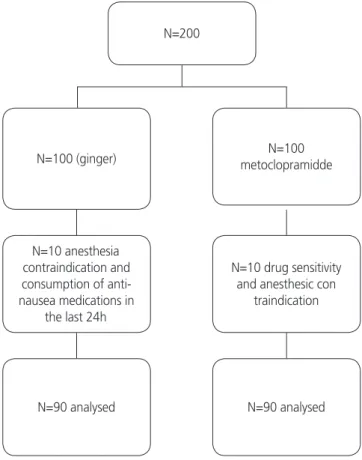
This study was registered at the Iranian Center for Clinical Trials (IRCT201611028611N3) after receiving approval from the local ethics committee of Qazvin University of Medical Sciences. A total of 200 pregnant women were recruited;
20 were excluded from the study (10 in each group), and
Fig. 1. CONSORT diagram.
N=10 anesthesia contraindication and consumption of anti- nausea medications in
the last 24h
N=90 analysed N=100 (ginger)
N=200
N=10 drug sensitivity and anesthesic con
traindication
N=90 analysed N=100 metoclopramidde
90 subjects in each group were finally included in the study (Fig. 1).
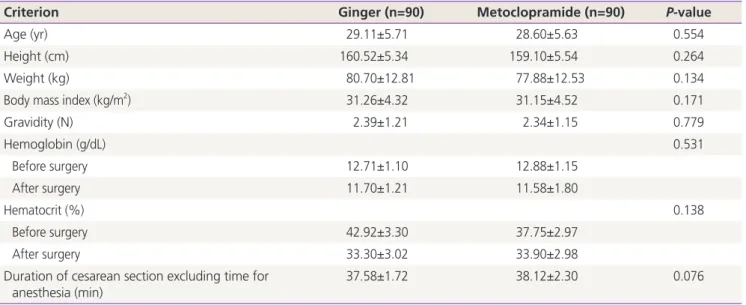
The demographic data of the study population were not significantly different (Table 1).
The history of nausea and vomiting at the beginning of pregnancy was evaluated. There were 23 patients (25.5%) in the ginger group and 20 patients (22.2%) in the metoclo- pramide group (P=0.185); however, there was no significant difference between them.
The severity of nausea in the first 6 postoperative hours was investigated (Table 2). As shown in Table 2, there was no significant difference in the severity of nausea and vomiting between the 2 groups (P=0.487 and 0.652, respectively).
The frequency of nausea and vomiting during and after cesarean section between the 2 groups was not significantly different (Table 3).
The use of ondansetron for breakthrough vomiting during and after surgery was also not significantly different between them (P=0.12).
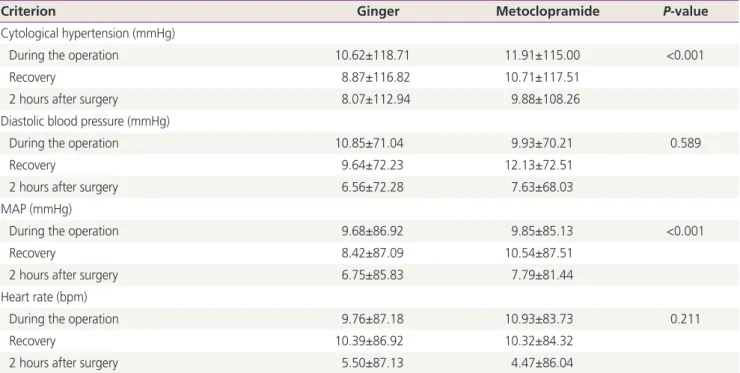
However, as shown in Table 4, the metoclopramide group had a lower systolic blood pressure (P<0.001; df=2.176;
f=18.66) and mean arterial pressure (P<0.001; df=2.176;
f=6.36) than the ginger group.
The analysis showed that there was no side effect of the medication according to the dose in either group, including heart burn in the ginger group and extrapyramidal side ef- fect in the metoclopramide group.
Discussion
This study showed that there was no significant difference in
Table 1. Demographic data of the study population divided into 2 groups
Criterion Ginger (n=90) Metoclopramide (n=90) P-value
Age (yr) 29.11±5.71 28.60±5.63 0.554
Height (cm) 160.52±5.34 159.10±5.54 0.264
Weight (kg) 80.70±12.81 77.88±12.53 0.134
Body mass index (kg/m2) 31.26±4.32 31.15±4.52 0.171
Gravidity (N) 2.39±1.21 2.34±1.15 0.779
Hemoglobin (g/dL) 0.531
Before surgery 12.71±1.10 12.88±1.15
After surgery 11.70±1.21 11.58±1.80
Hematocrit (%) 0.138
Before surgery 42.92±3.30 37.75±2.97
After surgery 33.30±3.02 33.90±2.98
Duration of cesarean section excluding time for
anesthesia (min) 37.58±1.72 38.12±2.30 0.076
Data were presented as means±standard deviations.
Table 2. Relative severity of nausea and vomiting in the first 6 postoperative hours in the 2 groups
Criterion Ginger Metoclopramide P-value
Nausea Mild 32 (84.2) 15 (75.0) 0.487
Moderate 6 (15.8) 5 (25.0)
Severe 0 0
Vomiting Mild 33 (89.2) 18 (94.7) 0.652
Moderate 4 (10.8) 1 (5.3)
Severe 0 0
Data were presented as number (%).
the frequency and severity of nausea and vomiting between the 2 study groups. Furthermore, metoclopramide reduced the blood pressure more than did ginger, although this dif- ference may be not clinically meaningful.
The results of the present study demonstrate that both ginger and metoclopramide decrease the frequency and severity of nausea and vomiting in all stages of cesarean sec- tion; however, ginger demonstrates superior hemodynamic stability compared with metoclopramide. The results contra-
dict those of Kalava et al. [8] in terms of the effect of gin- ger; this difference may be attributed to the changes in the medication doses. Conversely, our results agree with those of Montazeri et al. [4] who conducted a study on 160 patients undergoing various surgical procedures using general anes- thesia as well as spinal and epidural anesthesia and showed that the rate of nausea in the first 2 postoperative hours was significantly lower in their low ginger-receiving group.
Amouee et al. [9] compared between the effects of ginger
Table 3. Comparison of the mean frequency of nausea and vomiting during and after surgery between the 2 groups
Group Variable Ginger Metoclopramide Total P-value
Nausea During the operation 21 (23.3) 13 (14.4) 34 (18.9) 0.182
2 hours after surgery 5 (5.6) 2 (2.2) 7 (3.9) 0.444
6 hours after surgery 2(2.2) 1 (1.1) 3 (1.7) 0.563
12 hours after surgery 0 0 0 -
24 hours after surgery 0 0 0 -
Vomit During the operation 2 (2.2) 5 (5.6) 7 (3.9) 0.444
2 hours after surgery 2 (2.2) 1 (1.1) 3 (1.7) 0.563
6 hours after surgery 1 (1.1) 0 1 (0.6) 0.320
12 hours after surgery 0 0 0 -
24 hours after surgery 0 0 0 -
Data were presented as number (%).
Table 4. Comparison of the mean systolic and diastolic blood pressures, MAP, and heart rate during pregnancy in the 2 groups
Criterion Ginger Metoclopramide P-value
Cytological hypertension (mmHg)
During the operation 10.62±118.71 11.91±115.00 <0.001
Recovery 8.87±116.82 10.71±117.51
2 hours after surgery 8.07±112.94 9.88±108.26
Diastolic blood pressure (mmHg)
During the operation 10.85±71.04 9.93±70.21 0.589
Recovery 9.64±72.23 12.13±72.51
2 hours after surgery 6.56±72.28 7.63±68.03
MAP (mmHg)
During the operation 9.68±86.92 9.85±85.13 <0.001
Recovery 8.42±87.09 10.54±87.51
2 hours after surgery 6.75±85.83 7.79±81.44
Heart rate (bpm)
During the operation 9.76±87.18 10.93±83.73 0.211
Recovery 10.39±86.92 10.32±84.32
2 hours after surgery 5.50±87.13 4.47±86.04
MAP, mean arterial pressure; bpm, beats per minute.
and placebo on the severity of PONV; they found that the mean score of nausea at 2, 4, and 6 postoperative hours in the ginger group was lower than that in the placebo group.
Finally, they showed that the use of ginger in preventing postoperative nausea has been effective and that ginger can be used as an anti-nausea medicine after surgery. The results are consistent with those of our study [9].
Lee and Shin [10] performed a study in South Korea and investigated the effect of ginger anesthesia oil on reducing nausea and vomiting after abdominal surgery. Their analysis showed that the scores of nausea and vomiting were signifi- cantly lower in the ginger-receiving group than in the control group. Although their results are consistent with those of the present study, the type of medication used for the interven- tion groups was different.
In terms of the confirmation of an effective dose of meto- clopramide in preventing PONV, De Oliveira et al. [11] con- ducted a meta-analysis of 30 clinical trials involving 3,328 individuals to investigate the efficacy of administration of 10 mg of metoclopramide before induction of anesthesia. They showed that this dose more effectively prevented PONV in cases of general anesthesia and local anesthesia [11].
Mishriky and Habib [1] conducted a meta-analysis in the United States on pregnant women undergoing cesarean sec- tion. They showed that metoclopramide at a dose of 10 mg administered half an hour before induction of anesthesia re- duced the rate of nausea and vomiting during and after sur- gery [1]. Their results are consistent with those of the present study.
Our study showed that ginger significantly reduced the severity of nausea and vomiting, similar to metoclopramide.
Although many studies have compared the effects of each of these 2 medications with those of various medications on nausea and vomiting during and after surgery [1], only 1 study has investigated the effect of ginger and metoclo- pramide on nausea and vomiting during and after surgery [12].
Our study showed that ginger and metoclopramide had the same effect in reducing nausea and vomiting during and after surgery, which is in contrast with the results of Moslem et al. [12]. There are many differences between their study and the present study, including the type of sampling, type of anesthesia, age and sex of the subjects, sample size, dose of the medications, and method of prescribing the medica- tions. In their study, patients aged 18–80 years undergoing
cholecystectomy under general anesthesia were included;
further, both male and female patients were recruited. The dose of metoclopramide was different, and it was adminis- tered orally. In our study, patients aged 18–40 years undergo- ing cesarean section under spinal anesthesia were included, and a sample size of 180 patients was selected; the patients received metoclopramide at a dose of 10 mg through intra- venous injection. The factor that may have caused the same effect between ginger and metoclopramide in our study was the oral administration of ginger and intravenous administra- tion of metoclopramide within half an hour before the sur- gery; owing to the faster effect of intravenous administration of metoclopramide compared with that of oral administra- tion of ginger, the 2 medications were identical in reducing nausea and vomiting during and after surgery.
According to previous studies, a dose of 1 g of ginger and 10 mg of metoclopramide does not affect the fetus and the Apgar score. The effect of these medications on the gas- trointestinal tract is attributed to their direct effect without affecting the strength and resistance of the sphincter and on the central nervous system [8].
The present study also indicated that the systolic and dia- stolic blood pressures and mean arterial pressure (MAP) in the metoclopramide group after surgery were significantly lower than those in the ginger group, although these differ- ences may not be clinically meaningful. Previous studies have reported no association of the systolic and diastolic blood pressures or MAP with metoclopramide intake.
The cause of decreased systolic and diastolic blood pres- sures and MAP in the metoclopramide group can be attrib- uted to the antagonistic effects of dopamine on blood pres- sure. Given that dopamine is a medication used to increase blood pressure, it is possible that the antagonistic effects of metoclopramide have an additive effect of reducing blood pressure in patients who are simultaneously under spinal an- esthesia. Therefore, ginger appears to be safer in this respect than metoclopramide in pregnant women who need to un- dergo cesarean section under spinal anesthesia.
Prior to this study, no study has compared between tradi- tional pharmaceutical medications and herbal supplements to reduce nausea and vomiting; thus, this is one of the strengths of the present study.
In this study, both groups were the same, and the con- founding factors were reduced as much as possible. Consid- ering the results of this study and other studies that report
the effects of the use of ginger in reducing PONV, ginger is then recommended in controlling nausea and vomiting in pregnant women undergoing cesarean section under local anesthesia compared with metoclopramide owing to its he- modynamic instability.
It is also recommended that similar studies be conducted on the use of different doses of ginger to identify the ideal dose and compare the effect with that of other commonly used medications. Therefore, the results of this study can be used as a basis for conducting a more comprehensive re- search with a larger sample size.
In future, similar studies on patients undergoing cesarean section under general anesthesia are needed to achieve more comprehensive results.
In conclusion, the results showed that both ginger and metoclopramide reduce nausea and vomiting in patients undergoing cesarean section to a similar extent; however, metoclopramide has more potential for hemodynamic insta- bility. It can be concluded that ginger is a simple, low-cost, and safe supplementary anti-emetic medication for control- ling PONV in patients undergoing cesarean section under spinal anesthesia.
Acknowledgements
This study was based on the doctoral dissertation by Dr.
Aynaz Bostan. We sincerely appreciate the cooperation of the Health Deputy of Qazvin University of Medical Sciences and the Center for Clinical Research and Development of Kowsar Hospital.We would also like to thank Zahra Moham- madi for her help with the statistical data analysis and Dr.
Maryam Palizdar for her cooperation.
Conflict of interest
No potential conflict of interest relevant to this article was reported.
Ethical approval
All procedures in the study were performed in accordance with the ethical standards of the Institutional and National
Research Committee and with the 1964 Helsinki declaration and its later amendments or comparable ethical standards (IRCT201611028611N3).
Patient consent
Written consent was obtained from all participants.
References
1. Mishriky BM, Habib AS. Metoclopramide for nausea and vomiting prophylaxis during and after caesarean deliv- ery: a systematic review and meta-analysis. Br J Anaesth 2012;108:374-83.
2. Tobi KU, Imarengiaye CO, Amadasun FE. The effects of dexamethasone and metoclopramide on early and late postoperative nausea and vomiting in women undergo- ing myomectomy under spinal anaesthesia. Niger J Clin Pract 2014;17:449-55.
3. Arslan M, Ozdemir L. Oral intake of ginger for chemo- therapy-induced nausea and vomiting among women with breast cancer. Clin J Oncol Nurs 2015;19:E92-7.
4. Montazeri AS, Hamidzadeh A, Raei M, Mohammadiun M, Montazeri AS, Mirshahi R, et al. Evaluation of oral ginger efficacy against postoperative nausea and vomit- ing: a randomized, double-blinded clinical trial. Iran Red Crescent Med J 2013;15:e12268.
5. Panahi Y, Saadat A, Sahebkar A, Hashemian F, Taghikhani M, Abolhasani E. Effect of ginger on acute and delayed chemotherapy-induced nausea and vomit- ing: a pilot, randomized, open-label clinical trial. Integr Cancer Ther 2012;11:204-11.
6. Mohamed F, Firas D, Riadh B, Walid D, Lasaad S, Ab- delhamid K. Combined use of metoclopramide and dexamethasone as a prophylactic antiemetic in elective cesarean section under spinal anesthesia. Middle East J Anaesthesiol 2012;21:829-34.
7. Beck JV, Arnold KJ. Parameter estimation in engineering and science. New York (NY): Wiley; 1977.
8. Kalava A, Darji SJ, Kalstein A, Yarmush JM, Schianodi- Cola J, Weinberg J. Efficacy of ginger on intraoperative and postoperative nausea and vomiting in elective cesar- ean section patients. Eur J Obstet Gynecol Reprod Biol
2013;169:184-8.
9. Amouee M, Montazeri S, Zadeh RA, Ghorbani M. The effect of ginger capsule on nausea and vomiting during and after caesarean section under spinal anesthesia. Int J Clin Med 2016;7:106-12.
10. Lee YR, Shin HS. Effectiveness of ginger essential oil on postoperative nausea and vomiting in abdominal surgery patients. J Altern Complement Med 2017;23:196-200.
11. De Oliveira GS Jr, Castro-Alves LJ, Chang R, Yaghmour E,
McCarthy RJ. Systemic metoclopramide to prevent post- operative nausea and vomiting: a meta-analysis without Fujii’s studies. Br J Anaesth 2012;109:688-97.
12. Moslem A, Nemat-Shahi M, Asadi A, Keikhosravi A, Azhdari-Zarmehri H. Comparison of the effect of ginger and metoclopramide in prevention of nausea and vomit- ing after cholecystectomy. Majallahi Danishkadahi Pizish- kii Isfahan 2016;34:1121-7.