ABSTRACT
Background and Objectives: Whether beta blockers favorably impact the clinical outcome in patients with acute myocardial infarction (AMI) remains in debate. We investigated the impact of beta blocker on major clinical outcomes during 2 years after percutaneous coronary intervention (PCI) in patients with AMI.
Methods: All patients with the first AMI treated with PCI for the period of 2005 to 2014 from the Korean National Health Insurance Service claims database were enrolled. We defined the regular user as medication possession ratio (MPR) ≥80% and non-user as MPR=0%. We compared the occurrence of all cause death, myocardial infarction (MI) and stroke according to adherence of beta-blockers. A 1:1 propensity score-matching was conducted to adjust for between-group differences.
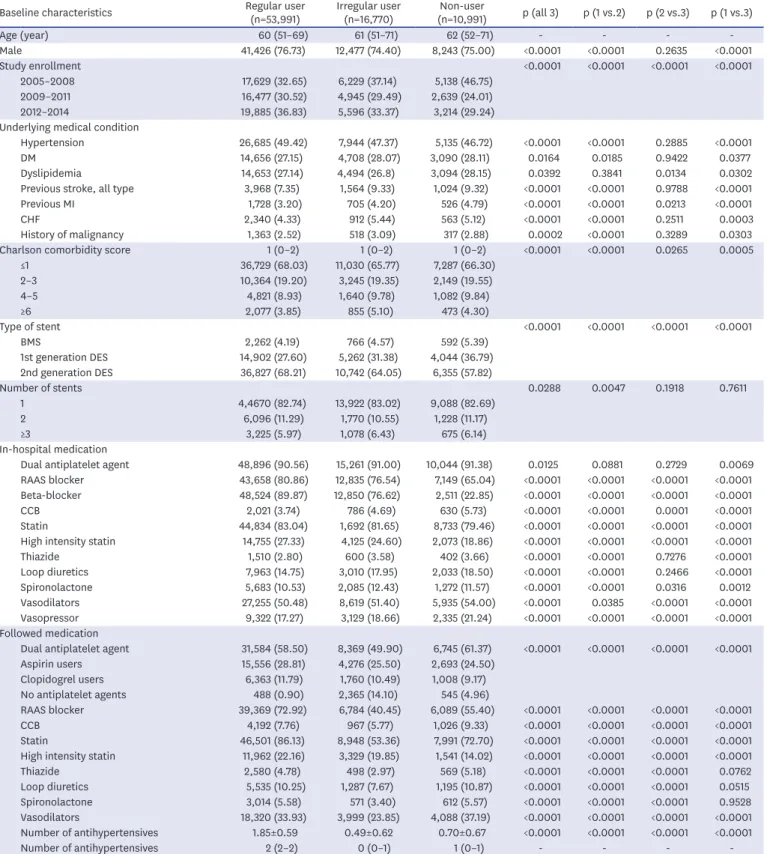
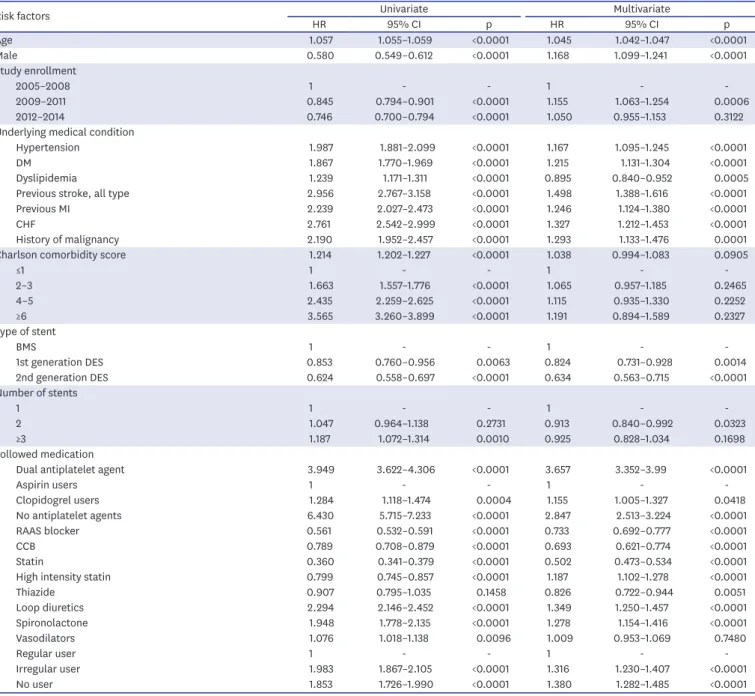
Results: We identified a total 81,752 patients with met eligible criteria. At discharge, 63,885 (78%) patients were prescribed beta blockers. For 2 years follow up period, regular users were 53,991 (66%) patients, non-users were 10,991 (13%). In the propensity score matched population, regular use of beta blocker was associated with a 36% reduced risk of composite adverse events (all death, MI or stroke) (hazard ratio [HR], 0.636; 95% confidence interval [CI], 0.555–0.728; p<0.001). Compared to no use of beta blocker, regular use significantly reduced all death (HR, 0.736; 95% CI, 0.668–0.812; p<0.001), MI (HR, 0.729; 95% CI, 0.611–0.803; p<0.001) and stroke (HR, 0.717; 95% CI, 0.650–0.791; p<0.001).
Conclusions: Prescription of beta blocker in patients with AMI after PCI was sequentially increased. Continuous regular use of beta blocker for 2 years after AMI reduced major adverse events compared to no use of beta blocker.
Keywords: Adrenergic beta-antagonists; Myocardial infarction; Secondary prevention
Original Article
Received: Jul 16, 2019 Revised: Oct 29, 2019 Accepted: Dec 4, 2019 Correspondence to Myeong-Ki Hong, MD, PhD Division of Cardiology, Severance Cardiovascular Hospital, Yonsei University College of Medicine, 50-1, Yonsei-ro, Seodaemun-gu, Seoul 03722, Korea.
E-mail: [email protected]
Copyright © 2020. The Korean Society of Cardiology
This is an Open Access article distributed under the terms of the Creative Commons Attribution Non-Commercial License (https://
creativecommons.org/licenses/by-nc/4.0) which permits unrestricted noncommercial use, distribution, and reproduction in any medium, provided the original work is properly cited.
ORCID iDs Hoyoun Won
https://orcid.org/0000-0001-7880-3477 Yongsung Suh
https://orcid.org/0000-0002-1975-123X Gwang Sil Kim
https://orcid.org/0000-0001-5206-8187 Young-Guk Ko
https://orcid.org/0000-0001-7748-5788 Myeong-Ki Hong
https://orcid.org/0000-0002-2090-2031 Funding
This study was supported by a grant from the Korean Society of Cardiology (201605-03) and Severance Hospital (4-2015-0700, 4-2018- 0136). We thank you for J. Hwang, who is a professor of division of mathematics and big data science, Daegu University, Gyeongsan, Korea, to support statistical analysis.
Hoyoun Won , MD, PhD
1, Yongsung Suh , MD, PhD
2, Gwang Sil Kim , MD
3, Young-Guk Ko , MD, PhD
4,5, and Myeong-Ki Hong , MD, PhD
4,51
Cardiovascular & Arrhythmia Center, Chung-Ang University Hospital, Chung-Ang University College of Medicine, Seoul, Korea
2
Department of Cardiology, Myongji Hospital, Goyang, Korea
3
Department of Cardiology, Sanggye-Paik Hospital, Inje Universiy College of Medicine, Seoul, Korea
4
Division of Cardiology, Severance Cardiovascular Hospital, Yonsei University Health System, Seoul, Korea
5