• 검색 결과가 없습니다.

Clinical Outcomes in Patients with Intermediate Coronary Stenoses: MINIATURE Investigators (Korea MultIceNter TrIal on Long-Term Clinical Outcome According to the Plaque Burden and Treatment Strategy in Lesions with MinimUm Lumen ARea lEss Than 4 mm2 Usin

N/A
N/A
Protected

Academic year: 2021

Share "Clinical Outcomes in Patients with Intermediate Coronary Stenoses: MINIATURE Investigators (Korea MultIceNter TrIal on Long-Term Clinical Outcome According to the Plaque Burden and Treatment Strategy in Lesions with MinimUm Lumen ARea lEss Than 4 mm2 Usin"

Copied!
8
0
0

로드 중.... (전체 텍스트 보기)

전체 글

(1)

Korean Circulation Journal

Print ISSN 1738-5520 • On-line ISSN 1738-5555

Clinical Outcomes in Patients with Intermediate Coronary Stenoses:

MINIATURE Investigators (Korea MultIceNter TrIal on Long-Term Clinical Outcome According to the Plaque Burden and Treatment Strategy in Lesions with MinimUm Lumen ARea lEss Than 4 mm 2 Using Intravascular Ultrasound)

Young Joon Hong, MD 1 , Yun Ha Choi, MS 1 , Soo Young Park, BS 1 , Chang Wook Nam, MD 2 , Jang Hyun Cho, MD 3 , Won Yu Kang, MD 4 , Sang Rok Lee, MD 5 , Sung Yun Lee, MD 6 , Sang Wook Kim, MD 7 , Sang Yeob Lim, MD 8 , Kyung Ho Yun, MD 9 , Jung Sun Kim, MD 10 , Jin Won Kim, MD 11 , Woong Chol Kang, MD 12 , Ki Seok Kim, MD 13 ,

Jin Ho Choi, MD 14 , Joong Wha Chung, MD 15 , Soo Joong Kim, MD 16 , Youngkeun Ahn, MD 1 , and Myung Ho Jeong, MD 1

1

Division of Cardiology, Chonnam National University School of Medicine, Gwangju,

2

Division of Cardiology, Keimyung University College of Medicine, Dongsan Medical Center, Daegu,

3

Division of Cardiology, Saint Carollo Hospital, Suncheon,

4

Division of Cardiology, Gwangju Veterans Hospital, Gwangju,

5

Division of Cardiology, Chonbuk National University College of Medicine, Jeonju,

6

Division of Cardiology, Inje University College of Medicine, Ilsan Paik Hospital, Goyang,

7

Division of Cardiology, Chung-Ang University College of Medicine, Seoul,

8

Division of Cardiology, Korea University College of Medicine, Ansan Hospital, Ansan,

9

Division of Cardiology, Wonkwang University College of Medicine, Iksan,

10

Division of Cardiology, Yonsei University College of Medicine, Severance Hospital, Seoul,

11

Division of Cardiology, Korea University Guro Hospital, Seoul,

12

Division of Cardiology, Gachon University Gil Medical Center, Incheon,

13

Division of Cardiology, Jeju National University College of Medicine, Jeju,

14

Division of Cardiology, Samsung Medical Center, Seoul,

15
Division of Cardiology, Chosun University College of Medicine, Gwangju,

16

Division of Cardiology, KyungHee University Medical Center, Seoul, Korea

Background and Objectives: We evaluated the two-year clinical outcomes in patients with angiographically intermediate lesions accord- ing to the plaque burden and treatment strategy.

Subjects and Methods: We prospectively enrolled patients with angiographically intermediate lesions (diameter stenosis 30–70%) with an intravascular ultrasound (IVUS) minimum lumen area (MLA) <4 mm

2

with 50–70% plaque burden of 16 Korean percutaneous coronary intervention centers. Patients were divided into medical therapy group (n=85) and zotarolimus-eluting stent group (ZES; Resolute) group (n=74). We evaluated the incidences of two-year major adverse cardiovascular events (MACE).

Results: A two-year clinical follow-up was completed in 143 patients and MACE occurred in 12 patients. There were no significant differ- ences in the incidences of death (1.3% vs. 3.0%, p=0.471), target vessel-related non-fatal myocardial infarction (0.0% vs. 0.0%, p=1.000) and target vessel revascularizations (7.8% vs. 4.5%, p=0.425) between medical and ZES groups. Independent predictors of two-year MACE included acute myocardial infarction {odds ratio (OR)=2.87; 95% confidence interval (CI) 1.43–6.12, p=0.014}, diabetes mellitus (OR=2.46;

95% CI 1.24–5.56, p=0.028) and non-statin therapy (OR=2.32; 95% CI 1.18–5.24, p=0.034).

Conclusion: Medical therapy shows comparable results with ZES, and myocardial infarction, diabetes mellitus and non-statin therapy were associated with the occurrence of two-year MACE in patients with intermediate lesion with IVUS MLA <4 mm

2

with 50–70% of plaque burden. (Korean Circ J 2014;44(3):148-155)

KEY WORDS: Coronary artery disease; Atherosclerotic plaque; Intravascular ultrasonography.

Received: January 5, 2014 / Revision Received: February 4, 2014 / Accepted: February 21, 2014

Correspondence: Myung Ho Jeong, MD, Principal Investigator of Korea Acute Myocardial Infarction Registry, Director of Cardiovascular Convergence Research Center Nominated by Korea Ministry of Health and Welfare, Chonnam National University Hospital, 671 Jebong-ro, Dong-gu, Gwangju 501-757, Korea Tel: 82-62-220-6243, Fax: 82-62-228-7174, E-mail: [email protected]

• The authors have no financial conflicts of interest.

This is an Open Access article distributed under the terms of the Creative Commons Attribution Non-Commercial License (http://creativecommons.org/licenses/

by-nc/3.0) which permits unrestricted non-commercial use, distribution, and reproduction in any medium, provided the original work is properly cited.

(2)

Introduction

Clinical decision making and the management of intermediate coronary stenosis, defined by a diameter stenosis of 30% to 70%

continues to be a therapeutic dilemma for cardiologists.

1)2)

Intra- vascular ultrasound (IVUS) examination and functional assessment of coronary stenosis have been used to define the severity of such lesions and to designate patients to the most appropriate therapy.

3-6)

Although optimal IVUS criteria for predicting functional significance of intermediate coronary lesions are variable according to individual studies which have been performed recently,

7-9)

the cut-off value of IVUS minimum lumen area (MLA) 4 mm

2

is still being used for the prediction of future clinical events.

Currently, no relevant data are available for the comparison be- tween medical therapy and drug-eluting stent for intermediate le- sions, that are particularly common in Asian patients.

10)11)

We hy- pothesized that medical therapy is not inferior to drug-eluting stent for the treatment of the intermediate lesions with IVUS MLA <4 mm

2

with 50–70% of plaque burden. Therefore, the purpose of the pres- ent study was to compare the optimal medical therapy and the drug-eluting stent for the long-term clinical outcome in patients with angiographically intermediate lesions with IVUS MLA <4 mm

2

with 50–70% of plaque burden.

Subjects and Methods

Patient population

The investigators of the Korean MultIceNter TrIal on Long-Term Clinical Outcome According to the Plaque Burden and Treatment Strategy in Lesions with MinimUm Lumen ARea LEss Than 4 mm

2

Using Intravascular Ultrasound (MINIATURE) study were selected of 16 major percutaneous coronary intervention centers in Korea (http://

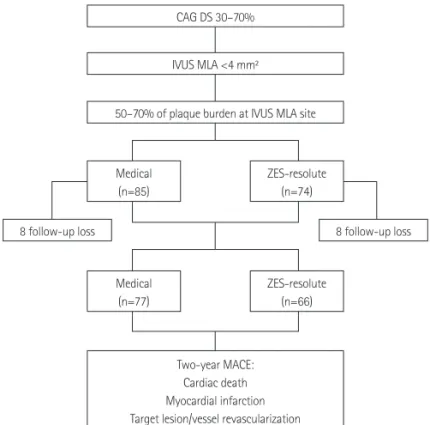
miniaturestudy.or.kr). The study algorithm is shown in Fig. 1. Patients were eligible for this study if they were at least 18 years of age and showed intermediate coronary artery stenosis (diameter stenosis 30–70%) with IVUS MLA <4 mm

2

with 50–70% of plaque burden on coronary angiogram. Culprit lesion in silent ischemia or stable angina was defined as the coronary lesion whose diameter steno- sis by QCA was greatest in a patient with multi-vessel disease. Cul- prit lesion was defined as the site of acute coronary occlusions or, for non-occluded arteries, as the site of greatest narrowing within an angiographically significant stenosis corresponding to the elec- trocardiographic changes in patients with acute coronary syn- drome. Target lesions enrolled in the present study were non-culprit lesions that had not been treated with percutaneous coronary in- tervention in patients with acute coronary syndrome. We initially treated the culprit lesions first and observed the non-culprit lesions

in other arteries in patients with acute coronary syndrome. Major exclusion criteria for the study enrollment were a known hypersen- sitivity or contraindication to heparin, anti-platelet agents, zotaro- limus or contrast media; systemic (intravenous) use of zotarolimus within 12 months, severe left ventricular systolic dysfunction (left ventricular ejection fraction <25%); cardiogenic shock and left main coronary artery lesion. One hundred fifty nine patients who under- went IVUS examination for angiographically intermediate lesions with IVUS MLA <4 mm

2

with 50–70% of plaque burden (Fig. 2) were prospectively enrolled between November 2008 and May 2010. Zo- tarolimus-eluting stent (ZES; Resolute, Medtronic, Minneapolis, MN, USA) was chosen as the only type of stent in the present study and patients were randomized into medical therapy group (n=85) or ZES group (n=74). We enrolled the non-culprit lesion if the patient had a multi-vessel disease and ZES was deployed for the culprit lesion in the culprit vessel and an intermediate lesion was located at the non- culprit vessel. The data were analyzed by quantitative coronary an- giography (QCA) and IVUS core laboratory (Chonnam National Uni- versity Hospital). Sixteen patients (8 patients in each group) were lost to follow-up during two years of clinical follow-up. Finally 143 patients were clinically followed up for two years. The protocol was approved by the ethics committee of each participating medical center and the patients granted their consent to participate in the study after the index procedure.

Fig. 1. Flow diagram of the patients enrolled in MINIATURE study. CAG:

coronary angiography, DS: diameter stenosis, IVUS: intravascular ultra- sound, MLA: minimum lumen area, ZES: zotarolimus-eluting stent, MACE:

major adverse cardiac event.

CAG DS 30–70%

IVUS MLA <4 mm

2

50–70% of plaque burden at IVUS MLA site

Two-year MACE:

Cardiac death Myocardial infarction Target lesion/vessel revascularization Medical

(n=85)

Medical (n=77)

ZES-resolute (n=74)

ZES-resolute (n=66)

8 follow-up loss 8 follow-up loss

(3)

Coronary angiographic findings

Coronary angiogram was analyzed by a validated QCA system (Philips H5000 or Allura DCI program, Philips Medical Systems, Am- sterdam, North Holland, the Netherlands). Reference diameter and minimal lumen diameter were measured in diastolic frames of or- thogonal projections with the outer diameter of the contrast-filled catheter as the calibration standard. Perfusion was evaluated ac- cording to the Thrombolysis in Myocardial Infarction (TIMI) criteria.

12)

Intravascular ultrasound imaging and analysis

All IVUS examinations were performed after intracoronary ad- ministration of 300 µg nitroglycerin using a commercially available IVUS system in each participating hospital. The IVUS catheter was advanced distal to the target lesion and imaging was performed retrograde to the aorto-ostial junction at an automatic pullback speed of 0.5 mm/sec.

Qualitative analysis was performed according to the American College of Cardiology Clinical Expert Consensus Document on Stan- dards for Acquisition, Measurement and Reporting of Intravascular Ultrasound Studies.

13)

We measured the external elastic membrane (EEM) and lumen cross-sectional area (CSA) using planimetry soft- ware (Echoplaque 3.0, INDEC Systems Inc., Santa Clara, CA, USA). The plaque plus media (P&M) CSA was calculated as EEM CSA minus lumen CSA and the plaque burden was calculated as P&M CSA di- vided by EEM CSA. Proximal and distal references were the single slices with the largest lumen and smallest plaque CSAs within 5 mm proximally and distally, but before any large side branch.

Hypoechoic plaque was less bright compared with the reference adventitia. Hyperechoic noncalcified plaque was as bright as or brighter than the reference adventitia without acoustic shadowing.

Hyperechoic calcified plaque was hyperechoic with shadowing. A calcified lesion contained >90° of circumferential lesion calcium.

The plaque was classified as mixed if there was no dominant plaque composition.

Major adverse cardiovascular event

Hospital records of all patients were reviewed to obtain informa- tion on clinical demographics and medical history. Follow-up infor- mation was obtained through review of hospital charts, telephone interviews and the interventional database of each participating center. Major adverse cardiovascular event (MACE) included death, target vessel-related non-fatal myocardial infarction, target lesion and target vessel revascularization (TLR and TVR). A target-vessel re- lated non-fatal myocardial infarction was defined as ischemic symp- toms associated with cardiac enzyme elevation ≥3 times the upper limit of normal value. TLR was defined as percutaneous coronary in- tervention of the lesion site including 5-mm proximal or distal to the lesion in medical therapy group and as repeated revasculariza- tion of a lesion anywhere within the stent or the 5-mm borders proximal or distal to the stent in ZES group. TVR was defined as any revascularization of the target lesion or any segment of the epi- cardial coronary artery containing the target lesion.

Statistical analysis

The Statistical Package for the Social Sciences (SPSS) for Win- dows version 15.0 (SPSS Inc., Chicago, IL, USA) was used for all anal- yses. Continuous variables were presented as the mean value±1 SD;

comparisons were conducted by Student’s t-test or nonparametric Wilcoxon test if normality assumption was violated. Discrete vari- ables were presented as percentages and relative frequencies;

comparisons were conducted by chi-square statistics or Fisher’s ex- act test as appropriate. Multivariate analysis was performed to de- termine the independent predictors of two-year MACE. A p<0.05 was considered statistically significant.

A B

Fig. 2. Coronary angiography (A) and intravascular ultrasound (B) images in distal circumflex artery in a 55-year-old female who presented with unstable

angina. EEM: external elastic membrane, CSA: cross-sectional area.

(4)

Results

Baseline characteristics, coronary angiography and intravascular ultrasound findings

The baseline characteristics, coronary angiography and IVUS find- ings are summarized in Table 1. There were no significant differences in baseline characteristics, coronary angiography and IVUS findings Table 1. Baseline characteristics, coronary angiography and intravascular

ultrasound findings

Medical (n=85)

ZES

(n=74) p

Age (years) 61.7±10.1 64.1±9.7 0.127

Male gender, n (%) 54 (63.5) 45 (60.8) 0.724

Clinical presentation, n (%)     0.718

Silent ischemia 2 (2.4) 0 (0.0)

Stable angina pectoris 29 (34.1) 24 (32.4) Unstable angina pectoris 40 (47.1) 36 (48.6)

NSEMI 10 (11.8) 9 (12.2)  

  STEMI 4 (4.7) 5 (6.8)  

Diabetes mellitus, n (%) 18 (21.2) 24 (32.4) 0.108

Insulin 10 (11.8) 9 (12.2) 0.884

Thiazolidinedione 4 (4.7) 4 (5.4) 0.840

Hypertension, n (%) 46 (54.1) 34 (45.9) 0.304

Smoking, n (%) 31 (36.5) 20 (27.0) 0.445

Hypercholesterolemia, n (%) 28 (32.9) 27 (36.5) 0.639

Prior MI, No. (%) 2 (2.4) 1 (1.4) 0.643

Previous PCI, No. (%) 4 (4.7) 4 (5.4) 0.840

Ejection fraction (%) 64.0±8.1 65.2±8.9 0.409

White blood cells (10

3

/mm

3

) 7.5±2.5 7.1±2.1 0.217

Hemoglobin (g/dL) 13.3±1.5 12.9±1.8 0.153

Platelet count (10

3

/mm

3

) 234±57 238±55 0.612

Glucose (mg/dL) 126±46 131±46 0.581

Creatinine (mg/dL) 0.9±0.3 0.9±0.3 0.720

Creatine kinase-MB (U/L) 12±25 15±32 0.471

Cardiac specific troponin-I (ng/mL)

1.27±5.24 5.48±17.59 0.052

hs-CRP (mg/dL) 0.86±3.02 0.56±1.03 0.431

NT-pro-BNP (ng/mL) 328±731 504±1048 0.359

Total cholesterol (mg/dL) 205±190 182±47 0.316

Triglyceride (mg/dL) 150±125 128±74 0.185

LDL-C (mg/dL) 113±40 113±39 0.942

HDL-C (mg/dL) 45±10 44±11 0.557

Apolipoprotein A1 (mg/dL) 122±36 115±36 0.336

Apolipoprotein B (mg/dL) 84±33 83±36 0.962

Lipoprotein(a) (mg/dL) 41±56 57±61 0.173

Target vessel, n (%) 0.078

Left anterior descending 57 (67.1) 56 (75.7)

Left circumflex 12 (14.1) 14 (18.9)

Right 16 (18.8) 4 (5.4)

TIMI flow grade, n (%) 0.358

2 3 (3.5) 6 (8.2)

3 82 (96.5) 68 (91.9)

Lesion location, n (%) 0.684

Middle 63 (74.1) 56 (75.7)

Table 1. Continued

Medical (n=85)

ZES

(n=74) p

Distal 22 (25.9) 18 (24.3)

Multivessel disease, n (%) 33 (38.8) 28 (37.8) 0.484 Reference diameter (mm) 3.01±0.24 3.01±0.24 0.941 Minimal lumen diameter (mm) 1.13±0.15 1.12±0.18 0.912

Diameter stenosis (%) 63±4 63±7 0.908

Stent diameter (mm) - 3.13±0.34 -

Stent length (mm) - 22.3±10.4 -

Stenting-related complications, n (%)

- 0 (0.0) -

Proximal reference

EEM CSA (mm

2

) 12.2±3.2 12.5±3.2 0.510

Lumen CSA (mm

2

) 7.9±1.8 8.1±1.9 0.613

P&M CSA (mm

2

) 4.3±1.8 4.6±2.2 0.241

Plaque burden (%) 34±8 35±10 0.380

Minimum lumen site

EEM CSA (mm

2)

9.1±2.0 9.2±1.9 0.722

Lumen CSA (mm

2

) 3.3±1.1 3.3±1.3 0.916

P&M CSA (mm

2)

6.1±1.4 6.2±1.3 0.514

Plaque burden (%) 65±4 66±3 0.425

Distal reference

EEM CSA (mm

2

) 9.1±2.5 8.9±2.3 0.606

Lumen CSA (mm

2

) 6.5±1.7 6.4±1.6 0.544

P&M CSA (mm

2)

2.7±1.5 2.5±1.0 0.124

Plaque burden (%) 28±6 28±8 0.526

Lesion length (mm) 14.3±5.8 15.1±8.5 0.210

Plaque morphology, n (%) 0.760

Hypoechoic 40 (48.2) 33 (44.6)

Hyperechoic non-calcified 3 (3.6) 3 (4.1) Hyperechoic calcified 1 (1.2) 0 (0.0)

Mixed 39 (47.0) 38 (51.4)

Data are n (%) or mean±SD. ZES: zotarolimus-eluting stent, NSTEMI: non- ST segment elevation myocardial infarction, STEMI: ST-segment elevation myocardial infarction, PCI: percutaneous coronary intervention, hs-CRP:

high-sensitivity C-reactive protein, NT-pro-BNP: N-terminal pro-B type na-

triuretic peptide, LDL-C: low density lipoprotein-cholesterol, HDL-C: high

density lipoprotein-cholesterol, TIMI: Thrombolysis in Myocardial Infarction,

EEM: external elastic membrane, CSA: cross-sectional area, P&M: plaque

plus media

(5)

in both groups. About one fifth of the patients had myocardial in- farction without statistical significance between medical therapy and ZES group. More than two thirds of the target vessel was the left anterior descending artery, 94.3% of the patients had TIMI flow grade 3, the minimal lumen diameter was 1.12±0.17 mm and the di- ameter stenosis was 63±5%. The MLA was 3.3±1.2 mm

2

, the plaque burden at the MLA site was 66±4% and the lesion length was 14.7±7.0 mm.

Medications and major adverse cardiovascular event at two-year follow-up

Medications and MACE at two-year follow-up are summarized on Table 2. Clopidogrel was more frequently used in ZES group than in medical therapy group and the use of other medications were not different between both groups at two years follow-up. The fol- low-up low-density lipoprotein cholesterol level was 83±36 mg/dL in medical therapy group and 80±28 mg/dL in ZES group.

Major adverse cardiovascular event occurred in 4.7% in medical therapy group and in 5.4% of cases in ZES group during one year of follow-up and in 9.1% in medical therapy group and in 7.5% of cas- es in ZES group during two years of follow-up. Four MACE (including

one death, three TLRs and three TVRs) in the medical therapy group and four MACE (including two deaths, two TLRs and two TVRs) in the ZES group occurred during one year of follow-up. Sixteen pa- tients were lost to follow-up during the two years of follow-up. A two-year follow-up was completed for 77 patients in medical thera- py group and for 66 patients in ZES group. Seven MACE (including one death, six TLRs and six TVRs) in medical therapy group and five MACE (two deaths, two TLRs and three TVRs) in ZES group occurred during two years of follow-up. There was no target-vessel related non-fatal myocardial infarction in both groups and no stent throm- bosis occurred in the ZES group. There were no significant differenc- es in the occurrence of MACE between medical therapy group and ZES group after two years.

Baseline characteristics, coronary angiography, and

intravascular ultrasound findings according to the presence or absence of two-year major adverse cardiovascular event

The prevalence of myocardial infarction (58.3% vs. 15.3%, p<0.001) and diabetes mellitus (58.3% vs. 29.0%, p=0.024) was significantly higher in patients with MACE compared with those without MACE.

Glucose, creatine kinase-myocardial band, cardiac specific troponin- I and N-terminal pro-B type natriuretic peptide were significantly higher in patients with MACE compared with those without MACE.

At two-year follow up, statins were used less frequently in patients with MACE compared with those without MACE (50.0% vs. 77.9%.

p=0.032).

There were no significant differences in target vessel, reference diameter, minimal lumen diameter and diameter stenosis between patients with MACE and those without MACE. However, a TIMI flow grade 3 was less frequently observed in patients with MACE com- pared with those without MACE (75.0% vs. 96.2%, p<0.001).

There were no significant differences in MLA and plaque burden at MLA site and plaque morphology between patients with MACE compared with those without MACE. The plaque burden at the distal reference segment was significantly greater (32±8% vs. 26±7%, p=0.019) and IVUS lesion was significantly longer (19.4±17.3 mm vs. 14.7±9.8 mm, p=0.010) in patients with MACE compared with those without MACE.

Independent predictors of two-year major adverse cardiovascular event

Multivariate analysis was performed to identify independent pre- dictors of two-year MACE (Table 3). The following variables were tested (with p<0.1 in univariate analysis): acute myocardial infarc- tion, diabetes mellitus, smoking, N-terminal pro-B type natriuretic peptide, non-statin use, TIMI flow grade, plaque burden at distal ref- erence segment and IVUS lesion length. Independent predictors of Table 2. Medications and major adverse cardiovascular events at one year

and two years of clinical follow-up

Medical ZES p

Medications, n (%) N=85 N=74

Aspirin 80 (94.1) 72 (97.3) 0.330

Clopidogrel 55 (64.7) 69 (93.2) <0.001

Cilostazol 7 (8.2) 6 (8.1) 0.977

Beta-blocker 42 (49.4) 40 (54.1) 0.559

Calcium channel blocker 32 (37.6) 28 (37.8) 0.980

ACE inhibitor 20 (23.5) 19 (25.7) 0.754

ARB 38 (44.7) 35 (47.3) 0.744

Statin 61 (71.8) 60 (81.1) 0.980

1-year follow-up MACEs, n (%) N=85 N=74

Death 1 (1.2) 2 (2.7) 0.480

Myocardial infarction 0 (0.0) 0 (0.0) 1.000

TLR 3 (3.5) 2 (2.7) 0.766

TVR 3 (3.5) 2 (2.7) 0.766

2-year follow-up MACEs, n (%) N=77 N=66

Death 1 (1.3) 2 (3.0) 0.471

Myocardial infarction 0 (0.0) 0 (0.0) 1.000

TLR 6 (7.8) 2 (3.0) 0.217

TVR 6 (7.8) 3 (4.5) 0.425

Data are n (%). ZES: zotarolimus-eluting stent, ACE: angiotensin converting

enzyme, ARB: angiotensin receptor blocker, MACE: major adverse cardio-

vascular event, TLR: target lesion revascularization, TVR: target vessel re-

vascularization

(6)

two-year MACE included acute myocardial infarction {odds ratio (OR)=2.87; 95% confidence interval (CI) 1.43–6.12, p=0.014}, dia- betes mellitus (OR=2.46; 95% CI 1.24–5.56, p=0.028) and non-statin therapy (OR=2.32; 95% CI 1.18–5.24, p=0.034).

Discussion

The present study demonstrated that 1) MACE occurred in 9.1%

of medical therapy group and in 7.5% of ZES group during two years of follow-up, 2) the prevalence of myocardial infarction and diabetes mellitus was significantly higher in patients with two-year MACE compared with those without two-year MACE, 3) statins were less frequently used in patients with two-year MACE compared with those without two-year MACE, and 4) myocardial infarction, diabetes mellitus and non-statin therapy were the independent pre- dictors of MACE in patients with angiographically intermediate le- sions with IVUS MLA <4 mm

2

with 50–70% of plaque burden during two-year follow-up.

Intermediate coronary lesion remains an unresolved problem for interventional cardiologists treating patients with coronary artery disease. Previous study suggested that IVUS MLA of <4 mm

2

was found to be the threshold for flow-limiting stenosis.

3)

However, this criterion is only applicable to lesions located at proximal epicardial coronary arteries with a reference segment diameter >3 mm, lim- iting the use of IVUS-derived anatomic criteria to define the func- tional significance of a subset of lesions. Furthermore, lower cut-off value of MLA has been recently suggested to predict functionally significant coronary stenosis.

7-9)

Although optimal IVUS criteria for predicting functional significance of intermediate coronary lesions are variable, The Providing Regional Observations to Study Predic- tors of Events in the Coronary Tree (PROSPECT) study

14)

showed non- culprit lesions associated with recurrent events were more likely than those not associated with recurrent events to be characterized by MLA <4.0 mm

2

or plaque burden >70% or to be classified on the basis of radiofrequency IVUS as thin-cap fibroatheromas.

The present study compared the optimal medical therapy and ZES for the long-term clinical outcome in patients with angiographically intermediate lesions with IVUS MLA <4 mm

2

with 50–70% of plaque burden. Similar to the PROSPECT study, MACE occurred in 9.1% in medical therapy group and in 7.5% in ZES group during two years of follow-up.

14)

There was no target vessel-related non-fatal myo- cardial infarction in both medical therapy group and ZES group and there was no stent thrombosis (early, late and very late stent throm- bosis) in ZES group during two years of follow-up. Medical therapy is not inferior to treat patients with intermediate stenosis with MLA

<4 mm

2

with 50–70% of plaque burden if compared with ZES. Op- timal medical therapy as well as ZES implantation is a good option for the treatment of angiographically intermediate lesions.

In the present study, myocardial infarction, diabetes mellitus and non-statin therapy were the independent predictors of MACE during two years of follow-up. In the present study, of 12 MACEs were nine TVR-related and three were deaths. The risk of plaque progression is high in patients with AMI, in diabetic patients and in patients with- out statins. Patients with acute myocardial infarction have more vulnerable plaque components in their culprit lesion in addition to their non-culprit lesion. The occurrence of MACE during follow-up was equally attributable to the recurrence at the site of culprit le- sions and to non-culprit lesions and most of nonculprit lesions had thin-cap fibroatheromas in the PROSPECT study.

14)

Therefore, a non- culprit lesion with intermediate stenosis in patients with acute myo- cardial infarction has the potential to develop plaque progression and to provoke future events. A rapid progression of atherosclero- sis can be seen in diabetic patients.

15)

An impaired glycemic homeo- stasis has direct influence on the propagation of atherosclerotic plaque

16)

and plaque regression and stabilization are attenuated by statin therapy.

17)

Diabetic patients have atherogenic dyslipidemia and hyperglycemia and the potential to generate advanced glyca- tion endproducts.

18)

Statin therapy could induce the regression of coronary atherosclerosis and there was a strong linear relationship between achieved low density lipoprotein-cholesterol (LDL-C) levels Table 3. Independent predictors of plaque progression at minimum lumen area site

Odds ratio 95% confidence interval p

Acute myocardial infarction 2.87 1.43–6.12 0.014

Diabetes mellitus 2.46 1.24–5.56 0.028

Non-statin therapy 2.32 1.18–5.24 0.034

TIMI flow grade 0.97 0.94–1.02 0.329

N-terminal pro-B type natriuretic peptide 1.29 0.33–12.13 0.376

IVUS lesion length 1.05 0.82–1.32 0.574

Plaque burden at distal reference segment 1.25 0.37–10.21 0.734

Smoking 1.90 0.14–3.02 0.740

TIMI: Thrombolysis in Myocardial Infarction, IVUS: intravascular ultrasound

(7)

and the course of atherosclerosis.

19-22)

So, optimal medical therapy is needed to treat patients with angiographically intermediate le- sions with IVUS MLA <4 mm

2

with 50–70% of plaque burden. In the present study, TLR at 2-year follow-up tended to be greater in the medical therapy group than in the ZES group if MACE was com- pared between both groups. However, the trend of difference in TLR would be smaller if we use an optimal medical therapy including high-dose statin. Intensive statin therapy is essential to regress and to stabilize plaque and to prevent the occurrence of MACE at long- term follow-up especially in patients with acute myocardial infarc- tion and diabetes mellitus.

There are several study limitations to be mentioned. First, the sample size in this multicenter study was too small to compare the long-term clinical outcomes of medical therapy and second gener- ation drug-eluting stents in patients with angiographically inter- mediate lesions. Second, lesion selection and IVUS imaging were performed at the discretion of the individual operators, leading to potential selection biases. Third, patients were not consecutive and only those patients who agreed to participate were enrolled in the present study. Fourth, we did not evaluate the impacts of plaque characteristics on clinical outcomes and we did not evaluate the functional severity of stenosis. Fifth, MACE occurred in only 12 pa- tients during the two years of follow-up, thus the study may be underpowered to identify independent predictors of MACE.

In conclusion, MACE occurred in 9.1% in medical therapy group and in 7.5% in ZES group during two years of follow-up and that was not statistically different between medical therapy and ZES group. A target-vessel related non-fatal myocardial infarction was not developed in both groups and a stent thrombosis did not occur in ZES group. Myocardial infarction, diabetes mellitus and non- statin therapy were associated with the occurrence of two-years MACE in patients with angiographically intermediate lesions with IVUS MLA <4 mm

2

with 50–70% of plaque burden. Medical thera- py as well as ZES is a good option for the treatment of intermediate lesions. An IVUS evaluation of the non-culprit intermediate lesions without use of pressure wire would be useful to predict a future cardiac event in patients with multi-vessel disease after the percu- taneous coronary intervention to the culprit lesion is finished.

Acknowledgments

This study was supported by a grant of the Korean Society of In- terventional Cardiology, and a grant of the Korean Health Technol- ogy R&D Project, Ministry of Health & Welfare, Republic of Korea (HI13C0163), and a grant of The Korean Society of Cardiology, The Korea Centers for Disease Control and Prevention (2013-E63005-00), and The Korean Health Technology R&D Project (HI13C1527), Min-

istry of Health & Welfare, and the Bio & Medical Technology Devel- opment Program of the National Research Foundation (NRF) funded by the Korean government (MEST) (2012M3A9C6049744), and the National Research Foundation of Korea Grant funded by the Kore- an Government (2011-0008875), and the Korea Healthcare technol- ogy R&D Project, Ministry for Health, Welfare and Family Affairs (HI12C0275), and Chonnam National University Hospital Research Institute of Clinical Medicine (CRI 11080-21), Republic of Korea.

References

1. Briguori C, Anzuini A, Airoldi F, et al. Intravascular ultrasound criteria for the assessment of the functional significance of intermediate coro- nary artery stenoses and comparison with fractional flow reserve.

Am J Cardiol 2001;87:136-41.

2. Tobis J, Azarbal B, Slavin L. Assessment of intermediate severity coro- nary lesions in the catheterization laboratory. J Am Coll Cardiol 2007;

49:839-48.

3. Abizaid A, Mintz GS, Pichard AD, et al. Clinical, intravascular ultra- sound, and quantitative angiographic determinants of the coronary flow reserve before and after percutaneous transluminal coronary an- gioplasty. Am J Cardiol 1998;82:423-8.

4. Pijls NH, Van Gelder B, Van der Voort P, et al. Fractional flow reserve. A useful index to evaluate the influence of an epicardial coronary steno- sis on myocardial blood flow. Circulation 1995;92:3183-93.

5. Pijls NH, De Bruyne B, Peels K, et al. Measurement of fractional flow reserve to assess the functional severity of coronary-artery stenoses. N Engl J Med 1996;334:1703-8.

6. Baumgart D, Haude M, Goerge G, et al. Improved assessment of coro- nary stenosis severity using the relative flow velocity reserve. Circula- tion 1998;98:40-6.

7. Ahn JM, Kang SJ, Mintz GS, et al. Validation of minimal luminal area measured by intravascular ultrasound for assessment of functionally significant coronary stenosis comparison with myocardial perfusion imaging. JACC Cardiovasc Interv 2011;4:665-71.

8. Koo BK, Yang HM, Doh JH, et al. Optimal intravascular ultrasound cri- teria and their accuracy for defining the functional significance of in- termediate coronary stenoses of different locations. JACC Cardiovasc Interv 2011;4:803-11.

9. Kang SJ, Lee JY, Ahn JM, et al. Intravascular ultrasound-derived predic- tors for fractional flow reserve in intermediate left main disease. JACC Cardiovasc Interv 2011;4:1168-74.

10. Dhawan J, Bray CL. Are Asian coronary arteries smaller than Cauca- sian? A study on angiographic coronary artery size estimation during life. Int J Cardiol 1995;49:267-9.

11. Lip GY, Rathore VS, Katira R, Watson RD, Singh SP. Do Indo-Asians have smaller coronary arteries? Postgrad Med J 1999;75:463-6.

12. Effects of tissue plasminogen activator and a comparison of early in- vasive and conservative strategies in unstable angina and non-Q-wave myocardial infarction. Results of the TIMI IIIB Trial. Thrombolysis in Myocardial Ischemia. Circulation 1994;89:1545-56.

13. Mintz GS, Nissen SE, Anderson WD, et al. American College of Cardiol-

(8)

ogy Clinical Expert Consensus Document on Standards for Acquisi- tion, Measurement and Reporting of Intravascular Ultrasound Studies (IVUS). A report of the American College of Cardiology Task Force on Clinical Expert Consensus Documents. J Am Coll Cardiol 2001;37:

1478-92.

14. Stone GW, Maehara A, Lansky AJ, et al. A prospective natural-history study of coronary atherosclerosis. N Engl J Med 2011;364:226-35.

15. Nicholls SJ, Tuzcu EM, Kalidindi S, et al. Effect of diabetes on progres- sion of coronary atherosclerosis and arterial remodeling: a pooled analysis of 5 intravascular ultrasound trials. J Am Coll Cardiol 2008;

52:255-62.

16. Boyle PJ. Diabetes mellitus and macrovascular disease: mechanisms and mediators. Am J Med 2007;120(9 Suppl 2):S12-7.

17. Takayama T, Hiro T, Ueda Y, et al. Plaque stabilization by intensive LDL- cholesterol lowering therapy with atorvastatin is delayed in type 2 dia- betic patients with coronary artery disease-Serial angioscopic and in- travascular ultrasound analysis. J Cardiol 2013;61:381-6.

18. Stancoven A, McGuire DK. Preventing macrovascular complications in type 2 diabetes mellitus: glucose control and beyond. Am J Cardiol 2007;99(11A):5H-11H.

19. Nissen SE, Tuzcu EM, Schoenhagen P, et al. Statin therapy, LDL choles- terol, C-reactive protein, and coronary artery disease. N Engl J Med 2005;352:29-38.

20. Nissen SE, Nicholls SJ, Sipahi I, et al. Effect of very high-intensity statin therapy on regression of coronary atherosclerosis: the ASTEROID trial.

JAMA 2006;295:1556-65.

21. Nicholls SJ, Tuzcu EM, Sipahi I, et al. Statins, high-density lipoprotein cholesterol, and regression of coronary atherosclerosis. JAMA 2007;

297:499-508.

22. Hong YJ, Jeong MH, Ahn Y, et al. Effect of pitavastatin treatment on changes of plaque volume and composition according to the reduc- tion of high-sensitivity C-reactive protein levels. J Cardiol 2012;60:

277-82.

수치

Fig. 1. Flow diagram of the patients enrolled in MINIATURE study. CAG:
Fig. 2. Coronary angiography (A) and intravascular ultrasound (B) images in distal circumflex artery in a 55-year-old female who presented with unstable  angina

참조

관련 문서

Long-term outcomes of short dental implants supporting single crowns in posterior region: a clinical retrospective study of 5-10 years.. Osteotome sinus

In 4-week group, the group filled with bone graft with decortication revealed larger new bone formation area than shown in the group that had a defect area

Results: In this research, in the group with fibromyalgia patients group, systemic lupus erythematosus patients group and without systemic autoimmune

In this randomized trial of patients receiving mechani- cal ventilation, the high-flow oxygen ventilation strategy during SBT did not reduce the risk of weaning failure on days

The associations of hepatic steatosis and fibrosis using fatty liver index and BARD score with cardiovascular outcomes and mortality in patients with new‑onset type 2

Although visceral fat adiposity has known to be associated with clinical, pathologic, and oncologic outcomes in patients with colorectal cancer (CRC), the

In elderly metastatic colon cancer patients, the treatment results of combination therapy with targeted treatment showed similar results to those reported in clinical trials

The ‘Investigation of outcomes after GOLimumab Discon- tinuation,’ or GOLD, was an observational study involving 10 centers nationwide that analyzed clinical data